

HR Help Desk: Definition, Benefits, and Implementation Guide
This article is a complete playbook for HR teams looking to launch or upgrade their HR help desk. It covers everything from evaluating features and comparing the top tools of 2026.
What is an HR Help Desk?
Key Use Cases for an HR Help Desk
Core Features of HR Help Desk Software
Best HR Help Desk Software in 2025
How to Choose the Right HR Help Desk Software?
What is an HR Help Desk?
An HR help desk is a centralized support system that helps HR teams manage, resolve, and track employee queries across channels, teams, and workflows.
It works just like a customer service desk, but for your employees.
Let’s say your team gets the same leave policy question five times a week. One reply comes from someone on HR Ops, another from someone in Payroll. The answers aren’t wrong, but they’re not consistent either. It creates confusion, back-and-forth, and wasted time.
With an HR help desk:
- Each query gets logged and tracked.
- It’s routed to the right person automatically.
- Employees often get a clear, policy-aligned answer from a knowledge base article.
This way, employees aren’t waiting. And your HR team isn’t stuck repeating themselves.
How HR Help Desks Have Changed From Before
Managing employee queries through scattered emails and spreadsheets is no longer sustainable. Manual processes will inevitably slow down response times, create inconsistencies, and make it impossible to track performance at scale.
Employees lose confidence in HR, and teams are left putting out fires rather than improving processes.
Fast-forward to today. HR help desks now work more like modern customer service platforms. AI has completely changed the way these processes work. Using AI, you can automate routine tasks, provide real-time visibility, and ensure employees receive consistent, policy-aligned answers. Here’s how you can build it:
- Automate ticket routing: AI sorts and assigns every query to the right person instantly. No more lost or delayed requests.
- Enable self-service: Create a knowledge base and chatbot workflows so employees can get quick answers to common questions.
- Track everything in real time: See what’s pending, what’s overdue, and who’s handling it. Fix bottlenecks before they turn into bigger problems.
- Identify trends early: Use AI insights to spot recurring issues and close process gaps for good.
The contrast between traditional and modern approaches is clear:
The message here is simple: manual processes no longer meet the speed and scale of modern work. HR leaders must implement AI-powered help desks to increase efficiency, improve employee experience, and free their teams to focus on strategic priorities.
In-person queries, emails, spreadsheets
Centralized, cloud-based system
No visibility into query status
Real-time tracking and SLA monitoring
Inconsistent answers from different team members
Standardized responses via a shared knowledge base
Repetitive tasks done manually
Chatbots handle FAQs, and automate ticket routes tickets
High dependency on individual knowledge
Team-wide visibility and reporting
The Role in ESM and HR Service Center Models
When employees need help, they don’t think in departments; they just want answers. For example:
- Where’s my laptop?
- How do I change my tax details?
- What’s the process for bereavement leave?
But behind every request, there’s a chain of handoffs across HR, IT, Finance, Admin, and sometimes all of them.
Without a connected system, the employee does the follow-up. They ping HR, who forwards it to IT, who forgets to loop in Finance. This means nobody knows where things stand.
This is where service models like ESM (Enterprise Service Management) or HR service centers come in. They bring every team into a shared system, so employees don’t have to chase answers and HR isn’t stuck being the middleman.
Let’s say a new employee joins:
- HR sets up their paperwork and benefits
- IT prepares their laptop and access
- Finance adds them to payroll
- Admin gets their desk and ID card ready
One onboarding request triggers all of it, each step routed to the right team with clear deadlines. These teams typically work together in an ESM setup:
- HR for leave, onboarding, and policy questions
- IT for tools, devices, and access issues
- Finance for reimbursements, payslips, and tax information
- Facilities/Admin for seating, ID cards, and logistics
The result? HR doesn’t spend half the day checking on tasks they don’t own. Employees don’t have to ask twice. And every team sees the full picture without relying on inbox searches.
Why HR Help Desks Matter (and Their Major Benefits)
Employees expect quick, accurate answers and transparency on the status of their queries. HR issues pile up without a structured system, policies are applied inconsistently, and compliance risks grow.
An HR help desk changes this dynamic. It centralizes support, introduces accountability, and gives leaders complete visibility into what’s working and what’s not. With a modern HR help desk in place, you can:
- Resolve issues faster: Every query is tracked and routed to the right person automatically, eliminating backlogs.
- Maintain consistency: Pre-approved templates and workflows ensure all employees receive clear, policy-aligned answers.
- Offer self-service: A searchable knowledge base allows employees to resolve common questions on their own, reducing ticket volume.
- Stay compliant: Every interaction is time-stamped and documented, providing an audit-ready record when needed.
- Improve decision-making: Trend analysis across departments, regions, and employee types uncovers process gaps before they escalate.
- Scale HR operations: Automation and structured collaboration across HR, IT, and Finance help the function grow without adding headcount.
HR teams that adopt structured service delivery tools see measurable impact like faster turnaround times, better visibility into employee needs, and stronger compliance. The right HR help desk helps make operations smoother and improves employee engagement
Key Use Cases for an HR Help Desk
An HR Help Desk helps standardize and simplify HR teams’ core daily processes. From employee onboarding to offboarding, here’s how it supports the full employee lifecycle:
1. Manage leave and time-off requests.
Employees can submit leave requests, check remaining balances, view holiday calendars, and clarify time-off policies.
Suppose an employee requests time off directly in Slack. The system automatically logs the request, routes it to the right manager for approval, and sends an update via email once it’s processed.
What you can manage using it:
- PTO and sick leave requests
- Comp-off tracking
- Leave balance visibility
- Company-wide holiday schedules
2. Automate and track onboarding tasks.
Onboarding is one of the most complex HR processes, involving coordination across HR, IT, Admin, and Finance. Without structure, tasks get missed, timelines slip, and the new employee’s first impression suffers.
An HR help desk eliminates these gaps by allowing you to set rules-based triggers for every onboarding step. When certain conditions are met, like a new hire being added to the HR system, the platform can automatically launch the tasks and reminders tied to that milestone.
Here’s how it works: when a new joiner logs into the HR portal, they see a welcome kit, a checklist of required tasks (such as uploading documents), and a clear agenda for their first day. Behind the scenes, the help desk ensures each department is aligned and accountable.
What you can automate:
- Send welcome emails and grant access to essential resources.
- Notify IT to provision devices and software.
- Trigger policy acknowledgments and form submissions.
- Alert Admin for ID generation, seating allocation, or building access.
When you build onboarding workflows this way, you reduce manual handoffs, increase productivity, and have a seamless experience.
3. Handle life event updates.
Employees can easily report changes like a name update, marriage, or dependent addition and upload supporting documents for HR to review and process.
If an employee submits a request to update their last name and attaches a marriage certificate, the help desk routes it to HR, logs the request, and updates the employee once it’s complete.
What you can handle:
- Name and address changes
- Marital status and dependent updates
- Insurance enrollment adjustments
- Tax form updates
4. Coordinate performance review cycles.
Performance reviews require precise coordination across employees, managers, and HR. Missing deadlines or losing track of feedback undermines the process and can lead to disengagement.
An HR help desk brings order and accountability to review cycles. You can set up workflows to notify managers, track progress, and flag delays before they become problematic.
Automated reminders ensure employees and managers complete each step on time, while HR gains full visibility into what’s outstanding.
What you can track:
- Self-assessments and peer reviews.
- Manager evaluations.
- Goal setting and performance notes.
- Final performance summaries.
- Performance Improvement Plans (PIPs) and follow-up actions.
5. Track training and development requests.
Employees can raise tickets to enroll in training, request learning budgets, or propose new skill-building opportunities.
Let’s say an employee requests to attend a leadership workshop. The system routes the request to HR, tracks the approval process, and logs the decision.
What you can support:
- Internal training sign-ups
- External course approvals
- Learning budget tracking
- Compliance training completion
6. Run structured offboarding processes.
The help desk coordinates with HR, IT, Finance, and Admin to ensure a smooth exit.
Once an employee resigns, the system sends them a checklist with pending tasks, such as returning assets, completing an exit survey, and verifying final payouts.
What you can provide:
- Leave, travel, and reimbursement policies
- Company code of conduct
- Grievance handling procedures
- HR team contact directory
7. Make HR policies and forms easy to find.
Employees can quickly find answers to HR questions or download necessary forms without emailing someone on the team.
For example, if an employee searches “WFH reimbursement policy” and immediately finds an article with the latest process and claim limits.
What you can automate:
- Resignation acceptance and document collection
- Final settlement coordination
- System access revocation
- Exit interviews and feedback
Core Features of HR Help Desk Software
A modern HR help desk must do more than track requests. It needs to drive real outcomes. The right platform enables faster resolutions, consistent answers, and full visibility into employee needs.
When done right, it reduces repetitive work and strengthens compliance. It also frees up HR teams to focus on strategic priorities instead of chasing tasks.
The features below are the ones you must prioritize to achieve these results.
1. Use a ticketing system to track every HR request.
Employee requests often get buried in email threads or Slack pings. A ticketing system fixes that by giving every query structure: who handles it, the status, and when it’s due.
Here’s how it works:
- An employee submits a query. For example, “Can I take a half day on Friday?”
- The system creates a ticket and tags it appropriately (e.g., Leave Request).
- It’s automatically routed to the HR team member responsible for that category or location.
- The request follows a pre-defined workflow, like sending it to the manager for approval.
- Once processed, the system updates the ticket, notifies the employee, and marks it resolved.
This structured approach gives you full control over every HR request. You’ll know who owns it, what stage it’s in, and when it will be resolved.
Using a ticketing system, you can streamline leave approvals, onboarding checklists, exit formalities, and policy updates.
It matters because:
- You ensure accountability so every task is owned and completed.
- You save time on routine work, so you don’t chase approvals or manual updating.
- You create consistency so the employees know what to expect, and HR knows what’s next.
2. Deflect repeat questions with a self-service portal.
A self-service portal allows employees to find answers without waiting for HR to respond. Employees shouldn’t have to email HR to ask, “What’s the reimbursement policy?” A searchable self-service portal puts answers a click away, anytime.
Include resources around:
- Company policies (e.g., leave, WFH, reimbursements)
- Employee benefits
- Step-by-step process guides (e.g., how to apply for LTA, how to update PAN details)
- Downloadable forms and templates like leave application forms, health insurance enrolment forms, grievances forms, etc.
- Onboarding resources for new hires.
Instead of emailing HR to ask for the travel policy, an employee logs into the portal, searches “travel reimbursement,” and finds a clear article explaining the process. It should include claim limits and required documents.
The self-service knowledge base can help:
- Reduce HR workload by reflecting on routine questions.
- Increase consistency in answers so everyone sees the same information.
- Help onboard new employees faster and more independently.
- Make information available anytime, without relying on HR’s availability.
A good self-service portal supports and empowers employees to find information for themselves.
3. Use AI and chatbots to reply instantly to common HR questions.
AI-powered chatbots ensure employees get answers without waiting. They handle routine repetitive questions in real time, cut down on ticket volume, and keep HR focused on complex work that requires human judgment.
How to implement this effectively:
- Answer common questions (e.g., “How many casual leaves do I have left?”) instantly.
- Recommend articles from the knowledge base based on the query.
- Collect relevant information before routing the request to HR (e.g., department, issue type, urgency).
- Update employees on the status of existing requests.
For example, an employee types “update my emergency contact” in the chat widget. The bot verifies their ID, opens the form, and confirms the update, all in one interaction.
Done right, AI-driven chatbots remove the constant back-and-forth and make employee support faster, more consistent, and scalable.
4. Support employees on the channels they already use.
Employees shouldn’t have to learn a new tool just to request time off or check a policy. A strong HR help desk integrates with the channels they already use, like Slack, MS Teams, email, or mobile, so support is effortless.
This approach makes support more accessible for everyone:
- Employees get help without switching tools or logging into a separate platform.
- Frontline and remote workers can easily access HR support on the go.
- HR can serve a distributed workforce without sacrificing speed or response time.
Let’s say an employee submits a leave request via Slack during a conversation. They receive an email confirmation and later check the status through the mobile app while traveling.
Omnichannel support eliminates friction, improves adoption, and ensures employees use the system you’ve put in place.
5. Track what’s working (and what’s not) with reporting.
To continuously improve support, you must understand what’s happening under the hood. Reporting gives HR the data to identify what’s working, what’s broken, and where to invest.
Some metrics you can track are:
- Volume of requests by category (e.g., payroll, onboarding, compliance)
- First response time
- Average time to resolution
- SLA compliance (e.g., percent of tickets resolved within 24 hours)
- Knowledge base usage (e.g., which articles are used, which aren’t)
- Employee satisfaction with support (CSAT)
Pro Tip: Use trends to anticipate problems before they escalate. For instance, if payroll-related queries always spike at month-end, schedule proactive reminders, refresh KB articles, or allocate extra support resources during that period.
When you track and act on these insights, HR moves from reactive problem-solving to strategic planning.
6. Keep employee data secure and audit-ready.
HR support tools handle sensitive data like bank details, salary information, health records, and grievance reports. If you can’t guarantee airtight security, everything else in your system loses credibility.
Strong data protection does three things:
- Protects employee trust and company reputation.
- Ensures compliance with labor laws and industry regulations.
- Prevents accidental or unauthorized access to personal data.
What to look for in a secure HR help desk:
- Role-based access (e.g., only payroll sees compensation data).
- End-to-end encryption for data in transit and at rest.
- Comprehensive audit logs to track actions across the system.
- Compliance with standards like GDPR, HIPAA, and SOC 2.
- SSO and Two-Factor Authentication for secure access.
If a data request or audit arises, you should be able to instantly generate a report showing exactly who accessed what, when, and why. This level of control protects both employees and the organization.
Recommended reading
7. Integrate with your existing HR stack.
Your HR help desk cannot operate in isolation. If it doesn’t connect with the tools your team already uses, you’ll duplicate work, lose data, and slow down processes. Integrations keep everything in sync and allow HR to scale without adding unnecessary complexity.
Here’s why this matters:
- Keep employee data consistent across all systems.
- Eliminate manual handoffs and double entry that waste time.
- Grow from 50 to 500 employees without rebuilding processes from scratch.
Integrations you must prioritize:
- HRIS platforms (e.g., BambooHR, Workday, SAP)
- Payroll and benefits systems
- Communication tools (Slack, Teams, Gmail, Outlook)
- IT service desks (for onboarding and offboarding coordination)
- Calendar tools and Single Sign-On (SSO) systems
For example, when a new hire is added to your HRIS, the help desk automatically triggers onboarding workflows, such as sending tasks to HR, IT, and Admin. This ensures everyone stays in sync without manual handoffs.
The goal is simple: build a connected ecosystem in which your HR help desk becomes the operational backbone of employee support.
Best HR Help Desk Software in 2025
The right tool depends on your team size, the complexity of workflows, integration needs, and how much you want to automate. Below are the best tools to consider in 2025, each with a different strength.
1. Hiver
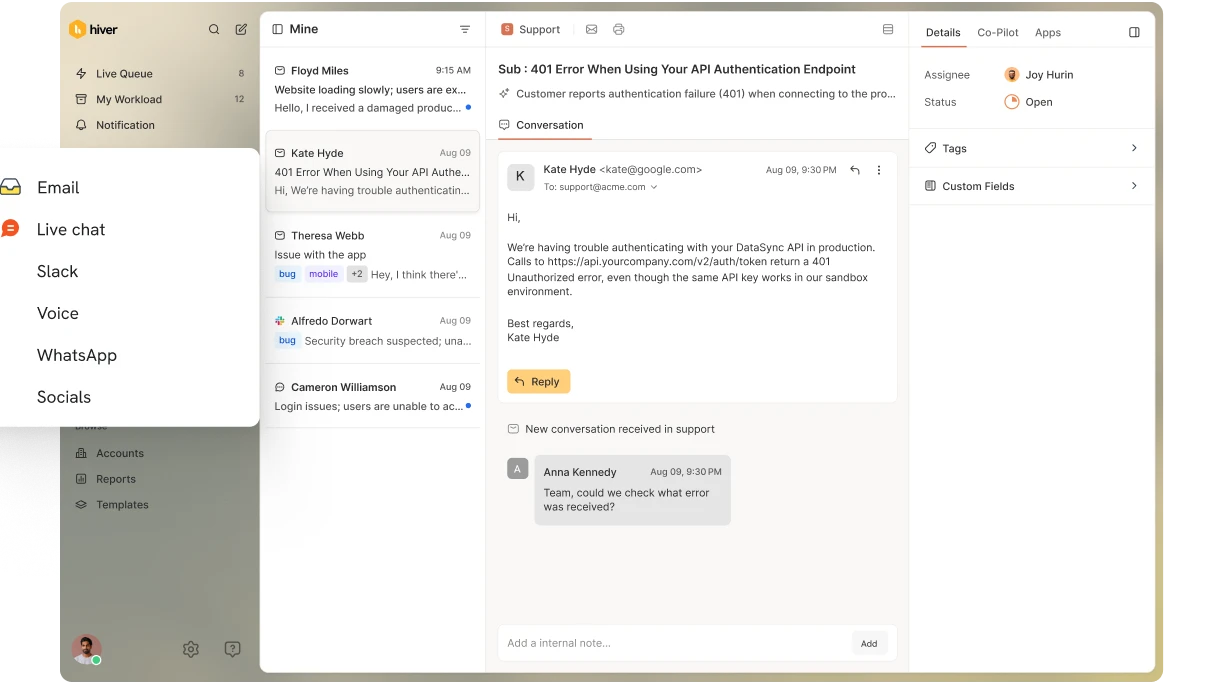
Hiver is AI-first customer service software with a modern, intuitive interface that can simplify employee support. It enables HR teams to manage employee requests across email, chat (including live chat and chatbots), self-service knowledge bases, mobile, and other channels.
With Hiver, you manage all employee requests via email, chat, knowledge base, or mobile from one centralized dashboard. Teams can see exactly what’s pending or overdue and who is responsible for each query. This ensures no request slips through the cracks, and employees get timely, accurate responses every time.
How does it work?
- Every employee request is automatically converted into a trackable ticket via email, chat, or a self-service portal.
- Tickets are routed to the right HR partner or department using rules you define (e.g., payroll requests → Finance, benefits questions → HRBP).
- HR can collaborate internally using private notes, track ticket progress, set priorities, and respond from a single dashboard.
- SLA tracking and real-time alerts keep your team accountable and ensure nothing falls overdue.
- If you’re juggling requests across shared inboxes, spreadsheets, and DMs, Hiver brings everything together, making HR support organized, measurable, and scalable.
If you manage HR support through scattered emails and manual reminders, Hiver gives you structure and speed.
Key features
Here are some of Hiver’s features:
Shared inboxes and ticketing

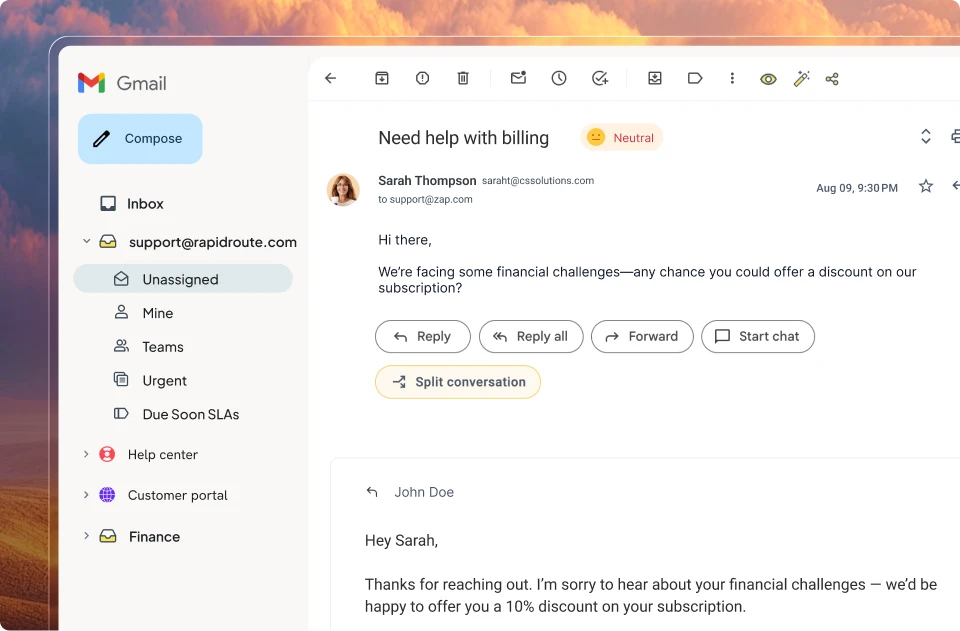
Hiver turns shared inboxes into structured workspaces. Every employee request becomes a trackable ticket with a clear owner, due date, and status. This visibility ensures accountability across the HR team, prevents requests from being lost, and allows you to prioritize the most urgent tasks. Employees benefit from quicker responses and fewer follow-ups.
AI Copilot

Hiver’s AI Copilot is a powerful virtual assistant accelerates HR response times. It suggests contextually accurate responses, automatically fills in routine answers, and flags urgent tickets so the team can respond quickly.
Copilot also summarizes long conversation threads into concise notes, making getting context at a glance easier. This enables HR teams to focus on higher-value work rather than typing the same responses repeatedly.
24/7 support
Hiver’s customer support is available around the clock. You also receive hands-on onboarding and implementation support, so your team can set up and scale quickly with confidence.
Self-service knowledge base

Hiver helps HR teams deflect common questions with a built-in self-service knowledge base. You can create a searchable repository of policies, forms, FAQs, and process guides so employees can find answers themselves.
This significantly reduces incoming ticket volume and empowers employees to get help anytime.
Omnichannel support
With Hiver, employees can reach HR through their preferred customer service channels, like email, chat, mobile, or knowledge base. HR teams manage all these channels from one dashboard, creating a seamless employee experience and eliminating blind spots.
Reporting and analytics

Hiver has robust reporting and real-time analytics to help HR leaders measure and improve performance. You can track SLA adherence, resolution times, ticket volume by category, employee satisfaction scores (CSAT), and individual team member performance.
Insights into recurring issues and workflow bottlenecks allow you to fix problems proactively, coach team members effectively, and continuously refine your processes.
Automations
Hiver’s automation engine eliminates repetitive work. You can set up rules to automatically assign tickets based on type, categorize and tag requests, escalate overdue items, and send reminders when deadlines approach.
These automations allow your HR team to manage higher query volumes without sacrificing quality or speed.
Integrations
Hiver integrates seamlessly with over 100 business applications, including BambooHR, Workday, Slack, Microsoft Teams, Salesforce, and Asana. These integrations ensure employee data and context flow between systems, so HR doesn’t waste time switching tools or re-entering information. Requests can be resolved faster with complete context available in one place.
Collaboration tools
HR teams can work effortlessly with private notes, draft sharing, and collision detection. These features reduce duplicate work, maintain message consistency, and make involving the right team members in complex cases easy.
Pricing
- Free Plan – $0/user/month: Best if you’re just starting out and want to test basic shared inboxes and ticketing with up to 3 users.
- Lite – $19/user/month: Suited for small HR teams who want structure without overinvesting early. Includes essential automation, a self-service portal, and collaboration features.
- Growth – $29/user/month: The best value for most growing HR teams. You get unlimited users, advanced analytics, more integrations, and workflow automations to manage higher query volumes.
- Pro – $49/user/month: Ideal if you’re a mature HR operation needing CSAT tracking, advanced reporting, and SLA workflows to ensure quality at scale.
- Elite – Custom pricing: For large or highly regulated organizations that require advanced audit controls, HIPAA compliance, and premium support.
This is what Hiver’s users have to say:
- “Hiver has completely transformed how our team manages shared inboxes and collaborative email workflows.” – Lean L. Small-Business
- “Hiver makes it much easier to stay organized and collaborate as a team.” – Chase E. Enterprise
2. ServiceNow HR Service Delivery
ServiceNow HRSD is an enterprise-grade HR service management platform built to handle the complexity of large organizations. It gives employees a single place to get help while unifying HR, IT, Finance, and Facilities teams behind the scenes.

The platform is designed for scale: it combines case management, advanced workflow automation, virtual agents, and integrations into one system. HR teams can design structured, end-to-end experiences for onboarding, payroll changes, internal transfers, and more. This makes sure every process runs the same way, every time.
Key features
- Give employees a single portal for all HR services, while HR teams manage cases in a single workspace with full history and context.
- Set Helpdesk SLAs, add internal notes, and follow each case through to resolution.
- Use Now Assist AI to instantly handle common employee questions like “What’s my leave balance?” and reduce repetitive tickets.
- Access advanced dashboards to monitor SLA compliance, resolution times, ticket volume, and employee self-service usage, helping HR leaders optimize resources.
- Build step-by-step experiences for onboarding, parental leave, or role transitions.
- Integrate with Workday, SAP SuccessFactors, payroll systems, ITSM tools, and identity platforms to keep employee data accurate and eliminate manual handoffs.
Pricing
ServiceNow HRSD offers custom pricing plans. You need to reach out to their sales team to get a quote.
This is what users think of this:
- “ServiceNow HRSD is a natural fit for managing employee services at scale. With out-of-the-box features, strong customer support, and seamless updates, delivering a great employee experience for tens of thousands of users is essential.” – Rafael N, Enterprise company
- “The user-friendly platform offers robust automation features that drastically reduce manual HR tasks. I particularly appreciate the case management tools, self-service portals” – Rodrigo C, Mid-market
3. Zendesk
Zendesk is a structured customer service platform that can double back as an HR helpdesk. It can help manage employee requests at scale. It pulls every query from email, Slack, Teams, and web forms into a single dashboard. This way, every ticket has a clear owner and deadlines are tracked automatically.

What sets the tool apart is that you can automate ticket routing based on topic or location. Define SLAs for internal queries and escalate payroll or compliance issues if unresolved.
HR teams also get a customizable help desk help center. You write the policy once, publish it, and tag it so it’s easier for the employees can search for answers easily.
You can create workflows for leave approvals, build conditional flows for benefits updates, and view detailed audit logs of every interaction.
This gives HR teams the ability to handle higher volumes of requests without delays or confusion. Employees get faster, consistent responses. HR leaders get the data they need to enforce those SLAs, identify bottlenecks, and improve service delivery.
Key features
- Capture HR queries from Slack, email, or web forms and turn them into trackable tickets.
- Zendesk AI detects the intent behind messages and suggests the right next step. For example, if someone asks, “How many PTO days do I have left?”, Zendesk can suggest the correct policy article or draft a response before HR intervenes.
- Set automation rules to route tickets to the right HR partner based on urgency, department, or topic.
- Use pre-approved reply templates that adjust based on ticket context (e.g., employee’s region or employment type).
- Publish HR policies, how-to guides, and FAQs in a central knowledge base.
- Set internal response and resolution goals for different request types.
- Use live dashboards to monitor queue health, satisfaction scores, and unresolved issues before they escalate.
- Employees can raise tickets where they already work (Slack or Teams), and Zendesk syncs with your HRIS or payroll tools to centralize context and speed up resolution.
Pricing
- Suite Team – $55/agent/month (Core ticketing, multichannel support, basic automation, and help center.)
- Suite Growth – $89/agent/month (Adds SLA management, advanced workflows, multilingual help center, and Zendesk AI features like auto-triage and macro suggestions.)
- Suite Professional – $115/agent/month (Adds HIPAA-enabled, Advanced AI, skills-based ticket routing, and analytics)
- Suite Enterprise – custom pricing
Zendesk users have this to say:
- “Zendesk’s automation and macros reduce HR workload and help us resolve tickets much faster.” — Abhishek R.
- “The interface is clean and makes it easy to manage HR tickets at scale. The knowledge base reduces repetitive queries significantly.” — Ganesh S.
Recommended reading
4. Freshservice by Freshworks
Freshservice is built for HR teams to automate their entire process by connecting HR with IT, Finance, and Admin in one workflow.

Instead of chasing updates across departments, you can design step-by-step processes that trigger tasks instantly and track their completion. Let’s take onboarding, for example. Using Freshservice, a single HR form submission can instantly trigger device setup (IT), payroll registration (Finance), desk allocation (Admin), and document tracking (HR) in one go. Each task is routed with built-in logic, deadlines, and ownership.
It’s entirely no-code, so that HR teams can build and manage these processes. And you don’t have to stop at HR. Freshservice connects easily with IT, finance, and admin teams, so multi-departmental workflows happen without chaos.
Key features
- Create a catalog of HR services employees can request anytime.
- Build visual workflows that trigger tasks, approvals, and reminders across departments.
- Handle multi-step processes like onboarding, relocation, or offboarding by routing subtasks to the right teams with deadlines.
- Let employees raise requests, check statuses, or find answers through a personalized portal. You can brand it for your organization and populate it with FAQs, documents, and how-to guides.
- Set internal deadlines for different request types and let the system monitor them. Freshservice escalates unresolved requests so you don’t have to follow up manually.
- View trends by request type, resolution time, satisfaction scores, and workflow bottlenecks. Make data-backed decisions to improve HR service delivery.
- Connect Freshservice with HRIS (BambooHR, Workday), communication tools (Slack, Microsoft Teams), and productivity tools to sync data and streamline processes across departments.
Pricing
Freshservice offers multiple plans depending on your internal support needs. For most HR help desk use cases, the following tiers are most relevant:
- Growth – $39/agent/month (Includes service catalog, ticketing, automations, SLA management, and a self-service portal.)
- Pro – $99/agent/month (Adds advanced workflow orchestration, approvals, custom roles, and time tracking. It is ideal for complex HR processes like onboarding or offboarding.)
- Enterprise – $129/agent/month (Includes sandbox environments, audit logs, and enterprise reporting. It is suited for large organizations with strict compliance and internal governance.)
This is what users have to say:
- “What I like most about Freshservice is the intuitive interface and process automation, which make ticket management easier and increase team efficiency.” — Mariana L., Sales Development Rep, (Small Business)
- “Freshworks platform has been a welcome change for me and honestly refreshing to use.” – Cathleen V., IT Systems Analyst, (Mid Market)
Recommended reading
5. Zoho People
Suppose you’re constantly answering the same 10 questions, losing track of who’s waiting for what, it is inevitable. Zoho Desk helps you take control by transforming your internal HR support into a structured, self-service-first operation.

Employees raise requests via a branded portal instead of pinging you on five different platforms. And here’s where Zoho Desk becomes uniquely useful: its Blueprints feature allows you to build and enforce step-by-step workflows for complex processes, like parental leave, salary changes, or offboarding, without needing coding skills.
Zoho’s assistant, Zia, cuts resolution time by suggesting knowledge-base answers before HR gets involved. It flags urgent queries, prioritizes based on sentiment, and keeps your team focused on high-value work.
The result is clear: fewer missed tickets, faster resolution times, and consistent employee experiences at scale.
Key features
- Automatically turn emails, Slack messages, or form submissions into tickets.
- Assign ownership, tag the subject (e.g., “payroll,” “benefits”, or “leave”), and track progress.
- Set conditional approvals and enforce compliance rules so every ticket follows a standard path.
- Employees can access policies, fill out forms, or get guided help without contacting HR.
- Tag teammates in tickets, add private notes, and do internal handoffs within the system.
- Grab analytics on resolution times, ticket volume, SLA adherence, and deflection rates. Use the HQ dashboard and auto-reports to optimize HR service delivery.
- Connect with BambooHR, Slack, Teams, and other systems to sync employee data and trigger actions (like auto-updating records when a ticket closes) automatically.
Pricing
- Free – $0 for up to 3 agents (Basic ticketing, private knowledge base, email channel, and predefined SLAs.)
- Express – $7/agent/month (Supports up to 5 agents. Adds basic workflows, SLA rules, round-robin ticket assignment, and custom dashboards.)
- Standard – $14/agent/month (Unlimited agents. Includes social channels, macros, workflow rules, public knowledge base, and time tracking.)
- Professional – $23/agent/month (Adds Blueprints, ticket collision detection, team roles, multi-department support, and custom reports.)
- Enterprise – $40/agent/month (Includes Zia AI for sentiment analysis & reply suggestions, live chat, multi-brand portals, advanced customizations, audit logs, and optional field-level encryption.)
Zoho Desk user’s have this to say:
- “Zoho Desk gives us control and visibility. Every request is tagged, tracked, and resolved, which wasn’t possible before.” — Mario M., Business Consultant (Small Business)
- “Zoho Desk’s AI assistant Zia speeds up response times by suggesting answers, detecting sentiment, and flagging tickets that need escalation.” – Ritesh S., Support Engineer (Small-Business)
6. BambooHR
If your HRIS already manages employee records, time off, and performance, but support requests will still pile up in the shared inboxes, BambooHR lets you handle those requests without switching systems.

Employees can raise questions, submit documents, or request support directly from their BambooHR dashboard. HR teams get centralized visibility and task tracking inside the platform they use daily.
You can reduce the back-and-forth by guiding actions within a system built for employee lifecycle management.
Key features
- When employees submit HR requests, they go straight into BambooHR portal. HR can then track and resolve them without external tools.
- Use BambooHR’s built-in workflows to route forms like address changes or benefits updates. Requests automatically trigger notifications and approvals.
- Employees can check their PTO balance, update their personal information, or view benefits on BambooHR, which prevents support tickets from being created.
- Ask BambooHR – the AI assistant answers policy-level questions, flags eNPS sentiment trends, or guides users to documents.
- Track workforce trends, performance cycle compliance, and PTO usage using live dashboards.
- BambooHR integrates via Zapier or native connectors, so ticket context (like hire date or department) travels with the request.
Pricing
BambooHR offers custom pricing for each package. You need to reach out to the sales team.
This is this what users had to say:
- “We’ve used BambooHR for a couple of years and I can’t say enough good things about it. Their customer service is truly exemplary, responsive, helpful, and always goes the extra mile. The platform itself is extremely user‑friendly… It has become an indispensable part of our HR toolkit.” — Brandy R., HR Generalist (Mid-market company)
- “BambooHR is easy to use on both the app and website. As an employee and admin, I can quickly find what I need—and the platform keeps getting better as we grow.” – Lia W., HR Generalist (Small business company)
7. Leena AI
Leena AI is built to handle everyday HR requests through a conversational interface. Employees simply ask questions, and Leena responds instantly.

It connects with your existing tools like, Workday, ADP, ServiceNow, Slack, Teams, and pulls the right data without HR having to step in.
What makes Leena stand out is WorkLM™, its proprietary AI model that understands intent, handles conversations in over 100 languages, and triggers real-time workflows.
For HR teams trying to reduce ticket volume, response time, and burnout, Leena becomes the first line of defense, resolving up to 99% of routine queries on its own.
Key features
- Employees can check leave balance, holiday calendars, payroll info, or policies just by asking in chat.
- If a query needs human input, it’s turned into a ticket with full context and routed to the right HR rep.
- Launch short, conversational employee surveys inside chat and get real-time insights into employee morale.
- Leena flags recurring issues so you can improve documentation and reduce future queries.
- With 100+ language capabilities and awareness of regional time zones, Leena AI has availability for employees worldwide ideal for distributed workforces.
Pricing
Leena AI offers custom pricing for various requirements. You need to contact their sales team for more information.
Leena AI users have this to say:
- “Leena AI handles common HR questions automatically—it saves time and helps new employees a lot.” — Vijay K., Associate Consultant, (TCS)
- “Leena AI makes HR processes faster and easier, from onboarding to query management. Simple to use and highly effective.” – Akash S. (Enterprise)
8. HappyFox
HappyFox is a powerful internal help desk that helps HR teams automate high-stakes workflows. From onboarding to grievance redressals, it gives you complete control over routing, approvals, SLAs, and escalations, all configured through a no-code rules engine.

What sets it apart? You can build deeply customized workflows (like “route payroll issues to finance after 6 PM” or “escalate onboarding delays to reporting managers”) using Smart Rules, HappyFox’s visual automation builder.
Everything is centralized, auditable, and handled on time, without endless pings or tracking sheets.
HR teams can also create a clean internal knowledge base to deflect repetitive queries like “How do I apply for comp-off?” while maintaining a human touch when needed.
HappyFox is especially useful if your HR team works alongside IT or Admin. You can run all internal support from one place while keeping responsibilities, views, and permissions distinct.
Key features
- Set round-robin, skill-based routing, due dates, and escalation, all of which are configured once and then handled by the system.
- Use categories and statuses to mark tickets like “Payroll Urgent” or “Onboarding Task.” Smart Rules can auto-assign these to the appropriate teams.
- Publish internal and external articles on leave policy, reimbursement procedures, or onboarding checklists.
- Trigger notifications when tickets age and escalate overdue items to the reporting managers.
- Track satisfaction trends over time and identify support bottlenecks.
- The help desk and KB support multiple languages, making global HR coverage easy.
- Handle requests via email, live chat, phone, Slack, or Teams in one dashboard.
Pricing
- Basic – $24 (Includes unlimited email/portal tickets, SLA management, self-service portal, knowledge base, and SSO.)
- Team – $49 (Adds multi-brand support, custom roles, domain mapping, custom ticket queues, and EU data center option.)
- Enterprise Pro – Custom pricing (Offers agent scripting, advanced audit logs, priority support, 2 TB attachments, unlimited reporting history, and 24/7 phone support.)
HappyFox user’s have this to say:
- We’ve used HappyFox for five years, it’s easy to implement, simple for our team to use, and gives us clear workflow reporting. – Sheldon O. (Mid-Market)
- The software is easy to set up and customize, especially the knowledge base. Their support team is friendly, responsive, and always ready to jump on a call for 1:1 help. – Benjamin K. (Small-Business)
9. Kayako One
Kayako One is a multi-channel help desk platform built for speed, clarity, and context. It is especially useful for HR teams managing a high volume of internal requests.

Every employee interaction via email, live chat, or web form is automatically organized into a unified timeline using Kayako One’s SingleView™. HR reps can see the entire conversation history at a glance, reducing back-and-forth, avoiding contradictory responses, and speeding up resolution.
Kayako One’s built-in AI enhances this further with tools that auto-summarize past messages and suggest replies. Your team spends less time digging through threads and more time delivering actual support.
If your HR team handles high-volume, multi-channel communication, Kayako helps you stay organized, responsive, and consistent.
Key features
- All channels, email, live chat, and internal notes appear in one threaded view (SingleView™).
- Built-in AI pulls key info from past messages and recommends response templates, so HR reps don’t have to go looking for answers.
- Internal FAQs and knowledge center guides surface relevant answers before creating a ticket.
- Use macros and rules to assign tickets based on category or urgency, such as routing payroll issues to finance or holiday requests to benefits.
- Set internal targets, monitor ticket age, and trigger escalations automatically when deadlines approach or pass.
- Dashboards show ticket volume, resolution time, and satisfaction trends, allowing you to drill down on recurring issues.
Pricing
- Kayako One Pricing – $79/month (flat fee): Includes a shared inbox, ticketing, multilingual help center, multiple team inboxes, basic reporting, AI-driven workflows, and multi-brand messaging.
- AI-resolved tickets are billed at +$1 per resolved ticket
This is what users had to say:
- “Kayako’s AI features cut our ticket volume drastically. It auto-resolves repeat queries and helps agents reply faster with smart suggestions and summaries” – Etee D., (Small-Business)
- “Kayako’s AI speeds up replies with summaries, suggestions, and self-learning from past tickets, saving time and keeping responses consistent.” – Anna K., (Small-Business)
Recommended reading
10. Grove HR
Grove HR is a mobile-first HR platform that combines help desk functionality directly within your HRIS. Instead of toggling between tools, your team can manage employee requests, approvals, and workflows from the same system where you track time-off, onboarding, or performance reviews.

What sets Grove HR apart is how seamlessly it connects support with action. When an employee raises a request. Let’s say a role change or benefits question comes in, it’s automatically tied to the profile of the person asking, routed through the right approval flow, and tracked to completion.
If you want an all-in-one system for HR operations and employee support, especially one that’s intuitive on mobile, Grove HR offers a lightweight but powerful solution.
Key features
- Employees can raise support tickets without leaving the GroveHR dashboard, which they already use for time-off and records.
- Grove’s Essentials plan lets you set up approval flows that assign tasks or tickets automatically.
- Alongside help desk support, Grove manages ATS, onboarding, peer reviews, goal tracking, and pulse surveys so that HR can handle support and operations in one platform.
- The platform includes a native mobile app so employees can raise requests or track ticket status on their phones.
- Use Engage-tier features like recognition badges and pulse surveys to gather feedback tied to support experiences.
Pricing
- Free – $0: For up to 50 employees, includes Core HR, time off tracking, onboarding, and a mobile app.
- Essentials – $3/user/year: Adds task automation and ATS integration.
- Perform – $4/user/year: Adds goal setting, peer reviews, and auto-scheduled performance cycles.
- Engage – $6/user/year: Includes peer recognition, pulse surveys, social feed, and team messaging.
This is what Grove HR users had to say,
- “Grove HR is a user-friendly HR platform that automates key tasks, tracks employee activity, and simplifies workflows” – Dibakar N., (Mid-Market)
- “What I love most is its simplicity. It works seamlessly on both mobile and desktop, giving employees easy access and making HR management effortless.” – Verified User, (Mid-Market)
11. DeskPro
Deskpro is a platform that can be used to build a custom internal support experience. Whether you’re managing employee requests in one country or ten, it allows HR teams to create their branded portals, define ticket workflows by department or location, and manage every interaction as per internal guidelines.

Where it shines: complex HR teams that serve diverse roles (e.g., full-time, remote, contractors) and need a system that adapts to their structure.
Key features
- Route requests to the right person, trigger approvals, and set automatic escalations for overdue tasks.
- Employees can submit requests, check statuses, and access HR forms from a branded employee portal.
- Collect HR queries from email, chat, web forms, or phone calls in one dashboard.
- Collaborate with finance or IT on tickets securely without exposing sensitive data.
- Publish HR policies, guides, and forms to deflect repetitive questions.
- Every ticket and action is logged for compliance and reporting.
Pricing
- Team – $39: Basic ticketing and reporting.
- Professional – $59: Adds SLAs, automation, and knowledge base.
- Enterprise – $99: Advanced security, sandboxing, and premium support.
This is what the users are saying:
- “I love grouping tickets by organization. It lets me focus on one school at a time and work through tickets efficiently.” – Daniel E., (Small-Business)
- “Deskpro streamlines ticket handling with advanced automation, custom workflows, and SLAs. Its omnichannel support lets us manage email, chat, calls, and social messages from one interface, improving efficiency and consistency.” – Ivo R., (Mid-Market)
12. Intercom
Intercom is a conversational support platform that HR teams can use to provide instant, chat-first support to employees. It’s designed for teams that want to reduce response times, automate repetitive queries, and keep support accessible across web, mobile, and messaging apps.

The platform stands out for its proactive and AI-driven support; it doesn’t just wait for tickets. HR teams can send targeted messages, use chatbots to resolve simple requests, and instantly hand off complex queries to the right human.
Key features
- Offer real-time support to employees via web, mobile apps, or embedded widgets.
- Handle repetitive HR questions automatically, such as leave policies, payroll timelines, or onboarding steps.
- Send targeted updates to employees about policy changes, approvals, or reminders.
- Assign requests to the right HR partner and track them from a single interface.
- Publish HR policies, guides, and FAQs to reduce ticket volume.
- Connects with Slack, Microsoft Teams, Workday, and other HR tools to keep data in sync.
Pricing
- Essential – $29/user/month: Live chat, shared inbox, and basic automation.
- Advanced – $85/user/month: Adds advanced bots, proactive messaging, and analytics.
- Expert – $132/user/month: Includes workflow automation, custom reporting, and enterprise features.
- Fin AI Agent – $0.99 per resolution: Tailored for large, distributed teams with advanced security and support.
Intercom’s users have this to say:
- “Intercom’s Fin lets us analyze, deploy, and customize AI in one place, giving full control to adjust content and manage everything without relying on third parties.” – Verified User (Mid-Market)
- “We love how Intercom’s AI is transparent, customizable, and reliable. It gives us control, helpful snippets, and smart recommendations—delivering a better experience for our customers.” – Verified User (Small-Business)
13. Gorgias
Gorgias is an automation-first help desk designed to handle high-volume, repeat HR queries with minimal manual effort. While it originated in eCommerce, its template-driven and trigger-based workflows make it ideal for HR teams that want to respond to employee questions quickly.

Its real edge is in eliminating repetitive tasks. Instead of answering the same “What’s the leave policy?” or “When is payroll processed?” multiple times, Gorgias can detect keywords, auto-tag the request, reply with a pre-approved workflow, and escalate to HR only if needed. This turns a small HR team into a highly responsive, process-driven support function.
Key features
- All HR requests from email, chat, and web forms land in one organized dashboard.
- Automate repetitive responses and auto-route requests to the right HR function.
- Reduce manual routing with rules for payroll, benefits, onboarding, or exit tasks.
- Publish HR policies, forms, and how-to guides to deflect common queries.
- Monitor ticket volume, resolution speed, and deflection rate to improve efficiency.
- Works seamlessly with Slack, Teams, and HRIS platforms to sync data and approvals.
Pricing
- Starter – $10/month: 50 tickets/month with basic ticketing and workflows.
- Basic – $50/month: 300 tickets/month with automation rules and reporting.
- Pro – $300/month: 2,000 tickets/month with advanced workflows and integrations.
- Advanced – $750/month: 5,000 tickets/month, multi-department setup, and dedicated support.
These are what user reviews are saying:
- “Gorgias is intuitive, keeps everything organized, and its automation saves me time on daily tasks.” – Silvy P., (Small-Business)
- “Gorgias streamlines all our emails, chats, and social messages into one inbox. Its tagging and automation save time, prevent missed messages, and make handling common inquiries effortless.” – Jessie H. (Small-Business)
14. Dixa
Dixa is designed for HR teams that want to treat employee requests like ongoing conversations, not isolated tickets. Its interface feels like a messaging hub, where emails, calls, and chats appear as continuous threads instead of separate cases.

What makes Dixa unique is its people-first approach, which allows HR to see the full history of every interaction. This makes every employee query feel personal and informed. Combined with automation and intelligent routing, it helps small HR teams deliver a high-touch experience at scale.
Key features
- Manage employee requests from email, phone, chat, and social messaging in one dashboard.
- Automatically route queries to the best-suited HR team member, based on skills or topic.
- Agents see full interaction history across channels for context-driven responses.
- Use rules to tag, prioritize, and follow up on HR tickets without manual tracking.
- Connect with HRIS tools, Slack, and Teams for faster updates and internal communication.
Pricing
Dixa offers three main pricing tiers (per user, per month):
- Growth– $89: Omnichannel support with basic routing, external knowledge, and reporting.
- Ultimate – $139: Adds automation workflows, analytics, and advanced integrations.
- Prime – Custom: For enterprise HR teams needing complex routing, multi-department setups, and dedicated support.
This is what the users had to say:
- “Dixa is intuitive, easy to onboard, and streamlines our daily support while continuously improving with useful features.” – Sofie G., (Mid-Market)
- “Dixa is reliable, easy to use, unifies all communication channels, and comes with excellent, responsive support.” – Jeppe K., (Mid-Market)
15. Lanteria HR
Lanteria HR is an HR management platform built for companies using Microsoft 365 and SharePoint. What makes it unique is its deep integration with the Microsoft ecosystem, allowing HR teams to manage requests, documents, and workflows directly within the tools employees already use.

It’s especially valuable for HR teams that handle compliance-heavy processes like leave approvals, document management, and performance reviews. Requests can be submitted, tracked, and approved without leaving SharePoint, creating a centralized and audit-ready HR workflow.
Key features
- Handle HR requests, approvals, and document storage within familiar tools like Microsoft 365 and SharePoint.
- Track help desk metrics like leave requests, benefits queries, or document approvals from one hub.
- Automate approvals and notifications for HR processes without coding.
- Combine help desk functions with training, evaluations, and employee development tracking.
- Store and organize HR files securely with full audit trails.
- Get visibility into request volume, SLA compliance, and HR performance metrics.
Pricing
Lanteria HR provides custom pricing based on the number of employees and selected modules. Contact their sales team for an exact quote.
This is the user review:
- “We’ve used Lanteria for years and love its flexibility, on-premise or cloud hosting, and ongoing updates. Their dedicated support team is responsive and reliable.” – Shrung V., (Small Business)
- “Lanteria is flexible, secure, easy to use, and integrates seamlessly with Office 365. It is perfect for any business needing a customizable HRMS.” – Akshay U., (Small-Business)
How to Choose the Right HR Help Desk Software?
This section is a practical playbook where you’ll learn how to evaluate tools through outcomes, workflow fit, integrations, scale & compliance, and adoption & total cost. By the end, you’ll know exactly what to test, what to ignore, and how to pick a platform your team will actually use.
Here’s a step-by-step breakdown to guide your decision:
1. Start by listing your most common HR requests.
Before looking at tools, map out your everyday HR support tasks. What are the 5–10 types of requests your team handles weekly?
For example:
- “How many casual leave days do I have left?”
- “I need to update my address for payroll.”
- “Can I get a copy of my Form 16?”
- “How do I enroll in the health insurance plan?”
Write these down. Your help desk software won’t be a good fit if it doesn’t simplify these exact workflows.
Pro Tip: Spend a week collecting actual queries from your HR inbox or Slack channels. Use this to create a shortlist of must-have use cases (e.g., leave management, onboarding workflows, document requests). Choose a tool that covers at least 80% of these.
2. Check how easy it is for both employees and HR to use.
The tool that you choose should feel intuitive from day one. That means employees should be able to raise a request in less than a minute. HR reps should be able to route, respond, and resolve tickets without needing IT support.
So you need to look for a clean interface that requires minimal clicks and has mobile accessibility.
Pro Tip: Ask vendors for a free trial or live demo. Give your HR intern or a non-HR teammate 3 test tasks (e.g., raise a ticket, assign it, close it). If they’re stuck or confused, it’s a red flag.
3. Make sure the tool can automate repetitive tasks.
The biggest benefit of an HR help desk is saving time. So the software should take routine, manual work off your plate.
Look for tools that let you:
- Auto‑route requests to the right HR function. For example, interview scheduling questions go to your Talent Acquisition team, while policy or employee‑relations concerns go to the People Success team.
- Set up approval workflows, so when someone requests time off or submits a document, it routes through the proper chain without you manually chasing it.
- Trigger reminders for unresolved tickets so nothing slips through.
- Escalate issues automatically when deadlines are missed.
The biggest benefit of an HR help desk is saving time. So the software should take routine, manual work off your plate.
Pro Tip: Ask the vendor to show you how to set up a leave approval workflow from start to finish, without writing code or needing IT support. If it takes more than 10 minutes or looks confusing, the tool isn’t truly built for HR teams.
4. Check if it integrates with the tools you already use.
The help desk should integrate with your existing stack. If it doesn’t, you’ll spend time manually updating different systems, which will defeat the purpose.
Some key integrations that you need to look for:
- HRIS platforms like BambooHR, Keka, Darwinbox
- Communication tools like Slack, Teams, Gmail, or Outlook teams
- Payroll software and identity/access management tools
Pro Tip: Don’t just ask if it integrates. Ask the vendor to show you how a new hire added to your HRIS triggers onboarding tasks in the help desk. Watch to see if it’s seamless or needs IT intervention.
5. Make sure reporting gives you insights, not just data.
You can’t improve what you don’t track. However, just tracking raw ticket counts isn’t enough. You need to understand the bottlenecks and employee sentiment.
What to expect from good reporting:
- Average response and resolution time – how quickly your team closes requests.
- SLA performance – which teams or locations consistently meet or miss deadlines.
- Top request types & FAQs – e.g., payroll queries, onboarding questions, or leave requests.
- Agent‑level performance – number of tickets handled, first‑response speed, and CSAT/feedback scores.
Pro Tip: Ask if the tool lets you export or schedule reports. It’s a bonus if it integrates with BI tools like Looker or Tableau for deeper insights.
6. Understand the total cost first, and as you scale.
Pricing models vary widely. Some tools are charged per HR agent, others by employee volume, and some by feature access.
What to clarify in terms of pricing:
- What’s included in the base plan (automation, SLA tracking, knowledge base)?
- Are there any add-on costs—like setup fees, user limits, or integration charges?
- Will the pricing change drastically as you add more locations or users?
Pro Tip: Share a real scenario with the vendor. “We have 3 HR users and 200 employees today. What would we pay if we double the headcount next year?” Ask for a written quote based on this.
7. Evaluate the vendor’s support and roadmap.
A help desk tool is mission-critical. If it stalls, employee requests pile up fast. Pick a vendor that’s easy to reach, proactive, and consistently improving their product.
Check for:
- Support availability: 24/7 chat, email, or phone support in your time zone.
- Onboarding & training: Smooth implementation and hands‑on guidance for your HR team.
- Product roadmap: A track record of regular updates and a clear plan for future improvements.
Pro Tip: Read reviews on G2, Capterra, or Reddit about support and onboarding experiences. They reveal more than a sales demo ever will.
Hiver, for example, offers 24/7 support and is known for its responsive team. Their support team has expanded significantly over time, ensuring customers can connect with a real, knowledgeable agent instantly.
How to Implement an HR Help Desk?
HR helpdesk can change how your team delivers support. This step-by-step process will help you go live with a system that employees use and HR teams benefit from.
Step 1: Define your HR service catalog and find your tool.
Before you set up software, define what kinds of support you’ll offer.
How to do it:
- Open your HR inbox or Slack history from the last month.
- Group every request into 5–7 categories. Examples: Leave, Onboarding, Payroll, Reimbursements, HR Letters, Exit Process.
- Prioritize the top 3 categories where your team spends the most time.
- Check out the tools that can help you out in your categories.
This matters because these categories become the request types in your help desk system. Without this step, you’ll end up with a clunky interface that employees ignore.
Pro Tip: Block 30 minutes on your calendar in a week to skim your HR inbox or Slack channels. Copy-paste recurring queries into a spreadsheet; this will become your blueprint for the help desk categories
Recommended reading
Step 2: Set up request forms and routing logic.
Start with 4–5 high-volume categories and create simple request forms for each. Don’t overwhelm users with too many fields.
Let’s say, for a Bank Account Update request:
- Employee Name (auto-filled)
- New Account Number
- Effective From Date
- Upload a cancelled cheque
After this, you need to set up auto-routing rules so the request goes to Payroll → then to Manager (if approval needed) → then to Finance.
This matters because structured requests require faster resolution and fewer follow-ups. Without this, HR becomes a bottleneck.
Pro Tip: Limit your first form to 4 fields max. Then test it with an employee (ideally not from the HR team). If they ask for clarification, rework the labels. Simplicity beats completeness when you’re just starting.
Recommended reading
Step 3: Build a basic knowledge base.
In your knowledge base, start with the most basic questions your customers ask. You do not have to write 100+ articles; even five that have all the required information work.
What to include:
- Leave policy: formats, eligibility, carryover rules
- Reimbursement process: what’s covered, turnaround time
- Onboarding checklist: what new hires need to complete
- Work-from-home policy
- “How to raise a ticket” article
Make sure that each article answers one clear question and links directly to the relevant form or document.
Pro Tip: Embed knowledge base links inside ticket forms. This reduces repeat queries.
Step 4: Run a 5 to 8 person pilot
Your HR team must use the tool you select. So, make sure that you test the help desk with the team for at least 2 – 4 weeks.
During the pilot:
- Ask employees to submit real queries through the new system.
- Monitor which requests get delayed or stuck.
- Collect feedback via a quick form or a 15-minute call.
By doing this, you’ll catch broken workflow, missing fields, or confusing language before it becomes a company-wide issue.
Pro Tip: Set up a shared Slack channel with pilot users and encourage them to raise real requests. Use emojis or labels like “👍” and “🤔” on feedback to identify what’s working and what needs fixing fast.
Step 5: Launch help desk company-wide with a simple playbook
Once the pilot is done, you need to send it out to the whole company. The company needs to understand the new process and how they need to work with the help desk.
To launch:
- Create a 2-minute Loom video or Slack post: “Here’s how to get HR support.”
- Link to the portal and list 3–4 example queries they can raise.
- Host 2 live 20-minute sessions for different teams.
You can pin the help desk link inside Slack or other platforms to make it easy for employees to access.
Pro Tip: Make sure that the playbook is scannable and short. If it’s long, the playbook will be ignored
Recommended reading
Frequently asked questions
What is the HR help desk?
An HR help desk is a support system that helps HR teams manage and respond to employee questions. It acts like an internal customer support center. Employees can submit requests, track progress, and find answers to common queries. HR teams use it to assign tasks, prioritize issues, and ensure nothing slips through the cracks.
Who do I call if HRIS not helping me?
If your HRIS isn’t resolving your issue, don’t wait. Submit a request directly through your HR help desk or reach out to your assigned HR contact. Most companies have a backup process through email, chat, or a ticketing system where HR can step in and fix what the HRIS can’t.
How do I reach out to HR for help?
Start with your company’s official HR help desk portal. You can usually find it linked in your intranet or pinned in your team communication tool like Slack. If the portal isn’t available, send your query through the HR email or ask your manager for the right point of contact. Always include context and supporting documents to avoid back-and-forth.
Is HR really there to help employees?
Yes. The role of HR has evolved from just enforcing policy to actively supporting employees. They’re there to guide you through onboarding, resolve issues, answer policy questions, and help with career-related concerns. A structured HR help desk ensures this support is timely, documented, and consistent, so you’re never left guessing who to contact or how to get help.