






Getting started with Hiver
If you talk to customers every day, keeping an eye on your inbox isn’t optional. It’s essential. Forwarded threads, endless CCs, and cluttered inboxes only slow things down.
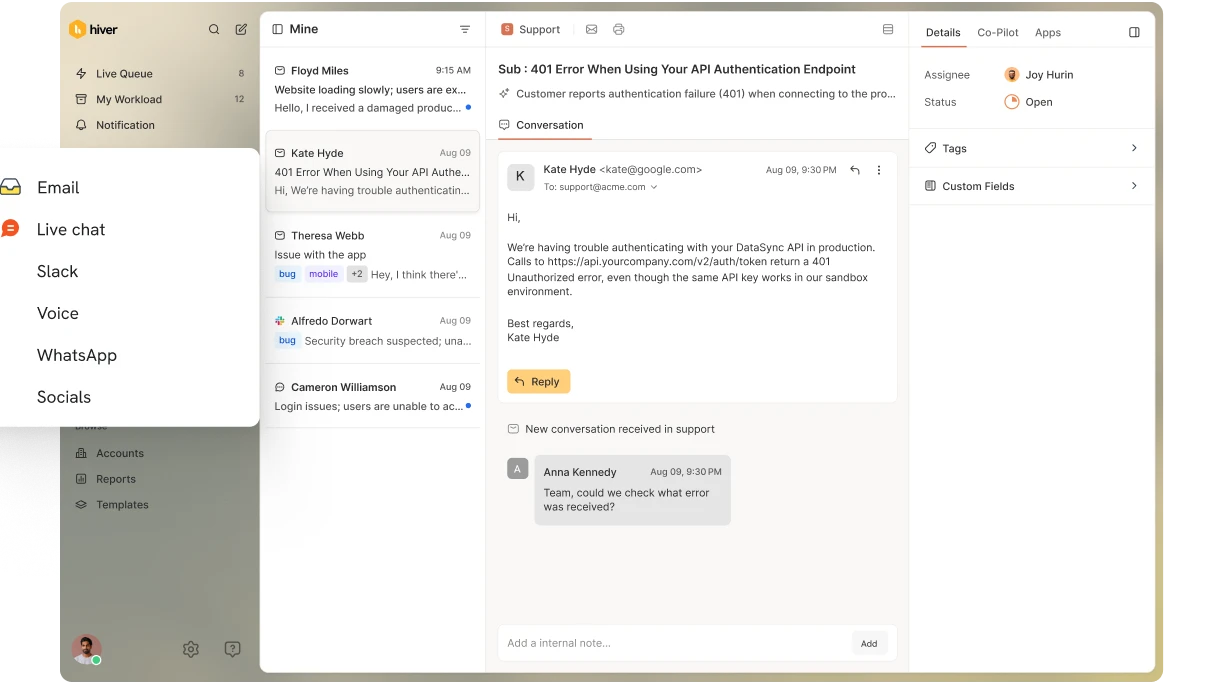
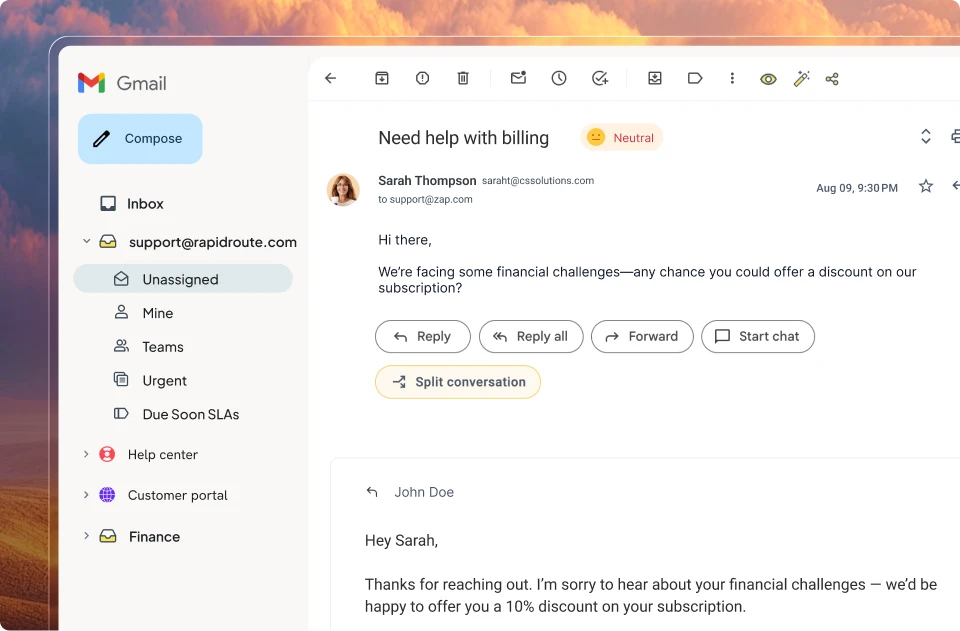
There’s a simpler way to handle customer conversations. Hiver brings together all your service channels, such as support@yourcompany.com or billing@, along with your team and customer context, directly into Gmail. No switching tabs, just fast and effortless service from your inbox.
Whether you’re setting things up for the first time or fine-tuning your workflows, this step-by-step guide will help you get the most out of Hiver’s powerful features.
Let’s walk through the setup so you can hit the ground running.
This onboarding guide covers the steps to set up Hiver in Gmail. If you’re using Outlook and planning to implement Hiver Omni, please head over here.
Table of Contents
Step 1: Download the extension and authenticate your account
Hiver works right on top of your Gmail. Install the Chrome extension, head over to your Gmail account and follow the prompts to authenticate your account. You’ll be setting up your first Shared Inbox in minutes.
Step 2: Create your first Shared Inbox
The next step is to create a Shared Inbox, such as support@ or info@, and connect it to your shared email account, whether it’s a Google Group or a regular user account. Follow the steps in the guided setup flow, and you’ll be up and running quickly.
Think of your Shared Inbox as an email account that multiple team members can access and manage together. It’s ideal for teams that handle high volumes of emails, such as support or billing. Messages sent to addresses like support@ or info@ are visible to everyone, so your team can collaborate, assign, and respond quickly, all in one place.
Step 3: Add your team to the Shared Inbox
Invite your teammates so you can assign emails, co-write replies, collaborate seamlessly, and ensure every conversation gets the attention it deserves.
Additional resources:
Working inside your inbox
Once emails start landing in your Shared Inbox, Hiver makes it easy to stay in control. You can assign emails, track their status, and collaborate with your team so every customer gets a timely, well-crafted response. Here’s how:
1. Assignments
Have you ever had a “Wait, who’s handling this?” moment? Emails slip through the cracks, or worse, two people reply at once. With assignments, every email has a clear owner. Open the email, head to the Hiver panel on the right, and assign it to yourself or a teammate. Simple, clear, and no more guesswork.
2. Views
Views let you filter conversations based on what matters most, such as unresolved issues or pending customer responses. Hiver includes the default views below:
Unassigned – All new incoming emails land here, waiting to be picked up.
Assigned – Emails that have been assigned to you or your teammates.
Pending – Conversations that are in progress, often waiting for a customer’s reply.
Team – A snapshot of your team’s workload. See who’s handling what.
Closed – All resolved conversations live here for easy reference.
You can also create custom views by status or tag to stay focused on what needs your attention.
3. Status
Hiver makes it easy to track the status of every email or customer conversation, whether it’s still open (“Open”), waiting on the customer (“Pending”), or fully resolved (“Closed”).
4. Notes
Got a customer query that needs input from different team members? There is no need to forward emails or switch to Slack or Teams. Just @mention a teammate (or even non-Hiver users) directly within the Notes section on the right panel. Notes stay private to your team, keeping internal chats organized and out of the customer’s view.
5. Tags
Use Tags to categorize emails, such as “High Priority,” “Billing Issue,” or “Feature Request.” Tags add context so you can sort conversations by topic and quickly find them when needed. They also keep your inbox organized and lay the groundwork for reporting and workflows.
6. Shared Drafts
Need to collaborate with other agents to craft the perfect response? With Shared Drafts, multiple teammates can collaborate on a reply before hitting send. No more back-and-forth outside the inbox.
7. Conversation Follows & Collision Alerts
Avoid duplicate replies with real-time Collision Alerts that let you know when someone is already responding. Use Conversation Follows to stay updated on important threads, even if you are not the one replying.
8. Email Templates
Some customer queries, such as password resets, refund policies, or product questions, tend to repeat. Instead of typing out the same reply each time, Email Templates let your team create reusable responses that can be inserted into replies with just a click. Save time, respond faster, and keep your responses consistent and professional every single time.
Automate your workflows
We all get too much email. Manually assigning, tracking, and replying to every message? Not a good use of your time. Hiver’s Automations takes the busywork off your plate, so your team can stay efficient while supporting customers. Here’s how:
1. Auto-responder
Customers don’t expect instant resolutions, but they do want to know their message was received. Automate acknowledgement of a customer’s query by sending a response like, “Thanks for reaching out! Our team is on it and will get back to you soon.” It’s a simple touch that builds trust from the get-go.
2. Rule-based assignment
A well-organized inbox means that every email reaches the right person. With Rule-Based Assignment, teams can set up rules to automatically route emails based on the sender info, CRM ownership, subject, or content.
For example:
- Emails with “technical issue” in the subject go straight to the IT team.
- Messages from customers are assigned to respective account managers as per CRM ownership.
- All emails with a “refund” tag are routed to the finance team.
You can also set up custom triggers and conditions, such as keywords, sender domains, or specific timeframes, to tailor the automation to your team’s needs.
3. Categorize conversations
Easily automate the process of categorizing your emails by adding tags. They can be added based on email content or subject line. Combined with rule-based assignments, this ensures the right people handle the right emails without manual sorting.
4. Service level agreements (SLAs)
Your customers are reaching out across every channel, and your team’s working hard to keep up. But how do you make sure every customer query gets a timely response? SLAs enable you to set clear response and resolution time targets. You can even set up proactive alerts to notify your team before a breach happens.
Additional resources:
- Setting up automations
- Different types of automations
- Set up an Auto-responder
- Creating SLA policies
Work smarter with Hiver AI
Teams spend a lot of time categorizing conversations, drafting replies, and searching for context across different tools. Hiver AI helps reduce this manual effort by assisting agents directly in Hiver and automating parts of the support workflow.
As an admin, you can enable and configure Hiver AI features from the Admin Panel, train them using real conversations, and use their outputs to power Automations, reporting, and agent workflows.
Here’s how Hiver AI helps your team work more efficiently.
1. Train and configure AI Agents
Hiver AI Agents help automate key support workflows such as categorizing conversations, understanding customer tone, extracting information, and reviewing response quality.
From the Admin Panel, you can train AI using real conversations from your Shared Inbox and configure the AI Agents your team needs. As your team continues to work in Hiver, you can refine AI performance over time by training it with examples and correcting predictions when needed.
Hiver AI Agents include capabilities such as AI Tagging, AI Sentiment Analysis, AI Extract, AI Tasks, and AI QA.
2. Automatically categorize and understand conversations
Keeping conversations organized helps teams route and prioritize emails faster.
AI Tagging automatically categorizes new inbound conversations using your category-based tags, such as Billing Issue, Feature Request, or Bug Report. This keeps tagging consistent and reduces manual work for agents.
At the same time, AI Sentiment Analysis evaluates the emotional tone of conversations and classifies them based on customer sentiment. Depending on your setup, conversations can be categorized on a 3-point scale (Positive, Neutral, Negative) or a 5-point scale (Very Positive to Very Negative). This helps teams quickly identify frustrated customers and prioritize conversations that may need immediate attention.
3. Assist agents while they respond
Hiver AI also helps agents work more efficiently while responding to customers through AI Copilot.
AI Copilot provides several tools that support agents:
- Ask AI: Agents can use Ask AI to quickly look up answers from connected knowledge sources such as help articles, documentation, or internal resources. This is especially useful when handling product questions, policy queries, or troubleshooting issues, as agents can get accurate information instantly without leaving the conversation.
- AI Compose: Writing clear, professional responses can take time, especially when handling complex or sensitive issues. AI Compose helps agents refine their drafts by fixing grammar, improving clarity, adjusting tone, or restructuring sentences so responses remain polished and easy for customers to understand.
- AI Summarizer: Customer conversations can sometimes span long email threads with multiple replies. AI Summarizer quickly generates a concise summary of the conversation so agents can understand the full context at a glance. This is particularly helpful for handling escalations, revisiting older conversations, or when a new agent needs to take over a thread.
- AI Suggested Responses generates ready-to-use reply drafts for common customer queries, helping teams respond faster while keeping responses consistent.
4. Find answers quickly with AI Search
Agents often need to look up product details, policies, or troubleshooting steps before responding to customers. AI Search helps surface relevant knowledge base articles and internal documentation directly inside the conversation.
For example:
- An agent receives a question about a refund policy → AI Search surfaces the relevant help article so the agent can quickly confirm the correct response.
- A customer asks about a product feature → the agent can instantly find the related documentation without switching tabs.
By making information easier to access, AI Search helps agents respond faster while ensuring replies stay accurate and consistent.
5. Extract important information from conversations
Customer emails often contain key details such as order numbers, invoice IDs, tracking references, or claim numbers.
AI Extract automatically identifies and pulls these structured details from conversations so your team doesn’t have to manually scan emails or copy information.
For example:
- A customer includes an order number in their message → AI Extract captures it and adds it to a note for the support team.
- An email mentions an invoice ID → the value can be used in an automated reply or workflow.
Once extracted, this information can be used in notes, automated replies, or Automations ensuring consistent data capture across workflows.
6. Automate workflows with AI Tasks
With AI Tasks, you can use AI inside Automations to detect intent or extract insights from conversations.
For example:
- A customer email mentions a feature request → AI Tasks captures the request details and automatically adds them to a note for the product team.
- A message includes tracking details or claim information → AI Tasks extracts the relevant information and triggers a follow-up workflow.
This helps teams capture insights from conversations and trigger the right actions without additional manual work.
7. Maintain response quality at scale
Maintaining consistent response quality becomes harder as support teams grow.
AI QA Coach automatically reviews replies while agents draft them and highlights areas for improvement, such as tone, clarity, completeness, and personalization.
For example:
- An agent drafts a reply that doesn’t fully address the customer’s question → AI QA Coach suggests adding the missing information before sending.
- A response sounds too abrupt → the tool recommends improving the tone to make it more empathetic and customer-friendly.
Admins can also review AI QA Insights to monitor response quality trends, identify coaching opportunities, and ensure the team maintains a consistent standard for customer communication.
Analyze your team’s performance
Get a clear view of your team’s performance with key metrics like response times, conversation volume, customer feedback, and trending topics, all in one place.
Hiver Analytics comes with ready-to-use reports right out of the box. You can also build custom dashboards to track all the key metrics that matter, giving you everything you need in one view.
- Conversations Report: Measure response times, track overall conversation volume, and drill down by topics like “billing” or “refund” to uncover trends and insights.
- Users Report: Get a clear picture of every team member’s workload and response times to optimize overall performance.
- CSAT Report: Measure overall customer sentiment and feedback across conversations.
- SLA Report: Monitor compliance and violations across response and resolution times to uncover what’s slipping through and fix it before it happens again.
- AI Sentiment Analysis: Track customer sentiment trends across conversations to understand how customers feel about their interactions with your team.
Additional resources:
Setting up Integrations
Responding to a customer query isn’t always straightforward. You often need to look up details (like order history, customer info, or more) in your billing systems, ERP, and CRMs. Maybe you even need to create a follow-up task in ClickUp, Asana, or Jira. This is where the endless tab-switching begins– before you know it, you spend more time hunting down information than helping the customer.
Hiver makes this easier by bringing customer data from your favorite tools into your inbox. No more jumping between tabs, just all the context you need right where the conversation is happening.
Here’s how teams use Hiver’s Integrations:
- Check and update order history in Stripe or Shopify
- View and update customer details in HubSpot, Salesforce, or NetSuite
- Create and manage tasks in ClickUp, Asana, and 100+ other apps
- Automate tags, routing and more based on data in 3rd party apps
Check out all our integrations here. Don’t see the tool you use? No worries—just reach out, and we’ll explore how we can help build it for you.
Additional resources:
Getting help from Hiver
1. Get 24/7 live support
Do you have a question or need help? You can get instant support by speaking live to one of our support agents. Just head over here to initiate a chat.
Prefer email? Contact us anytime at support@hiverhq.com. We’re always here to help!
2. Live onboarding sessions
Every week we host live online product walkthroughs (or demos) where you can see how Hiver works. You can learn all about the platform, note down best practices, and have your questions answered in real time. You can register by following the link here.
3. Hiver Community
Connect with other Hiver users, share insights, and stay updated on new features. Join our community here.
4. Help Center
Our Help Docs are the best place to get instant answers. The library has everything, including product tutorials, step-by-step instructions, and deep dives into our features and capabilities. Explore now.