






TL;DR
Here are the top AI help desk picks for 2026:
- Intercom Fin – Best for teams that prefer deflecting queries across channels
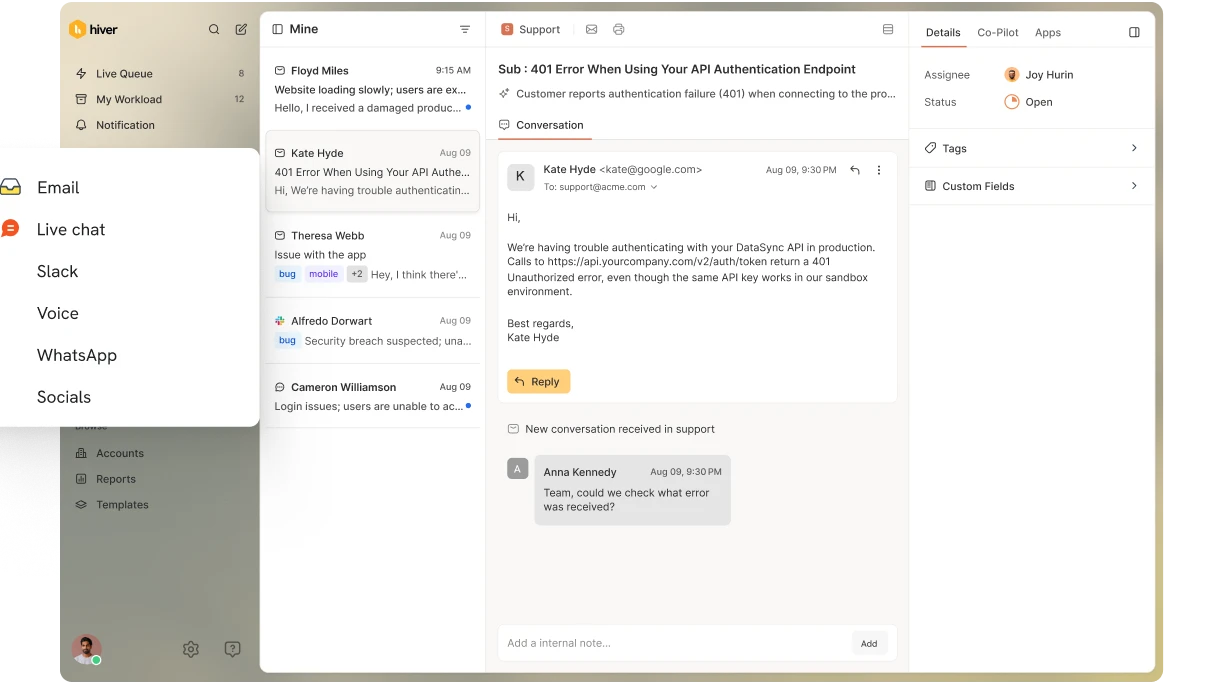
- Hiver – Best for teams that want to manage complex, high-stakes support with AI
- Salesforce Agentforce – Best for teams managing support within an existing Salesforce ecosystem
- Help Scout – Best for small support teams that predominantly handle requests via email
- Zendesk – Best for large teams with high ticket volume
Almost every helpdesk tool today claims to be “AI-powered.” In practice, most of them mean the same thing: a bot that answers FAQs and hands it off to a human when it can’t.
The problem shows up the moment a request gets complex. These AI help desks were primarily built to deflect high-volume transactional queries, so anything outside that scope lands in the human queue with no context and no groundwork done. The gap between what you see during the product demo and what holds up on a complex ticket is wider than most vendors admit.
This guide is created to cut through that gap. I’ve put together the 10 best AI help desks to make your search easier.
What Is an Artificial Intelligence Helpdesk?
An AI help desk is customer service software that determines how to handle each incoming ticket. It can reply, route, escalate, or close a ticket on its own. This is unlike a regular help desk where an agent routes tickets and writes responses manually.
The bigger differentiator is what happens to the tickets that do reach the agents. A well-built AI helpdesk gives an agent the context they need the moment they pick up a ticket. It can summarize a conversation, analyze the customer’s sentiment, pull out relevant account history, and even suggest replies grounded in past resolutions.
Most tools in this category optimize for deflection, keeping as many tickets away from humans as possible. That works for high-volume,transactional support. But, mature AI helpdesks go further. They treat AI as something that runs across the full support lifecycle. This way, teams can measure success by how fast, accurate, and consistent every conversation is, whether it is handled by AI or a human agent.
How Does an AI Help Desk Work?
The clearest way to understand this is through what happens when a query comes in.
Take a straightforward query first. Say a customer writes clearly, “I want a refund”. The AI identifies it as a refund status query, pulls the relevant order details from the connected CRM or order management system, and responds with the current status, without involving a human agent.
Now consider something complex. A user reports a login issue. An automated prompt asks the user for their error code, the AI recognizes it as a known four-digit authentication error, refreshes the token through an API, and confirms the fix back to the customer. The issue is resolved before a human agent ever needs to look at it.
That’s the difference between AI that deflects simple queries and AI that actually moves complex ones forward.
Top AI Help Desk Solutions for 2026 (Ranked by AI Features)
| Platform | Best fit for | Standout AI feature | Pricing |
|---|---|---|---|
| Intercom Fin AI | AI-first, multi-channel deflection | Fin AI Agent + “Let Fin answer first” workflows | No free plan; Paid plans start from $29/seat/mo |
| Hiver Omni | Teams that want full control over how AI runs across the support lifecycle | AI Agents (for end-to-end deflection) and AI copilot (for assistive capabilities) | Free plan; Paid plans start from $25/user/mo |
| Salesforce Service Cloud + Agentforce | Large teams managing support within an existing Salesforce ecosystem | Agentforce Copilot + case classification | No free plan; Paid plans start from $25/user/mo |
| Help Scout | Teams relying on emails for support conversations | AI Answers in Beacon (Docs-driven self-service) | Free plan; Paid plans start from $25/user/mo |
| Zendesk | High-volume support with complex workflows | Intelligent triage + AI layers at scale | No free plan; Paid plans start from $55/agent/mo |
| Gorgias | Shopify-native ecommerce support | AI Agent that can take Shopify actions | No free plan; Paid plans start from $10/user/mo |
| Missive | Small teams that want email, chat, and social channels managed from one shared inbox | AI Rules (intent & sentiment-based routing) | No free plan; Paid plans start from $14/user/mo |
| Freshdesk + Freddy AI | Mid-market teams wanting a traditional helpdesk + AI | Freddy AI Agents + auto-triage + Copilot | Free plan; Paid plans start from $18/agent/mo |
| ServiceNow CSM + Now Assist | Enterprise cross-team orchestration | Predictive intelligence + case clustering | No free plan; reach out to sales for paid plans |
| Front | Teams managing complex customer operations across multiple channels and internal stakeholders | Topics (AI classification) + Copilot | No free plan; Paid plans start from $29/user/mo |
How I Evaluated These AI Helpdesk Tools
I paid most attention to how the AI handled confusing policy questions, edge cases that don’t fit neatly into a workflow, and escalations where context gets lost.
Here’s what I checked for:
- Hallucination test (Accuracy): Real policy questions about refunds and billing disputes were put to the test. Did the AI connect to the CRM or ERP to pull actual data, or did it invent an answer?Tools that bluffed didn’t make the list.
- Structured automation. The real test isn’t whether AI can suggest a reply. It is whether it can read a message, extract the order ID or issue type, update the right fields, and route to the correct team.
- AI feedback loop: AI that makes the same mistakes is a liability. The focus was on whether the system learns from flagged responses and improves accuracy over time.
- Visibility into impact. Most AI tools claim to save time. Few can actually show you where. I looked at whether the platform reports on how often AI resolved a query without help, which workflows it accelerated, and where it’s underused.
Best 10 AI Help Desk Solutions: Deep Dive
1. Intercom Fin AI Agent (Best for teams prioritizing query deflection across channels)
Fin is Intercom’s AI support agent, built to resolve customer questions across chat, email, and messaging without routing everything to a human first. It pulls answers from your help center, connected apps, and website content, and handles a high volume of queries end to end.
For transactional support, order status, account questions, password resets, it’s genuinely strong.

However, the trade-off is in cost and scope. Fin can be expensive at volume, since it’s billed per resolved conversation on top of seat fees.
There’s also an ecosystem dependency that doesn’t get enough attention: Fin works best when your support data lives inside Intercom. Customer information sitting in external systems outside Intercom’s approved app store simply isn’t accessible to it, which puts a ceiling on how much context the AI can actually work with.
Also, for teams that need AI that spans the full agent workflow, specifically quality coaching on human replies, intent-driven workflow automation, and structured data extraction from conversations, Hiver Omni covers that ground more flexibly.
Intercom’s Top AI Features
- Answer Inspection on Fin: You can set clear rules for tone, escalation, and what Fin should never say. When something looks off, the ‘answer inspection’ feature shows exactly which sources and rules were used, so it’s easy to fix.
- AI Copilot for Agents: For conversations that do reach a human, Copilot lives inside the agent inbox and helps summarize threads, draft replies, and surface relevant context. Agents spend less time reconstructing what happened and more time actually resolving the issue.
- Multilingual AI Support: Fin can handle conversations across languages using the same knowledge base and workflows.
- Simulations and “Let Fin Answer First” Workflows. Before turning Fin on for customers, teams can run it against real scenarios to test how it responds.
- AI Reporting and Custom Topics: The dashboard shows what volume of queries Fin is resolving versus escalating, how those outcomes affect CSAT, and which topics drive the most automation. Custom Topics groups conversations by theme, so a manager can see Fin handles billing well but struggles with shipping, then go fix the underlying knowledge.
Intercom: Pros and Cons
| Pros | Cons |
|---|---|
| Fin goes beyond FAQs and can resolve real issues like refunds and account lookups once workflows are set up. | AI pricing can add up quickly. Fin is billed per resolved conversation on top of per-seat costs, making total spend harder to predict. |
| Strong support for AI-first workflows across chat and in-app messaging, with clean handoffs to humans when needed. | Heavily dependent on content quality. Fin performs best when help articles and connected content are well structured and up to date. |
Intercom Pricing
- Essential: From $29/seat/month, billed annually.
- Advanced: From $85–$99/seat/month, billed annually.
- Expert: From $132/seat/month, billed annually.
Fin AI Agent is priced separately at $0.99 per resolved conversation. Fin AI Copilot is an additional $35/user/month.
Recommended reading
2. Hiver Omni (best for teams that want to deploy AI across the support lifecycle)
Complex and high-stakes requests don’t fit neatly into a deflection workflow. They need real investigation, cross-team input, and context pulled from the systems that actually hold customer data. Hiver Omni is built for that kind of support.
The AI goes beyond deflection and runs across the full support lifecycle. Incoming requests get triaged and routed based on intent. Agents get reply suggestions and context mid-conversation so they’re never starting from scratch. Every response gets scored against quality parameters the team defines. As conversations accumulate, recurring themes and emerging issues get surfaced automatically. Support leaders get to act on those issues before customers start escalating.
That compounds over time. In fact, Bynder automated 2,500 workflows a month, saving 198 hours. Group Miki managed 18,000+ weekly customer interactions with AI, without adding to their headcount.

That said, Hiver is designed for teams where human judgment still plays a central role. If the goal is to automate the majority of conversations with minimal human involvement, there are other tools like Intercom built specifically around that model.
Hiver’s AI Features:
- AI Agents: They handle incoming requests end to end. Routine queries get resolved directly without agent involvement, so what reaches the queue is what actually needs a human.
- AI Tasks: For everything that does need a human, AI Tasks does the groundwork first. It reads intent rather than phrasing, so a billing complaint worded five different ways still gets extracted, categorized, and routed to the right team before an agent opens it.
- AI Copilot: Once the ticket lands with an agent, AI Copilot steps in. It surfaces relevant context, drafts replies, and pulls answers from internal docs so agents aren’t starting from scratch on every conversation.
- AI QA: After the response goes out, AI QA scores it against parameters the team defines: tone, accuracy, completeness, process adherence. Most teams manually review 2-3% of conversations. AI QA covers all of them.
- AI Topics: Across all of this, AI Topics groups conversations into themes and tracks how those themes move over time. If refund complaints are creeping up month over month, that’s visible while there’s still time to act.
Hiver: Pros and Cons
| Pros | Cons |
|---|---|
| AI across the full support lifecycle: resolution, triage, agent assist, QA, and insights | Reply suggestions can feel off-tone in sensitive conversations until the AI is trained on your team’s voice |
| Granular control over when AI steps in and how much autonomy it has |
Hiver Pricing
Unlike most tools, Hiver Omni includes all AI functionalities across all the paid plans. No add-ons required.
- Growth: $25/user/month
- Pro: $55/user/month
- Elite: $85/user/month
Hiver also offers a 7-day free trial. You can explore all features before committing.
3. Salesforce Service Cloud + Agent Force (Best for large teams that want AI inside an existing CRM stack)
Salesforce’s AI draws on everything already living in your CRM — case history, renewal timelines, account health, customer tier. So an agent picking up a renewal-stage account gets a very different suggested reply than one handling a new customer.
But that depth comes with real implementation weight. Agentforce Service Agent requires Data Cloud as a hard prerequisite, and the Case Classification feature needs thousands of closed cases before predictions become reliable. Teams expecting a fast setup will find the onboarding cost hard to justify.

Where Salesforce pulls ahead is in handoffs. Work Summaries condense long case threads into structured synopsis the moment a conversation closes, and Conversation Catch-Up does the same when a case transfers to another agent mid-way. Tools like HelpScout or Front don’t have an equivalent feature, and for large teams handling complex multi-touch cases, that saves a lot of time.
Salesforce’s Top AI Features
- Agentforce Copilot: Complex cases often have no obvious starting point. Agentforce generates a step-by-step resolution plan directly on the case page, drawing information from your knowledge base, policies, and past case patterns. It’s assistive rather than autonomous, which makes it a sensible first step for teams easing into AI-assisted workflows.
- AI Service Agent: This is the customer-facing autonomous agent, handling incoming requests across chat, messaging, WhatsApp, and self-service portals without agent involvement. It hands off to a human with full context when it hits something it can’t resolve.
- Einstein Search Answers: Instead of returning a list of articles, this surfaces a 1-3 line direct answer from the most relevant Knowledge article when a rep searches for information in the middle of responding to a customer.
- Agent Force Work Summaries: At the end of a messaging, email, or voice interaction, the agent clicks once and gets a structured summary covering the issue, actions taken, and resolution.
- Knowledge Articles: Agentforce can help generate and update knowledge articles using real support interactions.
- Einstein Flow Generation: Admins describe a workflow in plain language and Salesforce drafts it as an automated Flow. It handles flows up to around six elements, so it works well for straightforward processes. Anything more complex still needs to be built manually.
Salesforce Service Cloud: Pros and Cons
| Pros | Cons |
|---|---|
| Highly customizable and flexible. You can tailor workflows, fields, and AI behavior to fit your needs. | You pay twice, for platform+ AI. Einstein is not a standalone purchase. You need Service Cloud first, usually Enterprise or Unlimited, and then pay extra for Einstein or GPT capabilities. |
| With Einstein AI handling scoring, predictions, and conversational summaries, it actively supports sales teams in their day-to-day work. | Best value only if you’re mostly in Salesforce. Einstein shines when most service data, channels, and workflows already live in Salesforce and Data Cloud. |
Salesforce Service Cloud Pricing
- Starter (from ~$25/user/month)
- Pro (from ~$100/user/month)
- Enterprise (around ~$175/user/month)
- Unlimited (around ~$350/user/month)
- Agentforce 1 Service (around ~$550/user/month)
Einstein GPT for Service is usually sold as an add-on to Salesforce Service Cloud, starting at around $50 per user/month on plans like Enterprise or Unlimited (it’s not available on the Starter Suite).
Recommended reading
4. HelpScout (Best for teams that run support over email and want lightweight AI assistance)
Small support teams don’t always need a full-scale helpdesk. Help Scout’s interface is super clean, the workflows stay predictable, and AI works in the background without demanding significant configuration to get started.
Turning on AI Answers in Beacon is where the difference shows up first. Customers typing questions into the chat widget get answers pulled from your Docs before a conversation even opens. Simple “how do I” questions stop reaching the queue almost immediately, and what reaches agents is what actually needs a human.
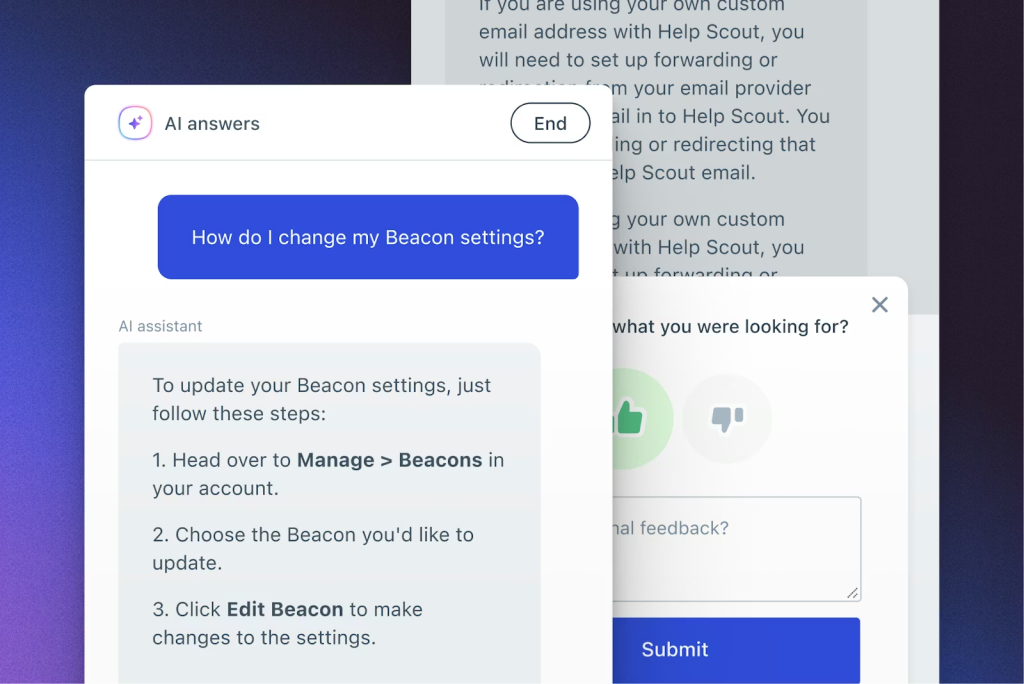
The limitation is scope, and it’s worth being direct about it. Help Scout’s AI is built around the inbox: drafting replies, summarizing threads, handling self-service questions from your Docs.
There’s no intent-based routing, no quality scoring on agent replies, and no trend detection across conversations. Compared to tools like Hiver or even Missive, the automation ceiling is noticeably lower.
For a small team where email is the primary channel and volume is manageable, that’s a reasonable fit. For teams that need AI to drive routing decisions, flag quality issues, or surface emerging patterns, Help Scout isn’t the right tool.
Help Scout’s Top AI Features
- AI Answers in Beacon. Beacon becomes a lightweight self-service assistant that answers customer questions directly from your Docs and selected web pages. Questions that have a clear answer in your knowledge base never reach the inbox.
- Custom AI Voice per Beacon. Each Beacon can be configured with its own tone and phrasing guidelines, so the self-service experience stays consistent with how the rest of the brand communicates.
- AI Drafts. Reply drafts get generated inside the composer based on your Docs and past conversations. Particularly useful for new agents who are still learning common responses.
- AI Assist. Agents can adjust tone, fix grammar, shorten or expand a reply, without leaving the compose window.
HelpScout: Pros and Cons
| Pros | Cons |
|---|---|
| AI fits naturally into an email-first workflow without requiring significant setup or configuration. | Customer-facing AI is priced per resolution, so costs grow as self-service usage scales. |
| Steady product improvements and a team that responds to customer feedback. | No AI agents or intent-based automation, which are now standard on most competing platforms. |
Help Scout Pricing
- Free: up to 100 contacts/month with 5 users
- Standard: $25/user/month
- Plus: $45/user/month
- Pro: $75/user/month
AI Answers is billed separately at $0.75 per resolved conversation on any paid plan, with optional spend caps.
Recommended reading
5. Zendesk (Best for large teams with high ticket volume and complex workflows)
Zendesk is a mature enterprise helpdesk with a substantial AI layer built across triage, self-service, and the agent workspace. The core product, SLAs, views, macros, triggers, is unchanged. What AI adds is the ability to organize work before agents even open a ticket.
With intelligent triage turned on, incoming tickets arrive pre-tagged by intent and sentiment and get routed automatically. The queue looks sorted before anyone touches it. On the agent side, reply suggestions get pulled from similar past tickets and relevant help center articles, so agents spend less time writing from scratch and more time reviewing and sending.
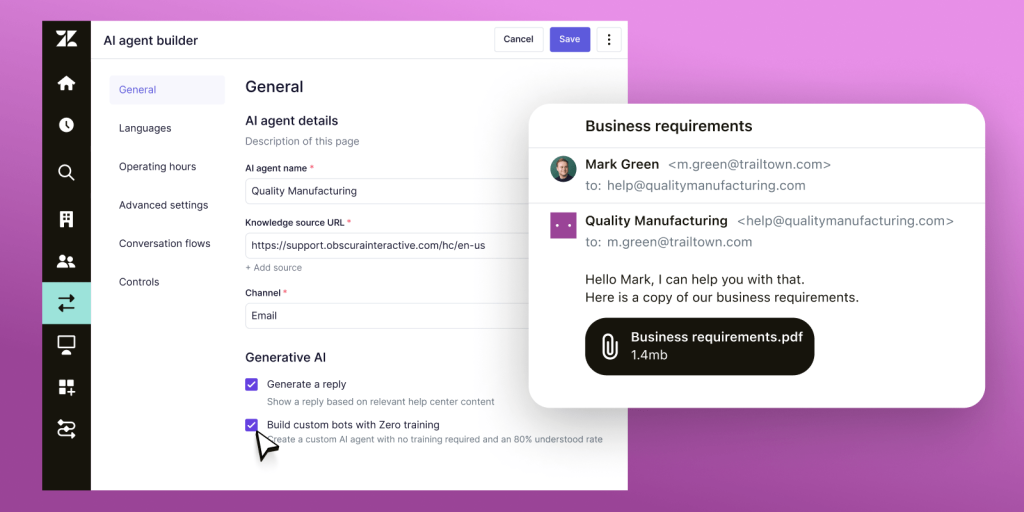
Where Zendesk starts to strain is cost and control. Advanced AI sits behind higher-tier plans and add-ons, and teams often find themselves paying for capabilities they don’t fully use to unlock the ones they need.
The setup and tuning process is admin-heavy. For teams that want similar AI depth, specifically intent-based routing, quality monitoring, and trend detection, without the pricing complexity, Hiver covers the same ground at a lower per-seat cost. It also includes AI across plans rather than gating it behind tiers.
Zendesk’s Top AI Features
- AI Agents. Handle customer queries across chat and messaging using your help center content and configured flows, resolving common requests without agent involvement.
- Intelligent Triage and Routing. Detects intent, sentiment, language, and urgency on arrival, then tags and routes tickets to the right team without manual sorting.
- Zendesk Copilot. Surfaces reply suggestions, conversation summaries, and relevant articles or macros directly inside the agent workspace.
- AI Knowledge Content. Uses generative AI to rewrite, expand, and create help center articles based on real ticket patterns, helping keep documentation current as support volume grows.
- AI-Powered Search. Improves article and ticket search for both agents and customers by surfacing the most relevant results rather than returning broad keyword matches.
- AI Insights and Reporting. Tracks resolution rates, escalation patterns, and high-volume intents so teams can see where automation is working and where it needs adjustment.
Zendesk: Pros and Cons
| Pros | Cons |
|---|---|
| AI handles a meaningful share of repeat tickets with contextual replies and smart routing across channels. | Advanced AI features require higher-tier plans and additional add-ons, making total cost hard to predict. |
| Layered AI approach means teams can adopt gradually without rebuilding existing workflows. | Setup and ongoing tuning can be admin-heavy, especially for teams without dedicated ops support. |
Zendesk Pricing
- Suite Team: $55/agent/month, billed annually
- Suite Growth: $89/agent/month
- Suite Professional: $115/agent/month
- Suite Enterprise: custom pricing
Advanced AI is typically an add-on at around $50/agent/month. Some AI agents are billed per resolved conversation, which can increase costs as volume scales.
Recommended reading
6. Gorgias (Best for Shopify-Native, Revenue-Focused E-Commerce Platform)
Gorgias is purpose-built for ecommerce teams, and that focus is visible from the moment you connect your store. Orders, customers, inventory, and past conversations all surface inside the support dashboard, so agents and AI are working from the same picture of what’s happening.
What makes Gorgias stand out is how commerce-aware the AI actually is. When a customer asks about a return, the AI Agent checks eligibility against your policies and explains next steps without involving a human. Beyond resolving issues, it can suggest exchanges instead of refunds and nudge high-intent shoppers toward checkout using live cart and inventory data.

That said, Gorgias is a narrow fit. It’s built for ecommerce, Shopify in particular, and that specialization is both its strength and its ceiling. Freshdesk covers similar ticket volumes for mid-market teams but works across industries and integrates with a broader set of tools.
If your support stack extends beyond ecommerce platforms, or if you need AI that handles B2B account complexity rather than consumer transactions, Gorgias isn’t the right tool. But for a Shopify-heavy team where revenue attribution and conversion are part of the support mandate, nothing else on this list comes close.
Gorgias’ Top AI Features
- AI Shopping Assistant. Acts as a front-line assistant on product and cart pages, recommending items based on browsing behavior and inventory rather than just answering questions.
- Shopify and Ecommerce Integrations. The AI Agent reads and acts on real-time data from Shopify, AfterShip, subscription tools, and fulfillment systems, so it can take actions inside the conversation rather than just describing them.
- Brand-Aware Responses. Gorgias trains the AI on your help center, internal guidelines, and past replies so answers stay consistent with your tone and policies rather than defaulting to generic language.
- Revenue Attribution. Tracks how much revenue is influenced by AI-handled conversations, so teams can measure whether support is driving conversions, not just deflection.
Gorgias: Pros and Cons
| Pros | Cons |
|---|---|
| AI can resolve common ecommerce issues by taking direct actions in Shopify, not just describing what to do. | Flows, actions, and automations need meaningful upfront configuration before the AI performs reliably. |
| Connects support and sales in a single workflow, with revenue attribution that most helpdesks don’t offer. | AI pricing sits on top of ticket-based pricing, making total costs harder to predict as volume grows. |
Gorgias Pricing
Gorgias’ pricing combines a ticket-based helpdesk plan with AI and automation add-ons.
- Starter: ($10/user/month)
- Basic ($50/month)
- Pro ($300/month)
- Advanced ($750/month)
AI Agent, Rules, and advanced Flows are priced separately, so the real cost depends on how you automate support and sales conversations.
Recommended reading
7. Missive (Small teams that want to manage multiple channels from one shared inbox)
Missive brings in email, SMS, and social channels into one shared inbox, keeping every conversation assigned, tracked, and visible to the right people in the team. It’s AI capabilities are built into how conversations are routed and replied to rather than sitting as a separate product on top.
The rules engine is worth calling out specifically: it can route and categorize conversations based on intent and sentiment, not just keywords, which puts it a step ahead of basic shared inbox tools.
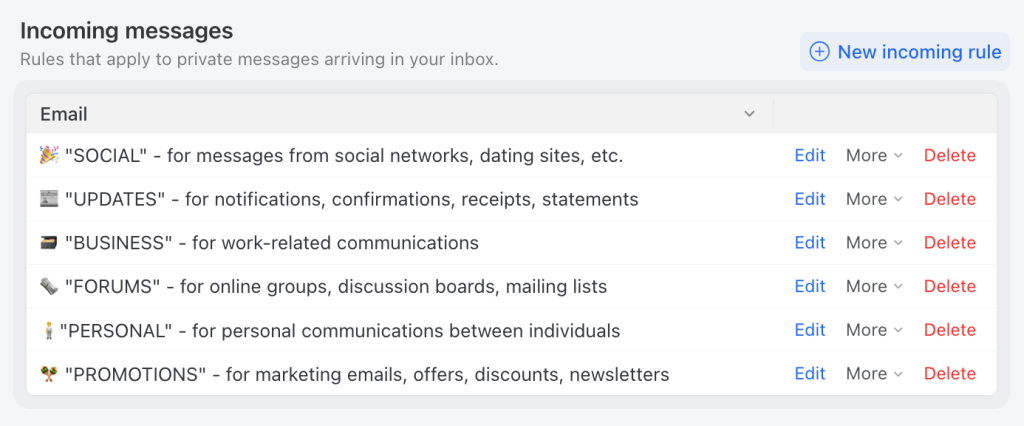
The catch is that AI capabilities require connecting your own OpenAI API key. It’s not a dealbreaker, but it means there’s a setup step before you can actually put it’s AI capabilities to use,
Front sits in the same category and is the more natural comparison. Both tools bring AI into the workflow rather than bolting it on as a separate product. Front includes AI natively with no external setup, while Missive gives teams more control over which models they use and keeps usage costs visible. For a technical team that values that flexibility, it’s a real advantage. For a team that wants AI working on day one without configuration, Front is the simpler path.
Missive’s Top AI Features
- AI Rules. Detect intent and sentiment in incoming messages, then automatically assign, tag, or create tasks across email, SMS, and social channels. Unlike keyword filters, these work even when customers don’t phrase things the way you’d expect.
- AI Drafting and Rewriting. Generate reply drafts, adjust tone, translate messages, or clean up wording directly inside the composer using reusable prompts the whole team can access.
- Advanced Rules. Standard non-AI rules handle auto-assignment, snoozing, tagging, and responses based on sender, keywords, or channel. The AI and non-AI layers work alongside each other rather than replacing one with the other.
- Bring-Your-Own-AI. Teams connect their own OpenAI API key and choose which models to use, keeping AI behavior and costs under direct control rather than metered through the platform.
Missive: Pros and Cons
| Pros | Cons |
|---|---|
| AI Rules understand intent and sentiment rather than matching keywords, which meaningfully reduces manual triage. | Requires your own OpenAI API key, which adds setup friction and puts usage costs outside the platform. |
| Automation distributes work across the team efficiently, and many teams use Missive to replace several separate tools. | Configuring automations takes time and can feel complex at first, especially for teams without a dedicated admin. |
Missive Pricing
- Starter: $14/user/month, billed annually
- Productive: $24/user/month, billed annually
- Business: $36/user/month, billed annually
AI automations require your own OpenAI key, so there’s no separate AI add-on fee from Missive directly.
Recommended reading
8. Freshdesk + Freddy AI (Best for mid-market teams that want built-in AI across tickets, chat, and email)
Freshdesk is a traditional helpdesk with Freddy AI built into the core workflow. It handles incoming ticket triaging, drafts replies for agents, and answers common customer questions automatically before they reach the queue.
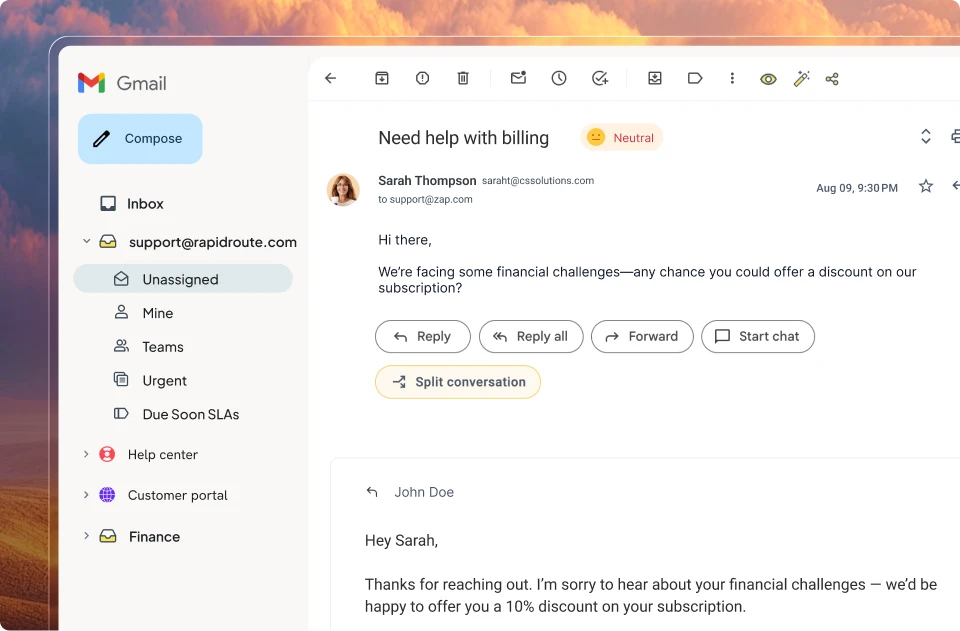
At the same time, a ticket from an unhappy customer approaching an SLA deadline gets flagged, prioritized, and routed to the right team without human intervention.
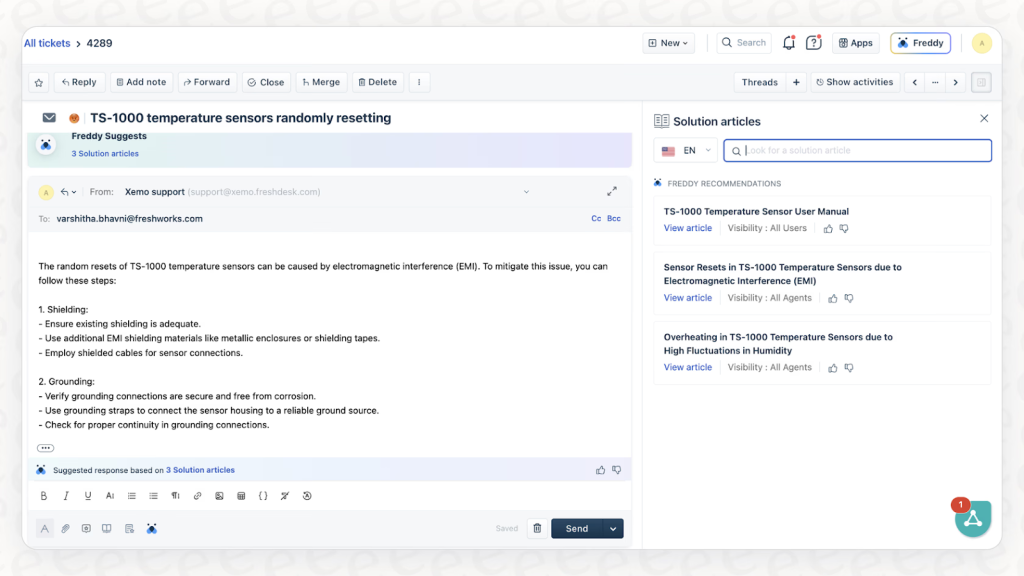
For mid-market teams evaluating options, Zendesk can be its strong competitor. Both cover similar ground across triage, agent assist, and self-service, but Freshdesk is generally cheaper and faster to set up. That matters for teams without a dedicated ops admin to manage the rollout.
Zendesk goes deeper on automation and reporting, but that depth requires configuration time and a pricing structure that compounds as you add seats and features. The real question isn’t which tool does more. It’s how much customization your team actually needs versus how much capacity you have to build and maintain it.
Freshdesk’s Top AI Features
- Freddy AI Agents. Handle common queries across chat, email, and portals using your knowledge base, and hand off to humans with context when a query falls outside what they can resolve.
- Freddy Copilot for Agents. Suggests replies, summarizes conversations, translates messages, and drafts resolution notes inside the ticket view, so agents have what they need without switching screens.
- Auto-Triage and Intelligent Routing. Analyzes intent, sentiment, and urgency to set priority, assign to the right group, and surface high-risk tickets before they breach SLA.
- Multilingual Support. Freddy detects language and translates conversations in real time, helping global teams handle different regions without building separate workflows for each.
- Freddy AI Insights. Turns ticket data into trend alerts and root-cause analysis, giving support leaders early signals on SLA risk and CSAT patterns rather than waiting for them to show up in reports.
Freshdesk: Pros and Cons
| Pros | Cons |
|---|---|
| AI is built end-to-end across customer automation, agent assistance, and analytics without needing external tools. | Freddy only works within the Freshworks ecosystem, limiting flexibility for teams that use other platforms. |
| Works across support channels like email, chat, messaging, and the help center without breaking context between channels. | AI performance depends on knowledge base quality, which requires regular upkeep to stay effective. |
Freshdesk Pricing
- Growth: ~$18/agent/month
- Pro: ~$59/agent/month
- Enterprise: ~$95/agent/month
Freddy Copilot is typically an add-on starting around $29/agent/month. Freddy AI Agent usage is billed separately based on automated sessions, so costs can vary as volume scales.
Recommended reading
9. ServiceNow CSM + Now Assist (Best for Enterprise-Scale, Cross-Team AI Orchestration)
ServiceNow is a heavyweight by design. Now Assist is built into the same forms, workspaces, and virtual agents that teams already use rather than added as a separate module. For large organizations managing complex, multi-team support, that integration depth is the point.
Where ServiceNow handles things differently is at scale. When a wave of similar complaints arrives, AI groups them into a shared incident pattern, creates a problem record, and pulls in the right internal teams with full customer context already attached.
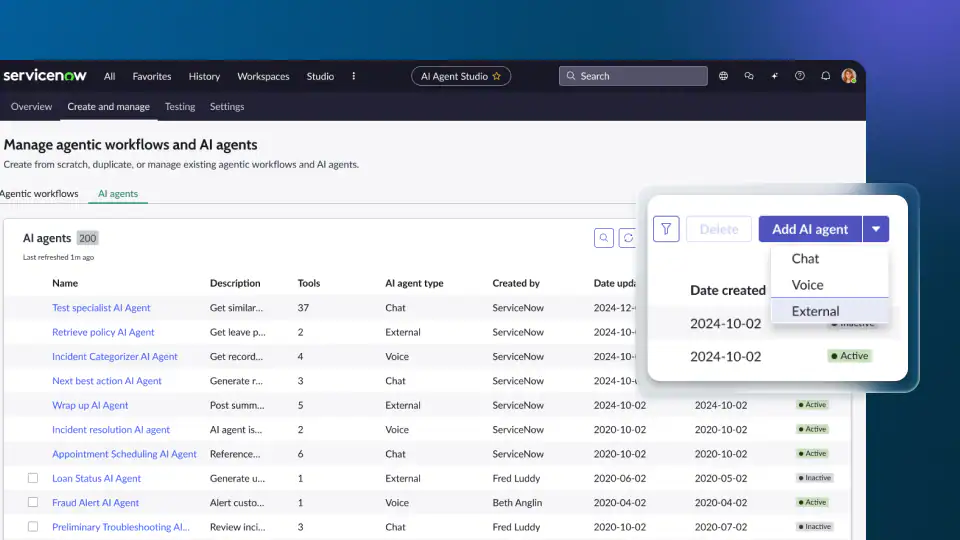
Salesforce sits at the same end of this list, and the differences are worth understanding before choosing between them. ServiceNow’s strength is cross-team orchestration, incident management, and internal SLA visibility. Salesforce’s strength is account context from CRM data.
If your support operation is heavily internal, with engineering, ops, and finance teams all involved in resolution, ServiceNow is more naturally suited. If the priority is customer-facing account intelligence tied to renewal and revenue data, Salesforce has the edge.
ServiceNow’s Top AI Features
- Virtual Agent with Generative AI: Common requests across web, mobile, and collaboration tools get handled without agent involvement. When a query falls outside its scope, it escalates cleanly to a human with full context intact rather than dropping the customer mid-conversation.
- Predictive Intelligence and Smart Routing: Before a ticket even reaches a team, the AI reads its intent, urgency, and sentiment to decide where it should go. SLA risks get flagged early, so teams are responding to warnings rather than reacting to breaches.
- Anomaly Detection and Case Clustering: A sudden spike in similar complaints doesn’t appear as fifty separate tickets. The AI groups related cases into a shared incident or problem record, so teams address the root cause once rather than resolving the same issue repeatedly.
- AI-Powered Search and Knowledge Recommendations: Both agents and customers get answers surfaced from existing knowledge, records, and prior resolutions without having to dig through documentation manually. Repetitive lookups and guesswork drop significantly for teams with a well-maintained knowledge base.
ServiceNow Pros and Cons
| Pros | Cons |
|---|---|
| Strong at handling large, recurring issues: AI spots patterns and SLA risks so teams fix root causes rather than individual tickets. | Requires dedicated admins and clean data to perform well. Setup complexity is significant. |
| Virtual agents, predictive intelligence, and automated workflows reduce manual effort at a scale most other tools can’t match. | Cost and complexity make it overkill for smaller teams or simpler support operations. |
ServiceNow Pricing
ServiceNow doesn’t publish fixed pricing. Customer Service Management is typically sold as an enterprise contract, often starting in the tens of thousands of dollars annually depending on scope, users, and integrations. Now Assist and other generative AI capabilities are licensed as separate modules with negotiated pricing.
Recommended reading
10. Front (Best for Teams Needing AI-Assisted Shared Inbox & Lightweight Helpdesk)
Front is a shared inbox that has grown into a lightweight helpdesk for CX and ops teams managing multiple channels. Email, SMS, live chat, and social all sit in one workspace, with conversations getting easily assigned and visible across the team.
Its standout feature is Topics. Rather than relying on keyword rules, it reads the intent of an incoming message and assigns a category like “billing issue” or “order status” automatically. That category then drives routing, queue assignment. Front also has a Copilot that helps with reply suggestions without any manual intervention.
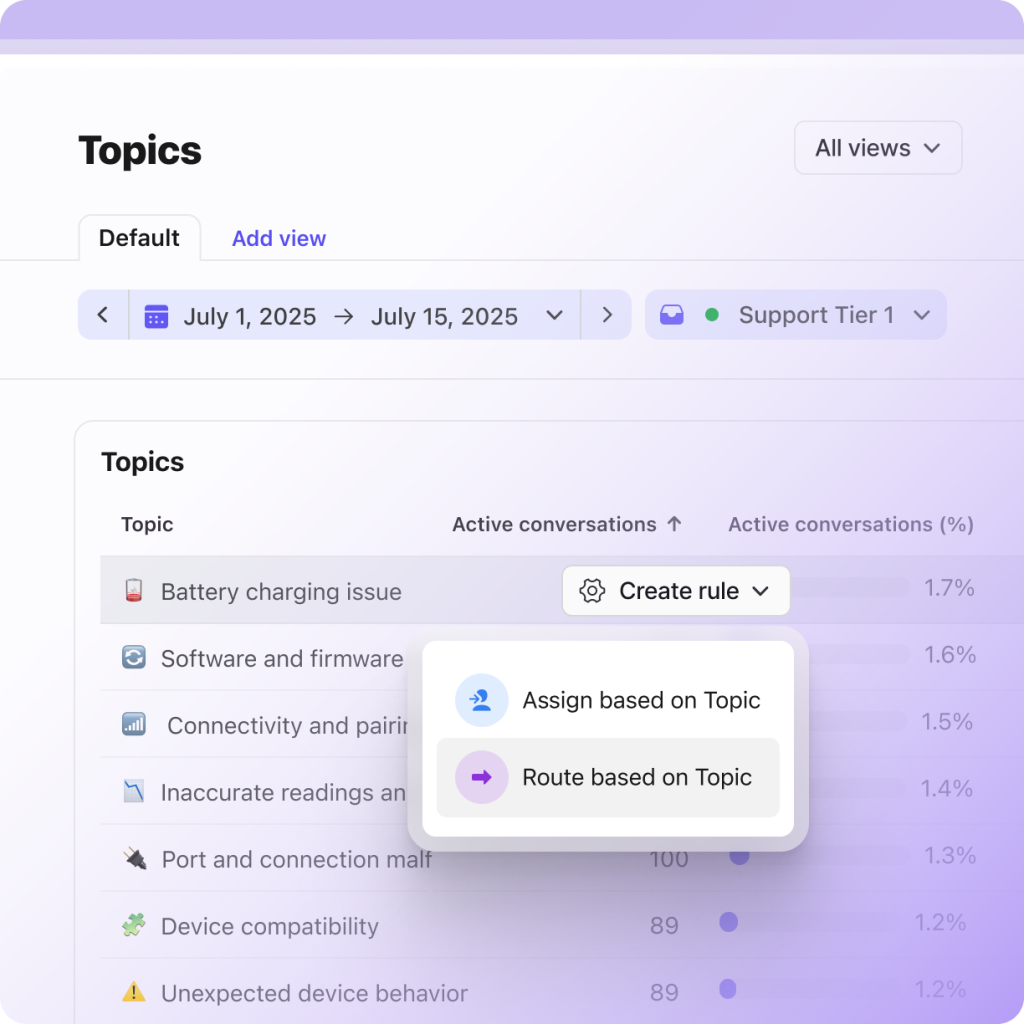
Where Front starts to show its limits is in operational depth. Reply quality across the team isn’t scored or monitored, and workflow automation stays at the level of routing and tagging. It doesn’t turn a conversation into a structured set of actions the way intent-based automation in tools like Hiver does.
For teams whose primary problem is inbox chaos and slow response times, Front solves it well. For teams that need AI to drive quality decisions and structured workflows beyond routing, that gap becomes harder to ignore.
Front’s Top AI Features
- Copilot for setup guidance: Describe automations in plain language and let Copilot suggest rules and configurations.
- AI-Assisted Knowledge Base. Agents can query the knowledge base in natural language mid-conversation and insert relevant answers directly into replies.
- Rules Powered by AI Signals. Topics and other AI inputs feed routing rules, load balancing, prioritization, and SLA workflows without needing separate configuration.
- Smart QA and CSAT Insights. AI analyzes sentiment and conversation quality across threads, giving managers visibility beyond what basic survey scores capture.
- Copilot for Setup Guidance. Teams can describe automations in plain language and have Copilot suggest rules and configurations rather than building them manually.
Front Pros and Cons
| Pros | Cons |
|---|---|
| AI Topics cut down manual triage by grouping messages by reason for contact automatically, keeping high-volume inboxes organized. | AI suggestions weaken when knowledge, macros, and FAQs aren’t centralized inside Front. |
| Copilot drafts and summarizes replies directly in the inbox without requiring agents to switch tools. | More advanced AI-driven workflows take time to configure and typically need an experienced admin. |
Front Pricing
- Starter: ~$29/user/month, billed annually
- Growth: ~$79/user/month, billed annually
- Scale: custom pricing
Recommended reading
How to Choose an AI Help Desk for Your Business in 2026
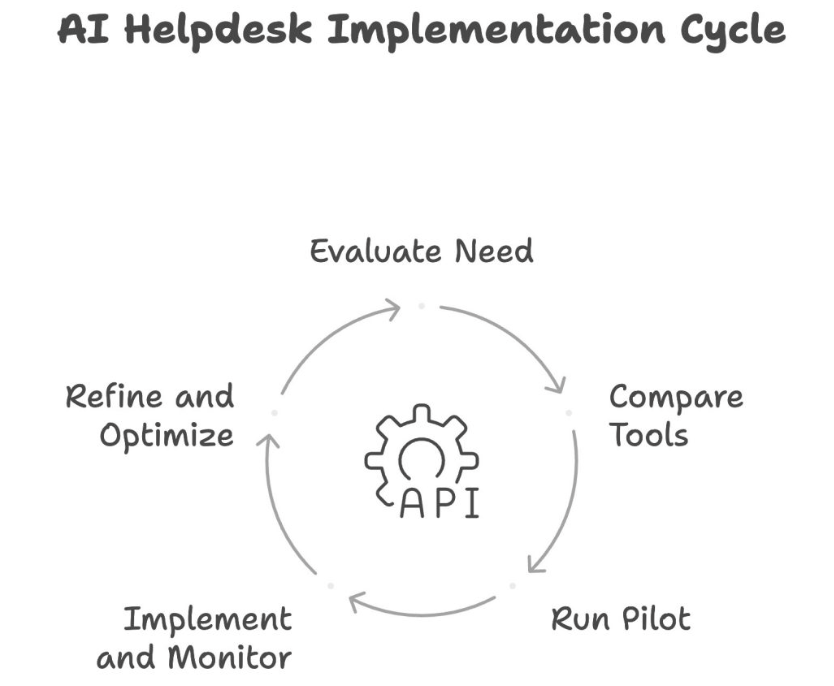
Choosing an AI helpdesk is less about who has the most features and more about whether it actually works with your team, data, and workflows.
A simple way to evaluate tools is to think like a real support team under pressure. Here’s what Nirmal Gyanwali has to say about it:
“AI is really just a partnership; it only works if you’ve got good data, good tech, and people who understand how to use it. Too many companies buy ‘AI’ before they fix their content, processes, and integrations—then blame the tool when it underdelivers.” — Nirmal Gyanwali, Founder & CMO, WP Creative
For teams, start by checking if AI even makes sense for you
- Look at your ticket mix. If 40–50% of volume is repetitive and policy-driven (order status, refunds, password resets), AI is worth testing.
- Audit your data. AI only works as well as your knowledge base, policies, and integrations.
- Be honest about change. AI helpdesks work best when teams are willing to adjust workflows, not just turn on a bot.
Then compare tools on these core criteria
- Automation depth: Can the AI actually take actions like updating orders or triggering workflows, or does it only answer FAQs?
- Data extraction and workflow automation: Modern AI helpdesks don’t just read messages, they structure them. They can extract order IDs, issue types, or deadlines from a conversation and use those values to update fields, route to the right team, and trigger downstream workflows. So the question you should ask is: does the AI turn unstructured messages into structured actions, or does an agent still have to do that manually?
- Messy language handling: Test real customer queries, not clean scripts. Good AI should handle vague, emotional, or multi-part questions.
- Agent assist quality: Do AI drafts save time, or do agents rewrite everything?
- Quality and coaching insights: Most teams sample 2-3% of conversations a week for QA, which means the other 97% goes unchecked. Look for a tool that scores every reply (human or AI) against your quality parameters and surfaces patterns you can act on. This will help you surface things like which agents are technically accurate but consistently curt, or which new hires are missing the kind of context senior agents add by default.
- Pattern and trend detection: The right tool surfaces patterns earlier, and automatically groups conversations by theme so you can act on what’s emerging. Maybe a recent app update is causing login failures across one customer segment. Maybe complaints about a specific shipping carrier are clustering by region. Catching these as they form can prevent churn.
- Workflow fit: Does it integrate cleanly with your e-commerce stack, CRM, and routing logic?
- Visibility: Can you track deflection, AI accuracy, escalations, and CSAT impact?
- Cost and governance: Understand pricing clearly. Per-seat vs per-resolution adds up fast at scale.
Lastly, always run a small pilot. Limit it to a few high-volume intents and one or two channels. Measure response time, deflection, CSAT, and how much agents actually trust the AI. This is exactly what Sarah Caminiti emphasizes as well, on Hiver’s podcast:
“AI can be amazing—but it shouldn’t talk to customers without strict QA. Where AI really helps is in freeing up time, so your team can focus on trends, supporting each other, and shaping the product”.– Sarah Caminiti, Manager of Customer Support at Tailscale
The ROI of an AI Helpdesk

The value of an AI helpdesk shows up in clear business outcomes, not just better support experiences. Teams see lower support costs, better use of agent time, stronger retention, and better revenue over time.
Here’s where the ROI typically shows up.
Lower support costs
AI takes care of a large portion of repetitive questions like order status, refunds, and shipping updates. As more of this work moves to self-service and automation, teams can handle higher volumes without constantly adding headcount. Over time, this brings down the overall cost of running support.
Higher agent productivity
With AI helping with triage, summaries, and reply drafts, agents spend less time searching for information or rewriting the same responses. That frees them up to focus on complex or sensitive issues instead of repetitive tasks, making each agent’s day more efficient and less reactive.
Recommended reading
Faster resolutions and better CSAT
AI-driven routing and guidance ensure issues reach the right person with the right context from the start. Customers get quicker, clearer answers, fewer handoffs, and less repetition, which naturally improves satisfaction and reduces frustration.
Consistent quality at scale
Speed is only half the picture. The other half is whether quality holds up as volume grows. AI-powered QA scores every reply against your standards, surfacing patterns no human reviewer could catch by spot-checking. Managers can see exactly which agents need coaching, which issue types drive low scores, and which workflows quietly compromise tone or accuracy. Without this kind of visibility, scaling support usually means scaling inconsistency.
Better retention and revenue protection
Support is often where customers decide whether to stay or leave. When issues are resolved quickly and consistently, trust goes up. That helps reduce churn and encourages repeat purchases, turning support into a driver of retention instead of a cost center.
When NOT to Use an AI Helpdesk
I’ll be honest hese – not every team needs an AI helpdesk. And not every team that needs one is ready for it yet.
After running this evaluation, I came away with a clear sense of when AI is the wrong call. Here’s where I’d hold off.
1. Your support volume doesn’t justify it
If your team handles fewer than a few hundred tickets a month, AI is mostly overhead. You’ll spend more time setting up workflows, training the AI on your knowledge base, and reviewing its outputs than you’d save in deflection. At that volume, a well-organized shared inbox and clear ownership solve 90% of the problem. AI becomes worth the effort once volume starts overwhelming the team’s ability to keep up.
2. Your knowledge base is a mess
This is the one I’d flag hardest. AI is only as good as the content it pulls from, and most teams underestimate how bad their documentation actually is. Stale articles, conflicting policies, undocumented edge cases, half the answers living in someone’s head or in a Slack thread from 2023. Turn AI on top of that, and it confidently gives wrong answers at scale.
A recent Qualtrics report found that AI-powered customer service fails at four times the rate of other tasks. That number isn’t just about model quality. AI multiplies whatever’s there, including the gaps. So if your knowledge base needs a cleanup, do that first.
3. You’re not ready to change how the team works
AI doesn’t just sit on top of existing workflows. It changes them. Routing logic gets rebuilt around intent and not keywords. QA shifts from sampling to continuous coverage. Agents stop doing repetitive triage and start handling complex, more cognitively demanding work. If the team isn’t ready for that shift, the ollout stalls.
Gartner research backs this up. In a recent survey of over 300 customer service leaders, only 20% reported reducing agent headcount despite 74% having deployed AI.
As CX Dive summarized it: “The business case for AI in service needs a reset, from ‘replace the workforce’ to ‘redesign the work.'”
So, please note that AI isn’t a replacement for the team. It’s a redistribution of where their time goes. If you’re not prepared to manage that, hold off until you are.
How to Implement an AI Helpdesk Solution in 3 Simple Steps
Even the most advanced AI helpdesk needs focus, training, and solid content to work well. These three steps help teams roll out AI safely, build trust, and see results early.
1. Start Small With a Focused Pilot
The biggest mistake teams make is turning AI on everywhere at once. Instead, begin with a narrow pilot that’s easy to measure and easy to fix.
- Choose one or two high-volume, low-risk intents like order status or password resets.
- Limit rollout to one or two channels, such as web chat and email.
- Set clear goals for deflection, response time, and CSAT before you start.
Review AI conversations weekly with agents. Look at where answers were unclear, where routing failed, and where humans stepped in.
2. Train Your Team to Work With AI
AI works best when agents understand how to use it, not when it runs in the background unnoticed.
- Run hands-on sessions where agents see AI draft replies, summarize threads, and suggest next steps.
Create simple guidelines for when to trust AI, when to edit, and when to ignore it. - Add AI usage standards to onboarding so new hires learn the right habits early.
“The key is to use AI to augment human capabilities, not replace them. It should eliminate repetitive tasks and free people to focus on higher-value work.”
— Annette Franz, Episode 7
3. Improve the Content That Powers Your AI
AI is only as good as the content it learns from. Poor or outdated knowledge is one of the most common reasons AI underperforms.
The good news is that modern AI helpdesks don’t just consume content, they help you improve it. Every conversation, escalation, and AI miss is a signal pointing back to a gap in your knowledge base. The right tool surfaces those signals so content improvement becomes a continuous loop instead of a quarterly cleanup project.
- Regularly review help articles, macros, and internal guides your AI pulls from.
- Write answers clearly, using headings, FAQs, and examples so AI can extract accurate responses.
- Use AI analytics to spot failed intents, frequent escalations, and unanswered questions, then fix those first. Your tool’s AI would automatically cluster conversations by theme, so when a group of queries keeps escalating without a clean resolution, you can trace it back to a missing or weak knowledge article. You would also be able to track when agents repeatedly search for something the documentation doesn’t cover well, which is often the fastest way to find content that needs a rewrite.
- You can also use AI to review existing articles for accuracy, freshness, and clarity.
- Failed intents, frequent escalations, and unanswered questions cost the most in agent time and customer trust. So fix articles on those first.
It’s also what Christian Sokolowski, VP of Customer Support at Rebuy Engine mentions, on Hiver’s Experience Matters Podcast:
“We review content daily. We update scripts, refine guidance, and continuously improve interactions.”
Choosing the right AI helpdesk
After testing and comparing so many AI helpdesks, one thing became clear: there’s no single “best” tool for everyone. The right choice depends on how your team works, how much complexity you’re ready to manage, and what you want AI to actually do.
Most platforms treat AI as a faster way to reply. But the real value shows up when AI does more than that – when it structures messy conversations into actions, surfaces trends and quality gaps you’d otherwise miss, and continuously improves how support runs. That’s the shift from AI as a feature to AI as a system.
Hiver was built for teams making that shift. Teams that want structure, automation, and intelligence layered into their day-to-day work. If your goal is to reduce manual effort without losing control, Hiver is worth a closer look. No pressure. Just a better way to run support when you’re ready.
Frequently asked questions
1. When and who should switch from a free helpdesk to an AI-premium helpdesk?
Teams should consider upgrading when support volume grows and response times start slipping. If a large share of tickets are repetitive questions like order status, refunds, or password resets, AI can meaningfully reduce workload. It’s also a good signal if agents spend too much time routing, searching, or rewriting replies. In short, when support starts feeling reactive instead of controlled, AI-premium tools are worth the move.
2. How do companies use AI to reduce helpdesk workload?
Most teams use AI to deflect common questions before they reach agents and to auto-route tickets by intent and urgency. AI also helps agents by drafting replies, summarizing long threads, and surfacing the right knowledge instantly. Over time, automation takes over predictable actions like tagging, assigning, or closing simple tickets.
3. Which key metrics can be improved with AI helpdesk software?
AI helpdesk software directly improves metrics like first response time, resolution time, and cost per ticket by automating triage and handling repetitive questions. It also boosts first contact resolution by routing issues correctly and providing agents with better context. Customer satisfaction and CSAT often improve as wait times drop and handoffs feel smoother.
4. What is the difference between AI helpdesk and helpdesk software?
A traditional help desk gives your team a place to manage tickets. Whereas, an AI helpdesk does that and decides what to do with each ticket on its own. It can handle predictable work like tagging, routing, and replying in the background. The bigger shift is what each tool optimizes for: traditional helpdesks are built around human throughput, AI helpdesks around resolution quality at scale.
5. Is AI helpdesk better for customer support or IT support?
Both. The same capabilities (auto-routing, triage, knowledge-based replies, agent assist) work for either, what changes is the content and integrations behind it. Customer support AI connects to CRMs and e-commerce tools, while IT support AI connects to ITSM platforms and identity providers. Tools like Hiver support multiple inboxes, so one platform can handle support@ and it@ side by side.
6. What features matter most in AI helpdesk software?
The five that matter most: AI that resolves routine queries on its own, AI that assists agents on harder ones, automation that turns conversations into structured actions, quality monitoring across every reply, and analytics that flag trends early. Don’t over-index on deflection rate. A high deflection number means little if the answers are wrong or quality slips on the conversations humans still handle.
7. Which AI helpdesk is best for small teams?
The best fit is one that’s quick to set up, doesn’t need a dedicated admin, and includes AI in the base plan rather than as an expensive add-on. Hiver and Help Scout are typically strong picks. Hiver in particular offers a free tier with unlimited users and core AI features in standard plans, so small teams can start with AI from day one.