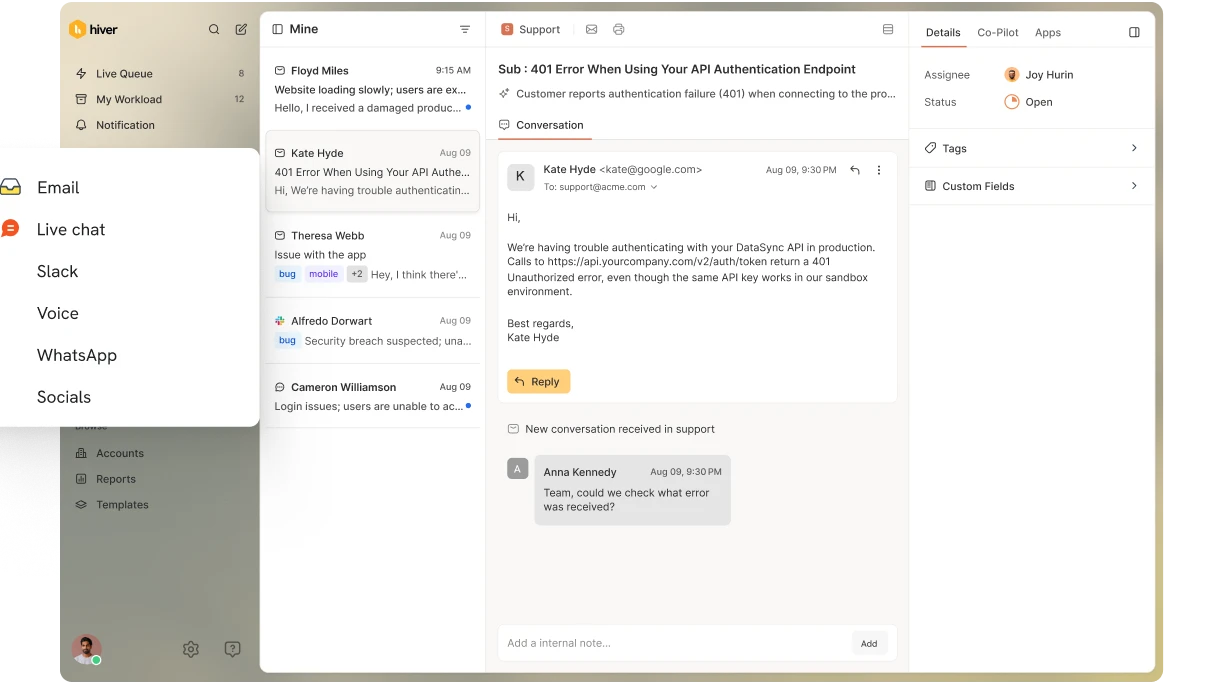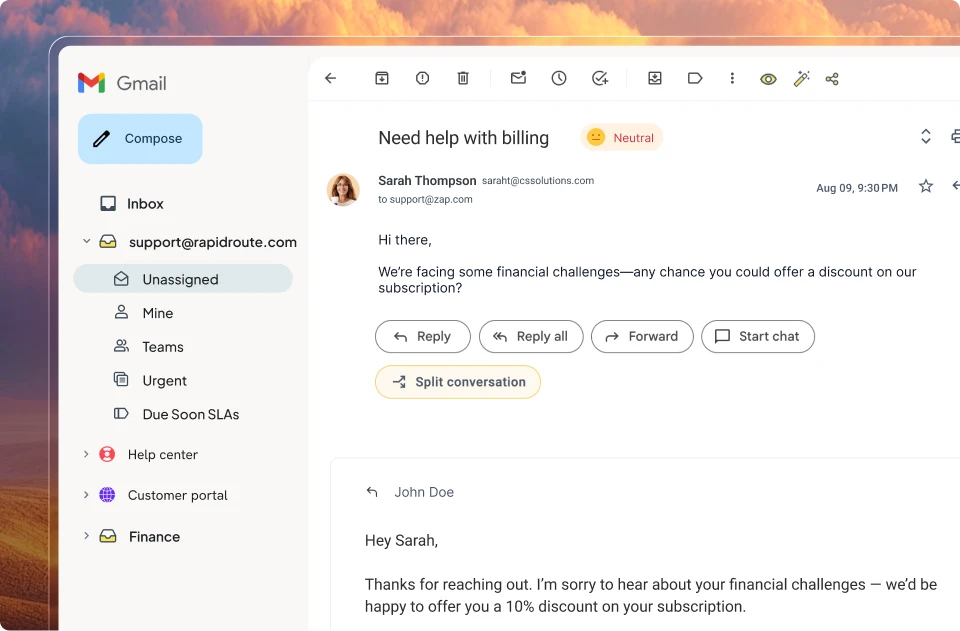





TL;DR
- A live chat widget is a small chat bubble that lets visitors message your team instantly
- It helps reduce friction, capture leads, and improve conversions in real time
- Set it up by creating a chat inbox, customizing the widget, and embedding a script on your site
- Compare tools like Hiver, Tawk.to, Tidio, LiveChat, and Olark based on features, pricing, and use case
- Chats are routed to the right agent or bot, with AI handling repetitive queries and humans stepping in when needed
I’ve lost count of the number of times I’ve visited a website, had a quick question, and left because there was no easy way to ask it.
Instead, I’d find a contact form and a message saying someone would reply “within 24 hours.” By that point, I’d usually move on.
Most visitors behave the same way. If getting help takes too long, they simply leave.
That’s why so many websites now use live chat widgets. A small chat bubble can turn a confused visitor into a customer simply by answering their question at the right moment.
In this guide, I’ll show you how to add a live chat widget to your website in minutes and which tools are actually worth using.
What is a Live Chat Widget?
A live chat widget is a small chat bubble that is embedded in the corner of a website. When a visitor clicks on it, they can instantly start a conversation with your team without any forms to fill or waiting for an email reply.
It gives customers a direct line to support in the exact moment they need help, whether that’s a quick product question, troubleshooting, or checking on an order.
A live-chat widget in action
Why Add Live Chat to Your Website?
Many website visitors leave simply because they can’t get a quick answer when they need it. Live chat solves that by letting customers ask questions instantly, right while they’re considering a purchase or exploring your product.
Here are some of the biggest reasons businesses add live chat widgets:
- Instant support that reduces friction: Visitors get answers in seconds, not hours, removing drop-off points and boosting conversions.
- Increased sales and revenue: Visitors who use live chat are 2.8x more likely to convert and spend up to 60% more per purchase because you help them overcome objections in real-time.
- Higher lead capture: Live chat lets you collect qualified leads at the exact moment they’re ready to engage, increasing website conversions.
- Valuable customer insights: Every chat gives you data: pain points, objections, and product feedback you can use to optimize your site.
- 24/7 coverage with chatbots: Automated replies handle FAQs, bookings, and common questions even when your team is offline, managing up to 80% of routine tasks and customer inquiries.
How to Add a Live Chat Widget to your Website in 5 Steps
If you’re not technical (like me), installing a live chat widget might feel intimidating. But I promise, it’s dead simple. In fact, most live chat widgets are incredibly simple to go live, even if you’re not a developer.
Since I work at Hiver, the best example I can walk you through is how to set up Hiver’s live chat widget. It’s one of the easiest implementations I’ve come across, and takes just 15 minutes.
Watch this video to learn how to set up Hiver’s live chat widget.
Step 1: Sign Up on Hiver
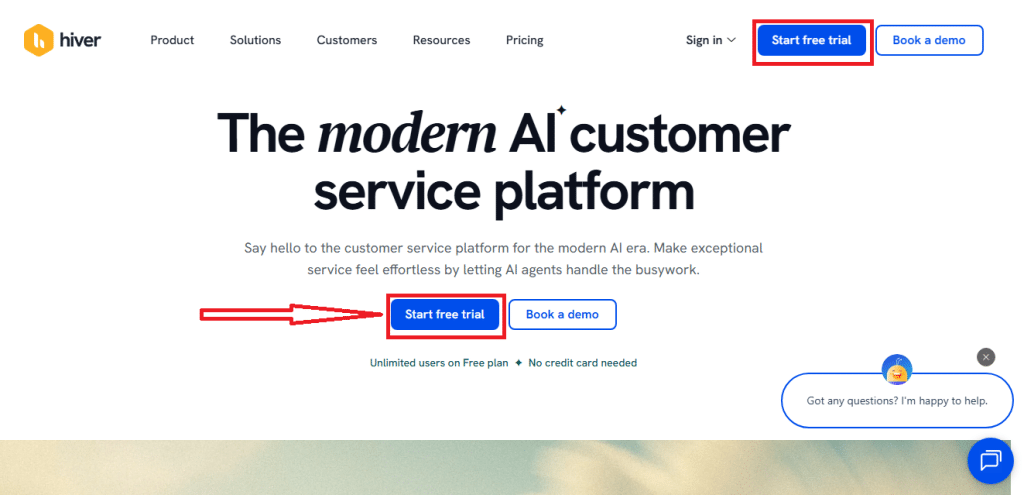
Go to the Hiver homepage and click Start free trial. Use the provided options to sign in using your personal or work email.

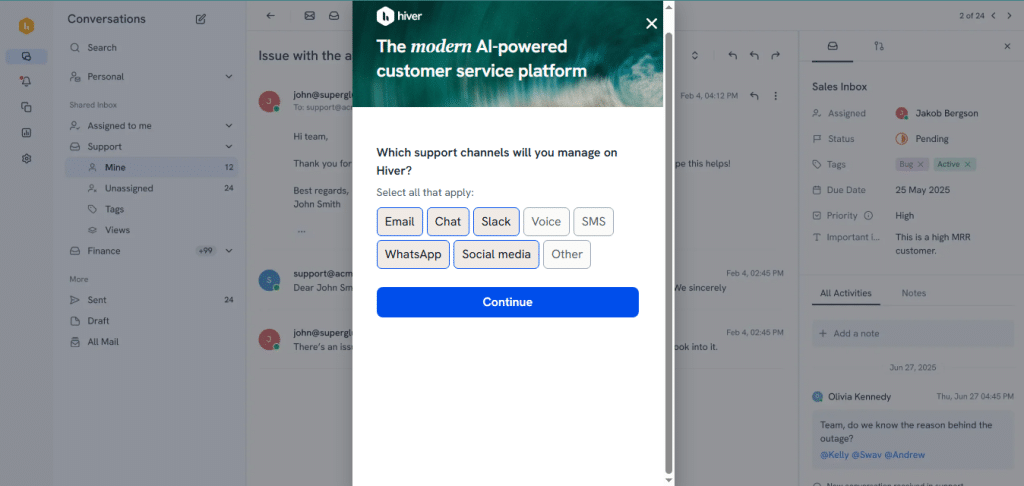
After submitting your email, proceed to authenticate your account. Hiver will then ask which channels you plan to manage. Select Chat along with any others your team uses. These selections help Hiver tailor your workspace.
Once your account is set up, open Hiver Settings and launch the Admin Panel to start configuring your chat inbox.
Step 2: Create a Chat Inbox for Your Website
In the Admin Panel, go to the Chat section and select Create Chat Inbox.
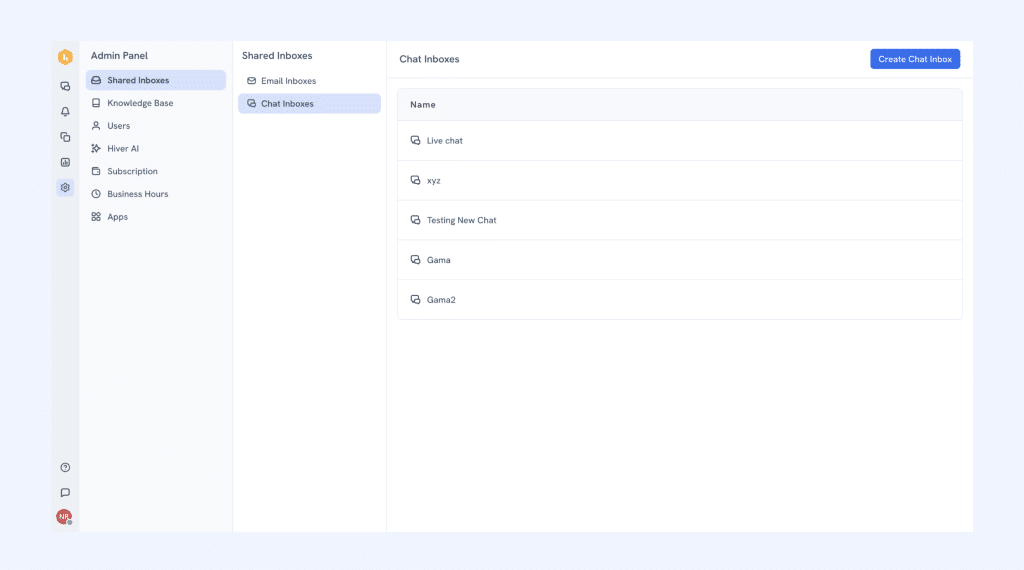
Give the inbox a clear name (e.g., “Live Chat” or “Website Chat”).
Add the team members who should handle incoming chats; at least one active user is required.
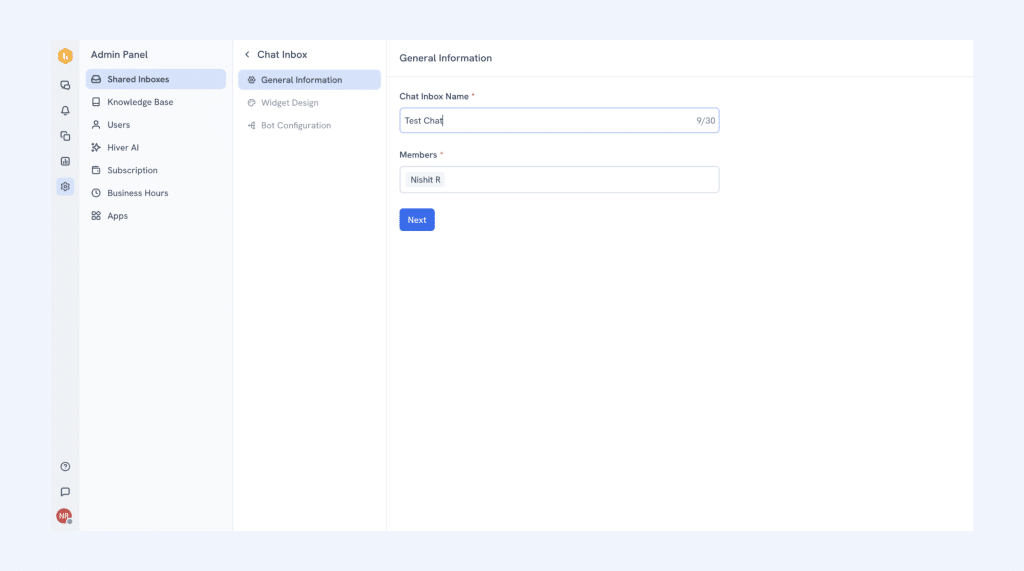
Click Next to save. The new chat inbox will now appear alongside your other inboxes and is ready for widget setup in the next steps.
Step 3: Customize Your Live Chat Widget

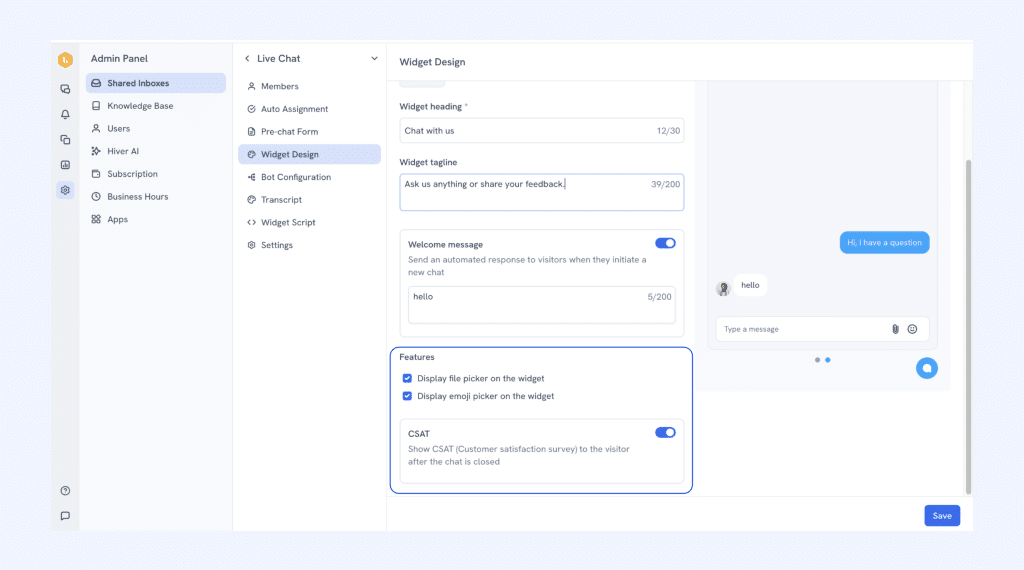
Next, select “Widget design” from the left menu to access design settings.
- Use the colour picker or add a hex code to match the widget to your brand; the live preview updates instantly.
- Edit the header text and optional subtext to create a short, friendly greeting for visitors.
- Update the default welcome message that appears when someone opens the chat window.
- You can even see a live preview for spacing, avatar placement, and message bubble style.
Click Save once you’re satisfied; the design is now ready for bot identity setup.
Step 4: Configure Your Bot Identity and Basic Behavior
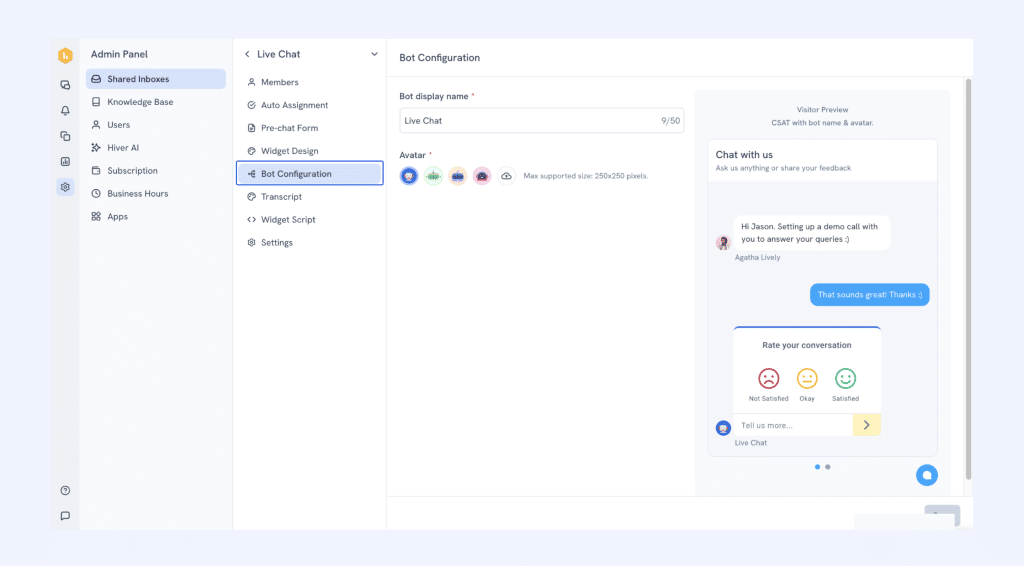
Next, select Bot configuration from the left menu.
- Set the bot name (e.g., “Support Bot” or “Help Desk Assistant”); it appears on all nudges and automated messages.
- Choose or upload a bot avatar (square image up to 250×250 px) to give your bot a clear, neutral identity.
Once identity and rules are set, you’re ready to move on to installation and advanced chatflow settings.
Step 5: Embed the Live Chat Widget on Your Website
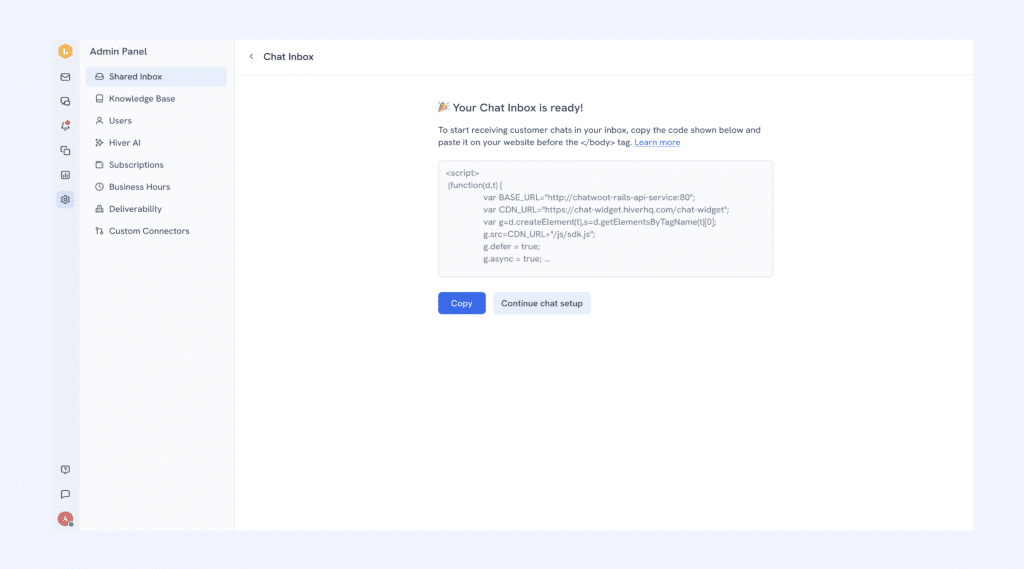
Open your chat inbox and you will see a widget script displayed on screen.
- Copy and paste the script into your website’s HTML before the closing </body>tag, or add it in your CMS/code editor.
- If using a tag manager, place the snippet inside a custom HTML tag and load it on all relevant pages.
- Refresh your site to confirm the widget is visible
Once this is done, your live chat is officially up and running.
You can always come back to the widget design screen later to enable features like file attachments, emoji picker, or CSAT.
(Bonus) Step 6: Build Advanced Chatbot Features
Once your widget is live, you can fine-tune how conversations begin and how you follow up.
Go to:
Settings → Shared Inboxes → Chat Inbox
Here are a few useful options to set up:
- Pre-chat form: Collect visitor details like name, email, or phone number before the chat starts. This helps your team personalize conversations and follow up later.
- Chat transcripts: You can automatically send a copy of the conversation to your team or the visitor after the chat ends. Useful for record-keeping and follow-ups.
- CSAT surveys: Get customer feedback once a chat is closed to understand how your team is performing.
- Chatflows: If you want more control, you can set up chatflows to guide conversations with automated messages or route visitors to the right team.
You don’t need to configure all of this right away. The basic setup gets you live. These options help you add structure as your volume grows.
10 Best Live Chat Widgets for Your Website in 2026
There are dozens of live chat tools out there, but most fall into two extremes. Either they’re free but limited, or powerful but expensive and complex to set up.
For this list, I’ve prioritized tools that are quick to implement, easy for teams to adopt, and flexible enough to scale.
That’s also why Hiver is #1 on this list. It’s one of the few tools that combines ease of setup, built-in automation, and a genuinely usable free plan, without forcing teams into complex configurations from day one.
| Tool | Key Features | Pricing | Best For |
| Hiver | -AI-powered automation-Smart assignment -Unified inbox for chat + other channels-CSAT + analytics | -Starts at $25/user/month-Free plan available | Mid-sized to enterprise teams who want to deploy agentic chat for resolutions |
| Tawk.to | -Real-time visitor monitoring-Basic helpdesk + KB-File sharing-Multilingual support | -Completely free-$39/mo to remove branding | Solo founders, early-stage teams, or businesses on a tight budget |
| Tidio | -AI agent (Lyro)-Behavior-based chat triggers-Prebuilt lead-gen flows-Live typing preview | -Free for 50 chats/mo-Paid plans start at $49.17/mo | Ecommerce teams looking to automate FAQs and boost conversions |
| LiveChat | -Product cards in chat-Pre-chat surveys-Goal tracking-CRM integrations | -Starts at $19/user/month-14-day free trial, but no free plan | Sales teams focused on lead gen and high-touch customer engagement |
| Zendesk | -Advanced automation & routing-Integrated help center & ticketing-Analytics & reporting-CRM + app integrations | -Starts at $19/agent/month-Free trial available, no free plan | Large teams needing a full customer support suite |
| Re:amaze | -Customizable live chat with proactive messaging and AI-powered responses.-Shared inbox for email, chat, social media, SMS, and voice.-Ecommerce integrations with Shopify, WooCommerce, and BigCommerce.-Built-in help center, chatbot automation, and ticket management. | -From $29/user/month -14-day free trial is available | Ecommerce businesses managing customer conversations across channels |
| LiveAgent | -Live chat with proactive invitations, visitor tracking, and typing preview.-Omnichannel inbox for email, chat, phone, and social media.-Built-in ticketing, knowledge base, and customer portal.-Automation rules, reporting, and AI-powered agent assistance. | -From $15/agent/month -All plans come with a 30-day free trial | Businesses looking for an affordable all-in-one help desk |
| Qualified | -AI SDR engagement via chat, voice, and video.-Proactive intent-based messaging -Automatic meeting scheduling and intelligent routing.-Native Salesforce integration | -Custom pricing -No free plan or self-service trial. | B2B sales teams converting website visitors into pipeline |
| Olark | -Accessible live chat designs -Proactive chat invitations and real-time visitor insights.-Unlimited AI conversations on live chat plans.-Reporting, team management, and customizable chat widgets. | -$400/month with additional user seats at $29/month-14-day free trial available | Organizations prioritizing accessible website chat |
| Intercom | -Fin AI Agent for natural conversations.-AI Copilot with reply suggestions and knowledge retrieval.-Shared inbox, ticketing, and workflow automation.-Help center, reporting, and omnichannel messaging. | -From $29/seat/month -Fin is billed separately at $0.99 per successful resolution.-14-day free trial available. | Growing businesses scaling AI-powered customer support |
1. Hiver
G2 Rating: ⭐ 4.6 out of 5
Hiver’s live chat widget is known for its ease of use and powerful agentic capabilities. There’s hardly any setup, and teams are up and running in as little as 15 minutes. But what makes it an extremely compelling option?
A few things, actually.
The chat widget offers powerful agentic capabilities. You can build AI Agents that can resolve complex customer requests by pulling info from docs, tools, and pastt tickets. You can define precise rules when it steps in and when it hands off to your team with full context..
Hiver’s paid plans start at $25 per user/month, with AI features built in. Compare that to tools like Intercom, where the AI agent (Fin) alone costs $0.99 per resolution, on top of seat pricing starting at $29/user/month. At just 3,000 automated resolutions a month, that’s nearly $3,000 in additional costs, before seats or add-ons.
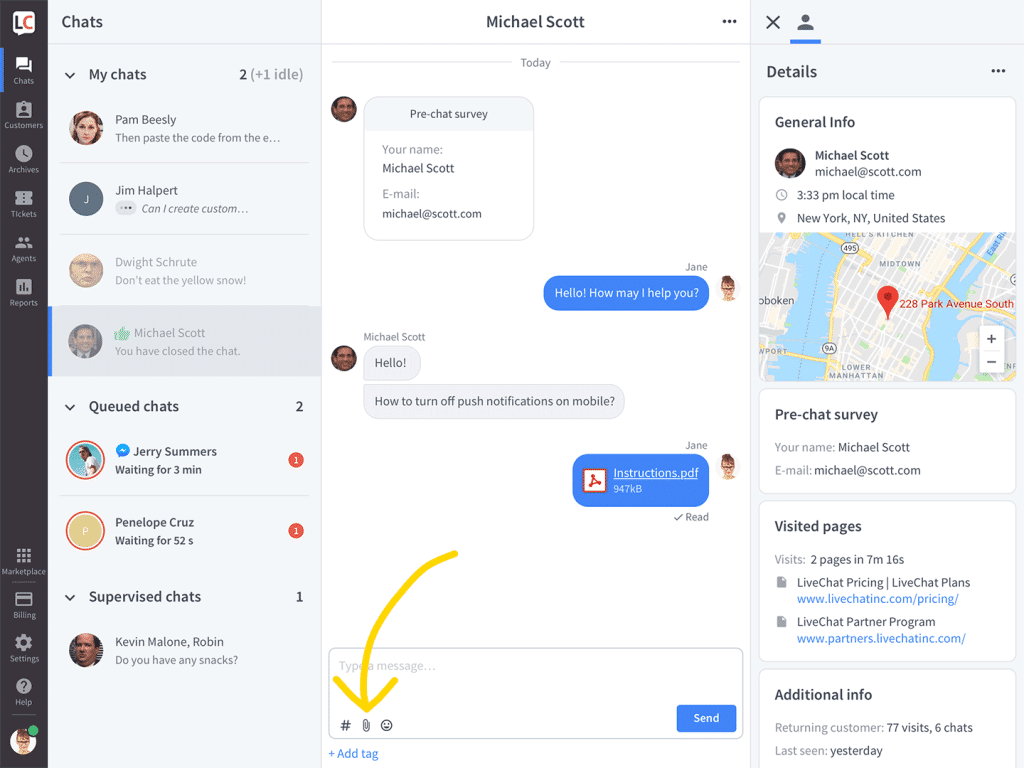
Get complete visibility on all customer chats, including who’s handling what in your shared inbox.
The real advantage, in my opinion, though, is what you get included in that price.
You can assign chats manually or automate routing based on rules. Every conversation shows clear ownership and status (open, pending, or closed), so nothing slips through the cracks.
Key features
- Smart chat routing to specific agents based on rules and AI. For instance, billing or finance-related queries like invoice issues or refund requests can be automatically routed to the finance team.
- AI suggested answers and canned chat replies
- AI Agents that resolve complex requests
- Built-in AI guardrails, observability and feedback loop
- Missed chats and escalation alerts
- Real-time data (response time, volume, and workload, CSAT scores)
- Widget customization and mobile support
Pricing
Hiver’s live chat feature is available as part of its forever-free plan, which also includes a shared inbox, knowledge base, WhatsApp support, and more. You can try these out without any commitment.
For additional features, like SLAs, advanced analytics or additional integrations, you can opt for our paid plans, which start at $25/user/month.
One thing to note is that Hiver offers 24/7 customer support across all plans. Also, we don’t charge a separate fee per channel (email, chat, WhatsApp). It’s all bundled into one plan, so you’re not constantly upgrading just to unlock essential features.
“The live chat inside our client portal makes it easy for customers to reach us in real time—and with chatbot workflows in place, a lot of common questions are handled automatically. It’s reduced our support load by about 20% during peak times.”
Werner Alsemgeest, Specialist Master, (CyberHunter)
“The biggest change with Hiver Live Chat is speed — chats land where we’re already working, so customers get an answer instantly without us juggling another system.”
William Ellick, IT & Support Manager, (fireco.)
“With Hiver, chatbots manage routine queries, and complex cases go straight to agents in real time. This improves productivity and ensures every request is resolved on time.”
Nelson Jay Dela Cruz, Deputy General Manager, (Group Miki)
2. Tawk.to
G2 Rating: ⭐ 4.5 out of 5
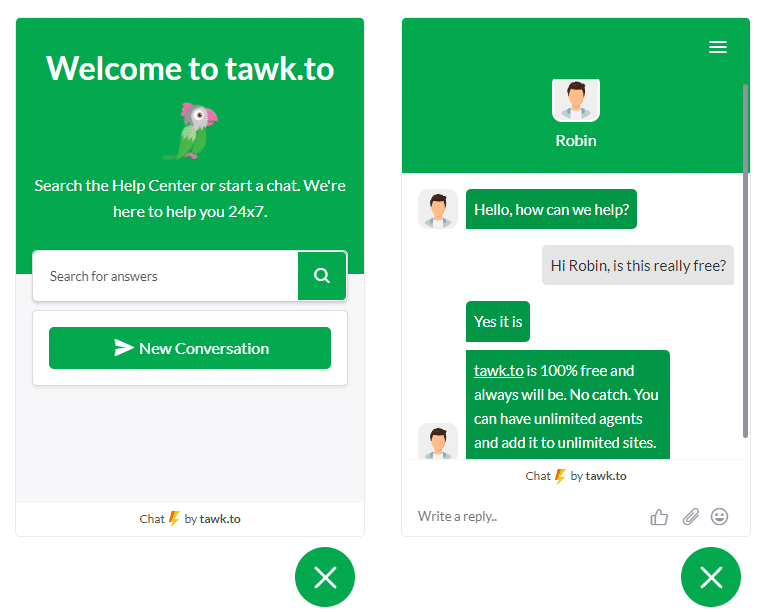
Tawk.to is a 100% free live chat software that lets you message your website visitors in real time. It’s built for businesses that want to offer instant support, without investing in a complex helpdesk or chatbot system.
Tawk.to also includes a built-in ticketing system, team messaging, and even a basic help center. If you’re just getting started with live chat, Tawk.to is a fantastic no-risk option.
While it covers the basics well, I think Tawk.to doesn’t scale gracefully. There’s no rule-based routing or AI to extract information and draft responses for you.
If your support volume is low, it works great as a starting point. But if you need automation, structured workflows, or better visibility into who’s handling what, you’ll likely need a more robust tool like Zendesk or LiveChat.
Key features:
- Real-time visitor tracking.
- Basic ticketing inside the dashboard.
- File sharing and simple team chat.
- Unlimited agents.
Pricing
Free forever. You get unlimited chats, unlimited agents, and full access to core tools like real-time monitoring, helpdesk, and basic customization without paying a cent.
But here’s the fine print: If you want to remove the “Powered by Tawk.to” branding, it costs $39/month per widget. If you want voice and video calling inside the widget, then that’s an add-on too.
What users like about Tawk.to
“What I like most about Tawk.to is how easy it is to use and how quickly it can be set up. As a user, I didn’t need much training before I could start handling chats confidently. The interface is straightforward, and managing multiple customer conversations at the same time feels smooth and well organized. I also appreciate that it’s a free tool while still offering solid features such as chat history, visitor monitoring, and basic reporting. Overall, it’s especially useful for real-time customer engagement and for resolving issues quickly as they come up.”
Where Tawk.to falls short
“Customization options are limited, and the design options for the chat widget are quite basic. The ticketing system only works with their knowledge base website and there is no option to import the data from your old knowledge base.”
Recommended reading
15 Best Live Chat Software for 2026
3. Tidio
G2 Rating: ⭐ 4.6 out of 5
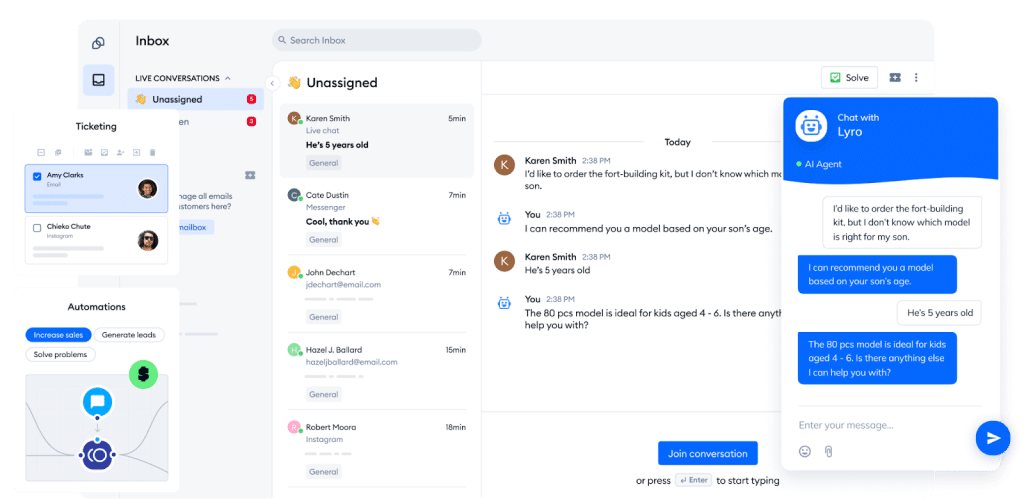
Tidio is built for teams needing fast, automated chat support. It combines live chat, a shared inbox, and AI-powered automation into one tool.
What sets Tidio apart is Lyro, their AI agent. Unlike basic chat tools, Lyro actively handles repetitive queries on its own while passing more complex conversations to human agents. This makes it a strong step up from simpler tools like Tawk.to, especially as your chat volume starts to grow.
That said, Tidio is still more chat-first than operations-first. From what I have seen, it works well for automating conversations, but may not be the best fit for teams managing multiple support channels or working with strict SLAs.
Also, its free and lower-tier plans come with basic analytics, limited customization, and no voice support.
As volume increases, its per-conversation pricing model can also become expensive.
At this stage, teams should start looking for more structured platforms like Hiver that offer stronger workflow control, better visibility across conversations, and predictable pricing.
Key features
- Automated replies with basic AI
- Prebuilt chatflows for lead capture
- Triggers based on visitor behaviour
- Live typing preview for fast responses
- Accessible via browser, desktop or mobile app
Pricing
Tidio charges based on the number of conversations, not agents. While this can seem affordable at first, costs can increase quickly as your chat volume grows. The platform offers a free tier for up to 50 conversations per month, with paid plans starting at $32.50/month. For example: a team handling 1,000 AI conversations per month would pay roughly $650/month, based on the standard per-conversation pricing model.
What users like about Tidio
“I’ve been using Tidio for the past three years. Before that, we tried a few other chatbots, but switched to Tidio for its reliability. The Lyro AI agent has been especially useful—it handles customer queries with relevant responses when our team is unavailable.”
Where Tidio falls short
“Some of the more advanced automation features are locked behind higher-tier plans, which can feel a bit limiting when you’re just starting out. I also found the analytics a little basic, more detailed reporting or user journey tracking would be helpful. Lastly, while the interface is clean, navigating between chats and settings isn’t always as smooth as it could be.”
4. LiveChat
G2 Rating: ⭐ 4.5 out of 5
LiveChat is built for teams that want a chat tool that’s easy to manage and gives them clear visibility into conversations.
Its strength is how well it supports agents during real-time chats. You can see what a customer/prospect is typing before they send it (message sneak-peek), tag and organize conversations, route chats to the right agent, and track response times and performance through built-in reports.
It also includes AI features like suggested replies, summaries, and auto-tagging to speed up responses and reduce manual work, without taking over conversations entirely.
Compared to Tidio, which focuses more on AI automation, LiveChat is built around helping agents respond faster and stay in control.
I’d go with LiveChat if your priority is to manage chats cleanly and keep a close eye on performance, without relying heavily on automation.
LiveChat’s strength is also its limitation: it’s chat-first, not support-suite-first. It doesn’t include email ticketing, knowledge base, or VoIP out of the box. You need to subscribe to separate products for these functionalities.
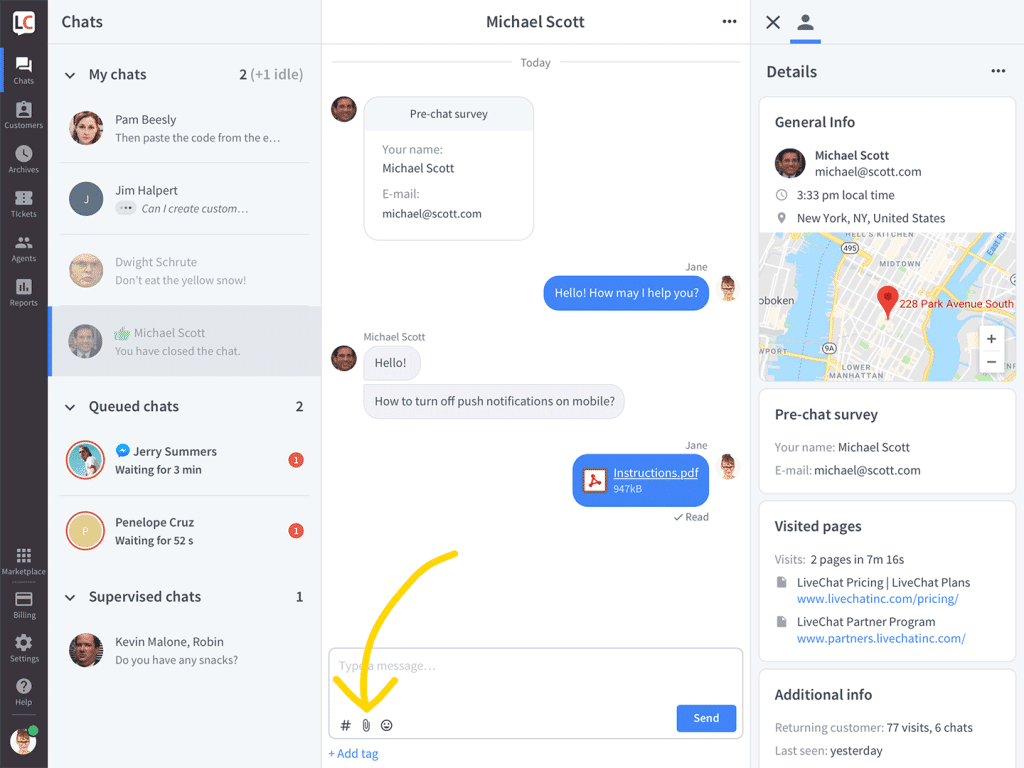
Key features
- AI ChatBot to handle customer queries
- Product cards inside the chat window
- Lead forms before chat starts
- Goal tracking for checkouts or demos
- CRM integrations
Pricing
LiveChat’s pricing starts at $19/user/month. But once you dig in, you’ll know that most of the useful features are locked behind higher-tier plans.
Also, if you want capabilities like ticketing or knowledge base support, you’ll need to purchase separate tools from the same company, like HelpDesk or ChatBot, on top of your base plan.
What users like about LiveChat
“We’ve been using LiveChat to support two websites for nearly nine years, and it’s been a highly valuable tool. Even in a technical support environment, it works well for handling queries in real time. The canned responses save a lot of time and are especially helpful for onboarding new agents who don’t yet have all the answers.”
Where LiveChat falls short
“The system was buggy at times, calls would drop frequently, and issues showed up across different environments. Given the cost, it’s hard to justify choosing this over some free alternatives.”
5. Zendesk
G2 Rating: ⭐ 4.3 out of 5

Zendesk’s live chat (Messaging) is part of its larger customer support system, not a standalone tool. It lets customers start conversations on your website, app, or social channels, and continue them even if they switch channels—without losing context.
The strength here is depth. You get features like AI agents that can handle FAQs and route issues, skills-based routing, SLAs, and a unified workspace where agents can manage conversations, customer context, and internal collaboration in one place.
It also goes beyond basic automation. Zendesk’s AI can resolve a large share of queries end-to-end, assist agents with replies and summaries, and improve over time.
Alongside this, you get advanced reporting, custom workflows, and deep configuration options to manage more complex support operations.
I’d recommend Zendesk if you’re handling high ticket volume across multiple channels and need tight control over workflows, SLAs, and performance.
Compared to tools like Hiver, which are quicker to set up and have more predictable pricing, Zendesk can become expensive and harder to manage as you scale. It usually only makes sense if you’re operating at a larger scale.
Key features
- AI agents that can resolve FAQs and automate queries end-to-end
- Skills-based routing and SLA tracking
- Unified workspace with full customer context and internal notes
- Custom workflows, triggers, and automation rules
Pricing
Zendesk starts at $19/agent/month for basic ticketing, but most teams need higher tiers to unlock messaging, automation, and AI. Plans with full capabilities typically range from $55 to $115/agent/month, with additional costs for add-ons like Copilot and advanced AI features.
What users like about Zendesk
“I still really appreciate having cross channel support with email, calls, and chats all in one central platform. One thing I’ve continued to value is how easy it is to review a customer’s full ticket history, which helps provide better context and continuity when assisting them.”
Where Zendesk falls short
“Since we moved from Chat to Messaging, CS CSAT has massively dropped… after the bot transfers to an agent, there is a ‘dead’ time of a few minutes. During that time, the end user is unable to speak with anyone, the bot does not reply, and they can basically be speaking with themselves.”
Recommended reading
11 Features To Look For in a Chatbot in 2026
6. Re:amaze
G2 Rating: ⭐ 4.6 out of 5
Re:amaze is a customer messaging platform built with ecommerce businesses in mind. Its live chat widget is quick to install, easy to customize, and lets businesses support customers directly from their website.
Beyond real-time text messages, the widget also supports native in-chat video calls, chat campaigns, and a self-service FAQ page. Status pages also appear per chat such that if a query can’t be resolved immediately, agents can seamlessly convert chats into support tickets for follow-up, ensuring nothing falls through the cracks.
And apart from live chat, Re:amaze also combines email, social media, SMS, voice, and messaging apps into a shared inbox, giving teams a complete view of every customer interaction. It also integrates deeply with ecommerce platforms like Shopify, BigCommerce, and WooCommerce, allowing agents to view order details, issue refunds, or check shipping information without leaving the conversation.
But while an excellent fit for online stores and growing ecommerce brands, businesses looking for a standalone live chat tool might find it too cumbersome.
Key Features
- Customizable live chat with proactive messaging and AI-powered responses.
- Shared inbox for email, chat, social media, SMS, and voice.
- Ecommerce integrations with Shopify, WooCommerce, and BigCommerce.
- Built-in help center, chatbot automation, and ticket management.
Pricing
Re offers three paid plans starting at $29 per user/month (you can save 10% with annual billing). A 14-day free trial is available, but there is no permanent free plan.
What Users like Abour Re:amaze
“We like that we can wrap in all of our sales channels for all of our ecommerce stores serving different markets and all of our sales channels while separating access into individual business units. Pricing is only per user which makes it easy to understand and predict our upcoming billable.”
Where Re:amaze falls short
“The settings screen is painful to navigate. It needs a refresh to be simpler and more intuitive to navigate. Setting the tool up is also not easy. I wouldn’t say it is hard, but it takes more time that if it was better designed.”
7. LiveAgent
G2 Rating: ⭐ 4.5 out of 5
LiveAgent markets itself as the fastest live chat software on the market, with chat widgets that can be installed in minutes using a simple code snippet. The widget is highly customizable and includes useful features like real-time typing preview, proactive chat invitations, visitor tracking, and embedded contact forms.
It’s a great fit for businesses that want more than just website chat, especially growing support teams looking for an affordable, all-in-one customer service platform.
Apart from chat widget setup, LiveAgent brings together email, phone, social media, contact forms, and customer portals in a single help desk. Every conversation automatically becomes a ticket, making it easy for agents to switch between channels without losing context.
The platform also includes a built-in knowledge base, automation rules, call center functionality, and AI tools to help teams handle higher support volumes more efficiently. While the interface isn’t the most modern compared to newer competitors, LiveAgent offers one of the most comprehensive feature sets for its price.
Key Features
- Live chat with proactive invitations, visitor tracking, and typing preview.
- Omnichannel inbox for email, chat, phone, and social media.
- Built-in ticketing, knowledge base, and customer portal.
- Automation rules, reporting, and AI-powered agent assistance.
Pricing
Paid plans start at $15 per agent/month (billed annually), with higher tiers adding features like call center support, SLA management, and advanced reporting for higher costs. All plans come with a 30-day free trial.
What Users like About LiveAgent
“LiveAgent facilitated communication between all departments involved in customer service. I appreciated how it streamlined real-time request receipt and immediate responses. LiveAgent provided a single dashboard that displayed everything, significantly reducing response times. It’s great that LiveAgent is constantly updated with new features that enhance service efficiency. I appreciated LiveAgent’s efficiency in storing and readily accessible data related to all tickets and chats. The mobile app is excellent and consistently effective, simplifying the handling of any number of tickets and seamlessly navigating between conversations.”
Where LiveAgent falls short
“UX is a bit disappointing and not up to industry standard. Also the tool is a jack of all trades, but master of none in our experience.”
8. Qualified
G2 Rating: ⭐ 5 out of 5
Qualified is built for B2B companies that want to turn website visitors into qualified pipeline. Its live chat widget goes beyond answering questions by proactively engaging visitors based on factors like company, buying intent, and page activity.
AI SDR agent Piper can start conversations through chat, voice, or video, qualify prospects, answer questions, and book meetings automatically. The widget integrates closely with Salesforce, making it particularly well suited for revenue teams already using the CRM.
Rather than functioning as a traditional help desk, Qualified focuses on accelerating the sales process. The platform combines AI-powered conversations with account identification, intelligent routing, meeting scheduling, and analytics to help sales teams engage high-value buyers at the right moment.
While it’s an excellent fit for enterprise B2B organizations, businesses looking for a customer support-first live chat solution may find other tools better aligned with their needs.
Key Features
- AI SDR engages visitors through chat, voice, and video.
- Proactive messaging based on buyer intent and account data.
- Automatic meeting scheduling and intelligent routing.
- Native Salesforce integration with conversation analytics.
Pricing
Qualified doesn’t publish fixed pricing. Plans are customized based on your business requirements, with Premier, Enterprise, and Ultimate packages available through its sales team.
What Users like About Qualified
“What I like best about Qualified is how quickly it delivered measurable business value while still being easy to manage. The implementation team was highly engaged, responsive, and collaborative throughout the rollout. Piper (Lena) has significantly increased visitor engagement, booked more qualified meetings, and improved the experience for prospects with fast, personalized conversations. From a Revenue Operations perspective, I also appreciate the tight Salesforce integration, flexible routing, robust reporting, and the ability to continuously refine conversations without heavy technical work. It has become a scalable extension of our inbound sales process and has exceeded our expectations in both performance and ease of administration.”
Where Qualified falls short
“The platform can be quite complex and difficult to navigate and edit unless you put a lot of time into learning it and/or you have a great rep to help you.”
9. Olark
G2 Rating: ⭐ 4.3 out of 5
Olark is a simple live chat solution with a strong focus on accessibility. Its chat widget is independently certified to meet WCAG 2.1 AA standards, making it one of the best options for organizations that need to support visitors with disabilities.
Setup takes just a few minutes, and businesses can customize the widget, trigger proactive chat invitations, and monitor visitor activity in real time. It’s particularly well suited for small businesses, educational institutions, and public sector organizations where ease of use and accessibility are top priorities.
The platform also includes reporting, targeted chat campaigns, team management, and AI-powered automation for handling common visitor questions.
Unlike larger customer support suites, Olark keeps its feature set intentionally focused, making it easier to manage without unnecessary complexity. However, businesses looking for a full omnichannel help desk or extensive ticketing capabilities may find it less comprehensive than all-in-one customer service platforms.
Key Features
- WCAG 2.1 AA-certified live chat for accessible customer conversations.
- Proactive chat invitations and real-time visitor insights.
- AI chatbots with unlimited AI conversations on AI plans.
- Reporting, team management, and customizable chat widgets.
Pricing
Olark’s standard AI website agent costs $400/month if billed annually, with unlimited AI conversations and one human agent seat included in the plan. Additional seats priced separately at $29/month and all plans come with a 14 day free trial.
What Users like About Olark
“I really like just how simple and easy it was to pick up and use. We didn’t have to have a long training on how to use the software, you just start using it. I also like how you could create custom responses in the software to make things easy.”
Where Olark falls short
“The monthly subscription fee can make someone stop using Olark especially for small startups like ours. I wish they can have have a free package so that people who cannot afford the monthly subscription fee can still benefit from one of the best chat apps for a website.”
10. Intercom
G2 Rating: ⭐ 4.5 out of 5
Intercom’s live chat widget is powered by Fin AI Agent, one of the most capable AI customer agents available today.
Instead of simply answering FAQs, Fin understands customer intent, carries on natural conversations, resolves complex issues, and knows when to hand the conversation over to a human agent. It also supports proactive messaging and works across chat, email, and other channels, making it a strong choice for fast-growing businesses that want to scale customer support without sacrificing service quality.
The Intercom platform also extends far beyond live chat. It combines a shared inbox, ticketing, AI Copilot for agents, workflow automation, help center, and reporting into a single customer service platform.
As support volumes grow, teams can rely on Fin to resolve routine and increasingly complex conversations while agents focus on high-value interactions. This balance of AI automation and human support makes Intercom particularly well suited for scaling support operations.
Key Features
- Fin AI Agent for natural, human-like customer conversations.
- AI Copilot with reply suggestions and knowledge retrieval.
- Shared inbox, ticketing, and workflow automation.
- Help center, reporting, and omnichannel messaging.
Pricing
Intercom’s Helpdesk plans start at $29 per seat/month, while Fin AI Agent is charged separately at $0.99 per successful outcome. A 14-day free trial is available.
What Users like About Intercom
“I like Fin’s efficiency as it makes some customers happy to receive a quick answer. I enjoy working hand in hand with AI, as it takes off a lot of load that can be quickly resolved and lets the team focus on the complicated interactions. The setup was super easy, and I was very surprised by how quick it is to get Fin on board and set up to work with us.”
Where Intercom falls short
“Setting up the workflows can be tricky; there is a lot of flexibility but also a bit of nuance that isn’t always clear. It requires a good amount of trial-and-error in order to feel comfortable with a version that can be customer facing.”
How a Live Chat Widget Works
Here’s a quick visual representation of how a live chat widget works in the front end (for the website visitor):
How a live chat works on your website
Here’s what’s happening behind the scenes when someone opens your chat widget:
- A visitor clicks the chat bubble, and your widget loads instantly on the page.
- The chatflow kicks in. Either a bot greets them, or the widget waits for the visitor to start the conversation.
- Messages appear in your inbox in real time, so agents can jump in without switching tabs or tools.
- Routing rules (or AI) decide who should take the chat based on workload, topic, or priority.
- Agents reply instantly, and the visitor sees responses right inside the widget, just like a messaging app.
- If needed, the chat hands off to another teammate, without the customer losing context or having to repeat anything.
Recommended reading
What is a Chatbot How Does it Work? 2025 Guide
Must-Have Features in a Live Chat Widget
If you want a chat widget that actually helps your team work fast (and keeps customers happy), features like smart routing, flexible customization, automated responses, and self-service options are non-negotiable.
Here’s a detailed list of essential features:
1. Real-time replies
The whole point of live chat is speed. Make sure the widget lets you (or a bot) reply instantly. There shouldn’t be any lag. Otherwise, it quickly becomes a liability. As one Reddit user put it, “A chat widget that sits there unanswered for hours is worse than no chat at all.”
2. Chatbot + human handoff
One of the major reasons websites don’t use chat, according to a Reddit user, is: “If I’m in the help chat, it’s because I want to speak to a human being for an exception-to-the-rule issue.”
In such scenarios, the ability to quickly hand off to a human becomes critical. Some questions can be handled by a bot, but others need human intervention. A good widget knows when to make that switch without making the customer repeat themselves.
3. Smart routing
Your sales team shouldn’t see refund queries, and your support team shouldn’t get pricing questions. Look for tools that assign chats to the right people automatically.
4. Easy customization
You should be able to customize the widget based on your brand colours, add a logo, and tweak the welcome message. It should feel like your business and not a third-party plugin.
5. Mobile-Friendly
You’d have people visiting your website from their phones. If the chat box is clunky on mobile, you’re going to lose leads. Test it before you commit.
6. AI suggestions
Some tools offer AI copilots that suggest replies from your knowledge base. That means your team doesn’t have to dig for answers; AI can fetch them in real-time.
For smaller teams, this is often what makes live chat manageable at scale. In aReddit discussion on when teams added live chat widgets, one business owner shared:
7. CSAT surveys
Once the chat ends, you should be able to ask: “How did we do?” A good widget makes it easy to collect feedback while the experience is still fresh.
8. Chat analytics:
You need to know what’s working. Look for tools that show chat volume, response time, missed chats, and satisfaction scores.
9. Integrations
A live chat widget on its own is just a conversation layer. But once you connect it to your CRM, helpdesk, or ecommerce tools, it becomes far more useful. Your team can see order history, access past conversations, or create tickets without switching tabs. Instead of asking customers for the same details again, they can resolve queries faster with full context.
Here’s how different integrations work:
| Integration Type | Why it matters | Example tools |
| CRM | Gives agents full customer context (history, deals, lifecycle stage) so conversations aren’t starting from scratch | Salesforce, HubSpot |
| Ecommerce | Lets teams check orders, process refunds, or update details directly from chat | Shopify, WooCommerce |
| Helpdesk / Ticketing | Converts chats into trackable tickets and ensures follow-ups don’t get lost | Zendesk, Freshdesk |
| Knowledge Base | Enables quick answers and powers bots to resolve common queries instantly | Notion, Confluence, HelpDocs |
| Collaboration | Allows teams to loop in others, share context, and resolve issues faster internally | Slack, Microsoft Teams |
| Analytics & Reporting | Tracks performance metrics like response time, CSAT, and volume trends | Google Analytics, Looker |
Recommended reading
Compare your CSAT score with industry benchmarks
Mistakes to Avoid While Setting Up Live Chat
I’ve seen businesses add a chat widget to their site and expect magic. But without the right settings, context, or workflows, it can create more confusion for your team and your customers.
In this section, I’ll break down the most common mistakes, like poorly timed triggers, missed chats, generic responses, and how to avoid them. Whether you’re just getting started or optimizing an existing setup, these tips will help you get more value out of your live chat tool.
❌ Mistake #1: Triggering the chat widget too early (or too often)
When a chat pops up the moment a visitor comes to your site, it is an example of bad customer experience. This kind of aggressive timing does more harm than good. It feels pushy, interrupts the browsing experience, and often leads to visitors closing the chat without reading the message.
Solution: Use behavior-based nudges to show it only when the visitor seems genuinely interested or stuck.
For example:
- If a visitor is idle on the checkout page for 30 seconds, trigger: “Need help completing your order?”
- If someone visits the pricing page more than once, nudge them with: “Can I help you compare plans?”
- On the contact page, wait until they scroll past the form, then ask: “Looking for something else?”
❌ Mistake #2: Forgetting to set expectations when no one’s online
This happens more often than you’d think. A visitor lands on your site late at night, sees the chat widget, and types a question, thinking someone’s there to help. But no one responds. If your live chat is active 24/7 but your team isn’t, you’re creating a false promise of real-time support.
Solution: Always assume your chat widget will be clicked, even during off-hours. The fix is simple but powerful:
- Set an away status with a message like “We’re currently offline, but we’ll get back to you by tomorrow morning.”
- Or, trigger an auto-reply with the expected response time or an alternative way to reach support.
- You can also switch to a contact form or email capture after hours, so you don’t lose the lead.
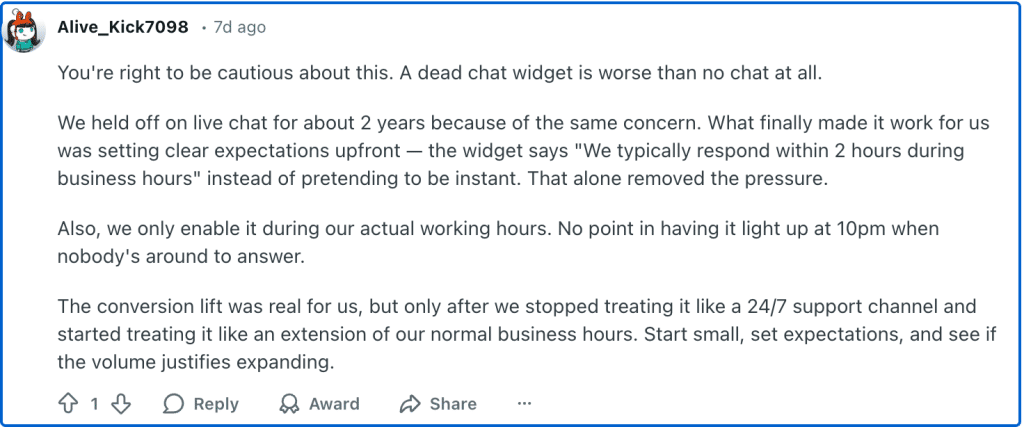
As one business owner put it in a Reddit thread: a dead chat widget is worse than no chat. To tackle this, they set clear expectations and only run it during business hours to actually see results.
❌ Mistake #3: Skipping mobile optimization
I’ve seen way too many websites where the chat bubble covers the “Buy Now” button or stacks awkwardly over a pop-up offer. This way, visitors end up rage-tapping until they leave.
The problem is simple: most live chat tools are designed with desktops in mind, but more than half of your visitors are likely on their phones.
Solution: Don’t assume “responsive” means optimized. Here’s what to check for:
- Does the widget cover CTAs, like “Add to Cart” or “Contact Us”?
- Is the dismiss or close button easy to tap?
- Does it play nicely with other overlays like pop-ups or banners?
- Is the text readable without zooming?
Recommended reading
Live Chat Best Practices: The Ultimate List of Dos and Don’ts
❌ Mistake #4: Not tracking chat analytics
If you’re not reviewing the data, you’re guessing. This leads to wasted time, missed revenue, and poor support quality. You won’t know:
- Which agents are overwhelmed
- Why certain chats go unanswered
- If your proactive messages are converting
- Or what questions keep coming up again and again
Also, being able to see what questions visitors ask but don’t convert on can be incredibly valuable. As one Reddit user pointed out,“that’s basically free insight into what visitors care about.”
Solution:
Regularly check:
- Missed chats – Where are you losing conversations, and why?
- First response time – Are visitors waiting too long to hear back?
- CSAT scores – What’s the quality of your conversations?
- Conversion rate from chat – Are chats helping people take the next step, like buying, booking, or signing up?
Set Up Your Live Chat Widget Right
Most tools today make installation dead simple: paste a code snippet, maybe tweak some colors, and it’s live. But what actually sets your widget apart from others is how you set it up after that.
Here’s a quick rundown of what I’d do if I were setting up live chat from scratch:
- Customize the greeting on high-intent pages like pricing or checkout.
- Set clear offline hours so people aren’t expecting replies at 2 AM.
- Route chats smartly and do not dump everything on one agent.
- Trigger nudges only when visitors seem stuck or hesitant.
- And definitely: track what’s working. If you don’t look at missed chats or CSAT scores, you’re flying blind.
Whatever chat widget you choose, the goal is the same: make chat helpful, personal, and low-friction.
If you want a live chat widget that’s quick to set up and is packed with some really good automations, try Hiver. You’ll get real-time analytics, AI-powered chat support, and full visibility of what your team is working on, all in one place.
Try Hiver for free or schedule a free demo.
Frequently Asked Questions
1. What is a live chat widget?
A live chat widget is a small interactive box typically embedded on a website that allows visitors to chat with support or sales teams in real time.
2. How does a live chat widget work?
It connects website visitors to your support or sales team instantly via a chat interface. Agents receive messages on their dashboard or helpdesk and can reply in real-time or set up automated responses.
3. Why should I add a live chat widget to my website?
Live chat widgets improve customer support, boost engagement, reduce bounce rates, and increase conversions by offering instant help when users need it.
4. Where should I place a live chat widget on my website?
Most websites place the widget at the bottom-right corner of the page, where it’s visible but not intrusive. It should be easily accessible on all key pages, like product, pricing, and support pages.
5. Can a live chat widget be automated?
Yes, most live chat widgets support automation through chatbots, canned responses, or workflows to answer common questions instantly and route complex queries to agents.
6. Are live chat widgets secure?
Yes, most modern live chat tools use encryption and comply with data privacy standards like GDPR. Always check the provider’s security certifications and privacy practices.