






Gorgias made a name for itself as the go-to customer support platform for Shopify merchants. With tight ecommerce integrations and built-in order management, it quickly became a default choice for online stores.
But as customer expectations have grown, Gorgias hasn’t kept up.
The reality is that Shopify Integration is now a basic part of customer service software.
What used to be a differentiator is now a standard feature. And while other platforms have evolved, Gorgias users are stuck with limited reporting, an expensive ticket-based pricing model, and a slow support team.
But here’s the good news: We battle-tested some of the best Gorgias alternatives on the market, which offer everything the platform does—plus the scalability, flexibility, and support quality that modern ecommerce teams need.
In this guide we’ll explore these options and help you pick the right Gorgias alternative for your team.
Table of Contents
- Why Look for a Gorgias Alternative?
- What users say about Gorgias
- Gorgias Alternatives & Competitors (Based on User Reviews)
- 1. Hiver: Best for E-commerce teams that want multichannel support with AI-powered automation
- 2. Zendesk: Best for Enterprise ecommerce businesses that need robust reporting and advanced customization
- 3. Front: Best for teams needing advanced collaboration and workflow automation
- 4. HappyFox: Best for multi-department support teams needing a support tool beyond e-commerce
- 5. Help Scout: Best for small to medium teams with low ticket volume
- 6. Kustomer: For enterprise teams needing CRM integrated customer support
- 7. Tidio: Best for teams prioritizing automation and superior chatbot capabilities
- 8. Re:amaze: Best for mid-sized teams seeking multichannel support with chatbot
- 9. Gladly: Best for teams that want conversation-driven customer support.
- 10. Richpanel: Best for Multi-brand ecommerce merchants who want strong self-service tools.
- Why Hiver is the Best Gorgias Alternative
- Frequently asked questions
- Start using Hiver today
Why Look for a Gorgias Alternative?
As an official Shopify partner, Gorgias is high on the recommendation list for e-commerce stores.
However, users (including me) have realised that it comes with limitations that can soon turn into roadblocks, especially as your store scales.
Here’s my personal experience connecting my Shopify store to Gorgias:
And here are some drawbacks I found while test-driving the platform:
- I noticed that the SLA customization could be more in-depth. I wasn’t able to add tags, set specific business hours, or apply SLAs to different types of conversations.
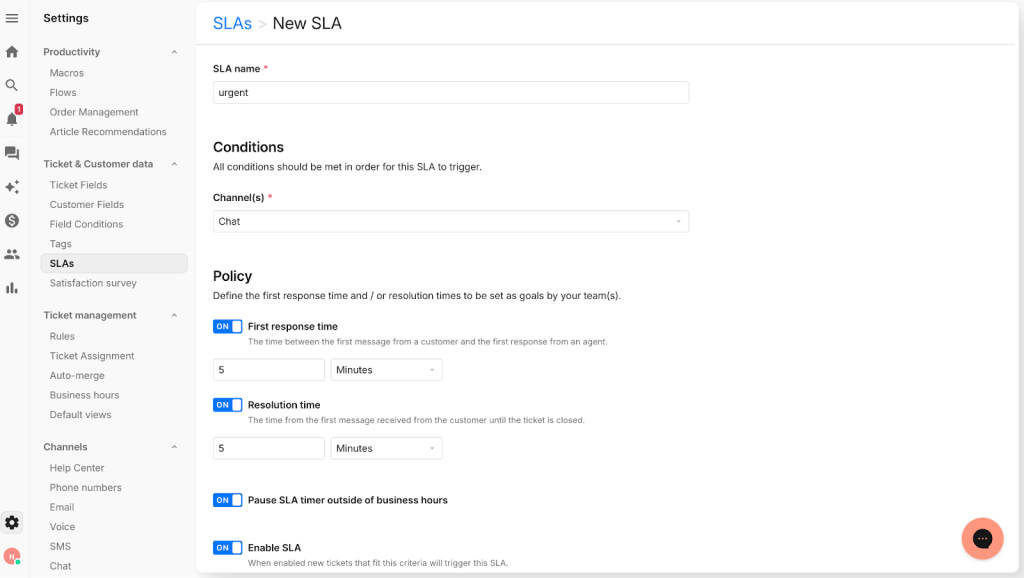
Gorgias SLA customization
- The collaboration features are pretty bare bones. I could not find common features such as collision detection, shared drafts, or even approvals, when replying to customer inquiries. Though internal notes and mentions exist, they don’t go far enough to support real team collaboration.
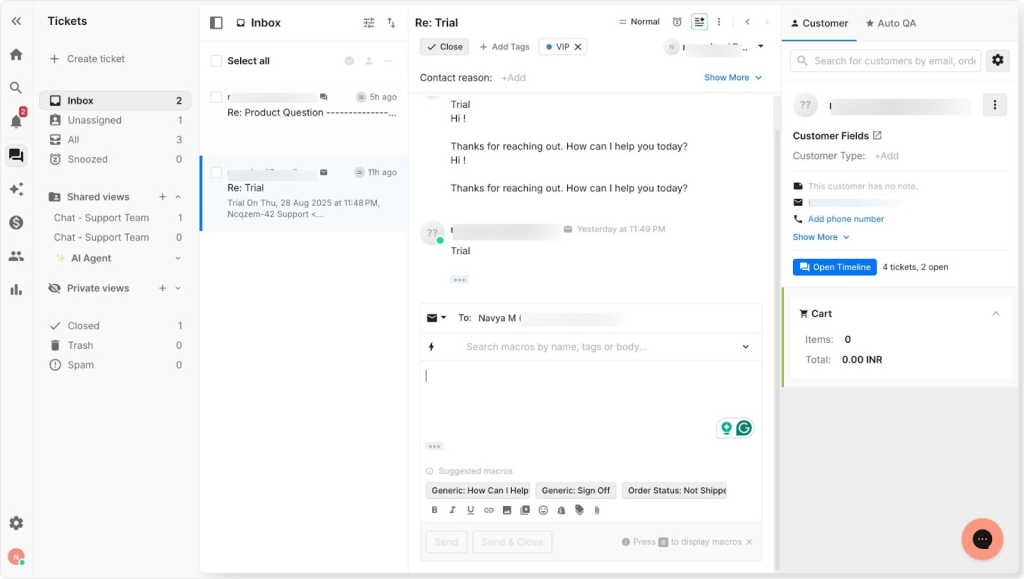
Lack of collaboration features in Gorgias
- I noticed some missing features in the reporting section. Export options are limited to CSVs, and analytics are displayed only as heatmaps or tables. I also checked out their help center, which suggested more chart variations are “in progress,” but they aren’t available yet.

Gorgias’ lack of customization with reports
What users say about Gorgias
Setting aside my personal experience, these were the most common issues Gorgias users highlighted.
- Most of the reviews were around Gorgias’s pricing. The ticket-based model is expensive to start with, and is also heavy on the pocket as your team scales.
“Several glitches need to be fixed. The add-on charges when you exceed the ticket limits are also kind of expensive”
“It’s priced too high compared to the rest of the market and it’s support is not helpful. We’ve been on another platform that actually treats us as a partner”
2. While the basics are easy to figure out, many users faced the same issue that I did. To truly use the platform, there’s a significant learning curve at hand:
“Learning curve is hard, and even after you get the basic hang of it, there is still a lot of raw power going unharnessed that would take expert knowledge/coding”
“Gorgias is a powerful software, but it takes time to learn how to use it effectively. We have to invest time and resources into training and onboarding to get the most out of it”
3. Several users echoed my concern about reporting limitations, while others noted that the Shopify-focused features fall short for those using different platforms:
“Reporting functionality is still in its infancy, and integrations seem limited compared to other helpdesk options out there”
“The platform could be great, but it is in a constant state of flux, and half the features don’t work for BigCommerce sites. The system is full of bugs and inconsistencies. The system is geared specifically to Shopify”.
Gorgias Alternatives & Competitors (Based on User Reviews)
Now that we’ve got the limitations out of the way, here’s a breakdown of the top Gorgias alternatives:
| Platform | Best For | Pricing |
|---|---|---|
| Hiver | E-commerce teams that need multichannel support with AI-powered automation | Free plan available; Paid from $19/user/month; 7-day free trial |
| Zendesk | Enterprise ecommerce teams that need detailed reporting, advanced customization, and omnichannel support | Starts at $19/user/month; Suite plans from $55/user/month; 14-day free trial |
| Front | Teams prioritizing advanced collaboration and workflow automation across channels | Starts at $25/user/month; 14-day free trial |
| HappyFox | Multi-department teams needing customizable, ITIL-aligned ticketing and automation | Starts at $24/agent/month; free trial via demo request |
| Help Scout | Small to medium teams wanting a simple, email-like support interface | Free plan available; Paid from $25/user/month; 14-day free trial |
| Kustomer | Enterprise teams going for CRM-integrated omnichannel support with advanced automation | From $89/agent/month; no free trial |
| Tidio | SMBs wanting affordable AI chatbots and live chat automation | Free plan available; Paid from $24.17/month |
| Re:amaze | Mid-sized ecommerce teams needing affordable multichannel support with chatbots | From $29/user/month; 14-day free trial |
| Gladly | Enterprise brands focused on personalized, conversation-driven customer service | From $38/user/month; higher tiers require annual contracts |
| Richpanel | Multi-store merchants wanting to reduce ticket volume through self-service | From $69/agent/month; add-ons for self-service portal |
1. Hiver: Best for E-commerce teams that want multichannel support with AI-powered automation

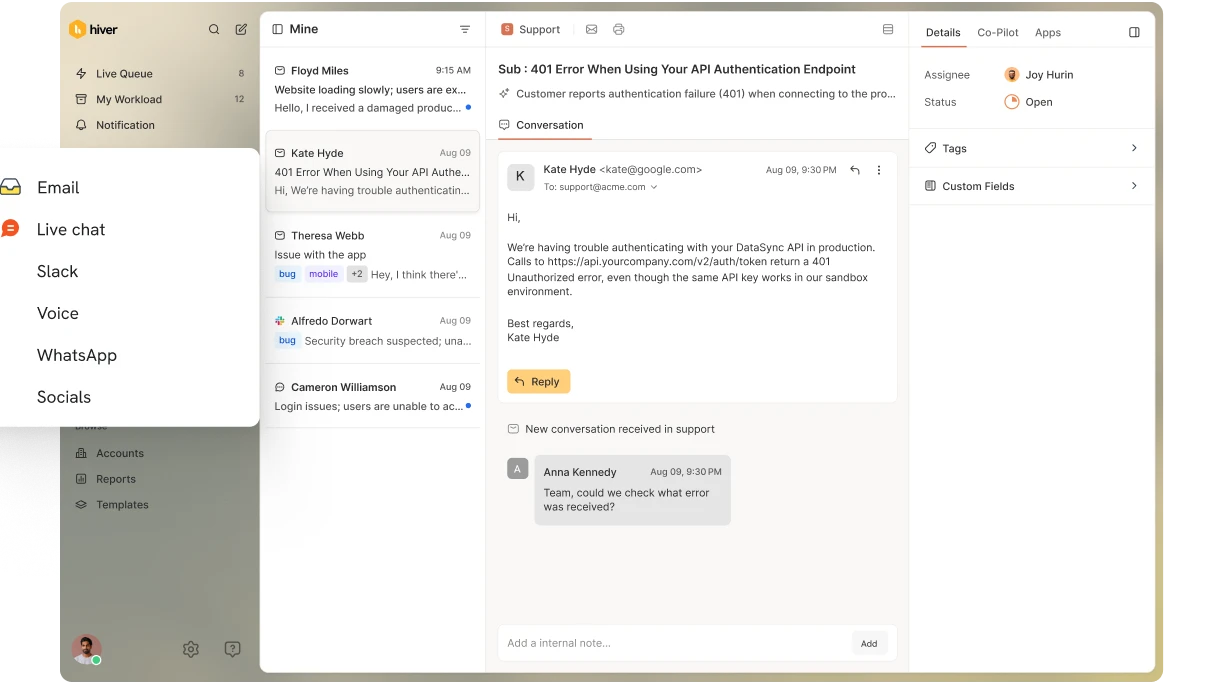
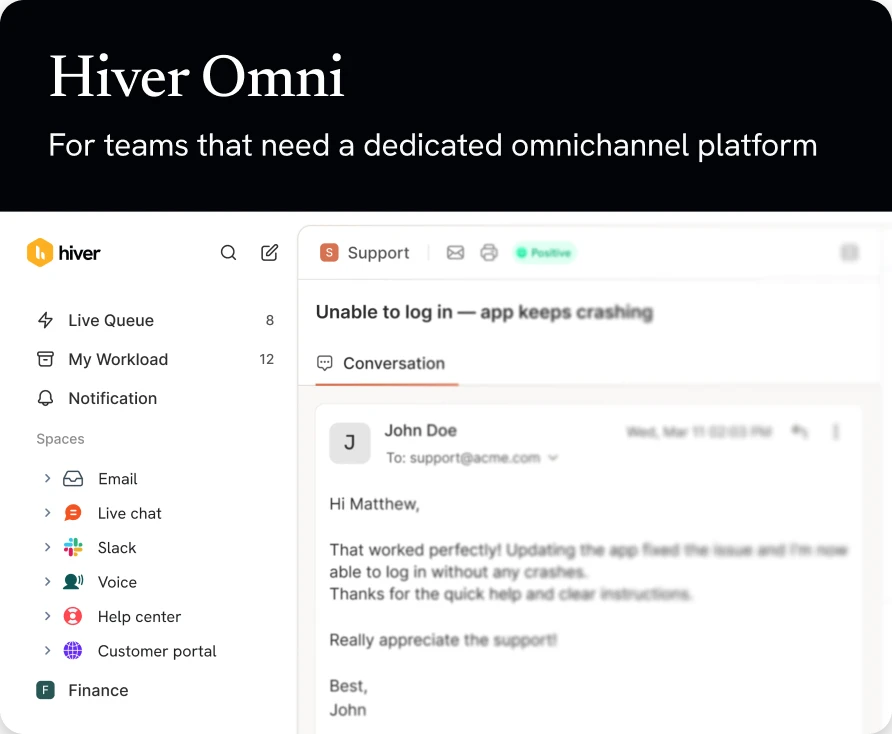
Hiver UI for customer service teams
Hiver is an AI-powered customer service platform that brings together email, live chat, WhatsApp, and phone support in one intuitive, easy-to-use interface. Unlike Gorgias’s complex setup, Hiver gets teams up and running in 30 minutes with minimal setup needed.
Not to toot our own horn, but Hiver excels in its ability to scale support without adding complexity. It offers native integrations with tools like Shopify and WhatsApp, built-in automations to reduce manual work, and real-time collaboration features.
If you’re on Gorgias, you know its is built primarily for Shopify. But with Hiver, you can work seamlessly across ecommerce platforms and support channels, making it a stronger choice if you want flexibility, faster onboarding, and a smoother experience.
Key Features
- Multichannel Support: Handle email, live chat, WhatsApp, and phone inquiries from a unified interface.
- Assistive & Deflection capabilities: Hiver’s AI helps teams respond faster and more accurately. AI Copilot suggests replies and searches connected documents and apps in real time. AI agents automate ticket routing, triage, and sentiment detection. With AI Insights, you can track churn risks and uncover patterns that help improve support.
- Live chat widget for e-commerce: Chat with customers in real time right from your website. Agents can start conversations proactively, get AI-suggested replies, use custom templates, and automate workflows.
- Macros: Use templated responses for common ecommerce queries (order status, returns, shipping).
- Email automation and rules: Set up simple rules to handle repetitive tasks like assigning tickets, tagging emails, sending follow-ups, or closing messages.
- E-commerce Integrations: Integrates with Shopify, Zapier, HubSpot, QuickBooks, NetSuite, Salesforce, etc.
- Customer Context: You get built-in CRM functionality with customer history and interaction timelines for personalized support.
- Team Collaboration: Internal notes, tagging, and real-time collaboration features ensure no ticket falls through the cracks.
- Real-time Analytics: Track key metrics like first response time, resolution time, CSAT ratings, and team performance with customizable reports.
Why Ecommerce Teams Choose Hiver over Gorgias
“We find Gorgias to be limiting, especially their AI offerings are quite subpar”
“Gorgias is an expensive tool. On top of that we spend for our Gmail subscription too, which really adds onto the costs”
This was what real Gorgias users mentioned in our demos, while considering making the switch to Hiver.
E-commerce teams, in particular, often tell us why they see Hiver as a stronger alternative to Gorgias—here’s one example:
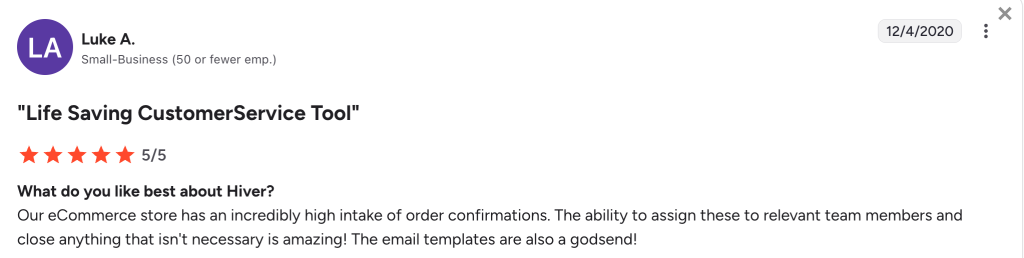
While Gorgias demands heavy setup—custom workflows, technical configuration, and is geared towards a UI that fits ecommerce workflows, Hiver’s setup feels familiar from day one. Your team can start being productive immediately without weeks of training or complex setup processes.
On top of that, Hiver provides 24/7 support across all plans, a major advantage since many Gorgias users report limited support availability.
Pricing
- Free Plan: Basic multichannel support across email, chat, WhatsApp, and phone
- Lite: $19/agent/month – Full ticketing, live chat, automations, customer portal, reporting, and analytics
- Pro: $49/agent/month – Advanced automation, AI features, custom reports, analytics, and integrations
- Elite: (Custom quote) – Enterprise features like unlimited automations, inboxes, skill-based routing, and SSO
All plans include a 7-day free trial with access to the complete feature set.
How Hiver’s Pricing compares to Gorgias’s Pricing:
Assuming a 10-member support team with about 2000 tickets per month, let’s compare how Gorgias and Hiver’s pricing stack up against each other:
| Plan Tier | Hiver (per agent/month) | Gorgias (per month) | Annual Difference (10 agents) |
|---|---|---|---|
| Entry / Starter | Lite: $19 → $190/month for 10 agents, unlimited tickets | Starter: $10 for 50 tickets + $0.40 per extra ticket → $790/month (only 3 seats allowed) | $7,200 annually — Hiver is far more affordable, Gorgias gets very expensive |
| Mid-level | Growth: $29 → $290/month for 10 agents, unlimited tickets | Basic: $50 for 300 tickets + $40 per 100 overage → ~$730/month at 2,000 tickets | $5,280 annually — Hiver is far more affordable, Gorgias becomes expensive with overages |
This pricing advantage is what makes Hiver cost-effective and practical. Instead of Gorgias’s unpredictable ticket-based model that can jump from $60 to $900+ monthly, Hiver offers transparent per-agent pricing that makes budgeting predictable. You pay the same amount whether you handle 100 tickets or 10,000 tickets per month.
2. Zendesk: Best for Enterprise ecommerce businesses that need robust reporting and advanced customization
Zendesk for customer service operations
Zendesk is a trusted name in customer service software. While Gorgias is built mainly for Shopify, Zendesk supports a broader range of ecommerce platforms and channels—email, chat, voice, and more, all in one place.
It also stands out for its support across broader ecommerce operations with advanced automation, deep reporting, and native omnichannel capabilities. In my opinion, it’s also a better fit for teams that have outgrown Gorgias’s limited workflows and want enterprise-grade tools.
What makes Zendesk a Gorgias Alternative:
- Advanced Custom Reporting: Create unlimited custom reports with no cutoff dates on historical data based on clusters.
- Robust Integration Ecosystem: 100+ E-commerce integrations alone, compared to Gorgias’ limited integrations.
- Customer Profiles: Pulls in data from across your systems—inventory, billing, and customer preferences—to create detailed customer profiles.
- Side conversations: Include teammates for help right within the ticket using private threads, Slack, or other channels, compared to Gorgias’ minimal collaboration features.
- AI-Powered Automation: Use pre-trained chatbots, AI-generated response suggestions, and intelligent ticket routing.
Zendesk Cons:
- Zendesk isn’t a fit for small teams that only need basic Shopify order management.
- While the integration library is diverse, it isn’t for e-commerce brands that rely heavily on built-in apps/integrations for customer loyalty, returns, and exchanges.
Zendesk Pricing:
Zendesk offers a 14-day free trial. Paid plans start at $19/month/agent.
How Zendesk’s Pricing compares with Gorgias’s Pricing:
Assuming a 10 member support team with about 2000 tickets per month, let’s compare how Zendesk and Gorgias’s pricing stack up against each other:
| Plan Tier | Zendesk (per agent/month) | Gorgias (per month) | Annual Difference (10 agents) |
|---|---|---|---|
| Entry / Starter | Support Team: $19 → $190/month for 10 agents, unlimited tickets | Starter: $10 for 50 tickets + $0.40 per extra ticket → $790/month | $7,200 annually — Zendesk is far more affordable, Gorgias gets very expensive |
| Mid-level | Suite Team: $55 → $550/month for 10 agents, unlimited tickets + AI included | Basic: $50/month for 300 tickets → quickly runs into overages at 2,000 tickets (~$104/month) | ~$5,352 annually — Zendesk costs more, but it supports unlimited tickets and scales better |
Recommended reading
3. Front: Best for teams needing advanced collaboration and workflow automation
Front for collaborative customer operations
Front is a customer communication platform that combines the simplicity of email with the power of a helpdesk. It’s designed for teams that want to manage email, chat, SMS, and more from one inbox.
One of Gorgias’s biggest gaps is collaboration, and that’s exactly where Front stands out. Smart workflows let teams route, prioritize, and tag messages automatically, while features like internal comments, shared drafts, and collision detection keep everyone on the same page.
With advanced analytics on top, Front offers more collaboration, control, and visibility than Gorgias.
What makes Front a Gorgias Alternative:
- Real-time Collaboration: Features like Internal comments, shared drafts, and team assignments for seamless collaboration.
- Unified Inbox: Get email, chat, SMS, and social media messages into a single, organized workspace.
- Advanced Analytics: Get performance reports and insights into team productivity and customer satisfaction metrics.
- AI Features: AI features like answers, CoPilot, Smart QA, and Smart CSAT as add-ons for teams, over Gorgias’s limited AI features.
- E-commerce and CRM Integrations: Integrates with Shopify, HubSpot, Zendesk Sell, PipeDrive, etc.
Front Cons:
- If you’re an E-commerce business needing deep platform-specific integrations (like WooCommerce or Shopify order management), Front may not be the right fit.
- Front doesn’t offer e-commerce live order management.
Front Pricing:
Front offers a 14-day free trial. Paid plans start at $25/agent/month.
How Front’s Pricing stacks up against Gorgias’s Pricing:
For a support team with 10 agents and about 2000 tickets a month, here’s what the price comes upto:
| Plan Tier | Front (per agent/month) | Gorgias (per month) | Annual Difference (10 agents) |
|---|---|---|---|
| Entry / Starter | Starter: $25 → $250/month for 10 agents (single-channel) | Starter: $10 for 50 tickets + $0.40/extra → $790/month (only 3 seats) | $6,480 annually — Front is more affordable; Gorgias gets very expensive with overages |
| Mid-level | Professional: $65 → $650/month for 10 agents (omnichannel + more automation) | Basic: $50 for 300 tickets + $40/100 overage → ~$730/month at 2,000 tickets | $960 annually — Front is more affordable; Gorgias remains ticket-capped |
Recommended reading
4. HappyFox: Best for multi-department support teams needing a support tool beyond e-commerce
HappyFox for multi-department support teams
If you’re looking for a helpdesk that works for different teams such as IT, HR, and multi-departments, then HappyFox is your best pick. It’s a customizable help desk built for variety of internal and external functions, unlike Gorgias, which is focused mainly on ecommerce.
Its standout features include Kanban-style ticket views, asset tracking, and custom workflows that adapt to different departments. You also get powerful AI tools like auto-generated knowledge bases, sentiment analysis, and multilingual support features that Gorgias doesn’t offer.
What makes HappyFox a Gorgias Alternative:
- Order and Return Management: Manage orders, returns, and refunds for e-commerce operations in a single dashboard.
- Kanban Ticket View: Use drag-and-drop ticket organization for better workload visibility between agents.
- AI-Powered Automation: HappyFox AI provides automated knowledge base creation, multilingual support, and intelligent ticket routing.
- Multi-Brand Support Centers: Manage multiple brands or departments with separate, customized support portals.
- Chatbot: AI-powered chatbot for quick replies, to automate escalations, for multilingual support, and intelligent ticket routing
HappyFox Cons:
- Not really a fit for e-commerce businesses that specifically need deep Shopify integration and order management.
- You’d need to work on additional configuration for some e-commerce features that are in-built into platforms like Gorgias.
HappyFox Pricing:
HappyFox offers a free trial, but it’s gated behind a demo request. Once they understand your requirements, you’ll get access to a trial account to explore the platform. Their paid plans start $24/agent/month.
It’s important to note that some e-commerce integrations, such as WooCommerce are only available on higher plans.
5. Help Scout: Best for small to medium teams with low ticket volume
Help Scout for intuitive customer support
Help Scout is a customer support platform that has the upper hand with ease of use. It has a clean, email-like interface that’s easy for teams to pick up and use right away.
Unlike Gorgias, which can feel heavily tailored to ecommerce, when you use Help Scout, you get a smoother, more polished experience.
Users also praise it for its responsive support, straightforward pricing, and smart self-service tools like the Beacon widget.
Why Help Scout is a Gorgias Alternative:
- Customer History: Get detailed customer profiles with support conversation history, contact info, tags, and custom fields.
- Beacon Widget: Use the In-app messaging and self-service widget on ecommerce sites or apps.
- E-commerce Integrations: Get integrations such as Shopify, WooCommerce, Magento, Samcart, etc.
- Detailed Analytics: Use the analytics feature to get in-depth data on team performance, customer satisfaction, and support metrics.
- AI-Powered Assistance: Get smart summaries, suggested replies, and automated response drafting to improve agent productivity.
Help Scout Cons:
- Help Scout can fall short for businesses with high ticket volume (500+ tickets per day)
- It does not offer native WhatsApp, Twitter, or phone channel support
- Not a great fit for teams needing advanced customization options.
Help Scout Pricing
Help Scout offers a free trial for 14 days. Paid plans start at $25/month per user.
Recommended reading
6. Kustomer: For enterprise teams needing CRM integrated customer support
Kustomer for enterprise-grade customer service CRM
Kustomer offers an omnichannel CRM experience with a unified customer timeline—with email, SMS, chat, social messages, order history, everything connected in one profile.
This way, your agents see the complete customer history without switching between tabs. Gorgias, by comparison, treats each message separately and focuses mainly on Shopify workflows.
From my research, what really sets Kustomer apart is its focus on enterprise team needs and native CRM capabilities. With AI-powered workflow automation, intelligent routing, integrations, and custom dashboards, it goes beyond what Gorgias offers for enterprise teams.
What makes Kustomer a Gorgias Alternative:
- Intelligent Conversation Routing: Set automated routing of tickets based on customer type, request type, agent capacity, and other custom attributes.
- CRM-Powered Chatbots: Get highly personalized chatbots that use customer data to provide contextual assistance.
- Real-Time Dashboards: Live performance monitoring with visibility into SLAs, handle times, customer sentiment, and team efficiency metrics.
- Ecommerce Integrations: Integrate with Shopify, Loop, BigCommerce, Adobe Commerce, etc.
- Multi AI Agent Automation: Design multiple AI Agents, such as Sales, Human, KB agents, to autonomously resolve issues, summarize issues, and speed up responses.
Kustomer Cons:
- It’s not a plug-and-play e-commerce support solution.
- It requires dedicated technical resources for setup and configuration.
- Not suited for teams focused on basic ticket management without CRM requirements.
Kustomer Pricing:
Kustomer offers AI agents for customers and reps as add-ons, and does not have a free trial. Paid plans start at $89/per agent/month.
7. Tidio: Best for teams prioritizing automation and superior chatbot capabilities
Tidio for AI-powered customer support automation
Tidio is an AI-powered support tool with advanced automation and live chat capabilities. Its standout feature is the Lyro AI chatbot, which resolves inquiries in multiple languages, pulls answers from website content and handles more queries than Gorgias’s limited AI.
Compared to Gorgias and most other ecommerce-focused platforms on this list, Tidio also offers a more intuitive chatbot builder with templates, smart triggers, and extras like video calls, all at lower pricing and with a simpler setup.
Why Tidio is a Gorgias Alternative:
- Visual Chatbot Builder: With Tidio, you get an intuitive drag-and-drop interface and an extensive template library for creating diverse conversation flows.
- Live Chat and Video Calls: Customize your chat widget for e-commerce sites with video calling options.
- Proactive Flows: Customize and create no-code conversion paths that trigger at crucial moments in the customer journey.
- E-commerce Integrations: Seamless connections with Shopify, WooCommerce, BigCommerce, and other major platforms for order management.
- Workflow Automation: Use smart triggers and automated responses for common queries, follow-ups, and lead nurturing sequences.
Tidio Cons:
- Tidio only supports manual upload of support knowledge, so it might not fit businesses needing a help center or knowledge base functionality.
- Its Lyro chatbot only integrates with Shopify and not other e-commerce platforms.
- It does not provide extensive customer context visibility during conversations.
- For companies with low ticket volumes (<100 tickets), Tidio might be an overkill.
- Tidio does not offer native SMS, Twitter, or phone support
Tidio Pricing:
Tidio offers a free trial and a free plan. Paid plans are on the basis of billable conversations and start from $24.17/month.
Recommended reading
8. Re:amaze: Best for mid-sized teams seeking multichannel support with chatbot
Re:amaze for scalable multichannel customer support
Re:amaze is one of the more direct alternatives to Gorgias, and a great fit for teams that value automation and personal engagement. It is a customer service platform that unifies chat, email, social, SMS, and phone support without the high costs of larger helpdesks.
Unlike Gorgias’s Shopify focus, what stands out with Re:amaze is its broader channel coverage and real-time customer feeds for proactive outreach. I also noticed features such as ready-to-use chatbots (Order bot, FAQ bot, etc) to automate routine questions, and pricing that scales better for larger teams.
What makes Re:Amaze a Gorgias Alternative:
- Unified Inbox: Get all tickets from email, chat, SMS, VOIP, Facebook, Instagram, Twitter, and Shopify in a single interface.
- Prebuilt Chatbots: Includes Hello Bot, FAQ Bot, and Order Bot to handle repetitive questions.
- Live User Monitoring: View visitors in real time, including location, current page, and browsing history for proactive outreach.
- Built-in Knowledge Base: You get a self-service portal for customers plus internal documentation for agents.
- Analytics and Reporting: Monitor team performance, response times, and resolution rates by channel and agent, not just revenue-centric analytics.
Re:Amaze Cons:
- Lesser integrations compared to Gorgias.
- It’s not a good fit for brands that prioritize sales attribution, revenue metrics, and deep Shopify analytics.
- If your team has high ticket complexity, Re:Amaze might not meet your expectations..
Re:Amaze Pricing
Re:amaze offers a free trial. Paid plans start at $29/user/month.
9. Gladly: Best for teams that want conversation-driven customer support.
Gladly for relationship-driven customer service
Gladly is a people-focused service platform that organizes interactions around customers, not tickets. This approach gives agents full context to provide relationship-driven support, as they see customer conversation history across all channels.
Unlike Gorgias, which focuses on ticket resolution and ecommerce-specific workflows, Gladly keeps every interaction in a single conversation thread per customer for a seamless experience.
Why Gladly is a Gorgias Alternative:
- Conversational AI (Sidekick): Gladly’s AI works on every channel, offering product recommendations, answering questions, and helping your agents with responses.
- Intelligent Agent Matching: Routes customers to the best agent for their needs, based on expertise, past interactions, and availability.
- Live Chat Payment: With Gladly, customers can complete purchases directly through live chat on your website.
- Real-Time Performance Insights: Track how your team is doing with detailed analytics on agent performance, channel efficiency, and conversation outcomes.
- E-commerce integrations: Connect with Shopify, BigCommerce, Spree, Magento, and more to streamline your e-commerce support.
Gladly Cons:
- It’s mostly suited for enterprise teams, and can be expensive for small e-commerce businesses.
- Users report lags during peak hours, slowing down response times.
- Gladly might not fit teams that prioritize rapid ticket throughput over relationship building.
Gladly Pricing:
Gladly does not offer a free trial, with paid plans starting at $38/user/month. Higher-tier plans require annual commitments and minimum user counts, making entry costs significantly higher than other Gorgias alternatives.
Recommended reading
10. Richpanel: Best for Multi-brand ecommerce merchants who want strong self-service tools.
Richpanel for self-service customer support automation.
If your team is looking to automate repetitive support tasks using self-service, Richpanel is a no-brainer. It’s great for ecommerce brands that want to give shoppers a personalized portal to track orders, process returns, and make changes without waiting for agent replies.
Unlike Gorgias’ focus on ticket management, Richpanel prioritizes reducing support volume through advanced automation. It also supports up to five store connections, making it better for multi-brand merchants.
What makes Richpanel a Gorgias Alternative:
- Multi-Store Management: You can manage up to five different stores or brands from one dashboard.
- Sidekick AI: Get an AI agent that learns from your previous customer service interactions, FAQ pages, and articles.
- Unified Customer Profiles: Agents can see each customer’s full history—what they’ve bought, what’s in their cart, what they’ve browsed—alongside every past conversation.
- Revenue Analytics: Measure how your support team contributes to sales through upsells, cross-sells, and helping customers complete purchases.
- Multi-Lingual Self-Service: Offer localized help centers and self-service options so customers can get help in their preferred language.
Richpanel Cons:
- It may be overkill for brands with single-store operations that don’t need multi-store capabilities.
- Users mention scope for more documentation on how to set up and use the tool.
- If you prefer ticket-based workflows over conversation-centric approaches, Richpanel might not be the best choice.
- It also doesn’t have extensive third-party integrations for e-commerce.
Richpanel Pricing:
Richpanel does not offer a free trial. Paid plans start at $69/agent/month. All plans get a free Sidekick AI add-on, but a self-service portal costs $99 as an add-on, regardless of the plan.
Why Hiver is the Best Gorgias Alternative
If your ecommerce business needs a support platform that’s powerful yet easy to set up, Hiver is your best bet. It combines email, live chat, WhatsApp, and phone support in one easy-to-use platform. Connect it to your ecommerce store and your team can start handling every customer interaction without wasting time on complex configurations.
Where Gorgias can feel restrictive and expensive as you grow, Hiver keeps things simple. You get AI automation, real-time collaboration, and built-in customer context that help your team respond faster and resolve issues more smoothly.
It works across multiple ecommerce platforms, not just Shopify, giving you the flexibility to scale support your way. Wondering how Hiver can simplify your e-commerce support? Start your free trial today and see the difference.
Frequently asked questions
What is the cheapest alternative to Gorgias?
Hiver is one of the most affordable Gorgias alternatives. Its Lite plan starts at just $19/user/month (annual billing) with unlimited tickets, making it far more cost-effective than Gorgias’s ticket-based pricing. Teams get essential helpdesk features like automation, analytics, and 24/7 support without worrying about overage fees.
Is Gorgias a CRM?
No, Gorgias is not a full-fledged CRM. It’s primarily a helpdesk platform built for e-commerce, offering customer support through email, chat, and social channels. While it pulls in some customer data (like order history) to assist agents, it lacks the broader sales, marketing, and pipeline management capabilities of true CRMs like HubSpot or Salesforce.
What’s the difference between Tidio and Gorgias?
Tidio focuses on AI-powered automation and live chat, while Gorgias is mainly an ecommerce helpdesk built for Shopify users. Tidio’s Lyro chatbot stands out with multilingual support, the ability to scan your website for answers, and an easy-to-use visual builder—capabilities Gorgias doesn’t offer. Gorgias, however, offers deeper Shopify order management and ticketing workflows, making it more ecommerce-specific but less versatile on the automation side.
What’s the difference between Gorgias and Zendesk?
Gorgias is a Shopify-focused helpdesk tool with order management baked in, making it attractive for smaller ecommerce brands. Zendesk, on the other hand, is a full-scale customer service platform with omnichannel support, advanced reporting, and a large integration ecosystem. For teams that need enterprise-level customization, analytics, and support across multiple channels, Zendesk is a stronger option. But for leaner Shopify-first teams, Gorgias is simpler and easier to adopt.
Start using Hiver today
- Collaborate with ease
- Manage high email volume
- Leverage AI for stellar service