




Gladly has built a name for itself in the customer service world.
But if you have landed here, there’s a good chance it’s not quite working for your team anymore.
Maybe the agent-based pricing is getting tough to scale with. Or your team’s juggling too many tabs to keep up with growing ticket queues. Or perhaps you just need stronger automation, better analytics, or a UI your agents can actually enjoy.
Whatever the reason, there are better customer support options for you out there.
In this guide, we’ll walk through some of the most popular alternatives to Gladly, break down what each does best, and help you figure out which one’s actually right for the way your team works.
Quick disclaimer before you dive in.
We put this guide together to help you choose the best fit, not just the most popular name.
Our comparisons focus on what actually matters in day-to-day support: ease of use, automation, pricing, channel coverage, and how well each tool grows with your team. We’ve dug into product details, explored real-world use cases, and looked closely at what customers are saying.
Sometimes, the list includes Hiver. But the approach stays the same: editorial, honest, and grounded in how people work.
Table of Contents
- First Things First, Why Are Teams Switching from Gladly?
- TL;DR: Best Gladly Alternatives Compared
- 13 Best Gladly Alternatives You Can Choose From
- ✅ Choose the Gladly Alternative That Works for You
- Frequently Asked Questions
First Things First, Why Are Teams Switching from Gladly?
Gladly is great at what it promises: giving customers a more personal, conversation-based support experience.
But people are still Googling alternatives. (Believe us, we’ve got search volume to back this claim.)
So we started digging into reviews to understand what was not working. A few patterns stood out.
One user noted, Gladly is “not an easy platform for those that aren’t used to multiple integration systems.”
Another shared, “Adding a task and assigning it to someone else is not an intuitive step… they all get assigned to yourself unless you change the assignment.”
A third mentioned, “There is no easy simple way to add people to the system, and some of the options are hard to find.”
These aren’t dealbreakers on their own. But when they show up consistently, they explain why teams start looking around.
Ultimately, we narrowed down the problems to these:
- The agent-based pricing model often gets expensive as headcount increases or roles become more blended.
- The UI isn’t the most intuitive for new agents. Onboarding takes longer, and switching between tools can feel clunky.
- Conversations feel unified at first glance, but agents may need to switch views or workflows depending on where the conversation started.
- There’s no way to pause or temporarily defer a thread, which makes queue management tricky.
- Teams looking for strong automation, analytics, or knowledge base tools often find those features limited.
- Integrations exist but are not always deep enough to fit into more complex tech stacks.
Most teams leave Gladly when they realize they’ve outgrown it and need something that scales better with their goals and workflows.
TL;DR: Best Gladly Alternatives Compared
Here’s a side-by-side comparison of the top Gladly alternatives:
| Tool | Best For | Starting Price |
|---|---|---|
| Hiver | New-age support teams | $19/user/month |
| Zendesk | Enterprise-scale support | $55/agent/month |
| Kustomer | Brands with complex CX needs | $89/user/month |
| Gorgias | E-commerce businesses | $50/month (300 tickets) |
| Intercom | SaaS and product-led companies | $29/user/month |
| Freshdesk | Budget-conscious teams | $15/agent/month |
| HubSpot Service Hub | Customer-centric GTM teams | $9/user/month |
| Zoho Desk | Teams in the Zoho ecosystem | $7/agent/month |
| Front | Teams focused on collaboration | $19/user/month |
| Help Scout | Simplicity-first support teams | $20/user/month |
| Salesforce Service Cloud | Enterprise IT and CX | $25/user/month |
| Kayako | Mid-sized support teams | $79/agent/month |
| Tidio | SMBs using chat and automation | $24.7/month |
💡 Pricing reflects entry-level or base-tier plans as of July 2025. Features and costs may vary based on usage.
13 Best Gladly Alternatives You Can Choose From
1. Hiver

Why it’s a Gladly alternative: Teams often hit roadblocks with Gladly’s rising costs and unintuitive setup. Hiver is easier to roll out, with multichannel support and built-in AI that scales smoothly without extra fees.
Let’s get the obvious out of the way: we’ve put Hiver first on this list.
But this is not because we think it’s the only answer, but because it’s the one we know best. And honestly, if you’re evaluating Gladly alternatives, it’s worth a serious look.
What sets Hiver apart is how quickly teams can get started. The platform is designed for ease; everything from onboarding to day-to-day use feels intuitive. You don’t need weeks of training or a consultant to make it work.
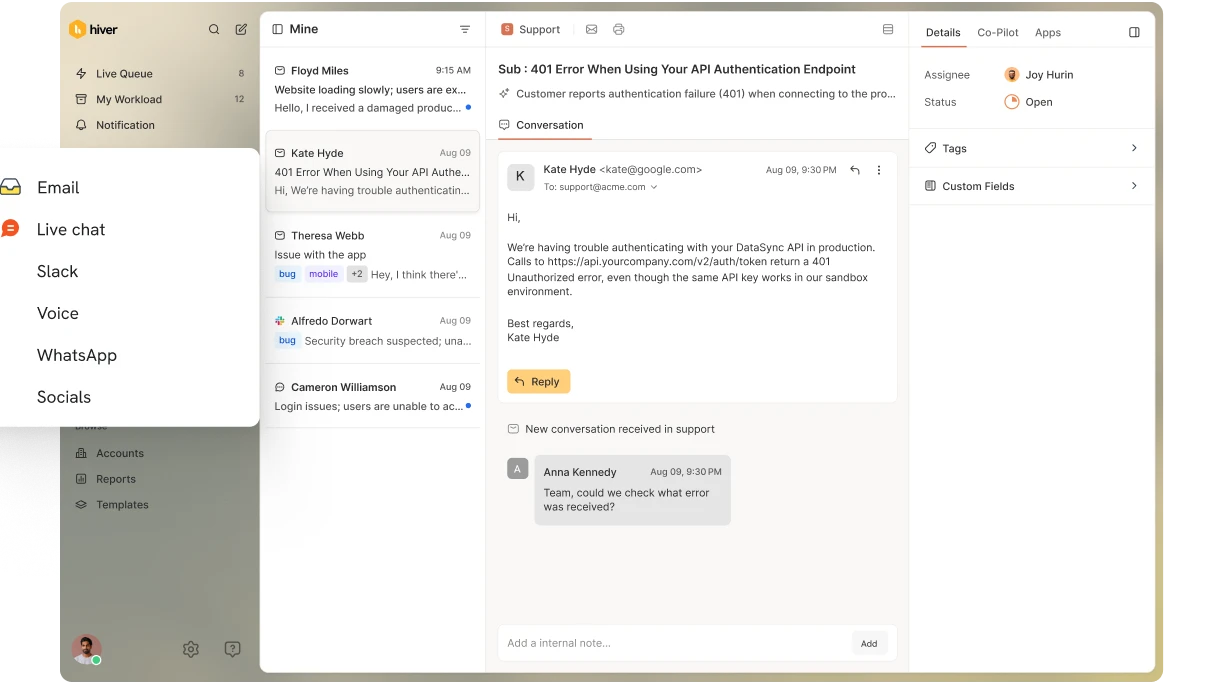
Moreover, it is a modern, AI-powered customer service platform that helps support teams manage communication across channels without the usual chaos of switching tools. Its clean, unified interface brings together customer context, team collaboration, and automation in one place.
The real power, though, is in how deeply AI is embedded. Hiver’s AI Copilot drafts replies, searches across documents and connected apps to suggest accurate answers, and even detects sentiment. AI agents can triage, assign, or respond to queries without any manual input. AI Insights gives teams visibility into churn risk, emerging issues, and performance trends without needing a data analyst.
And with 24/7 support included in every plan (yes, even onboarding help) and pricing starting at just $19 per user, Hiver makes powerful support accessible without the bloat.
Pros:
- Intuitive, unified interface for quick onboarding and seamless multichannel support
- Built-in AI Copilot to suggest replies, summarize threads, and assist with ticket resolution
- AI-powered live chat that deflects FAQs and provides instant answers using connected data
- Workflow automation for routing, assigning, and closing tickets based on custom rules
- Internal notes and shared draft features to improve team collaboration
- An integrated knowledge base that lets customers find answers on their own, and a customer portal to track every request in real time
- 100+ integrations to centralize context from apps like Salesforce, Jira, HubSpot, and Slack
- 24/7 support and onboarding help are included in every plan
- Starts at $19/user/month, with no hidden costs for core functionality
Cons:
- Some advanced capabilities like voice support, SLA tracking, and API access are only available on higher-tier plans
Pricing:
Hiver offers four pricing options:
- Forever free plan
- Lite: $19 per user per month
- Pro: $49 per user per month
- Elite: $79 per user per month
What our customers say about Hiver:
“Hiver is great for making sure everyone stays on track, each customer is taken care of, or assigned to their respective support members. It was super easy to implement and integrate in our daily routine, we use it every day!” [User Review, G2]
“Our clients often tell us that they choose us over our competitors due to our speed and quality of communication. We could not achieve this without Hiver.” [Customer Review]
Product Ratings:
2. Zendesk
Why it’s a Gladly alternative: Gladly works for smaller teams, but larger operations often need stronger automation and analytics. Zendesk delivers those enterprise capabilities with customizable workflows and reporting.
Zendesk is one of the most established names in customer support, known for handling large, complex service operations. Its network of AI agents can instantly resolve routine issues, while Zendesk Copilot assists human agents with suggested replies, summaries, and next-step recommendations. Unlike some platforms, AI is woven into every channel, including voice, where intelligent IVR, call routing, and real-time transcription shorten resolution times in even high-volume contact centers.

Beyond AI, Zendesk provides a solid ticketing system, customizable help center, community forums, and analytics to track SLA breaches, CSAT, and agent performance. Internal teams can also use Zendesk to automate HR and IT requests with the same resolution-focused workflows.
That said, it’s not the quickest tool to master. Between the layered menus, separate views, and setup steps, smaller teams or those switching from simpler tools may need to budget weeks for onboarding and optimization. And if you want the advanced AI and reporting capabilities, you’ll have to look at the more expensive plans.
Pros:
- Strong automation engine for ticket assignment, tagging, and SLA workflows
- AI agents and Copilot assist with instant resolutions and agent productivity
- Customizable dashboards and reporting tools for tracking team performance
- Extensive integration marketplace to connect CRMs, analytics tools, and more
- Knowledge base and customer portal included for self-service and transparency
- Scales well for large or distributed teams with complex workflows
Cons:
- AI and bot features are locked behind higher-tier plans
- Setup and customization can take weeks, especially for smaller or newer teams
- UI can feel cluttered when managing multiple views or workflows
- Reporting updates can lag, and some metrics require exporting to external tools
- Customer support quality is sometimes rated below expectations
Pricing:
- Suite Team: $55/agent/month
- Suite Growth: $89/agent/month
- Suite Professional: $115/agent/month
- Suite Enterprise & Enterprise Plus: Custom pricing
Rating:
3. Kustomer
Why it’s a Gladly alternative: Support teams who feel Gladly still fragments customer context turn to Kustomer. Its unified timeline puts every interaction, purchase, and note in a single view for agents.
Kustomer takes a CRM-first approach to customer service, putting every email, chat, voice call, SMS, and social message into a single, scrollable timeline. This gives agents a full history of each customer’s interactions, purchases, and preferences before they even start typing a reply.

For teams that rely on context to deliver more personalized service, Kustomer can be a strong fit. It includes built-in chatbots, workflow automation, sentiment analysis, and integrations with tools like Shopify, Salesforce, and Slack. The interface is clean and modern, though it might take some adjustment if you’re used to traditional ticketing layouts.
The main trade-off is complexity. Some of the more powerful features, like advanced workflows or detailed analytics, sit behind enterprise plans. And getting the most out of Kustomer often means having someone internally who can manage setup, integrations, and ongoing tweaks.
Pros:
- Unified customer timeline that brings together all interactions in a single view
- Built-in automation and chatbot features for faster responses and lower workload
- Strong CRM-style context: agents can view orders, events, or metadata alongside messages
- Supports all major channels: email, chat, SMS, voice, and social media
- Workflow builder allows teams to automate actions based on triggers and conditions
- Native reporting tools with customizable dashboards
- Integrations with platforms like Shopify, Salesforce, and Slack
- Omnichannel routing and sentiment analysis to prioritize conversations
Cons:
- CRM-style interface can feel unfamiliar for teams used to ticket-based systems
- Setup and integration can be complex without dedicated support
- Pricing is on the higher end compared to similar tools
Pricing:
- Enterprise: $89/user/month (seat-based starting plan)
- Ultimate: $139/user/month
- Enterprise Bundle (all-inclusive): $129/user/month
- Ultimate Bundle (all-inclusive): $179/user/month
Rating:
4. Gorgias
Why it’s a Gladly alternative: If Gladly feels too general-purpose, Gorgias is tailored for e-commerce. Agents can update orders, issue refunds, and pull Shopify data directly in the inbox.
Gorgias was designed with online retail in mind, so it feels right at home in a Shopify, BigCommerce, or Magento environment. Agents can pull up order details, issue refunds, and update shipping status without leaving the conversation view, which keeps interactions quick and context-rich.

It unifies email, live chat, SMS, and social messages (Facebook, Instagram) in one dashboard and uses intent detection to automate repetitive requests such as “Where’s my order?” This focus on e-commerce workflows can dramatically cut handling time for busy stores.
If you operate outside of retail or need more advanced AI and self-service capabilities, its feature set may feel a bit restrictive.
Pros:
- Deep integration with Shopify and other e-commerce platforms
- Agents can take order actions directly from the conversation view (refunds, edits, etc.)
- Basic knowledge base for FAQ content
- Automation features like intent detection and rule-based tagging or auto-responses
- Macros and canned responses to reduce time spent on FAQs
- Centralized view of order data and customer interactions
- Customizable performance reports and pre-built analytics dashboards
- Simple onboarding and setup process for retail teams
Cons:
- Strongest fit is for e-commerce; feature set may feel limited outside of that vertical
- Automation and AI tools are less flexible than those in broader service platforms
- Knowledge base and self-service tools are basic compared to other solutions
Pricing:
- Basic: $50/month
- Pro: $104/month
- Advanced: $140/month
- Enterprise: $185/month
Rating:
5. Intercom
Why it’s a Gladly alternative: Teams that liked Gladly’s conversational approach but need deeper in-product engagement often move to Intercom. Its Fin AI bot and proactive triggers help resolve issues while users are still in-app.
Intercom focuses on real-time, in-product conversations, making it popular with SaaS companies and app-based businesses. It combines live chat, email, in-app messaging, and chatbots in a single workspace, so teams can assist users while they’re still engaged.
The Fin AI bot and resolution bots can handle repetitive questions instantly, while behavior-based triggers let you send targeted messages or guidance before a user hits a roadblock.

The experience is polished, but Fin is priced per resolution, which means costs can escalate quickly as usage grows. On top of that, traditional ticketing workflows and analytics depth are more limited compared to platforms designed primarily for customer support rather than product engagement.
Pros:
- Live chat, email, in-app messaging, and bots unified in one interface
- AI-driven Fin bot and resolution bots for fast query deflection
- Behavior-based targeting for proactive user support and onboarding
- Smooth, modern UI with relatively quick setup for core features
- Integrates with CRMs, analytics, and collaboration tools to keep context in sync
- Central inbox for managing conversations from multiple channels
Cons:
- Fin’s per-resolution pricing can get expensive as usage scales
In the words of a Reddit user, “$1 per resolved conversation sounds reasonable… until you realize that simple, repetitive questions like “How do I change my avatar?” end up being more expensive than human support.”
- Better suited for SaaS and app teams; less tailored for traditional help desk operations
- Ticketing and email management tools are simpler than in dedicated support platforms
- Knowledge base customization and reporting options are limited
Pricing:
- Essential: $29/user/month
- Professional: $85/user/month
- Enterprise: $139/user/month
- Fin Agent: $0.99per Fin resolution
Rating:
6. Freshdesk
Why it’s a Gladly alternative: When Gladly’s pricing or complexity becomes a hurdle, Freshdesk is an attractive swap. It offers affordable entry plans with straightforward ticketing, SLAs, and a built-in knowledge base.
Freshdesk (a part of the Freshworks suite) offers a clean, approachable interface that works well for teams looking to get a support desk up and running without heavy setup. For companies looking to modernize their workflows, Freddy AI is the centerpiece. It assists agents by drafting replies, summarizing conversations, and suggesting knowledge base articles in real time. Managers get value from Freddy Insights, which highlights ticket trends and operational bottlenecks, making it easier to spot issues before they grow.
It comes with automation features for routing, SLA tracking, and canned responses, plus a knowledge base for self-service. Reporting covers key metrics, and the marketplace offers plenty of integrations for CRMs, project management tools, and e-commerce platforms.

However, some users report that licensing can get complex fast, with add-ons and Flexi agent pricing layers. Getting the most out of automation and analytics often involves costly upgrades. Performance can dip during peak periods, leading to slower UI behavior or search delays.
Pros
- Freddy AI handles drafting, tone refinement, summarization, auto-triage, and self-service, which help in scaling efficiently
- Strong ticketing workflows (SLAs, parent-child tickets, shared ownership)
- Personalized dashboards and automated report exports
- Easy-to-use ticketing system with minimal onboarding time
- Built-in knowledge base for customer self-service
Cons
- Advanced AI and automation require pricey add-ons and complex licensing
- Custom reporting and analytics are limited at lower tiers
- Performance and search slowdowns reported under high volume
- Mobile app lacks full feature parity with the desktop experience
- Customer support quality can be inconsistent, with delayed or generic responses
Pricing:
- Free: Up to 2 agents
- Growth: $15/agent/month
- Pro: $49/agent/month
- Enterprise: $79/agent/month
Rating:
7. HubSpot Service Hub
Why it’s a Gladly alternative: Some companies leave Gladly because it doesn’t tie tightly into sales or marketing. HubSpot Service Hub connects support to the full CRM, giving agents visibility into every customer touchpoint.
HubSpot Service Hub is part of HubSpot’s larger CRM ecosystem, so if you’re already using their marketing or sales tools, it fits right in. The platform offers ticketing, live chat, a knowledge base, customer feedback tools, and automation workflows, all tied directly to your CRM data.
That integration means agents can see every interaction a customer has had with your company, from marketing emails to past purchases. You can also build self-service portals, automate repetitive processes, and create reports that combine support, marketing, and sales metrics.

However, if you’re not already in the HubSpot ecosystem, the learning curve and pricing can be sticking points. Some support features, like advanced routing or in-depth analytics, are gated behind higher plans, and costs can climb quickly if you need multiple hubs.
Pros:
- Deep integration with HubSpot CRM for a complete customer view
- Tools for ticketing, live chat, knowledge base, and customer feedback
- Automation for workflows, routing, and follow-up
- Self-service portal creation to reduce ticket volume
- Detailed reporting that spans support, marketing, and sales data
- Centralized customer profiles for more personalized service
Cons:
- Best value when paired with other HubSpot hubs; standalone use may feel pricey
- Some advanced features require higher-tier subscriptions
- Learning curve if you’re not familiar with HubSpot’s interface
- Limited flexibility compared to standalone help desk tools in certain areas
Pricing:
- Starter: $9 per seat/month
- Professional: ~$90 per seat/month
- Enterprise: ~$150 per seat/month
Rating:
8. Zoho Desk
Why it’s a Gladly alternative: Gladly’s automation and reporting can feel limited for complex teams. Zoho Desk steps in with customizable workflows, dashboards, and its AI assistant Zia for ticket recommendations.
For teams already invested in the Zoho suite, Zoho Desk has become one of the most capable help desk platforms, especially for those that want customization without giving up usability.
Zia, its long-standing AI assistant, analyzes sentiment, suggests replies from your knowledge base, and summarizes conversations so agents can respond faster. The newer Zia GenAI brings generative AI into the mix, drafting polished, multilingual replies in a consistent tone, while Zia Agents now take over repetitive triage and anomaly detection tasks autonomously.
Automation is another strength. Blueprints let support leaders design multi-step ticket workflows that mirror real-world processes like approvals or escalations, and Guided Conversations creates conversational self-service flows that walk users through solutions in real time. Reporting is highly customizable as well; managers can create KPI dashboards, track agent availability, and use formula fields to calculate values such as SLAs or refunds directly inside tickets.

That said, the interface can feel complex for new users, and the depth of customization means more time spent on setup. Additionally, some users experience performance issues, including slow loading times and glitches, and the free plan is restrictive.
Pros:
- Deep AI features with Zia, Zia GenAI, and Zia Agents for automation and efficiency
- Strong customization with Blueprints, workflows, and SLAs
- Highly flexible reporting and formula fields for ticket data
- Integrated knowledge base, community forums, and self-service options
- Works seamlessly with Zoho CRM for a full customer context
Cons:
- Interface can feel crowded for first-time users
- Customization flexibility comes with a steeper setup curve
- Performance can occasionally be slow under heavy loads
- Free plan is restrictive; most advanced AI features are only in higher tiers
- Integration ecosystem outside Zoho products is less extensive
Pricing:
- Express: $7/agent/mo
- Standard: $14/agent/mo
- Professional: $23/agent/mo
- Enterprise: $40/agent/mo
Rating:
9. Front
Why it’s a Gladly alternative: Teams frustrated with Gladly’s clunky collaboration tools often find relief in Front. It transforms email, SMS, and chat into a shared inbox where teammates can comment, assign, and draft together.
Front reimagines the shared inbox as a modern customer service platform. Instead of a rigid ticketing system, agents work in an inbox-style interface that feels familiar but adds collaboration tools like internal comments, assignments, and shared drafts — making it easier for teams to coordinate without slowing down responses.
The newest layer is Front AI, which automatically categorizes conversations into Topics, drafts replies, summarizes long threads, and surfaces insights into why customers are reaching out. For managers, it highlights efficiency gaps and trends in real time, so teams can adjust workflows quickly. Combined with automation rules, live chat with bots, and a lightweight knowledge base, Front balances AI-powered speed with human oversight.

While Front includes automation rules and integrations with CRMs and project tools, it doesn’t have as many out-of-the-box support features (like a built-in knowledge base or customer portal) as other help desk platforms. Some users also note inbox clutter when managing very high email volumes, duplicate messages, and limited organization tools.
Pros:
- Shared inbox with collaboration tools like internal comments and shared drafts
- Front AI for conversation categorization, drafting, and insights
- Custom routing rules and workflow automation
- Conversation-first interface that’s easy to learn and familiar to email users
- Calendar integration, @mentions, and tags to improve internal visibility
- 100+ integrations, including HubSpot, Salesforce, Jira, and Asana
- Fast onboarding with minimal configuration required
Cons:
- Lacks a native knowledge base, customer portal, or advanced SLA management
- Automation and analytics are more limited compared to traditional ticketing platforms
- Inbox clutter and occasional duplicate emails
- Layout isn’t very customizable (e.g., reading pane placement)
Pricing
- Starter: $25/user/month
- Professional: $65/user/month
- Enterprise: $105/user/month
Rating:
10. Help Scout
Why it’s a Gladly alternative: Gladly’s UI can be heavy for new agents. Help Scout offers a simpler inbox-style interface with a built-in knowledge base and Beacon widget for lightweight self-service.
Help Scout is designed to ensure customer communication feels personal, even at scale. Its shared inbox looks like a regular email client but comes with features like collision detection (to prevent duplicate replies), saved replies, and internal notes for team collaboration. Additionally, every conversation comes with a complete customer history and timeline, so agents always have the right context before they reply.
AI comes included in every plan, powering reply drafts, summaries, and translations. Beacon, the in-app widget, combines help docs, AI chat, and live chat in one place, while Messages lets teams onboard, collect feedback, or share updates proactively. Reporting covers team performance and trends, and 100+ integrations extend its reach across CRMs, eCommerce, and marketing tools.

While its simplicity is a big plus, it’s not as feature-dense as some all-in-one platforms. Advanced automation, deep analytics, or omnichannel routing may require other tools alongside Help Scout.
Pros:
- Fast onboarding and intuitive, inbox-style interface
- AI features (drafts, summaries, translation) are included on all plans
- Beacon widget combines chat, docs, and contact options in one place
- Internal notes, tagging, and collision detection for team collaboration
- Workflow automation for tagging, assigning, and auto-responding
- Shared knowledge base and customizable customer portal
- Simple reporting dashboards to track response time, volume, and happiness ratings
- Integrates with tools like Slack, HubSpot, and Salesforce
Cons:
- No built-in voice or SMS support
- Limited advanced automation and reporting features compared to larger platforms
- Best suited for straightforward support workflows, less flexible for complex operations
Pricing:
- Standard: $25/month
- Plus: $75/month
Rating:
11. Salesforce Service Cloud
Why it’s a Gladly alternative: Gladly isn’t built for high-volume enterprise environments. Salesforce Service Cloud brings full case management, omnichannel routing, and customizable AI-driven workflows at global scale.
Salesforce Service Cloud is built for scale, with a deep set of features designed to handle high-volume, complex support operations. It offers case management, AI-powered Einstein recommendations, omnichannel routing, and a 360-degree view of every customer through the Salesforce CRM.
Enterprises often use it for its workflow automation, knowledge management, and integration ecosystem, including thousands of AppExchange apps. You can also build custom processes and dashboards tailored to your industry or service model.

One major con is complexity; configuring Salesforce to fit your exact needs often requires admin expertise, and costs can rise quickly once you add advanced features or higher support tiers. Smaller teams may find it more than they need.
Pros:
- Omnichannel case routing for phone, chat, email, social, and more
- Einstein AI for predictive recommendations and automated responses
- Comprehensive customer profiles via Salesforce CRM
- Highly customizable workflows, dashboards, and reports
- Large integration marketplace through AppExchange
- Strong knowledge management and self-service capabilities
Cons:
- Requires a Salesforce admin or team for setup and maintenance
- Pricing starts at $25/user/month, but can climb steeply with advanced modules, premium support, or add-ons
- Overhead may be too high for smaller or mid-sized teams
Pricing
- Starter: $25/user/month
- Pro: $100/user/month
- Enterprise: $165/user/month
Rating:
12. Kayako
Why it’s a Gladly alternative: For mid-sized teams that find Gladly too complex for their needs, Kayako is a lighter alternative. Its single conversation thread keeps context unified across channels without the extra enterprise overhead.
Kayako focuses on pulling every customer interaction, across email, chat, social media, and your help center, into a single thread. The goal is to give agents context without the extra clicks, so they can respond faster and keep conversations consistent.
It includes the essentials: a built-in knowledge base, workflow automation, and a visual activity timeline of each customer. Collaboration features like private notes and shared views make it easier for teams to coordinate responses.

However, Kayako is lighter than many enterprise platforms. You’ll get the basics without a steep learning curve, but AI, advanced analytics, and broader integration options are more limited. For high-volume or complex environments, those gaps may become noticeable over time.
Pros:
- Multichannel support across email, chat, Twitter, Facebook, and help center
- Unified conversation view that stitches messages across channels into one thread
- Custom views, tags, and internal notes for better team collaboration
- Workflow automation for assigning, tagging, and follow-ups
- Knowledge base with search and categorization features
- Visual activity timeline for customer interaction history
- No-code setup for small to mid-sized support teams
- Self-service help center for customers
Cons:
- Limited AI capabilities and basic automation compared to modern platforms
- Reporting is functional but not as customizable or detailed
- Fewer integrations than larger platforms
- Some users report performance issues or slower response times on large volumes
Pricing:
- Kayako One: $79/month
Rating:
13. Tidio
Why it’s a Gladly alternative: If you mainly relied on Gladly for chat and automation, Tidio is a lighter alternative. It provides live chat, a visual chatbot builder, and multichannel messaging at an SMB-friendly price.
Tidio is a live chat and chatbot platform tailored for small businesses that want to add real-time support to their websites. It combines human chat, AI automation, and a visual chatbot builder into one easy-to-use product.
The platform allows teams to manage conversations from live chat, email, Facebook Messenger, and Instagram DMs in one place. Tidio’s AI chatbot can handle basic queries, qualify leads, and trigger automations, all through a visual, drag-and-drop builder.

It’s a strong fit for teams that need a lightweight support tool with chatbot automation. However, it’s not built to be a full-service help desk, and features like ticketing, SLAs, or knowledge base management are either limited or missing.
Pros:
- Live chat and chatbot builder in one unified dashboard
- Visual editor for building automated responses and flows without code
- Multichannel messaging from website chat, Messenger, Instagram, and email
- AI assistant to automate FAQs, lead capture, and routing
- Integration with Shopify, WordPress, and CRM tools
- Customizable widget design to match your site
- Fast setup and minimal training required
- Free plan available with core features
Cons:
- Not a full help desk, limited features for ticketing, SLAs, or workflow customization
- Basic reporting and analytics compared to more robust platforms
- Best suited for small teams with lower volume or simple use cases
- Some advanced chatbot features require upgrading to higher plans
Pricing:
- Starter: $24.17/month
- Growth: $49.17/month
- Plus: $749/month
- Premium: Custom pricing
Rating:
💡 Pro Tip: How to Switch from Gladly Without Breaking ThingsThinking about switching, but nervous about the move?
Here’s a quick migration checklist to help you transition smoothly, without disrupting your support operations:
Export your customer, ticket, and workflow data from GladlyIdentify gaps: Which channels, automations, reports, or integrations are must-haves in your new platform?Choose the right tool (scroll back up if you need a refresher)Ask your new provider about onboarding help and migration toolsRun a 2-week pilot alongside Gladly to test everything before making a full switch. This isn’t about slow onboarding, it’s simply a best practice to ensure a smooth transition no matter which tool you pick.
✅ Choose the Gladly Alternative That Works for You
Gladly set the stage for more personal, conversation-led support. But once your team starts scaling, the cracks often show: higher costs, clunky workflows, and limited automation can slow you down.
The good news? You have plenty of strong alternatives, whether you want enterprise-level customization, e-commerce–specific workflows, or something lightweight for a growing team. Each tool on this list brings its own strengths, so the right choice depends on how you serve customers today and how you want to grow tomorrow.
And if you’re looking for something that’s powerful, modern, and easy to roll out, Hiver is a great place to start. It brings all your support channels, customer context, and automation into one unified platform. The setup is quick. The support is available 24/7. And the AI is built to make agents faster, not replace them.
👉 Ready to switch? Start your Hiver trial today
Frequently Asked Questions
What is the best Gladly alternative overall?
There’s no one-size-fits-all. It depends on your team size, channels, and complexity. That said, if you’re looking for something intuitive, AI-powered, and fast to set up, Hiver is a strong choice.
What’s the most affordable Gladly alternative?
Freshdesk offers a free plan, and Hiver starts at $19/user/month with all core ticketing and automation features included, no hidden costs for onboarding or support.
Can I migrate tickets from Gladly to another platform?
Yes. Most platforms offer migration tools or onboarding support. First, you’ll need to export your data from Gladly. Use our checklist above to guide the process.
Does Hiver offer chat and automation like Gladly?
Yes. Hiver includes AI-powered live chat, chatbot automation, rule-based ticket routing, reply suggestions, and more in one unified platform.
Start using Hiver today
- Collaborate with ease
- Manage high email volume
- Leverage AI for stellar service