




When I started evaluating automated ticketing systems, I expected clear differences in how they handled intake, routing, and execution. Instead, most platforms made the same AI claims.
To understand what actually works, I evaluated more than 30 automated ticketing systems and tested them against real support workflows. I examined how they classified messy tickets, enforced SLAs, routed issues across teams, and triggered actions in systems such as CRM or billing.
One distinction became obvious. Most tools automate tasks such as tagging or assignment. Very few automate outcomes. The difference shows up in whether the system eliminates reassignment loops, removes repetitive approvals, and executes predictable workflows without human correction.
This guide focuses on the platforms that actually reduce operational oversight.
Table of Contents
- What is an Automated Ticketing System?
- The “Automation Maturity” Framework for Evaluating an Automated Ticketing System
- How Did I Evaluate Automated Ticketing Systems?
- The Top 5 Automated Ticketing Systems in 2026
- How AI Has Changed Automated Ticketing Systems?
- Top 8 Features of an Automated Ticketing System
- How to Implement an Automated Ticketing System (Step-by-Step Checklist)
- How to Choose the Right Automated Ticketing System for Your Team
- The Future of Automated Ticketing Systems
- Frequently asked questions
What is an Automated Ticketing System?
An automated ticketing system is software that handles the triage, routing, prioritization, and follow-up of incoming requests without human intervention.
When a request comes in, the system should understand what it’s about, determine urgency, route it to the right person, apply the correct priority, and trigger the next steps without someone manually managing the flow.
That is the standard. Real automation removes the need for constant triage, eliminates reassignment loops, and prevents tickets from stalling in queues. It ensures work progresses based on logic rather than availability.
If a system still depends on humans to sort, escalate, or push tickets forward, it is not automated. It is assisted.
The “Automation Maturity” Framework for Evaluating an Automated Ticketing System
When evaluating automated ticketing systems, you need to understand how they behave when a ticket enters the queue. Over time, I’ve found that most platforms fall into three clear levels of automation maturity.
Level 1: Auto-Triage
This is the most basic form of automation. Here, the system tags, routes, or assigns tickets based on predefined rules. It may use keywords, customer segments, or skill-based routing to move tickets to the right queue. For example, you define explicit rules such as:
- If the subject contains “refund,” route to Billing.
- If the customer tier equals Enterprise, assign to Tier 2.
- If the ticket age exceeds 4 hours, escalate.
This reduces manual sorting, but humans still read, prioritize, and decide next steps. Most legacy helpdesks operate at this level.
Level 2: Agent Assist
At this stage, AI supports decision-making but does not replace it.
The system can detect sentiment, classify intent more accurately, and suggest replies. It may surface relevant knowledge base articles or recommend actions based on similar past tickets.
How it works:
- A ticket enters.
- The AI model evaluates language and context.
- It assigns intent (e.g., refund, cancellation, technical issue).
- It flags sentiment (e.g., frustrated, urgent).
- It drafts a response or recommends next steps.
- An agent reviews and approves.
This reduces cognitive load in agents. Agents no longer start from scratch. However, resolution still depends on human validation. Automation supports the workflow, but does not execute it.
Level 3: Autonomous Resolution
This is where automation shifts from assistance to execution.
The system can interpret intent, extract necessary details, trigger workflows across integrated systems, and resolve certain tickets end-to-end without agent involvement.
How it works:
- A ticket enters.
- The system identifies intent and required data.
- It verifies eligibility against policy rules.
- It triggers actions in connected systems (CRM, billing, ERP).
- It sends confirmation to the customer.
- It updates records and closes the ticket.
For example, a refund request within policy limits can be validated, processed, logged, and confirmed without agent involvement.
Here, humans step in only when the request falls outside defined thresholds or requires judgment.
Why This Framework Matters?
Many platforms blur these levels together. They describe features without clarifying whether automation assists agents or actually resolves tickets.
When evaluating automated ticketing software, the key question is simple:
At which level does this AI automation ticketingsystem operate today?
Automation maturity is not about how many AI features exist. It is about how much decision-making the system can handle without adding oversight.
How Did I Evaluate Automated Ticketing Systems?
Before narrowing this list down, I evaluated more than 30 automated ticketing systems across AI-first platforms, traditional help desk tools, and collaboration-focused inbox solutions.
I did not judge them based on how impressive the demos looked. I tested them against real support scenarios and evaluated them on three non-negotiables.
- First, accuracy. If the system could not consistently identify intent and priority without manual correction, it failed.
- Second, execution depth. If it stopped at routing and could not trigger real actions across billing, CRM, or internal systems, it did not qualify as automation.
- Third, operational load. If maintaining it required constant rule tuning and supervision, it was not mature.
If a platform required constant adjustment, it did not make the shortlist. If it handled complexity without supervision and reduced operational load, it did.
The Top 5 Automated Ticketing Systems in 2026
After evaluating 30+ automated ticketing systems across real support workflows, these five consistently handled intent classification, routing accuracy, and workflow execution with the least manual oversight.
The comparison below looks at automation depth, AI capability, pricing transparency, and security posture.
| Tool | Best Fit | Automation Strength | Starting Price | Free Trial |
|---|---|---|---|---|
| Hiver | Growing support teams that want AI-driven automation without heavy configuration | Context-based intent classification, sentiment detection, structured data extraction, policy-based autonomous actions, AI Copilot drafting, AI Insights for operational patterns | $25 /user/month | 7 days (Elite access during trial) |
| Zendesk | Mid-market to enterprise teams needing deep customization | AI Agents for autonomous resolution, AI Copilot, advanced trigger engine, predictive insights; depth depends on plan tier and add-ons | $19 per agent per month. Copilot add-on ~$50/mo + per resolution charges | 14 days, no card required |
| Freshdesk | SMB to mid-market teams seeking structured automation at lower cost | Freddy AI for intent tagging, drafting assistance, chatbot deflection, rule-based workflow automation; execution depends on configuration | $19 per agent per month | 14 days, Enterprise access during trial |
| Intercom | Chat-first support teams focused on deflection | Fin AI for autonomous chat resolution, AI-assisted routing, connected data responses, workflow automation; pricing tied to resolution volume | $29 per seat per month, $0.99 per resolvxed conversation | 14 days |
| Front | Collaboration-heavy teams managing shared inbox workflows | AI-assisted drafting, summaries, rule-based routing, collaboration automation; limited native autonomous resolution | $25/sea per month, Copilot is available at $20/month/seat | 14-day trials |
(Pricing is available on vendor sites as of 2026.)
1. Hiver
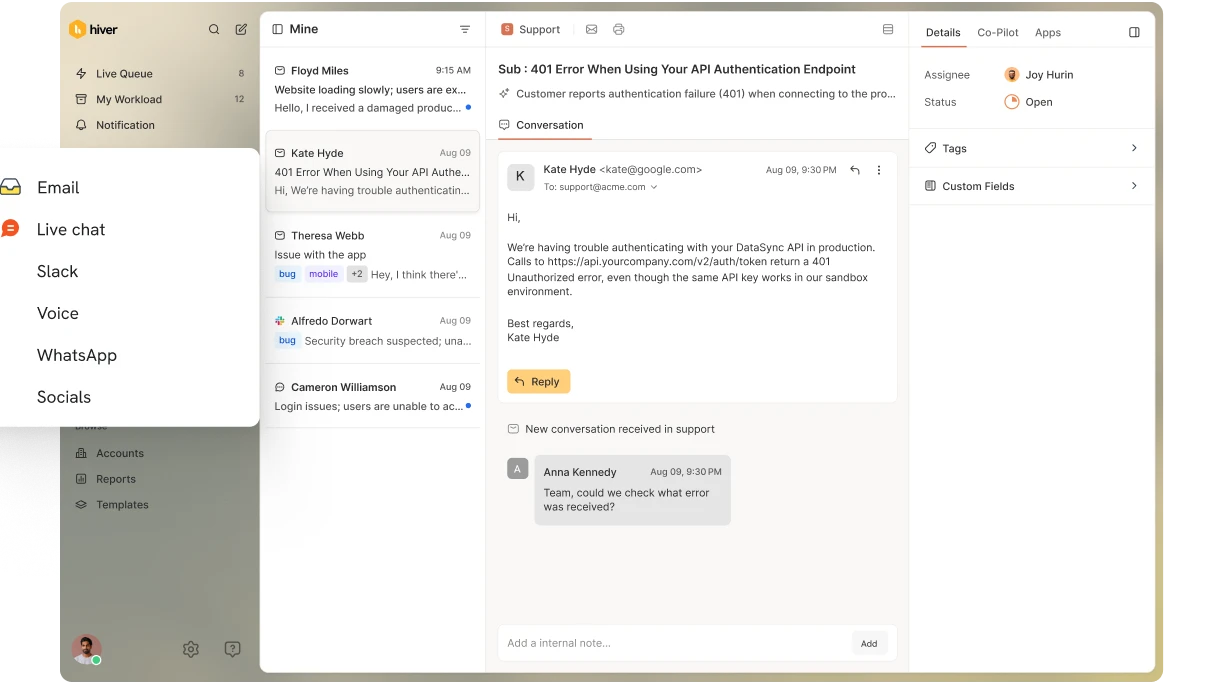
I evaluated Hiver against a simple operational benchmark: does the system remove decisions from agents at intake, or does it still rely on manual correction behind the scenes?
Hiver’s automation is built around context, not keywords. It processes the full message, classifies intent, detects sentiment, extracts structured data such as invoice or order numbers, and routes based on meaning.
In billing-heavy and operations-driven environments, that directly reduces reassignment, manual tagging, and priority adjustments. The difference becomes clearer in execution.
What actually impressed me about Hiver
- Intent-driven triage: Tickets are categorized by meaning rather than exact text matches, which lowers misrouting and reduces the need for manual fixes.
- Policy-based autonomous actions: AI Tasks execute multi-step workflows, such as routing, tagging, and triggering follow-ups, when defined conditions are met. Routine actions do not wait for human approval unless guardrails require it.
- Embedded AI assistance: AI Copilot drafts replies, summarizes long threads, and refines tone inside the ticket view, which shortens handling time without forcing agents into separate tools.
- Operational intelligence: AI Insights surface volume spikes, recurring patterns, and performance gaps without requiring custom reports.
- Security & compliance: Security posture includes SOC 2 Type II, ISO 27001, GDPR, and HIPAA, all of which matter for regulated teams.
As volume increases, the system is designed to absorb intake complexity instead of pushing correction work back onto the team.
2. Zendesk
Zendesk is a powerful ticketing system with automation workflows, but it is configuration-heavy. When I evaluated it, the strength was clear: the trigger engine can support extremely complex routing structures. However, AI depth depends heavily on plan tier and add-ons.
Its AI agents can resolve a high percentage of repetitive interactions, but the cost scales with usage and configuration quality.
What I observed about Zendesk’s features
- AI Agents for ticket handling: Zendesk AI can autonomously resolve repetitive requests such as password resets, order status queries, or policy-based refunds. Resolution rates depend on training quality and configuration, and usage-based pricing can scale with volume.
- Copilot for agents: Provides recommended next steps and personalized replies based on ticket context, speeding up handle times.
- Automated prioritization & routing: AI examines ticket content and sentiment to decide priority and assign to the most suitable agent or group.
- AI Insights for operations: Real-time insights on predicted ticket volumes, trends, and resolution time drivers aid staffing and forecasting.
- Security & compliance: SOC 2 Type II, ISO 27001, GDPR compliance support enterprise procurement requirements.
Zendesk works well when you have the operational maturity to manage it. It is less forgiving if your workflows are not well-designed.
3. Freshdesk
Freshdesk is built around structured workflows with AI layered on top. It is easier to configure than heavily customizable enterprise systems, but its automation depth depends on how much you invest in setup and add-ons.
Freddy AI primarily improves agent productivity rather than replacing decisions end-to-end. In my evaluation, it meaningfully reduced reply drafting time and improved tagging accuracy, but autonomous execution required additional configuration and guardrails.
Where Freshdesk performs
- Intent recognition with Freddy AI: Automatically identifies ticket intent and applies tags, reducing initial sorting effort and lowering misclassification when the taxonomy is well-defined.
- AI-powered reply suggestions: Drafts contextual responses and recommends relevant knowledge base articles, which speeds up first response and resolution time without removing the agent from the loop.
- Freddy-powered chatbots: Handle common, repetitive queries through conversational automation, helping deflect high-frequency tickets before they reach agents.
- Rule-based SLA and workflow automation: Triggers escalations, reminders, and assignments based on defined conditions. This works reliably when workflows are clearly structured.
- Security & compliance: Security standards meet common mid-market compliance requirements with SOC 2 Type II, ISO 27001, and GDPR standards.
Freshdesk works well for teams that want structured automation with AI assistance built in. If your goal is progressive automation and agent productivity gains, it fits. If your priority is deep, policy-driven autonomous execution across systems, it requires more deliberate configuration.
4. Intercom
Intercom is built around autonomous, AI-first resolution. Its Fin AI agent is designed to resolve customer conversations end-to-end without requiring human intervention for routine queries. That is the core proposition.
Fin is trained on your knowledge base and connected data sources, and it can handle high-volume, FAQ-driven interactions independently. When properly trained and scoped, it deflects a meaningful percentage of repetitive tickets before they reach an agent.
However, pricing scales with resolution volume, so successful automation directly increases usage cost.
What stands out about Intercom
- Fin AI agent for autonomous resolution: Designed to handle and resolve a significant portion of queries and hand off complex ones to human agents.
- Workflow automation: Intercom Workflows automate conversation flows, follow-ups, and handoffs across channels.
- Inbox Copilot tools: Assist human agents by drafting replies, summarizing long threads, and populating tickets with context.
- Multilingual and data connectors: Fin can use connected data sources (like CRM or e-commerce platforms) to personalize responses, including in multiple languages.
- Security & compliance: Security certifications include SOC 2, ISO 27001, and GDPR compliance.
If your support is chat-first and FAQ-heavy, Intercom’s automation depth is compelling. If you rely heavily on email workflows and complex backend integrations, evaluation should go deeper.
5. Front
Front is designed around team collaboration first and automation second. Its AI capabilities focus on helping agents move faster inside conversations rather than replacing decision-making at intake or resolution.
In my evaluation, automation in Front improved coordination and response speed, but it did not materially reduce manual triage or enable deep autonomous execution.
Where Front adds real value
- AI-assisted drafting and summaries: Helps agents generate responses and digest long email threads quickly, reducing handling time in high-collaboration environments.
- Rule-based routing and SLA automation: Assigns conversations and triggers reminders based on defined rules, but autonomous resolution requires external tooling or integrations.
- Shared inbox workflows: Automation integrates tightly with internal comments, shared drafts, and collaboration tools, which speeds up cross-functional coordination.
- Conversation analytics: Surfaces trends and bottlenecks through reporting rather than intent-driven triage.
- Security & compliance: Security certifications include SOC 2 Type II, ISO 27001, and SSO support.
If your primary challenge is team coordination, this works. If your goal is to reduce manual triage and enable autonomous workflows, the automation ceiling is lower.
How AI Has Changed Automated Ticketing Systems?
When I compared automated ticketing systems, the real difference showed up at intake. The question was simple: can the system understand a ticket the way a human would, or does it rely on rigid rules?
Most older platforms labeled as “automated” are built on rule engines. You configure logic such as:
- If the subject contains “refund,” → assign to billing.
- If priority equals high → notify manager.
This works when inputs are structured and predictable. The problem is that customer requests are not.
Customers do not write in predefined categories. They write in context. A ticket might say, “I was charged twice, and I’m not happy,” or “Something seems wrong with my last invoice.” The intent is clear to a person, but it may not contain the exact keyword your rule depends on.
When that happens, the system misroutes the ticket. A human then steps in to reassign it, correct the priority, and fix the tags. As volume grows, those corrections become part of daily operations.
An AI automation ticketing system completely changes the intake layer. They use natural language processing to classify intent, detect sentiment, extract structured data, and determine routing based on context.
Consider a message like: “I was charged twice and I’m frustrated.”
- A rule engine looks for the word “refund.”
- An AI-driven system identifies a billing dispute, detects negative sentiment, assigns the correct priority, extracts relevant transaction details, and routes the ticket accurately. If configured, it can also trigger downstream actions such as initiating a refund workflow or updating CRM records.
This is the dividing line.
- Rule-based systems automate predefined conditions.
- AI-driven systems interpret context and act on it.
For buyers, that distinction determines whether automation reduces manual oversight or simply shifts it. If your team still spends time correcting misroutes and adjusting priorities, the system has not moved beyond rules.
Top 8 Features of an Automated Ticketing System
If a platform claims automation, these are the capabilities that prove it. Without them, someone on your team is still sorting, correcting, escalating, or cleaning up behind the system.
- Intent-Based Auto-Triage: The system should understand what the ticket is about without relying on exact keywords. When it routes correctly the first time based on meaning, you no longer need manual sorting.
- Dynamic Round-Robin Assignment: Your query assignment/request assignment should reflect the real workload and not just a rotation. When the system factors in open tickets and agent capacity, it prevents silent overload and keeps response times stable as it scales.
- Sentiment-Triggered Escalations: Frustrated customers should not wait in standard queues. When the system detects urgency or a negative tone and automatically raises priority, it protects high-risk interactions before they escalate.
- Autonomous Workflow Execution: Automation should not stop at routing. When policy conditions are met, the system should execute actions such as refunds or account updates without requiring repetitive approvals, which directly shortens resolution time.
- Bidirectional CRM or ERP Sync: Support and backend systems must stay aligned. When ticket updates automatically reflect in CRM or billing tools and vice versa, you avoid duplicate entry and prevent data inconsistencies.
- Structured Data Extraction: Agents should not be copying order numbers into fields. When the system extracts key details from free-form messages automatically, intake becomes faster and reporting becomes cleaner.
- Context-Aware SLA Automation: Timelines should reflect priority, customer tier, and business hours. When SLAs are enforced dynamically instead of by static timers, breach rates drop without constant supervision.
- Continuous AI Quality Monitoring: Quality cannot depend on sampling a small percentage of tickets. When every conversation is reviewed against defined standards automatically, consistency improves without increasing QA headcount.
Automation is only meaningful when your team spends less time triaging and more time solving complex problems.
How to Implement an Automated Ticketing System (Step-by-Step Checklist)
Automation should be treated like a systems rollout, not a configuration exercise. Each step below builds on the previous one. Skipping steps leads to routing errors, broken syncs, and unnecessary rework.
Step 1. Map your data architecture before enabling automation.
Do not turn on automation until your data model is stable. AI can only make correct decisions if the underlying structure is consistent.
What you need to do
- List every intake channel: Document email, chat, voice, WhatsApp, portal, and confirm what metadata each channel sends into the system.
- Define mandatory ticket fields: Lock in required fields such as customer identifier, intent, priority, SLA tier, queue, status, and channel. If these fields are not consistently populated today, fix that before proceeding.
- Standardize your ticket schema: Ensure every ticket, regardless of channel, follows the same structure and field definitions.
- Map backend integrations: Identify which systems must sync with the ticketing platform, such as CRM, billing, ERP, or subscription tools. Specify exactly which fields sync and in which direction.
- Define source-of-truth ownership: Decide which system controls each critical field. For example, CRM owns the customer tier, and billing owns the refund status. Do not allow conflicting updates.
When this step is done, you should have a documented schema, an integration map, and clean field consistency across recent tickets. If you cannot review 20 recent tickets and see clean, consistent data across required fields, automation will fail downstream.
Step 2: Train and validate intent classification
Automation starts with accurate intent detection. If the system misclassifies tickets, everything that follows, like routing, SLA enforcement, and execution, will break.
What you need to do
- Pull real historical data: Export at least 60 to 90 days of tickets. Do not use ideal examples. Use messy, real conversations.
- Identify your highest-volume intents: Group tickets into the top 10 to 15 recurring categories that cover the majority of your volume, such as refunds, cancellations, login issues, and billing disputes.
- Consolidate overlapping categories: Avoid overly granular labels that create confusion. Each intent should map to a clear operational path.
- Create a labeled validation set: Manually tag a sample of tickets to use as a benchmark. This becomes your ground truth dataset.
- Test classification accuracy: Measure how often the system assigns the correct intent. Track false positives and misroutes.
- Set confidence thresholds: Define the minimum accuracy required for automatic routing. Low-confidence classifications should default to manual review.
When this step is complete, you should have a validated intent library with measurable accuracy and a defined confidence threshold for automated decision-making.
If classification accuracy is inconsistent, do not enable auto-routing. Fix the taxonomy first.
Step 3: Connect intent to routing and execution logic.
Intent detection by itself does not create automation. A system only becomes automated when each intent leads to a defined, predictable operational outcome.
Here is how you operationalize that.
- Map each intent to clear ownership: Every intent must route to a specific queue or skill group. Avoid generic “support” buckets. A billing dispute should go to billing. A technical integration issue should go to the integration team. Ownership must reflect expertise.
- Configure workload-aware assignment: Do not rely on static round-robin rules. Enable assignment based on real-time capacity so tickets distribute according to availability and SLA pressure.
- Define execution policies for repetitive actions: For workflows such as refunds, subscription upgrades, or account changes, define eligibility rules. Specify thresholds, limits, and approval requirements. The system should know when it can execute and when it must escalate.
- Automate backend updates: When an action occurs, CRM, billing, and ERP systems must update automatically. Test bidirectional sync thoroughly to avoid data conflicts and reconciliation work later.
- Link sentiment and SLA triggers: Configure automatic priority escalation when negative sentiment is detected, or SLA risk increases.
What this looks like in practice:
If a ticket is classified as a duplicate charge, the system should route it to billing, extract the transaction reference, verify whether the amount falls within defined auto-refund limits, update the CRM once processed, and escalate only if policy thresholds are exceeded.
When this step is complete, you should have a documented routing matrix, defined execution policies, verified backend synchronization, and escalation rules tied directly to intent and SLA risk.
If the system only assigns tickets but still requires manual approval for routine actions, the automation layer is not complete.
Step 4: Run human-in-the-loop validation before full automation
Do not move directly from configuration to full autonomy. Automation must prove accuracy under supervision before it controls execution.
What you need to do
- Enable shadow mode first: Let the system classify, route, and recommend actions, but require agents to confirm before execution. This allows you to observe behavior without operational risk.
- Track correction rate: Measure how often agents override intent classification, routing decisions, or automated actions. High override rates signal weak training or misaligned thresholds.
- Audit automated decisions daily: Review a structured sample of AI-classified tickets. Check whether routing, priority, and backend updates align with policy.
- Monitor misroutes and false escalations: If tickets are being reassigned frequently or escalated unnecessarily, refine intent definitions or confidence thresholds.
- Adjust automation scope gradually: Increase autonomy only when correction rates fall within acceptable limits.
You should see decreasing override rates, stable routing accuracy, and minimal misclassification before expanding scope.
If agents do not trust the automation, scaling it will create resistance and operational friction.
Step 5: Deploy in phases and measure operational impact.
Full deployment should happen only after automation proves it improves measurable outcomes. Configuration completion is not the goal, but performance improvement is.
What you need to do
- Start with low-risk, high-volume intents: Automate predictable categories such as password resets, invoice requests, or standard refunds before expanding into complex or regulated workflows.
- Define baseline metrics before rollout: Capture current first response time, average resolution time, reassignment rate, SLA breach rate, and manual intervention frequency.
- Roll out automation category by category: Expand only after each automated intent shows measurable improvement compared to baseline.
- Monitor correction and override trends: If override rates increase after expansion, pause and recalibrate. Do not scale broken logic.
- Schedule recurring model reviews: Reassess classification accuracy monthly. Customer language evolves, and automation degrades if not maintained.
When this step is done, you should have:
- Lower reassignment rates.
- Reduced average handling time.
- Fewer SLA breaches.
- Fewer manual approvals for repetitive tasks.
If those metrics do not improve, automation has not matured. Adjust before expanding further.
How to Choose the Right Automated Ticketing System for Your Team
Choosing the right automated ticketing system is not about comparing feature grids. It is about matching the system to your operational reality. The safest way to do that is to move through this decision path in order.
1. Define the one problem you are solving.
Start by identifying the single biggest breakdown in your current workflow.
- If tickets are constantly misrouted, you need strong intent-based triage.
- If agents spend too much time approving routine actions, you need policy-based execution.
- If SLAs slip because workload is uneven, you need dynamic assignment.
The tool should solve your dominant constraint first, not add secondary improvements.
2. Decide how much autonomy you are ready for.
Automation can assist agents or replace repetitive decisions. These are different outcomes.
- If your goal is to improve drafting speed and tagging consistency, AI assistance features are sufficient.
- If your goal is to reduce repetitive approvals and lower handling time structurally, you need automation that executes actions within defined guardrails.
Choosing a system built for high autonomy when your team is not ready for it will increase oversight. Choosing a system built only for assistance when your volume demands execution will not reduce the workload.
3. Match the system to your workflow complexity.
The depth of configuration you need depends on how complex your environment is.
- Teams operating across multiple product lines, customer tiers, compliance constraints, and regions require structured routing logic and strong control mechanisms.
- Teams with predictable and repetitive ticket categories benefit more from accurate AI classification and execution than from layered customization.
Avoid purchasing enterprise-level complexity if your team does not have the operational maturity to maintain it.
4. Evaluate your data readiness.
Automation relies on clean inputs and stable integrations.
Before committing to a system, confirm that ticket fields are consistently populated, customer records are reliable, SLA definitions are clearly enforced, and backend systems expose stable APIs for synchronization.
If your data hygiene is inconsistent, prioritize platforms that are easier to configure and monitor rather than those that depend heavily on advanced rule logic.
5. Model cost against scale.
Different platforms structure AI pricing differently. Some bundle AI capabilities into higher tiers, while others charge per resolution or per add-on module.
You should understand how costs scale with volume, how pricing changes as autonomy increases, and whether AI functionality is native or gated behind upgrades. Automation should lower operational strain without introducing unpredictable cost growth.
The right automated ticketing system is the one that reduces manual decisions in your most painful workflow while remaining manageable for your team. If the automation tool adds complexity that you must constantly supervise, it will not scale with you.
The Future of Automated Ticketing Systems
Automated ticketing systems are no longer evolving around better dashboards or smarter triggers. They are evolving around a single outcome, such as removing manual decision-making at scale.
The next phase is not about configuring more rules. It is about reducing the number of manual decisions required to move a ticket from intake to resolution. Classification, prioritization, routing, execution, and quality monitoring will increasingly happen without human intervention, but within clearly defined guardrails.
This shift will expose weak automation fast. As ticket volume grows, systems will either absorb complexity or amplify it. If your platform reduces oversight as you scale, you are building operational leverage. If it demands more supervision with every increase in volume, it is not automation. It is technical debt.
Frequently asked questions
How does an automated ticketing system work?
An automated ticketing system captures incoming requests and converts them into structured tickets. It uses rules or AI to classify intent, assign priority, route tickets, enforce SLAs, and trigger predefined actions. Advanced systems can also update CRM or billing records automatically, reducing manual triage and repetitive approvals.
How is an automated ticketing system different from a help desk?
A help desk manages support operations broadly. An automated ticketing system focuses specifically on automating ticket intake, routing, prioritization, and execution. Traditional help desks rely on manual assignment and static rules, while modern automated ticketing systems reduce human intervention using AI and workflow automation.
Can an automated ticketing system resolve tickets without human agents?
Yes, an automated ticketing system can resolve predictable, policy-defined tickets without human agents. It can process standard refunds, update account details, and respond to common queries automatically. Complex or exception-based cases still require human judgment.
What features should I look for in an automated ticketing system?
Look for intent-based auto-triage, workload-aware routing, sentiment-triggered escalation, policy-based execution, and reliable CRM or ERP integration. A mature automated ticketing system should reduce manual decisions, not just reorganize tickets.
Is an automated ticketing system suitable for small businesses?
Yes, an automated ticketing system is suitable for small businesses when ticket volume increases or repetitive tasks consume time. Smaller teams benefit from automatic routing and SLA enforcement, but should prioritize systems that are easy to configure and maintain.
How long does it take to implement an automated ticketing system?
Implementation typically takes a few weeks to a few months, depending on workflow complexity and integrations. Core automation can be deployed quickly, but full execution workflows require structured testing and validation.
What are the top automated ticketing systems in 2026?
Top automated ticketing systems in 2026 include Hiver, Zendesk, Freshdesk, Intercom, and Front. The right choice depends on automation depth, workflow complexity, pricing structure, and integration requirements.