




Support leaders usually switch tools when basic work starts breaking. This means that the first response times slip, ownership gets unclear, and agents spend more time navigating the tool than resolving the issue. With DevRev, agents often have to dig through product objects like issues, parts, and linked development items. All of this just to reply, update a status, or close a request. Simple tasks like resetting access or confirming billing changes get tied to product timelines, which have no impact on resolution.
When ticket volume increases, it also becomes more challenging to track ownership and identify which conversations are genuinely at risk of missing SLAs. DevRev integrates product, engineering, and support into a single system. For many CX teams, that structure complicates core support execution and pushes them to look for simpler, support-first alternatives.
Table of Contents
- A Quick Glance at DevRev Competitors
- How We Evaluate and Test Tools
- Top 12 DevRev Alternatives: Compared by Buying Criteria
- 12 Best DevRev Competitor Reviews: Detailed Deep Dives
- 1. Hiver – Best for AI-powered, omnichannel support
- 2. Freshdesk – Best for SMB teams that want an all-in-one helpdesk
- 3. Zendesk – Best for large, multi-channel support operations
- 4. Intercom – Best for chat-led and proactive support
- 5. Help Scout – Best for small teams focused on personal, email-led support
- 6. Front – Best for cross-functional inbox collaboration
- 7. Zoho Desk – Best for cost-conscious teams that want structure without complexity
- 8. Gorgias – Best for e-commerce support tied to revenue actions
- 9. ServiceNow – Best for large, regulated enterprises with complex workflows
- 10. Jira Service Management – Best for engineering-led support teams
- 11. HubSpot Service Hub – Best for CRM-first support teams
- 12. Salesforce Service Cloud – Best for Salesforce-centric, enterprise support teams
- Why Are Companies Looking for DevRev Alternatives?
- Key Features to Look for in DevRev Competitors
- How to Choose the Right DevRev Alternative for Your Team
- Frequently Asked Questions
A Quick Glance at DevRev Competitors
If you already know DevRev isn’t the right fit, this list helps you quickly compare alternatives based on how different support teams operate. Each tool stands out for a specific use case, so you can narrow down what’s worth a deeper look.
- Best AI-powered support alternative: Hiver – Designed for fast triage, clear ownership, and SLA tracking across channels, without product or engineering complexity.
- Best all-in-one helpdesk for SMBs: Freshdesk – A straightforward helpdesk that brings tickets, chat, and phone into one place and is easy to set up.
- Best for large-scale support teams: Zendesk – Built to handle high volumes, complex routing, and multiple support channels.
- Best for conversation-led support: Intercom – Works well for teams that rely on in-app chat, bots, and proactive messaging.
- Best for human-first CX teams: Help Scout – Focuses on clean workflows, fast onboarding, and personal customer interactions.
- Best for cross-team collaboration: Front – Useful when support, sales, and operations all work from the same inbox.
- Best budget-friendly option: Zoho Desk – Offers core automation and reporting at a lower price point.
- Best for e-commerce support: Gorgias – Built around order, refund, and shipping workflows for online stores.
How We Evaluate and Test Tools
We tested each DevRev alternative in real support scenarios, with a focus on how teams operate during high ticket volume and tight SLA windows. Our evaluation looked at how easily agents can resolve issues without losing context. We also looked at how clearly leaders can track backlog health and SLA risk. Finally, we assessed how quickly teams see value, without heavy setup or unpredictable costs. The goal was to evaluate practical impact, not feature depth.
Top 12 DevRev Alternatives: Compared by Buying Criteria
Below is a comparison of DevRev alternatives. It focuses on daily support use cases, key capabilities, and how pricing scales as teams grow.
| Platform | Category | Key Features | Rating (G2) | Pricing |
|---|---|---|---|---|
| Hiver | Best for AI-led, SLA-driven support teams | AI triage and categorization, skill-based assignment, SLA automation, real-time workload visibility, omnichannel | 4.6⭐ | Free plan available; paid plans start at $25/ user; 7-day free trial |
| Freshdesk | Best for SMB omnichannel support | Ticketing, chat, phone, automation rules | 4.4⭐ | Free tier available; paid plans start from $15/month |
| Zendesk | Best for large-scale operations | Omnichannel routing, extensive marketplace | 4.3⭐ | Starts from $19/agent; a 14-day free trial is available |
| Intercom | Best for chat-led support | Bots, in-app messaging, outbound automation | 4.5⭐ | $29 per seat/month; 14-day free trial available |
| Help Scout | Best for small teams avoiding complex workflows | Shared inbox, docs, customer profiles | 4.4⭐ | Starts from $25/month; a 15-day trial is available |
| Front | Best for cross-functional inboxes | Email collaboration, routing rules | 4.7⭐ | Paid plans start from $25/month; a 14-day free trial is also available |
| ServiceNow | Best for enterprise IT and support | ITSM, workflows, governance | 4.4⭐ | Quote-based pricing |
| Salesforce Service Cloud | Best for CRM-first orgs | Deep CRM integration, automation | 4.4⭐ | Free tier available; paid plans start at $25/month; a 30-day free trial is available |
| Zoho Desk | Best for cost-conscious teams | Ticketing, automation, reports | 4.4⭐ | Free plan available; paid plans start at $7/month; a 15-day free trial is available |
| Gorgias | Best for e-commerce brands | Shopify native, automation macros | 4.6⭐ | Paid plans start at $10/month for 50 tickets; a 7-day free trial is also available |
| Jira Service Management | Best for engineering-led teams | Issue tracking, IT workflows | 4.3⭐ | Free plan available; paid plans start at $7.91 per user/month; a 14-day free trial is available |
| HubSpot Service Hub | Best for HubSpot users | CRM-linked support, automation | 4.4⭐ | Free plan available; paid plans start at $9 per user/month |
12 Best DevRev Competitor Reviews: Detailed Deep Dives
Here are the 12 best DevRev competitors for 2026, chosen based on how well they handle everyday customer support work. Each section outlines who the tool is best suited for, its strengths, and key considerations before making a choice.
1. Hiver – Best for AI-powered, omnichannel support
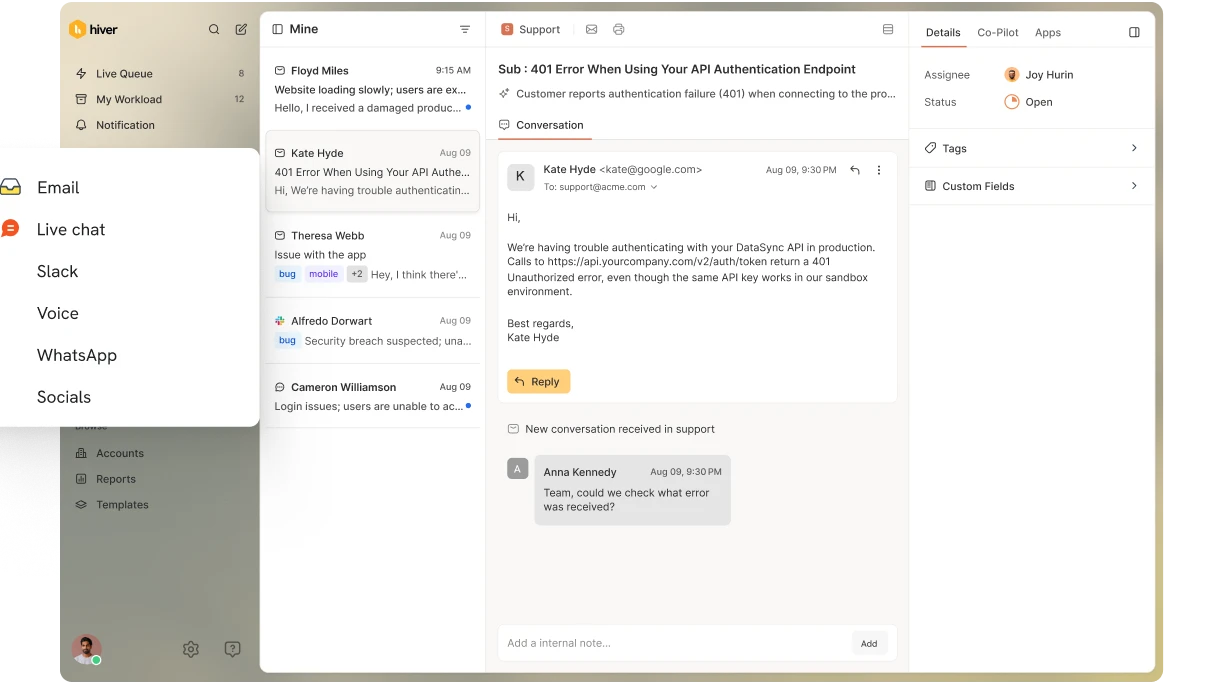
Hiver is an AI-powered, omnichannel customer service platform that automatically sorts, prioritizes, and assigns customer conversations as they come in. This removes the need for manual queue sorting when volume spikes.
One standout feature of this DevRev alternative is that once a conversation is assigned, Hiver AI summarizes long threads and highlights key details before an agent replies. This reduces context-switching, especially when tickets are reassigned or escalated.
Key Features
- AI Triage and Prioritization: Hiver AI analyzes incoming conversations and sorts them based on intent and urgency, so time-sensitive issues surface first.
- Automatic assignment by workload: It auto-assigns conversations to agents based on their availability and capacity, ensuring work is evenly distributed as volume changes.
- Real-time SLA tracking: You get visibility into which conversations are approaching their SLA deadlines and need intervention. This enables managers to step in and address issues before they affect customers.
- AI-assisted replies with context awareness: Hiver Copilot helps agents draft replies by pulling in relevant context from the conversation, past interactions, and internal notes. This reduces response time while keeping answers consistent and on-brand.
- Omnichannel workload view: Hiver’s omnichannel feature consolidates conversations from all channels into a single view. This makes it easier to identify overloads and balance work across the team.
Pros
- Assigning conversations, tracking status, and adding internal notes all happen in one place. This cuts down internal back-and-forth and helps teams respond faster during busy periods.
- Agents can assign, reply, tag, and add notes from the same screen without learning a complex object model. New agents can start handling conversations without long training or setup.
- “The ability to assign emails, track status, and communicate internally via notes improves productivity and response time significantly.”
- “The intuitive and simple interface is another aspect I enjoy, as it ensures that even those less tech-savvy find it user-friendly to adopt.”
Cons
- Slack integration is limited to notifications. Being able to manage or update conversations directly from Slack would save time for teams that live there.
- Reporting covers most support needs, but deeper customization would help teams that want more granular analysis.
- “A two-way integration with Slack would be extremely helpful. Right now, we can view some notifications, but deeper integration to manage tasks or conversations directly from Slack would improve efficiency.”
- “Also, the analytics are great, but occasionally I wish there were even deeper reporting options. Overall, these are minor compared to the value it provides.”
Reviews are from G2
Pricing
Hiver offers a free plan with conversation assignment, internal notes, and basic reporting. Paid plans start at $25 per user/month and offer AI-based sorting, automatic assignment, conversation summaries, and SLA tracking. A 7-day free trial is also available.
Who this is for
Hiver is ideal for CX and support teams that want AI-led automation and omnichannel support, without the need for heavy setup or ongoing configuration.
Who this is not for
Skip this if your primary goal is to manage product roadmaps, engineering backlogs, or tightly couple support tickets to development work.
Recommended reading
How AI Development Can Add More Humanity to Customer Service
2. Freshdesk – Best for SMB teams that want an all-in-one helpdesk
Freshdesk is a help desk platform designed for small and mid-sized teams. It brings email, chat, and phone support into one system without needing a lengthy technical onboarding. It adds structure to incoming support requests by using skill-based routing, prioritization, and SLA escalations. This ensures tickets are processed in a predictable order, even as volume increases.
Key Features
- Rule-based automation: Uses predefined rules to assign tickets, set priorities, and trigger escalations. It helps teams manage higher volume without constant manual sorting.
- Built-in SLAs and escalations: Tracks response and resolution times and escalates tickets as deadlines approach. It allows your team to stay on top of SLA commitments.
- Self-service and knowledge base: Enables teams to publish help articles and FAQs, reducing repetitive questions and incoming ticket volume.
- Basic reporting and dashboards: Offers clear visibility into ticket volume, response times, and agent performance without requiring advanced setup.
Pros
- Collaboration is enabled through native integrations with tools like Slack, Microsoft Teams, Outlook, and RingCentral. Agents can discuss, update, and act on tickets from the tools they already use without switching apps.
- Automation is flexible and easy to customize. You can adjust routing, priorities, and SLAs to match how your team actually works.
- “It provides full collaboration features (with Slack, Teams, Outlook, RingCentral), making it easier to work on the tickets.”
- “I really like how customizable the automation and workflows are from ticket routing to SLA setup; everything can be tailored to fit our exact needs.”
Cons
- The mobile app is less responsive than the desktop version, which limits its usefulness for handling tickets on the go.
- Reporting handles standard metrics well, but customization options are limited when teams want deeper or more tailored dashboards.
- “The mobile-based application of this tool is not as smooth as it should be.”
- “The reporting and analytics section could be more flexible, especially when creating custom dashboards.”
Reviews are from G2
Pricing
A free tier covers basic ticketing, which works for very small teams or simple setups. Paid plans start at $15 per agent per month, offering automation, SLAs, and additional channels. It makes Freshdesk more suitable once volume increases and response targets start to matter.
Who this is for
Small to mid-sized support teams that want to control routing, priorities, and SLAs through explicit rules.
Who this is not for
This is not a great fit if you want AI to handle routing, prioritization, and workload decisions automatically. It also falls short if you need workflows that adapt dynamically as volume and complexity grow.
Recommended reading
Freshdesk vs Hiver: Say goodbye to clunky UX and slow support
3. Zendesk – Best for large, multi-channel support operations
Zendesk is built for teams that need custom routing and escalation rules across support scenarios. Tickets can be routed by customer tier, issue type, channel, region, or agent skill.
For example, enterprise customers can follow one escalation path, billing issues another, and compliance-related tickets a third. You can define who receives a ticket first and when it should move to another team if it remains unresolved. If deadlines are missed, the system escalates the ticket automatically.
Key Features
- Multi-layer ticket views and queues: Creates separate views for teams, regions, or priorities so agents and managers focus only on relevant work.
- Role-based permissions and approvals: Controls who can view, update, or approve tickets, which matters in regulated or multi-team environments.
- Extensive app marketplace: Extends Zendesk with CRM, QA, workforce management, and analytics tools without custom development.
- AI-powered agent assist and deflection: Zendesk AI uses bots to handle common questions and suggests replies to agents during responses. It works best after workflows and knowledge bases are properly set up.
Pros
- It provides a centralized workspace for reviewing and managing incoming customer requests collaborativel. It eliminates the need for shared inboxes or email workarounds.
- Its robust reporting tracks trends like backlog growth, SLA breaches by group, and top contact reasons.
- “A centralized place for reviewing what information comes in that is accessible to multiple users without the need for a shared Gmail inbox.”
- “The integration with other tools and detailed reporting also makes it easy to track performance and improve customer satisfaction.”
Cons
- The platform takes time to set up and can feel overwhelming for new users, especially teams without prior experience managing complex support systems.
- Configuration and customization often require IT support and higher budgets, which can be a barrier for startups or smaller teams with limited resources.
- “While Zendesk Support Suite is powerful, it can feel overwhelming for new users due to its complex setup and wide range of features.”
- “Zendesk support suite has advanced and complex features that require IT resources for configuration and customization according to the company’s needs, which also need Budgets and extra costs. This could be a barrier to start-up companies that have small capital and low-skilled labourers who might need the training.”
Reviews are from G2
Pricing
Plans start at $19 per agent per month. Advanced automation, analytics, and full omnichannel support are available only on higher tiers,. This increases total cost as teams add agents, channels, and add-ons. Zendesk offers a 14-day free trial.
Who this is for
Teams with large support operations that need granular control over routing, workflows, and reporting across multiple channels.
Who this is not for
Not a good fit for teams that want support workflows to stay self-managing and straightforward. Avoid Zendesk if your team cannot dedicate time and budget to ongoing setup and admin work.
Recommended reading
4. Intercom – Best for chat-led and proactive support
If most customer questions come through in-app or website chat, teams often choose Intercom for its AI agent, Fin. It answers common questions directly in chat using your help docs and past conversations, so requests don’t need a human agent.
This approach reduces the volume of live chat support, keeping agents focused on complex issues rather than repetitive questions. Intercom works best when teams want AI to handle first-line support rather than manage long-running, SLA-driven tickets.
Key Features
- Messenger (in-app and website chat): Intercom lets teams chat with customers directly inside the app or on the website, instead of moving conversations to email.
- Fin (AI support agent): Answers common questions automatically using knowledge base articles and past conversations. It reduces the number of chats that reach agents.
- Workflows (chat automation and routing): Automates chat flows and routes conversations based on user actions, plan type, or lifecycle stage before an agent steps in.
- Inbox with AI Assist: Provides agents with reply suggestions and shortcuts during live chats, enabling them to respond faster with full context.
Pros
- Fin handles repetitive questions on its own, but hands off conversations smoothly when a human is needed. It ensures that customers still feel like they are talking to a real support team, not getting stuck in bot loops.
- Intercom integrates seamlessly with CRM platforms like Salesforce, HubSpot, and Zendesk, allowing support teams to easily slot it into their current setup without disrupting their workflow.
- “The balance between automation and human-like interaction makes it stand out from other AI tools.”
- “It integrates well with our existing tools and works right alongside our support team.”
Cons
- Fin relies heavily on your knowledge base. If articles are outdated, vague, or poorly structured, Fin gives incomplete or incorrect answers, which then creates more cleanup work for agents.
- Fin charges per resolution, and those costs rise fast as volume grows. You end up weighing whether each automated resolution is worth the spend, which makes pricing harder to predict.
- “Fin depends a lot on how well your help‑docs / knowledge base cover a topic. If your content isn’t clear, detailed, or well‑structured, Fin may misunderstand or give incomplete answers.”
- “Fin charges per resolution, which sounds fair until you realize how fast those costs add up. Intercom’s pricing tiers mean you’re constantly doing mental math about whether each resolution is “worth it.”
Reviews are from G2
Pricing
Intercom uses a usage-based pricing model. Plans start at $29 per month for the base bundle. Fin is priced separately at $0.99 per resolution, so costs increase as AI handles more conversations. A 14-day free trial is also available.
Who this is for
Teams that receive a high volume of short, repetitive questions that do not require follow-ups, handoffs, or long investigations.
Who this is not for
Not a good fit for teams that rely heavily on email workflows, need strict ticket tracking, or want predictable costs as volume increases.
Recommended reading
5. Help Scout – Best for small teams focused on personal, email-led support
Help Scout is built for small support teams that want simple, end-to-end ownership of customer conversations. It works best when agents manage requests from first reply to resolution without complex routing or automation.
Teams use Help Scout for email-based support, internal notes, and clear customer history. The platform favors predictable workflows over heavy configuration or AI-driven processes.
Key Features
- Shared inbox with collision detection: A shared inbox lets multiple agents work from the same set of customer conversations. This is where collision detection helps. It shows when someone else is already replying, so teams avoid duplicate responses and stay aligned, even when ownership is shared.
- Saved replies for common questions: Lets agents respond faster to repeat questions while keeping replies consistent and personal.
- Customer profiles with full conversation history: Shows past interactions in one place, helping agents maintain context across longer conversations.
- Docs knowledge base: Supports lightweight self-service for common questions without pushing teams into bot-heavy workflows.
Pros
- The Help Scout team is responsive and keeps customers informed about product updates clearly and helpfully. The updates focus on what’s changing and why it matters, not on pushing upgrades.
- Setup is quick, and ongoing maintenance is minimal. Because the system stays simple, teams spend more time helping customers and less time managing the tool.
- “Their team is constantly updating features and notifying their customers with new information and products in a way that isn’t salesy or pushy, but purely informative.”
- “Helpscout was easy to set up. And to maintain the system. And as a result, my customers are helped much better.”
Cons
- Reporting is fairly basic. It provides high-level visibility, but teams that require deeper or more advanced analytics will find it limiting.
- The Docs knowledge base lacks advanced features. Collaboration while editing, stronger article filtering, and bulk exports are required to make it more practical for larger or growing teams.
- “The reporting capabilities from Help Scout are shallow, and they need advanced support.”
- “Sometimes I wish it had more advanced functionality in the HelpDocs module like team collaboration in edit mode, article filtering to search, and the ability to download a list of all articles.”
Reviews are from G2
Pricing
A free plan is available with shared inbox access and basic reporting. Paid plans start at $25 per user per month and add features like saved replies, collision detection, and the Docs knowledge base. A free trial is available for paid plans.
Who this is for
Teams that handle a lower volume of conversations and prioritize thoughtful, human responses over speed or automation.
Who this is not for
Teams with high ticket volume or strict SLAs should avoid it. It is also not a good fit if you want AI to handle routing, prioritization, and deflection.
Recommended reading
6. Front – Best for cross-functional inbox collaboration
With Front, customer conversations stay in shared inboxes instead of becoming tickets. You assign an owner, add internal comments, and loop in teammates directly on the message before replying to the customer. This works best when conversations move between team members frequently, and you need quick coordination.
Key Features
- Front AI (reply drafting and summaries): Front AI helps agents draft responses and summarize long threads so they can step in quickly when conversations change hands.
- Shared drafts and activity indicators: Shows when someone is drafting or replying to a message, which helps avoid duplicate or conflicting responses.
- CRM data synced into conversations: Front pulls customer and account data from tools like Salesforce or HubSpot directly into the conversation view. You can see account details, deal status, or past interactions without switching tools.
- Internal comments and @mentions: You can collaborate directly inside a conversation, tag the right people, and decide on a response. All this without switching tools or forwarding messages.
Pros
- Front works well as a single place to manage conversations across Slack, WhatsApp, email, phone, calendars, and internal tools. Having everything in one interface reduces context switching and makes collaboration easier across teams.
- Setup is quick and straightforward. Teams can move to Front without a long onboarding phase, which makes the transition smooth and minimizes disruption to day-to-day work.
- “I like to use Front as a unifying tool for systems, which allows me to integrate Slack, WhatsApp, email, phone, calendar, and internal system into a single interface.”
- “The initial setup of Front for my team was super easy, which made the transition smooth and hassle-free.”
Cons
- Creating folders and tags is slow. You have to go into settings and add them one by one, which becomes frustrating during busy days.
- The interface can feel overwhelming when message volume spikes, especially with many notifications coming in at once.
- “I find the folder creation process in Front to be cumbersome and time-consuming. Each time I need to create tags, I have to navigate to the settings and do it manually one by one, which feels like a waste of time, especially during a busy day.”
- “One aspect I find challenging about Front is that it can become overwhelming, particularly when there is a large influx of messages and notifications.”
Reviews are from G2
Pricing
Plans start at $25 per user per month and include shared inboxes, basic workflows, and standard analytics. Higher tiers add features like omnichannel support, advanced automation rules, AI drafting and summaries, and expanded reporting. A free trial is available for 14 days.
Who this is for
Front is perfect if customer conversations regularly move between support, sales, and operations, and shared visibility matters more than strict ticket control.
Who this is not for
This is not a good fit for teams that rely on heavy automation, strict SLAs, or AI to handle routing and deflection at scale.
Recommended reading
7. Zoho Desk – Best for cost-conscious teams that want structure without complexity
Zoho Desk offers a high level of customization at a relatively low cost. You can configure ticket fields, layouts, workflows, and SLAs without upgrading to enterprise plans or paying separately for each capability.
This makes it practical for teams that need structured workflows but have strict budget limits. If you already use Zoho CRM, Zoho Desk keeps customer data and ticket history linked automatically. It reduces setup and keeps workflows consistent.
Key Features
- Zia AI: Zoho Desk has an AI assistant, Zia, that automatically classifies tickets, detects customer sentiment, and suggests responses to help agents triage and respond faster within existing workflows.
- Custom fields and layouts: You can tailor ticket fields and views to match your processes without upgrading to enterprise plans.
- Rule-based automation: You can control assignment, priority, and escalation using simple rules, without relying on AI or paid add-ons.
- SLA policies: You can define response and resolution targets and track breaches directly inside the ticket workflow.
Pros
- You can set up automations and workflows without developer help. Even advanced rules are manageable for small teams without technical expertise.
- Support responses are fast and directly helpful when you run into setup or configuration issues.
- “Honestly, the biggest surprise for me has been how easy it is to set up automations without being a developer. I’m configuring Zoho Desk for our 5-person team, and I expected the automation part to be a nightmare, but it’s actually pretty intuitive – even the Deluge script automations are manageable for someone like me who isn’t technical.”
- “Additionally, when we requested assistance for a specific issue, the response was very quick and effective.”
Cons
- The mobile app is limited. Accessing detailed ticket history or reviewing reports on the go is not as smooth as on a desktop.
- The interface is clunky, and building reports often takes multiple attempts to get the layout and filters right.
- “Some parts of the interface feel a bit clunky, and it takes a few tries to get reports to look the way you want.”
- “The mobile app can also feel somewhat limited, particularly when trying to access detailed ticket histories or generate reports while on the move.”
Reviews are from G2
Pricing
Zoho Desk offers a free plan for up to three agents. Paid plans start with the Express plan at $7 per user/month and add automation, SLAs, and customization. Higher tiers unlock omnichannel support and AI features, such as Zia. A 15-day free trial is also available.
Who this is for
Zoho Desk is a good fit if you want an affordable, all-around helpdesk with predictable pricing and traditional ticket workflows.
Who this is not for
Skip Zoho Desk if you want AI to handle routing and prioritization automatically. It’s also not a good fit if you need a more modern, collaboration-focused interface for daily work.
Recommended reading
8. Gorgias – Best for e-commerce support tied to revenue actions
Gorgias connects customer conversations directly to e-commerce data. From the same screen where an agent replies, they can issue refunds, cancel orders, edit subscriptions, or check delivery status. This eliminates tool switching, making e-commerce support faster and more efficient than a standard helpdesk.
Key Features
- Automation rules and macros: You can automate tagging, routing, and replies, and use macros to handle repetitive order questions quickly.
- Revenue and conversion tracking: You can measure how support interactions impact refunds and repeat purchases by linking conversations directly to order outcomes.
- Omnichannel support tied to orders: You can manage email, chat, and social messages in one place while keeping the full order context attached.
- Shopify-first workflow depth: You can complete common Shopify support tasks, like refunds, order edits, and subscription changes, directly from the support conversation without switching tools.
Pros
- Setup is quick and intuitive. The interface makes it easy to connect your store and start handling conversations without a long onboarding or technical setup.
- Automation features like intent detection, macros, and automated replies help teams handle high ticket volume while still keeping responses relevant and personalized.
- “The setup process was straightforward, thanks in part to the user-friendly UX, which made getting started a breeze.”
- “Features like automated responses, intent detection, and macros allow teams to handle high volumes of inquiries quickly without sacrificing personalization.”
Cons
- Training the AI agent takes effort. The controls are not very intuitive, which makes fine-tuning intent detection and responses harder than they should be.
- Analytics are more technical than agent-friendly. Team leads may find it harder to pull and share clear performance metrics with frontline agents quickly.
- “I wish there were better, more intuitive options for training the AI agent.”
- “The analytics, from a team leader’s perspective, can be a bit challenging. Whenever I have to share the agent’s metrics, it’s a bit more technical than what the customer support agents are used to.”
Reviews are from G2
Pricing
Gorgias uses usage-based pricing that scales with ticket volume. Plans start at $10 per month, with costs increasing as volume and channels grow. AI agents are priced as an add-on at $0.90 per month. A 7-day free trial is available to evaluate the platform before committing.
Who this is for
Gorgias is a perfect fit if most support tickets are tied to orders, shipping, returns, or subscriptions, and agents need to take action inside the conversation.
Who this is not for
Skip Gorgias if your support work isn’t ecommerce-driven. It’s designed around orders and shipping workflows, which don’t map well to general support. It’s also a poor fit if you need predictable per-agent pricing instead of volume-based costs.
Recommended reading
9. ServiceNow – Best for large, regulated enterprises with complex workflows
ServiceNow runs customer support inside a broader enterprise IT service management system. Tickets follow defined workflows with approvals, role-based access, and audit trails. These workflows are often tied to IT, security, or internal service processes. Every workflow is controlled and traceable by design. This makes ServiceNow effective for regulated environments, but inflexible for fast-moving customer support teams.
Key Features
- AI-powered automation and agent assist: ServiceNow AI classifies tickets, predicts routing, suggests next actions, and assists agents during resolution. All this is achieved within existing workflows, rather than through separate bots.
- Low-code workflow and form builder: You can build and modify workflows, approval steps, and ticket forms using visual tools. This makes it possible to adapt processes without writing custom code, even as requirements change.
- Enterprise system integrations: Support workflows can connect directly to CMDBs, identity systems, security tools, and internal service catalogs. This keeps support actions tied to the systems that actually control access, assets, and risk.
- Audit and compliance framework: Every change, action, and approval is logged automatically. This creates a complete audit trail for compliance, reviews, and regulatory reporting without additional tooling.
Pros
- Dashboards and reports give leaders clear visibility into ticket volume, SLA compliance, and bottlenecks, making it easier to monitor service performance and enforce accountability.
- The platform scales well across large organizations. Built-in self-service portals, structured workflows, and enterprise reporting improve efficiency for IT teams. It also provides end users awith a more consistent service experience.
- “The dashboard and reporting features make it easy to track service performance and ensure SLAs are met.”
- “The platform’s scalability, reporting capabilities, and self-service portal significantly improve operational efficiency, visibility, and overall user experience for both IT teams and end users.”
Cons
- The platform has a steep learning curve. Initial setup and ongoing customization require technical expertise, and changes often take time to implement.
- Licensing costs are high. Since the pricing is geared toward large enterprises, it makes ServiceNow hard to justify for smaller teams or organizations with limited budgets.
- “While ServiceNow offers robust capabilities, the platform may seem somewhat complicated for newcomers. Setting up and configuring the system initially demands a certain level of technical expertise, and making customizations can often take considerable time.”
- “Additionally, the licensing fees can be quite steep for smaller organizations, potentially making the platform less accessible.”
Reviews are from G2
Pricing
ServiceNow uses custom, quote-based pricing based on modules, user types, and scale. Pricing varies widely, and costs are typically high compared to standard helpdesk tools.
Who this is for
ServiceNow is the right choice if support workflows must follow strict rules, approvals, and compliance standards across a large organization.
Who this is not for
Avoid ServiceNow if you want a quick setup, simple agent workflows, or a tool focused primarily on day-to-day customer support execution.
Recommended reading
ServiceNow Pricing 2025: License Types, Hidden Fees & What You Actually Pay
10. Jira Service Management – Best for engineering-led support teams
Jira Service Management (JSM) is designed to keep customer support tightly connected to engineering work. Support requests can convert directly into Jira issues, inherit workflows, and follow the same prioritization logic engineers already use. This makes handoffs between support and engineering explicit and traceable.
It works best for bug reports, incidents, or feature-related issues that require engineering involvement. It is less focused on customer-facing experience and more on internal coordination and issue resolution.
Key Features
- Rovo AI (AI assist): Atlassian Intelligence helps with ticket summaries, suggested replies, and faster issue triage inside Jira workflows.
- Change management (CAB workflows): You can route changes through predefined approval steps, assign risk levels, and document rollback plans. This is especially useful for teams managing production releases or infrastructure updates.
- Custom request types and workflows: You can define separate forms and workflows for bugs, incidents, access requests, and service tasks. Bugs go to engineering, access requests follow approval steps, and incidents escalate automatically.
- SLA tracking and reporting: You can see which tickets are at risk of missing SLAs while they’re still being worked on. This helps teams step in before deadlines are missed.
Pros
- Deep integration with developer tools like Bitbucket and GitHub lets you link code commits directly to tickets. You can see progress on bugs or features without chasing engineers for updates.
- Built-in reports make it easy to track ticket progress, SLA performance, and bottlenecks across support and engineering. It helps maintain clear ownership without manual follow-ups.
- “The integration with development tools (like Bitbucket/GitHub) is excellent, allowing us to link code commits directly to tickets so we always know the status of a feature without bothering the developers.”
- “Its robust reporting analytics and automated recurring tasks help maintain clear accountability.”
Cons
- The interface is complex and overwhelming at first. There are many options and settings, which makes onboarding slower for new users.
- Configuring workflows and permissions is complicated. Even small changes often require a dedicated Jira admin to avoid breaking existing processes.
- “One thing I dislike about Jira is that when I first started using it, it felt very complex and overwhelming. The UI has a lot of options, and it takes time to understand how everything works.”
- “Configuring permissions and workflows is also overly complicated; you often need a dedicated Jira Admin just to make simple process changes without breaking something else.”
Reviews are from G2
Pricing
Jira Service Management offers a free plan for up to three agents with core ticketing and basic automation. Paid plans start at $7.91 per user/month and scale with added features like advanced SLAs, automation rules, and incident management. A 7-day free trial is available for all paid tiers.
Who this is for
Jira Service Management works best when customer support teams regularly hand off issues to engineering teams, and both need to track bugs, incidents, and fixes in Jira.
Who this is not for
Skip this if your support team requires a modern, customer-facing experience that works across multiple channels. It’s also not the right fit if you need AI to handle routing and responses without heavy setup.
Recommended reading
11. HubSpot Service Hub – Best for CRM-first support teams
HubSpot Service Hub handles support inside the same CRM that sales and marketing teams use. Tickets, emails, chats, and calls are attached directly to contact and company records, along with deal history and lifecycle data. This works well when support decisions depend on account context, revenue stage, or customer history.
Key Features
- AI assistance: HubSpot AI, Breeze, helps draft replies, summarize tickets, and suggest content, mainly to speed up agent responses.
- Shared inbox and help desk features: You can manage email, chat, and form submissions in one place with basic routing and ownership.
- Knowledge base and customer portal: You can publish help articles and give customers a portal to track their tickets.
- Automation and playbooks: You can automate simple routing, follow-ups, and internal actions using HubSpot workflows.
Pros
- The interface is easy to pick up, so new team members can start working without a long training ramp.
- Reporting is straightforward. You can quickly see how the team is performing and where things need improvement without digging through complex dashboards.
- “I also appreciate how intuitive the interface is—training new team members is quick.”
- “The reporting tools make it easy to track performance and identify areas for improvement.”
Cons
- Advanced automation and workflows require setup time, and reporting customization is limited compared to dedicated helpdesks.
- Costs increase sharply on higher tiers. The free plan covers only the basics, and paid plans bundle features that many support teams may not need.
- “Some of the more advanced features can be a bit complex to set up, and customization options for reporting could be more flexible.”
- “The premium version of HubSpot Service Hub is very expensive, and the free version has very limited access to features.”
Reviews are from G2
Pricing
HubSpot Service Hub offers a free plan with basic ticketing. Paid plans start at $9 per user per month for the Starter tier. The Professional and Enterprise plans unlock automation, customer portals, and AI features. Pricing increases significantly as you move up tiers, especially for larger teams.
Who this is for
This is the perfect fit if your support team works closely with sales or customer success and relies heavily on shared CRM data.
Who this is not for
Skip HubSpot Service Hub if your team handles a high volume of tickets. Its SLA controls and routing options are limited. This makes it harder to enforce deadlines or move work quickly between agents and teams.
Recommended reading
12. Salesforce Service Cloud – Best for Salesforce-centric, enterprise support teams
Salesforce Service Cloud is designed for account-based, enterprise support. Every case (customer request) is governed by CRM data such as customer tier, contracts, entitlements, and account hierarchy. This allows teams to enforce different SLAs, routing rules, and service levels based on who the customer is, not just what the issue is. This level of control is powerful for large organizations with complex support agreements.
Key Features
- Rules-based case routing at enterprise scale: You can route cases using custom conditions such as customer tier, product line, region, language, and agent skill. This is built for large teams handling multiple support tiers and queues.
- Einstein AI for Service: Salesforce Einstein helps classify incoming cases, suggest replies, and recommend next actions based on CRM data and past resolutions. The AI works directly inside Salesforce case views and queues. Suggestions appear as agents work, instead of routing conversations through a separate bot or automation layer.
- Omnichannel with workload management: You can manage email, chat, phone, and messaging in one queue while controlling agent capacity, availability, and priority across channels.
- Field service and escalation controls: Cases can escalate into field service tasks, approvals, or cross-team workflows, which is useful for organizations that support complex products or regulated processes.
Pros
- All customer data is in one place. Agents can view account details, contracts, and past cases on the same screen, eliminating the need to switch tools or re-establish context.
- Salesforce Service Cloud dashboards give managers a live view of response times across teams and queues. This makes it easier to spot delays as they build and step in before cases fall behind.
- “I appreciate how it unifies information by bringing everything I need to know about the customer into one place.”
- “The dashboards are very useful for monitoring response times and identifying any areas where delays might be occurring.”
Cons
- The interface is dense and takes time to learn. Even small changes often require navigating multiple settings, which slows down day-to-day adjustments.
- Heavy customization can impact usability. As workflows, rules, and data volume grow, the interface can feel cluttered, and performance may slow down.
- “At first, the sheer number of features and settings can feel a bit overwhelming. Making simple adjustments often requires more steps than you might anticipate, and navigating through the menus can be confusing.”
- “Some users feel the interface can be a bit busy, and performance may slow down if the system is heavily customized or handling large amounts of data.”
Reviews are from G2
Pricing
Salesforce Service Cloud offers a free starter suite with up to two users, which includes basic case management and limited features. Paid plans start at $25 per user/month. The higher tiers are required for omnichannel routing, advanced automation, entitlements, and Einstein AI. A 30-day free trial is available on paid plans.
Who this is for
Salesforce Service Cloud is a strong fit if your company already runs on Salesforce and support needs to follow account structure, contracts, and CRM-driven rules.
Who this is not for
Skip it if you want a quick setup, simple support workflows, or predictable pricing without the need for Salesforce-level administration.
Recommended reading
Sales Support: How to Build It and Help Your Team Close More Deals
Why Are Companies Looking for DevRev Alternatives?
Teams often adopt DevRev to improve alignment with product and engineering. Many later find that this structure adds friction to everyday support work, which is when they start looking for alternatives.
1. Support work is tied too closely to product and engineering objects
Agents often have to navigate issues, parts, or roadmaps to resolve simple requests, such as billing questions or access changes. This adds steps without improving resolution.
“The interface can be a bit confusing at first, and sometimes finding specific information takes longer than expected. It’s powerful, but there’s a learning curve.”
This pushes support teams toward support-first tools like Hiver, Zendesk, or Help Scout. Agents can work from clear queues without navigating product or development objects.
2. Integration and customization restrictions
Users have mentioned gaps in integrations (e.g., local messaging tools or telephony) and challenges with tailoring workflows or APIs to specific needs.
“While the major ones (Slack, GitHub, etc.) work well, I’d love to see deeper connections with tools like Salesforce, Jira, and other enterprise apps.”
These gaps often send support teams looking for platforms with broader integrations and more flexible workflows. Tools like Hiver, Zendesk, Front, or Salesforce Service Cloud fit more easily into existing support stacks.
3. Steep learning curve and onboarding friction
New users, especially non-technical agents, take longer to get comfortable with how DevRev structures work. This slows early adoption and delays productivity because the workflow is built around product objects, not support queues.
“Because DevRev brings multiple functions (support, product, engineering) into one place, it can take new users a little time to adapt to the workflow.”
In response, support teams favor tools like Hiver, Help Scout, or Freshdesk. These platforms are built around support workflows, so non-technical agents ramp faster and reach productivity sooner.
4. Limited mobile experience
The mobile app makes it difficult to review context, update tickets, or track ownership, which limits its usefulness for on-the-go support work.
“Mobile experience works fine for basic tasks, but advanced features are better on desktop.”
As a result, teams adopt tools like Zendesk, Freshdesk, or Salesforce Service Cloud. They offer stronger mobile workflows. Agents can review context, update tickets, and track ownership on the go.
User reviews are from G2
Recommended reading
Key Features to Look for in DevRev Competitors
When evaluating DevRev alternatives, focus on features that remove friction from daily support work, not platforms that add new layers of process.
1. Clear ownership and SLA visibility
Check whether you can see the owner and SLA risk of a ticket at a glance. If you need custom views or reports to answer “who owns this” or “what’s about to breach,” that’s a red flag.
2. AI that reduces manual work
Look for AI that automatically classifies tickets, prioritizes urgency, and summarizes long threads before an agent responds. If AI only drafts responses or needs heavy training, it won’t save much time.
3. Reporting you can use without setup
You should be able to answer basic questions immediately. What’s in the backlog? Where are delays happening? Which issues keep repeating? If reporting requires dashboards, exports, or admin help, it slows decision-making.
4. Fast agent onboarding
Ask how long it takes a new agent to handle real tickets. Tools that require weeks of training or configuration usually add process overhead rather than removing it.
5. Pricing that stays predictable
Prefer per-agent pricing over usage-based models tied to volume, AI actions, or internal users. This keeps monthly costs stable even when ticket volume spikes, seasonal demand changes, or automation usage increases.
6. Built-in email and chat support
Core channels should work out of the box. If email or chat requires add-ons, plugins, or workarounds, complexity will grow quickly.
How to Choose the Right DevRev Alternative for Your Team
By this point, the pattern should be clear. Most teams move away from DevRev because everyday support work becomes heavier than it needs to be.
The right alternative depends on how your team already works. If support regularly hands issues to engineering, tools like Jira Service Management make that handoff explicit. If account context and contracts drive decisions, CRM-first platforms like Salesforce Service Cloud or HubSpot Service Hub fit better. If speed and shared visibility across teams are most important, Front is a strong shared-inbox alternative.
If your priority is executing support at scale without added product or engineering complexity, Hiver fits teams that want simple workflows. AI-led triage, clear ownership, and omnichannel support help teams move faster as volume increases.
Frequently Asked Questions
1. What is DevRev?
DevRev is a platform that combines product, engineering, and support data into a single system. It links customer issues, development work, and support conversations so product and engineering teams can see the full context of customer problems in one place.
2. What is the best alternative to DevRev for small teams?
For small support teams focused on operational simplicity and fast time to value, Hiver is often the best alternative. It provides AI-led triage, clear ownership, and omnichannel support, all without requiring heavy setup or technical dependencies.
3. Why are companies switching from DevRev?
Companies usually switch because DevRev’s product-engineering integration adds overhead to daily support work. Common reasons include:
-Support workflows become tied to product/engineering objects unnecessarily.
-Setting up and changing workflows requires technical resources.
-Pricing becomes hard to predict as usage grows.
-Reporting and SLA visibility require custom configuration.
4. Can DevRev integrate with Slack, Jira, or traditional help desk software?
Yes, DevRev can integrate with tools like Slack and Jira, but integrations often require configuration and technical involvement. In many cases, teams find these integrations less seamless than in traditional helpdesk platforms that offer deeper, built-in support for these tools.
5. Is DevRev a CRM or a helpdesk tool?
DevRev is neither a traditional CRM nor a traditional helpdesk tool. It blends support, product, and engineering data in one platform. Because of this hybrid model, it behaves differently from dedicated CRM systems (like Salesforce) or helpdesk tools (like Freshdesk or Hiver).
6. What features do DevRev competitors offer?
Competitors vary by focus, but key capabilities across leading alternatives include:
-Clear ticket ownership and SLA tracking (e.g., Zendesk, Hiver)
-AI for triage and summaries (e.g., Hiver, Intercom Fin)
-CRM-linked support (e.g., Salesforce Service Cloud, HubSpot Service Hub)
-Engineering workflow alignment (e.g., Jira Service Management)
-Omnichannel routing and automation (e.g., Zendesk, Freshdesk)
-Order and ecommerce actions for direct transactional support (e.g., Gorgias)