

HubSpot vs. Salesforce - A Detailed Comparison
A straightforward breakdown of HubSpot vs. Salesforce, and Hiver across core features, pricing, support capabilities, integrations, and usability. Facts to help you decide what’s best for your business needs.
HubSpot vs. Salesforce vs. Hiver
Quick Decision Guide
HubSpot vs. Salesforce vs. Hiver Platform Comparison
Hubspot vs. Salesforce vs. Hiver Overview
Feature Deep Dive
Migration considerations when switching between platforms
Final Recommendations
Next Steps
6 reasons why Hiver can be the better option compared to HubSpot vs. Salesforce
Choosing the right customer support platform can feel overwhelming. With hundreds of options available, it’s easy to get lost in feature lists and vendor promises. After spending months testing HubSpot, Salesforce, and Hiver with real support teams, I’ve learned that the best platform isn’t always the one with the most features. It’s the one that actually makes your team’s job easier.
This guide breaks down three fundamentally different approaches to customer support, helping you understand which one fits your team’s actual needs, not just what sounds impressive in demos.
Quick Decision Guide
Choose HubSpot Service Hub if: You’re already using HubSpot’s CRM and want unified customer data across marketing, sales, and support workflows.
Choose Salesforce Service Cloud if: You’re running an enterprise with complex processes, need extensive customization, and have dedicated IT resources for implementation.
Choose Hiver if: You want a platform that can handle all your complex workflows, has AI Agents that can automate common processes, and a workspace your team understands on day one.
HubSpot vs. Salesforce vs. Hiver Platform Comparison
Setup Time
45-75 days
Weeks to months
Hours
Ticketing & Case Mgmt
Advanced and customizable.
Built-in, tied to CRM
Efficient, SLA‑driven ticket workflows
Shared Inbox & Collaboration
Multiple queues, teams.
Shared views, portal access
Shared inbox with tagging, collision detection
Automation & Workflows
Full automation, macros, AI.
CRM-based automation
Built-in automation for SLA, routing without code
Knowledge Base
Robust external and internal help center.
Integrated KB with CRM sync
Internal KB for agents; no public portal
Multi-Channel Support
Email, chat, phone, social.
Primarily email/chat; voice via Twilio
Chat, voice, WhatsApp, email, all in one platform
Reporting & Analytics
Enterprise analytics & forecasting.
Basic dashboards; tied to CRM
Response time metrics, SLAs, team productivity stats
Ease of Setup
Days or weeks with admin involvement.
Moderate; easier if using HubSpot CRM
Very fast, self-setup within hours
Pricing Transparency
Add-ons raise total cost.
Scales with CRM usage and paid tiers
Flat, clear pricing; Growth starts at $25/user
Admin & Maintenance Overhead
High admin and configuration effort.
Moderate; benefits from CRM familiarity
Minimal ongoing admin; intuitive collaboration focus
Hubspot vs. Salesforce vs. Hiver Overview
Choosing the right help desk software can be overwhelming. There are plenty of options, but which one is truly right for your team? Let’s break it down, step by step, to make sure you pick the best tool for your business.
HubSpot: The Integrated Approach
HubSpot works best when you’re already invested in HubSpot’s ecosystem. It combines ticketing, automation, and customer portals with your existing CRM data, creating a unified view of each customer’s journey from marketing touchpoint to support resolution.
What makes it valuable:
- Support tickets automatically connect to contact records, deal history, and marketing interactions
- Workflows can trigger across teams, a support issue can alert sales about account risks
- Knowledge base integrates with your content marketing strategy
- Reporting aligns with your existing sales and marketing dashboards
Where it falls short:
- Support features feel secondary to CRM functionality
- Advanced capabilities require expensive tier upgrades
- Implementation complexity grows with customization needs
- Limited flexibility for support-specific workflows
User experience: A HubSpot user took to Reddit to share both the pros and cons of the platform. Among the drawbacks, the setup process, portal customization, and pricing stood out as key challenges. They wrote:
“The setup process takes real work. You need to plan your pipelines, properties, and workflows ahead of time. If you skip that and just turn it on, it can feel underwhelming. We spent time mapping out how we wanted the portal to work before inviting clients in. Portal customization is limited. You can brand it and edit the copy, but you won’t get full design control. It works well for support use cases, but if you’re hoping to use it as a more general client dashboard, there are some layout limitations. Pricing feels like a stretch if you’re not fully using it. If you’re only getting a handful of tickets per month, you might not see a strong return. But once you scale past that, the time saved through automation and tracking makes it worthwhile.”
This captures HubSpot’s reality: powerful when properly implemented, disappointing if you expect it to work perfectly out of the box.
Salesforce: The Enterprise Powerhouse
Salesforce is built for organizations that need industrial-strength case management. It offers granular workflow controls, advanced AI capabilities, and extensive customization options through its massive ecosystem.
Core strengths:
- Advanced case routing based on agent skills, customer value, and complex business rules
- Einstein AI provides predictive case classification and automated response suggestions
- Agentforce enables custom AI agents for specific support scenarios
- AppExchange offers 4,000+ integrations and specialized applications
- Enterprise-grade reporting and compliance capabilities
Implementation realities:
- Setup typically requires weeks or months of planning and configuration
- Steep learning curve for both agents and administrators
- Pricing complexity with numerous add-ons and feature tiers
- Often over-engineered for mid-sized teams’ actual needs
User experience: On G2, a Salesforce user shared their experience, reflecting on the challenges they faced while navigating the platform. Their review paints a familiar picture for teams who value flexibility but struggle with complexity and cost”
“It can feel overly complex at times, especially with all the customizable features and settings, which can be overwhelming to manage. Additionally, it can be pricey depending on the features needed, and sometimes the interface isn’t as intuitive as it could be.”
Salesforce delivers incredible capability, but that capability comes with significant complexity overhead.
Hiver: The agentic omnichannel solution
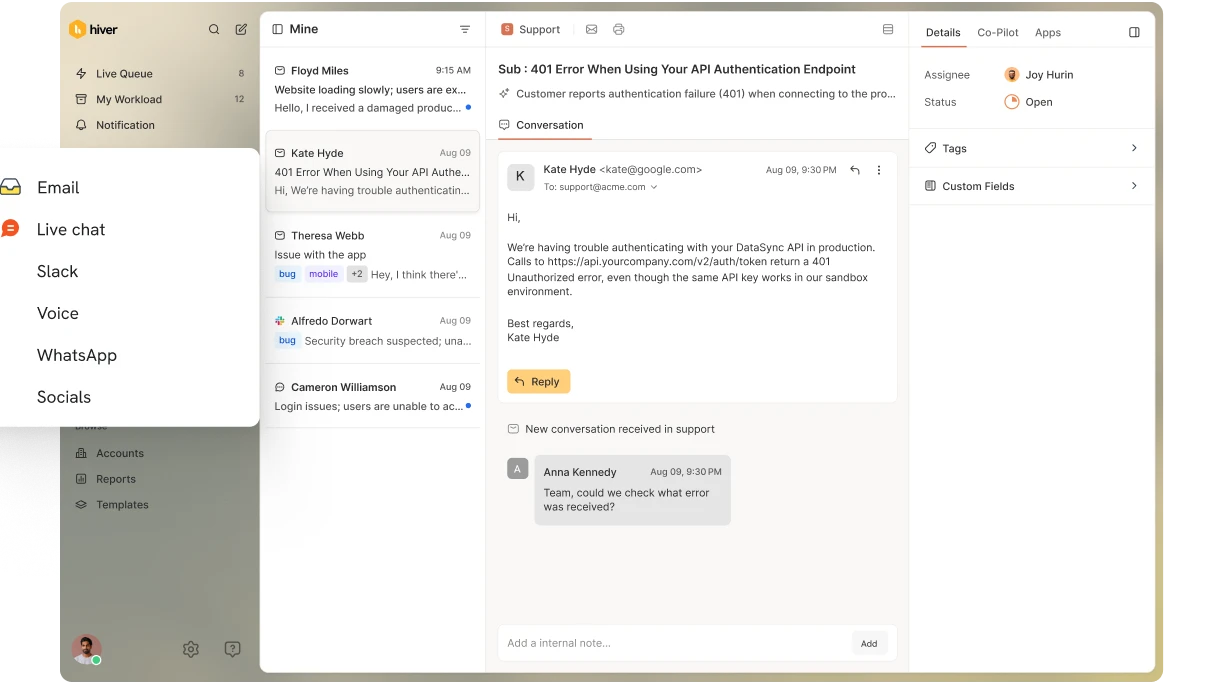
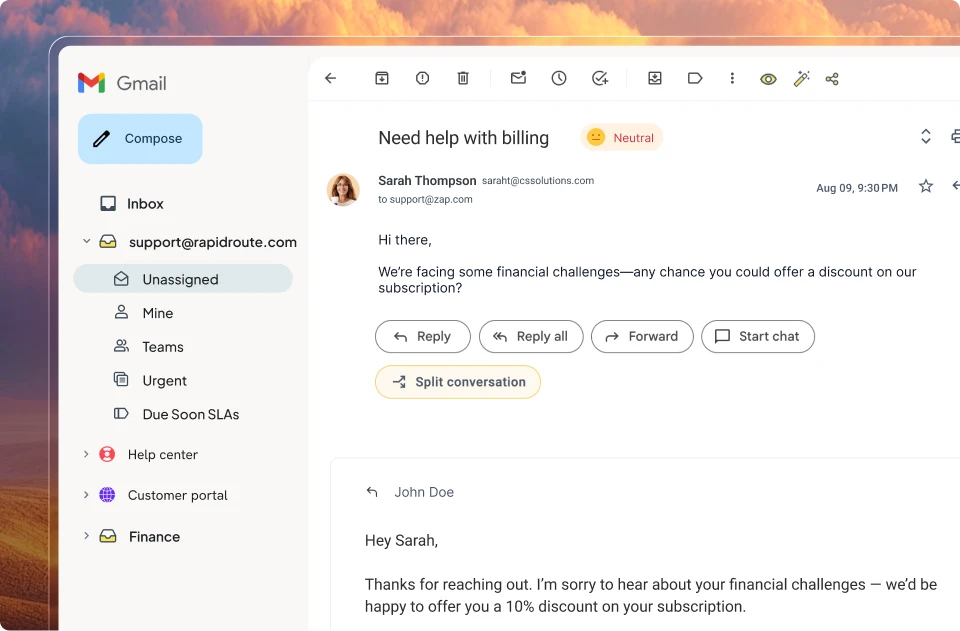
Hiver is an agentic omnichannel customer service platform, and it ships in two forms. Teams that live in Gmail run Hiver there, with no new interface to learn. Teams that need a dedicated omnichannel workspace run Hiver Omni, with email, chat, Slack, voice, and WhatsApp in one place. Same AI Agents, same automation, same reporting underneath.
Key differentiators:
- AI Agents run complex support: lookups across your other systems, multi-step approvals, the action taken and not just the reply drafted
- Setup and configuration in natural language. Teams go live in an hour.
- Built-in cross-team collaboration features like Slack threads, linked Jira and Linear issues, notes, and collision detection
- Visual workflow builder to automate triage, routing, escalations, and more
- Omnichannel support (email, chat, voice, WhatsApp)
Focused limitations:
- Not designed as a full CRM replacement for sales pipeline management
- Integration ecosystem is smaller than enterprise platforms
- Customization focuses on support workflows rather than broad business processes
User experience: A DevOps Engineer shared their experience using Hiver on G2, highlighting how it helped their team manage high email volumes. Their review reflects the kind of support and adaptability many growing teams look for and often don’t find in larger, less hands-on platforms:
“We are a large customer of Hiver with 75 users and a large volume of emails going through it. Hiver has a good product for collecting email analytics and improving email workflow. But the best part is the team. They are very helpful and a partner in the process of implementing the application. This is something some other competitors don’t offer. We appreciate all they have done to make the tool work for our unusual use case. It’s an easy application to use and integrates easily with all of our clients.”
The emphasis on partnership and practical implementation support often matters more than feature breadth.
Feature Deep Dive
Ticketing and Case Management: How they actually handle your daily chaos
Ticketing systems can either save your sanity or slowly crush your soul. The key is finding one that organizes your work without making every simple task feel like filling out tax forms.
Salesforce can set up routing rules that consider everything: agent expertise, customer VIP status, issue complexity, time zones, and probably the weather if you really wanted to. Need to automatically escalate billing issues from enterprise clients to your senior team during business hours only? Salesforce can do that. The catch? Someone needs to actually build and maintain all these rules, which usually means hiring a Salesforce admin or becoming one yourself.
HubSpot takes a more balanced approach. When a support ticket comes in, you can immediately see the customer’s complete history, their recent purchases, what marketing emails they’ve opened, which sales rep they’ve talked to. It’s a genuinely helpful context that can turn a generic “my account isn’t working” into “this customer just spent $10k and is trying to onboard their team.” The ticketing itself is straightforward, though you’ll hit some walls if you need complex routing without upgrading your plan.
Hiver’s interface is extremely intuitive, making it effortless to get started.
Here’s how it actually works: You can assign customer emails to team members with one click, add tags like “billing” or “urgent,” and track status as Open, Pending, or Closed, all without leaving Gmail or Outlook. Internal notes appear as color-coded comments that only your team sees, so you can add context like “customer called about this yesterday” or “needs follow-up with technical team” right in the email thread.
The genius is in what you don’t have to do. No copying and pasting customer emails into a separate system. No switching between tabs to update ticket status. No explaining to new hires how your ticketing system works because they already know how to use email. Collision detection prevents duplicate responses by showing when a colleague is already working on the same email.
Team Collaboration: Avoiding the "I Thought You Were Handling That" Problem
Nothing kills customer trust faster than getting three different responses from three different agents, or worse, no response because everyone assumed someone else was handling it.
HubSpot gives you shared inboxes that work well when your team is small and everyone knows what everyone else is doing. It’s like having a shared desk, functional until too many people try to use it at once. You get basic collision detection, so at least you know when someone else is looking at the same ticket.
Salesforce approaches collaboration like a corporate project management system. You have Chatter for internal discussions, queues for organizing work, and detailed assignment rules. It’s thorough but can feel heavy-handed for everyday support work. Imagine using Microsoft Project to organize your grocery shopping. Technically it would work, but you might miss the simplicity of a regular list.
Hiver nails this by keeping collaboration inside a single workspace:
- Collision detection: Get a heads-up when a colleague is already working on the same email. This means no more duplicate responses
- Private notes: Add internal comments that customers never see, like “this customer called yesterday about the same issue”
- Shared drafts: When you need team input on a tricky response, colleagues can add suggestions before you hit send
- @mentions: Ping specific team members directly within the email thread
Automation: Your Robot Assistant (When It Works Right)
Good automation makes for a really efficient assistant who handles routine stuff so you can focus on complex problems. Bad automation follows rules so rigidly it creates more work than it saves.
Salesforce offers automation that borders on artificial intelligence. Einstein can look at an incoming case and predict whether it’s likely to escalate, suggest which knowledge base articles might help, and even draft potential responses based on similar historical cases. The new Agentforce feature can actually handle entire conversations for routine issues. It’s impressive when it works, but setting it up properly requires significant time investment and enough historical data for the AI to learn from.
HubSpot Service provides solid automation that integrates well with your CRM data. It can automatically assign VIP customer issues to senior agents, trigger follow-up sequences for resolved tickets, and escalate cases that haven’t been touched in X hours. The automation rules are reasonably intuitive if you already think in HubSpot terms, though you might need to upgrade your plan for the really smart stuff.
Hiver focuses on automation that actually saves time without requiring a computer science degree:
- Smart assignment: Distribute tickets fairly across your team or route specific types of issues to specialists
- SLA tracking: Get alerts before you miss response time commitments, not after
- Response templates: Smart suggestions based on what the customer actually wrote, not just generic canned responses
- Follow-up reminders: Automatic nudges for cases waiting on customer responses
The key difference? Hiver’s automation works out of the box, while the others require configuration time that most teams underestimate.
Multi-Channel Support: Meeting Customers Where They Are
Your customers don’t think in channels, they just want help. Whether they email, chat, call, or WhatsApp, they expect you to have context about their previous interactions.
Salesforce is the omnichannel champion. It can handle phone calls with automatic transcription, web chat with screen sharing, social media monitoring, SMS, WhatsApp Business, and integrations with platforms you’ve probably never heard of. The impressive part is how it maintains context across all these channels. The challenging part is that each channel often requires separate setup and sometimes additional licensing costs.
HubSpot does email and chat really well, and you can add phone support through their Twilio integration. Social media monitoring exists but feels like an afterthought compared to their core CRM functionality. For most businesses, it covers the essential bases without overwhelming complexity.
Hiver takes an interesting approach by unifying everything within one intuitive interface:
- Email: Works natively with Gmail and Outlook
- Live chat: Web widget that creates email threads for each conversation
- Voice calls: Click-to-call functionality with automatic conversation logging
- WhatsApp Business: Direct integration that treats messages like email threads
- SMS: Text conversations that appear alongside email history
Instead of jumping between different tools for different channels, everything appears in one unified conversation view. It’s not the most feature-rich omnichannel solution, but it might be the most usable.
AI Features: Helpful Robot or Overhyped Marketing?
Everyone’s talking about AI in customer support, but the reality is that most AI features fall into two categories: genuinely helpful time-savers or impressive demos that don’t quite work in real life.
Salesforce Einstein AI is the most sophisticated option, and when it has enough data to work with, it can be genuinely impressive. It analyzes customer sentiment in real-time (useful for identifying frustrated customers before they escalate), suggests relevant knowledge base articles, and can even draft response recommendations based on similar historical cases. The newer Agentforce capabilities can handle entire customer conversations for routine issues. The catch? You need Enterprise-level pricing and substantial case volume for Einstein to be effective. It’s like hiring a brilliant consultant who needs six months to understand your business before becoming useful.
HubSpot Breeze AI feels more practical for everyday use. Even on lower-tier plans, you get AI writing assistance for responses and knowledge base articles. The Breeze Copilot can summarize customer conversations, suggest next steps, and help create content. It’s not as sophisticated as Einstein, but it’s immediately useful without requiring massive data sets or lengthy training periods.
Hiver’s AI focuses on practical automation that works right away:
- Intelligent routing: Analyzes email content to suggest the best agent for each issue
- Smart templates: Recommends relevant response templates based on what the customer actually wrote
- Performance insights: Identifies patterns in your team’s workflow and suggests improvements
Migration considerations when switching between platforms
From any platform to Hiver: Generally straightforward since email data remains in existing accounts.
HubSpot to Salesforce: Complex due to data model differences. Requires extensive planning and often custom development.
Salesforce to HubSpot: Moderately complex, typically requires simplifying workflows and accepting some feature limitations.
Final Recommendations
For Most Growing Teams: Consider Hiver First
Unless you have specific enterprise requirements or deep CRM integration needs, Hiver offers the best balance of powerful features and operational simplicity. The platform is intuitive to use and eliminates learning curve while providing professional support capabilities.
Best for: Teams that want better support tools without operational disruption
For CRM-Integrated Organizations: HubSpot Makes Sense
If you’re already invested in HubSpot’s ecosystem or need tight integration between marketing, sales, and support functions, HubSpot provides clear value despite higher complexity and cost.
Best for: Organizations prioritizing unified customer data and cross-team workflows
For Enterprise Requirements: Salesforce Delivers
When compliance needs, extensive customization, or enterprise-scale operations are essential, Salesforce justifies its complexity and investment through unmatched capability.
Best for: Large organizations with dedicated resources and requirements smaller platforms cannot meet
Next Steps
If you're interested in Hiver:
- Book a demo
- See how it works with your actual support workflow
- Most teams know within 24 hours if it’s the right fit
If HubSpot seems right:
- Assess your current CRM integration needs
- Plan for 2-3 month implementation timeline
- Consider starting with a pilot team
If Salesforce is necessary:
- Define specific requirements and compliance needs
- Budget for comprehensive implementation support
- Plan 6+ month deployment timeline
Questions to Ask Yourself
- What’s causing the most friction in your current support process?
- How much time can you realistically invest in learning and implementing new tools?
- What would success look like six months after deployment?
The best customer support platform is the one that makes your team more effective at helping customers. Everything else is secondary.
6 reasons why Hiver can be the better option compared to HubSpot vs. Salesforce
1. Speed of adoption
Salesforce often demands weeks of onboarding; HubSpot can be slow for non-CRM teams. Hiver, by contrast, lets teams start working in hours with no dedicated training.
2. Inclusive pricing
Both Salesforce and HubSpot require upgrades or add-ons for key support features which drive up costs. Hiver includes essential functions (automation, reporting, messaging) in all plans.
3. Native workflows with SLA focus
4. Agent-friendly interface
Users consistently praise Hiver’s user-friendly UI and responsive support. In contrast, both Salesforce and HubSpot are regularly flagged for complexity or inconsistent support experience.
5. Built with support teams in mind
Hiver focuses solely on support efficiency, whereas Salesforce is sales-first and HubSpot is CRM-first. That makes Hiver more intuitive for customer support users.
6. Less admin overhead
Hiver’s design reduces reliance on IT or admins. Support teams can manage workflows, automations, and tracking themselves which eliminate bottlenecks and gives teams more autonomy.
Real success stories

“With Hiver, I always know where an issue stands—and we no longer miss emails. It’s like having an extra person on my team.”
Nathan Strang
Ocean Freight Operations Manager, Flexport

“With Hiver, we’re finally having real conversations with our customers. No ticket numbers, no robotic emails—just personal, human interactions.”
Scott Gellatly
General Manager, itGenius
How long does it take to set up HubSpot?
Why is HubSpot so expensive?
What are the cons of HubSpot?
What are the limitations of Salesforce?
Is Salesforce complicated to use?
Is Salesforce hard to learn?

Vasundhara is a Senior Copywriter at Hiver who works in the Digital Marketing team at Hiver. They research from platforms like Reddit, Product Hunt, G2, Gartner, and Capterra to put forward real-world experiences and present balanced software comparisons that help readers make informed decisions.