




Gorgias has built a strong reputation among ecommerce brands because of its direct integrations with platforms like Shopify and BigCommerce. It centralizes customer conversations and order data in one place, which helps support teams work faster.
As more teams scale with it, gaps have become clearer. Managers say the analytics feel too technical, and agents report slowdowns during busy periods. Automation exists, but workflows can feel rigid unless you invest time in tuning them.
If your team is growing or just starting, the real question is simple. Is Gorgias still the right choice, or should you consider alternatives?
This review breaks down its features, pricing, pros, and cons so you can make the best decision for your support needs.
TL; DR
- What is Gorgias? Ecommerce helpdesk that connects with Shopify, Magento, and BigCommerce. Centralizes email, chat, social media, and SMS in one console, allowing agents to view or update order details without leaving the dashboard.
- Best for: D2C and ecommerce brands that want tight storefront integrations and handle medium to high ticket volumes. Strong fit for Shopify merchants linking support with order management.
- Pricing: Starter from $10/month (50 tickets), Basic from $50 (300 tickets), Pro from $300 (2,000 tickets), Advanced from $750 (5,000 tickets), Enterprise custom.
- Key strengths: Deep ecommerce integrations, unified multichannel inbox, strong automation with macros and triggers, clean interface, and built-in order management.
- Main drawbacks: Ticket-based pricing can be unpredictable, automation setup can feel complex, analytics are too technical for frontline teams, and performance may slow at high volumes.
Table of Contents
What is Gorgias?
Gorgias is a cloud-based helpdesk designed for ecommerce brands. It connects directly with Shopify, Magento, BigCommerce, and WooCommerce. Agents can view order status, issue refunds, or update shipping details without leaving the dashboard.
It also centralizes conversations from email, live chat, SMS, WhatsApp, Facebook, Instagram, and TikTok. By linking customer service activity to revenue, Gorgias positions support as both a service and a growth function for online stores.
For merchants selling across multiple channels, this combination of storefront data and customer communication can be helpful.
Key Features of Gorgias
Gorgias is built specifically for ecommerce workflows. It focuses on keeping customer conversations fast, contextual, and tied to order information.
1. Ecommerce integrations
Gorgias connects with major ecommerce platforms and syncs order data directly inside the helpdesk. Agents can check customer history, update orders, and process refunds in one place.
“It also integrates Shopify, email, chats, and calls. Everything is so automated and tagged properly, and it’s easy to organize each individual and personalized tickets from each customers.”- G2 user
2. Support across channels
Email, chat, SMS, WhatsApp, Facebook, Instagram, and TikTok messages all flow into one dashboard. Agents do not need to switch between tools to manage conversations.
“Gorgias has been a game-changer for our customer support operations. This platform excels at organizing and streamlining communications, making it easy to manage emails, social media interactions, and chat, including a chatbot, all in one place.” – G2 user
3. Automation and rules
Macros and rules help tag, assign, and route tickets. Repetitive questions, such as order tracking or delivery timeframes, can be answered automatically.
“Another big perk is the level of automation. Tickets are auto-assigned, rules are set, and macros/templates are there to make our lives so much easier.”- G2 user
4. AI features
Gorgias uses AI to classify intent, detect sentiment, and suggest replies. These tools guide agents toward faster responses and help managers identify common themes in ticket volume.
5. Collaboration tools
Internal notes, assignments, and shared views make it easier for agents and supervisors to coordinate responses.
“Super easy to use, setting standards, simplifying customer support, not only for supervisors to keep an eye on things, but also for agents to frequently use it to assist customers timely manner.”- G2 user
6. Analytics and reporting
Gorgias tracks metrics such as first response time, resolution time, ticket trends, and revenue created from support interactions. This helps teams plan staffing and evaluate workflow efficiency.
7. Integrations and customization
The platform connects with CRMs, marketing tools, subscription apps, shipping platforms, and review tools. Teams can also create custom views to adapt the helpdesk to their processes.
Gorgias Customer Reviews: What Users Like and Don’t Like
Pros
1. Powerful automation and macros
Users appreciate how automation reduces repetitive work and speeds up responses.
“The automation function, such as macros and triggers, helps reduce wait/response times and enhances team productivity.” – G2 user
2. Easy to use
Gorgias is known for its simple interface and easy onboarding.
“I love how it has changed the Customer Support experience at my company.” – G2 user.
3. Centralized customer support
Consolidating all channels in one inbox is a major highlight.
“The centralized inbox allows our team to respond to emails and social media posts without switching between platforms, which saves so much time and eliminates the risk of missing messages.” – G2 user
Cons
1. Pricing concerns
Some users feel the platform is expensive for smaller teams.
“It’s priced too high compared to the rest of the market, and its support is not helpful.” – G2 user
2. Automation issues
Rules do not always trigger correctly, and some users find the setup complicated.
3. Notification and CRM gaps
Several reviewers mentioned limited notification options.
“What I don’t like about Gorgias is the lack of notification for new tickets (emails). You only get notified if a new chat is available, but there are no options to add notifications for everything else.” – G2 user
Gorgias Pricing Analysis
Gorgias charges based on ticket volume. It keeps the entry point affordable, but costs rise as support activity increases. For growing ecommerce teams, the month-to-month bill can be difficult to predict.
| Plan | Monthly Price (2025) | Included Tickets | Key Notes |
|---|---|---|---|
| Starter | $10 | 50 tickets/month | Good for very small stores or initial testing |
| Basic | $50 | 300 tickets/ month | Suited for small but growing teams |
| Pro | $300 | 2,000 tickets/month | Works for mid-sized ecommerce businesses |
| Advanced | $750 | 5,000 tickets/month | Ideal for brands with high ticket volume |
| Enterprise | Custom | Custom allocation | Built for large operations that need scale and advanced support |
Beyond the base plans, Gorgias charges overages when ticket limits are crossed. Extra tickets are billed in bundles, and SMS or voice channels may include usage-based fees.
Since pricing depends on activity rather than seats, teams with seasonal spikes need to budget carefully.
One user shared their frustration with the value, saying, “It’s priced too high compared to the rest of the market, and its support is not helpful.”
Hiver’s Competitive Advantage
Hiver uses a simple per-user pricing model. Teams know exactly what they will pay each month, even when ticket volume fluctuates. It makes budgeting easier for support leaders who want predictability.
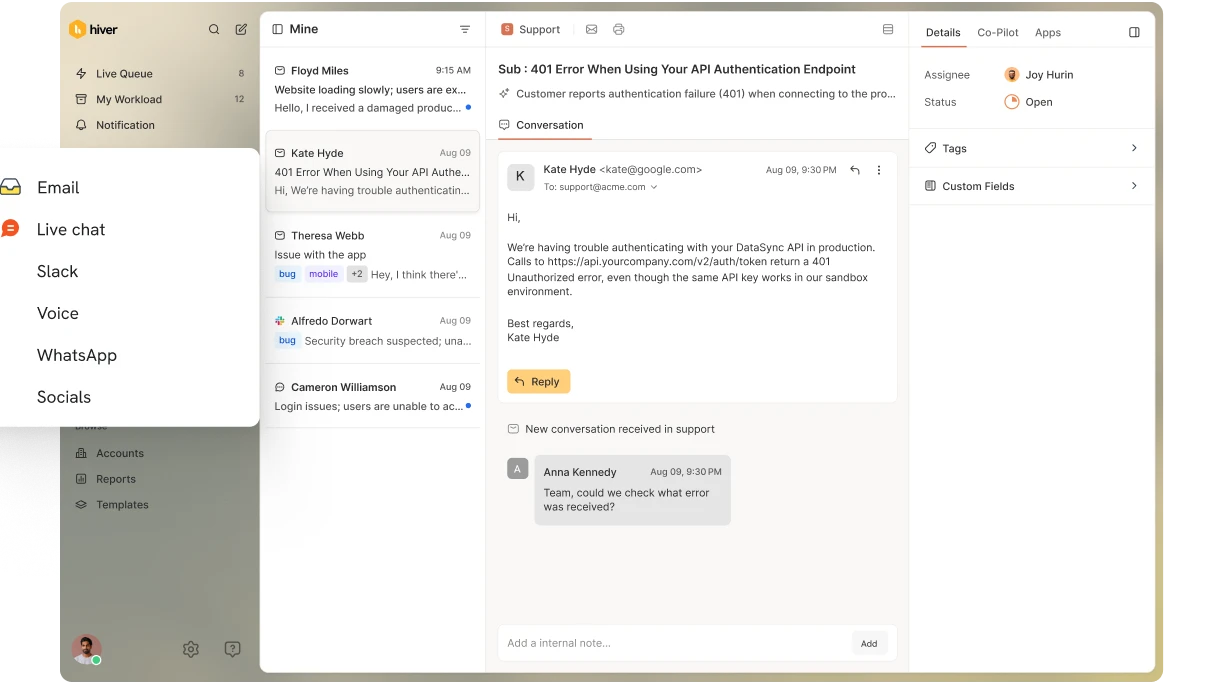
Hiver also offers a Free plan for teams that are just getting started. It includes shared inboxes, ticketing, team collaboration, live chat, WhatsApp, voice, and a knowledge base. It gives teams an easy way to experience Hiver without any commitment.
For growing teams that need more automation and customer-facing tools, the Growth plan starts at $25 per user per month (billed annually). It adds SLAs, custom fields, a customer portal, workflows, and rule-based automations, which help teams manage higher volumes with ease.
For small and mid-sized businesses, or companies outside of ecommerce, this mix of clear pricing, quick onboarding, and easy-to-use AI makes Hiver a practical and scalable alternative.
Hiver vs Gorgias: Which One Works Better for Growing Teams?
Gorgias is built specifically for ecommerce. Its storefront integrations are its biggest strength, especially for Shopify merchants who need real-time order visibility.
The trade-off is complexity and unpredictable pricing. Automation rules take time to configure. Analytics can feel technical. Ticket-based billing makes costs change month to month.
Hiver takes a simpler approach. Pricing is based on the number of users, not the volume of tickets. Teams know exactly what they will pay each month. Setup is fast, and the modern interface makes onboarding easy.
Hiver also offers:
- Multichannel inbox for email, live chat, WhatsApp, voice, SMS, and social
- AI-powered live chat and chatbots for 24/7 instant responses
- AI Copilot for triage, summaries, and suggested replies
- Automation across assignments, tags, workflows, and SLAs
- Knowledge base and customer portal
- Analytics such as conversation reports and tag insights
Teams can activate the Hiver AI add-on instantly, without the need for complex setup.
For ecommerce teams that need deep storefront visibility, Gorgias is a good fit. For businesses seeking predictable pricing, fast onboarding, and straightforward day-to-day management, Hiver is a practical choice.
Choosing What Works Best for Your Business
Both platforms solve different needs. Gorgias gives ecommerce brands strong integrations and revenue visibility. Hiver offers predictable pricing, a modern interface, multichannel support, and easy adoption for teams across industries.
If you want an ecommerce-focused helpdesk with built-in order handling, Gorgias works well. If your priority is fast setup, transparency, and effortless scaling, Hiver is worth serious consideration.
Book a personalized demo today to see how Hiver can support your team.
Frequently Asked Questions
1. How long does Gorgias take to set up?
Shopify merchants can set it up quickly. More advanced use cases, such as automation and custom integrations, may require longer processing times.
2. Can Gorgias handle high ticket volumes?
Yes. It is built for growing stores, but some users report slowdowns during peak periods.
3. What extra costs should teams expect?
Expect overage fees for exceeding ticket limits and usage fees for SMS or voice.
4. How does Gorgias compare to simpler helpdesks?
Gorgias excels at ecommerce. Tools like Hiver focus on ease of use, fast setup, and predictable per-user pricing.
5. Is Gorgias ideal for teams outside of ecommerce?
Not necessarily. Non-ecommerce businesses may find more value in platforms built for general customer service workflows.
Start using Hiver today
- Collaborate with ease
- Manage high email volume
- Leverage AI for stellar service