

Best Help Desk Software for 2025: A Buyer’s Guide
What Is Help Desk Software?
Best Help Desk Software for Customer Service Teams
Best Enterprise Helpdesk Software
Best IT Helpdesk Software
Best Free Helpdesk Software
Best E-commerce Helpdesk Software
Best Helpdesk Ticketing Software
Best Helpdesk Software for Small Businesses
Best Open-Source Helpdesk Software
Best Helpdesk Software for App Developers
Best CRM Helpdesk Software
How to Choose the Best Help Desk Software
Picking the right help desk software isn’t straightforward.
Every tool claims to offer AI, automation, and faster ticket resolution. But in reality, the wrong choice can slow your team down, with steep learning curves, hidden costs, or workflows that don’t fit how your agents actually work.
The truth is, not all help desks are built for the same type of team. What works brilliantly for a three-person support desk may may not suit an enterprise or a retail customer support team.
So, we dug deep into the best helpdesk platforms to review each – not just skimming the surface but really looking at what sets them apart.
We pulled in real user reviews, testimonials, and even notes from our own sales calls and prospects who’ve tried them.
In this guide, we’ll unpack the best help desk software, their features and drawbacks, to help you find the right fit for your team.
What Is Help Desk Software?
Help desk software is a platform that centralizes all your customer conversations in one place. It pulls customer inquiries from email, chat, social, and phone into a single dashboard, turning each into a trackable ticket with a unique ID. This means agents don’t have to juggle multiple platforms; they can assign, prioritize, and track every request from start to finish in one organized system.
Infact, the best help desk tools are designed solve the real challenges of support teams without piling on unnecessary features or tech overload.
How I Picked the Best Help Desk Tools
Having worked with a customer support platform, I didn’t just rely on feature lists or product pages. I dug deeper into our sales calls, actual user testimonials, and even user reviews from customer support teams to see what actually matters to them.
- Ease of use over complexity: Help desk tools should eliminate friction, not add to it. I looked for tools that teams can start using from day one, without the headache of a lengthy onboarding or setup process.
- Essential features: Having talked to our own support teams at Hiver, I noted down the must-haves: automation, reporting, basic ticketing, collaboration tools, self service, and chatbots, without forcing upgrades to higher tiers.
- AI features: AI features are woven into every modern helpdesk tool, deflecting repetitive tickets and giving customers faster, more accurate answers. I prioritized AI that genuinely helps with triaging tickets, summarizing emails, drafting replies, and acting as an agent’s co-pilot.
- Automation: Manual work can only take your support team so far. I looked at helpdesk software that includes automated or custom workflows that reduce agent effort.
- Collaborative tools: Collaborative tools help agents work together and close tickets faster. I looked for features like shared drafts, internal notes, collision alerts, and easy knowledge sharing.
- Analytics: Support teams don’t work on a set-it-and-forget-it system. You need real-time visibility into agent performance, satisfaction scores, response times and handle times to know how well your support is performing.
- Transparent pricing: No hidden fees, no add-ons for basic functionality. I prioritized platforms that disclosed their pricing and features upfront.
- Integrations: Ideally, you’d want a tool that connects well with your existing tech ecosystem. I considered help desk platforms that offer basic and advanced integrations for all needs.
The 10 Best Help Desk Ticketing Software Tools at a Glance
Here’s a quick breakdown of the top helpdesk tools in the market:
Hiver
Best for teams that need an AI-powered helpdesk without the learning curve
Free plan and 14-day trial; paid plans from $19/agent/month
Zendesk
Best for large teams needing a full-featured ticketing system
14-day free trial; paid plans from $19/agent/month
HappyFox
Best for IT teams needing ITIL-aligned workflows and asset management
14-day free trial (via demo); paid plans from $49/agent/month
Spiceworks
Best free helpdesk for small IT teams
Completely free (ad-supported)
Gorgias
Best for e-commerce customer service
Free plan; paid plans from $10/month for 50 tickets
Freshdesk
Best for small to mid-sized teams wanting advanced features on a budget
Free plan and trial; paid plans from $15/agent/month
Help Scout
Best for small businesses prioritizing email management and self-service
14-day free trial; paid plans from $25/user/month
osTicket
Best for teams wanting a free, open-source helpdesk with full customization
Free (self-hosted); costs for hosting & maintenance
Jira Service Management
Best for IT and developer teams already in the Atlassian ecosystem
Free plan (up to 3 agents); paid plans from $19/agent/month
HubSpot Service Hub
Best CRM-connected helpdesk for unified sales, marketing, and support data
Free plan; paid plans from $15/user/month
Best Help Desk Software for Customer Service Teams
1. Hiver
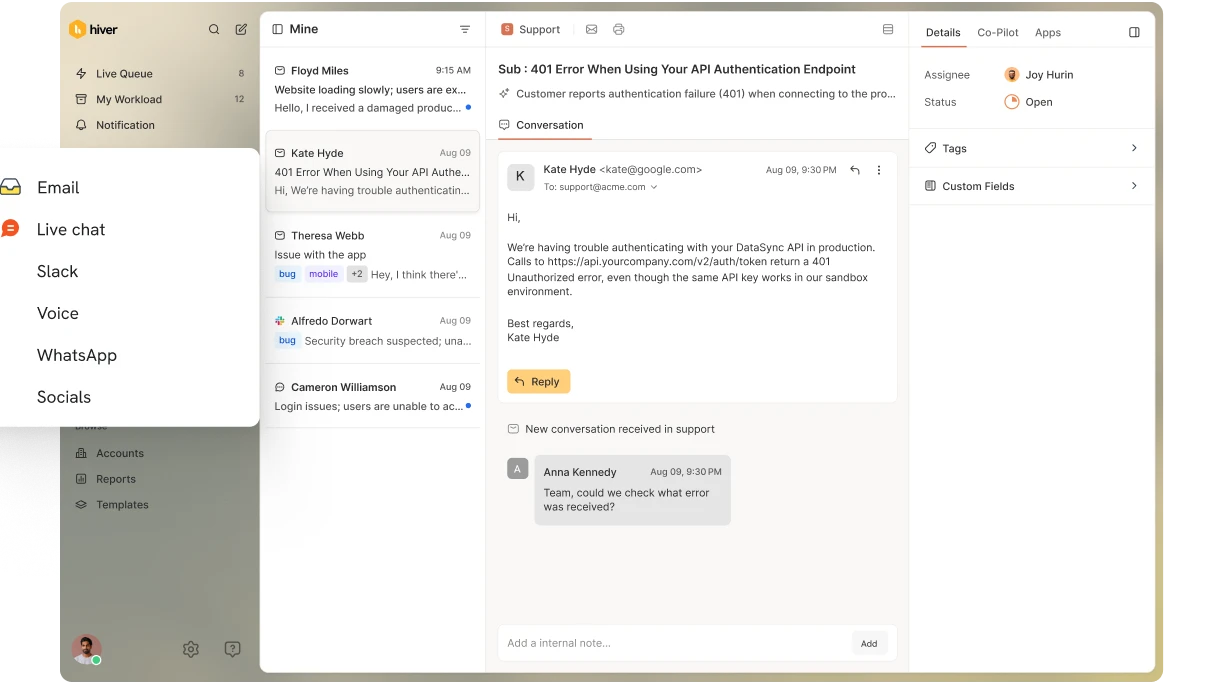
Hiver is an AI-powered multichannel help desk software designed to make small teams more efficient and powerful. It has the look and feel of your email inbox, with a panel on the left to manage all support channels – email, live chat, WhatsApp, voice, SMS, and social media. Since the interface is so familiar to most of us, you have to spend no time learning a new tool from scratch. It’s very intuitive.

Hiver is a modern, AI-powered helpdesk that makes customer service effortless, especially with its familiar interface and minimal learning curve.
It also layers in AI and automation, bringing together core help desk capabilities like email, live chat, phone support, and social into a single platform. You can use AI to deflect repetitive queries with auto-responses, suggest replies for agents, and automate time-consuming tasks like ticket triage and routing.
You can also run both personal and shared team email accounts inside Hiver, so customer support and internal work emails stay in one place. Teams also love how they can assign emails, leave internal notes, and collaborate on replies without leaving their interface.
What really stands out is how fast Hiver is to set up and how it offers 24/7 customer support across all plans, something most helpdesk software reserve as a premium feature or for higher tiers.
What sets Hiver apart:
- Multi-channel Support: Teams can handle email, live chat, WhatsApp, and calls from one unified dashboard.
- Real-time collaboration: Assign emails, add internal notes, @mention teammates, and work on shared drafts all within a single email thread.
- Smart Automation: You can set up rule-based workflows for automatic assignment, routing, and responses that actually work reliably.
- AI Capabilities: Hiver blends real-time AI assistance with smart automation. AI Copilot summarizes conversations, suggests polished replies, and pulls answers from your connected tools. AI Agents handle ticket triage, routing, auto-closing thank-you emails, and even multi-step workflows like refunds. AI Insights tracks sentiment, flags churn risks, measures automation performance, and highlights emerging trends.
- SLA Management: Set and track SLAs to prioritize tickets, meet response deadlines, and automatically escalate when violations occur.
- Self-Service: Create a knowledge base (internal or external) for common user queries and customer portals to raise and track tickets.
- Integrations: Connect Hiver seamlessly with tools like Slack, Aircall, Asana, Salesforce, and more to keep workflows smooth.
- Real-time Analytics: Get a real-time reporting dashboard that tracks response times, agent performance, and customer satisfaction scores.
Cons:
- Limited social media integration compared to some competitors
- WhatsApp is the only messaging app supported (no Twitter or LinkedIn yet)
What users say about Hiver:
“Hiver makes it much easier to stay organized and collaborate as a team. The ability to assign emails, leave internal notes, and track ownership has streamlined our operations and reduced miscommunication”– User, G2
“I think that the Knowledge Base should be more available to the Free version users. I could easily use it for my end users but it’s under a paid version”.– User, G2
“We’ve had a great experience using Hiver for customer service. The platform made it incredibly easy to manage our shared inbox and respond to customer inquiries efficiently. Assigning emails to team members, tracking conversations, and collaborating internally without forwarding threads has been a game-changer”– User, G2
Pricing:
Hiver offers a free trial and a free plan with basic features. Paid plans start at $19/user/month.
Best Enterprise Helpdesk Software
2. Zendesk

Zendesk is an extensive help desk software meant for larger, enterprise teams. While a bit on the expensive side, it is worth the investment if your team is handling thousands of tickets daily, and you want a support tool that can handle that scale.
Zendesk also stands out for its AI agents. When connected to your knowledge base or support resources, it can resolve common queries and provide multilingual support across email, chat, voice, and SMS.
The tool also goes beyond basic ticketing, giving teams advanced workflow automation, SLA controls, and tools to manage support at scale. Its AI CoPilot works alongside your support agents to detect intent, analyze sentiment, route tickets intelligently, and suggest ready-to-use replies from support docs.
What sets Zendesk apart:
- Ticketing System: Get advanced ticket routing, priority settings, and macros for handling large volumes efficiently.
- AI features: Zendesk AI provides agents with real-time suggestions, predictive ticket routing, sentiment analysis for triaging emails, and resolving common customer queries.
- Multi-Channel Support: Email, social media, web channels, live chat, and phone support, all in a single dashboard.
- Automation and Workflows: Get custom rules for ticket assignment, escalation, and automated responses that work at scale.
- Rich Reporting: Get in-depth and visual reports on team performance, ticket backlog, customer satisfaction, and operational metrics.
- Enterprise Integrations: 1,000+ pre-built integrations with CRMs, e-commerce platforms, and business tools.
Cons:
- Steeper learning curve than other alternatives.
- Can be expensive for smaller teams that don’t need enterprise features.
- It can also feel overwhelming for teams that need basic ticket management.
What users say about Zendesk:
“We’re not able to forward emails without removing the previous email chains. Sometimes when an email comes in, and it’s an automated statement, it lands in Gmail, but not in Zendesk, which can cause us to miss invoices and statements from our suppliers”- Previous Zendesk user on a Hiver Demo
“As a manager, I really value the insights I get from Analytics (formerly Zendesk Explore). It allows me to tie team performance directly to merit-based recognition and promotional decisions.”- User, G2
I also really appreciate the clean interface, the ability to create and reuse macros (for fast replies), and how easy it is to build a knowledge base with Zendesk Guide. Once I got used to the basics, I saw how powerful the platform can be for organizing and streamlining customer support- User, G2
Pricing:
Zendesk offers a 14-day free trial. Paid plans start at $19/agent/month.
Recommended reading
Best IT Helpdesk Software
HappyFox

If you’re looking for an internal helpdesk that works across departments such as HR, IT, and customer support, HappyFox is your best bet. It’s built specifically for IT teams that need to manage both internal employee requests and customer support.
What sets Happyfox apart is its IT-focused design, with workflows for asset management, incident and change management, and problem categorization, plus integrations with popular IT management tools.
While HappyFox also offers a service desk feature, its IT helpdesk offering delivers ITIL-aligned features that easily meet the needs of mid-sized teams. Unlike many IT platforms that require long deployments and heavy admin work, HappyFox is easier to set up and use.
What sets HappyFox apart:
- Omnichannel Ticketing: Automatically turns customer messages from email, phone, chat, social media, and web forms into tickets, all managed from one inbox.
- IT-Focused Features: HappyFox has built-in asset management, problem categorization, and integration with IT infrastructure tools.
- Multilingual Knowledge Base: Create and manage knowledge bases across multiple languages, helping users find answers without raising tickets.
- Custom Workflows: Get the option to tailor ticket fields, categories, statuses, and business hours to match how your team works.
- SLA Management: Set SLA levels by ticket type and priority to automate responses, follow up on requests, or get alerts when violations happen.
Cons:
What users say about Happyfox:
“We were using Happyfox, but we switched as it wasn’t really working for us in terms of like custom integrations, and sometimes, it’s not user-friendly” – Former Happyfox user on a Hiver Demo
“With minimal configuration you can start your help desk support system. It is easy to maintain, easy to integrate with existing platforms, and also extensible via its powerful API. After an easy implementation, you can start providing customer support almost instantly”- User, G2
“The customer support provided has been excellent. However, it would be helpful to have additional training resources available for new users to get up to speed more quickly”.- User, G2
Pricing:
HappyFox offers a 14-day free trial, gated behind a demo request. Paid plans start at $24/agent/month.
Recommended reading
Best Free Helpdesk Software
Spiceworks

Spiceworks offers a completely free help desk solution that’s particularly popular with IT teams and small businesses that need basic ticket management, but don’t have a solid budget. It’s ad-supported, which keeps it free, and includes network monitoring tools that make it especially valuable for IT departments managing both support tickets and infrastructure.
The platform provides essential help desk functionality—ticket creation, assignment, tracking, and basic reporting—without the premium price tag. While it doesn’t have all the bells and whistles of paid solutions, it covers the fundamentals well enough for teams that need to get organized without spending money.
What sets Spiceworks apart:
- Email Management Features: Use automated responses, custom ticket views, and ticket rules to assign and categorize tickets for agents.
- IT Network Tools: Includes network monitoring, inventory management, and IT asset tracking alongside help desk features.
- Community Support: The tool has a large user community providing templates, best practices, and troubleshooting help.
- Simple Setup: Quick installation and configuration designed for small IT teams to get started with basic ticketing software.
- End User Portal: Give your users a customer portal to create and track issues independently.
- Basic Reporting: Track key metrics like ticket churn, response rates, and other basic customer service metrics.
Cons:
- An ad-supported interface may feel cluttered.
- Features like tasklists and bulk actions are only available on the paid plan.
- No advanced automation or AI features.
- Support relies on community forums rather than dedicated customer service.
What users say about Spiceworks:
“We’ve been using Spiceworks, and while it’s very basic, they are starting to charge for some features, but it lacks a lot of reporting that we are looking for, so we don’t see the need to pay. Instead, we are looking for a basic ticketing system that’s easy to use and is cloud-based”-Former Spiceworks user on a Hiver Demo
“It is simple, streamlined, and perfect for a small business help desk. I can set up my agents, ticket notifications and start receiving tickets in minutes, and it is easy to use”– User, G2
“The mobile app lacks some features which are on desktop, often email notifications are delayed, integrating with other systems is quite challenging. There are also response delays sometimes”– User, G2
Pricing:
The Core plan is completely free, and paid plans start from $5/seat/month.
Best E-commerce Helpdesk Software
Gorgias

If you’re running an ecommerce business, you’d ideally need a help desk that combines support features with order history, returns, and account details. That’s where Gorgias stands out.
It goes beyond what basic extensions can do and is deeply integrated with the e-commerce ecosystem. Agents can see order history, shipping status, and product details right within support tickets, and even process order modifications without switching platforms.
The platform connects directly with Shopify, Magento, WooCommerce, and other e-commerce platforms to provide agents with context that generic help desk tools fail to match.
What sets Gorgias apart:
- E-commerce Integration: Built for Shopify (and beyond), Gorgias integrates order management, shipping, returns, subscriptions, and loyalty programs into one platform.
- AI Agents: Get an AI Shopping bot that converses and recommends products to customers, as well as a Support bot that automatically handles returns, order management, and FAQs.
- Ticket Management: Assign tickets based on channel, topic, customer sentiment, agent capacity, and more.
- Revenue Impact Tracking: The dashboard is designed to show analytics on how support interactions directly impact sales and business metrics.
- E-commerce Templates: Pre-built response templates designed specifically for common e-commerce support scenarios.
- Customer Timeline: View each customer’s orders, events, and interactions across all channels, with a clear summary for every touchpoint.
Cons:
- Limited scope of usage for non-e-commerce businesses.
- Pricing scales with ticket volume, which can become expensive for high-traffic stores.
- Fewer general collaboration features compared to traditional help desk tools.
What users say about Gorgias:
“The AI offerings at Gorgias are pretty subpar, and there’s scope for the reporting feature to be better, like what Zendesk or Intercom offer”– Former Gorgias user on a Hiver Demo
“Can be tricky when searching tickets and merging. It can’t always find the right ticket for you unless you guess the correct information. As per merging, it doesn’t give you a lot of info on what the overall view is”– User, G2
“Gorgias is intuitive and easy to navigate, even for new team members. Its integration with our existing tools was seamless, and the customization options mean we can tailor the platform to meet our specific needs”– User, G2
Pricing:
Free plan available. Paid plans start at $10/month for 50 tickets. With Gorgias, costs increase as the plans are based on ticket volume.
Recommended reading
Best Helpdesk Ticketing Software
Freshdesk

Freshdesk is a cost-effective helpdesk with AI features and ticket management for small to mid-sized teams. It’s a no-brainer for teams that want advanced routing, SLA management, and multi-level escalations, without the complexity of enterprise platforms.
Freshdesk also stands out for features such as Freddy AI, a conversational AI agent that handles common customer queries and helps agents improve response times. It also offers proactive insights to help teams dig deeper into support data, and parent-child ticketing that links related issues to a single master ticket.
What sets Freshdesk apart:
- Advanced Ticketing: Parent-child ticketing, ticket templates for faster responses, priority management, and automated escalation workflows.
- Unified Agent Dashboard: Convert emails, social media messages, web forms, and chat into unified tickets.
- Freddy AI CoPilot: Get an AI assistant for your support agents that prioritizes and routes customer queries, recognizes customer sentiment, summarizes and generates responses, reducing agent effort.
- Agentic Platform: Use Freshdesk’s out of the box IT and HR agents, or build custom ones to drive faster, more personalized support.
- Unified Customer Context: View every customer interaction, ticket, key activities, past interactions, preferred channels, and contact details in one place.
- Performance Analytics: Get detailed reporting on ticket resolution times, agent productivity, and customer satisfaction trends.
Cons:
- It can feel overwhelming for teams that only need basic ticket management.
- Creating detailed reports either needs more technical know-how or upgrading to higher-tier plans.
- Mobile app functionality is more limited than the desktop experience.
What users say about Freshdesk:
“We’re currently using Freshdesk, and we’re looking to find an alternative since there are so many bugs. We were missing out on new email notifications in our client inbox- sometimes it works, and sometimes it doesn’t”– Former Freshdesk user on a Hiver Demo
“We use it frequently every day, and its automation features significantly reduce manual work. Plus, the multi-channel support ensures smooth communication across email, chat, phone, and social media”– User, G2
“One shortcoming which I personally encountered is the inability to open multiple tickets in separate tabs within Freshdesk. This design choice requires support agents to open several browser tabs instead of being able to manage everything within a single Freshdesk window” User, G2
Pricing:
Freshdesk offers a free trial and a free plan, with paid plans starting at $15/agent/month.
Recommended reading
Best Helpdesk Software for Small Businesses
Help Scout

HelpScout is a perfect fit for small-to mid-sized businesses looking for email management, collaboration, automation, and workflow capabilities. Its customer profile feature pulls in details such as customer history, transaction records, and past tickets from connected tools like CRMs and payment platforms. This way, agents have less context switching to do.
A standout is their AI answers, a self-service assistant that offers multilingual support, answers customer queries by referring to sources like the knowledge base or internal documentation and escalates to agents when needed.
Small businesses can also take advantage of the platform’s responsive support, unlimited user-based pricing, and smart self-service tools, such as the Beacon widget.
What sets Help Scout apart:
- Shared Inbox: Manage multiple emails, such as support@ or billing@, within an email-like interface.
- Simple Setup: Since the interface is similar to email, teams can get up and running in hours and avoid the complexity of enterprise software.
- Beacon Widget: Embed Beacon on your website to handle live chat and email, answer common questions instantly, and route complex issues to agents.
- In-app messages: Nudge customers to try new or overlooked features, or use them to share NPS and CSAT surveys.
- Help Docs: Get advanced customization on your Docs site, track visitors, article popularity, manage multiple Docs sites, and add private collections for internal users.
- Scalable Pricing: Works as an affordable option for small teams due to unlimited seats.
Cons:
- Users cite the need for a dialog box letting users know the result of their workflow changes.
- There’s limited reporting features compared to other platforms.
- Many CRM integrations are only available on higher plans.
What users say about HelpScout:
“We currently use HelpScout, but it isn’t quite where we need it to be. Primarily, in terms of reporting, it’s fairly minimal and manual. The cross-team collaboration is also not as advanced as we would need it to be to bring the customer success team in the same tool”– Former HelpScout user on Hiver Demo
“I use this tool daily to manage our company’s integrated Google inboxes. The clean, well-organized interface keeps distractions to a minimum, making it easy to focus on each task efficiently”– User, G2
“It is user-friendly, very efficient, and reliable. Allows easy integrations with other systems. Ease of interaction with customers from the support side”– User, G2
Pricing:
Help Scout offers a free trial for 14 days. Paid plans start at $25/month per user.
Recommended reading
Best Open-Source Helpdesk Software
osTicket

osTicket is a free, open source help desk software for teams that are willing to install and host it themselves. It’s best for organizations that have the required developer resources ready, and those who need complete control over their support infrastructure. With such open source software, teams get customization flexibility and avoid vendor lock-in.
The platform offers core help desk functionality such as ticket management, email integration, and basic automation, while allowing unlimited customization through its open-source codebase.
What sets osTicket apart:
- Complete Control: With full access to the source code, developers can customize the platform and add new features through third-party integrations.
- Agent Tasks: Use the tasks feature to create to-do lists for support agents or tag them to a particular ticket.
- Auto Responders: Use a configurable automatic reply with custom variables for common scenarios like closing a ticket.
- Custom Columns: View tickets based on custom criteria that you specify, such as priority tickets, pending, or closed tickets.
- Custom Workflows: Use the source code to build specialized processes and business rules that match your exact requirements
- Plugin Ecosystem: Choose from an extensive library of community-developed plugins and integrations to customize your helpdesk.
Cons:
- Requires technical expertise for setup, maintenance, and customization.
- No official customer support, and your team would have to rely on community forums and documentation.
- Interface feels outdated or old compared to other helpdesk tools in the market.
What users say about OSTicket:
“We’re looking for an alternative because with OS ticket, we need to install it or set up in the cloud or our own premises, and we’re looking to avoid that”- Former OS Ticket user in a Hiver Demo
“OSTicket does run on an older PHP Framework. So, it can be a little slow and feel outdated. But, the features it has are what enables this software to still be chosen as Support System for SMEs”.– User, G2
Pricing:
OsTicket is a free open-source software. Costs include hosting, maintenance, and development resources.
Recommended reading
Best Helpdesk Software for App Developers
Jira Service Management

Jira Service Management is designed for IT support teams that already use Atlassian and work closely with development teams. Especially for technical support requests that might turn into development tasks, Jira excels at transforming support tickets into development tasks without losing context or requiring manual data transfer.
It also stands out for real-time collaboration, automatio, and asset tracking features. Its virtual service agent deflects common tickets, triages emails, and uses smart mentions to tag agents in tickets based on past resolutions.
For app developers, Jira offers Forge: a development environment to build apps that extend JSM’s functionality, from customizing customer portals to adding fields and integrating with existing services.
What sets Jira Service Management apart:
- Customizable Portals: Easily create branded, intuitive portals for different teams (IT, HR, facilities, etc.) so users can submit requests and track progress in one place.
- Asset and Configuration Management (CMDB): Use Jira’s Service Desk features to track assets and configuration items. Link assets directly to tickets for faster troubleshooting.
- AI in ITSM: Use AI to group similar incidents, build custom conversation flows, surface relevant articles, triage tickets, assign agents smartly, and create automation rules with NLP.
- Conversational Ticketing: Users can raise and respond to tickets directly from Slack or MS Teams, with two-way sync.
- Atlassian Intelligence: Use generative AI to summarize conversations, suggest replies, and route tickets based on historical patterns across the Atlassian ecosystem.
- Automation and Workflow Customization: Use AI or no-code automation to tailor workflows, route tickets, trigger notifications, and update fields.
Cons:
- Steep learning curve, especially for non-technical support staff.
- To use a virtual service agent, users need to upgrade to higher-tier plans.
- Requires teams to have used the Atlassian ecosystem previously for optimal use.
What users say about Jira:
“Jira, from my experience, it’s more for complex tasks or development life cycles where there are a lot of people collaborating and there are many dependencies. It’s also a bit heavy on the UI, with the UX not being that great either.”– Former Jira user on a Hiver Demo
“As an administrator, I find Jira Service Management easy to manage and configure. It allows me to create workflows and automation rules based on our team’s needs” – User, G2
“Jira Service Management brings a lot of structure to our IT operations. The ticketing system is reliable, and the automation features really save time. I especially like how well it integrates with other Atlassian tools”– User, G2
Pricing:
Jira offers a free plan for up to 3 agents. Paid plans start at $19/agent/month.
Recommended reading
Best CRM Helpdesk Software
HubSpot Service Hub

HubSpot Service Hub fits teams that want complete integration between sales, marketing, and customer support data. If you’re already using HubSpot’s CRM or marketing tools, Service Hub can benefit your customer support team and offer a ticketing system where every customer interaction is added to a unified customer timeline and relationship history.
The platform’s strengths, apart from customer context, are its customer success workspace to check deals that are in progress or closed, AI-powered call analytics, AI-powered automation, and finally, Breeze AI HubSpot’s suite of AI tools.
Breeze AI includes Breeze Copilot (an in-app assistant for summarizing records, drafting replies, and building workflows) and specialized Breeze Agents for customer service, content, social media, prospecting, and knowledge base automation (currently in beta). Together, they help automate repetitive work and reduce agent effort across the customer lifecycle.
What sets HubSpot Service Hub apart:
- CRM Connected Helpdesk: Deliver multilingual support with AI language detection, skill-based routing, and AI-powered summarization and reply suggestions to speed up responses.
- Conversation Intelligence: Capture voice data with HubSpot’s CRM and surface top trends, conversations, and topics.
- Unified Customer Data: Get a complete view of every customer. Use it for marketing automation and segmentation, and identify and merge duplicate records.
- Automated Workflows: Trigger actions across marketing, sales, and service based on support interactions.
- Customer Health Scoring: Track customer satisfaction and relationship strength across all touchpoints with the customer success workspace.
- Reporting Integration: Get detailed metrics on agent performance and CSAT and surface insights on how customers are interacting with your team, such as chat wait times and knowledge base metrics.
Cons:
What users say about HubSpot:
“We’ve used HubSpot in the past, and as a CRM, it’s not really designed for email management. We’re looking for a tool that integrates email well within the ticketing system”– Former HubSpot user on a Hiver Demo
“What I like most about HubSpot Service Hub is how everything is centralized in one place — from support tickets to customer communication. The automation features save us hours every week, and the AI tools like Breeze make responding to customers faster and smarter”– User, G2
“Its user-friendly interface and intuitive design. Compared to other platforms I have used—like Insightly and even Salesforce—HubSpot is significantly easier to navigate and doesn’t require extensive training to get started”– User, G2
Pricing:
HubSpot Service Hub offers a free plan with limited features. Paid plans start at $15/month per seat.
Recommended reading
How to Choose the Best Help Desk Software
Post all my research, the conclusion is this: The best help desk software for your te-0am is the one that works within your workflows and supports your team; not one that works against them. Most teams struggle with help desk tools because they pick something that looks impressive in demos but creates friction in real-world use.
During your decision process, start with how you currently handle support. For instance, don’t force your team into a completely different interface if your team lives in email. If you need live chat and phone support, make sure those channels integrate seamlessly rather than feeling like separate tools bolted together.
If you want something that naturally fits into your existing workflow without the learning curve and expensive upgrades, Hiver is worth a shot.
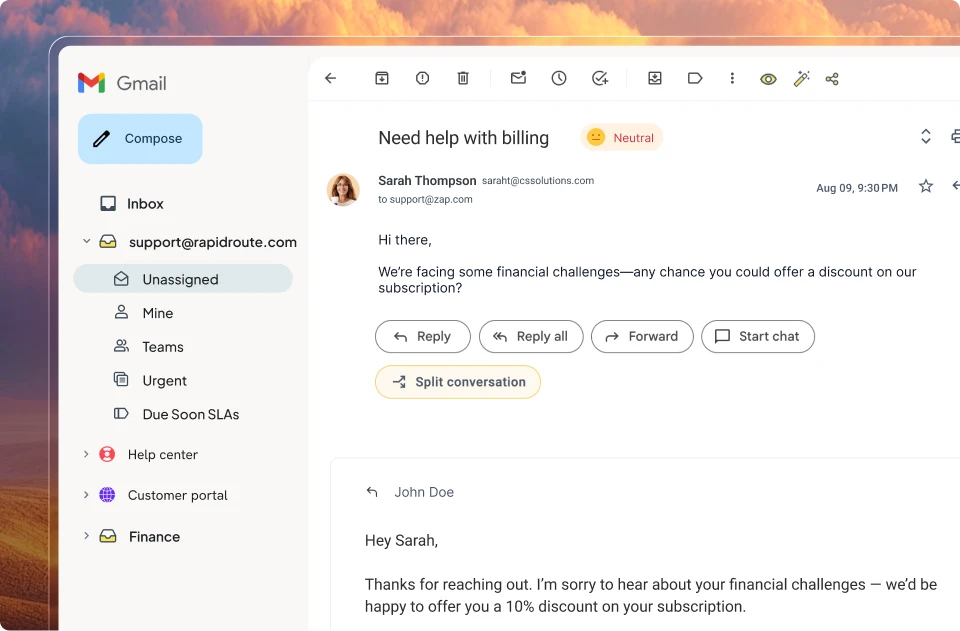
It gives you all the help desk features you need while feeling like the email interface your team already knows. Most teams get up and running in minutes, not months.
Curious to try it out? Start a free trial today and see how it fits in your workflow.
Frequently asked questions
How long does it typically take to set up a help desk system?
Most help desk systems can be set up in 1-2 weeks. Cloud-based platforms like Hiver can be up and running in a day, especially if they integrate with existing email systems, ensuring minimal downtime.
What are the top help desk ticketing solutions?
Some of the best help desk ticketing solutions in the market include:
- Hiver – AI-powered modern helpdesk that’s easy to adopt.
- Zendesk – Enterprise-grade ticketing with robust workflows and reporting.
- Freshdesk – Affordable, feature-rich option for small to mid-sized teams.
- Jira Service Management – Ideal for IT and development teams using Atlassian tools.
- Help Scout – Great for small businesses focused on email and self-service.
What are the top free help desk solutions for small businesses?
If you’re on a budget, these help desk solutions that offer free and affordable plans stand out:
- Hiver – Free plan with basic features, plus a 14-day trial for premium features.
- Freshdesk – Free plan with core ticketing and multi-channel support.
- Spiceworks – Completely free (ad-supported), ideal for small IT teams.
- osTicket – Open-source and free to use if you can host and maintain it yourself.
- HubSpot Service Hub – Free plan with limited helpdesk and CRM features.
Customer service software that feels like your inbox