

Customer Service Mindset: What It Is, Why It Matters, and How to Build It in 2025

Written by

Reviewed by

Written by

Reviewed by

expert verified

Expert Verified

Last update: January 2, 2026
customer service mindset

Table of contents

    When I started in customer service, I heard all the standard rules. The customer is always right. Put them first. Always smile. Never argue. I followed them because that was the job. Over time, I learned that none of those rules mattered if I didn’t understand what the customer was actually trying to fix. A customer service mindset shifts the focus from following rules to understanding the real problem, confirming what the customer needs, and removing extra steps. It also reminds you to keep customers updated until the issue is fully resolved.

    Table of Contents

    What is a Customer Service Mindset?

    A customer service mindset is an approach where every interaction is used to identify the customer’s exact problem and choose the simplest path to fix it. It relies on empathy, clear communication, and full ownership of the outcome. 

    Teams that follow this approach outline the next steps, stay with the customer until the issue is resolved, and surface recurring problems early so leaders can refine policies or workflows.

    Why a Strong Customer Service Mindset Matters

    A strong customer service mindset improves how teams handle pressure, manage complex issues, and work across departments. It also creates a more predictable and trusted experience for customers. The impact shows up in shorter handling times, fewer repeat contacts, and smoother coordination across teams.

    A strong customer service mindset goes a long way in building loyalty
    A strong customer service mindset goes a long way in building loyalty

    Here is what a strong customer service mindset delivers:

    • Faster resolutions: Agents identify the real issue quickly and avoid unnecessary back-and-forth.
    • Fewer escalations: Problems are handled correctly at the first point of contact.
    • Clear communication: Customers know what is happening and what to expect next.
    • Higher customer confidence: Ownership and follow-through build trust in every interaction.
    • Lower repeat contact rate: Teams fix the root cause instead of patching the symptom.
    • Better cross-functional alignment: Support, product, and operations teams work from the same understanding of customer pain points.
    • Stronger retention and brand loyalty: Customers stay when service reduces friction and delivers consistent outcomes.

    Key Components That Build a Strong Customer Service Mindset

    A strong customer service mindset is built on specific behaviors that help teams understand the issue, communicate clearly, and resolve problems with less effort for the customer. Here are the core traits to inculcate a strong mindset. 

    Key principles that make for a strong customer service mindset
    Key principles that make for a strong customer service mindset
    • Empathy and Patience: The ability to fully understand the customer’s context, frustration, and end goal before acting. This prevents rushed assumptions and leads to solutions that match the real issue.
    • Ownership: A clear sense of responsibility for the outcome of the issue, even when multiple teams or systems are involved. Ownership reduces handoffs, shortens resolution time, and strengthens customer trust.
    • Responsiveness: A bias toward timely acknowledgment and clear updates is necessary. It ensures that customers know their issue is understood, what will happen next, and when to expect progress. It reduces uncertainty and repeated follow-ups.
    • Adaptability and Clear Communication: The capacity to adjust tone, detail, and guidance based on the customer’s familiarity and emotional state. Information needs to be broken into simple, actionable steps so customers can move forward without confusion.
    • Curiosity and Effective Problem-Solving: A habit of asking focused questions to identify root causes rather than applying quick fixes. This leads to accurate resolutions, even in high-pressure situations, and prevents repeat contacts.
    • Proactive Problem-Solving: An awareness of recurring patterns, such as repeated login failures or billing errors. These signals are surfaced beyond support and used to fix underlying issues so customers stop encountering the same problems.
    • Continuous Improvement: A structured way of capturing customer feedback and internal signals helps eliminate recurring issues at the source. It ensures that the same problems aren’t handled again and again in individual conversations.

    Examples of a Customer Service Mindset in Action

    A customer service mindset becomes real only when it shows up in day-to-day decisions. These examples show how different companies apply that mindset in moments that matter to customers.

    1. Chewy: Compassion Beyond Transactions

    Chewy is an online pet supply retailer, but what sets it apart is its deep understanding of the bond people share with their pets. One customer reached out to return an unopened bag of dog food after losing their dog. Instead of sending a routine refund, the support team mailed a handwritten condolence card and a bouquet of flowers. And this is not a one-off incident. Customers have often received hand-painted portraits of their pets from Chewy’s team.

    These gestures aren’t random. Many Chewy agents are pet owners themselves, and the company encourages them to respond with genuine care when customers are struggling. Over time, this has shaped a culture where empathy is part of every interaction. Customers remember these moments and often share them long after the issue is resolved. It is a big reason Chewy has grown into the largest pet food retailer in the US.

    2. Trader Joe’s: Doing the Right Thing Without Being Asked

    Trader Joe’s is known for its friendly stores, but one story shows how far their customer service mindset can go. During a heavy snowstorm, an elderly man was stuck at home and couldn’t get groceries. His daughter called several stores nearby to ask for help. Most said they didn’t deliver. However, Trader Joe’s didn’t treat that as the end of the conversation. The employee on the phone took the order, suggested a few items that fit his dietary needs, and arranged a free delivery to his doorstep in the snow.

    Trader Joe’s is known for its customer service
    Trader Joe’s is known for its customer service/ source: Trader Joe’s

    Nothing about this was policy. It was a simple decision to help someone who genuinely needed it. That choice turned an ordinary grocery call into a story people still share today. It reflects exactly what a customer service mindset looks like in action.

    3. Southwest Airlines: Empowerment That Enables Real Service

    Southwest gives frontline employees real authority to solve issues. One well-known example is how the team handles damaged luggage. Instead of sending customers through a long claims process, agents replace suitcases on the spot and let travelers continue their trip without delay. 

    Employees apply the same judgment during delays, rebookings, and fee waivers. They rebook flights immediately, offer travel vouchers during disruptions, and waive fees when a policy gets in the customer’s way. 

    Southwest Airlines offers loyalty rewards to customers
    Southwest Airlines offers loyalty rewards to customers

    That operational freedom shows up in the numbers. Southwest consistently ranks highest in customer satisfaction among U.S. airlines. In the 2024 J.D. Power North America Airline Satisfaction Study, Southwest tops the Economy/Basic-Economy segment. 

    It also leads in overall customer-service recognition: in 2024, Newsweek named it the best customer-service airline in the U.S., and it appears on the 2025 list of America’s Most Responsible Companies. 

    Because of these consistent rankings, travelers compare Southwest favorably against other carriers. In a crowded, competitive market, that reputation becomes a real differentiator and drives loyalty.

    11 Ways to Cultivate a Strong Customer Service Mindset

    A strong customer service mindset does not develop from a single training session. It grows when leaders model the behavior, systems reinforce it, and teams practice it every day. The strategies below give you clear actions you can implement across your team.

    1. Lead by Example and Embrace a Customer-First Culture

    A customer service mindset forms when leaders consistently demonstrate the behaviors they expect from the team. Agents watch how leaders respond to customer issues, make decisions, and communicate under pressure. These visible actions set the standard for how service should be delivered.

    Your team follows the way you deliver customer experience 
    Your team follows the way you deliver customer experience 

    Why it matters

    Leaders shape decision-making across the team. When agents see leaders clarify problems before acting, review the full context of a case, or resolve escalations without rushing, they adopt the same habits. This leads to more accurate diagnoses, fewer unnecessary escalations, and a more consistent customer experience.

    How to do it

    • Join support or QA reviews weekly or monthly: Understand real customer issues and the decisions agents need to make.
    • Share customer stories with clear takeaways: Highlight what worked, what didn’t, and how it should shape future behavior.
    • Work a small set of tickets during peak periods: Experience frontline pressure firsthand and model the standard for tone and ownership.
    • Explain the reasoning behind decisions: When you override a policy or approve a gesture of goodwill, explain why. It teaches teams how to think, not just what to do.
    • Acknowledge strong service behaviors publicly: Call out examples where agents demonstrated clarity, empathy, or great problem-solving so the team sees what “good” looks like.

    2. Provide Ongoing Training and Development

    When training is built around real support scenarios, it strengthens the customer service mindset. This includes handling delayed shipments, billing disputes, product edge cases, frustrated customers, and situations where policies don’t apply cleanly. Teams improve when they learn how to accurately diagnose issues, communicate effectively, and handle pressure with confidence. 

    Training should sharpen judgment in decision-making, not just reinforce scripts. It should prepare agents to choose the right action when information is incomplete, emotions are high, or multiple systems and teams are involved.

    Continuous training ensures a consistent customer experience
    Continuous training ensures a consistent customer experience

    Why it matters

    Service quality declines when training becomes static. New features, policies, and customer expectations require agents to adapt quickly. When training focuses on real cases, agents make fewer errors, resolve issues faster, and avoid repeating the same mistakes. It also reduces escalations because agents know how to handle complexity independently.

    How to do it

    • Use real transcripts for practice: Pick recent escalations, walk through what caused the confusion. Using these, show agents how to refine or rephrase their responses for clarity.
    • Run scenario-based role-plays: Make your team practice common tricky situations, like billing issues or customers misunderstanding a feature. Teach agents what to ask and how to explain the fix in a simple way.
    • Offer short e-learning refreshers: Release modules when policies or features change so agents stay current without long training blocks.
    • Conduct coaching sessions tied to QA: Use specific QA findings to show how tone, accuracy, or missing context affected the interaction. Use these to teach agents how to correct it.
    • Create playbooks for complex workflows: Document step-by-step instructions for high-impact tasks, such as refunds, account merges, or subscription errors.

    3. Actively Seek and Use Customer Feedback

    Customer feedback shows you where customers slow down, get confused, or abandon a task. It captures issues that don’t always appear in internal dashboards. When feedback is treated as input for improving workflows and communication, it becomes a tool for reducing friction across the entire experience.

    Customer feedback helps you understand customer experience better
    Customer feedback helps you understand customer experience better

    Why it matters

    Feedback often exposes problems before they turn into larger operational issues. It reveals unclear instructions, broken steps in the journey, and product gaps that create repeat contacts. Using these signals to guide fixes reduces complaints and helps teams solve problems correctly the first time.

    How to do it

    • Track score trends, then analyze comments when available: Monitor CSAT and NPS changes by queue, issue type, or workflow trends by queue, issue type, or workflow to spot where things break down. When customers leave comments, group them to see if the issue is speed, clarity, or how well the problem was resolved.
    • Send quick post-interaction polls: Capture genuine customer sentiment with 1–2 targeted questions right after a chat or email.
    • Run brief user interviews each month: Ask customers where they got stuck and what slowed them down.
    • Monitor social channels: Watch for repeated themes in complaints or questions across platforms.
    • Share trends with clear owners: Assign each issue to a product, engineering, or operations owner and include sample tickets.

    4. Empower Employees and Encourage Autonomy

    Teams work faster and resolve issues more accurately when they have the authority to act without waiting for a supervisor. Autonomy doesn’t mean saying yes to everything. It means providing agents with clear limits and sufficient context to make informed decisions.

    If your employees feel empowered to take action, the customers will build faith in your brand
    If your employees feel empowered to take action, the customers will build faith in your brand

    Why it matters

    Most delays happen because agents pause to get approval. This slows down resolutions and frustrates customers. When front-line teams have defined guardrails and the right information, they can solve issues on the first touch and reduce unnecessary escalations.

    How to do it

    Create exception rules: Define when agents can issue refunds, credits, replacements, or waivers.

    • Give full context access: Ensure agents can see order history, past conversations, and CRM notes.
    • Use simple decision guides: Provide flowcharts or checklists for recurring tricky cases.
    • Encourage proactive fixes: If an agent sees the real issue early, they should resolve it immediately instead of waiting for another ticket.
    • Trust agents to act within limits: Allow agents to resolve issues immediately when the fix is clear, even if the scenario isn’t spelled out in a rule. Speed and judgment matter more than strict adherence in these moments.
    • Back decisions, not just outcomes: Review examples where agents used good judgment, even if the result wasn’t perfect. Publicly reinforce that thoughtful action is valued over escalation.

    5. Practice Empathy and Personalization

    Empathy helps agents understand what the customer is dealing with before they act. Personalization ensures the guidance matches the customer’s exact setup. Together, they strengthen a customer service mindset by helping agents identify the real issue and give steps the customer can follow without confusion.

    Empathizing with customers makes your agents more trustworthy to customers
    Empathizing with customers makes your agents more trustworthy to customers

    Why it matters

    Customers share more information and cooperate more when they feel heard. That leads to more precise diagnoses and fewer back-and-forth messages. Personalized guidance also lowers the likelihood of errors because it fits the customer’s exact situation.

    How to do it

    • Personalize templates with customer context: Use templates as a base, then adapt them with the customer’s name and details from their request so the reply feels relevant, not generic.
    • Acknowledge their frustration: Start by recognizing what the customer is going through before explaining the fix. This helps lower tension and makes the conversation smoother.
    • Tailor instructions: Use CRM or help desk data to give steps that match the customer’s device, plan, or settings. This prevents confusion and avoids sending instructions they cannot use.
    • Offer options: Give customers a choice in how they want to continue, such as a call, a chat, a detailed walkthrough, or a shorter set of steps. This lets them pick what’s easiest for them and speeds up resolution.
    • Keep explanations simple: Break the solution into small, clear steps that the customer can complete without guessing. This reduces errors and cuts down on back-and-forth messages.

    6. Build Long-Term Customer Relationships

    Customers remember how your team supports them over time, not just how you solve a single ticket. Building long-term customer relationships means looking beyond the immediate question and ensuring the customer can move forward without running into the same issue again. It turns support from a transactional function into a continuity of care.

    Recognizing long-term customers builds loyalty and brand value
    Recognizing long-term customers builds loyalty and brand value / source – Marriot Bonvoy

    Why it matters

    Most churn signals begin as minor service issues. When teams follow up, track patterns, and understand a customer’s history, they catch problems earlier and prevent repeat contacts. This improves retention, reduces frustration, and gives customers confidence that your team is paying attention, not just closing tickets.

    How to do it

    • Send follow-ups on complex cases: Check in after 24–48 hours to confirm the fix is working and offer help if anything else breaks.
    • Review customers with frequent contacts: Look at the whole customer journey to find recurring blockers and coordinate fixes with product or operations.
    • Recognize long-term customers: Add gestures like priority routing, faster responses, or small rewards to show appreciation.
    • Track customer history in your CRM: Use past conversations and preferences to avoid repeating questions they’ve already answered.
    • Share patterns internally: If multiple customers run into the same issue, surface it early so teams can address the root cause.

    7. Recognize and Reward Exceptional Service

    Recognition reinforces the behaviors you want the team to adopt. This includes following through on complex cases, proactively updating customers, and fixing root causes instead of applying quick workarounds. It also involves coordinating across teams when issues span multiple departments, such as billing, product, or operations. By highlighting these actions, teams build consistency, and new hires quickly understand what strong service looks like in practice.

    Rewarding employees helps keep morale up
    Rewarding employees helps keep morale up

    Why it matters

    Recognition increases engagement, lowers burnout in high-volume environments, and helps retain your strongest performers. It also raises overall service quality because agents are more likely to repeat behaviors that are acknowledged and celebrated.

    How to do it

    • Call out great service in team meetings: Share a specific example of what the agent did well and why it mattered to the customer.
    • Use customer comments in recognition: Highlight quotes from CSAT or NPS responses to make the impact feel real and direct.
    • Give spot bonuses for strong judgment calls: Reward cases where agents prevented an escalation or fixed a root cause.
    • Create a peer-nomination system: Let agents recognize colleagues who supported them or demonstrated strong service habits.
    • Rotate a weekly “service win” highlight: Share one standout interaction each week to reinforce the standard.

    8. Foster a Positive and Collaborative Culture

    A supportive team environment makes it easier for agents to stay patient, communicate clearly, and handle pressure during busy periods. Culture shapes how people work together, solve problems, and show up for customers. A strong customer service mindset develops more quickly in teams that feel connected and supported.

    A collaborative environment leads to quicker resolution, enhancing customer experience
    A collaborative environment leads to quicker resolution, enhancing customer experience

    Why it matters

    Customer service work can be emotionally demanding. When the team environment is strong, agents stay calmer, make fewer mistakes, and resolve issues more effectively. A healthy culture also reduces turnover, which protects the consistency of your customer experience.

    How to do it

    • Set explicit norms for communication: Define how agents escalate issues, ask for help, and hand off conversations.
    • Support wellness during peak hours: Build in short reset breaks or quick decompression windows.
    • Highlight effective teamwork: Share examples of agents collaborating to solve complex cases.
    • Run brief check-ins: Give teams a chance to surface blockers before they impact customers.
    • Create simple team rituals: Use weekly highlights or appreciation rounds to strengthen connection.

    9. Offer Diverse Roles and Growth Opportunities

    Customer service teams perform better when agents see a future for themselves beyond day-to-day ticket handling. Growth opportunities provide agents with new skills and exposure to various aspects of the business. They also reinforce the customer service mindset by showing how support connects to product decisions, operational fixes, and customer outcomes.

    When agents look at career growth, their performance improves
    When agents look at career growth, their performance improves

    Why it matters

    Without clear advancement paths, strong performers stagnate or leave. Growth reduces burnout, improves retention, and encourages agents to take ownership of their work. It also builds a more versatile team, which helps with workload spikes, complex workflows, and cross-functional projects.

    How to do it

    • Create specialization tracks: Offer focused roles in areas like billing expertise, product knowledge, QA reviews, or training support. For example, a few agents can specialize in billing. They handle complex invoice issues and flag recurring problems. The rest of the team focuses on faster day-to-day resolutions.
    • Set up rotation programs: Assign agents to temporary stints within product, engineering, or operations. It allows them to build new skills and gain experience for senior or cross-functional roles.
    • Offer side projects: Assign process improvement tasks or documentation updates to agents who want to develop new skills.
    • Build mentorship pairs: Match experienced agents with newer team members for ongoing guidance and practical skill-building.
    • Share clear promotion criteria: Document what it takes to move into senior agent, team lead, or specialist roles. This gives agents a clear picture of their journey ahead.

    10. Encourage a Proactive, Problem-Solving Mindset

    Proactive customer service means looking beyond the immediate question to anticipate what the customer actually needs. Agents act early, spot potential friction, and take initiative before the issue escalates. This shifts the focus from answering questions to solving problems in the moment.

    This mindset is evident in the Trader Joe’s example above. The employee didn’t stop at answering whether delivery was available. They recognized the real issue: an elderly customer with no access to groceries during a snowstorm. By acting promptly, they ensured the customer had food and resolved the situation in a single interaction.

    Why it matters

    Gaps in product behavior, unclear instructions, and broken workflows often create the issues that customers usually report. When teams identify these early, they reduce repeat contacts and prevent problems from escalating. These insights also help product and operations fix the underlying causes.

    How to do it

    • Review repeating tags weekly: Check which tags appear most often to spot issues that keep coming back. This helps you separate isolated problems from ones that need deeper fixes.
    • Document root causes: Ask agents to note what created the issue, not just what the customer reported. Clear root-cause notes make it easier to see patterns across tickets.
    • Set alerts in your helpdesk: Create alerts for tags or keywords that suddenly increase. A spike often signals an outage, product bug, or recent change that needs attention.
    • Map common customer journeys: Walk through key tasks the way customers do to identify what slows them down and leads to task abandonment. These friction points often explain why specific tickets repeat.
    • Create clear escalation paths: Define who agents should contact when they notice a pattern or systemic issue. Fast escalation prevents the problem from spreading to more customers.

    11. Use Technology That Supports a Strong Customer Service Mindset

    Technology supports a customer service mindset when it removes friction from the agent’s workflow. A shared inbox, CRM context, and AI summaries help agents see the full picture immediately. This allows them to confirm the issue, select the correct fix, and keep the customer updated without delay.  

    Why it matters

    If systems are slow or disconnected, agents spend time searching for details rather than resolving the issue. This leads to slower responses, repeated questions, and frustrated customers. Tools that simplify workflows improve accuracy and help agents deliver consistent, thoughtful service.

    How to do it

    • Use an omnichannel helpdesk: Tools like Hiver, Zendesk, or Intercom keep all customer conversations in one place. They also allow customers to move between email, chat, or phone without repeating information, so agents always have full context.
    • Add CRM data to interactions: Platforms such as Hiver, HubSpot, or Salesforce show history, plan details, and past issues, which helps agents give precise answers.
    • Utilize AI for routine tasks: AI can prepare summaries, draft replies, route conversations, or handle simple questions, allowing agents to focus on higher-value issues.
    • Create a clear knowledge base: Build step-by-step articles for common issues that customers can follow independently, and agents can reference during live conversations. This gives customers a self-serve option and helps agents stay consistent without guessing or rewriting explanations.

    Tools and Resources to Support a Customer Service Mindset

    The tools you use shape how well agents understand the customer’s situation. Choose platforms that centralize conversations in one place. Ensure they clearly display past interactions. Select tools that minimize manual work, allowing agents to concentrate on identifying the root cause of the issue. This makes it easier for teams to apply a strong customer service mindset every day.

    1. Customer Feedback and Analytics Tools

    Feedback tools help teams see where customers struggle and what consistently causes friction. These insights guide improvements in communication, product design, and internal workflows.

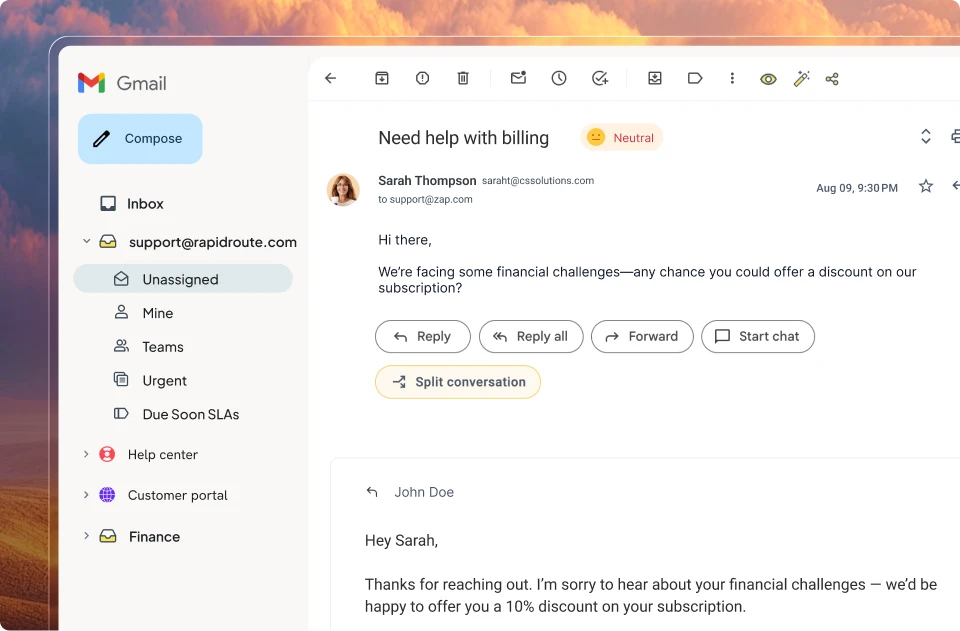
    With Hiver, you can analyze your CSAT & NPS surveys
    With Hiver, you can analyze your CSAT & NPS surveys

    Why it matters

    CSAT, NPS, social listening, and behavior analytics help you understand real customer experiences instead of basing decisions on assumptions. When teams use this data well, they reduce repeat issues and improve accuracy in responses.

    Here are some tools that you should keep handy:

    • Hiver’s CSAT and analytics to capture customer satisfaction scores and track agent performance and response trends directly inside your helpdesk.
    • Qualtrics to run structured CSAT and NPS programs across multiple customer touchpoints.
    • Survicate or Typeform to collect quick post-interaction feedback with short, targeted surveys.
    • Brandwatch or Sprout Social to monitor customer sentiment and recurring issues across social channels.

    2. AI and Automation for Personalized Service

    AI supports a customer service mindset by surfacing customer history, drafting first responses, and flagging key details from long threads. With the basics handled, agents can focus on diagnosing the issue and personalizing the solution to each customer’s needs.

    You can compose responses quickly and more accurately with Hiver’s AI Copilot
    You can compose responses quickly and more accurately with Hiver’s AI Copilot

    Why it matters

    AI reduces errors that come from rushed replies or missing context. It helps agents give consistent answers, follow correct steps, and avoid unnecessary back-and-forth with customers.

    Here are some tools that you should keep handy:

    • Hiver’s AI feature helps with reply suggestions, summaries, triage, and sentiment detection.
    • Intercom Fin for automated answers to common questions.
    • Ada or Freshworks Freddy AI for conversational chatbots.
    • Zapier for workflow automation across support systems.

    3. Omnichannel Platforms and Knowledge Bases

    Omnichannel platforms keep all customer conversations in one place, no matter where they start. Customers can email, chat, call, or message on social channels, and agents still see the full history. This helps agents understand the situation quickly and respond with the right context.

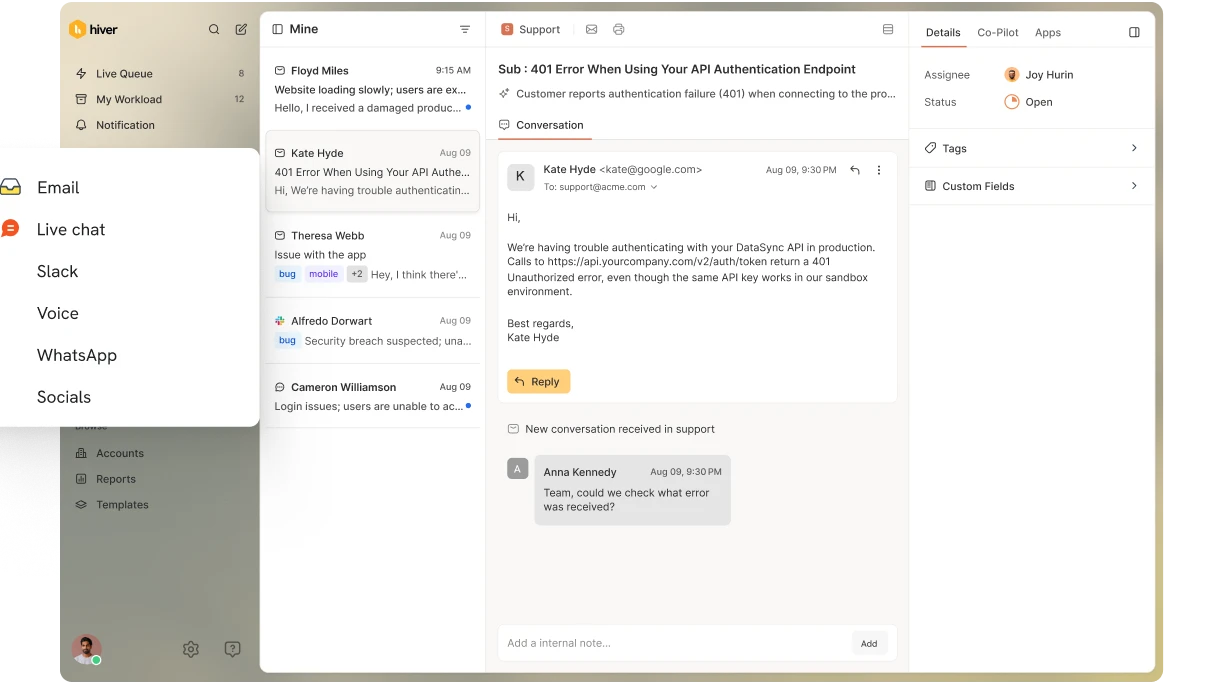
    Hiver brings all your channels in one unified view
    Hiver brings all your channels in one unified view

    Knowledge bases support customers who prefer to solve simple issues on their own. They also give agents a single source of truth for policies, troubleshooting steps, and product instructions, which improves consistency across the team.

    Why it matters

    When customers switch channels, they should not have to repeat their issue. Unified platforms keep the full history visible, which helps agents respond faster and with greater accuracy. Knowledge bases reduce ticket volume and improve self-service success.

    Here are some tools that you should keep handy:

    • Hiver for a unified view into the shared inbox, chat, voice, and WhatsApp.
    • Zendesk for managing high-volume multichannel operations.
    • Freshdesk for support teams using multiple touchpoints.
    • Hiver, HelpDocs, or Guru for creating searchable internal and external knowledge bases.
    • Confluence for storing process documentation and internal workflows.

    Why a Customer Service Mindset Creates Long-Term Impact

    A customer service mindset shows its value in how teams work each day. When agents understand the real issue, communicate clearly, and take ownership, customers receive faster fixes and fewer reasons to return with the same problem. It also gives leaders clearer insight into what needs to improve across products and workflows.

    Making this mindset stick requires consistent training, clear guardrails for autonomy, and tools that give agents full context without slowing them down. When these pieces are in place, service becomes more accurate, more predictable, and easier for customers to navigate.

    The outcome is straightforward. Fewer follow-ups. Lesser escalations. Stronger retention. And a support experience that customers trust every time they reach out.

    Frequently Asked Questions

    1. What is a customer service mindset?

    A customer service mindset is an approach where agents identify the customer’s real problem. They remove unnecessary steps, communicate clearly, and stay accountable until the issue is fully resolved.

    2. Why is a customer service mindset important?

    It improves accuracy and reduces repeat contacts. It also builds trust because customers get the right fix the first time. Teams handle high-volume or complex cases more effectively when they diagnose issues accurately.

    3. How do you cultivate a customer service mindset in your team?

    Model the behaviors you expect. Train using real scenarios. Review customer feedback often. Give agents clear decision-making guardrails. Recognize examples of strong problem-solving.

    4. What are the key traits of a customer service mindset?

    -Empathy to understand context.
    -Patience to avoid rushed assumptions.
    -Ownership to resolve the issue end-to-end.
    -Responsiveness to set clear timelines.
    -Adaptability to match the customer’s comfort level.
    -Curiosity to uncover the root cause.

    5. What are real-world examples of a strong customer service mindset?

    Brands like Chewy, BARK, Netflix, and Southwest Airlines show how mindset shapes decisions and customer loyalty.

    6. How do you measure the impact of a customer service mindset?

    You measure it by tracking CSAT, NPS, first contact resolution, repeat contact rate, resolution time, QA scores, and patterns in recurring issues identified by the support team.

    7. What is the difference between a customer service mindset and a sales mindset?

    A customer service mindset focuses on diagnosing the issue and reducing customer effort, while a sales mindset focuses on influencing decisions and driving revenue. Both matter, but they define success differently.

    Author

    Rashi is a B2B content marketer who helps brands strengthen customer experience (CX) and customer service (CS). She focuses on customer-first growth, creating strategies and content that drive loyalty, empower support teams, and align business goals with customer needs.

    Finally, a customer service platform you can set up in 15 minutes

    10,000+ teams found a better way to
    deliver customer service. Your turn.

    Get unlimited users on the Free plan  ✦  No credit card needed

    based on 2,000+ reviews from

    Get Hiver's Chrome extension for Gmail to start your 7-day free trial!

    Step 1

    Add Hiver’s extension to your Gmail from the Chrome Webstore

    Step 2

    Log in to the extension to grant necessary permissions

    Step 3

    Enjoy your 7-day free trial of Hiver

    The modern AI-powered
    customer service platform

    Not ready to install Hiver’s Gmail extension?

    That’s okay. Would you be open to try Hiver’s standalone web-based customer 

    service platform, which does not require downloading the Gmail extension?

    Thank you for your interest!

    The web app is currently under development—we’ll notify you as soon as it’s live.

    In the meantime, you can get started with your 7-day free trial by downloading our Gmail extension.

    The modern AI-powered
    customer service platform

    Book your slot

    Awesome! We've reserved your spot.

    You’ll receive an email shortly with the details. Don’t forget to add to your calendar!

    “Our clients choose us over competitors due to our speed and quality of communication. We couldn’t achieve this without Hiver”

    Fin Brown

    Project Manager

    Getitmade@2x

    Get in touch with us

    Fill out the form and we’ll get back to you.

    demo popup graphic

    Get a personalized demo

    Connect with our customer champion to explore how teams like you leverage Hiver to: