




I admit — call centers have come a long way. What started as an Automated Business Exchange system in the 1960s has transformed over time.
Back then, multiple agents could handle customer interactions over the phone. Now, it has evolved into a comprehensive system that helps provide customer support, track interactions, and improve service quality.
In the 1970s, the ‘wow’ factor was automated call routing. Today, it is AI.
When it comes to modern-day call center software, it goes beyond just allowing you to handle phone calls. It helps you understand your customers contextually and provides predictive support—even before the customer can ask for something.
So, what goes into call center management in 2025? What are some of the best practices you must know and essential KPIs you need to track? Let’s find out!
[cta_block]
What is Call Center Management?
Call center management is the intricate process of overseeing and coordinating a call center’s daily operations to ensure optimal support agent performance and exceptional customer service delivery.
It encompasses a wide range of responsibilities and functions, including:
1. Workforce Management: This typically involves scheduling the correct number of agents to handle call volumes while ensuring no one is overworked or idle. It includes:-
- Forecasting: Using historical or real-time data to predict call volumes and staff.
- Scheduling: Managing shifts to balance agent availability during peak hours.
- Adapting to Demand: Quickly adjusting when unexpected spikes or drops in calls occur.
2. Performance monitoring: Tracking key performance indicators (KPIs) and analyzing agent performance ensures that call center goals are met. Important metrics include Average Handle Time (AHT), First Call Resolution (FCR), the percentage of issues resolved on the first call, and Customer Satisfaction (CSAT), among others.
3. Technology and Tools: The right tools can improve your call center’s efficiency and agents’ productivity. That’s why managing a call center also involves implementing and maintaining software. This can include customer relationship management (CRM) software, call monitoring and analytics tools to track performance, and omnichannel platforms to manage queries from phone, email, and chat in one place.
4. Customer Experience Management: Any call center’s ultimate goal is to ensure customers receive timely, accurate, and helpful responses. To do this, the center must minimize wait times and ensure smooth call transfers when needed.
5. Compliance and Security: Call centers often handle sensitive customer data, so adhering to compliance standards to ensure security is essential. This can include using secure systems to store and transmit customer information and training agents on data privacy regulations like GDPR or HIPAA.
6. Process Improvement: This usually includes regularly reviewing and updating training programs, adopting new technologies to streamline workflows, and encouraging feedback from agents and customers to identify improvement areas.
Now that we know how a call center works let’s look at the different types of call centers.
Types of call centers: inbound, outbound, and blended
Based on the nature of their operations and the type of interactions they handle, call centers can be categorized into three types: inbound, outbound, and blended call centers.
Here’s a quick rundown of the difference between an inbound, outbound, and a blended call center:
| Aspect | Inbound Call Center | Outbound Call Center | Blended Call Center |
| Purpose | Handle incoming customer support calls, inquiries, and complaints. | Make outgoing calls to prospects to make a sale. | Handle both incoming and outgoing calls, combining customer support and sales efforts. |
| Call direction | Customers initiate calls | Agents initiate calls | Both customers and agents initiate calls |
| Examples | Tech support, order tracking, billing queries. | Cold calls, product promotions, debt collection. | Customer service and follow-ups, cross-selling opportunities. |
| Key Metrics | First Response Time (FRT), Average Handle Time (AHT), Customer Satisfaction Score (CSAT). | Conversion rate, Call-to-sale ratio, Lead generation. | Combines inbound and outbound metrics |
| Preferred Technology | IVR, CRM, and help desk software. | Auto-dialers, CRM, and campaign management tools. | Unified platforms with both inbound and outbound capabilities. |
| Challenges | A high volume of customer complaints or queries | Rejection, low conversion rates | Balancing workloads and agent adaptability |
| Best For | Support-focused businesses | Sales-driven businesses | Businesses requiring both sales and support |
Inbound Call Centers
Inbound call centers primarily handle incoming customer calls on product or service inquiries, troubleshooting, and more.
Key activities in inbound call centers include:
- Customer support for technical or product-related queries.
- Handling complaints and troubleshooting issues
- Processing orders, refunds, and payments.
- Offering information about services or promotions.
Since inbound call centers are customer-focused, they often measure success using metrics like First Call Resolution (FCR), Average Handle Time (AHT), and Customer Satisfaction (CSAT).
Outbound Call Centers
On the other hand, outbound call centers involve agents making calls to customers or prospects. They are typically sales—or marketing-driven operations that focus on promoting products, generating leads, or following up with customers.
Key activities in outbound call centers include:
- Telemarketing and sales outreach.
- Customer follow-ups (e.g., feedback or renewal reminders).
- Conducting surveys or market research.
- Collection of payments or dues.
Outbound call centers focus on conversion, lead generation, and call success rates as key performance indicators.
Blended Call Centers
As the name suggests, blended call centers combine the functions of both inbound and outbound operations. Agents in these call centers handle a mix of incoming and outgoing calls.
For example, an agent in a blended call center might work on assisting a customer with a query and then making follow-up calls to prospects later. This model is for businesses that want to combine customer service with proactive outreach without needing separate teams.
Blended call centers also require special tools to manage workflows effectively. Tools like automatic call distribution (ACD) and dialer systems ensure a smooth transition between inbound and outbound tasks. A mix of customer service and sales metrics, such as FCR, CSAT, and conversion rates, are often used to measure performance in blended call centers.
Recommended Reading: Call Center Customer Service: A Detailed Guide
7 Tips for Effective Call Center Management
1) Create a positive work environment to make your agents feel empowered.
Fostering a positive work culture is very important, especially when your team is working remotely. Doing this can not only make your agents feel valued but also increase their productivity.
You can do this by recognizing and rewarding outstanding performance, encouraging open communication between agents and management, and offering opportunities for career growth through promotions or skill-building programs.
Consider organizing monthly team-building activities to strengthen camaraderie among agents. For example, you can award “Best Customer Story of the Month” to an agent who creatively resolves a difficult query.
Protip: Build a Transparent and Honest Culture
A call center job is high-pressure—it demands quick thinking, patience, and resilience to handle customer frustrations daily. Without a supportive and transparent culture, employees can quickly feel burned out or undervalued. For example, when team members leave or are terminated, it’s important to address the situation openly rather than ignoring it, which can create feelings of insecurity among the remaining staff. This Reddit thread has some actionable takeaways that you can use.

2) Leverage AI and automation to save time and boost productivity
Ever wish you could clone your best agents to handle more tasks at once? While we haven’t figured out cloning (yet), AI and automation can help to an extent.
They can take care of repetitive, time-consuming tasks, leaving your agents to focus on the complex issues that truly need human attention. It’s like giving your team a productivity boost without hiring extra staff. In fact, 79% of businesses consider automation essential in their customer experience strategy, indicating a strong shift towards automated solutions.
- With AI-driven solutions like chatbots and virtual agents, you can ensure customers receive instant responses to frequently asked queries 24/7.
- Not only this, AI tools can also automate tasks such as generating call summaries and transcripts, allowing agents to focus on providing quality customer service rather than administrative duties. This will help improve efficiency and ensure consistent documentation of customer interactions.
3) Go omnichannel
This may sound counterintuitive, but customer preferences have changed over time. They no longer depend solely on phone support.
In fact, as per Hiver’s Customer Survey Benchmark report, 77% of customers prefer email, and 63% use live chat to communicate with brands. That’s why it’s important to connect with customers where they are.
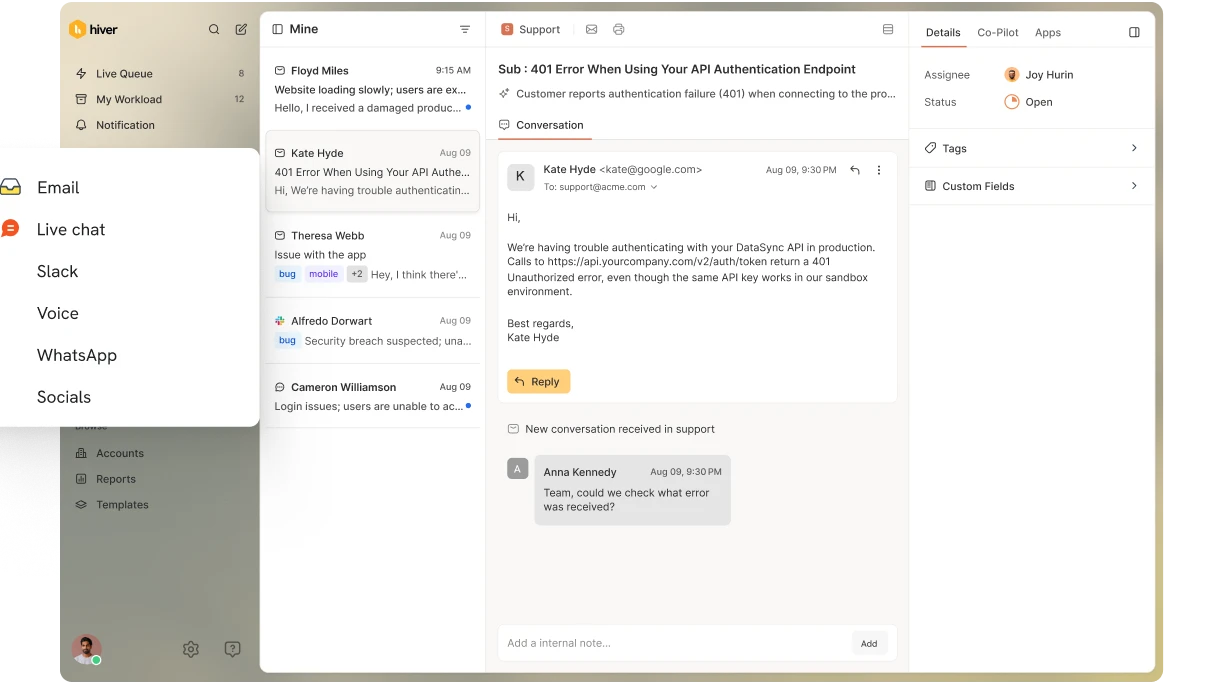
An omnichannel strategy works best for this. Omnichannel support allows customers to interact with you through their preferred channels—be it voice calls, live chat, social media, or email. This helps agents handle customer queries across multiple channels, empowering them to minimize wait times and eventually improve customer satisfaction.

4) Enable self-service resources for agents and customers
Call center agents often have queries. They may direct them toward you to ensure smooth operations. For instance, they might ask you:
- “Can you provide more information about the latest product updates or features?”
- “What should I do if a customer asks for something outside our standard policies?”
- “What should I do if I encounter technical issues with our call center software?”
Instead of attending to every support agent’s request, consider providing them with resources to help themselves and free up your bandwidth.
Create an internal knowledge base with FAQs, troubleshooting guides, and best practices. Within your self-service portal, incorporate interactive tools such as decision trees or video tutorials.
Similarly, empower your customers with effective self-service options to reduce the workload on your call center agents. Here are effective self-service options that you can implement:
- Comprehensive customer portal: You can create a well-organized customer self-service portal to allow customers to submit their issues and track their resolution status. This will simplify the process of query submission and tracking.

- Automated Call Systems: Automated phone systems allow customers to resolve simple issues without speaking to an agent. For example, customers can check their account balance, reset passwords, or request service updates through an interactive voice response (IVR) system. An IVR system is an automated phone system that lets callers interact with a company’s services using voice commands or keypad inputs.
- Live chat: Unlike email or phone support, live chat immediately responds to customer inquiries. Implementing live chat on your website can help customers get answers to routine questions, track orders, and schedule appointments quickly and reliably. This will provide customers with instant responses, guide them through troubleshooting steps, and even escalate issues to human agents when necessary.
Recommended Reading: What Is A Customer Portal and How Can It Be Used to Improve Customer Experience
5) Collect and analyze customer feedback to find insights
Proactively seeking customer feedback through surveys after customer interactions helps in several ways. It provides valuable insights into service quality and areas needing improvement. And if you time your surveys just right, you can maximize your response rate. For example, immediately after the interaction, post-purchase, after a significant event like product launches or updates, and at regular intervals.
To streamline customer follow-ups for feedback, you can leverage customer satisfaction (CSAT) surveys. This will help your agents save time when drafting surveys from scratch.
Did you know? A lot of organizations prioritize the voice of the customer (VOC) programs to not only improve their internal processes but also drive product development. Fullscript, a digital health platform, is quite committed to integrating customer feedback into product development.
Siobhán James, Director of Client Operations at Fullscript, highlights how they started their Voice of the Customer initiative a year ago, and now they’re already scaling it up.

Recommended Reading: The Ultimate Guide to Customer Follow-Up [Free Email Templates Included]
6) Invest in user-friendly tools
Easy-to-use tools allow agents to provide faster responses and more accurate solutions.
Think about it: if agents can access tools that don’t require a learning curve instead of tools with clunky and outdated interfaces, won’t their job become easier?
Therefore, invest in tools that help your support staff manage scalability. Look for software that has an intuitive interface, allows you to connect with customers on multiple channels, helps you integrate a knowledge base, and automates routine tasks, among other features.
Do you need a separate call center management software?
The short answer: Not necessarily. Contrary to popular opinion, opting for a helpdesk solution that integrates call center functionality is more efficient. This approach offers a unified platform for managing all customer support interactions—calls, emails, chats, and more—eliminating the need for multiple tools.
Separate call center management tools may seem appealing initially, but they can introduce unnecessary complexity, a learning curve, and additional costs. Think about it: if you install a separate software to manage calls, you’d have to train your agents on how to use the software. Not to mention the time spent switching between apps to manage incoming calls and searching for customer information/interaction history. This slows down productivity and increases the risk of errors during customer interactions. Additionally, from a cost perspective, investing in separate software for your call center can quickly add up—not just in licensing fees but also in training, onboarding, and maintenance costs.
However, an all-in-one helpdesk ensures that all communication channels are seamlessly interconnected, giving agents a 360-degree view of customer data in one place. The result? Faster resolutions, fewer mistakes, and happier customers with no extra costs.
7) Monitor and analyze call center performance
Ensuring that your call center is running at peak performance is not just about answering calls quickly. It’s about consistently delivering exceptional customer experiences while optimizing your team’s efficiency.
That’s why monitoring and analyzing call center performance helps. By closely monitoring key metrics and trends, you gain valuable insights into what’s working, what’s not, and where there’s room for improvement.
But here’s the big question: how do you gauge the overall health of your call center? Which metrics should you focus on? To help with this, you can leverage tools like Hiver that offer reports and analytics out of the box.
They help you instantly track real-time data such as call volume, active conversations, resolved conversations, and wait times, among other metrics, to gauge agent performance.

Let’s say on the day of a new product/feature launch, your reports and analytics show a sudden surge in call volume, and you notice that the average wait time is increasing due to this spike. This insight can help you ensure staffing levels and manage workload better.
On that note, let’s take a more detailed look at some of the most important KPIs that every call center should keep track of.
Key Performance Indicators (KPIs) to monitor for Effective Call Center Management
When managing a call center, data will act as your compass. Here are some data points that you can look at when to measure your call center’s success:
- First Call Resolution (FCR):
First Call Resolution measures the percentage of customer issues resolved during the first interaction without requiring follow-up for escalation. A high FCR indicates that agents are well-trained and equipped to handle customer concerns effectively.

- Average Handle Time (AHT):
Average Handle Time tracks the total time taken by an agent to resolve a customer issue, including talk time and after-call work. While a lower AHT reflects efficiency, balancing speed with quality is important to avoid rushing customer interactions.

- Customer Satisfaction Score (CSAT):
CSAT measures how satisfied or dissatisfied customers are. Customers rate their satisfaction on a scale (e.g., 1–5), and the average score represents the overall service quality.

- Net Promoter Score (NPS):
Net Promoter Score gauges the likelihood of customers recommending your service or brand to others. Customers rate their likelihood on a scale of 0 to 10, and scores are categorized as promoters (9–10), passives (7–8), or detractors (0–6).

- Call Abandonment Rate
The call abandonment rate represents the percentage of customers who hang up before reaching an agent. A high abandonment rate typically indicates long wait times or inadequate staffing.

- Agent Productivity Metrics (Optional):
Agent productivity metrics track how effectively agents manage their tasks. This includes the number of calls handled, schedule adherence, and time spent on after-call work.

After establishing the importance of which KPIs to track, let’s talk about the tools that can make a difference when it comes to managing a call center. These tools not only help you keep an eye on the important metrics but also streamline your operations, boost agent productivity, and enhance the overall customer experience.
Top 5 Call Center Management Software for 2025
1. Hiver
If you’re looking for software that helps you manage customer calls and is easy to use, Hiver’s Aircall integration will work best for you. Unlike traditional call center tools, Hiver is a full-fledged helpdesk with an intuitive interface.

By integrating with Aircall, Hiver allows support teams to manage calls seamlessly alongside interactions from other support channels, such as email, chat, and WhatsApp.
Key features:
- Centralize Customer Interactions: Manage customer calls and emails in one place, ensuring that no query—whether it’s a call or an email—slips through the cracks.
- Automatically create tickets for calls: Every incoming or outgoing call is logged in Hiver as a ticket, complete with details like caller information, call duration, and notes.
- Assign and track call tickets: Assign call tickets to team members directly inside Hiver. Monitor their progress in real-time to ensure prompt resolutions.
- Analytics and reporting: Get a comprehensive view of your team’s performance. Identify bottlenecks, track response times, and make data-driven decisions to optimize operations.
2. Zendesk
Zendesk is a leading customer service platform. Their integrated voice solution synchronizes with all other channels, allowing agents to access all customer information immediately. Each call is automatically generated into a ticket, allowing agents to track interactions seamlessly.

In case an agent is unavailable, callers can leave a voicemail. The system also allows agents to set up callback requests, ensuring that customers can get back in touch without losing their place in the queue.
Key Features:
- Real-time call monitoring and analytics: Supervisors can listen in on live calls to assess the quality of interactions.
- Automatic call routing and IVR (Interactive Voice Response): Automatic call routing ensures that calls are directed to the right agent based on predefined rules, such as the agent’s expertise, availability, or priority level.
- Customizable call center workflows: Managers can configure workflows based on business hours, team availability, and specific customer needs. For example, different types of calls can be routed to different teams or agents.
- Customer profiles: Agents have access to complete customer profiles that include interaction history, preferences, and previous support issues.
- AI features: Zendesk’s AI features help with the automatic transcription of calls, post-call summaries, and sentiment analysis that helps agents understand customer emotions during interactions.
3. Talkdesk
Talkdesk is an AI-powered solution that aims to improve agent performance, enhance customer service, and scale your call center operations. The platform supports multiple communication channels, including voice, SMS, email, and social media.
One of Talkdesk’s standout features is its ability to generate summaries of customer interactions automatically. After a call ends, the AI quickly compiles key points, including the intent, outcome, and next steps.

This automatic summarization can save agents 30 to 60 seconds of manual note-taking time, enabling them to wrap up calls more efficiently and move on to assist the next customer.
Key Features:
- Call monitoring and quality assurance: Built-in call monitoring tools allow managers to listen to live calls without interrupting the conversation.
- Real-time analytics: Get real-time insights into key performance metrics, such as call volume, average handling time, and agent performance.
- Automation features: Streamline routine tasks, such as ticket creation and follow-ups.
- Disposition selection: In addition to generating summaries, Talkdesk’s AI automatically selects the appropriate call disposition. This means agents do not have to spend additional time manually categorizing calls or determining their outcomes, further streamlining the post-call process.
Recommended reading – Zendesk vs Talkdesk
4. Five9
A fully cloud-based contact center platform, Five9 emphasizes transparency and security while providing essential features such as predictive dialing and workforce optimization.
One of its standout features is Voice+, an advanced voice solution that leverages AI and automation to improve call handling and efficiency. With Voice+, call centers can integrate voice interactions seamlessly with other communication channels.

Another powerful feature is the Five9 Agent Desktop, designed to simplify the agent’s workflow. This unified interface gives agents a 360-degree view of the customer by consolidating customer information, interaction history, and tools needed for resolution in one place.
Key Features:
- Omnichannel Capabilities: With Five9, you can manage customer interactions across multiple channels—voice, email, chat, SMS, and social media—within a single platform.
- Workforce Optimization: Managers can predict call volumes accurately and align staffing levels accordingly. This ensures that agents are available when needed while minimizing labor costs.
- Call Scripting: The platform includes customizable call scripting tools that guide agents through conversations while ensuring consistent messaging across the team.
- Predictive Dialer: Five9’s predictive dialer automates outbound calling by predicting when agents will be available based on current call patterns.
- Video Support: Including video capabilities allows customers to escalate their interactions to video calls when necessary. This enhances personalization and enables agents to provide more effective assistance.
5. RingCentral Contact Center
Used by over 400,000 organizations worldwide, RingCentral is an AI-powered all-in-one platform that simplifies call center management. It offers powerful AI features, including AI Assist and Virtual Agent, to help call center agents resolve customer queries faster.

AI Assist helps agents during live interactions by providing real-time suggestions, sentiment analysis, and relevant information. For instance, it can surface knowledge-based articles, highlight key points from previous conversations, and offer response templates based on the customer’s tone and query.
On the other hand, Virtual Agents take customer self-service to the next level. Acting as a conversational AI bot, it can handle routine queries like order tracking, appointment scheduling, or FAQs without needing a live agent.
Key features:
- Omnichannel engagement: RingCentral allows your call center to interact with customers across multiple channels, including voice, email, chat, and social media.
- Workforce optimization: It helps with intelligent routing to ensure calls go to the right agent based on their skills. Additionally, features like Virtual Agent handles routine tasks, freeing up agents to focus on more complex issues.
- Mobile accessibility: RingCentral’s mobile application allows agents to manage calls and communications from anywhere, ensuring they remain connected even when working remotely or on the go.
- AI-powered features: RingCentral incorporates AI technologies such as AI Conversation Expert (formerly RingSense), which provides conversation intelligence and real-time insights during calls.
- Push-to-talk: Push-to-talk enables agents to communicate instantly with colleagues at the push of a button, similar to a walkie-talkie. This allows agents to quickly collaborate internally on customer calls.
How to Choose the Right Software for Call Center Management
Whether you’re going with a separate call center software or an all-in-one helpdesk, there are a few things you can consider before making a decision:
– Look for integration with existing tools (e.g., CRM, email)
Ensure the software can seamlessly integrate with existing systems. For example, CRM platforms to centralize customer data and email management tools to streamline workflows.
– Evaluate ease of use and onboarding process
It is crucial for your support team to quickly adapt to the software. So, look for a user-friendly interface and training resources like tutorials and documentation to assist with onboarding.
– Ensure analytics and reporting features
Data is key to improving call center performance. Ensure the software provides real-time metrics to track agent performance, call volumes, and customer satisfaction, among other things.
– Don’t neglect security features
Given the rise in data breaches, ensure that the software includes robust security measures such as encryption, two-factor authentication, and compliance with relevant regulations (e.g., GDPR, HIPAA).
Improve your contact center management with the right tools
Effective call center management isn’t just about meeting metrics; it’s about empowering your team to deliver exceptional customer experiences.
Investing in the right tools and technology can transform your contact center into a hub of efficiency and customer satisfaction. From AI-powered call routing to real-time analytics, these tools streamline operations and enable your agents to focus on what truly matters: building meaningful connections with customers.
As you look forward to making your call center operations more manageable, consider implementing a solution like Hiver. With its user-friendly interface, powerful features, and integration with AirCall, Hiver can help you transform your customer support experience and easily manage scalability.
Frequently Asked Questions (FAQs)
1. What is the primary goal of call center management?
The primary goal of any call center is to help customers on time. Whether through IVR or a human agent, the focus is on ensuring that customer queries, concerns, or issues are addressed accurately. This means minimizing wait times, providing clear and helpful solutions, and creating a seamless experience with every interaction.
2. How to effectively manage a call center?
To effectively manage a call center, focus on four key areas: agent training and development, Quality Assurance, Technology integration, Workforce management, performance metrics, disaster recovery, and business continuity.
3. What is the structure of a call center?
Call centers have a clear structure to keep operations running smoothly. At the top, there’s the Director of Customer Service or Head of the Call Center, who makes strategic decisions and oversees everything. Reporting to them, you have call center managers who take care of daily operations and set performance targets. In some setups, you have another level of managers – usually team leads or supervisors – who take care of administrative tasks and work with frontline agents regularly. And the largest group comprises frontline support staff who interact with customers and answer their queries.