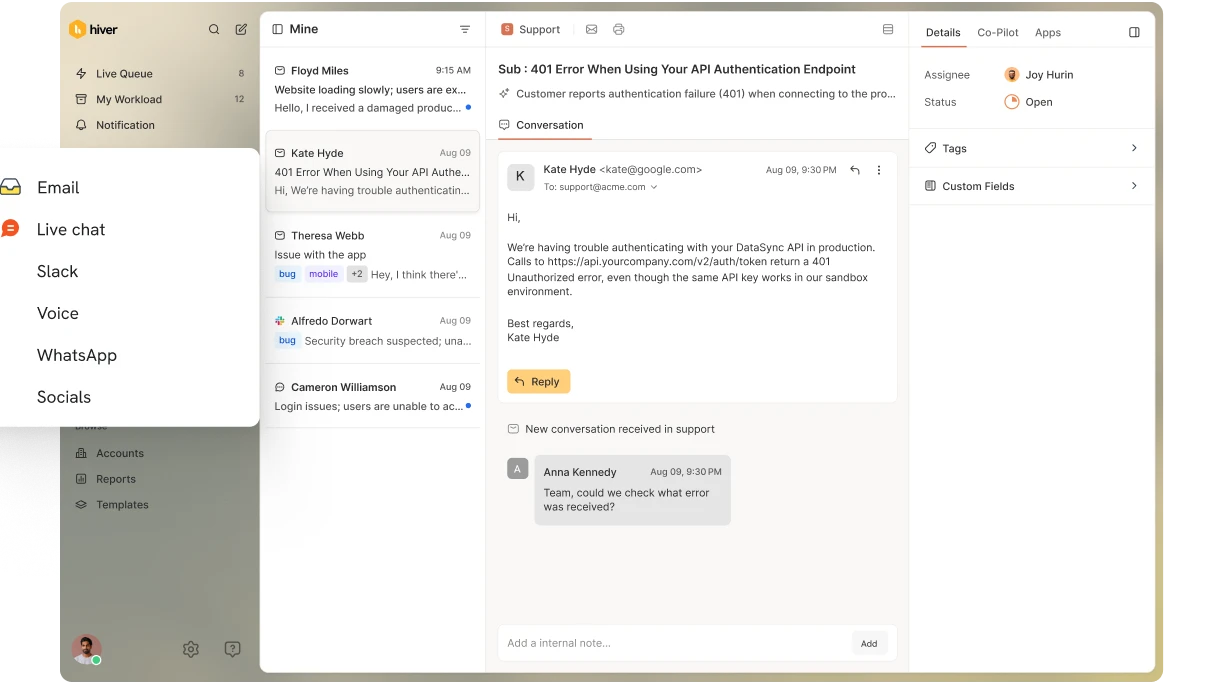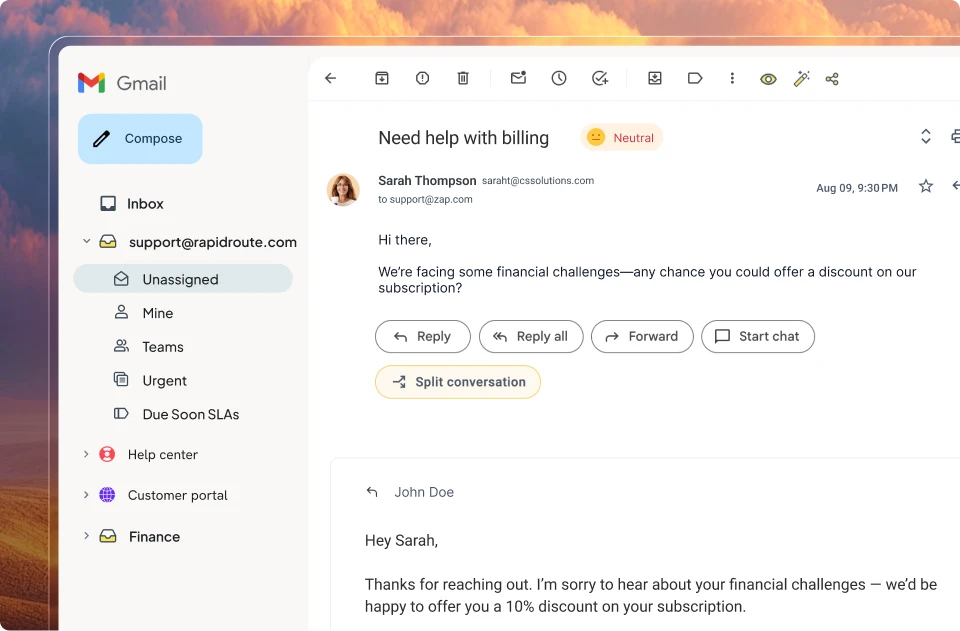







Help Scout works great for small teams managing basic email support, but its AI only handles simple tasks and drafts. Plus, it charges an extra $0.75 for every issue the AI resolves. Hiver takes the top spot because its AI is built right in, handling everything from routing tickets and auto-resolving issues to QA and analytics. Zendesk and Intercom round out the list as solid alternatives depending on what your team needs.
| Tool | Best for | Starting price | G2 rating |
| Hiver | Teams running complex, cross-team support who also want AI across the full support lifecycle | $25/user/mo (Growth) | 4.6/5 (1,283 reviews) |
| Zendesk | Enterprise-scale ticket management with deep customization | $19/agent/mo (Support Team) | 4.3/5 (6,707 reviews) |
| Intercom | Teams prioritizing AI chatbot resolution volume | $29/seat/mo (Essential) | 4.5/5 (3,345 reviews) |
Looking for an alternative to Help Scout?
When you search for customer support software, Help Scout shows up on almost every shortlist. It holds a 4.4/5 rating on G2 across 400+ reviews and a 4.6/5 on Capterra from more than 220 users. Most teams appreciate how easy it is to use and how it keeps conversations feeling personal and genuinely human.
But teams looking for Help Scout alternatives tend to tell a different story. Their frustrations are consistent, and they follow a pattern. If you’re starting to feel those gaps too, here are the best Help Scout alternatives based on my research.
Why listen to us?
Hiver is an agentic omnichannel customer service platform built for complex support. More than 10,000 teams trust Hiver, including Flexport, Gusto, Ping Identity, and Epic Games. Flexport cut resolution times by 50% after switching, and ConService saves 265 hours of agent time every month. Hiver’s AI isn’t bolted on through an acquisition or a third-party integration. AI Agents, AI Copilot, AI QA, and AI Insights were all built natively into the platform. They share context, learn from every resolution, and work together across the full support lifecycle. That’s the lens we bring to this comparison.

Why are businesses looking for Help Scout alternatives?
When I went through reviews and customer feedback on Help Scout, I did not find one big issue pushing teams away. It was a pattern of small gaps that start to matter as teams scale.
- AI is still relatively limited once workflows get more complex. Help Scout handles drafting and basic assistance reasonably well, but it lacks the deeper automation layers teams increasingly expect as support scales. Things like intent-based triage, autonomous resolution workflows, proactive QA, or AI that can pull context across systems still require external tooling or manual workarounds.
- Reporting is the first thing that breaks. Help Scout has basic dashboards, but when you need deeper SLA and performance visibility, you will see the limitations. Teams mention shallow insights and missing filters. One user summed it up by saying it is “not great for reports” and lacks depth for proper analysis.
- Automation also feels limited once workflows get complex. The platform works for basic use cases, but scaling it is harder and sometimes risky. One user shared how a small mistake led to “2,000 email responses for already closed emails” after switching between manual and automated workflows. That kind of risk makes it harder to rely on automation at scale.
- There is no native SLA support. This comes up repeatedly. Teams cannot track response deadlines or escalations without external tools. One reviewer put it plainly: “they still don’t have SLA support.”
- Integrations are also weak spots. While Helpscout has integrations with a lot of tools, the depth is missing. For example, while you can pull data from Salesforce, it does not allow you to find relevant information without leaving Helpscout which means agents still end up tab switching.
Help Scout works well when support is straightforward and the team is small. But as soon as you need better visibility into support performance and workflows that scale cleanly across channels, you start running into limitations. That is usually when teams begin looking for alternatives.
9 Help Scout alternatives at a glance
Before we get into the detailed breakdown, here’s a quick overview of how these Help Scout alternatives compare across pricing, strengths, and ideal use cases.
| Tool | SOC2/HIPPA | AI Capabilities | Best for | Pricing Model | Biggest strength | Biggest limitation |
| Freshdesk | SOC 2, HIPAA (Enterprise) | Freddy AI Copilot, AI Agent, AI Insights, ticket summarization, sentiment detection | Structured support teams needing automation at scale | $19/user/month14-day free trial | Strong ticketing, SLAs, routing, and Freddy AI | UI can feel cluttered and advanced features get expensive |
| Hiver | SOC 2, HIPAA, GDPR | AI Agents, AI Tasks, AI Copilot, AI QA, AI Topics | Teams managing complex email support queries | $25/user/month7-day free trial | Handles complex cross-team email support with rich customer context and AI throughout the support lifecycle | Mobile app experience and rigid enterprise queue handling can improve |
| Zendesk | SOC 2, HIPAA (Enterprise) | AI Agents, AI Copilot, intelligent routing, automated workflows | Enterprise-scale support operations | $19/agent/month14-day free trial | Deep customization, AI deflection, and operational scalability | Complex setup, admin overhead, and rising costs |
| Intercom | SOC 2, HIPAA (Enterprise) | Fin AI Agent, AI Copilot, AI Analyst | AI-first customer support | $29/seat/month + AI usage14-day free trial | Best-in-class AI agent experience with Fin | Pricing becomes unpredictable and AI consistency varies |
| Gorgias | SOC 2 | AI Agent, AI Assist, ecommerce automations | Ecommerce support teams | $10/month7-day free trial | Deep Shopify and ecommerce integrations | Usage-based pricing scales quickly |
| Front | SOC 2, HIPAA (Enterprise) | AI Compose, AI Answers, conversation summaries, workflow automation | Cross-functional customer support collaboration | $25/user/month14-day free trial | Excellent internal collaboration and omnichannel workflows | AI accuracy and pricing can become concerns at scale |
| Kayako | SOC 2 | AI-powered ticket automation and workflow assistance | AI-led support operations | $1 per resolved AI ticketNo free trial but free demo available | AI workflows focused on reducing backlog and operational load | Clunky UX, support complaints, and platform reliability issues |
| HubSpot Service Hub | SOC 2, HIPAA (Enterprise) | Breeze Customer Agent, AI assistance, customer journey insights | Teams that want support tightly connected to their CRM | Free plan available Paid from $7/seat/month 14-day free trial (Professional) | Unified CRM, support, customer success, and AI in one platform | Most advanced service and AI capabilities require Professional or Enterprise plans |
| ClickUp | SOC 2, HIPAA available on Enterprise | ClickUp Brain, AI writing, AI knowledge search, workflow automation | Teams combining customer support with project management | Free Forever plan Paid from $10/user/montFree trial available | Keeps customer requests, product work, and internal collaboration in one workspace | Requires more setup than a dedicated customer support platform |
A quick note on how we evaluated these Help Scout alternatives
So instead of relying only on feature pages, I spent time going through G2 reviews, Reddit threads, pricing pages, and real customer feedback to understand where teams actually outgrow Help Scout and what they switch to next.
I mainly looked at things like AI quality, automation, collaboration, reporting, integrations, pricing, and how well these platforms hold up once support starts getting more complex.
Now let’s look at each Help Scout alternative in detail.
11 best Help Scout alternatives in 2026: Detailed Breakdown
Here’s a detailed breakdown of where each platform stands out, and where it starts falling short.
1. Hiver – Best for teams managing complex email support queries
Hiver is the agentic omnichannel customer service platform built for teams that manage complex support across channels, tools, and internal teams.

Most platforms in this category still treat AI as an add-on. They acquired a chatbot company, plugged it into the front end, and called it AI-powered. The result is AI that can deflect simple questions. But it doesn’t touch triage, quality, the knowledge base, or the account-level context that shapes how a ticket gets handled.
Hiver’s AI was built natively into the platform from the start. The AI Agents don’t stop at answering questions. They read the request, reason across your help center, past conversations, and connected tools, and take the action the request needs. That includes responding to the customer, updating a system, or looping in a team for approval. For a large share of requests, that’s where the case ends, and nobody on your team gets involved.
When a request genuinely needs judgment, Hiver hands it off as a relay instead of a restart. AI Copilot routes and categorizes the request, then pulls records from your connected tools. It surfaces sentiment, health scores, and churn signals right in the conversation. Your teammate walks in knowing the account behind it, and Copilot drafts a reply grounded in your help center and conversation history.
After the reply goes out, AI QA reviews every conversation against the quality parameters you define. AI Insights surfaces patterns while there’s still time to act. You’ll see if an agent resolves well but gets the tone wrong, or if a request type keeps generating friction.
After the case closes, AI Knowledge Builder reads resolved conversations and drafts articles where an answer was never documented. It also flags content that’s gone stale. What your team works out once becomes knowledge that AI Agents resolve the next time it comes up.
Key features
- Omnichannel support: Manage email, chat, Slack, voice, SMS, and social conversations in one place while keeping customer context connected across channels.
- Ticketing: Organize every request with clear ownership, priorities, SLAs, custom fields, queues, and a complete activity history.
- Cross-team collaboration: Keep conversations, notes, handoffs, and internal discussions connected so teams can solve complex issues without losing context.
- AI Agents: Let AI handle customer requests from intent to resolution, taking actions across systems and escalating to a person when needed.
- AI Copilot: Help agents work faster by finding context, drafting replies, suggesting next steps, and carrying out approved actions across connected tools.
- Self-updating help center: Turn resolved conversations into new help articles and automatically flag existing content that may be outdated or inaccurate.
- Integrations & workflows: Connect your existing tools and automate routing, tagging, triage, escalations, and other support workflows.
- Customer Intelligence: Combine conversations, CRM data, product usage, and calls to understand customer health, sentiment, and churn risk.
- Analytics: Track support volume, response times, resolution times, SLAs, satisfaction, team performance, and customer trends across channels.
Pricing
Hiver Omni is priced per user, per month, billed annually.
- Growth: $25/user/mo
- Pro: $55/user/mo
- Elite: $85/user/mo
AI Agents and AI Copilot are bundled from the Growth plan up. They aren’t sold as metered add-ons.
Rating
G2: 4.6/5 (1,283 reviews)
When to pick Hiver over Help Scout
Choose Hiver if you manage complex support that requires collaboration across teams, channels, and systems.. It keeps customer history, internal handoffs, Slack conversations, CRM data, and account context connected in one place.

Hiver is also built for support teams that want to transform their customer operations with AI. It offers deeper AI automation across the support lifecycle. AI Agents can resolve requests, AI Copilot helps agents with context and replies, AI QA checks responses before they are sent, and AI Topics surfaces recurring issues and knowledge gaps. Its intent-based routing is also more flexible than Help Scout’s keyword-based automation.
Where Hiver falls short
Hiver’s mobile app is less capable than its desktop experience, and its broader feature set may be unnecessary for teams handling simple, high-volume transactional support.
2. Freshdesk
Freshdesk is an email-first help desk built for structured support operations at scale. It brings considerably more automation and SLA management to the table than Help Scout, and tends to scale more predictably as teams and ticket volume grow.

When to pick Freshdesk over Help Scout
Freshdesk starts making sense once your team is dealing with overloaded queues or missed SLAs, two areas where Help Scout falls short. It lets teams build routing workflows based on agent skills, workload, or priority level, making it easier to manage higher ticket volumes without things falling through the cracks.
For example, if billing conversations need to go to one queue and technical escalations to another, those rules are straightforward to set up and reliable at scale. VIP customers can be flagged and prioritized automatically before anyone manually touches the ticket.
Its AI agent, Freddy AI, can resolve repetitive requests without agent involvement and assist agents during live conversations. Help Scout has some AI drafting features, but nothing that touches the operational side of support the way Freddy does. Freshworks has also been pushing into multi-step AI interactions where AI agents handle full support conversations across email and chat rather than just suggesting replies.

Comparison of Freshdesk and Help Scout features on G2
Where does Freshdesk fall short?
The friction shows up when you need to go omnichannel. Live chat runs through Freshchat, voice through Freshcaller, and the omnichannel bundle is a separate product (Freshdesk Omni) with its own pricing tier. That means managing a suite of Freshworks products and the integrations between them rather than a single support workspace.
Reporting spans multiple dashboards, admin changes have to be replicated across tools, and conversations that move across channels don’t always carry full context.
Key features
- You get centralized ticketing and queue management with SLA controls
- Freddy AI helps you with automated resolutions and agent assistance
- You can route based on agent skills, workload, sentiment, and priority level
- Omnichannel support via Freshdesk Omni (separate product and pricing)
Pricing
Freshdesk starts at $19/user/month for the Growth plan. Higher plans unlock more advanced AI, omnichannel capabilities, reporting, and workflow automation.
Verdict
If Help Scout is feeling limited because ticket volume is growing and SLA management is getting harder to track, Freshdesk is a natural next step. Just go in knowing that omnichannel means adopting additional Freshworks products down the line, not unlocking more of the same platform.
3. Zendesk
Zendesk is the more likely fit if you need enterprise-scale ticket management and deeply customized workflows. It’s configurable down to the details, with admin controls for triggers, macros, custom ticket fields, role-based permissions, and a marketplace with hundreds of apps.

When to pick Zendesk over Help Scout
A big reason larger teams should move to Zendesk from Help Scout is scale. You can build advanced routing logic, highly customized dashboards, SLA structures, self-service flows, and automation rules without relying heavily on external tools. Its marketplace also includes 1,300+ integrations, making it easier to connect CRM, ecommerce, workforce management, and internal business systems into one support operation.
Zendesk’s AI features are significantly more developed than what Help Scout offers. Their AI agents handle repetitive customer requests across channels, while Copilot helps agents with customer context, suggested replies, and recommended actions directly inside workflows. The system also learns from past tickets, help center content, and customer interactions to improve automation and routing accuracy over time.
Where does Zendesk fall short?
While Zendesk performs best at AI-driven deflection and structured ticket operations, it can feel more rigid once conversations become nuanced, highly account-specific, or dependent on multiple internal teams working together. Tools that focus on cross team collaboration, like Hiver, would be a better fit in that case.
Users across G2 also mention that onboarding feels fragmented, reporting customization takes effort, and the platform becomes increasingly admin-dependent as workflows grow more complex. In fact, Help Scout scores higher across usability categories like ease of use, setup, admin experience, and quality of support on G2 (see snapshot below).

G2 comparison of Help Scout vs Zendesk across usability and support categories
The pricing model can also climb quickly. Unlike tools like Hiver, which has AI as a part of even its most basic plan, Zendesk’s AI capabilities and advanced workflows sit behind higher-tier Suite plans or paid add-ons.
Key features
- AI agents resolve repetitive requests end to end, with Copilot stepping in for complex ones
- SLAs, skill-based routing, and workflow automation built for high-volume operations
- Connects with 1,000+ integrations, with deep reporting and workforce management built in
Pricing
Zendesk starts at $19/agent/month for basic email support, but most omnichannel and AI capabilities begin on Suite plans starting at $55/agent/month. Advanced AI features like Copilot, QA, and workforce management often require additional add-ons or higher-tier plans.
Verdict
If you are moving away from Help Scout because your operations have grown too large and complex for it, Zendesk has the depth to handle that. Just go in knowing the setup overhead and total cost are significantly higher than most teams expect upfront.
4. Intercom – Best for AI-first customer support
Intercom is a messaging and ticketing platform that has rebuilt its core around Fin, its AI agent. Where most platforms treat AI as an add-on, Intercom has built its automation and agent workflows around it.

When to pick Intercom over Help Scout
If your support team spends a large part of the day answering repetitive questions like refunds, onboarding, account access, shipping updates, or policy FAQs, Fin can automate a significant portion of that workload across channels. Help Scout has basic AI drafting but nothing that handles deflection at this level.
Fin is the main reason teams move to Intercom. Teams can train Fin on their help center content, internal policies, and Procedures (a dedicated feature for mapping out complex, multi-step workflows) and test conversations before going live. It deploys across voice, email, chat, and social, and when a query falls outside what it can handle, it escalates to a human agent with full context intact.
One thing worth knowing: Fin does not require a full platform switch. It connects natively with Zendesk, Freshdesk, Salesforce, and HubSpot, so teams already on one of those platforms can layer Fin on top without migrating.
Where does Intercom fall short?
Fin’s biggest weakness is consistency. One reviewer specifically said Fin “only handles very simple questions,” while another mentioned that responses sometimes become “out of context” and fail to actually solve the ticket.
Reddit discussion from a team that switched away from Fin AI after struggling with inaccurate answers, pricing, and complex support queries
A repeated pattern across reviews is that it’s dependent on the fact that documentation needs to be kept up to date. Teams working across multiple languages or highly customized systems also reported integration gaps, escalation issues, and AI responses that occasionally confused customers instead of helping them.
Intercom also feels much more optimized for deflection. It works very well for reducing repetitive ticket volume at scale, but teams that need multiple internal teams collaborating closely inside the same thread will find Hiver a more natural fit.
Pricing is the other frequent frustration. Fin charges per resolution starting at $0.99, on top of seat pricing and paid add-ons like Copilot. Several reviewers described the model as “cost prohibitive,” particularly when paying for resolutions that still ended up needing human intervention.
Key features
- Fin AI Agent for automated resolutions and AI-driven support
- Works alongside Zendesk, Freshdesk, Salesforce, and HubSpot without migration
- Fin now includes support for Slack and Discord as support channels
- In-depth reporting on support performance and AI insights to improve them
Pricing
Intercom’s help desk starts at $29/seat/month, while Fin AI Agent pricing starts at $0.99 per resolution/outcome. Advanced plans begin at $85/seat/month, with additional AI add-ons like Copilot priced separately.
Verdict
A strong fit if reducing repetitive ticket volume through AI is the primary reason you are moving away from Help Scout. But go in with realistic expectations: pricing climbs quickly as resolution volume scales, and performance of AI on complex tickets is inconsistent.
5. Gorgias – Best for ecommerce support teams
Gorgias is built specifically for ecommerce brands, especially Shopify-heavy stores managing high volumes of support conversations tied directly to orders, refunds, shipping, subscriptions, and product recommendations.

Unlike Help Scout, which is channel and industry agnostic, Gorgias is purpose-built for one vertical and goes deep on it.
When to pick Gorgias over Help Scout
Gorgias makes the most sense once support is tightly connected to your ecommerce operations.
It has AI Agents that run in two modes depending on what you need. In Support Agent mode it handles inbound queries (order status, returns, shipping updates) automatically. Switch it to Shopping Assistant mode and it shifts from resolving issues to driving revenue: recommending products, offering discounts, and helping customers complete purchases. The AI agents follow brand rules throughout and escalate to a human when needed, across email, chat, SMS, Instagram, Facebook, and WhatsApp from one inbox.
A big reason ecommerce brands move to Gorgias is integration. Multiple users specifically mentioned leaving Help Scout because Gorgias “integrates with pretty much everything” across the ecommerce stack. Native integrations with Shopify, Klaviyo, Recharge, Yotpo, Magento, and hundreds of other ecommerce tools are one of its biggest strengths.
Where does Gorgias fall short?
Even users who liked the product described the pricing as significantly more expensive than alternatives once ticket volume starts scaling.
Another pattern across reviews is that automation and AI work best for standard ecommerce workflows, but less consistently for highly customized support operations. Some reviewers mentioned reporting limitations, unintuitive automation rules, and situations where macros or workflows sent incorrect information to customers after integrations disconnected.
Key features
- Get ecommerce AI Agent for support automation and sales assistance
- Native Shopify workflows for refunds, discounts, cancellations, and order management
- It has 300+ ecommerce integrations including Shopify, Recharge, Klaviyo, and Yotpo
Pricing
Gorgias uses usage-based pricing instead of charging mainly by seats. Plans start at $10/month for 50 tickets, while the Pro plan costs $300/month for 2,000 tickets and Advanced starts at $750/month for 5,000 tickets. Its AI Agent is priced separately at $0.90 per resolved conversation.
Verdict
If your support team exists primarily to serve an ecommerce operation and Help Scout is not giving you enough native integration with your order management tools, Gorgias is the most natural move.
6. Front – Best for cross-functional customer support collaboration
Front will work well for you if your support conversations regularly involve multiple people, approvals, escalations, or cross-functional coordination.

When to pick Front over Help Scout
Help Scout is a better fit for smaller, email-first teams that want a simple, personalized support experience. The limitations show up once conversations start involving multiple internal stakeholders or moving across channels.
G2 comparison of Front and Help Scout based on real user reviews
Front’s collaboration tools are significantly stronger than Help Scout. Teams can comment directly inside conversations, collaborate on shared drafts, and manage conversations across channels with the full history intact.
This is especially helpful for B2B teams during escalations. A customer issue that needs input from sales, legal, or a senior manager stays inside the thread without spinning off into a separate Slack channel or a forwarded email chain. Front also supports Slack as a native channel, so customer conversations happening in dedicated Slack channels get tracked and managed alongside email and chat without switching tools.
Front also does better on the AI front than Help Scout by going beyond drafts and summarization. Its AI Copilot assists agents in real time, Autopilot handles automated resolutions, Smart QA reviews conversation quality, and Smart CSAT tracks sentiment.
Where does Front fall short?
Even though Front’s AI agent has more capabilities than Help Scout, its performance quality (response accuracy and safety score) is rated lower than other support tools on G2.
There is also a steeper learning curve, and some advanced features and integrations are restricted to higher-tier plans.
Also, with Front, omnichannel support is only available on the Professional plan, which starts at $65/user/month. In comparison, Hiver includes omnichannel support starting at $25/user/month, making it a more affordable option for teams that need it.
Key features
- Track and manage Slack customer conversations alongside email and chat
- Front AI lets you automate resolutions, run QA reviews, and track CSAT sentiment
- Advanced routing, analytics, SLAs, and 160+ integration
Pricing
Front starts at $25/user/month for Starter, though that plan only supports a single channel type. Omnichannel support begins on the Professional plan at $65/user/month.
Verdict
If the main limitation of Help Scout is collaboration across agents or teams, Front handles that better. If AI accuracy and pricing are priorities, it is worth testing carefully before committing.
7. Kayako – Best for AI-assisted ticket resolution at scale
Kayako has repositioned itself around AI-first support operations through Kay, its AI agent focused on actually completing support tasks instead of just generating replies.

When to pick Kayako over Help Scout
If Help Scout is feeling limited because the ticket backlog is growing and the team cannot keep up with volume, Kayako is worth a look. Where Help Scout has no real automation depth, Kayako is built around reducing backlog, automating repetitive workflows, and lowering cost per ticket through AI-driven resolution.
A major part of that is integrations. Kay connects directly with tools like Shopify, Stripe, Salesforce, HubSpot, and internal APIs so it can take actions inside existing systems. For example, it can process refunds, update orders, unlock accounts, send return labels, or route tickets automatically without agents manually jumping between platforms.
The platform also pushes a much more operational AI story than Help Scout. Instead of positioning AI mainly as an assistant for summaries or drafting, Kayako focuses on metrics like ticket age reduction, backlog clearance, first-contact resolution, and lowering cost per ticket. Their positioning is less “better inbox” and more “scale support without scaling headcount.”
Where does Kayako fall short?
Compared to Help Scout, Kayako scores lower across nearly every G2 usability category, like ease of setup, quality of support, and product direction.

G2’s comparison table of Help Scout and Kayako
Reviewers also are not fans of the day-to-day experience. One user mentioned: “The ticketing service was clunky and not user-friendly… issues regarding real-time updates, responses, and attachments.” There are also limitations around search, integrations, and overall platform speed.
There were also repeated complaints around pricing and account management.
Key features
- Kay AI agent for automated ticket resolution and workflow actions
- AI triage, routing, and backlog reduction workflows
- Omnichannel inbox that supports multiple channels such as ticketing, live chat, and knowledge base
- Integrations with Shopify, Salesforce, Stripe, Slack, HubSpot, and custom APIs
Pricing
Kay charges $1 per fully resolved AI ticket, while Kayako One bundles ticketing, automation, reporting, inboxes, and onboarding into the broader platform.
Verdict
On pure feature depth and AI-driven automation, Kayako has the edge over Help Scout. But if day-to-day usability and predictable pricing matter as much as capabilities, Help Scout is the safer choice. Kayako’s UX friction and pricing complaints are consistent enough across reviews that they are worth weighing seriously before committing.
8. HubSpot Service Hub – Best for businesses that want customer support tightly connected to their CRM
Unlike Help Scout, where agents often need to switch between platforms to get customer info, HubSpot Service Hub is built around your customer data. Every ticket, conversation, purchase, and interaction lives alongside your CRM, giving agents all the context they need in one place.

When to pick HubSpot Service Hub over Help Scout
HubSpot is the stronger choice if using Help Scout has always made support feel disconnected from the rest of your customer operations or data. Because Service Hub sits on top of HubSpot’s Smart CRM, agents can immediately see a customer’s company, lifecycle stage, previous deals, marketing interactions, and support history before responding. As your team grows, you can also layer in AI-powered customer agents, knowledge bases, customer portals, customer success workspaces, advanced routing, and journey analytics, without moving to another platform. For organizations already invested in HubSpot’s ecosystem, that tight integration removes much of the manual work of keeping customer data in sync.
Where does HubSpot Service Hub fall short?
Many of HubSpot Service Hub’s most valuable service features, like the AI agents, knowledge bases, customer portals, and advanced automation, are reserved for Professional and Enterprise plans. It’s also a broader customer platform than Help Scout, so smaller teams looking for a lightweight help desk may find it more than they need.
Key features
- Unifies customer records by combining support history, deals, marketing activity, and CRM data in one workspace.
- Breeze AI helps resolve routine requests, assists agents, and automates repetitive support work.
- Customer portals and knowledge bases reduce ticket volume by letting customers find answers and track requests themselves.
- Advanced journey analytics and revenue outcomes predictions
Pricing
HubSpot Service Hub offers a free plan with the most basic features. Paid plans start at $10/seat/month (Starter), while AI-powered support capabilities, customer portals, and knowledge bases are available from the Professional plan ($100/seat/month). Enterprise starts at $150/seat/month.
Verdict
If Help Scout feels limiting because your support team lacks customer context or needs to collaborate closely with sales and customer success, HubSpot Service Hub is one of the strongest upgrades available. Just be prepared for costs to increase as you unlock its more advanced service and AI capabilities.
9. ClickUp – Best for teams that want support and project management in one platform
ClickUp is a project management platform first, but its customer service solution has evolved into a capable alternative for teams that want to manage tickets alongside product work. Unlike Help Scout, which focuses on just managing customer conversations, ClickUp lets support, engineering, and product teams collaborate from the same workspace, making it easier to turn customer issues into actionable work.

When to pick ClickUp over Help Scout
Choose ClickUp if customer support is tightly connected to product delivery or internal operations. Instead of resolving tickets in one tool and tracking follow-up work in another, teams can convert requests into tasks, link bugs to engineering backlogs, automate recurring workflows, and collaborate in real time from a shared workspace.
With ClickUp Brain, AI can summarize tickets, answer questions using workspace knowledge, assist with writing, and help teams find information across tasks and docs, reducing the back-and-forth between support and the rest of the business.
Where does ClickUp fall short?
ClickUp isn’t a dedicated help desk, so setting up customer support workflows requires more configuration than platforms like Help Scout. Teams looking for an out-of-the-box support solution may also find the breadth of features overwhelming at first.
Key features
- Customer requests become actionable tasks that stay connected to engineering and operations work.
- ClickUp Brain summarizes conversations, answers questions, and searches across your workspace using AI.
- Custom automations route work, update statuses, and eliminate repetitive support processes.
- Shared dashboards combine ticket progress, team workload, and project delivery in one place.
Pricing
ClickUp offers a free forever plan. Paid plans start at $7/user/month (Unlimited) and $12/user/month (Business). Enterprise pricing is custom and available on request.
Verdict
If Help Scout feels disconnected from the rest of your team’s work, ClickUp is a strong alternative that brings customer support, project management, and AI into one workspace. But keep in mind that you will have to invest more time in setup than you would with a purpose-built help desk.
10. Zoho Desk
Zoho Desk is a solid helpdesk option for teams already using other Zoho products. It integrates natively with Zoho CRM, Zoho Analytics, and Zoho Projects, so data flows between tools without third-party connectors.
On its own, Zoho Desk is a capable ticketing system with multichannel support, automation, and a knowledge base. But if you aren’t in the Zoho ecosystem, the value drops because integrations outside of Zoho aren’t deep enough to stand on their own.
Key features
- Multichannel ticketing: Manage tickets from email, chat, phone, social media, and web forms in one workspace.
- Zia AI assistant: Zia handles sentiment analysis, field predictions, and response suggestions.
- Zoho ecosystem integration: Native connections to Zoho CRM, Analytics, Projects, and other Zoho products.
- Workflow automations: Set up assignment rules, escalation triggers, and SLA tracking.
Pricing
Zoho Desk pricing, billed annually per user per month:
- Free: $0 (up to 3 agents)
- Express: $7/user/mo
- Standard: $14/user/mo
- Professional: $23/user/mo
- Enterprise: $40/user/mo
Pros
- Very competitive pricing, especially for small teams
- Deep integration with the Zoho ecosystem
- Zia AI assistant included in higher tiers without extra charges
Cons
- Outside the Zoho ecosystem, integrations aren’t deep
- Interface can feel dated compared to newer platforms
- Advanced AI capabilities don’t match purpose-built AI platforms
Fits teams already using Zoho products that want a helpdesk integrated into their existing stack.
11. HappyFox
HappyFox is a straightforward helpdesk designed for mid-size teams that want structured ticketing without the complexity of an enterprise platform. It handles email, chat, phone, and social support with clear SLA management and a clean interface.
Where HappyFox shows its limits is in AI and automation. The platform’s AI features are separate products with their own pricing. And the automation tools don’t go as deep as what you’d find in Zendesk or Hiver. If you want basic ticketing done well without a steep learning curve, it’s a reasonable fit.
Key features
- Ticket management: Organize and track support tickets with custom statuses, priorities, and categories.
- SLA management: Set and enforce response and resolution time targets with escalation rules.
- Knowledge base: Build a self-service help center for customers and internal teams.
- Task management: Break tickets into tasks and assign them to different team members.
Pricing
HappyFox pricing, billed annually per agent per month (5-agent minimum on all tiers):
- Mighty: $9/agent/mo
- Fantastic: $39/agent/mo
- Enterprise: $59/agent/mo
HappyFox AI is a separate product with its own pricing.
Pros
- Clean, simple interface with a low learning curve
- Strong SLA management out of the box
- Affordable entry point for small teams
Cons
- AI is a separate product, it isn’t built into the helpdesk
- 5-agent minimum means the entry price is $45/mo even for a team of one
- Fewer integrations than larger platforms
Fits mid-size teams that want structured ticketing and SLA tracking without enterprise-level complexity
Choose the right Help Scout alternative for your team
The best fit comes down to why and where Help Scout stopped working for your team.
Zendesk is the more likely fit for teams that need enterprise-scale ticket management and deeply customized workflows. The tradeoff is significant admin overhead and costs that climb steeply as you grow.
If the priority is handling more customer queries without adding headcount, Intercom is one of the stronger options right now.Hiver is built for B2B support teams where requests regularly involve multiple internal teams, account history matters, and a wrong answer carries real relationship risk. Try it free for 14 days and test it against your own queues.
Frequently Asked Questions
What is the best Help Scout alternative?
It depends on what’s driving the switch. For teams running complex support where AI, cross-team collaboration, and account-level context all matter, Hiver is the strongest fit. Its AI is native and covers triage, resolution, QA, and knowledge management in a single system. For enterprise-scale ticket management with deep customization, Zendesk is the more common choice, though the total cost is significantly higher.
Is Hiver better than Help Scout?
Hiver and Help Scout serve different types of support teams. Help Scout works well for small teams handling straightforward email support. Hiver is built for complex B2B support where requests involve multiple teams and account history shapes how a ticket gets handled. AI needs to do more than draft a reply. Hiver’s AI Agents resolve tickets autonomously, and AI Copilot assists your team on the harder requests. AI QA reviews every conversation for quality, including the ones a manager doesn’t have time to read.
Does Help Scout have AI?
Help Scout offers AI-powered features including AI Drafts for reply suggestions and AI Answers for automated customer responses. AI Answers is billed at $0.75 per resolution on top of your seat cost. Help Scout’s AI handles drafting and basic chatbot responses. It doesn’t offer intent-based triage, autonomous multi-step resolution, or quality assurance across every conversation. And the help center doesn’t write or update itself from resolved tickets.
Which Help Scout alternative is best for small teams on a budget?
Freshdesk (Growth at $19/agent/mo) and Zoho Desk (Express at $7/user/mo) offer the lowest entry points. Both cover basic ticketing, automation, and multichannel support. Hiver’s Growth plan starts at $25/user/mo and bundles AI Agents and AI Copilot into the price. You’re not paying extra for AI on top of your seats.
Can I migrate from Help Scout to another platform easily?
Most Help Scout alternatives offer migration support or import tools for conversations, contacts, and knowledge base articles. Hiver’s setup is designed to be remarkably simple. Most teams are up and running in minutes, without IT or outside consultants. The platform imports your conversation history so your team doesn’t lose context.
Does Help Scout have a free plan?
No, Help Scout does not currently offer a permanent free plan. It mainly offers free trials and paid subscription tiers.
How does Hiver’s pricing compare to Help Scout?
Hiver and Help Scout both start at $25/user/month. The difference is that Help Scout locks features like advanced SLAs, routing, Salesforce/Jira integrations, WhatsApp, and unlimited AI drafts behind higher-tier plans starting at $45/user/month, while its AI chatbot is priced separately at $0.75 per resolution. Hiver includes more AI, automation, analytics, and collaboration capabilities earlier, so costs tend to stay more predictable as support complexity grows.
Can I use a Help Scout alternative without migrating my email data?
Yes. Most major Help Scout alternatives, including Hiver, Zendesk, and Front, support email integrations and migration tools that let teams transition gradually instead of rebuilding everything from scratch.