






Support leaders are under constant pressure to justify spend and improve ROI, especially when per-agent costs climb, and leadership expects clear efficiency gains. When evaluating Gladly, the core question is simple. Can a premium, people-first support platform lower the cost per conversation? Can it improve first-contact resolution? Can it help agents resolve complex issues faster?
Gladly’s approach directly affects all three. It uses a customer-centric conversation model where every interaction lives in a single, continuous thread. That design also shapes its pricing. For many teams, the real challenge is understanding the full cost once per-agent pricing, annual contracts, voice usage, SMS fees, and add-ons are factored in.
This guide breaks down Gladly pricing, allowing you to evaluate the trade-offs in 2026 clearly.
Gladly Pricing Quick Summary
Gladly follows a premium, quote-based pricing model built for voice-heavy support teams.
- Starting price: ~$180–$210 per agent per month (annual contracts)
- Pricing structure: Custom pricing with minimum seat commitments
- Extra costs: Voice minutes, SMS usage, add-ons, and professional services
- Cost predictability: Low. Spend increases as usage and headcount grow
- Best fit: Large B2C teams where voice is the primary support channel
For most digital-first or scaling teams, Gladly is expensive to maintain long-term. Alternatives like Hiver, Zendesk, and Gorgias offer more transparent pricing, easier scaling, and more substantial ROI without usage-based surprises.
What Is Gladly Software?
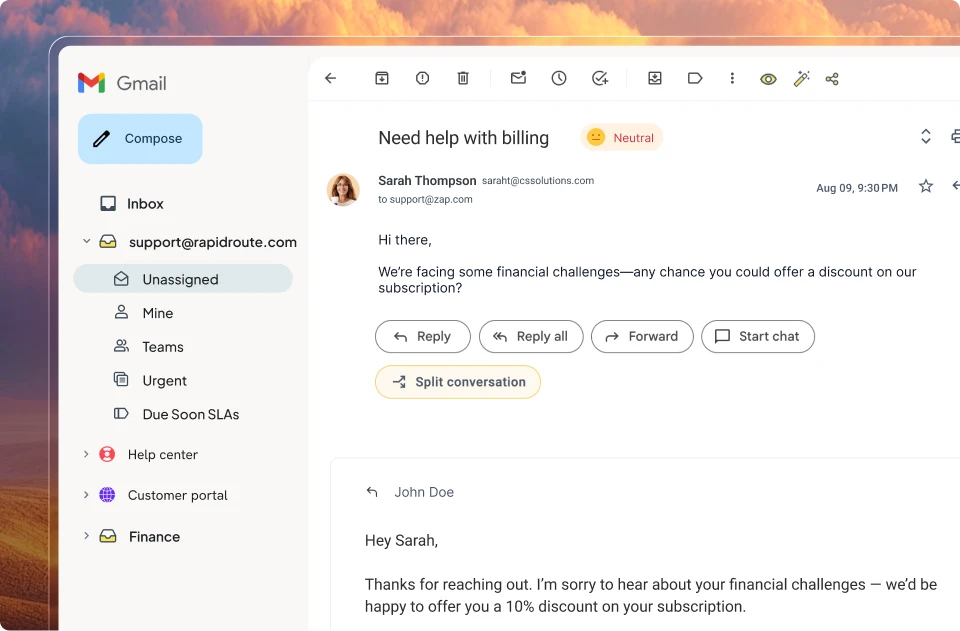
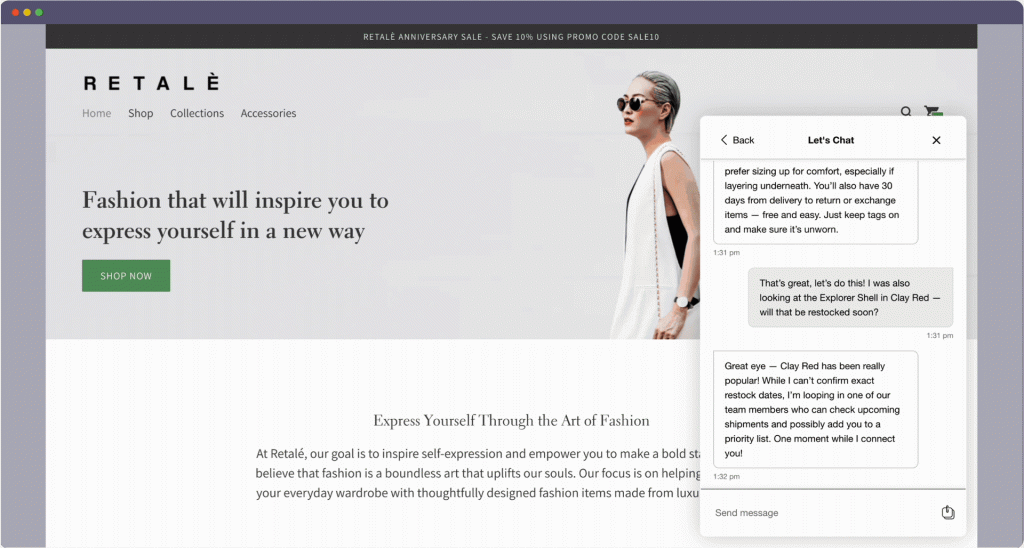
Gladly is a customer service platform where every customer has one continuous conversation instead of multiple tickets. Every email, chat, call, and SMS from a customer is added to the same thread. That thread stays active across channels and over time, even when the customer reaches out again days or weeks later. Agents can review past issues, promises, and resolutions before replying. This means when a customer follows up, agents respond swiftly rather than asking the customer to repeat information or starting a new ticket.
Gladly is best suited for:
Retail, e-commerce, travel, and subscription-based companies where customers contact support repeatedly. Gladly is a good option when voice is the primary channel and agents need full context from past interactions to avoid restarting cases.
Is Gladly Worth the Price?
Gladly is priced at the very top of the customer support market. Based on customer reviews and reported quotes, pricing typically starts around $180–$210 per agent per month, billed annually. This is significantly higher than platforms like Zendesk, Hiver, and Gorgias. They offer core features such as omnichannel support, automation, reporting, and integrations at a much lower cost.
At this price, the question is not about features. It comes down to outcomes. You need to decide whether Gladly actually reduces repeat contacts, speeds up resolution, and lowers cost per interaction enough to justify the higher per-agent spend.
To evaluate that, let’s look at how Gladly is designed and which features directly influence agent efficiency and resolution speed.
- Single customer timeline across channels: Every email, chat, call, SMS, and social message from a customer appears in one continuous thread. This means that agents do not switch between tickets or tools.
- Built-in voice and telephony: Gladly includes native calling, IVR, and call routing, making it easier for teams that rely heavily on phone support.
- Conversation-level ownership and routing: Conversations are assigned and routed at the customer level rather than per message. This reduces handoffs and maintains clear accountability when issues span multiple interactions.
- Workflow optimized for repeat contacts: Gladly keeps the same conversation open when customers follow up, even across channels. This works well for returns, subscription changes, and other multi-step issues.
Pros
- Gladly is easy to set up and configure. Teams can get up and running quickly without complex workflows or heavy customization, which reduces implementation time and speeds up agent adoption.
- It handles high volumes across voice, email, chat, and SMS in one place. This makes it easier for teams to manage mixed-channel workloads without switching tools or losing context, especially in voice-heavy support environments.
- “I love how easy it is to set up Gladly; it really is very user-friendly since you only need to press ‘next’ and that’s it. The implementation of artificial intelligence helps a lot in my day-to-day, significantly improving my efficiency.”
- “Over the years, I’ve come to love Gladly’s capability to handle a diverse range of customer interactions through voice, email, chat, and SMS, seamlessly managing all our volumes.”
Cons
- Gladly does not include a built-in CSAT solution, and some key performance metrics like first contact resolution, average handle time, and repeat contact rates are not easily accessible. Teams often need to calculate metrics manually or rely on external tools, which adds effort and limits real-time visibility.
- Gladly’s pricing is hard to justify because costs are fragmented across per-agent fees, usage charges, and add-ons. Without a dedicated account manager, teams often lack clear visibility into what is driving costs. This makes Gladly’s pricing harder to understand and control.
- “I was disappointed that we didn’t have an account manager and that the platform lacked a built-in CSAT solution. Additionally, I found it frustrating that some important metrics were difficult to locate and had to be calculated manually, which was quite a hassle.”
- “I have a concern about Gladly’s pricing, which I feel could be addressed.”
Reviews are from G2
Recommended reading
Gladly Pricing Overview
Gladly does not publish standard pricing tiers. Costs are quote-based and depend on agent count, contract length, enabled channels, and usage. As a result, the final price can vary widely between teams, even with similar setups. Before signing, it is important to understand not just the per-agent rate, but how voice, SMS, add-ons, and contract terms affect total spend.
Below is a breakdown of how Gladly pricing is structured in practice, based on reported quotes, customer feedback, and market benchmarks.
Gladly Pricing Plans
Starting price:
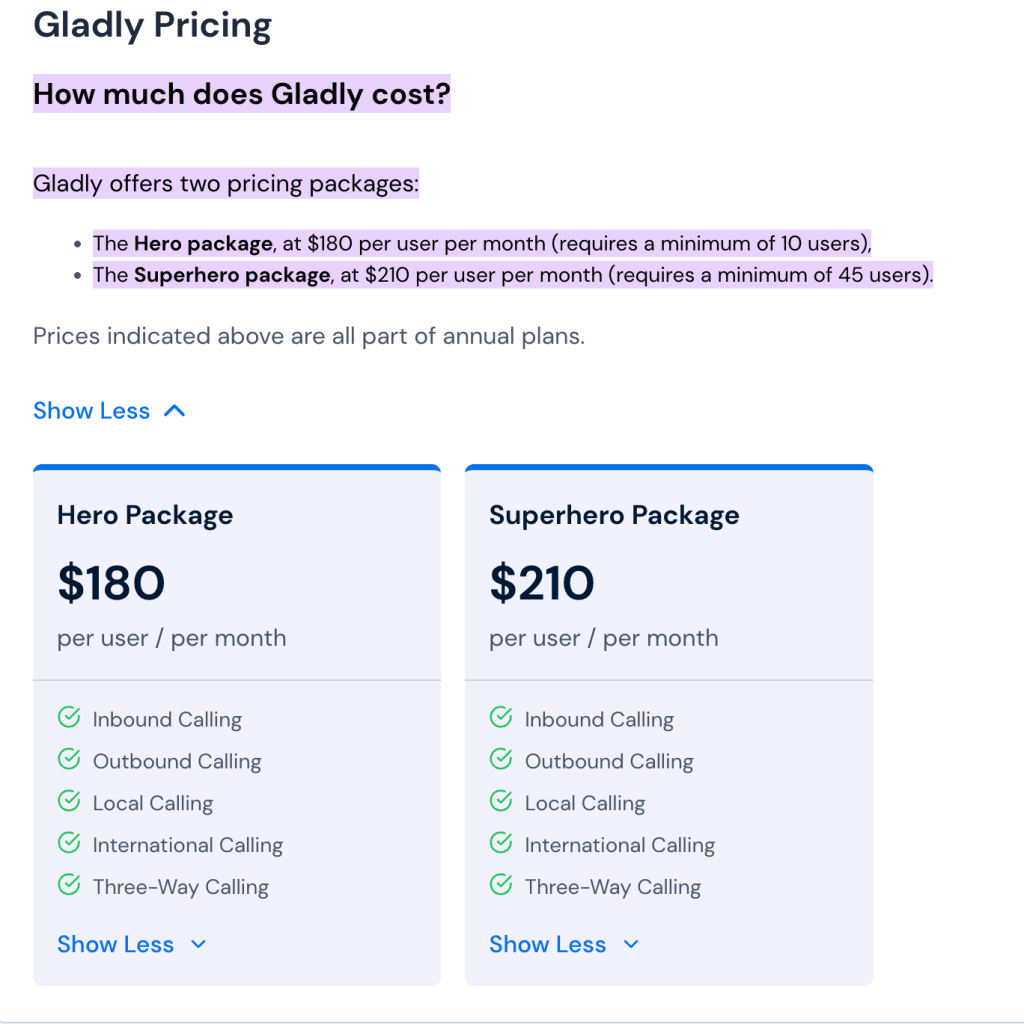
Gladly pricing typically starts at $180 to $210 per agent per month, i.e., the Hero and Superhero packages, billed annually. Final pricing varies based on contract size, negotiation, and enterprise requirements.
What this price usually includes:
- Access to the core Gladly platform for agents and admins
- Native support for email, chat, and social messaging within one agent workspace
- A single conversation view showing all past and current customer interactions
- Basic reporting on volume, response times, and agent activity
There is no free plan, and the base plan is bundled into the per-agent cost rather than sold separately.
Voice and Telephony Costs
Gladly includes native voice capabilities, but voice usage is often priced separately.
What may incur additional charges:
- Call minutes (inbound and outbound)
- IVR usage and call routing
- International calling and carrier fees
For voice-heavy teams, these usage-based charges can significantly increase the total monthly spend.
SMS and Messaging Costs
SMS is priced separately from the core platform.
What to expect:
- Per-message or per-conversation SMS fees
- Pricing varies by region and volume
SMS costs are added on top of per-agent pricing and can scale quickly for teams that rely on text-based support.
Add-Ons and Professional Services
Common paid add-ons include:
- Onboarding and implementation support
- Data migration services
- Premium integrations with CRM, data, and commerce systems, along with custom workflow configurations
- Advanced analytics and reporting modules
These are typically negotiated as one-time fees or annual add-ons and are not always included in the base quote.
Billing and Contract Terms
Here’s the standard contract structure:
- Gladly typically requires a 12-month commitment, with billing handled upfront or yearly rather than monthly.
- Many contracts include a minimum number of agent seats, so teams pay for a fixed count even if headcount drops.
- Monthly billing is uncommon. Adding or removing agents mid-contract often requires renegotiation, which further reduces cost predictability as team size changes.
Recommended reading
Gladly Pricing vs Competitors
Here is how Gladly compares to other popular CX platforms in terms of pricing transparency and flexibility. This comparison looks at how Gladly’s pricing compares with common alternatives like Zendesk, Hiver, and Gorgias. These tools are often evaluated alongside Gladly because they support similar customer service use cases.
The analysis is based on public pricing, customer-reported quotes, product documentation, and verified G2 reviews. We focus on per-agent costs, usage-based fees, contract terms, and how easily pricing scales as support teams grow.
Gladly vs Hiver
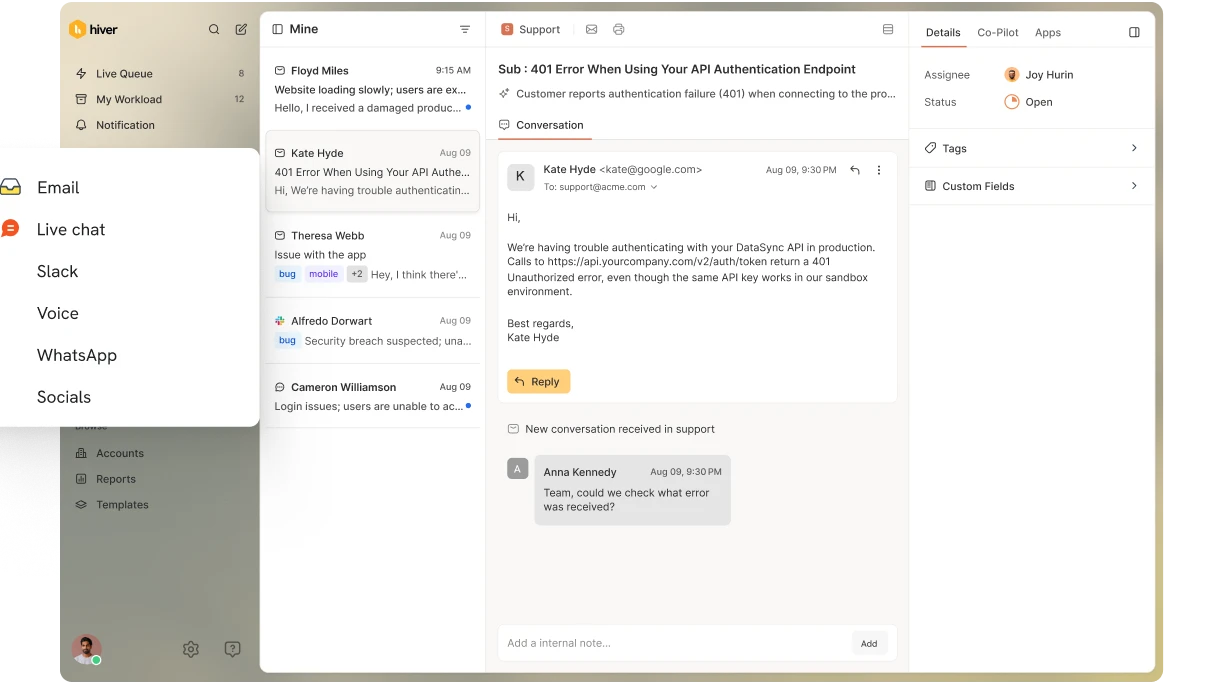
Hiver is a better fit for teams that want clear pricing, faster setup, and lower total cost. It takes an AI-first approach to customer service. Support works across email, live chat, voice, and self-service without usage-based pricing surprises.
Hiver includes built-in AI features like AI Copilot and AI Summaries to help agents respond faster and stay consistent. AI is also used to review conversations and surface quality issues. These capabilities are included within clear pricing tiers, making costs easier to predict compared to Gladly’s quote-based model.
Here’s a detailed comparison of features in Gladly vs Hiver:
| Area | Gladly | Hiver |
|---|---|---|
| Core support model | Single, continuous customer conversation across channels | AI-driven workflows to review conversations, guide responses, and enforce quality standards |
| Voice capabilities | Built-in voice, IVR, and call routing | Supports voice calls through an integration with Aircall. |
| Handling repeat contacts | Keeps repeat messages from the same customer in a single, ongoing conversation, regardless of channel. | Handles repeat contacts as separate conversations, but uses AI summaries and quality rules to preserve context and ensure consistent responses across interactions. |
| AI capabilities | Limited AI support for automation and routing | AI Copilot for replies, AI summaries for context, and AI-driven quality checks |
| Knowledge management | Customer context pulled from past conversations | Knowledge base with AI to identify gaps and improve self-service |
| Pricing approach | Custom-pricing with usage add-ons | Transparent pricing tiers with no separate add-ons |
| Best suited for | Voice-heavy B2C teams with ongoing customer relationships | Teams that want AI-assisted support with clear, predictable pricing |
| Free plan | No free plan. Access is sales-led and requires an annual contract | Free plan available to test support workflows without a long-term commitment |
Gladly Pricing vs Hiver Pricing
Hiver offers four pricing plans, designed to scale from small teams to enterprise support operations.

1. Free Forever Plan
Best for small teams getting started with shared support workflows.
Includes:
- 1 shared mailbox
- Tags, notes, and email templates
- Shared drafts and internal collaboration
- Live chat and knowledge base
- Integrations with Slack, WhatsApp, and voice
2. Growth Plan
$25 per user per month, billed annually.
Best for growing teams managing multiple support channels.
Includes:
- 2 shared inboxes
- Unlimited tags and email templates
- Live chat, WhatsApp, and knowledge base
- Collision alerts
- 24×7 chat and email support
- Free onboarding assistance
- AI summaries and AI-assisted response suggestions
3. Pro Plan
$65 per user per month, billed annually.
Best for teams that need automation, analytics, and AI support.
Includes:
- All Growth plan features
- 5 shared inboxes
- Unlimited automations
- Voice channel via Aircall
- SLA tracking and business hours
- CSAT and analytics
- Integrations with Jira, Salesforce, Slack, Zapier, and QuickBooks
- AI Copilot for replies, advanced AI summaries, and AI-driven quality checks
4. Elite Plan
$105 per user per month, billed annually.
Best for large teams with advanced routing and reporting needs.
Includes:
- All Pro plan features
- Unlimited shared inboxes
- Round-robin and skill-based assignment
- Callback support
- Custom reports
- Dedicated success manager
- Okta integration
- Advanced AI controls for quality, consistency, and scale
Here’s a breakdown of Gladly pricing compared to that of Hiver.
| Pricing aspect | Gladly | Hiver |
|---|---|---|
| Pricing model | Quote-based | Published pricing tiers |
| Free plan | Not available | Available |
| Free trial | Not publicly offered | A 7-day free trial is available |
| Starting price | ~$180–$210 per agent per month | $0 (Free plan), paid plans start at $25 per user/month |
| Billing cycle | Annual contracts | Monthly and annual options |
| What pricing scales on | Agent count plus usage | Features included in the plan |
| AI features | Limited, often not core to pricing | AI Copilot, AI Summaries, and quality checks included |
| Add-ons | Voice, SMS, and usage-based charges | Optional add-ons, clearly listed |
| Cost predictability | Low. Total cost varies with usage and contract terms | Highly predictable. Pricing remains consistent with usage, making forecasting easier as teams expand. |
Key takeaway
Hiver delivers significantly better ROI for most teams. It offers 75–85% lower platform costs*, transparent pricing, and AI features included upfront. This makes it easier to justify spending and forecast costs compared to Gladly’s high per-agent pricing and variable usage fees.
* Savings estimate is based on typical Gladly pricing of $150–$180 per agent per month. Hiver’s paid plans start at $25 per user per month. The comparison looks only at base platform costs and excludes usage-based fees like voice and SMS.
Recommended reading
Gladly Vs Zendesk
Zendesk works best for teams that need structured ticketing, flexible workflows, and predictable pricing tiers at scale. It is designed to manage high volumes of support requests efficiently, with robust controls over routing, automation, and reporting.
Zendesk focuses on ticket-based workflows and operational flexibility. Teams can configure automations, SLAs, and views to match complex support processes. Pricing is published across clear tiers, making it easier to estimate costs upfront compared to Gladly’s quote-based model.
Here’s a detailed comparison of features in Gladly vs Zendesk:
| Area | Gladly | Zendesk |
|---|---|---|
| Core support model | Single, continuous customer conversation across channels | Ticket-based support with configurable workflows |
| Voice capabilities | Built-in voice, IVR, and call routing | Voice available as an add-on or through Zendesk Talk |
| Handling repeat contacts | Routes repeat messages into the same customer conversation | Creates new tickets or links tickets based on rules |
| AI capabilities | Limited AI support for automation and routing | AI-powered macros, sentiment detection, and automation (tier-based) |
| Workflow flexibility | Opinionated, conversation-led workflows | Highly configurable workflows and automation |
| Reporting and analytics | Standard reporting | Advanced reporting and dashboards (by plan) |
| Pricing approach | Quote-based pricing with usage add-ons | Published pricing tiers |
| Best suited for | Voice-heavy B2C teams with ongoing customer relationships | High-volume support teams that need control and flexibility |
Gladly Pricing vs Zendesk Pricing
Zendesk offers published pricing tiers that scale from basic ticketing to enterprise-grade support workflows. Plans are billed annually and priced per agent.
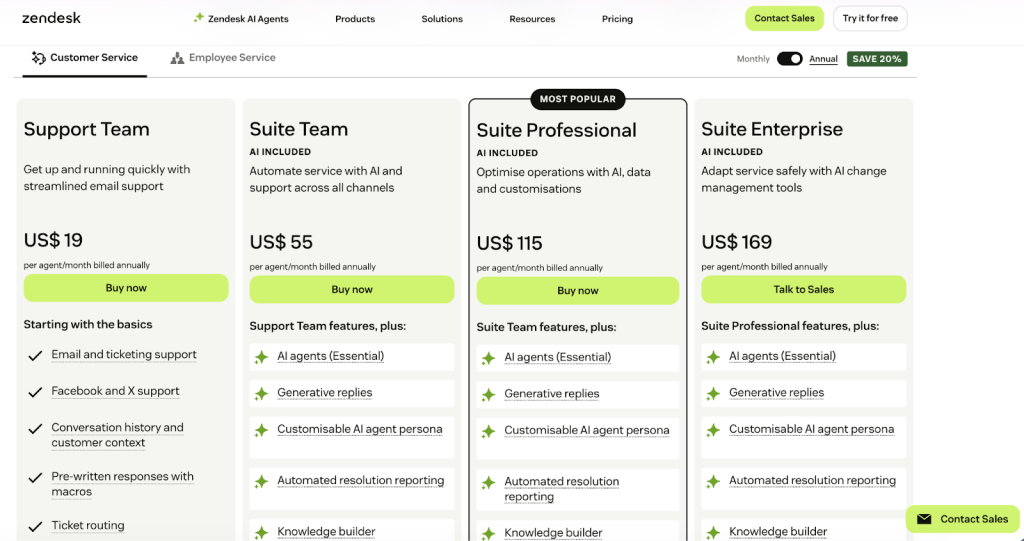
1. Support Team
$19 per agent per month (billed annually)
Best for teams getting started with ticketing.
Includes:
- Email and ticketing support
- Facebook and X (Twitter) support
- Conversation history and customer context
- Pre-written responses with macros
- Ticket routing and customizable automations
- Prebuilt analytics dashboards
- Agent performance and ticket trend reports
- 1,000+ integrations
- Streamlined onboarding and Zendesk support
2. Suite Team (AI included)
$55 per agent per month (billed annually)
Adds omnichannel support and basic AI.
Includes everything in Support Team, plus:
- AI agents (Essential)
- Generative replies and customizable AI personas
- Automated resolution reporting
- Knowledge builder and generative search
- Messaging with live chat
- Social messaging (Instagram, WhatsApp, Slack, etc.)
- Phone support and call routing
3. Suite Professional (AI included)
$115 per agent per month (billed annually)
Best suited for larger teams with advanced workflows and reporting needs.
Includes everything in Suite Team, plus:
- Up to 5 help centres
- Custom reporting with real-time insights
- App Builder and layout builder
- CSAT surveys
- Skills-based routing and IVR phone menu
- Custom ticket forms and SLAs
- 100 comment-only agents
- HIPAA compliance and data location options
4. Suite Enterprise (AI included)
$169 per agent per month (billed annually)
Designed for complex support operations and enterprise needs.
Includes everything in Suite Professional, plus:
- Advanced data protection and privacy options
- Sandbox environment for testing workflows
- Custom agent roles and permissions
- Expanded workspace customization and controls
Here’s a breakdown of Gladly’s pricing compared to Zendesk’s.
| Pricing aspect | Gladly | Zendesk |
|---|---|---|
| Pricing model | Quote-based | Published pricing tiers |
| Free plan | Not available | Not available |
| Free trial | Not publicly offered | A 14-day free trial is available |
| Starting price | ~$180–$210 per agent per month | Paid plans start at $19 per agent/month |
| Billing cycle | Annual contracts | Monthly and annual options |
| What pricing scales on | Agent count, usage (voice, SMS), and add-ons | Agent count and plan tier, with additional costs for AI, voice, and advanced features |
| AI features | Limited, often not core to pricing | Available in higher-tier plans |
| Add-ons | Voice, SMS, and usage-based charges | Add-ons clearly listed by product |
| Cost predictability | Low. Costs vary with usage and contract terms | Moderate. Tiered plans help, but add-ons and AI upgrades can reduce predictability |
Key takeaway
Zendesk is easier to scale without sudden cost spikes. Plans start at $19 per agent per month. Adding agents increases spend gradually and predictably. Gladly starts at $180+ per agent. Usage-based fees push costs higher as volume grows. This makes large team expansion harder to plan and justify.
Recommended reading
Zendesk Pricing 2025: Plans, Add-Ons, and What You Actually Pay
Gladly Vs Gorgias
Gorgias is built specifically for e-commerce support. It handles high volumes of order-related questions like shipping, refunds, and returns. It keeps the customer and order context available directly in the workflow.
Gorgias also uses a ticket-based model with ecommerce-focused automation. Pricing is published and scales more gradually, which makes costs easier to control compared to Gladly’s higher per-agent pricing and usage-based charges.
Here’s a detailed comparison of features in Gladly vs Gorgias:
| Area | Gladly | Gorgias |
|---|---|---|
| Core support model | Single, continuous customer conversation across channels | Ticket-based support optimized for ecommerce workflows |
| Voice capabilities | Built-in voice, IVR, and call routing | Voice available through integrations |
| E-commerce context | General B2C focus | Deep ecommerce context tied to orders and customer actions |
| Handling repeat contacts | Routes repeat messages into the same conversation | Uses tickets with automation and rules |
| AI capabilities | Limited AI support for automation and routing | AI used for intent detection, automation, and macros |
| Workflow automation | Opinionated, conversation-led workflows | Strong automation for e-commerce scenarios |
| Pricing approach | Quote-based pricing with usage add-ons | Published pricing tiers |
| Best suited for | Voice-heavy B2C teams with ongoing customer relationships | E-commerce teams handling high volumes of order-related queries |
Gladly Pricing vs Gorgias Pricing
Gorgias bases pricing on the number of support tickets included per month. All plans include unlimited users and a centralized helpdesk for e-commerce support.

1. Starter Plan
Starts at $10 per month (monthly billing)
Best for very small stores or early testing.
Includes:
- Up to 50 support tickets per month
- Basic email and live chat support
- Centralized helpdesk inbox
- Reporting and essential automations
- 7-day free trial
2. Basic Plan
$50 per month (billed monthly)
Good for small ecommerce teams with moderate ticket volume.
Includes:
- Up to 300 support tickets per month
- Unlimited agents
- Live chat and social messaging support
- Rules, macros, views, and ticket routing
- Help centre with unlimited articles
3. Pro Plan
$300 per month (billed monthly)
Best for growing DTC brands with higher support volume.
Includes:
- Up to 2,000 support tickets per month
- Unlimited agents
- Automation workflows and integrations with Shopify and ecommerce tools
- Omnichannel support across email, chat, and social channels
- Reporting and analytics dashboards
4. Advanced Plan
$750 per month (billed monthly)
For scaling ecommerce teams with large support volumes.
Includes:
- Up to 5,000 support tickets per month
- Full automation and configuration options
- Deeper analytics and workflow control
- Support performance metrics across channels
5. Enterprise Plan
Custom pricing
For large or complex ecommerce operations.
Includes:
- Custom ticket volume limit
- Advanced security, compliance, and dedicated support options
- Lower per-ticket rates and tailored terms
Here’s a breakdown of Gladly’s pricing compared to Gorgias’ pricing.
| Pricing aspect | Gladly | Gorgias |
|---|---|---|
| Pricing model | Quote-based | Published pricing tiers |
| Free plan | Not available | Not available |
| Free trial | Not publicly offered | A 7-day free trial is available |
| Starting price | ~$180–$210 per agent per month | Paid plans start at $10 per month, which includes 50 tickets |
| Billing cycle | Annual contracts | Monthly and annual options |
| What pricing scales on | Agent count plus usage | Agent count and ticket volume |
| AI features | Limited, often not core to pricing | Available as an add-on for $1 per solved conversation |
| Add-ons | Voice, SMS, and usage-based charges | Add-ons clearly listed |
| Cost predictability | Low. Costs vary with usage and contract terms | More predictable for e-commerce teams |
Key takeaway
Gorgias is more cost-effective for e-commerce teams. Entry plans start well under $100 per agent per month, compared to Gladly’s typical $150–$180+ per agent pricing. That puts Gorgias at roughly 40–60% lower platform cost for most e-commerce setups. Unless voice support is a core channel, Gladly’s higher per-agent pricing and usage-based fees are more complex to justify from an ROI standpoint.
Recommended reading
How to Decide if Gladly Is Right for Your Team
Gladly is a significant investment. Before committing, it helps to pressure-test the platform against how your support team actually works today and how it is likely to change over the next year.
1. Is voice your primary support channel, or just one of many?
Gladly makes the most sense when voice is central to your support operation. If calls drive most of your support volume, Gladly’s built-in voice can justify the cost. If voice is secondary, the premium is harder to defend.
In that case, Hiver is often a better option, with AI-led support across digital channels at a lower, more predictable cost.
2. Do agents need deep customer history across years, not just tickets?
Gladly works best for teams that rely on long-term customer context. It helps when agents regularly handle repeat customers and need to see past conversations, commitments, and outcomes in one place.
If most issues are one-offs and resolved quickly, this model adds less value. In those cases, Hiver, Zendesk, or Gorgias are often easier to justify due to lower cost and more flexible pricing.
3. Can your budget support $180+ per agent per month long-term?
Gladly’s per-agent pricing is high and often increases with usage. The cost has to make sense not just at launch, but as headcount grows. If budget pressure already exists, this can limit long-term ROI.
In these cases, platforms like Hiver or Gorgias are easier to justify, with lower entry pricing and clearer cost controls.
4. Are you comfortable with annual contracts and usage-based fees?
Gladly typically requires annual commitments and adds usage-based charges for voice and SMS. This works best for teams with stable volumes and predictable budgets.
If flexibility is a priority, tools like Hiver or Gorgias offer more adaptable plans without long-term lock-ins.
5. Will your support team grow or change significantly in the next year?
If your team size, channels, or workflows are likely to shift, Gladly’s contract structure can make changes expensive. Adding or reducing seats often requires renegotiation.
Teams in growth or transition phases usually do better with platforms like Hiver, Zendesk, or Gorgias, where scaling is simpler and pricing is easier to forecast.
Gladly Pricing: What to Decide Before You Commit
Gladly pricing locks you into a high-cost model built around voice and long-running customer conversations. At $180–$210 per agent per month, plus usage-based charges for voice and SMS, the total cost rises quickly as volume or headcount increases. Annual contracts and minimum seat commitments further reduce flexibility.
The most common mistake teams make is paying for voice-centric complexity that they do not consistently use. If voice is not your primary channel, or most issues close in one or two interactions, Gladly’s pricing is hard to justify.
For teams focused on improving response quality, consistency, and efficiency across digital channels, Hiver is the more practical option. It offers AI-driven quality checks, AI Copilot and Summaries, self-service through a knowledge base, and predictable pricing that scales without usage-based surprises.
Frequently Asked Questions
1. How much does Gladly cost per agent?
Gladly typically costs $180–$210 per agent per month, billed annually. Final pricing varies based on contract size, enabled channels, and usage.
2. Does Gladly offer a free trial or free plan?
No. Gladly does not offer a free plan, and free trials are not publicly available. Access is usually provided through sales-led demos.
3. Is Gladly pricing billed monthly or annually?
Gladly pricing is billed annually in most cases. Monthly billing is uncommon.
4. What is the minimum contract cost for Gladly?
Gladly requires an annual contract and often enforces minimum agent counts. For many teams, this results in a yearly commitment of roughly $20,000 to $30,000 or more, before usage-based charges for voice and SMS are factored in.
5. Are voice and SMS included in Gladly pricing?
Voice and SMS are not fully included in the base price. Call minutes, IVR usage, international calls, and SMS messages are typically charged separately.
6. Is Gladly worth the price for small and mid-sized businesses?
For most small and mid-sized teams, Gladly is not cost-effective, especially if voice is not the primary support channel. The pricing model is better suited to large, voice-heavy B2C teams.
7. What is the best alternative to Gladly with transparent pricing?
Hiver is a strong alternative. It offers published pricing tiers, a free plan, and AI-first customer service features, making the total cost easier to predict.