






Social media has become one of the main ways customers ask questions, report issues, and expect quick replies.
Every comment or message is part of a public support record – visible not just to the person asking but to everyone watching. Managing that volume manually or across disconnected tools leads to delayed responses, missed messages, and inconsistent support.
The right social media customer service software centralizes all incoming messages, assigns tasks to the right agents, and tracks what needs follow-up.
Many platforms now go further – flagging urgent issues automatically, handling routine inquiries with AI, and giving support managers real-time data on response times and customer satisfaction.
This guide covers the 8 best social media customer service tools to use in 2025, based on features that reduce manual work, improve team coordination, and keep service levels consistent across every platform.
Table of Contents
- What is a social media customer service software?
- 8 best social media customer service software compared (2025)
- Key features of a social media customer support platform
- Benefits of social media customer service tools
- Actionable tips for your social media customer service team
- 5 best practices for social media customer service
- Make your social channels work for you
- Frequently Asked Questions (FAQs)
What is a social media customer service software?
Social media customer service software is a platform that helps businesses manage and respond to customer messages, comments, and mentions across multiple social media channels from one dashboard.
It streamlines support operations by organizing all interactions, assigning tickets, and tracking conversations across platforms without switching between apps. Businesses use it to:
- Respond to customer inquiries across Facebook, Instagram, Twitter, LinkedIn, WhatsApp, and more in one place.
- Monitor brand mentions and keyword tags to catch issues or feedback in real time.
- Assign conversations to the right team members based on topic, language, or priority.
- Maintain a complete conversation history for each customer, even across multiple platforms.
- Integrate support activity with CRM tools or help desks for unified customer records.
Recent data shows that over 67% of customers find it convenient to contact customer support via social media, while 76% expect a reply within 24 hours. Platforms like WhatsApp, Facebook Messenger, and WeChat are experiencing a 36% rise in customer inquiries, leading businesses to prioritize these channels for support.
8 best social media customer service software compared (2025)
Here’s a side-by-side comparison of the top social media customer support tools in 2025 – features, supported platforms, AI capabilities, pricing, and more:
| Tool | Social channels supported | AI features | Pricing (starts at) |
|---|---|---|---|
| Hiver | WhatsApp, Facebook, Instagram, Email, Live Chat, Voice, SMS | AI auto-triage, reply drafting, AI-powered live chat, bot that pulls info from knowledge base, history, apps | $19/user/month. Free forever plan is available |
| Sprout Social | Facebook, Instagram, LinkedIn, X, TikTok, YouTube, Pinterest, WhatsApp | AI replies, caption generation, scheduling | $199/user/month |
| LiveAgent | Facebook, Instagram, Twitter, WhatsApp, Viber | Rule-based routing, canned replies | $9/user/month |
| Zoho Desk | Facebook, Instagram, Twitter | Keyword routing, sentiment tracking (beta) | $7/user/month |
| Sprinklr Social | 35+ channels (incl. TikTok, WhatsApp, YouTube, Reddit, Snapchat) | AI sentiment, smart compose, visual insights | Custom pricing |
| HubSpot | Facebook, Instagram, LinkedIn, Twitter | AI post generator, keyword monitoring | $45/month (Marketing Hub) |
| Zendesk | Facebook, Instagram, Twitter | AI chatbots, automation rules | $55/user/month |
| Hootsuite | Facebook, Instagram, TikTok, Threads, LinkedIn, YouTube, Pinterest | AI content creation, sentiment insights | $99/month |
1. Hiver
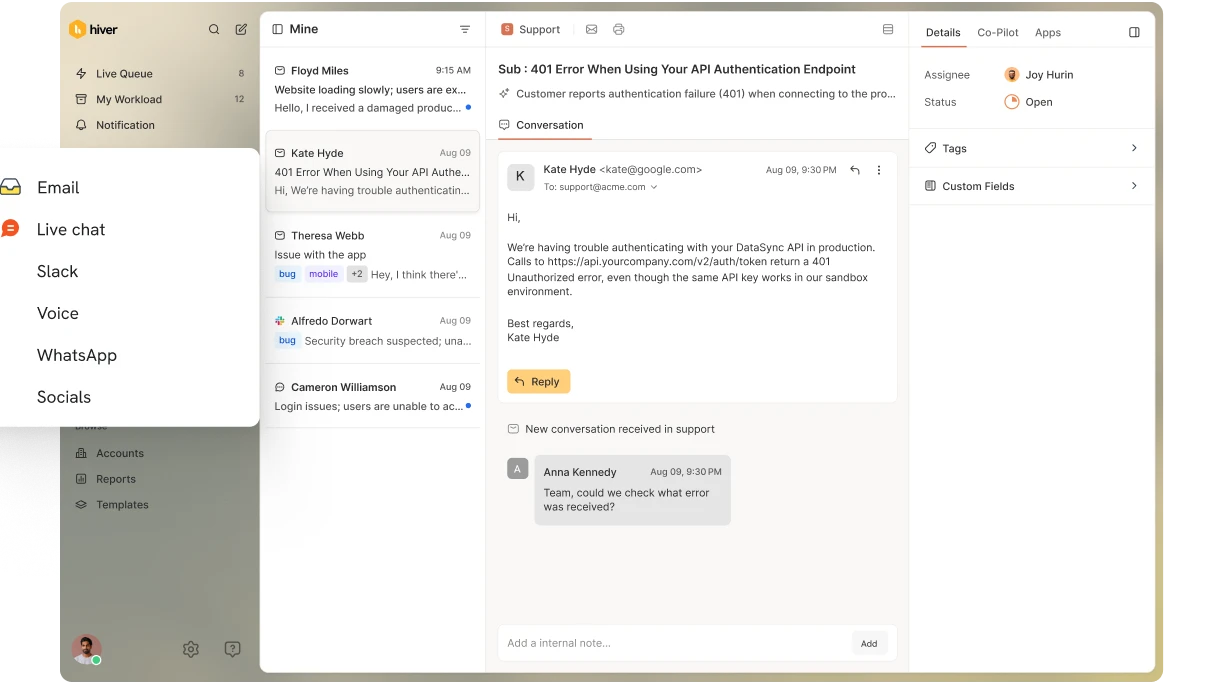
Hiver is a modern, AI-first help desk platform that lets you manage customer conversations across email, live chat, WhatsApp, voice, SMS, and social channels like Facebook and Instagram – all from a single interface. It’s built for teams that want powerful support capabilities baked in.
- Manage both personal and shared inboxes from one place.
- 24/7 support is included on all plans, with help during onboarding and beyond.

Key features
- WhatsApp integration: View, assign, and respond to WhatsApp messages in one platform. Supports group handling, notifications, and history tracking.
- AI automation: Auto-triage queries, draft smart replies, and route tickets to the right team member.
- Live chat with AI bot: Offer instant esupport using a bot that pulls answers from your knowledge base and past conversations.
- Team collaboration: Use internal notes to collaborate, assign queries for ownership, and reduce back-and-forth.
- Email templates: Save time and ensure consistent replies with canned responses for FAQs.
- Analytics: Track team performance, response times, and email volumes with built-in reports. Custom reports are also available.
Setting up the Hiver-WhatsApp integration is straightforward:
- Access Hiver admin panel: Go to the Hiver Admin Panel. Click “Create Shared Inbox” to start.
- Choose WhatsApp channel: While creating the shared inbox, pick ‘WhatsApp’ as the channel.
- Follow regulations: On the ‘Getting Started’ screen, be sure to comply with Facebook’s WhatsApp business regulations.
- Enter info: Move to the General Information page. Enter inbox name and names of Hiver users (agents) for WhatsApp responses.
- Connect your number: Visit your Facebook developer account for necessary info. Follow the guide to complete this step accurately.
- Provide webhook details: After the previous step, copy-paste webhook URL and token. Subscribe to webhook events on the Facebook developer account as detailed in the guide.
- Complete setup: Tick ‘I have completed the above steps’, and click ‘Create Inbox’. Your WhatsApp inbox is ready.
- Test the setup: Send a test WhatsApp chat to check if everything works. For issues, contact Hiver support at support@hiverhq.com.
Pricing
Hiver offers a free forever plan, and four paid plans. The Lite plan starts at $19/user/month, Growth plan is priced at $29/user/month, and Pro plan costs $49/user/month. There’s an Elite plan too, with custom pricing. A free trial for 7 days is also available.
“Hiver is great for making sure everyone stays on track, each customer is taken care of, or assigned to their respective support members. It was super easy to implement and integrate in our daily routine, we use it every day! I love that you can make notes on the side that customers aren’t able to see, but it keeps everything on track its great! If something isn’t right, the customer support is awesome and very helpful.”
– Hiver user review | G2
2. Sprout Social
Sprout Social is a unified platform for social media publishing, engagement, customer care, and analytics; all in one place. It lets you schedule, plan, and publish posts across major networks: Facebook, Instagram, LinkedIn, X (formerly Twitter), Pinterest, Threads, TikTok, WhatsApp, YouTube, and more.
- Platform interface supports English, Spanish, French, Italian, Brazilian Portuguese.
- Integrates with helpdesk/CRM tools like Zendesk, Salesforce, and UserVoice. Social commerce integrations are also available.

Key features
- Smart Inbox: Keeps full conversation history, shared contacts, team notes, and contact info visible to all users. Context stays intact when linking profiles like Twitter or Instagram.
- AI Assist: AI‑driven suggestions for replies and posts (tone adjustments, length, style, etc.), plus caption and alt-text generation.
- Automated workflows: Classify messages based on sentiment, keyword, VIP status, language, etc., and automatically assign cases or escalate as needed.
- Analytics & Listening: This includes paid promotion insights, hashtag/keyword tracking, sentiment scoring, message spike alerts, and trend detection.
Limitations
- Premium analytics and social listening are only available as add‑on modules.
- Some users report limitations in the API, and occasional need to re‑connect social profiles. This can be frustrating for teams syncing multiple networks.
“The pricing can be a bit steep, especially for small teams or startups. Some advanced features, like more granular competitor analysis or listening tools, are only available on higher-tier plans. Also, there’s a bit of a learning curve with setting up automation workflows.”
– Sprout Social user review | G2
Pricing
Starts at $199/user/month and goes up to $399/user/month for advanced features. Enterprise plans are custom. Free 30-day trial included.
3. LiveAgent
LiveAgent is a help desk and social media support platform that brings all your customer interactions – across Facebook, Twitter, Instagram, WhatsApp, and Viber – into one organized inbox. It turns every message, comment, or mention into a ticket, so your team can manage social support without switching tabs.
- Facebook: Manage messages, comments, and likes from one place.
- Twitter: Monitor @mentions and hashtags; reply directly from the inbox.
- Instagram: Handle comments, mentions, and DMs faster via tickets.
- WhatsApp & Viber: Convert all messages into tickets for quicker replies.
- Slack: Get real-time notifications when tickets are created or updated.

Key features
- Canned responses: Create templates for common replies, so your team can respond faster and consistently.
- Automation rules: Set up workflows to auto-assign tickets, prioritize VIP queries, or escalate urgent issues without manual effort.
- Instagram and Facebook comment management: Like, hide, delete, or respond to comments without switching tabs.
Limitations
- Once you merge tickets, the merged ticket can become unsearchable, which might affect visibility.
- The interface has limited customization options and may feel outdated to some users.
LiveAgent may sometimes take a while to pull emails through from outlook which can be inconvenient whilst on the phone to a customer. Features can sometimes change with no warning, which can slow you down as you have to learn where certain buttons are.”
– LiveAgent user review | G2
Pricing
Plan starts at $9 per agent/month for small businesses, $24 for medium teams, $39 for large businesses, and goes up to $59 for enterprise plans. A 30-day free trial is available.
4. Zoho Desk
Zoho Desk is an omnichannel ticketing platform that helps businesses convert public social activity – like mentions, comments, and tags – into support tickets and respond from a unified interface.
- Reply via DMs or comments on Facebook, Instagram, and Twitter, just like on the native apps.
- Schedule posts or respond directly from the platform (not just react to mentions).

Key features
- Private replies via DMs: Engage with users via Direct Messages when the issue is sensitive or needs more context.
- Auto-assignment rules: Automatically route social tickets to the right team based on hashtags, keywords, or account activity.
- In-app ticket actions: Perform common ticketing tasks (reply, assign, tag, prioritize) without leaving the social media module.
Limitations
- Feature-rich interface can feel overwhelming for new users.
- Mobile app experience is not as smooth or complete as the desktop version.
“At times, the UI can feel cluttered and not as intuitive as expected, especially for new users. Navigating between modules or configuring advanced settings sometimes requires multiple steps, which can slow down productivity.”
– Zoho Desk user review | G2
Pricing
Paid plans start at $7 per agent/month and go up to $50 per agent/month, depending on the features and plan type. A free plan is also available for up to 3 agents. A 15-day free trial is available.
5. Sprinklr Social
Sprinklr Social is an AI-powered platform built for enterprise-grade social media management. It unifies content publishing, engagement, listening, advertising, analytics, and customer service across 35+ social and messaging channels – Facebook, Instagram, Twitter, LinkedIn, YouTube, TikTok, WhatsApp, and more.
- Create and publish content across channels with a shared calendar and digital asset manager.
- Employees and influencers can easily amplify branded content with built-in advocacy tools.

Key features
- AI-driven engagement: Use Smart Response, Smart Compose, and sentiment detection to automate replies and tailor responses.
- Visual and text-based insights: Go beyond text monitoring with AI-powered image detection for brand mentions and content insights.
- Comprehensive reporting: Analyze data across paid, earned, and owned media. Build custom dashboards or use ready-made reports.
- Social listening: Track brand health, competitors, and campaign performance in real-time using millions of data points.
Limitations
- Primarily suited for large or enterprise teams; may be too complex for small businesses.
- Learning the platform isn’t a breeze. It requires time and work to get the hang of it and set it up to suit your needs.
“Some features, although powerful, are not always intuitive and require extensive training to be fully utilized. Moreover, it can happen that the platform lacks responsiveness during peak activity or that certain actions take longer than expected (e.g., loading conversations, updating statuses).”
– Sprinklr Social user review | G2
Pricing
Sprinklr Social follows a custom pricing model based on your team size and feature needs. You’ll need to contact their sales team for a quote. A 30-day free trial is available.
6. HubSpot
HubSpot is an all-in-one CRM platform that also offers built-in social media management tools to help you publish, monitor, and measure the impact of your social media efforts. Whether you’re replying to mentions, drafting posts with AI, or tracking ROI, HubSpot connects your social interactions to your CRM, so you always have full context.
- Run all your social media campaigns from the same place you manage emails, blogs, and landing pages.
- Link every social post to your CRM to see how it influences leads and sales.

Key features
- AI post generator: Quickly create social content using AI (in public beta) and schedule posts for when your audience is most active.
- Social media ROI tracking: See how social media contributes to visits, leads, and customers using built-in reports.
- Campaign association: Link social posts with broader marketing campaigns to track impact across channels.
- Inbox insights: Get AI-powered sentiment analysis and brand monitoring right from your inbox.
Limitations
- Limited to core platforms (Facebook, Instagram, LinkedIn, Twitter); no support for newer or regional networks.
- Advanced features like campaign management and detailed reporting are only available in higher-tier plans.
“It’s really expensive at the professional level. And the whole system is tuned for larger companies so it’s often difficult to adapt for smaller companies. Their website forms also don’t integrate well with Google Ads so you have to have a fully custom solution if you want to feed lead quality data back into Google Ads.”
– HubSpot user review | G2
Pricing
HubSpot’s social media tools are included in the Marketing Hub plans. Pricing starts at $45/month, with the Professional plan at $800/month and the Enterprise plan at $3,600/month. A 30-day free trial is available.
7. Zendesk
Zendesk is a popular customer service platform that also offers built-in tools for managing customer support on social media. It pulls in messages from Facebook, Instagram, and Twitter and converts them into tickets – making it easier for support teams to stay on top of every conversation.
- Switch seamlessly between public and private conversations (e.g., from tweets to DMs).
- Use automation rules to assign social media tickets to the right agents based on hashtags or keywords.

Key features
- AI-powered tools: Includes chatbots to handle common queries and reduce agent workload.
- Analytics and reporting: Track key metrics like response time, CSAT, and agent performance.
- Contextual responses: Agents get full access to past interactions, enabling more personalized social media replies.
Limitations
- Social listening features are basic compared to dedicated tools.
- Setup can be complex for smaller teams or non-technical users.
“As a beginner, the biggest challenge I faced with Zendesk Support Suite was the initial learning curve. There are a lot of features and settings, but not enough step-by-step guidance during setup—especially for someone new to customer support platforms. The terminology (like triggers, views, macros, SLA policies) can be confusing at first, and I had to rely heavily on external tutorials to understand how everything works.”
– Zendesk user review | G2
Pricing
Pricing starts at $55 per agent/month for the Suite Team plan, $89 for Suite Growth, and $115 for Suite Professional. The Suite Enterprise plan has custom pricing. A 14-day free trial is available.
8. Hootsuite
Hootsuite is a social media management platform, that centralizes scheduling, content creation, analytics, listening, and customer conversations – all within one platform. Teams can manage organic and paid content, automate replies, assign messages, and stay informed across networks like Instagram, TikTok, Threads, X (Twitter), Facebook, LinkedIn, Pinterest, and YouTube.
- Built-in AI tools generate captions, hashtags, post ideas, and script prompts using OwlyWriter AI.
- Integrates with CRM, marketing tools, and more to connect social strategies across your stack.

Key features
- Omnichannel publisher: Schedule unlimited posts across up to 5 accounts (Standard) or up to 10 (Professional), plus bulk scheduling and AI-recommended posting times.
- AI-powered content tools: Generate captions, hashtags, and content ideas using AI; plus Canva templates and stock photo access.
- Social listening & sentiment: Monitor brand mentions and trending topics; summarize sentiment; benchmark against competitors.
- Analytics & reporting: Access customizable and competitive performance reports, exportable formats, and benchmark insights up to 20 competitors.
Limitations
- Entry‐level plans are limited: Standard plan only supports one user and up to 5 social profiles, with no comment approvals or asset library.
- Limited native support for customer service workflows like SLA tracking or internal ticketing.
“Some features feel outdated, and the mobile app isn’t as responsive or intuitive as the desktop version. Also, certain advanced features (like deeper analytics and extra user accounts) require a more expensive plan, which can feel a bit costly as your team grows.”
– Hootsuite user review | G2
Pricing
Hootsuite offers three plans – Standard, Advanced, and Enterprise. Paid plans range from $99 to $249/month, depending on features and usage. The Enterprise plan comes with custom pricing. A 30-day free trial is available.
Key features of a social media customer support platform
The best social media customer service platforms help teams respond quickly, personalize conversations, and stay on top of every message – using features like AI chatbots, social listening, direct message integration, and real-time performance insights. Here’s what to look for:
- Full view of customer journeys: Access all social conversations, tickets, and historical context in one place – so agents know exactly who they’re talking to and what’s been said before.
- Live chat and direct message integration: Connect DMs and chat messages from Facebook, Instagram, X (Twitter), and WhatsApp into one dashboard to keep private conversations organized and actionable.
- AI for response generation: Use chatbots, smart replies, and AI suggestions to reduce busywork and help agents reply faster, without sacrificing quality or consistency.
- Social listening tools: Monitor keywords, hashtags, and mentions of your brand or competitors across platforms. Stay ahead of emerging issues, trends, and opportunities.
- Response time improvements: Automate ticket routing and priority tagging so no customer message is delayed. Speed is key to keeping public conversations under control.
- Easy channel escalation: Seamlessly move a public post to a private DM or escalate from social to email, voice, or chat when a more detailed conversation is needed.
- Actionable performance insights: Track key metrics like response time, resolution rate, sentiment trends, and customer satisfaction – all visualized in simple dashboards.
- Predictive engagement: Spot patterns in social conversations to know when to proactively reach out – like identifying potential churn or high-intent buyers.
- Knowledge management tools: Equip your team with ready-to-use templates, saved replies, and linked help center articles to improve consistency across platforms.
Benefits of social media customer service tools
Managing customer conversations across social media can feel chaotic without the right software to back you up. Tools built specifically for social customer service help your team stay organized, respond quicker, and build stronger relationships with your customers.
Here are some key benefits your business can expect from using social media customer service tools:
Faster response times
Social media customer service tools centralize messages across channels, significantly cutting down response delays. Customers expect quick replies on social channels, and these platforms help teams consistently meet those expectations.
Higher Customer Satisfaction (CSAT)
Instant responses, personalized social media interactions, and proactive support increase customer satisfaction and loyalty. For instance, using sentiment analysis, brands quickly identify frustrated customers and proactively resolve their issues, turning negative interactions into positive outcomes.
Increased Operational Productivity
Automation features handle repetitive tasks such as ticket tagging, categorization, and common inquiries, freeing agents to handle more complex issues. Example: An AI chatbot answers FAQs on Instagram direct messages, allowing agents to focus on high-value interactions.
Improved Brand Reputation Management
Real-time social listening enables proactive detection and handling of potential crises or brand-damaging issues. For instance, if a product defect is discussed frequently on social media, early identification through social monitoring allows brands to issue timely responses and prevent escalation.
Comprehensive Customer Insights
Advanced analytics provide deeper insights into customer sentiment, agent performance, conversation volume, and trending issues, informing strategic decisions.
Consistent Cross-Platform Experiences
Centralized tools enable consistent messaging across all social media platforms, strengthening brand identity and customer trust. Example: Agents have access to detailed customer histories, ensuring interactions on Facebook and LinkedIn reflect prior conversations, creating seamless customer experiences.
Enhanced Team Collaboration
Internal notes, assignments, and collaboration features facilitate teamwork, particularly when resolving complex customer issues. For instance, agents tag team members and share private notes within the platform, reducing internal communication gaps and improving resolution efficiency.
Actionable tips for your social media customer service team
Setting your customer support team up for success on social media starts with clear, practical strategies. Here’s how to equip your agents for faster resolutions, better customer interactions, and a consistently outstanding brand presence across all platforms:
- Set clear response guidelines: Define expected response times for different channels (e.g., Twitter within 30 mins, Instagram within 1 hour). Clearly document tone, language, and escalation rules to help agents handle conversations confidently.
- Prioritize conversations strategically: Use sentiment analysis and keyword alerts to identify urgent or sensitive issues quickly. Prioritize frustrated customers or issues with potential brand impact to avoid escalation.
- Personalize responses whenever possible: Encourage agents to use customers’ names, reference previous interactions, and avoid overly scripted replies. Personal touches boost customer satisfaction and brand loyalty.
- Create platform-specific knowledge bases: Maintain a centralized database of ready-to-use answers tailored to different platforms and common scenarios. Regularly update these resources based on trending customer questions and feedback.
- Regularly analyze customer feedback: Consistently review customer interactions to identify common problems, sentiment trends, and product feedback. Use these insights to improve internal processes and proactively address customer concerns.
- Train agents on crisis management: Equip your team to handle negative feedback or public criticism gracefully. Provide scenario-based training to manage challenging interactions calmly and turn potentially harmful situations into positive outcomes.
- Actively collaborate with marketing & product teams: Share customer insights and common issues with internal stakeholders regularly. Cross-team collaboration helps address root causes, informs product improvements, and ensures consistent brand messaging.
Recommended reading
5 best practices for social media customer service
Social media moves fast, and so should your customer service. Here’s how your team can ace customer interactions on social:
- Set clear response time goals: Define how quickly you’ll reply on each social channel (e.g., 15 mins on Twitter, 30 mins on Instagram). Share this clearly with your team so everyone’s aligned on expectations and urgency.
- Use a unified inbox tool: Stop juggling multiple tabs and notifications. Use a single platform (like Hiver) that brings all your social messages – Facebook, Instagram, Twitter, WhatsApp – into one inbox for quicker replies and seamless collaboration.
- Be human and personal: Social media users appreciate authentic interactions. Use first names, casual language, and relatable humor where appropriate. Avoid scripted, robotic replies.
- Prioritize public comments: Handle public comments quickly since everyone can see your response. Resolve sensitive issues in DMs, but publicly acknowledge you’re helping to maintain transparency.
- Analyze feedback and adapt: Regularly review your social media interactions to spot common complaints or requests. Use this insight to proactively address problems and improve your products or services.
Quick comparison: Best social channels for customer service
| Social channel | Best for | Recommended response time |
|---|---|---|
| Quick responses, public accountability, urgent queries | Under 15 mins | |
| Community engagement, general queries, detailed responses | Under 30 mins | |
| Brand building, casual interactions, visual content support | Under 30 mins | |
| Direct, private conversations, complex problem-solving | Within 1 hour | |
| Professional queries, networking, B2B support | Within 1-2 hours |
Make your social channels work for you
Managing customer service on social media can get messy fast. One missed DM, a delayed reply, or a forgotten comment can easily lead to a frustrated customer. The best way to avoid this is to bring all your channels into one place, define how your team should respond, and make sure nothing slips through the cracks.
A solid social media support setup helps your team stay consistent, reply faster, and give customers the kind of experience they’re expecting – clear, timely, and human. Small improvements here can make a big difference in how your brand is perceived online.
If you’re looking for a way to manage support across email, live chat, WhatsApp, voice, and social platforms like Facebook and Instagram in one place, Hiver is built to keep everything organized and easy to manage. Take a free trial.
Frequently Asked Questions (FAQs)
1. How quickly should businesses respond to customers on social media?
Most customers expect a response on social media within an hour, but at minimum, replies should be sent within 24 hours. Fast responses demonstrate attentiveness, help diffuse public frustration, and set your brand apart in a crowded feed. Some brands use automated acknowledgments to confirm receipt while a human prepares a detailed reply.
2. Should support be public or private on social media?
Start with a public reply for transparency – let the customer and wider audience know you’ve seen their issue. Move to private messages for sensitive details, account-specific info, or to keep the conversation organized. This approach balances openness with privacy and efficiency.
3. Can automation fully replace agents in social media support?
Automation, like chatbots and canned responses, handles high volume and repetitive questions well. However, complex, emotional, or unique cases still benefit from human empathy and problem-solving. The best results come from blending automation for speed and efficiency, with agents stepping in when nuance is needed.
4. How do you handle negative comments or public complaints?
Acknowledge concerns publicly and empathize in your first reply. If possible, offer a public solution or move the conversation to DMs for sensitive details. Avoid deleting or hiding negative comments unless they violate platform rules: transparency and politeness often turn critics into advocates.
5. Should companies create dedicated support profiles on social media?
Some brands operate separate customer support handles (e.g., @BrandSupport) to streamline customer service operations and reduce clutter on marketing channels. This can help segment inquiries, set clearer expectations, and prioritize queries – but it may also split your audience, so evaluate based on your volume and resources.
6. What are good ways to measure social media customer service success?
Track metrics like average response time, resolution rate, customer satisfaction (CSAT or NPS), sentiment analysis, and the percentage of issues resolved in-channel. Also, monitor repeat questions to spot gaps in public information, and feedback trends to guide improvements.
7. How do you manage inquiries coming from multiple languages or regions?
Use platform tools or software that support multilingual responses, time zone routing, and local regulations. Assign customer service agents with relevant language skills, and use auto-routing to connect customers with the best-matched team member for their region or language.
Start using Hiver today
- Collaborate with ease
- Manage high email volume
- Leverage AI for stellar service