Skip to content



Ever had a support experience so seamless, it felt like the agent already knew exactly what you needed?
No repeating yourself. No digging up ticket numbers. Just fast answers, clear next steps—and maybe even a follow-up to make sure everything was resolved.
That kind of service doesn’t happen by accident. The best support teams rely on consistent systems, not one-off heroics. They follow proven customer service best practices that ensure every conversation is efficient, empathetic, and on-brand.
In this guide, we’ve curated 20 best practices that top-performing support teams use every day. These aren’t vague ideals. They’re practical, doable habits your team can start applying today.
Let’s dive in.
Table of Contents
- Key Takeaways
- What Are Customer Service Best Practices?
- Importance of Customer Service Best Practices
- Top 20 Customer Service Best Practices for 2025
- 1. Clear communication
- 2. Empathy and active listening
- 3. Timely responses
- 4. Personalization
- 5. Continuous feedback collection
- 6. Employee empowerment
- 7. Use of AI and automation
- 8. Omnichannel support
- 9. Proactive problem-solving
- 10. Ongoing training and development
- 11. Tracking Key Performance Indicators (KPIs)
- 12. Self-service and community forums
- 13. Inclusive and accessible support
- 14. Customer-centric team culture
- 15. Team collaboration and knowledge sharing
- 16. Cross-functional alignment
- 17. Quality assurance and continuous improvement
- 18. De-escalation and conflict resolution
- 19. Agent well-being and support
- 20. Operational readiness for crises and spikes
- Common Mistakes to Avoid While Implementing Customer Service Best Practices
- Putting Customer Service Best Practices into Action
- Frequently Asked Questions
Key Takeaways
- Keep communication clear and jargon-free: Customers need simple, direct explanations they can easily understand. Removing ambiguity and internal language reduces friction and builds immediate clarity.
- Lead with empathy and active listening: Paying close attention to customer concerns and responding with real understanding helps customers feel heard, respected, and supported, even when the issue can’t be resolved instantly.
- Speed matters, but so does quality: Timely responses with accurate, personalized solutions build trust. Acknowledge quickly, then deliver thoughtfully.
- Empower your team with tools and autonomy: Give agents decision-making authority, access to customer context, and continuous training. This enables them to resolve issues confidently without constant escalation.
- Let AI handle the repetitive work, humans focus on what really matters: Use automation for triage, routing, and simple queries. Preserve the human touch for complex or emotionally charged conversations.
- Self-service and proactive support reduce friction: Invest in knowledge bases, community forums, and proactive outreach to help customers solve problems before they even reach your support reps.
- Track KPIs and optimize continuously: Use metrics like CSAT, NPS, and resolution time to identify improvement opportunities, guide coaching, and measure progress.
- Protect agent well-being to protect the customer experience: Support your team with manageable workloads, mental health resources, and continuous learning opportunities. Happy agents deliver better service.
What Are Customer Service Best Practices?
Customer service best practices are proven methods that help support teams respond faster, solve problems better, and build stronger customer relationships. They’re practical habits any team can follow to deliver consistent, high-quality support and drive customer retention along the way.
Importance of Customer Service Best Practices
Documented best practices give support teams a shared playbook, so service stays consistent, scalable, and gets better with every interaction. Here’s why they matter:
1. Consistency across every interaction
Without defined best practices, service quality depends entirely on individual judgment. Best practices create a shared playbook that gives customers the same level of care whether they reach a new hire or a seasoned veteran, on a Monday morning or Friday evening.
2. Faster onboarding and reduced training time
When best practices are documented and systematized, new agents have clear guidelines to follow from day one. Instead of learning through trial and error, they can ramp up quickly by following proven approaches. This brings down time-to-productivity and minimizes costly mistakes during the learning curve.
3. Scalability without quality trade-offs
As ticket volume grows, teams tend to burn out. Established practices, especially around automation, self-service, and prioritization allow you to handle increased demand without sacrificing response quality or agent well-being.
4. Data-driven improvement becomes possible
Best practices around KPI tracking and quality assurance give teams the framework to measure what’s working and what isn’t. They help teams identify trends, spot training gaps, and make targeted changes that actually move the needle.
5. Alignment across teams and channels
When support teams follow shared best practices for cross-functional collaboration and omnichannel consistency, customers get seamless experiences, no matter which channel they use or which department needs to get involved. This alignment also ensures customer insights flow back to product and engineering, turning support into a strategic asset rather than a cost center.
Top 20 Customer Service Best Practices for 2025
Here are 20 best practices great support teams rely on to create fast, thoughtful, and human customer experiences.
1. Clear communication
Clear, effective communication, both with customers and teammates, is the foundation of great customer service. When customer service representatives explain things simply and consistently, customers feel confident, heard, and informed.
How to Implement this Best Practice:
- Keep it simple: Use plain, jargon-free language. Break down technical steps into bite-sized instructions.
- Summarize next steps: End every interaction with a quick recap of what was resolved and what happens next.
- Double-check understanding: Use confirmation phrases like “Just to confirm…” to ensure nothing is lost in translation.
- Document for your team: Leave clear internal notes so teammates can seamlessly pick up where you left off during handoffs or escalations.
“Make sure your current systems and processes are accessible to remote teams, and make changes as needed so that your remote team has access and is capable of integrating into your existing systems. Also, review your current onboarding program and process. You might want to consider shifting it to include more virtual team bonding opportunities.”
Chloe Shill, Director of Operations at Flight CX, highlights certain customer communication protocols for remote support teams.
2. Empathy and active listening
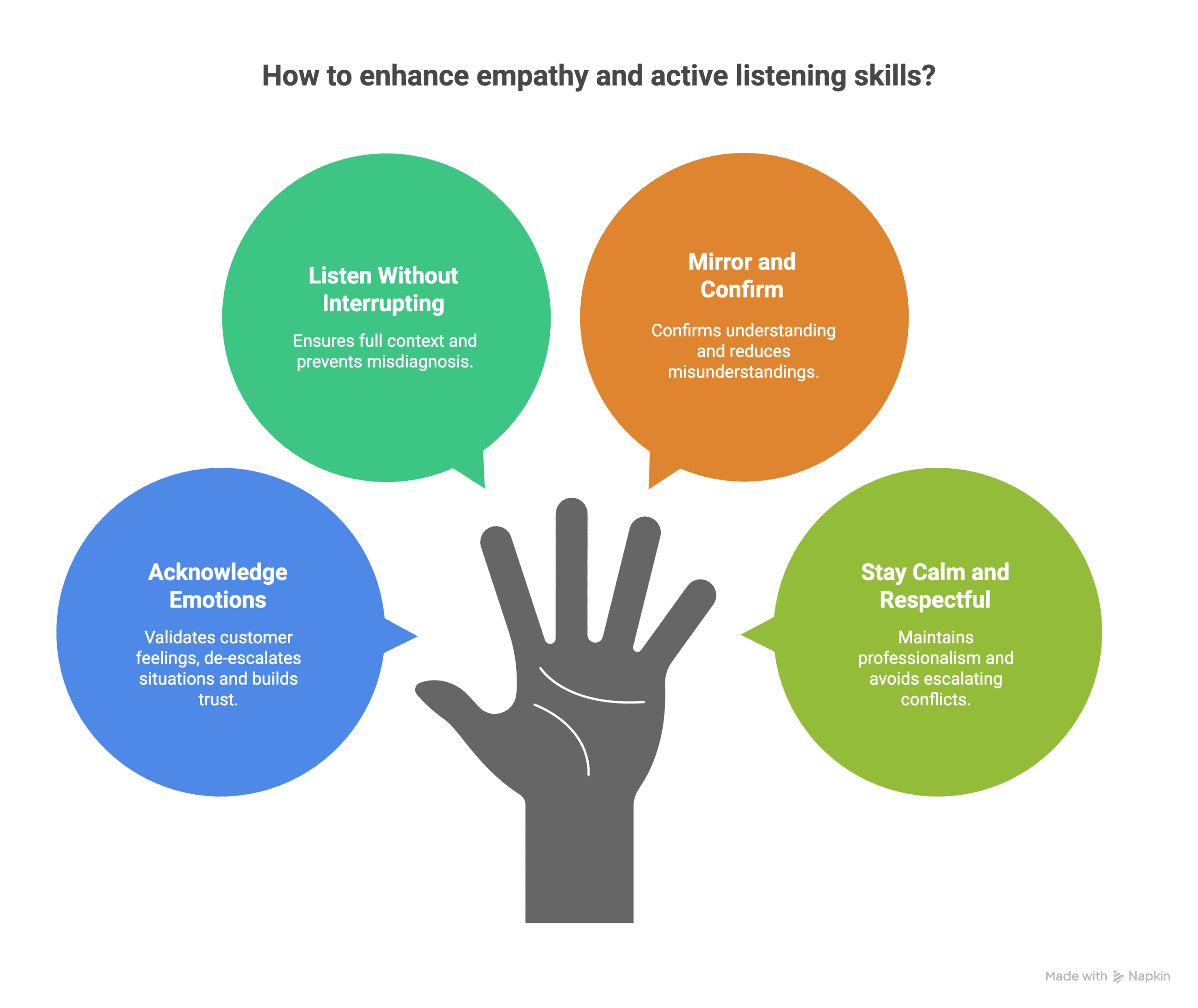
Empathy and active listening are core competencies in customer service. When customers feel heard and understood, they’re more likely to stay calm, collaborate on a solution, and walk away satisfied, even if their issue wasn’t fully resolved.
How to Implement this Best Practice:
- Acknowledge emotions early: Validate the customer’s frustration before jumping into a fix. A simple “I can see how frustrating that must be” goes a long way.
- Listen without interrupting: Let customers speak fully before responding to capture full context.
- Mirror and confirm: Rephrase what you heard to confirm understanding.
- Stay calm and respectful: Keep your tone steady and professional, even when the conversation gets heated.
Genuine empathy means being honest and realistic. Justin Bonar-Bridges, Customer Support Technician at Verisk Property Estimating Solutions, also shares why over-promising in customer service can be detrimental.
“It can be tempting to promise the moon to an angry customer in order to try and calm them down, but that’s going to do more harm than good if the promise cannot be fulfilled. The particulars of following through on your promise may go beyond the domain of the support employee, or even the support department, but it is imperative that it is done”
Justin Bonar-Bridges – Customer Support Technician, Verisk Prtestimoperty Estimating Solutions
3. Timely responses
We’re living in the instant gratification era, and for customer service teams that translates into providing extremely quick resolutions. Whether it’s a billing question or a critical outage, how fast your team replies sets the tone for everything that follows.
How to Implement this Best Practice:
- Acknowledge quickly: Send a “Got it, we’re looking into this” message within minutes, even before you have a solution.
- Set and share clear SLAs: Define what “fast” means across all channels and communicate it to both customers and your team.
- Automate the first touch: Use auto-replies, triage rules, and smart routing to instantly assign tickets and send personalized acknowledgments.
- Balance speed with clarity: Train your team to respond quickly while providing clear next steps or timelines.
4. Personalization
Today’s customers want to feel seen, understood, and supported based on their individual needs, not generic scripts.
That’s where personalization can help. It contributes to building trust, reducing follow ups on queries, and showing customers that your brand actually remembers who they are.
How to Implement this Best Practice:
- Go beyond the name: Reference purchase history, account type, preferred communication channel, or prior tickets to tailor your responses.
- Surface full customer context: Use CRMs or helpdesks that give agents a real-time view of customer history and past interactions.
- Capture micro-details: Tag customer preferences like “prefers SMS over email” for future interactions.
- Use proactive personalization: Recommend features or solutions based on customers’ usage patterns.
Want to see how support leaders personalize at scale? Stephanie Ouellet, Course Lecturer, Marketing at ESG UQAM, shares a fascinating insight:
“Personalization is one of the core elements that our customer experience team consistently delivers on. We do work with some elements of automation where it makes sense, but this is what allows us to put the extra focus and energy on the parts of the interaction that we can really personalize so every customer feels cared for on an individual level.”
Stephanie Ouellet – Course Lecturer, Marketing
5. Continuous feedback collection
Great support teams solve problems by spotting patterns. And the best way to do that is by collecting customer feedback regularly, not just once in a while.
Feedback helps you improve service, flag product issues, and build features your customers actually want. But it only works if it’s built into your team’s everyday workflow.
How to Implement this Best Practice:
- Ask early and often: Use post-interaction CSAT, NPS, or lightweight “How did we do?” forms to gather feedback while the experience is still fresh.
- Mix formal and informal: Beyond structured surveys, pay attention to casual feedback during chats, follow-ups, or even when a customer says “This helped a lot” or “This was confusing.”
- Listen across channels: Monitor community forums, social media, app store reviews, and support transcripts.
- Close the loop: Acknowledge feedback, even if you can’t act on it immediately. Let customers know when their input leads to a real change (like a product tweak or new article).
Vinay Damani, Product Support Manager at SourceBreaker, emphasises a crucial point about why support and product teams need to work hand-in-hand on actioning customer feedback:
“At SourceBreaker, we conduct monthly meetings between the support team and a product manager to raise any customer feedback. If the feedback is urgent, we work with the product team on finding a solution. If the feedback is something that’s nice to have or something customers would like to see, then we submit a feature request on the client’s behalf.”
Vinay Damani – Senior Customer Experience Manager
6. Employee empowerment
Support teams perform best when they’re trusted to think, act, and solve, not just follow instructions. But don’t mistake this kind of empowerment for free rein. It means giving your employees the tools, context, and clear decision-making authority to act with confidence.
How to Implement this Best Practice:
- Define decision-making zones: Let agents handle common requests like goodwill credits or trial extensions without approvals.
- Create clear guidelines: Document what agents can and can’t approve (e.g., refunds up to a certain amount).
- Equip them with the right tools: Provide fast access to customer history,
- knowledge bases, macros, and escalation workflows in one unified interface.
- Train for judgment: Use coaching and real examples to build problem-solving confidence beyond scripts.
- Set up a “solve for the customer” budget: Even a modest discretionary budget (say, ₹1000/month per agent) can help your team turn frustrating moments into small wins, and those wins add up to improved customer retention.
Invite agents to help improve workflows, policies, and response templates as they often know where the gaps are before anyone else does. Here’s what Emily Stubbs, Director of Customer Experience, Aerflo believes:
“The customer support team serves as the frontline for your business, so it’s vital to listen to their feedback. Encourage team members to raise any issues or concerns they encounter in customer interactions, even if these issues can’t be easily captured. Additionally, team members may offer valuable insights into existing processes, and if these processes aren’t effective, it may be time for a change.”
Emily Stubbs – Director of Customer Experience, Aerflo
Recommended reading
Employee Experience Management: Definition, Benefits, and Best Practices
7. Use of AI and automation
Smart use of technology is how support teams scale. When applied thoughtfully, AI and automation help teams respond faster, route smarter, and reduce agent fatigue, all while preserving the human touch where it matters most.
How to Implement this Best Practice:
- Automate the repetitive: Use automation rules to triage tickets, send reminders, and route queries by priority.
- Use AI to assist agents: Deploy tools that suggest responses, surface knowledge base articles, or auto-draft replies for review to dramatically cut handle time.
- Deploy chatbots strategically: Bots work well for FAQs and simple workflows. Make sure the transitions between bots and humans feel like one fluid conversation.
💡 Did you know? The most effective AI in customer support works across the entire support journey. Hiver’s AI includes autonomous agents that auto-tag and resolve FAQs, AI Copilot that assists agents in real-time with response suggestions and knowledge base answers, and AI Insights that flags at-risk customers and bottlenecks.
Best part? It’s plug-and-play with no complex setup required.
8. Omnichannel support
Today’s customers move fluidly across channels, starting a conversation on email, following up via chat, and tagging you on social media if things go wrong. Omnichannel support is about more than just being present on every channel. It’s about creating a consistent, connected experience, no matter where the conversation starts (or continues).
How to Implement this Best Practice:
- Be present where it counts: Meet customers on preferred channels but only commit to platforms you can support well.
- Unify the customer story: Use a system (like Hiver) that keeps all interactions across channels in a single view.
- Train for channel fluidity: Equip your team to adapt tone and workflows across different channels.
- Extend self-service everywhere: Make your knowledge base and FAQs accessible from chat, email signatures, and messaging apps.
💡 Did you know? 77% of customers prefer contacting brands via good old email? Read the entire study here.
9. Proactive problem-solving
Excellent customer support isn’t just about fixing what’s broken, it’s about anticipating customer issues before they ever become a ticket. This is the fundamental ideology behind proactive problem solving.
When customers see that you’re already one step ahead, they feel genuinely cared for.
How to Implement this Best Practice:
- Get ahead of known issues: If you’re aware of a bug, delay, or downtime, don’t wait for complaints. A quick “Just so you know” banner, email, or in-app message can reduce inbound ticket volume and frustration.
- Spot early warning signs: Monitor spikes in similar queries and rising search terms in your knowledge base. Use these signals to update docs, record walkthroughs, or inform product teams fast.
- Use data to predict friction: Analyze customer journeys and ticket history to identify where users typically get stuck.
- Reach out proactively: See signs of churn? Reach out with value before they complain.
Recommended reading
10. Ongoing training and development
In customer service, staying updated isn’t optional but essential.Continuous learning ensures support teams can handle evolving expectations, new tools, and emerging challenges.
How to Implement this Best Practice:
- Implement continuous learning: Move beyond one-off sessions with regular workshops, micro-trainings, and quizzes.
- Balance hard and soft skills: Train on both product knowledge and customer service skills like empathy and conflict resolution.
- Personalize growth plans: Help agents set individual learning goals with mentorships or courses.
- Promote cross-functional exposure: Let support reps shadow product, sales, or marketing teams.
Encourage practices like 10-minute roleplays, daily tips, or real-time coaching after challenging interactions to reinforce learning continuously. Simone Silva, a Chief Customer & Experience Officer at Newmar, talks about the role of AI in customer service training:
“A historical challenge of customer service training is the balance of in-classroom hours, on-the-job training, and onboarding. AI and Machine Learning have great potential to address this challenge by customizing the content delivery to the specific training needs of agents. It can also go one step further to live coaching, based on the type of interactions taking place between agents and customers.”
Simone Silva – Chief Customer & Experience Officer, Newmar
11. Tracking Key Performance Indicators (KPIs)
You can’t improve what you don’t measure. The best support teams are data-driven: they use metrics to guide coaching, uncover patterns, and celebrate progress.
How to Implement this Best Practice:
- Track the right metrics: Focus on CSAT, NPS, First Response Time, Average Resolution Time, and First Contact Resolution.
- Coach, don’t criticize: Use support metrics to identify training gaps or tooling issues, not to stress agents.
- Balance data with context: Pair numbers with customer comments and agent notes during reviews.
- Keep KPIs visible: Share dashboards and review performance in weekly standups.
Looking to set SMART support goals for your team? Global Product & Technical Support Executive, Miles Goldstein shares some sharp, actionable advice to help you get it right.
“Consider using metrics that are more realistic and harder to tamper with. For instance, you could set goals for the quality of escalations, such as having fewer than X% of ‘bad escalations’, where a bad escalation is rejected due to insufficient information. Setting goals for customer satisfaction is good too, but make sure you’re not penalizing employees for things out of their control.”
Miles Goldstein – Global Product & Technical Support Executive
12. Self-service and community forums
The best support strategy empowers customers to find answers independently. Self-service deflects repetitive queries, provides instant 24/7 answers, and frees agents to handle complex problems.
How to Implement this Best Practice:
- Build a rich knowledge base: Cover common questions with clear step-by-step articles and videos.
- Make it discoverable: Link your help center prominently and use chatbots to surface relevant articles.
- Keep content fresh: Update articles based on new features or frequent tickets.
- Enable community help: Foster customer forums where users can help each other.
A well-structured help center is just the starting point. Today, teams are opting for smarter systems to scale their self-service efforts better. Here’s what Kristin Sprows suggests:
“One strategic recommendation is implementing a true knowledge management system (KMS). A KMS allows you to search and immediately find what you need through prioritized search results. It also supports version control and governance for compliance, provides detailed reporting for actionable metrics, and increases your organization’s Return on Investment (ROI) through a variety of integration capabilities.”
Kristin Sprows – Senior Client and Relationship Success Manager
Recommended reading

13. Inclusive and accessible support
Support that’s truly customer-first accommodates all languages, abilities, and backgrounds. Inclusive support makes every customer feel valued.
How to Implement this Best Practice:
- Offer multilingual options: Use translation tools or hire multilingual agents for global users.
- Design for accessibility: Choose support channels and tools with accessibility in mind. Ensure your help center works with screen readers, provide captions or transcripts for tutorial videos, and offer alternatives like live chat or email for those who can’t use phone support (and vice versa).
- Train for cultural sensitivity: Make cultural awareness part of agent training.
- Gather diverse feedback: Seek input from customers with disabilities or from different regions.
14. Customer-centric team culture
Exceptional service stems from a team culture that obsesses over customers.
Customer-centric culture means every decision starts with “What’s best for the customer?”
How to Implement this Best Practice:
- Make customer stories central: Share customer feedback and testimonials in team meetings.
- Lead by example: Managers should model customer-first behavior and prioritize customer-impacting fixes.
- Hire and onboard for empathy: Recruit reps who demonstrate empathy and emphasize customer service values from day one.
It’s also important for the entire organization to be aligned on the principles of customer centricity. Here’s what Annette Franz, Founder & CEO of CX Journey Inc., said on Hiver’s Experience Matters Podcast:
“Customer-centricity is not about just one person or one message—it’s about the entire organization. It has to be enterprise-wide. Customers expect a consistent and seamless experience across all departments, channels, and touchpoints. That consistency doesn’t happen when only one part of the organization is customer-centric.”
Annette Franz – Founder & CEO of CX Journey Inc
15. Team collaboration and knowledge sharing
Customer service works best when agents collaborate and share knowledge. Many teams are moving to “swarming” approaches where multiple agents rally around tricky problems together.
How to Implement this Best Practice:
- Establish an internal knowledge base: Document solutions for uncommon issues and edge cases in an internal knowledge base.
- Use real-time collaboration tools: Invest in Slack, Teams, or helpdesk internal notes for quick brainstorms.
- Cross-train your team: Rotate agents through different product areas to prevent silos.
- Mentor and buddy up: Pair less experienced reps with veterans for ongoing learning.
16. Cross-functional alignment
The best support teams partner closely with product, engineering, and customer success to improve the entire customer experience. This cross-functional alignment turns support into a proactive, influential voice.
How to Implement this Best Practice:
- Create a feedback loop: Set up formal processes to share recurring issues and feature requests with product teams.
- Bring support into product planning: Include support reps in product meetings and beta tests.
- Encourage cross-team shadowing: Have teammates from other departments read tickets or join support calls.
- Align on shared goals: Tie customer outcomes into other teams’ OKRs for shared accountability.
True collaboration goes beyond weekly syncs. It’s about designing systems that keep everyone in the loop, automatically. Shankar Srinivasan, VP of Customer Experience at Hiver, shares how he makes this happen:
“We’ve set up intelligent alerts that notify Customer Success the moment their customer reaches out to support. That way, they know who’s actively seeking help and can follow up if needed. It’s all about working together across the customer lifecycle, from onboarding to renewal, and even churn prevention.”
Shankar Srinivasan – VP of Customer Experience at Hiver
17. Quality assurance and continuous improvement
QA in customer service means systematically reviewing interactions to ensure they meet standards and finding ways to improve. Modern teams use QA scorecards and AI-powered sentiment analysis.
How to Implement this Best Practice:
- Score tickets regularly: Sample tickets weekly and score them against a rubric for solution accuracy, tone, and timeliness.
- Share feedback one-on-one: Use QA findings as private coaching opportunities.
- Identify coaching trends: Look for patterns that indicate team-wide training needs.
- Calibrate as a team: Periodically review sample tickets together to align on great service standards.
Did you know? Hiver’s AI QA feature reviews every single customer conversation automatically. It scores replies in real time based on your chosen criteria and even flags missing information before an agent hits send. Agents can see live feedback while drafting and use one-click suggestions to polish tone or fill in gaps. It’s like having a QA coach inside your helpesk, 24/7.

Recommended reading
10 Proven Strategies to Boost Your Customer Service Quality Assurance
18. De-escalation and conflict resolution
Every support team will encounter upset or angry customers. De-escalation is about staying cool under pressure and guiding conversations from chaos to solution.
How to Implement this Best Practice:
- Stay calm and let them vent: Let customers express frustration fully before responding.
- Validate feelings and apologize: Acknowledge emotions and offer a genuine apology when appropriate.
- Use reassuring language: Keep your tone calm and use partnership phrases like “Let’s figure this out together.”
- Focus on solutions: Once the customer feels heard, steer toward resolution with clear next steps.
- Know your limits: Sometimes, despite your best efforts, if a customer continues to rage, have an escalation path, like involving a supervisor.
Recommended reading
Mastering Conflict Resolution in Customer Service: 5 Strategies for Success
19. Agent well-being and support
“Happy agents create happy customers.” Customer service can be high-pressure and emotionally taxing. Taking care of your team empowers them to take better care of customers.
How to Implement this Best Practice:
- Monitor workloads: Use scheduling tools and ticket data to balance assignments and prevent overload, and eventually, burnout.
- Encourage breaks and time off: Make it standard for agents to take short breaks and use vacation days.
- Provide mental health resources: Offer EAPs, counseling services, or quiet spaces for decompression.
- Celebrate wins: Call out great feedback and celebrate milestones to boost morale.
Recommended reading
Employee Benefits 101: Types, Importance & How to Build a Winning Program
20. Operational readiness for crises and spikes
Even the best teams face chaos like product outages, viral bug reports, or unexpected ticket surges. Crisis-readiness is about having the right playbooks and communication flows to protect CX under strain.
How to Implement this Best Practice:
- Create crisis playbooks: Prepare response guides for likely scenarios with suggested macros and escalation paths.
- Practice load testing: Simulate ticket spikes to test workflows and agent bandwidth.
- Predefine priorities: Teach your team how to triage clearly during high-volume events
- Debrief after events: Use post-mortems to tighten workflows and update documentation.
Common Mistakes to Avoid While Implementing Customer Service Best Practices
Implementing new best practices can be tricky. Avoid these common pitfalls to ensure your team adopts changes smoothly and customers feel the difference.
| Mistake in Implementation ❌ | Best Practice Approach ✅ |
|---|---|
| Over-automating interactions | Use AI to assist agents, not replace them. Ensure there’s always an easy “talk to human” option. |
| Focusing solely on speed (metrics) | Balance efficiency with empathy. A fast wrong answer is worse than a slightly slower correct one. |
| Ignoring agent feedback during rollout | Involve your team in process changes. They know the customer pain points best. |
| Treating training as a one-time event | Make learning continuous. Use micro-coaching and regular feedback loops to reinforce new habits. |
| Over-promising to calm customers | Stick to realistic timelines. Trust is built on reliability, not impossible promises. |
Putting Customer Service Best Practices into Action
Exceptional customer service doesn’t happen by luck. Instead, it’s built on repeatable best practices, continuous learning, and a culture that puts the customer at the heart of every decision.
In this guide, we’ve covered 20 actionable customer service best practices—from clear communication and empathetic listening to smarter use of AI and data-backed performance tracking. They’re habits your team can start building today.
The goal isn’t perfection but progress. When your team lives these principles daily, you’ll deliver experiences that earn loyal customers and turn support into a true competitive advantage.
Frequently Asked Questions
1. How can businesses improve their customer service?
Businesses can improve customer service by focusing on several key areas:
-Train and empower agents: Equip teams with the skills, tools, and authority to resolve issues confidently.
-Use the right technology: Leverage AI copilots, automation, and unified helpdesks to respond faster and reduce manual work.
-Strengthen self-service: Build knowledge bases and community forums so customers can find answers on their own.
-Act on customer feedback: Continuously gather insights to identify gaps and improve the experience.
-Align across teams: Feed support insights back into product and process decisions to drive long-term improvements.
What tools help in implementing customer service best practices?
Helpdesk platforms like Hiver, Zendesk, or Freshdesk centralize customer conversations across channels and enable ticket management, automation, and reporting.
AI and automation tools, including AI copilots, chatbots, and automated routing, handle repetitive queries and assist agents with response suggestions.
Knowledge management systems power self-service portals and internal documentation. CRM integrations provide agents with full customer context, including purchase history and past interactions.
Quality assurance tools enable ticket scoring, sentiment analysis, and coaching. Analytics and reporting dashboards track KPIs like CSAT, NPS, first response time, and resolution time. The right combination depends on your team size, channels, and specific workflow needs.