






Customer support has changed recently. Automation and AI-powered workflows are everywhere now, and most platforms are trying to keep up.
Zendesk is one of those platforms. Zendesk AI is now tied into the product in different ways. But for many teams, the experience hasn’t felt as easy as expected. Zendesk AI features often require extra setup or behave differently across channels.
A Zendesk user on Reddit describes the learning curve and usability challenges with Zendesk AI features.

Eventually, it starts affecting pricing conversations too. When AI is introduced through add-ons and usage-based fees, it’s not always clear what you’re paying for or how quickly costs scale as usage grows.
In this article, we’ll break down Zendesk’s 2026 pricing, what each plan includes, and how Zendesk AI is priced, and what teams actually end up paying once automation and AI are factored in.
Key Takeaways
- Zendesk’s real price is rarely the starter plan. Most teams move to $55–$115 per agent just to unlock basic automation, reporting, and routing.
- AI changes how you’re billed. Zendesk AI introduces outcome-based pricing, where automated resolutions can increase costs as usage grows.
- Add-ons drive up total spend. Advanced AI, QA, workforce management, storage, and privacy are all priced separately.
- Per-agent pricing makes scaling expensive. Every new agent multiplies plan costs and add-on fees.
- Budgeting becomes unpredictable over time. Costs vary based on team size, AI usage, and add-ons, making long-term planning harder.
Overview of Zendesk Pricing Plans
Zendesk’s pricing is spread across four main plans, each offering a different mix of channels, automation features, and customization:
- Support Team
- Suite Team
- Suite Professional
- Suite Enterprise
| Feature/Plan | Support Team | Suite Team | Suite Professional | Suite Enterprise |
|---|---|---|---|---|
| Annual Price (per agent/month) | $19 | $55 | $115 | $169 |
| Monthly Price (per agent/month) | $25 | $69 | $149 | $219 |
| Primary Support Channels | Email, basic social | Email, chat, messaging, social, phone | All Suite Team channels | All Suite Professional channels |
| Help Centers | ❌ Not included* | 1 help center | Up to 5 help centers | Up to 300 help centers |
| AI Included by Default (Essential AI) | ❌ No | ✅ Yes | ✅ Yes | ✅ Yes |
| AI Agents (Essential) | ❌ Not included | ✅ Included | ✅ Included | ✅ Included |
| Generative Replies | ❌ No | ✅ Included | ✅ Included | ✅ Included |
| AI Agent Persona (name, tone, avatar) | ❌ No | ✅ Included | ✅ Included | ✅ Included |
| Automated Resolution Reporting (Basic) | ❌ No | ✅ Included | ✅ Included | ✅ Included |
| Generative Search & Knowledge Builder | ❌ No | ✅ Included | ✅ Included | ✅ Included |
| Advanced AI Agents (Reasoning, Actions, Integrations) | ❌ Add-on | ❌ Add-on | ❌ Add-on | ❌ Add-on |
| AI Agent Builder & Multi-step Workflows | ❌ Add-on | ❌ Add-on | ❌ Add-on | ❌ Add-on |
| Advanced AI Reporting & Language Support | ❌ Add-on | ❌ Add-on | ❌ Add-on | ❌ Add-on |
| Copilot (Agent Assistance) | ❌ Add-on | ❌ Add-on | ❌ Add-on / Bundle | ❌ Add-on / Bundle |
| AI Quality Assurance (Conversation Scoring) | ❌ Add-on | ❌ Add-on | ❌ Add-on | ❌ Add-on |
| Workforce Management (Forecasting & Scheduling) | ❌ Add-on | ❌ Add-on | ❌ Add-on | ❌ Add-on |
| Outcome-Based AI Billing | Per automated resolution | Per automated resolution | Per automated resolution | Per automated resolution |
The issue for many teams is that these plans don’t add features in a simple, step-by-step way. You often have to upgrade to a higher tier just to unlock one or two essential features, which ends up costing more than expected.
Detailed View of Zendesk Plans + Hidden Costs
Let us break down what each plan tier includes and how the numbers start to look for real teams.
1. Zendesk Support Plan
Zendesk Support plans focus on essential help-desk functions meant for smaller teams that mainly operate through email.
You still get essentials like conversation history, prebuilt dashboards, and access to over 1,000 integrations.
However, the feature set remains lean compared to the Suite line, which means teams seeking AI, deeper reporting, or multiple channels will need to upgrade.
Zendesk Support pricing at a glance
| Plan | Annual Price (per agent/month) | Monthly Price | Highlights |
|---|---|---|---|
| Support Team | $19 | $25 | Basic ticketing, email, and social support, macros, and standard analytics |
| Support Professional | Pricing only via Zendesk sales | Pricing only via Zendesk sales | Adds SLAs, CSAT surveys, business hours, and multilingual support |
| Support Enterprise | Pricing only via Zendesk sales | Pricing only via Zendesk sales | Adds custom roles, skills-based routing, sandbox, advanced data privacy options |
The Support Team plan is the entry-level option for small businesses and early-stage SaaS startups that require a simple help desk. Teams get email and basic social support (Facebook and X), pre-written responses with macros, and standard analytics dashboards.
Its core features include:
- Email and ticketing support
- Facebook and X support
- Conversation history and customer context
- Pre-written responses with macros
- Ticket routing
- Customizable automations and triggers
- Prebuilt analytics dashboards
- Agent performance and ticket trend reports
- 1000+ easy-to-set-up integrations
- Streamlined onboarding with on-demand training
- Support from the Zendesk team
For a five-agent team on the annual plan, that works out to:
- $19 × 5 = $95 per month
- Around $1,140 per year
The Support Team can handle very straightforward use cases, but teams quickly encounter limitations when they require SLAs, CSAT tracking, or more robust reporting.
Support Professional
Support Professional is where Zendesk starts to feel usable for growing teams. You won’t find this plan listed on the public pricing page anymore, even though it’s still offered to customers.
Features explicitly mentioned on the Professional trial page:
- Time Tracking App to capture time spent on tickets
- SLAs (Service Level Agreements) to monitor service targets
- Customer Satisfaction (CSAT) surveys
- Business Hours
- Dynamic Content for multi-language placeholders
Best suited for: Support Professional is pitched as the plan that gives teams more visibility, better workflow control, and stronger reporting, making it suitable for support teams that need to scale beyond the basics.
Support Enterprise
Support Enterprise is positioned for larger or more complex organizations, but just like for the Support Professional plan, Zendesk doesn’t list pricing publicly. Teams only see these numbers during sales calls or when renewing legacy contracts.
- Custom agent roles
- Skills-based routing
- Sandbox environment for testing
- Advanced data privacy and compliance options
- Contextual workspaces and granular configuration
It’s a significant jump in capability, but also a significant jump in cost, and because pricing isn’t published, teams often go into this tier without a clear sense of total cost of ownership.
Important Note on Support Add-Ons (Updated as of Dec 2025)
One of the biggest challenges with Zendesk’s Support plans is that many of the features Zendesk promotes in its marketing.
Features like AI, quality assurance, scheduling, and privacy controls are not included in the base Support tiers. They must be purchased separately as add-ons.
The commonly required add-ons include:
- Premier plans – 24/7 Proactive support & engagement*
- Professional Services
- Custom training and certifications
- Hands-on help with Zendesk Assist
- Additional data storage
These add-ons are optional in theory, but in practice, most growing teams need at least one or two of them to run a complete support operation.
Why this matters
A team may enter Zendesk at $19 per agent, thinking they’re getting a low-cost help desk, but once they add AI, QA, scheduling, or stronger privacy features, the actual monthly spend can climb quickly.
Even though the Support tier is positioned as Zendesk’s “simple” offering, the reliance on add-ons means the total cost can become unpredictable, especially as your team grows.
Note: Zendesk no longer highlights the Support Professional and Support Enterprise plans on its public pricing page. Zendesk is clearly pushing new customers toward its Suite line. Suite plans bundle AI, messaging channels, and more automation, making them higher-value contracts for Zendesk.
By contrast, the Support plans are email-first and less expensive, which makes them less attractive from a revenue standpoint.
That’s why the pricing page guides users through:
Suite Team → Suite Professional → Suite Enterprise
As a result, buyers only see Suite plans up front, while Support Professional and Support Enterprise stay tucked behind sales pathways. The lack of upfront visibility makes comparison difficult and can mislead small teams into thinking Suite plans are the only upgrade path.
2. Zendesk Suite Plans
Zendesk Suite plans include channels such as email, live chat, messaging, social, and voice, all in a single workspace. These plans suit teams that want an omnichannel experience rather than email-only support.
Many growing companies skip Support entirely or upgrade from Support to Suite once their volume and channel mix increase.
Zendesk Suite pricing at a glance
| Plan | Annual Price (per agent/month) | Monthly Price | Key Inclusions |
|---|---|---|---|
| Suite Team | $55 | $69 | Ticketing, messaging, 1 help center, AI agents (Essential), reporting, voice |
| Suite Professional | $115 | $149 | Everything in Team, plus up to 5 help centers, advanced reporting, CSAT, skills-based routing, HIPAA |
| Suite Enterprise | $169 | $219 | Everything in Professional, plus up to 300 help centers, sandbox, custom roles, and dynamic workspaces |
Suite Team
Suite Team is positioned as the first true step into omnichannel support. You get everything included in the Support Team plan, plus a wider set of channels and AI tools to handle higher ticket volumes more efficiently. Suite team’s feature includes:
- AI agents on an “Essential” level
- Generative replies
- Customizable AI agent persona
- Automated resolution reporting
- Knowledge Builder
- Generative search
- One help center
- Live chat and social messaging (Instagram, WhatsApp, Slack, and more)
- Phone support and basic call routing
- Call routing
For a five-agent team on an annual plan:
- $55 × 5 = $275 per month
- Around $3,300 per year
Suite Team works for smaller support teams that want to add chat and messaging without managing multiple tools. Limitations appear when the business adds more brands, regions, or complex routing needs.
Suite Professional
Suite Professional is the most common choice for mid-sized teams that need stronger reporting, compliance, and workflow controls. You get everything in Suite Team, plus several features that help you scale operations more confidently:
- Up to 5 help centers for multiple brands or regions
- Skills-based routing
- IVR phone tree
- Customizable reporting with real-time insights
- Layout and app builder options
- CSAT surveys and service level agreements
- Skills-based routing and IVR
- Ticket side conversations and 100 comment-only agents
- HIPAA compliance and data location options
- Version management
For a five-agent team:
- $115 × 5 = $575 per month
- Around $6,900 per year
Suite Professional is typically where teams land once they require proper analytics, additional help centers, and improved routing, even though advanced AI and some analytics still rely on separate add-ons.
Suite Enterprise
Suite Enterprise is built for large, complex organizations with high-volume support needs. It includes everything in Suite Professional, plus a set of features that enable deep customization, advanced controls, and greater operational governance: It includes:
- Up to 300 help centers
- Sandbox environment for testing changes
- Custom agent roles and detailed audit logs
- Approval workflows and business rules analysis
- Visual data alerts and dynamic, contextual workspaces
- Ticket queues to prevent selecting low-effort tickets
For a five-agent team:
- $169 × 5 = $845 per month
- Around $10,140 per year
Realistically, companies on Suite Enterprise usually have far more than five agents, so yearly spend can grow into six-figure territory when you factor in higher seat counts and add-ons.
Add-ons on top of the Suite
Even though AI is marked as “included” at an Essential level, advanced capabilities often require extra spend:
- Advanced AI agents: For deeper reasoning, actions, and reporting
- Copilot: AI assistance for agents and admins
- Advanced Data Privacy and Protection: For stricter compliance needs
So while Suite plans feel more “complete” than Support, teams still need to factor in extra costs for advanced AI, QA, and WFM, especially as agent count grows.
Zendesk Hidden Costs
Zendesk pricing looks straightforward at first glance. If you look a little deeper, the actual costs start to surface, especially once AI and automation enter the picture.
1. The AI Resolution Math: Cost per Resolution (CPR)
Zendesk’s newer AI pricing shifts part of your bill from “per agent” to “per outcome.” Automated resolutions are capped per plan, and once usage crosses that limit, Zendesk charges per resolution.
Zendesk does list automated resolutions at $1.50 per resolution for teams that commit to a set volume, but this pricing isn’t directly visible on the main pricing page. It usually appears deeper within plan comparisons or billing documentation, so many teams don’t factor it into cost estimates during the initial evaluation.
For teams that don’t pre-commit to resolution volumes, automated resolutions are billed separately. Zendesk doesn’t clearly display a flat pay-as-you-go rate on its pricing page.
In practice, these charges are generally higher than committed pricing, with usage-based rates often cited around $2.00 per resolution, depending on contract terms and usage patterns.
2. The Advanced AI Add-On
Zendesk includes “Essential AI” in Suite plans, but anything beyond the basic feature is behind the Advanced AI add-on. Features like talking to sales, custom workflows, and more advanced AI controls require a separate purchase.
Advanced AI pricing applies per agent, which means AI costs rise linearly as your team grows.
3. The Per-Agent Multiplier Effect
Zendesk prices almost everything per agent: Plans, AI add-ons, quality assurance, workforce management, privacy, and contact center features.
Adding one feature for one agent might look affordable. Adding the same feature for 25 or 50 agents compounds costs quickly, especially when multiple add-ons stack on top of each other.
4. Why Most Teams End Up on the $115 Plan
Zendesk advertises a $19 entry plan, but most teams outgrow it fast. Basic automation, SLAs, routing, and reporting often push teams toward Suite Professional at $115 per agent/month.
For many businesses, that tier becomes the real starting point for running a functional support operation.
5. Extra Storage Fees Add Another Layer
Zendesk charges separately for additional storage through a paid add-on. Storage is sold in fixed units, priced at around $60 per unit, and must be purchased via billing or sales.
As ticket volumes, attachments, and historical data grow, teams can unexpectedly hit storage limits. That turns storage into another variable, usage-driven cost, making total Zendesk spend harder to forecast over time, especially for teams handling high volumes or long ticket retention.
What Zendesk Really Costs for Your Team
You are not just picking a pricing plan. What you pay depends on your team size, channel volume, support complexity, compliance needs, and how quickly you scale.
Below is a realistic look at what different teams actually spend once they start using Zendesk.
1. Early-Stage SaaS Startups (5–10 employees)
Early-stage teams often start with basic email support. Zendesk’s Support Team or Suite Team plan may seem like the most affordable option. Still, limitations are there.
Use case: A five-person SaaS team managing customer emails, basic chat support, and onboarding questions from early users. They need simple workflows, quick replies, and visibility into customer history.
Typical Zendesk plan: Support Team or Suite Team ($19–$55 per agent/month)
Hidden costs: AI automation adds another $50 per agent. The base plan also lacks CSAT reporting and SLAs, forcing teams to upgrade when ticket volume increases. Even minor automation needs push teams into Suite plans quickly.
Initial monthly cost: 5 × $19 = $95/month
After add-ons and upgrades:
Almost every early-stage team ends up combining Suite Team ($55 × 5) and AI add-ons ($50 × 5), taking the monthly spend close to: ≈ $525/month
Pain point: Teams start at a sub-$100 bill and end up paying more than five times that amount within a short time, mainly to use basic reporting.
Verdict: Not ideal for lean teams. Cost increases faster than product complexity.
2. Small Businesses (11–50 employees)
Growing companies typically adopt multiple channels, including live chat, phone, WhatsApp, and social messaging. Zendesk pushes these teams toward Suite Professional, where the costs start adding up quickly, with add-ons for QA, analytics, and privacy.
Use case: A SaaS or ecommerce business handling support through email, chat, and social channels. Needs reliable routing, SLAs, and reporting for team performance.
Typical Zendesk plan: Suite Professional at $115 per agent/month
Hidden costs: QA and Advanced Data Privacy together add around $50 per agent. Multi-brand help centers often require Suite Enterprise. Analytics and routing upgrades also sit behind higher tiers.
Initial monthly cost: 20 × $115 = $2,300/month
Final monthly cost (after add-ons):
QA + Privacy = 20 × $50 = $1,000
Total ≈ $3,300–$3,500/month
Pain point: Smaller teams end up paying large-enterprise pricing just to get accurate reports, brand-level help centers, or agent quality scoring.
Verdict: Strong product but costly. Initially cheaper, but expensive once real-world needs arise.
3. Mid-Sized Businesses (50–300 employees)
Mid-sized support teams require accurate forecasting, enhanced automation, and rigorous routing. Zendesk markets Enterprise as the solution, but even that tier doesn’t include WFM, QA, or advanced AI.
Use case: A global customer service team handling multi-region operations, multiple product lines, and higher ticket complexity.
Typical Zendesk plan: Suite Enterprise at $169 per agent/month
Hidden costs: AI ($50 per agent) and WFM ($25 per agent) are almost mandatory. QA, data compliance tools, and custom dashboards require more add-ons. Larger teams also require developer resources for integrations, which adds to operational costs.
Initial monthly cost: 75 × $169 = $12,675/month
Final monthly cost: AI + WFM = 75 × ($50 + $25) = $5,625
Total ≈ $20,000–$22,000/month
Pain point: Even Enterprise isn’t “complete.” Teams must pay significantly more to get the full automation and analytics stack required for mid-size operations.
Verdict: Useful for scaling teams, but the total ownership cost becomes very high very fast.
4. Large Enterprises (300+ employees)
Large enterprises require multi-brand support, deep compliance, custom workflows, and strict SLAs. Zendesk can support these needs, but only through its most advanced, custom-priced Enterprise+ plans, plus a long list of add-ons.
Use case: A multinational operation running 24/7 support across multiple channels with compliance requirements such as HIPAA or regional data restrictions.
Typical Zendesk plan: Custom Suite Enterprise+, around $200 per agent/month
Hidden costs: AI, privacy, and compliance bundles often add $100 per agent. API upgrades, developer hours, integration costs, and professional services can significantly inflate yearly spend.
Initial monthly cost: 300 × $200 = $60,000/month
Final monthly cost: Add-ons = 300 × $100 = $30,000
Total ≈ $95,000–$100,000/month
Pain point: Cost scales aggressively with headcount. Segmented workflows and compliance needs force teams into layers of add-ons and professional services.
Verdict: Powerful but costly. Works only for enterprises fully committed to Zendesk’s ecosystem.
5. C-Suite Perspective
Executives care about predictability, scale, and ROI. Zendesk’s seat-based model makes forecasting difficult because every add-on, every new hire, and every new channel multiplies the cost. Add in 12–24 month contracts, and companies often lock in a budget that doesn’t match real usage.
Use case: Finance, CX, and operations leaders are trying to plan annual budgets and ensure cost predictability.
Challenge: Each team growth milestone, such as hiring, expanding into new regions, or increasing automation, results in higher per-agent spend. Add-on packages are unpredictable and compound quickly.
Outcome: Even companies with solid budgets struggle to forecast Zendesk’s total spend over time accurately. Pricing feels variable and grows faster than expected.
Verdict: An enterprise-grade product, but challenging for budgeting purposes. Predictability is the most significant gap.
A Simpler, More Affordable Alternative to Zendesk
By this point, it’s clear why many teams start looking beyond Zendesk. Once you factor in higher Suite tiers, AI add-ons, and usage-based fees, the platform can feel heavy and harder to justify as your support needs grow. Hiver takes a very different approach here.
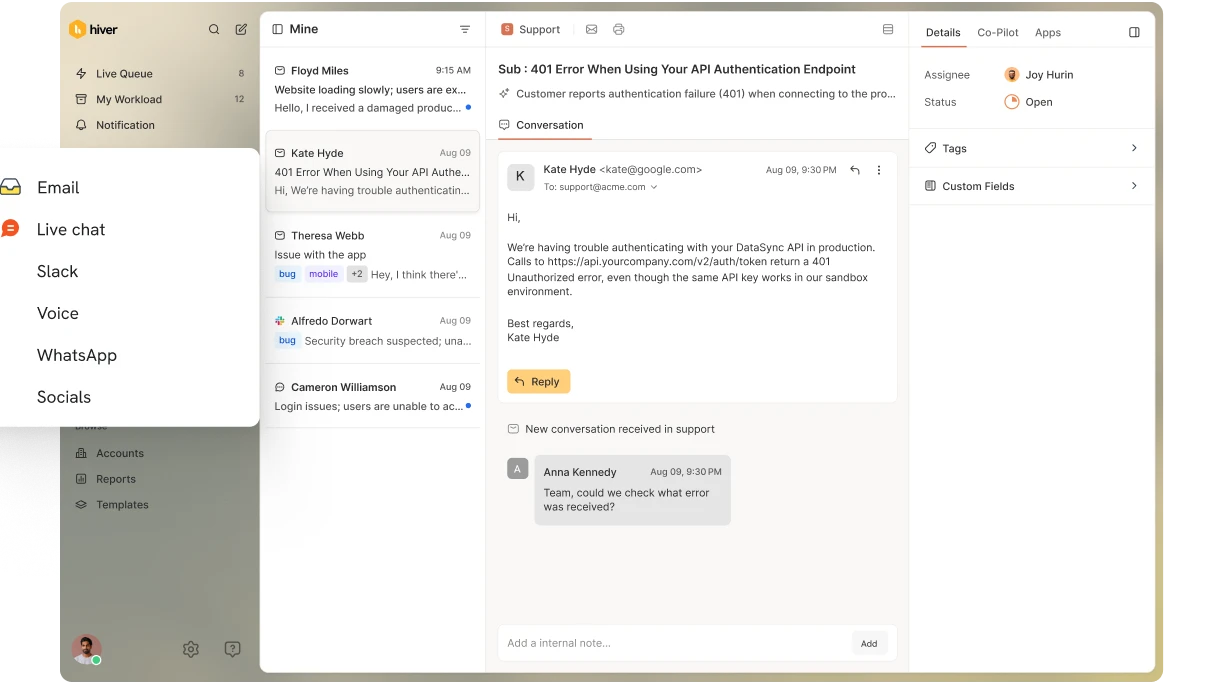
Hiver is an AI-powered customer service platform where pricing stays transparent as you scale. Instead of locking essential capabilities behind upgrades or add-ons, Hiver includes core support features upfront across its plans, so teams know exactly what they’re paying for from day one.
Unlike Zendesk, Hiver AI is not hidden behind separate modules or outcome-based billing. AI capabilities are clearly listed inside the plans themselves. As you move up the tiers, the use of AI becomes more powerful.
- On the Growth plan ($25/user/month), teams already get AI features like AI Compose and AI Summarizer, along with workflows, automation, and analytics.
- The Pro plan ($65/user/month) adds AI Agents and AI Copilot for teams looking to scale support with automation and real-time assistance.
- At the Elite plan ($105/user/month), advanced AI features like AI QA and upcoming AI Insights are included for larger or more complex teams.
No separate per-resolution charges. And no need to jump tiers just to unlock basics like automation, reporting, or SLAs.
The result is a support platform that’s easier to adopt and far easier to budget for as your team grows. You get modern AI-powered capabilities without dealing with layered add-ons or enterprise-style pricing surprises.
All of this leads to a natural question: How does Zendesk’s pricing approach actually compare to a simpler alternative?
To see the difference clearly, it helps to look at Zendesk and Hiver side by side, especially when it comes to pricing transparency and how costs scale over time.
Zendesk vs Hiver: A Transparent Comparison
Here’s how the two platforms differ once pricing and scale come into the picture.
| Pricing & Cost Factor | Zendesk | Hiver |
|---|---|---|
| Entry price | $19 per agent/month (Support Team) | Free plan available |
| Plan most teams end up on | $55–$115 per agent/month (Suite Team/Professional) | $25 per user/month (Growth) |
| AI availability | Partially included; advanced AI requires add-ons | AI features clearly included in paid plans |
| AI pricing model | Add-ons + outcome-based billing | Flat per-user pricing |
| Cost per automated resolution | ~$1.50–$2.00 per resolution | No per-resolution charges |
| Automation access | Locked behind higher tiers or paid AI add-ons | Included without upgrades |
| Add-ons that raise total cost | AI Agents, Copilot, QA, WFM, Privacy, Contact Center | None required for core workflows |
| AI visibility in plans | Spread across tiers, bundles, and add-ons | Clearly listed inside each plan |
| Usage-based fees | Yes (automated resolutions, voice, messaging) | No |
| Per-agent multiplier effect | Every add-on is priced per agent | Single per-user price |
| Storage and data limits | Extra storage billed separately | Included in plan limits |
| Budget predictability | Low — varies by usage and add-ons | High — fixed monthly cost |
| Scaling impact | Costs rise with agents and automation usage | Costs rise only with users |
| Free plan | No (trial only) | Yes |
With Zendesk, pricing usually feels fine at the start. But as soon as teams try to do what modern support actually requires, add AI, automate workflows, or monitor quality, the cost structure gets harder to follow.
What begins as a per-agent price slowly turns into a mix of seat fees, AI add-ons, and pay-per-resolution charges. The more automation you use, the more unpredictable the bill becomes, which makes budgeting a guessing game.
Hiver keeps things far simpler. AI features are clearly part of the plans instead of being tucked behind multiple upgrades.
There’s no cost per resolution, no usage-based math to track, and no surprise charges as volume increases. You pay a clear per-user price, and that number stays steady no matter how much you rely on automation or AI.
Final Take on Zendesk Pricing
Zendesk might look budget-friendly when you first sign up, but the moment you start adding the features your team actually needs, the price increases fast. For a lot of businesses, that’s the point where Zendesk stops feeling like a wise investment.
If you’d ask me, is Zendesk the best option out there?
For most teams, probably not. Start exploring alternatives that have better pricing and a good ROI for your investment.
For example, Hiver keeps things far simpler. The platform already includes multichannel support, collaboration tools, analytics, and workflow automation. And if you want advanced AI, it’s just one optional add-on, not five different modules priced per agent.
And if you’re exploring alternatives more broadly, there are other platforms that offer straightforward pricing and strong ROI as well. You don’t have to settle for a tool that becomes expensive the moment your needs grow.
You get a support solution that’s easier to adopt, easier to manage, and more budget-friendly.
If you’re looking for a customer service platform that scales with your team without surprising you at renewal time, Hiver is built exactly for that. See Hiver Pricing.
Frequently Asked Questions
1. How is Zendesk pricing structured?
Zendesk uses a per-agent pricing model, with key features split across tiers. The lowest tier begins at $19 per agent/month (billed annually). Most advanced capabilities go beyond the base plan and are available only via add-ons or higher tiers.
2. Does Zendesk include AI in all plans?
No. Basic AI capabilities appear only in Suite plans, while advanced AI requires a paid add-on ($50/agent/month).
3. Can Zendesk get expensive as you scale?
No. Basic AI capabilities appear only in Suite plans, while advanced AI requires a paid add-on ($50/agent/month).
4. Does Zendesk have a free version?
Zendesk does not offer a permanent free plan. It provides a time-limited free trial with access to Suite Professional features, after which you must move to a paid plan.
5. How much is the Zendesk AI add-on?
Zendesk’s Advanced AI is priced separately through sales. On top of that, automated resolutions are billed usage-based at around $1.50 per resolution, making AI costs scale with usage.
6. What are Zendesk light agents?
Light agents are internal collaborators who can view tickets and add internal notes but cannot reply to customers. They’re often used by managers, QA teams, or subject-matter experts who don’t handle support directly.