Skip to content





Every company says they deliver great customer service. Phrases like “customer-first” or “we go above and beyond” are peppered across websites, sales decks, and social media.
But ask their actual customers? You’ll often get a very different story.
Because expectations have changed. We live in an on-demand world. If a customer reaches out:
- They don’t want to wait 24 hours to hear back;
- They don’t want to repeat themselves across different channels;
- And they definitely don’t want templated replies that miss the point.
They want support that’s fast, personal, and genuinely helpful.
In fact, 1 in 4 customers will pay up to 10% more for good customer service, regardless of industry.
So what is good customer service today? What does it look like, and how can your team deliver it consistently? Let’s get into it.
Table of Contents
- What is Good Customer Service?
- Why is Good Customer Service Important?
- What are the Benefits of Great Customer Service?
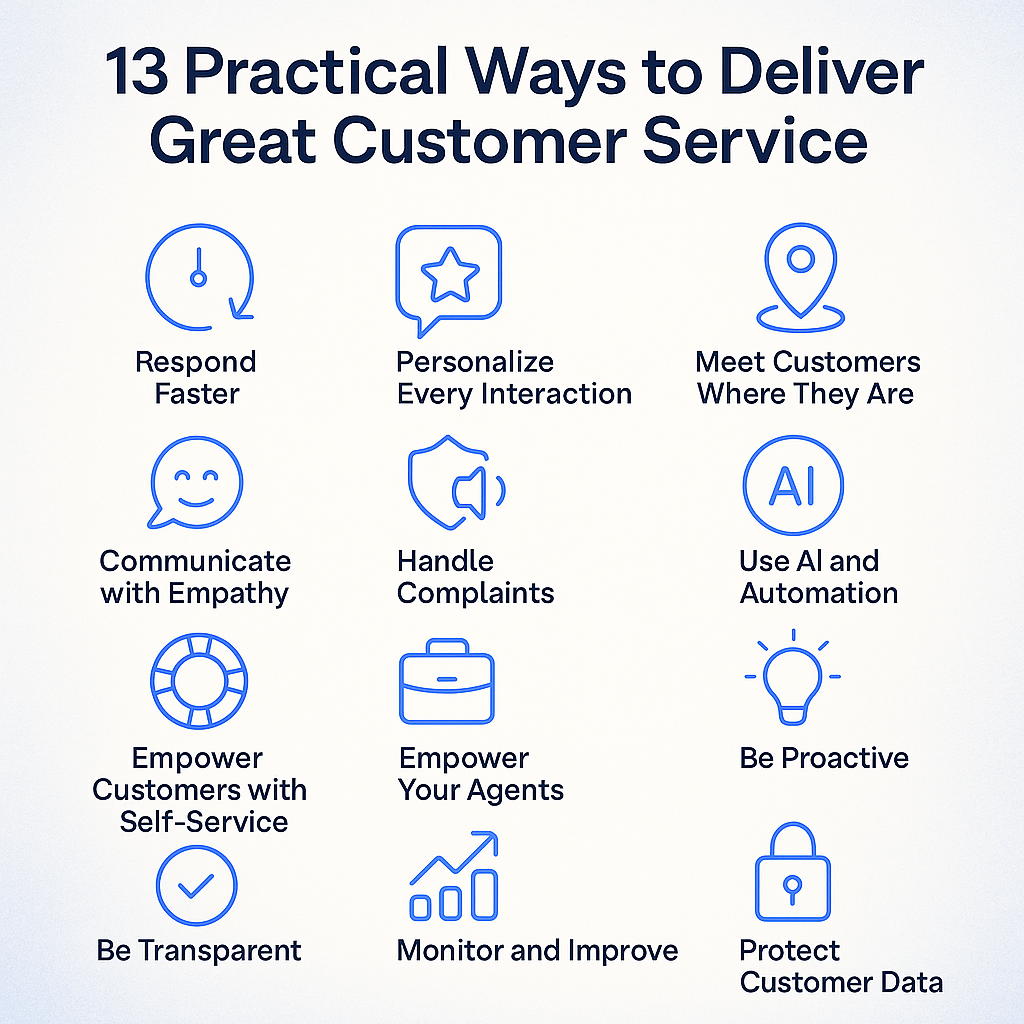
- 13 Practical Ways to Deliver Great Customer Service
- 1. Respond Faster
- 2. Personalize Every Customer Interaction
- 3. Meet Customers Where They Are
- 4. Train Agents to Communicate with Empathy and Clarity
- 5. Handle Complaints Professionally
- 6. Use AI and Automation to Scale Support
- 7. Empower Customers with Self-Service
- 8. Empower Your Agents
- 9. Be Proactive
- 10. Be Transparent and Manage Expectations
- 11. Monitor and Improve with Data-Driven Insights
- 12. Close the Loop With Feedback
- 13. Protect Customer Data with Privacy as a Priority
- How to Use Your Metrics to Drive Good Customer Service
- 3 Real-Life Examples of Brands That Deliver Good Customer Service
- How Hiver Helps You Deliver Excellent Customer Service
- Frequently Asked Questions
What is Good Customer Service?
At its core, good customer service is simple: listening well, responding fast, and leaving people feeling heard, helped, and valued. It’s about how you make your customers feel while you solve their problems.
A Quick Example of Good vs. Bad Customer Service
Let’s say a customer reaches out about a duplicate charge.
Poor service:
- They get an auto-reply, then radio silence for two days.
- They have to follow up multiple times.
- When someone finally replies, the agent uses finance jargon and blames the bank.
Good service:
- They waive the fee, apologize again, and reassure the customer that it won’t happen again.
- They get a reply in 10 minutes: “I’m so sorry about this—we’re checking with our billing team now. I’ll update you by 4 p.m.”
- The agent checks in again by 3:45 with a fix.
Why is Good Customer Service Important?
Most customers won’t remember every feature your product offers. But they will remember how your team made them feel when they needed help.
Whether it’s an unresolved issue, a slow reply, or an unempathetic tone, poor service can turn a one-time glitch into a lost customer. On the flip side, great service earns loyalty, trust, and long-term revenue.
Customer expectations are at an all-time high. Today’s buyers want:
- Fast, frictionless resolutions
- Conversations that feel human, not robotic
- A sense that their time is respected
And if they don’t get that? They won’t think twice about switching to a competitor. According to PwC, 32% of all customers would stop doing business with a brand they loved after one bad experience. Yes, that’s how high the stakes are.
What are the Benefits of Great Customer Service?
Investing in great customer service fuels long-term business growth across the board. Here’s how customer service excellence pays off :
1. Boost Long-Term Profits
Customer retention is powerful for your growth strategy. Just a 5% increase in customer retention can lead to a 25–95% increase in profits.
Why such a huge jump? Because loyal customers:
- Buy more often
- Spend more per transaction
- Don’t need as much hand-holding over time
When customers stick around, your support costs per person go down while their lifetime value goes up.
2. Save on Acquisition Costs
Between marketing, ads, sales cycles, and onboarding, new users cost far more than existing ones. In fact, it can cost 5-7x more to acquire a customer than to retain one.
Which makes excellent service one of the smartest investments you can make. It keeps the customers you’ve already worked hard to earn. And when switching providers is just a few clicks away, great support is your best defense against churn.
3. Generate More from Each Customer
When customers trust your team and feel well taken care of, they’re more open to hearing about your other offerings. And the potential payoff is huge:
Smart upselling and cross-selling can boost revenue by up to 42%, while personalized recommendations can lift earnings by as much as 35%.
The key? Don’t force the sale. Let good service build the relationship first.
4. Cultivate Brand Advocates
Compared to average users, satisfied customers are:
- 5× more likely to make repeat purchases
- 4× more likely to refer friends and family
- 7× more likely to try your new offerings
In other words, every great customer experience creates a ripple effect. Whether it’s a glowing review, a social media mention, or an off-hand referral to a colleague – word of mouth starts with good service.
5. Improve Employee Satisfaction & Retention
When agents are supported, trained well, and empowered with the right tools:
- They deliver better service
- They’re more likely to stay long term
For every 1% increase in employee engagement, customer satisfaction increases by 0.4%.
It’s a virtuous cycle:
- Happy agents → better service
- Better service → happier customers
- Happier customers → more appreciation, fewer escalations
- Fewer escalations → lower burnout for agents
And that means less turnover, lower hiring costs, and stronger team morale.
Recommended reading
13 Practical Ways to Deliver Great Customer Service
Great customer service doesn’t happen by chance. It’s built on intentional processes, the right tools, and a strong team mindset. Here are 13 practical ways to consistently deliver excellent service.
1. Respond Faster
A timely reply, sometimes even just an acknowledgment, can immediately calm an anxious or upset customer. Even if you don’t have the answer yet, a quick first response with “We’re looking into this” sets the right tone. The key is to acknowledge quickly, then follow through.
2. Personalize Every Customer Interaction
People can tell when they’re getting a copy-paste response. Tailor your replies using names, past context, and specific details. Instead of saying, “We’re working on it,” say, “I see you reported this yesterday. Our dev team is investigating, and I’ll update you within 2 hours.” Context and personalization builds trust.
3. Meet Customers Where They Are
Some customers email. Others prefer live chat, WhatsApp, or phone. Offering connected, cross-channel support helps customers reach you without using the channels of their choice, without repeating themselves. Make sure your help desk tool actually supports omnichannel visibility. Offering multiple channels only works if your team can track conversations and context across them.
4. Train Agents to Communicate with Empathy and Clarity
Support isn’t just about giving customers the right answers; it’s also about how you deliver them–with clarity and kindness. Make sure you:
- Acknowledge frustration before jumping into solutions
- Use calm, non-technical language and avoid jargon
- Offer actionable next steps
Scripts are a good start, but trust is built through flexible, human conversations.
5. Handle Complaints Professionally
Knowledge is essential, but it’s not enough. When a customer complains, speed and empathy matter most. Empower agents to fix issues on the spot, without jumping through hoops. A sincere apology and a swift, thoughtful solution can turn frustration into loyalty.
Pro Tip: Don’t bury your agents under layers of approvals. The quicker they can fix the issue, the more trust you earn.
Recommended reading
How to Deal With Difficult and Angry Customers (15 Tips and Examples)
6. Use AI and Automation to Scale Support
AI isn’t here to replace support agents. It’s here to help them. Use AI and automation to triage queries, suggest replies, respond to common queries and more. When deployed right, it sharpens accuracy, speeds up replies, and helps lean teams do more with less.
Did you know? Hiver offers AI capabilities at every stage of your customer service workflow. Hiver’s AI helps you triage and tag incoming messages, suggests context‑aware responses, detects customer sentiment, auto‑resolves low‑value interactions, and continuously improves with every correction.

7. Empower Customers with Self-Service
Not every customer wants to talk to support. In fact, many would prefer to find the answer themselves, if it’s easy to locate. That’s where strong self-service shines.
Core elements of modern self-service include:
- Searchable knowledge base: Go beyond FAQs. Include how-tos, videos, and guided workflows.
- Contextual help widgets: Offer answers inside your product – right where users get stuck.
- Customer portals: Let users track requests, access history, and manage issues independently.
- Community forums: Give customers a space to learn from peers (and lighten the load on your team).
- AI-powered search and chat: Help users find what they need at any hour of the day.
Great self-service reduces ticket volume, boosts satisfaction, and helps users solve problems on their terms.
8. Empower Your Agents
Customers aren’t the only ones who benefit from self-service and autonomy, your agents do too. That means offering agents:
- Access to internal knowledge (process docs, escalation paths)
- The right tools
- Ongoing training in product updates, workflows, tone, and troubleshooting
- Permission to make judgment calls (e.g., offering a discount or prioritizing a bug)
Recommended reading
9. Be Proactive
Don’t wait for customers to reach out about issues. Proactively inform them of bugs, delays, or outages before they notice.
Proactive support could mean:
- Sending usage tips for new features
- Following up after a support case closes
- Offering help if a customer hasn’t used your product in a while
Recommended reading
10. Be Transparent and Manage Expectations
Customers are more forgiving of delays if you keep them in the loop. Set realistic expectations (“We’ll follow up by 5 PM”), and update them if anything changes. Internally, make sure teams are aligned on what’s been promised to avoid confusion.
11. Monitor and Improve with Data-Driven Insights
You can’t improve what you don’t measure. The best support teams track key metrics to uncover roadblocks, coach agents, and streamline operations.
- First Response Time: How quickly does your team acknowledge a new request? A fast first response time builds trust, even if the fix takes time.
- Resolution Time: How long does it take to fully resolve an issue? Track both average and median to uncover outliers.
- CSAT (Customer Satisfaction Score): How do customers feel after an interaction? High scores signal quality, while drops can reveal broken processes.
- First Contact Resolution (FCR): How often do you solve the issue in one go? A high FCR means less back-and-forth, less frustration.
- Repeat Contacts: Are customers reaching out again for the same problem? This can point to unclear answers, product bugs, or training gaps.
Pro Tip: Use metrics to spark action, not just dashboards. Set regular review cadences, dig into outliers, and tie insights to real coaching, process tweaks, or product fixes.
12. Close the Loop With Feedback
If a customer gives you feedback, good or bad, they’re inviting you to improve. Acknowledge it, act on it, and close the loop. Let them know what changed because of their input. It signals that their voice matters.
Recommended reading
13. Protect Customer Data with Privacy as a Priority
Support often involves sensitive data. Treat it with care. That means:
- Using secure, role-based access for support tools
- Keeping personal information out of internal notes
- Being transparent about how customer data is handled
How to Use Your Metrics to Drive Good Customer Service
Knowing what to track is one thing, but knowing how to use those numbers is what drives real improvement.
Here’s how to get the most out of key service metrics:
- CSAT (Customer Satisfaction Score): Set up surveys to go out right after each support interaction. Review weekly to spot agent-specific coaching needs or recurring friction points.
- First Contact Resolution (FCR): Track how often issues are resolved in a single touchpoint. Use this to audit documentation, improve training, or clarify product workflows.
- First Response Time: Benchmark your response times by channel (e.g., <1 hour for email, <2 mins for chat). Set SLAs and automate reminders for anything slipping through.
- Resolution Time: Look beyond averages. Break this down by team, issue type, and customer segment to find the real bottlenecks.
- Customer Effort Score (CES): Pair CES with ticket metadata (channel, agent, issue type) to uncover hidden friction like clunky handoffs or multi-step workarounds.
- Net Promoter Score (NPS): Review NPS monthly or quarterly to measure broader sentiment. Tie changes back to recent launches, staffing changes, or new support processes.
Bringing It All Together
Tracking these metrics effectivelty gives you a 360° view of your customer service quality:
| Metric | Measures | Helps You Improve |
|---|---|---|
| CSAT | Customer happiness (per interaction) | Agent coaching, process feedback |
| FCR | One-touch resolution rate | Training, product documentation |
| First Response Time | How quickly you acknowledge requests | Staffing, automation setup |
| Resolution Time | How long it takes to solve issues | Workflow efficiency, team performance |
| NPS | Brand loyalty and sentiment | Product quality, overall CX strategy |
| CES | How easy it is to get help | Support process, channel usability |
💡 With Hiver’s built-in Analytics, your team can track everything right inside your helpdesk. No need for third-party dashboards or messy spreadsheets.
3 Real-Life Examples of Brands That Deliver Good Customer Service
1. Apple: The Genius Bar effect
Walk into any Apple Store and you’ll find the Genius Bar. It’s where trained experts offer one-on-one help including repairs, troubleshooting, and device setup.
Over time, this face-to-face, appointment-based model has evolved. Apple now offers tutorials, hybrid support, and learning sessions. It’s all designed to be calm, personal, and efficient.

No surprise then that Apple scored 85/100 in the 2024 American Customer Satisfaction Index.
2. Sephora: Omnichannel beauty that feels personal
Sephora blurs the line between online and in-store shopping:
- You can try on makeup virtually with their AR tool, Virtual Artist
- Match foundation shades with AI.
- Buy online and pick up at a store near you.

All these touchpoints connect to Beauty Insider – Sephora’s loyalty program with over 34 million members. That loyalty program now powers 80% of all purchases.
3. Get It Made: Speed + Service in a Traditional Industry
UK-based manufacturer, Get It Made, faced rising email volumes, slower replies, and coordination challenges as their business scaled. With Hiver’s shared inboxes, automation, and templates, they turned things around fast.

The result was a 250% boost in team efficiency, 25% faster response times, and glowing feedback from clients who called their support experience “a breath of fresh air.” Even while fully remote, their service stayed personal and responsive.
How Hiver Helps You Deliver Excellent Customer Service
Delivering good customer service today means showing up fast, staying personal, and solving problems across every channel. That’s exactly what Hiver helps you do, without an overwhelming learning curve.
From multichannel ticketing to AI-powered live chat, Hiver brings all your customer conversations into one intuitive interface. The AI Copilot steps in to triage issues, suggest replies, and deflect routine queries, so your team can focus on what matters most. Meanwhile, customers can help themselves via a searchable knowledge base and self-service portal.
And with real-time analytics and CSAT tracking built right in, Hiver helps you spot gaps, coach better, and continuously raise the bar on service quality.
Try Hiver for free and see how effortless excellent customer service can feel.
Frequently Asked Questions
What does good customer service look like?
Good customer service is when a customer gets fast, friendly, and helpful support, without needing to chase for updates or explain things twice. Think: quick replies, clear answers, and a team that genuinely wants to help.
How do you define good customer service?
Good customer service means solving issues efficiently, treating people with empathy, and making them feel heard, across every touchpoint, whether it’s email, chat, or phone.
Can you give an example of good customer service?
A great example of good customer service is when a customer reports a billing error and gets a prompt reply, a no-hassle fix, and a follow-up to ensure it doesn’t happen again. It’s proactive, respectful, and builds trust.
What are the key principles of good customer service?
-Listen carefully and fully before responding
-Reply quickly, even if just to acknowledge
-Be transparent about timelines and next steps
-Communicate with clarity and kindness
-Focus on solutions—not just answering tickets
Start using Hiver today
- Collaborate with ease
- Manage high email volume
- Leverage AI for stellar service