






“A great AM should service the cr*p out of the customer.”
These aren’t my words. They’re from a Reddit thread I came across while researching to put together the list for the best customer account management software. But it makes total sense to me.
Think about it: The most important thing is to provide value to your customers or give them the perception that they are getting more value than their investment. This means you must go beyond their immediate needs and consider the bigger picture.
That is only possible if you understand your client’s business inside out, anticipate issues before they arise, and provide insights contributing to their long-term success.
That’s where an excellent customer account management tool can make a difference. It brings all your customer data, workflows, and communication into one place. This helps your team stay proactive, aligned, and focused on customer growth.
In this guide, we’ll explore 16 customer account management tools to consider in 2025 and also help you evaluate the best one for your team.
What is Customer Account Management Software?
Customer Account Management (CAM) software is designed to help businesses manage their relationships with clients by streamlining interactions, tracking customer data, and enhancing overall customer service. It is a central hub where account managers can view all client-related information, making it easier to maintain, nurture, and grow customer relationships.
Key features of account management software typically include:
- Client data management: Storing and organizing customer contact information, account history, documents, and communication records in a unified database.
- Sales pipeline management: Tracking leads, opportunities, and deals through customizable sales stages to streamline the sales process.
- Workflow automation: Automating routine tasks like lead assignments, email follow-ups, and reporting to save time and improve efficiency.
- Analytics and reporting: Providing insights into sales performance, customer behavior, and revenue forecasting to help make data-driven decisions.
- Collaboration tools: Enabling teams to work together on accounts, share information, and stay aligned on customer interactions.
What are the Benefits of Customer Account Management Software?
Customer account management software centralizes client data, automates routine tasks, and delivers actionable insights. This helps your teams boost satisfaction, accelerate onboarding, and drive renewals and upsells at scale.
Let’s take a deeper look at the key benefits:
1. Centralized Customer Data
In many organizations, critical customer information is scattered across spreadsheets, inboxes, and various tools. Account management software brings everything into one place: contact information, communication history, purchase records, support tickets, and usage data. This unified view helps teams get up to speed quickly and maintain consistency across every touchpoint. Instead of switching between five platforms to prepare for a call, account managers have everything they need at a glance.
2. Collaboration Across Sales, Support, and Success
Customer relationships span multiple departments—sales handles the deal, support resolves issues, and success ensures long-term value. Without coordination, it’s easy to drop the ball. Account management tools provide a shared workspace where teams can tag each other, leave internal notes, assign tasks, and track ongoing updates. This fosters accountability, improves handoffs, and ensures the customer never has to repeat themselves, even when ownership changes.
3. Account Health Monitoring and Churn Prevention
Churn usually doesn’t happen overnight. It builds up due to missed signals, like reduced engagement, delayed responses, or unresolved issues. With account health scoring, alert systems, and engagement tracking, customer account management software helps teams identify at-risk accounts early. By acting on these signals—such as a dip in usage or a negative sentiment—teams can proactively reach out, resolve blockers, and prevent churn before it’s too late.
4. Performance Reporting and Forecasting
Account management isn’t just about day-to-day interactions; it’s about measuring what’s working and scaling it. These tools provide reporting dashboards that track metrics like renewal pipeline value, team responsiveness, customer satisfaction, and upsell performance. With these insights, leaders can spot trends, coach their teams more effectively, and make accurate forecasts based on real account data, not guesswork.
5. Personalized Customer Engagement at Scale
Account management software helps you by allowing you to segment customers based on lifecycle stage, contract value, usage behavior, or location. From there, you can trigger personalized check-ins, renewal reminders, or upgrade campaigns automatically where needed, but always grounded in the customer’s unique context.
Recommended reading
15 Best Customer Account Management Software Tools in 2025
| Customer Account Management Software | Key Features | Pricing Plan | G2 Rating |
|---|---|---|---|
| Hiver | – Shared inboxes for teams – SLA tracking – Collision alerts – Analytics – AI Copilot to surface customer information – Workflow automation | – Free plan available – Paid plan starts at $19 per agent/month | 4.7 / 5 |
| Hubspot CRM | – Contact and pipeline management – Email tracking – Deal automation – Reporting dashboards, -Marketing and service integrations | – Free plan available – Paid plan starts at $45 per agent/month | 4.4 / 5 |
| Salesforce | – Highly customizable CRM – Advanced workflow automation – AI-driven insights – Multi-department integrations – Robust reporting | – Free trial – Paid plan starts at $25 per agent/month | 4.2 / 5 |
| Zoho CRM | – Omnichannel support – AI-powered insights – Workflow rules – Sales automation – Customizable dashboards | – Free Trial – Paid plan starts at ₹800 /user/month, billed annually | 4.1 / 5 |
| Microsoft Dynamics 365 | – Full suite for sales, service, and marketing – AI-driven analytics – Workflow automation – Advanced reporting – Integrations. | – Free plan available – Paid plan starts at $65 per user/month | 4.0 / 5 |
| Freshsales | – AI lead scoring – Pipeline management – Sales automation – In-app phone & email – Reporting and analytics | – Free plan available – Paid plan starts $15/user/month (billed annually | 4.5/5 |
| Pipedrive | – Visual drag-and-drop pipelines – Activity reminders – Deal tracking – Email integration – Workflow automation – Reporting | – Free plan available – Paid plan starts at $12 per seat/month | 4.3/5 |
| Monday Sales CRM | – Customizable boards – workflow automation – visual dashboards – Account & deal tracking – Integrations with 200+ apps. | – Free plan available – Paid plan starts at $12 per seat/month | 4.6/5 |
| Flowlu | – CRM + project management – Finance tracking – Knowledge base – Collaboration tools – Task automation – Mind maps | – Free plan available – Paid plan starts at $29/month | 4.7/5 |
| Apptivo | – Modular apps for CRM – Project management – Customizable workflows – Reporting dashboards | – Paid plan starts at $20/MO | 4.4/5 |
| Kapta | – Key account plans – Relationship tracking – Performance reporting – Goal alignment | – Paid plan starts at $1000 / month | 4.7/5 |
| EngageBay | – All-in-one CRM with sales, marketing, and service modules – Email automation – Help desk – Deal pipelines – Contact management | – Free plan available – Paid plan starts at $12.74 per user/month | 4.6/5 |
| ChurnZero | – Customer health scoring playbook – Onboarding workflows – Usage analytics – Account segmentation – NPS surveys. | – Paid plan starts at $30K/year, typical | 4.7/5 |
| ClientSuccess | – Customer success dashboards – Renewal management – Success cycle tracking – Customer health monitoring | – Paid plan starts at ≈ $15K/year | 4.4/5 |
| Totango | – Prebuilt “success blocks” – Customer segmentation – Adoption and retention workflows – Automation – Analytics dashboards | – Free trial available – Custom pricing for enterprise plans | 4.4 |
| Planhat | – Customer success management – Revenue tracking – Health scoring – Customizable dashboard – Automated workflows | – Custom Pricing | 4.6/5 |
1. Hiver
AI works behind the scenes to route conversations, surface customer insights, draft replies, and automate repetitive tasks—so teams can focus on building stronger relationships and acting on what matters most.
Hiver is an AI-powered customer service platform that helps account managers and support teams manage all customer communication across email, live chat, WhatsApp, voice, SMS, and social media (Facebook and Instagram) from one centralized interface. For account management teams, Hiver delivers complete visibility into the account lifecycle from onboarding and QBRs (Quarterly Business Review) to escalations and renewals.
Here’s how Hiver Helps:
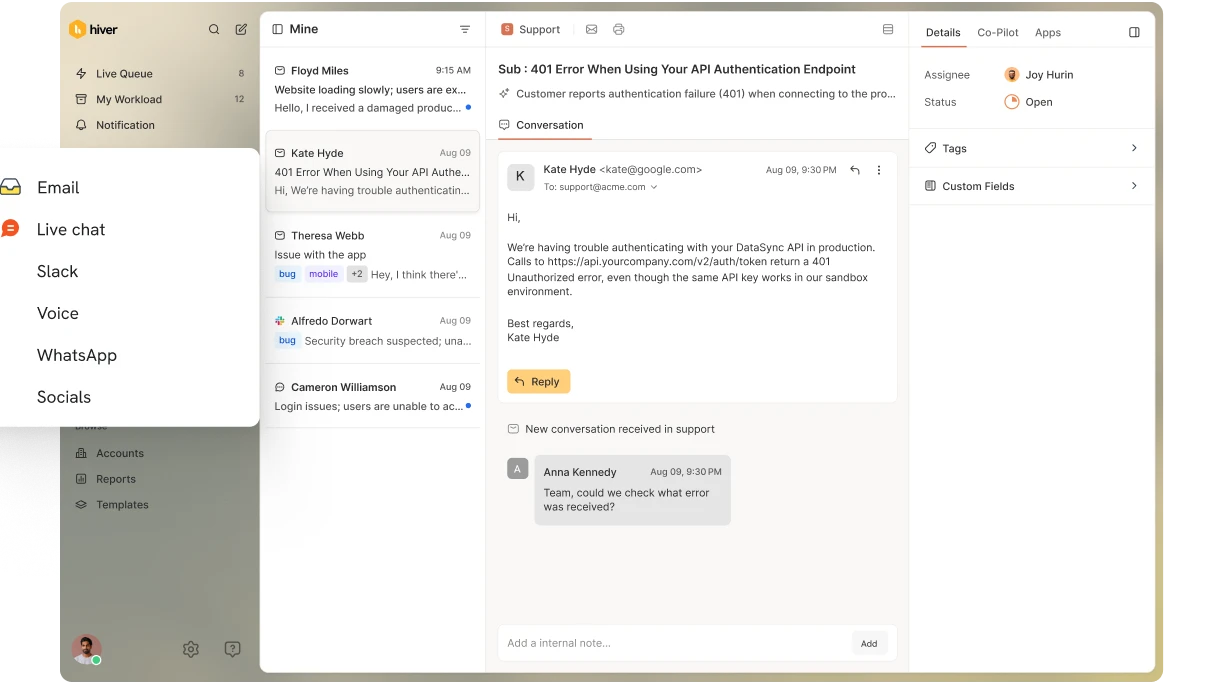
Shared inbox: Hiver brings together customer conversations from email, live chat, WhatsApp, voice, SMS, and social media into a single, shared inbox (like support@ or helpdesk@). Account managers can view, reply to, and assign messages without switching tabs or missing context, no matter where the customer reaches out.
They can also use internal notes and @mentions to collaborate behind the scenes—looping in teammates, adding context, or handing off conversations without the customer ever seeing it. This ensures smoother coordination and faster responses across the team.

AI Copilot for every agent: With AI Copilot, account managers get smart reply suggestions, recommended help articles, and instant access to customer data from connected apps, right when they need it. This speeds up responses and ensures every follow-up is informed and personalized.

AI-powered ticket routing and triage: You can automatically prioritize and route incoming queries based on urgency, email context, or account owner. This ensures high-value customers get attention fast and nothing falls through the cracks.
Account-level visibility with Contacts and Conversation ID: Hiver automatically builds rich contact profiles for every customer, displaying key account details and a timeline of all past conversations across channels in one place.
Each interaction is assigned a unique Conversation ID, making it easy for account managers to track issue history, collaborate with teammates, and follow up with full context, even when ownership changes.
Analytics and reporting: Hiver provides detailed analytics, such as response times, customer satisfaction metrics, and workload distribution. Account managers can leverage these insights to measure performance and make data-driven decisions to improve customer engagement and satisfaction.
Knowledge base, customer portal, and live chat: Customers can find answers through a branded knowledge base, raise requests via a self-serve portal, or chat in real-time with your team. These touchpoints integrate directly with your shared inbox for end-to-end visibility.
Customer feedback collection: It also enables customer feedback collection via CSAT surveys directly within the email thread, allowing account managers to gain insights into client satisfaction and identify areas of improvement.
Positive reviews:
- Some users find the analytics features helpful in tracking performance and understanding customer interactions better. They appreciate the insights that help in improving service delivery.
- Users report that Hiver enhances their ability to manage customer communications. It allows for assigning emails to team members, tracking responses, and ensuring no inquiries are overlooked. This has led to increased accountability and organization within teams.
Drawbacks
Some advanced features like custom SLA policies, analytics, and automation are only available on higher-tier plans.
Pricing:
- Lite plan: $19 per user per month (Up to 10 users)
- Growth plan: $29 per user per month (Unlimited)
- Pro plan: $49 per user per month (Unlimited)
- Elite plan: Custom pricing
Recommended reading
2. HubSpot CRM
HubSpot CRM is a powerful customer relationship management platform designed for businesses of all sizes. Used by account managers to centralize customer engagement across marketing, sales, and support, it makes customer history, company records, and call/email logs easily accessible. This transparency lets teams respond personally while scaling account operations efficiently.
It will also help bridge the gap between deal-making and account expansion by linking buying behavior with post-sale activities. Customer timelines and task prompts keep account managers ahead of renewals and check-ins without requiring them to build their own workflows from scratch.

Here’s how HubSpot CRM helps:
- A comprehensive view of customer data: HubSpot CRM provides a unified view of all customer interactions across sales, marketing, and support channels. Account managers can track emails, calls, meetings, and notes in one place, making it easier to monitor customer relationships and provide personalized service.
- Pipeline and deal management: With HubSpot’s deal management feature, account managers can create, track, and manage deals efficiently. The visual sales pipeline gives managers a clear picture of where customers are in the sales process, enabling proactive account management.
- Automation and workflows: HubSpot’s automation tools allow account managers to set up workflows that automate repetitive tasks, such as follow-up emails and reminders. This helps reduce manual effort and ensures no customer communication is missed.
- Task management: Account managers can assign tasks to themselves or other team members, set deadlines, and prioritize activities. This feature helps them monitor ongoing client interactions and ensures timely customer follow-up.
- Reporting and Analytics: HubSpot provides in-depth analytics and reporting on customer accounts, sales performance, and team activity. These insights help account managers evaluate performance, track customer satisfaction, and make data-driven decisions to improve engagement and retention.
Pricing:
- Free plan
- Starter Customer Platform: Starts at $45/mo
- Professional Customer Platform: Starts at $1,800/mo
- Enterprise Customer Platform: Starts at $8,610/mo
Positive reviews:
- HubSpot CRM offers the most feature-packed free plan compared to other CRMs, allowing users to manage up to 1 million contacts without paying. This generous free version is a major draw for businesses seeking a robust CRM solution.
- Many users praise HubSpot CRM for its user-friendly interface and intuitive navigation, which make it accessible even to non-sales personnel. The platform’s simplicity and logical design contribute to high team adoption rates.”
Drawbacks
- Users note that additional costs may arise for certain features, such as onboarding, API usage, and increasing contact limits beyond the free plan’s threshold.
3. Salesforce
Salesforce CRM is the enterprise workhorse that brings customer accounts, sales, service, and analytics into a single platform optimized for sophisticated account management. Its modular setup and AppExchange integrations allow teams to build custom pipelines, track post-sale milestones, and monitor multi-touch customer journeys at scale.

Seen as the lifeblood of account operations in larger organizations, Salesforce delivers proven frameworks for managing renewals, cross-sells, and customer health. With built-in collaboration and an AI toolbox (like Einstein), it surfaces relationship risks and expansion cues—helping AMs act ahead of time.
How Salesforce Helps Customer Account Managers:
- Sales Cloud and Account Management Tools: Salesforce’s Sales Cloud includes advanced features for tracking leads, managing pipelines, and closing deals. Account managers can create detailed customer profiles, monitor customer engagement, and precisely manage account health.
- Automation & AI (Einstein AI): Salesforce includes robust automation tools like workflows and processes, enabling account managers to automate routine tasks like follow-ups, alerts, and updates. Additionally, Einstein AI helps account managers predict customer behavior, identify high-value opportunities, and provide insights for better account management.
- Customizable Dashboards & Reports: Account managers can create custom dashboards to track key performance indicators (KPIs) such as account health, customer satisfaction, or pipeline status. These insights can be used to make data-driven decisions, monitor performance, and optimize account strategies.
Salesforce pricing:
- Essentials: $25 per user/month
- Professional: $75 per user/month
- Enterprise: $150 per user/month
- Unlimited: $300 per user/month
Positive reviews:
- Users often mention the powerful reporting features that Salesforce offers. Creating customized reports and dashboards allows businesses to gain valuable insights into customer behavior and sales performance, aiding decision-making.
Drawbacks:
- A common complaint among users is the outdated and complex user interface. Many find navigating unintuitive and challenging compared to more modern CRM solutions.
- This sentiment is echoed in several Reddit threads, where users express frustration with the platform’s design and usability.
Recommended reading
4. Zoho CRM
Zoho CRM offers a budget-friendly yet customizable platform tailored to growing account teams. While it includes standard CRM capabilities—like pipeline tracking and email syncing—it stands out for its flexible account modules and automation tools (with AI assistant Zia) that support follow-ups, segment growth opportunities, and streamline renewals.

For account managers on small-to-mid teams, Zoho CRM hits the sweet spot: flanked by contact records and deal pipelines, it offers lightweight customization options—like custom fields, tags, and workflows—so you can structure your account management process without wrestling a heavyweight system.
Here’s how Zoho helps:
- Comprehensive contact management: Zoho CRM provides a unified view of customer information, enabling account managers to track customer interactions, deal stages, and communication history. This 360-degree view helps in better understanding customer needs and preferences.
- Sales automation: Zoho CRM automates repetitive sales tasks such as follow-ups, task assignments, and email alerts. This automation frees up time for account managers to focus on building relationships and closing deals.
- Customizable dashboards and reports: The software offers highly customizable dashboards and reporting tools. Account managers can track KPIs, sales performance, and customer interactions in real-time, enabling data-driven decision-making.
- AI-Powered Zia: Zoho’s AI assistant, Zia, provides predictive sales analytics, sentiment analysis, and sales forecasting. Zia can suggest the best times to contact customers and identify potential issues before they escalate.
- Integration capabilities: Zoho CRM integrates with numerous third-party applications and other Zoho products, such as Zoho Books, Zoho Desk, and Zoho Campaigns. This integration allows seamless data flow across different functions, enhancing overall efficiency.
Pricing:
- Standard: ₹800 /user/month billed annually
- Professional: ₹1400 /user/month billed annually
- Enterprise: ₹2400 /user/month billed annually
- Ultimate: ₹2600 /user/month billed annually
Positive reviews
- Users frequently praise Zoho CRM’s extensive customization capabilities, allowing them to tailor the platform to their business needs. They particularly appreciate the ability to create custom fields, views, and modules.
- Some users mention that the tool helps retain clients and maintain fast communication, enhancing the customer experience. For instance, integrating multiple features like lead and contact management and workflow automation was highly appreciated, as it helps streamline account management processes.
Drawbacks
- On the downside, some users expressed dissatisfaction with Zoho’s email marketing capabilities, highlighting that it isn’t ideal for personalized cold emailing at scale.
5. Microsoft Dynamics 365
Microsoft Dynamics 365 brings CRM and Enterprise Resource Planning (ERP) together to help enterprises manage customer accounts with deep operational and financial visibility. Its strength lies in giving account managers access to sales data, support history, contracts, and forecasting—all tied to one customer record. This makes it ideal for teams managing complex B2B accounts or layered customer hierarchies across regions.

It also integrates tightly with Microsoft Teams, Outlook, and Excel, making it easier to collaborate internally and extract insights without disrupting existing workflows. For organizations already invested in the Microsoft ecosystem, Dynamics 365 offers an enterprise-grade way to unify and grow customer relationships at scale.
Here’s how Microsoft Dynamics 365 helps:
- Unified Customer Data: Dynamics 365 provides a complete view of customer interactions across various touchpoints, allowing account managers to track customer history, preferences, and behaviors. This 360-degree view enables more personalized and effective account management.
- Sales and Marketing Automation: Account managers can automate repetitive tasks such as follow-ups, emails, and lead nurturing. Dynamics 365’s built-in AI helps predict customer needs and behaviors, allowing account managers to be proactive rather than reactive.
- AI-Powered Insights: Microsoft Dynamics 365’s AI-driven insights help account managers make data-driven decisions. Features like lead scoring, sales forecasting, and customer sentiment analysis enable managers to prioritize key accounts and optimize their strategies.
- Customizable dashboards and reporting: Dynamics 365 offers customizable dashboards that allow account managers to track KPIs such as customer lifetime value, engagement metrics, and revenue performance. The platform also supports advanced reporting for in-depth analysis.
- Customer engagement tools: With tools for customer feedback, social listening, and case management, account managers can engage with customers more effectively and resolve issues quickly, improving overall satisfaction and retention.
Pricing for Microsoft Dynamics 365 CRM
- Sales Professional: $65 per user/month
- Sales Enterprise: $95 per user/month
- Customer Service Professional: $50 per user/month
- Customer Service Enterprise: $95 per user/month
- Marketing: $1,500 per month for 10,000 contacts
Positive feedback:
- Users appreciate its integration capabilities, especially with other Microsoft tools like Outlook, which allows for seamless customer data and communication management.
- Microsoft Dynamics 365 integrates customer account management with ERP, enabling businesses to manage customer relationships, finance, supply chain, and operations.
Drawbacks:
- Users noted areas for improvement, including the complexity of sharing data across teams, which can be challenging, especially for larger organizations.
- Some users have also pointed out that setting up the platform requires a learning curve, and they would like to see better user documentation and faster implementation of new features to keep up with competitors like Salesforce.
6. Freshsales
Freshsales by Freshworks is designed for teams that want to manage accounts with speed, clarity, and automation. Built on a modern interface, it combines customer lifecycle tracking with sales engagement tools, making it easy for account managers to move from pipeline to post-sale follow-ups without losing context.
Whether you’re a growing startup or mid-market team, Freshsales is ideal for managing repeat business and nurturing long-term account relationships.

Here’s how Freshsales helps:
- Unified customer view: Freshsales gives account managers a 360-degree view of each customer. This includes customer communication history, interaction timelines, and sales-related data.
- Automation and AI: Freshsales integrates AI-powered tools like Freddy AI, which helps automate repetitive tasks such as follow-up emails, lead scoring, and pipeline management. This enables customer account managers to focus more on building relationships and less on administrative tasks.
- Lead and deal management: The software enables easy lead capturing, nurturing, and deal tracking. Using AI insights, managers can create pipelines, assign tasks, and prioritize leads, helping them close deals more efficiently. The ability to set up workflows and custom automation further streamlines processes.
- Email and phone integration: With built-in telephony and email capabilities, Freshsales allows account managers to communicate directly with clients within the platform. This feature simplifies communication and ensures that all interactions are logged and accessible in one place.
- Reporting and analytics: Freshsales provides detailed reports and dashboards, giving insights into sales performance, customer engagement, and revenue trends. Account managers can use this data to improve their strategy, identify opportunities, and better serve their customers.
Pricing:
- Free
- Growth: $15/user/month (billed annually)
- Pro: $39/user/month (billed annually)
- Enterprise: $69/user/month (billed annually)
Positive reviews
- Freshsales’ mobile capabilities and integration with telephony tools are highly praised. Users can manage customer accounts from various devices and benefit from integrated communication channels like email, WhatsApp, and phone calls. This functionality helps businesses streamline their communication and customer management processes.
- Many users appreciate Freshsales’s ease of use and the ability to customize records for customer accounts. The interface allows users to track account history, demographics, and billing information.
Drawbacks
- Certain users feel that Freshsales may lack some advanced features that competitors offer or require third-party integrations like Zapier to unlock full functionality.
7. Pipedrive
Pipedrive is a sales-first CRM built for simplicity and action. Its visual pipeline and activity tracking make it a favorite among account managers handling fast-moving deals or customer relationships that require consistent touchpoints. Every step of the customer journey, from onboarding to expansion, can be logged and tracked with minimal overhead.
For account teams, Pipedrive acts like a smart task manager with CRM baked in. It helps reps stay organized, automate follow-ups, and manage client communication in one place.

Here’s how Pipedrive helps:
- Visual sales pipeline: The visual pipeline allows account managers to see where each customer stands, from first contact to deal closure. This visualization ensures nothing falls through the cracks, enabling account managers to prioritize tasks.
- Customizable fields: Pipedrive allows users to customize fields for customer accounts, ensuring that data relevant to their specific industry or customer base is easily accessible.
- Activity and communication tracking: Pipedrive tracks all customer interactions, including emails, calls, and notes, ensuring that account managers always have context on previous interactions. This centralized data improves customer relationship management by ensuring no touchpoint is missed.
- Automation features: Pipedrive offers automation features to streamline repetitive tasks like follow-up emails or reminders, enabling account managers to focus on high-value tasks, such as building stronger customer relationships.
- Reports and insights: The CRM provides reporting features that allow account managers to assess their performance, customer behavior, and sales cycle. These insights can help account managers optimize their workflow and spot areas for improvement.
- Integrations: Pipedrive integrates with various tools, including Google Workspace, Microsoft 365, Slack, and marketing automation software. This helps customer account managers integrate sales, marketing, and communication efforts.
Pricing:
- Essential Plan: $12 per seat per month
- Advanced Plan: $24 per seat per month
- Professional Plan: $49 per seat per month
- Enterprise Plan:$59 per seat per month
Positive reviews:
- Pipedrive excels in pipeline management, allowing users to visualize their sales processes effectively. Users find it helpful to customize pipelines for different sales campaigns, which aids in tracking deal progress and managing customer interactions.
- The platform integrates well with various third-party applications, such as Google Workspace, MailChimp, and Zapier, which enhances its functionality.
Drawbacks:
- Users have expressed concerns that Pipedrive may not be the best fit for comprehensive account management.
- Some feedback indicates that while it excels at managing sales pipelines, it may fall short when managing existing customer relationships and long-term account management.
8. Monday Sales CRM
Monday Sales CRM brings the flexibility of project management into account management workflows. Its fully customizable boards let teams build pipelines, follow-up schedules, onboarding plans, or QBR checklists, all tailored to how they actually work. This makes it perfect for teams managing both sales and ongoing client relationships.
Account managers can track every conversation, timeline, and status update in one view while using automation to assign owners, set reminders, and manage deadlines. It’s especially effective for companies that need visibility across sales, support, and delivery teams without a rigid CRM structure.

Here’s how Monday Sales CRM helps:
- Customizable dashboards: Monday Sales CRM allows users to create fully customizable dashboards, making it easy for customer account managers to visualize their pipelines, track deals, and manage customer interactions.
- Sales pipeline management: The software simplifies tracking leads and deals through a visual, drag-and-drop pipeline, which enables customer account managers to see where each client is in the sales process and to take necessary actions quickly.
- Automation: Monday Sales CRM offers workflow automation, reducing the need for manual updates. Automated reminders, follow-ups, and task assignments help customer account managers stay on top of tasks and ensure no missed opportunities.
- Collaboration: Teams can collaborate within the platform by sharing updates, leaving comments, and assigning tasks, making it a good tool for customer account managers who need to work closely with other departments, such as sales and support.
- Integrations: The software integrates with various third-party tools, such as Gmail, Slack, Zoom, and more, enabling a seamless experience for managing customer communications and interactions.
Pricing:
- Individual Plan: Free
- Basic: CRM $12 seat/month
- Standard: $17 seat/month
- Pro CRM: $28 seat/month
Positive reviews:
- The ability to customize dashboards and workflows to specific needs is a significant advantage for businesses. Tracking customer journeys from lead generation to post-sale activities is helpful for ensuring nothing slips through the cracks.
- Monday Sales CRM’s collaborative features also stand out. They enable teams to share boards, files, and updates in real-time.
Drawbacks:
- While praised for its customization and ease of use, some users mention limitations with its lead scoring (available only on higher tiers) and HIPAA compliance, making it less suited for highly regulated industries.
9. Flowlu
Flowlu blends CRM, task management, invoicing, and project tracking into one affordable platform. It’s ideal for account teams that need operational control beyond contacts and deals. It’s particularly useful for service-based businesses where account managers oversee not just client communication but also timelines, budgets, and delivery milestones.

Here’s how Flowlu helps:
- Integrated CRM and Project Management: Flowlu’s CRM integrates with its project management features, allowing account managers to track sales and post-sales project progress within the same platform. This integration ensures that the entire customer journey, from the initial interaction to project delivery, is managed seamlessly.
- Automation and Custom Workflows: The platform provides workflow automation to streamline repetitive tasks such as follow-up emails, task assignments, and reporting. This allows account managers to focus more on strategic tasks rather than spending time on administrative duties.
- Financial Tools: Flowlu offers built-in financial tools for invoicing, billing, and expense tracking. Account managers can handle customer billing directly from the platform, which makes it easier to manage ongoing financial interactions with clients and track revenue.
- Client Portal: Flowlu offers a portal where customers can view their project status, invoices, and other important details. This feature improves communication and transparency between account managers and clients, fostering better relationships.
- Analytics and Reporting: Flowlu’s analytics and reporting features provide insights into customer behavior, sales performance, and project success. Account managers can use these insights to optimize strategies, identify improvement areas, and provide clients with personalized support.
Pricing:
- Free Plan
- Team Plan: $29/month (billed annually)
- Business Plan: $59/month (billed annually)
- Professional Plan: $119/month (billed annually)
- Enterprise Plan: $239/month (billed annually)
Positive reviews:
- Users note that the ability to give customers access to their project and billing information through a client portal is a feature not commonly found in many other CRMs, making Flowlu a strong choice for businesses that prioritize customer transparency.
- Flowlu is also praised as an all-in-one business management tool that integrates CRM, project management, and financial management. Users appreciate that they can manage customer relationships, projects, and finances from a single platform, which enhances workflow efficiency.
Drawbacks:
- Some users have noted that the user interface could benefit from updates and further customization options in invoicing.
10. Apptivo
Apptivo offers a modular CRM system that supports account management, invoicing, project tracking, and customer service from a single dashboard. This system is especially helpful for small—to mid-sized teams that want to streamline customer engagement and operational workflows without breaking the bank.

Account managers can track communications, automate follow-ups, and manage contracts or service requests all within one platform. Apptivo is flexible enough to grow with your team, making it ideal for businesses that want CRM capabilities plus back-office integration.
Here’s how Apptivo helps:
- 360-degree customer view: Apptivo provides customer account managers with a full view of each customer, tracking their history, interactions, and critical details in one place. This helps manage relationships more effectively and improves customer satisfaction.
- Task automation: It automates many tasks, such as follow-up reminders, email campaigns, and task assignments, reducing manual workload and allowing managers to focus on higher-value tasks.
- Customization: Apptivo is highly customizable, allowing users to tailor their CRM experience. Customer account managers can create custom fields, workflows, and templates, which helps them adapt the software to unique business processes.
- Comprehensive suite: It combines a range of applications into one platform, including CRM, project management, invoicing, and task management, giving customer account managers all the tools they need in one place.
Pricing:
- Lite Plan: $20/MO Per user/Billed Monthly
- Premium: $30/MO Per user/Billed Monthly
- Ultimate: $50/MO Per user/Billed Monthly
- Enterprise: custom pricing
Positive reviews:
- Users highlight its ease of use and customization features, which allow teams to manage diverse client accounts seamlessly.
- Apptivo offers mobile-friendly access, which helps account managers stay updated on client interactions while on the go.
Drawbacks:
- Some users have pointed out limitations in integrations and minor difficulties with the interface, particularly regarding deployment.
11. Kapta
Kapta is purpose-built for strategic account management, giving teams the tools to manage key accounts with structure, transparency, and long-term planning. It moves beyond CRM by offering goal tracking, executive summaries, and success plans tailored to each account, making it ideal for enterprise teams focused on retention and growth.

Kapta excels in aligning internal teams around the customer’s voice. By surfacing strategic goals and organizing responsibilities through shared action plans it helps account managers stay proactive, demonstrate value, and deepen executive-level relationships.
Here’s how Kapta helps:
- Account planning and strategy: Kapta allows managers to create detailed account plans, set goals, and track progress. This helps align strategy with business objectives and ensure that account plans are actionable.
- Customer Insights: It provides in-depth insights into customer behavior, preferences, and needs, which helps in personalizing interactions and anticipating customer needs.
- Collaboration tools: Kapta includes tools for team collaboration, enabling account managers to work closely with internal teams and share insights and updates on key accounts.
- Performance Tracking: The software includes performance tracking and reporting features, allowing account managers to monitor the success of their strategies and adjust as needed.
- Customizable Dashboards: Kapta offers customizable dashboards that provide a visual overview of account health, progress, and key metrics, making it easier to manage and prioritize tasks.
Pricing:
- KAM Basics: $1000 / month
- KAM plus: $2000/ month
- Enterprise: $ 5000/ month
Positive reviews:
- According to one user, Kapta’s Account Health score has proven crucial for customer retention and has financially benefited their business.
- Users appreciate Kapta’s all-in-one approach, which integrates critical account management with customer engagement tools. This allows account teams to manage strategic customer relationships from a single platform.
Drawbacks:
- Kapta’s pricing, starting at $1000/month, may be cost-prohibitive for some businesses, especially smaller ones.
12. Engagebay
EngageBay offers an all-in-one CRM, marketing, and service platform that’s surprisingly powerful for small teams managing end-to-end customer relationships. It lets account managers track communication, automate reminders, and trigger marketing workflows based on customer behavior.

What sets it apart is its affordability and unified view of customer data. For businesses that want sales, service, and marketing aligned under one system, EngageBay provides a cost-effective solution.
Here’s how Engagebay helps:
- Contact Management: Store detailed contact information, including interaction history, preferences, and communication details.
- Pipeline Management: Track and manage sales pipelines, helping account managers oversee the progress of deals and customer interactions.
- Lead Scoring: Prioritize leads based on their engagement and likelihood to convert.
- Task Automation: Automate repetitive sales tasks such as follow-ups and reminders to improve efficiency.
- Reports and analytics: Account managers can track performance, identify trends, and make informed decisions to optimize strategies and improve account management.
Pricing
- Free plan
- Basic plan: $12.74 per user/month
- Growth plan: $55.24 per user/month
- Pro plan: $101.99 per user/month
Positive reviews:
- Users appreciate the visual deal pipeline that allows them to track the status of deals at a glance.
- EngageBay is recognized for its cost-effectiveness, especially for startups and small to medium-sized businesses.
Drawbacks:
- Some users report that EngageBay lacks advanced reporting capabilities compared to other CRM platforms.
- A few users mention that the onboarding process can be slow, requiring additional time and effort to configure the system properly.
13. ChurnZero
ChurnZero is a customer success platform designed to help SaaS businesses reduce churn, drive product adoption, and grow customer accounts. It offers a complete suite of tools to help account managers track customer health, manage renewals, and build proactive engagement strategies.

What makes ChurnZero ideal for customer account management is its ability to surface insights in real time. Teams can see who’s at risk, who’s ready to expand, and what actions are needed, without switching between tools.
Here’s how ChurnZero helps:
- Real-time customer health scores: ChurnZero aggregates product usage, support activity, survey data, and CRM fields to calculate live health scores, giving account managers instant insight into which customers need attention.
- Playbooks and automation workflows: Teams can build repeatable playbooks for renewals, check-ins, or escalations, and automate next steps based on customer behavior or timing.
- Success dashboards and timelines: Each account has a centralized timeline showing meetings, touchpoints, survey responses, and milestones, helping teams understand engagement over time.
- Customer segmentation and targeting: ChurnZero allows granular segmentation of customers based on lifecycle stage, health, ARR, usage, and more, making it easy to prioritize outreach and upsell efforts.
- In-app communication and surveys: Teams can trigger targeted in-app messages, NPS surveys, and pop-ups during key product moments, creating seamless engagement directly in the customer’s environment.
Pricing
- No free plan available; a live demo and trial are offered upon request.
- Pricing is custom and based on company size, number of users/customers, and feature set.
Positive Reviews
- Users appreciate that the tool gives a complete picture of customer activity and helps build scalable success workflows.
- Users also love the real-time alerts and task automation.
Drawbacks
- UI can feel a bit clunky and dated compared to newer platforms.
- “Steep learning curve for non-technical users without dedicated onboarding support.”
14. Totango
Totango is a purpose-built customer success and account management platform designed to align post-sale teams around growth and retention. Unlike generic CRMs, it’s architected from the ground up to manage renewals, expansion plays, health monitoring, and proactive engagement, all within configurable workflows.

Its modular design, SuccessBLOCs, allows account teams to scaffold processes like onboarding, renewal readiness, churn prevention, or expansion outreach and iterate over time. This makes it easy to scale structured account management practices across your team.
Here’s how Totango helps:
- Custom health scoring: Aggregate signals like usage data, product engagement, and support tickets into account risk indicators.
- Account-level timeline & lifecycle views: Visual progression of onboarding, QBRs, issues, and ROI milestones for each customer.
- Behavior-based triggers: Automatically kick off alerts, tasks, or playbooks when health metrics cross thresholds.
- Churn and expansion forecasting: Segment accounts primed for upsells or at risk—helping AMs prioritize outreach.
Pricing:
- Free Trial: 14-day access to full capabilities—demo or trial through Totango’s site.
- Estimated licensing: Common enterprise contracts (~10 seats, 2,000 accounts) begin at a custom quote; typical spend ~$66K–$123K/year.
Positive Reviews
- Some users say that the tool is “Very user‑friendly and easy to navigate,” and that it helps them track customer activity and manage workflows efficiently.
- Additionally, users note that the customizable reporting is nice and helps in quickly segmenting views. Also the health score flexibility is powerful.
Drawbacks
- Users have noted that the data loading speed can lag, especially with complex filters or dashboards.
- Integration setup may require effort, and AI churn models may need customization.
15. ClientSuccess
ClientSuccess is purpose-built for post-sale teams managing renewals, retention, and account growth. Unlike CRMs that focus on pipeline and lead tracking, it centers entirely around customer lifecycle management, with clear visibility into account health, key milestones, and engagement activity.

The tool also bridges collaboration across success, support, and account teams by keeping everyone aligned on what needs to happen next with each customer. It’s especially valuable for SaaS or subscription-based businesses that rely on long-term relationships and recurring revenue.
Here’s how ClientSuccess helps:
- Customer health scores and alerts: ClientSuccess tracks usage data, sentiment, and support interactions to calculate real-time account health scores. Account managers can set thresholds and get alerted when a customer’s engagement drops or risk increases.
- Renewal and expansion tracking: The platform lets teams manage renewals, forecast potential expansions, and set reminders for contract milestones, ensuring that no revenue opportunity is missed.
- Account timelines and lifecycle views: ClientSuccess builds a clear timeline of each account’s journey, including onboarding, QBRs, escalations, and success milestones. This gives AMs the visibility needed for strategic follow-ups.
- Automated playbooks and tasks: With prebuilt success playbooks, account managers can trigger step-by-step workflows for onboarding, adoption, or re-engagement, keeping service consistent and repeatable across accounts.
- Integrated survey and NPS tools: Built-in surveys allow AMs to measure customer satisfaction at key points. Results feed directly into account profiles, making it easier to prioritize outreach and improve relationships.
Pricing:
- Typical starting price: ~$15,000/year (per 4+ licenses)
- Startup Package: Focused on smaller teams. This plan offers core lifecycle workflows and health tracking (pricing requires contact).
- Growth Package: Suitable for SMB‑mid-market. Adds advanced reporting, integrations, professional services, and a named CSM.
- Enterprise Package: Full feature set with the highest level of support and custom integrations.
Positive reviews
Users appreciate “everything in one place,” ease of use, configurable dashboards, and responsive customer support..
Drawbacks
Some integration gaps exist (e.g., with Salesforce sync), and advanced automation features are limited.
16. Planhat
Planhat is a highly flexible customer success platform designed to support advanced account management strategies across the full customer lifecycle. It gives teams deep insight into engagement trends, usage patterns, and customer sentiment.

What makes Planhat especially useful for account managers is its ability to surface actionable data like churn risk signals, upsell readiness, or lifecycle stage within customizable dashboards. Teams can tailor workflows for renewals, expansions, or executive check-ins, and even share customer-facing portals with success plans and progress tracking.
Here’s how Planhat helps:
- Customizable success plans per account: Account managers can create tailored success plans for each customer, defining goals, timelines, and owner responsibilities. These are shareable with the customer for full transparency.
- Customer segmentation and triggers: Planhat enables detailed segmentation based on usage, behavior, or contract value. Account managers can then trigger specific playbooks, alerts, or communications tailored to each segment.
- Account portals and shared dashboards: With Planhat, AMs can give customers access to a branded portal that shows shared plans, KPIs, and updates, fostering trust and accountability in high-value relationships.
- Multi-touch engagement tracking: All emails, meetings, notes, and support activity are logged under the account, making it easy to view the full engagement timeline and collaborate with internal teams.
Pricing:
Custom pricing is only tailored to company size and needs, covering packages like Startup, Professional, and Enterprise.
Positive reviews
Praised for “flexibility in integrations,” centralized data, daily use by teams, and improved proactive engagement.
Drawbacks
It can feel overwhelming due to its configurability; the setup requires thoughtful planning
How to Choose the Right Account Management Software for Your Team?
Pick an account management tool that feels like a natural extension of your team. One that’s easy to learn, plays nicely with your favorite apps, automates tedious tasks, and delivers real-time insights. Here’s how you can do that:

1. Evaluate Based on Team Size, Customer Volume, and Workflow Complexity
Start by mapping your current customer management process:
- Are you juggling a few high-touch accounts or managing hundreds with repeatable check-ins?
- Do you need basic tracking or multi-step workflows with automations, escalations, and renewal pipelines?
The more complex your workflows, the more important it is to choose a tool with robust features like custom fields, role-based access, and task automation.
💡 Pro Tip: Sketch out a sample customer journey with touchpoints and handoffs. Use that map to identify which features are essential, and which tools can support them without extra plugins or workarounds.
2. Align With Existing Stack (Gmail, CRM, Slack, etc.)
Your account management software shouldn’t live in isolation. Choose something that plays well with the tools you already use—especially your email platform, CRM, help desk, and internal communication tools like Slack or Microsoft Teams. A tool that integrates cleanly reduces switching costs, syncs customer data across platforms, and improves visibility across teams.
3. Consider Pricing Scalability and Onboarding Effort
Pricing often scales with seats, features, or data usage. A low base price may balloon quickly as your team grows or needs more functionality. Also, check what onboarding support is included. Some tools offer white-glove setup or customer success reps, while others leave it all to self-service options like documentation.
4. Don’t Forget Internal Adoption and Training Ease
Even the best tool fails if no one can use it easily. Look for clean interfaces, easy navigation, in-app tips, and workflows that mirror how your team already operates.
Consider this:
- Will new hires pick it up quickly?
- Can less technical teammates use it without friction?
High adoption leads to better data hygiene, smoother collaboration, and stronger ROI. If it feels clunky, it won’t stick.
💡 Pro Tip: During your trial, ask 1–2 reps who weren’t involved in the decision to use the tool for a day. Their feedback will reveal how intuitive it really is.
Start Managing Customer Accounts More Effectively
Customer relationships don’t end after the sale; they begin there.
Without a clear system to manage those relationships, even the most well-meaning teams can miss follow-ups, lose visibility, or risk increasing churn rate.
A good customer account management tool gives you the structure, context, and collaboration needed to turn one-time buyers into long-term partners. From tracking renewal dates to coordinating handoffs between support and sales, these tools make it easier to stay proactive and aligned.
Before you choose a platform, take a step back: map your current workflows, identify where visibility breaks down, and pick a tool that fits how your team actually works, not just what looks good on paper. The right solution should make your team faster, your customers happier, and your growth more predictable.
Frequently asked questions (FAQs)
1. How is account management different from CRM?
CRMs are primarily used to manage leads and close new sales. Account management tools, on the other hand, focus on managing existing customers after the sale—tracking renewals, upsell opportunities, ongoing communication, and relationship health. While some CRMs offer account management features, dedicated tools provide more visibility into post-sale activity and collaboration across teams, such as support and customer success.
2. Which account management tool is best for small businesses?
For small businesses, the best account management tools are those that are easy to set up, integrate with existing platforms (like Gmail or CRMs), and offer flexible pricing. Tools like Hiver, Zoho CRM, or Help Scout are popular because they’re intuitive, lightweight, and don’t require a steep learning curve. Look for a platform that matches your current workflow and can scale with your team.
3. How do account managers use these tools daily?
Account managers use these tools to stay on top of customer conversations, track renewals, identify upsell opportunities, and collaborate with other teams. They often log calls and emails, check account health dashboards, set follow-up reminders, and update notes after meetings.
4. Can these tools help reduce churn?
Yes, account management tools help reduce churn by surfacing red flags early, such as low engagement, delayed responses, or unresolved issues. They allow teams to set up alerts, monitor health scores, and proactively follow up with at-risk customers. With better visibility and timely intervention, teams can retain more customers and improve satisfaction.
5. What’s the difference between customer success and account management?
Customer success focuses on helping customers achieve their goals with the product, often through onboarding, education, and support. Account management focuses more on the business relationship, handling renewals, upgrades, and commercial discussions. While both roles work closely together, customer success is success-driven, while account management is revenue-driven.
Start using Hiver today
- Collaborate with ease
- Manage high email volume
- Leverage AI for stellar service