




Quick summary
A help desk solves immediate problems. It’s where you go when something is broken and you need a fix now. A service desk manages the entire lifecycle of IT: it handles those daily quick fixes, but also plans updates, tracks performance, and works to prevent recurring issues altogether.
If your team mainly takes incoming calls to reset passwords or troubleshoot software, a help desk is the right tool for the job. If you’re managing complex operations across multiple teams, enforcing response times, and trying to improve systems over the long run, you need a service desk
What is a help desk?
A help desk is your team’s front line for reactive support. When a password needs resetting or a laptop won’t connect to the network, that request goes to the help desk.
The goal is here speed. Log the issue, route it to the right person, and get the user back to work. Help desks run on a ticketing system that tracks each request from submission to resolution.
Typical help desk responsibilities include:
- Logging and tracking incidents like hardware failures, software bugs, and access issues
- Routing tickets to the right team or specialist
- Maintaining a knowledge base so users can solve common problems on their own
- Escalating issues that need deeper expertise
If your team’s main job is answering “something’s not working, can you fix it?” requests, you’re running a help desk.
What is a service desk?
A service desk does everything a help desk does, and then goes further. It’s built around ITIL practices, which means it doesn’t just respond to problems. It also manages service requests, change management, and SLAs across the organization.
A help desk asks “what broke and how do we fix it?” A service desk asks “why does this keep breaking, and how do we prevent it?”
Core service desk responsibilities include:
- Incident management (the same break-fix work a help desk does)
- Problem management, identifying root causes behind recurring incidents
- Change management, so updates and rollouts don’t create new issues
- Service request fulfillment (new equipment, access provisioning, onboarding)
- SLA management and reporting on service quality
A service desk fits when your team needs to manage IT as an ongoing service, not a queue of individual fixes.
Differences between Helpdesk and Service Desk
Help desks and service desks both play crucial roles in a well-functioning IT support strategy. While the terms are often used interchangeably, they serve distinct purposes.
Here’s a detailed comparison:
| Parameter | Help Desk | Service Desk |
| Primary Focus | Resolving day-to-day technical issues for users and customers | Delivering and managing a broad range of IT services for businesses |
| Approach | Reactive – responds to problems as they arise | Proactive – focuses on service delivery and long-term improvements |
| Scope | One-off support tasks (resets, access) | End-to-end service management, workflows, asset tracking, and changes |
| Processes Covered | Incident management, basic troubleshooting | Incident, problem, change, release, and service request management |
| ITSM Alignment | May loosely follow some ITSM practices | Fully aligned with ITSM frameworks |
| Implementation and Customization | Lightweight setup, fewer integrations | Advanced tools, configurable workflows, ongoing optimization |
| Collaboration and Workflow Support | Limited collaboration; typically agent-to-agent or agent-to-user interactions | Designed for cross-functional collaboration and complex, multi-step workflows |
| Tool Integrations | Basic integrations (email, chat, shared inboxes) | Deep integrations with IT, HR, finance, and asset management tools |
| Typical Users | Startups, SMBs, and customer support teams | Mid-to-large IT teams, enterprises, regulated industries |
| Cost and Maintenance | More affordable, faster setup, minimal training | Higher upfront investment, ongoing training, broader toolset |
Features to Look for in a Help Desk and Service Desk
Whether you’re going with a help desk or a service desk, some features are non-negotiable. These tools may differ in scope—but they share a common goal: to deliver faster, smarter support.
Here’s what to look out for:
Ticketing System
A good ticketing system is at the core of both help desks and service desks. It captures issue details, routes tickets to the right team, tracks progress, and keeps a full history of actions taken. It also helps teams stay in sync with users through timely updates.
- For help desks: Prioritize speed and simplicity—quick ticket creation, clear views, and minimal steps.
- For service desks: Look for advanced features like ticket linking, problem management, and asset association.
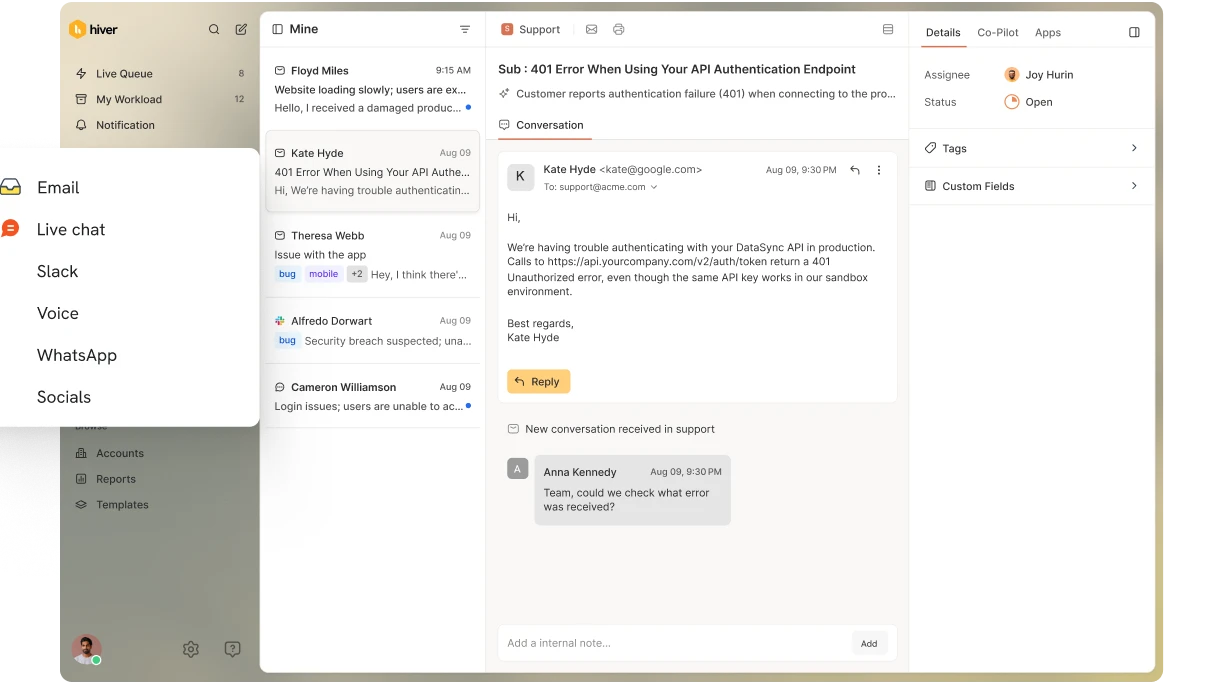
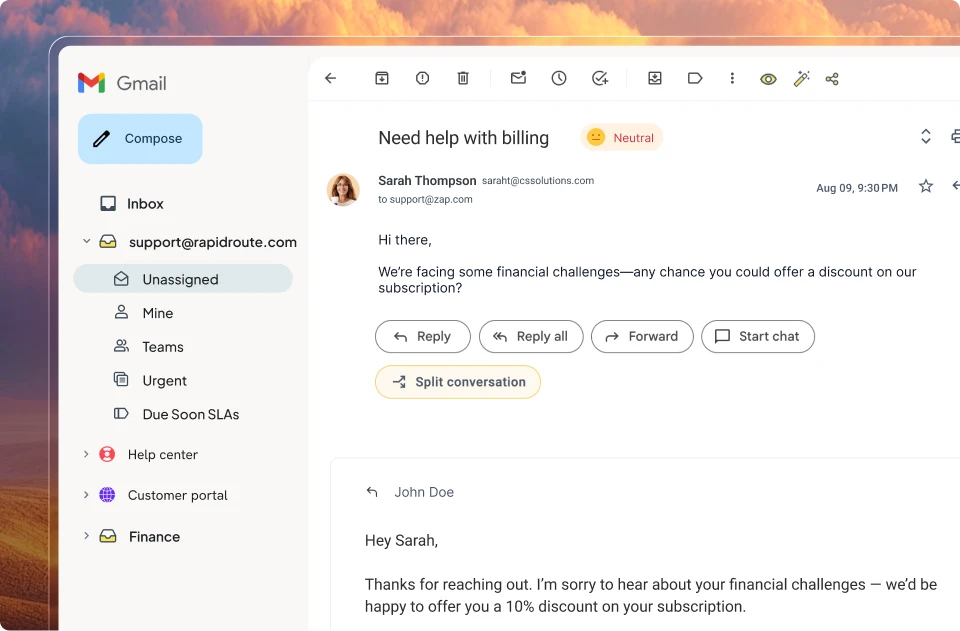
With Hiver, you can manage tickets directly from your shared inbox. It lets you easily assign owners, track status, and collaborate via internal notes. It’s powerful enough for service workflows, yet simple enough for fast-moving support teams.
Chatbots and Live Chat
Customers today expect real-time help. This makes chat a must-have feature in both help desks and service desks. Here’s how they work in tandem:
- Chatbots handle routine questions (like password resets or tracking updates) and gather initial information before escalating to an agent.
- Live chat connects users directly with a human for more nuanced or urgent issues that require judgment or empathy.
Together, they reduce email back-and-forth, shorten wait times, and let support teams work more efficiently.
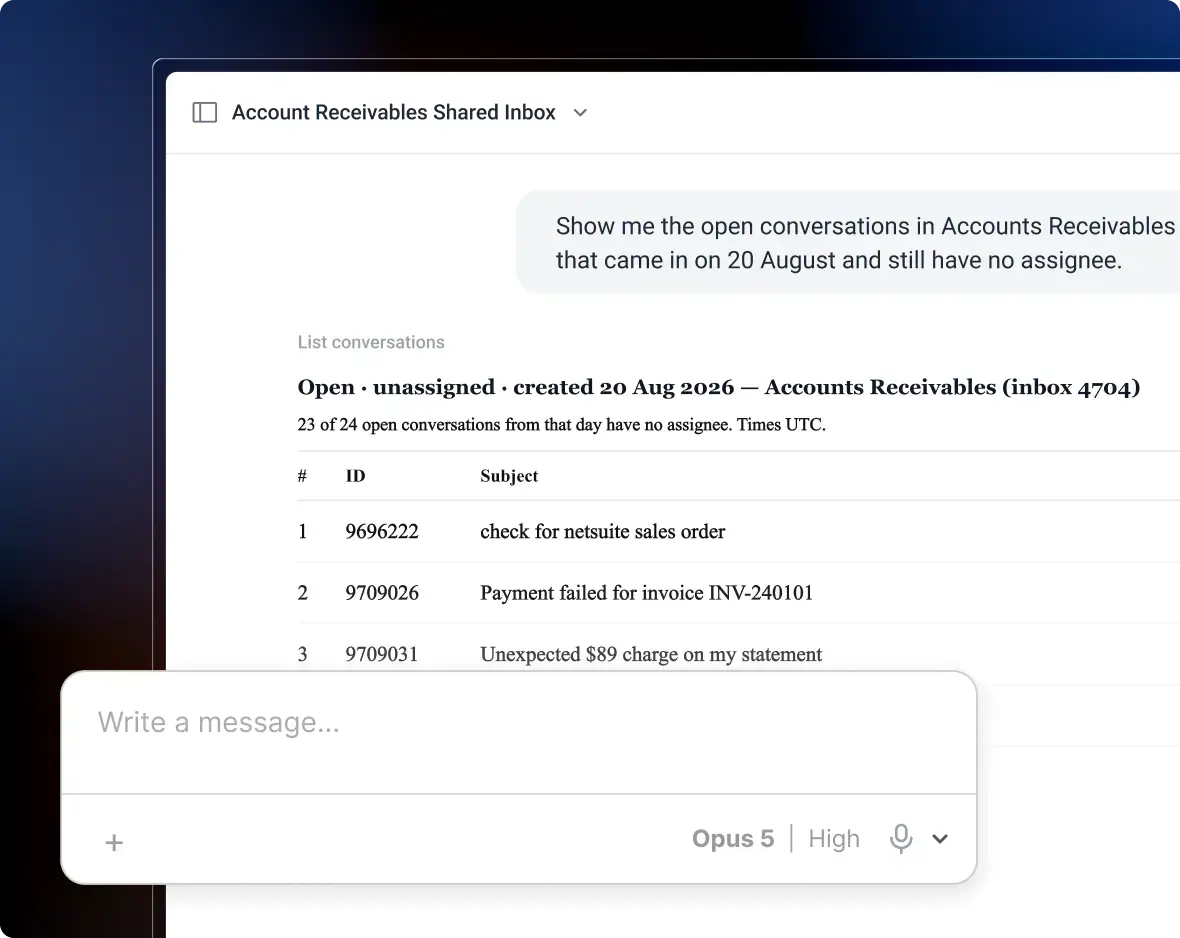
Hiver helps you offer 24/7 support with AI-powered chatbots and live chat built right into your help desk—no need to juggle platforms.
Knowledge Base
A well-built knowledge base helps customers and employees solve issues independently. This reduces ticket volume and empowers users to get quick answers.
Your knowledge base should:
- Be searchable and well-organized
- Include guides, FAQs, how-tos, and troubleshooting steps
- Deflect tickets by making support accessible anytime—no waiting, no back-and-forth
- Help agents resolve tickets faster by linking to internal reference content
Recommended reading: How to create a knowledge base
Pro Tip: Tie your knowledge base to real ticket trends. If your team keeps getting questions about invoice formats, create a knowledge base article on the topic and link to it directly from email replies or your chatbot.
Automation and Routing
Handling tickets manually can slow your team down. It often leads to delays, missed SLAs, or duplicate work. Automation takes care of repetitive tasks, helping your team stay focused and efficient.
Your automation setup should help you:
- Auto-assign tickets based on type, channel, priority, or team
- Send response templates (aka canned replies) for common issues
- Escalate urgent or overdue queries before they slip through the cracks
- Schedule reports, alerts, and reminders to keep teams on track
For help desks: Focus on automations that speed up response times.
For service desks: Look for complex, cross-functional automation—like approvals, multi-stage processes, and compliance workflows.
With Hiver, you can set up all these automation rules with minimal complexity. Assign emails, send pre-written replies, escalate time-sensitive queries, and generate reports—all from a clean, intuitive interface that works seamlessly alongside your existing workflows.
SLA Management
Service level agreements (SLAs) keep customer support reps accountable for responding to requests in a timely manner.
Look for a helpdesk or service desk that lets you:
- Set up multiple SLAs around your business hours
- Trigger alerts before an SLA is breached
- Tag and track violations automatically
- View SLA compliance over time
Hiver lets you set SLAs based on business hours, so you can get notified before deadlines, and track violations at a glance.
Reporting and Analytics
Insightful analytics is non-negotiable, whether you’re using a help desk or a service desk. Both tools should offer visibility into what’s working, what’s not, and how your team is performing.
Here are some customer service metrics to measure:
- Average first response time – Measures the time between a customer query and the agent’s first response to it.
- Average resolution time – Tracks how long it takes to fully resolve issues, helping you spot efficiency gaps.
- SLA adherence – Shows how well your team is meeting agreed-upon response or resolution deadlines.
- Ticket volume trends – Helps you understand demand across different channels and time periods.
- Customer satisfaction (CSAT) – Captures user feedback post-interaction to measure service quality.
- Backlog volume – Highlights how many unresolved tickets are past due, so you can prevent delays from piling up.
- Self-service usage – Tracks how often customers turn to your knowledge base, FAQs, or self-service resources instead of raising a ticket.
The right tool will also let you filter these reports by agent, channel, or issue type—so you can coach your team better, forecast staffing needs, and improve processes.
Recommended reading: 18 Customer Service Metrics+ How to Use Them
Hiver’s built-in analytics gives support managers full visibility into team performance, SLA compliance, and resolution trends from a single, easy-to-use dashboard.
Collaboration
Support works best when teams can communicate easily. Your help desk or service desk should make it simple for agents to work together without switching tools.
Look for features like:
- Private internal notes for agents to share context
- Tagging teammates to loop in the right people
- Shared ticket views to track progress on status and activity
- Collision alerts to prevent two agents from working on the same ticket
With Hiver, agents can add private notes, tag teammates, and coordinate behind the scenes without forwarding emails or jumping between tools.
When to use each
The decision comes down to complexity. If your team handles a predictable set of issues and the challenge is volume, a help desk keeps you moving.
But if your team deals with incidents that span departments and need formal SLA tracking, you’ll outgrow a help desk. A service desk built on ITIL practices gives you the structure for those operations.
Many teams start with a help desk and move to a service desk as IT operations grow. That migration gets easier when your platform already supports both.
Why native AI is the biggest difference maker here
The old debate between help desks and service desks was all about scope and process. Today, AI has completely changed that conversation. The real question now isn’t what you call your desk, it’s whether your platform’s AI was built into its DNA or just tacked on after the fact.
Most legacy tools added AI through quick acquisitions or third-party plugins. Because the AI and the core ticketing engine don’t share the same underlying data, the experience is clunky. You get an AI that can draft a basic response, but can’t look up customer history or trigger a background workflow in the same breath. Native AI, on the other hand, runs everything—triage, resolution, and reporting, in one place so context never gets lost.
Where Hiver Comes In

Hiver is an agentic omnichannel customer support platform, built for complex, high-stakes support. It gives you two ways to work: Hiver Omni (a dedicated support platform) or Hiver in Gmail (which lets you handle everything directly inside your inbox).
Hiver gives teams ticketing, cross-team collaboration, workflows and integrations to tackle support requests. And, Iinstead of relying on bolted-on add-ons, Hiver weaves native AI into every step of your workflow:
- AI Agents: Take care of routine requests end-to-end by reading intent, pulling data from connected systems, and taking action automatically.

- AI Copilot: Works alongside your team on trickier cases by surfacing relevant past tickets, writing draft replies, and suggesting best next steps.

- AI QA & Insights: Automatically reviews every conversation for quality and spots hidden trends so you can fix systemic issues faster.
Whether your team acts like a fast-moving help desk or a structured service desk, Hiver’s native AI handles the heavy lifting from first contact to post-ticket analysis. It’s why over 10,000 companies, including Flexport, Gusto, and Ping Identity, trust Hiver, with Flexport cutting resolution times in half.
FAQs
Is a help desk the same as a service desk?
No. A help desk fixes individual incidents as they come in. A service desk manages the broader IT service lifecycle, including problem management, change management, and SLA tracking. A help desk is a subset of what a service desk covers.
Do I need a service desk if I already have a help desk?
It depends on complexity. If your team handles straightforward requests, a help desk with strong automation is usually enough. If you’re managing cross-team workflows and tracking SLAs, a service desk gives you the structure to do that.
Can one platform handle both?
Yes. Platforms like Hiver combine ticketing, workflow automation, and AI that spans triage, resolution, and quality assurance in one system.
How does AI change the choice between a help desk and a service desk?
AI blurs the line between the two. With native AI handling triage, drafting replies, and surfacing patterns, you don’t have to choose between speed and depth. The bigger question is whether your AI is built into the platform or added on, because that determines how much context it can work with.