Skip to content





Picture this: Flight 847 to Denver sits on the tarmac for three hours. Passengers are live-tweeting their frustration while your gate agents frantically hand out meal vouchers and rehearse apology scripts.
Welcome to modern airline customer service, where every delayed flight becomes a potential PR crisis and every interaction gets scrutinized by millions on social media.
A single TikTok video of poor service can torpedo years of brand building. On the other hand, exceptional customer care can turn frustrated passengers into loyal advocates.
This brutal reality is what the airline industry faces today: customer service has evolved from a back-office function to a front-and-center brand differentiator.
The airlines winning this battle aren’t just solving problems faster—they’re fundamentally reimagining what passenger care looks like. They’ve discovered that memorable service isn’t about perfect operations, but about how you handle the chaos with empathy, and genuine care.
So, we’ve put together this guide to show you how to transform your customer service from reactive damage control into proactive service, creating experiences that turn even your worst travel days into stories worth sharing for the right reasons.
Table of Contents
- What Is Airline Customer Service?
- Why Is Airline Customer Service Important?
- 7 Proven Strategies to Improve Airline Customer Service
- 3 Examples of Excellent Airline Customer Service
- Key Customer Service Metrics to Track in the Airline Industry
- Ace Your Aviation Customer Service Strategy Today
- Frequently Asked Questions
What Is Airline Customer Service?
Airline customer service refers to the support and assistance provided to passengers before, during, and after their journey.
It includes everything from booking help and flight updates to in-flight service and baggage handling.
Here’s what it typically involves:
- Booking: The first impression matters. Great customer service here means an intuitive website or app, transparent fare information, seamless loyalty program integration, and multi-channel support through chat, phone, or social media.
- Check-in: Smooth check-in processes reduce travel anxiety. This includes flexible options (mobile, kiosk, counter), clear instructions, and staff ready to assist when technology fails.
- Boarding: When it’s time to board, good service means timely announcements, organized procedures, and approachable gate agents who confidently handle last-minute issues.
- In-flight Service: Once airborne, the focus shifts to comfort. This means attentive crew members, clean cabins, engaging entertainment, quality meals, and quick responses to passenger needs.
- Baggage Handling: Though behind the scenes, how you handle luggage significantly impacts satisfaction. Good service means accurate tracking, careful handling, and swift resolution when things go wrong.
- Customer Support: Throughout the journey, accessible support is crucial. Whether it’s booking assistance or help during disruptions, fast and empathetic responses shape the overall experience.
Essentially, great airline customer service goes beyond problem-solving and creates positive travel experiences that build trust and loyalty.
Why Is Airline Customer Service Important?
Good customer service isn’t just an expense for airlines, but is rather a powerful brand-building tool.
And the numbers don’t lie either. 86% of passengers are more likely to recommend airlines that create positive, memorable experiences.
Here’s also why, as an airline, customer service should be one of your key priorities:
1. You’re Building Loyalty, One Flight at a Time
Weather disruptions happen, flights get delayed, and connections are missed. But when passengers feel heard and respected through the chaos, they remember.
In such cases, your customer service shouldn’t just smooth over the bad experience. Instead, use service recovery to transform an unexpected situation into a loyalty-building moment.
For instance, when a passenger tells their friends, “The flight was delayed, but they really took care of us,” that’s a win that marketing dollars can’t buy.
Ultimately, In an industry where most travelers chase the lowest price, exceptional service makes them return to your airline.
It’s also what Carolyne Trulove, Vice President of Reservations and Service Recovery at American Airlines talks about in the “Tell Me Why” podcast:

“When we take care of our customers during disruptions, that’s when we really have the opportunity to build loyalty and show them what American Airlines is all about.”
Carolyne Truelove
Vice President of Reservations and Service Recovery at American Airlines
2. Your Reputation Is Public and Permanent
One angry tweet can undo years of brand-building.
Every airline now has a distinct voice and reputation across different platforms, making it crucial to address customer queries and complaints with consistency and care on social channels where your brand personality shines through.
However, showing that you prioritize solving problems—ideally with a touch of humor—can diffuse tension and even win new fans.
Gogo, an in-flight connectivity provider, demonstrates this perfectly with their witty yet helpful responses to frustrated passengers stuck with slow WiFi.

Social media response example showing how a brand handled a complaint with humor
Today, your reputation is shaped by passengers in real-time. Every experience they share becomes part of your brand story — for better or worse.
Recommended reading
3. You Retain Customers Better, Improving Revenue
Satisfied customers deliver a double win: they not only return, but they also become vocal advocates who bring friends and family along for the ride.
This word-of-mouth marketing reaches audiences that even the most expensive ad campaigns can’t touch, creating a multiplier effect on your marketing investments.
Here’s an example in action: When Alaska Air’s agent helped a passenger avoid missing their flight, the result was organic promotion:

Social media post praising Alaska Airlines for exceptional service
This authentic advocacy translates directly to revenue growth. According to a McKinsey & Company study, airlines with higher customer experience scores achieve an average revenue growth of 5.6%, compared to only 2.3% for airlines with lower CX ratings.
Essentially, happy passengers become your most powerful marketing asset, sharing genuine recommendations that carry far more weight than traditional advertising.

“Airlines centered on customer experience are leading the way with the lion’s share of profitability. These carriers are proving that prioritizing passenger satisfaction directly drives financial success”
Dr. Joe Leader
APEX (Airline Passenger Experience Association) Group CEO
Recommended reading
4. A Competitive Edge in a Crowded Sky
Most airlines fly similar planes on comparable routes at similar prices. What truly sets you apart? The passenger experience.
When travelers choose between competing airlines, it often comes down to how it feels to fly with you—the intangible moments that stick in their memory long after they’ve collected their luggage.
Consider Delta Airlines’ crew who delayed takeoff so a passenger could say goodbye to a loved one in their final moments—a gesture that went viral and showcased the airline’s humanity when it mattered most.

Social media post praising Delta airlines on how they delayed takeoff so a passenger could say goodbye to their loved one
These aren’t just perks — they’re emotional moments travelers don’t forget and the reason they’ll book with you again.
When your customer service demonstrates genuine care and human connection, you become memorable in a sea of airline options.
Recommended reading
7 Proven Strategies to Improve Airline Customer Service
Now that we’ve covered why exceptional customer service matters, let’s dive into actionable strategies that transform passenger experiences and build lasting loyalty:
1. Put the Passenger First — Always
Modern travelers expect to feel valued and respected from booking to baggage claim. Too often, airlines design systems around operational efficiency while passenger needs become an afterthought.
How to make it happen:
- Redesign policies with empathy at the core. Start with real passenger journeys—delayed flights, missed connections, special assistance needs—and rebuild your policies to support rather than penalize.
- Make accessibility non-negotiable. From website UX to boarding protocols to in-flight announcements, design for all languages and abilities.
- Empower staff to lead with judgment. Equip your frontline teams with the authority and support to bend rules when compassion calls for it. No one wants to hear “It’s policy” when they’re stressed, sick, or stranded.
- Listen—and act. Use passenger feedback not just as a performance metric, but as a source of truth. Regularly audit experiences, close feedback loops, and make visible changes that show passengers they’re being heard.
✈️ Real-world example: United Airlines developed comprehensive programs for service animals and emotional support pets, complete with dedicated relief areas and specialized staff training.

United Airlines’ detailed programs for service animals and emotional support pets
This thoughtful approach addresses both logistical challenges and the emotional needs of passengers traveling with companions who provide comfort and assistance.
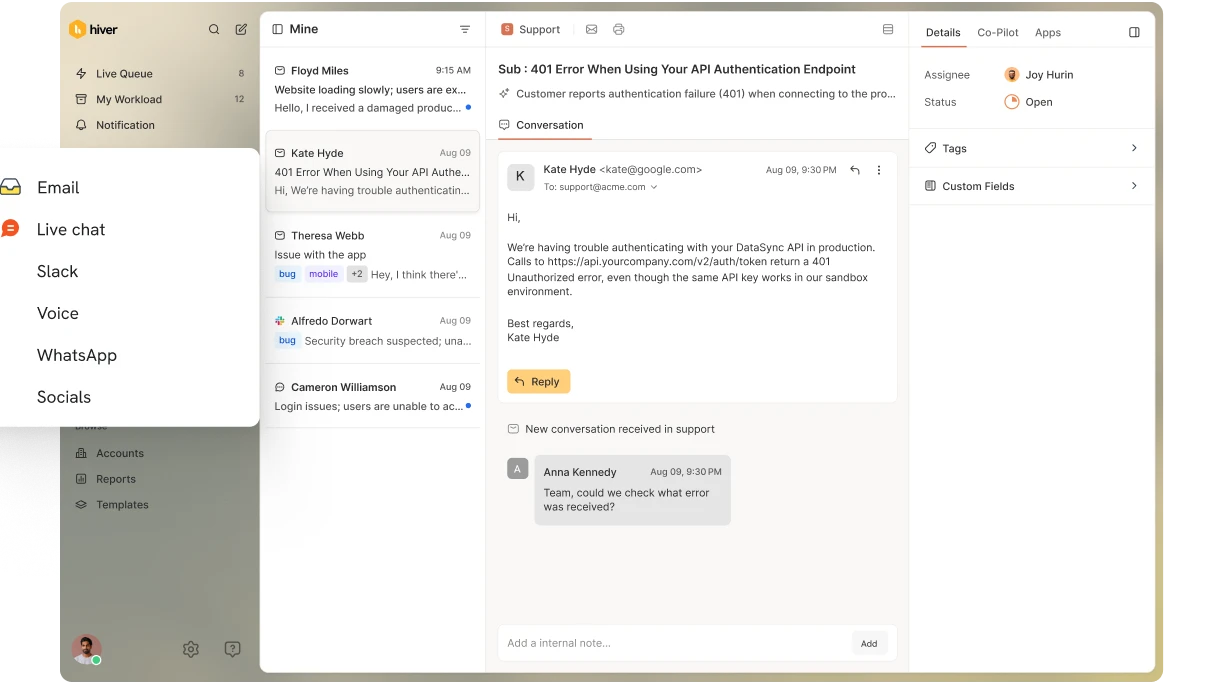
💡 Pro tip: Use Hiver’s shared inbox features to ensure passenger requests and special accommodations are visible across all relevant teams—from booking to boarding—so nothing falls through the cracks.
2. Adopt a Hospitality-First Mindset
Every flight is a hosted experience where small moments of genuine care can transform how passengers remember your airline. The difference between good and great service often lies in those authentic interactions that show you truly care.
How to make it happen:
- Train staff to offer warm, authentic greetings at every passenger touchpoint
- Shift from giving directions to providing assistance (help stow luggage instead of just pointing to overhead bins)
- Create memorable moments that passengers share long after they’ve reached their destination
- Focus on anticipating customer needs rather than just responding to requests
⭐ Real-world example: When Emirates discovered a teenage solo traveler was anxious about a flight delay, their crew didn’t just provide updates—they personally checked on her throughout the wait, arranged priority boarding, and ensured she felt safe and cared for.

Social media post appreciating Emirates for going the extra mile and helping a teenage solo traveller
The passenger’s father later shared the story online, praising how the airline treated his daughter like family during a stressful situation.
3. Hire and Train Service-Oriented Staff
Aviation employees face high-pressure situations daily where technical competence and emotional intelligence must work hand in hand. The best crew members stay calm under pressure, show compassion to distressed passengers, and resolve conflicts with confidence and grace.
How to make it happen:
- Prioritize emotional intelligence and people skills during the hiring process, not just technical qualifications
- Provide training that covers empathy, active listening, and stress management alongside safety procedures
- Equip staff to handle common challenges like turbulence anxiety, passenger conflicts, and emergency situations with both efficiency and care
- Create ongoing development programs that reinforce service excellence as a core competency
As demonstrated by Qatar Airways and Singapore Airlines’ training programs, crews equipped with both safety expertise and hospitality skills create an atmosphere of confidence that passengers can immediately sense.
“Flight attendants are the first and sometimes last line of defense when there’s a safety problem in the cabin. And, yes, in between, when things are normal, they’re there to provide cabin service.”
4. Communicate Clearly and Proactively
Passengers often find delays less frustrating than being left in the dark about what’s happening. Proactive, transparent communication builds trust and reduces the anxiety that comes with uncertainty.
How to make it happen:
- Use multiple channels (apps, SMS, email, announcements) to keep passengers informed about gate changes, delays, and baggage status
- Train staff to make frequent, clear announcements that actually help rather than confuse
- Share updates before passengers have to ask—anticipation builds confidence in your service
- Provide realistic timelines and honest explanations when things go wrong
⭐ Real-world example: Delta’s Fly Delta app exemplifies proactive communication by automatically notifying travelers of gate changes, delays, baggage tracking updates, and boarding group reminders.

Real-time notifications provided by Delta Airlines’ app- Delta Fly
These real-time updates show passengers that the airline is staying one step ahead of potential issues.
💡Pro tip: For airlines looking to improve communication across all customer touchpoints, Hiver’s live chat feature integrates seamlessly into your website.

Deliver conversational customer support with a live chat widget that’s powered by AI-suggested responses
This allows you to capture passenger details, assign queries to the right specialists, and track resolution progress—ensuring travelers never feel abandoned when they need help most.
5. Build a Culture of Collaboration Across Teams
To passengers, your airline represents one unified brand experience. Behind the scenes, however, it’s a complex ecosystem of teams that must work in perfect harmony. When departments operate in silos, the passenger experience inevitably suffers.
How to make it happen:
- Implement centralized communication systems that allow real-time updates about gate changes, weather delays, and special assistance needs across all departments
- Conduct joint briefings before high-traffic flights to align teams on potential challenges and VIP passengers
- Run regular cross-department training so cabin crew understands ground operations and vice versa
- Assign service coordinators for each flight to ensure seamless handoffs from check-in to arrival
💡 Did you know? Airlines can use Hiver’s shared inbox solutions to eliminate communication silos between teams.

Hiver’s collaboration features with internal notes and mentions to improve communication between teams
With features like shared notes, collision detection, and @mentions, departments can coordinate passenger needs seamlessly without endless email chains or missed communications that leave travelers frustrated.
6. Close the Loop with Post-Flight Feedback
Collecting feedback means nothing if you don’t act on it. Passengers want to see that their experiences drive real improvements, not just disappear into a data warehouse.
How to make it happen:
- Send post-flight CSAT surveys within hours of landing while the experience is still fresh
- Categorize feedback by specific issues and touchpoints to identify patterns and recurring problems
- Share insights across teams and follow up with passengers when their suggestions lead to actual changes
- Use customer feedback to recognize exceptional staff performance and address service gaps quickly
💡 Pro Tip: Tools like Hiver automatically send post-resolution surveys after customer support interactions and provide detailed analytics on agent performance, service gaps, and recurring issues. This transforms raw passenger feedback into actionable intelligence that drives continuous improvement.

Use Hiver’s CSAT surveys to gather actionable feedback, assess service quality, and pinpoint opportunities for growth
By following up thoughtfully, you send a powerful message: We’re listening, we’re learning, and we’re evolving based on what you tell us.
7. Deliver Reliable Support During Disruptions
Weather events, mechanical issues, and unexpected delays are inevitable in aviation. How you respond during these challenging moments defines your brand more than smooth operations ever could. Passengers evaluate not just what went wrong, but how you showed up when it mattered most.
How to make it happen:
- Develop clear playbooks for common disruption scenarios with specific steps and escalation procedures
- Empower frontline staff to offer reasonable compensation and accommodations without requiring supervisor approval
- Staff appropriately for crisis scenarios with calm, well-trained agents who have access to real-time flight and rebooking data
- Create dedicated channels for urgent disruption-related queries with faster response times
⭐ Real-world example: JetBlue’s “Customer Bill of Rights” provides agents with a structured framework that clearly outlines compensation and support options during delays or cancellations.

JetBlue’s structured framework for agents that outlines compensation and support options
This removes guesswork, ensures consistent service across all touchpoints, and empowers staff to resolve issues quickly without lengthy approval processes.
3 Examples of Excellent Airline Customer Service
Southwest Airlines: Approachable and Responsive Service
Southwest Airlines has built its reputation on being approachable and responsive. Their staff consistently goes the extra mile, whether helping nervous flyers, lightening the mood during boarding, or personally assisting with rebookings during delays.
On social media, their team responds quickly with wit and empathy, often turning complaints into compliments. Passengers frequently praise the airline’s flexibility with changes and the consistent, upbeat attitude of staff both on the ground and in the air.

Tweet from Southwest Airlines showing their conversational approach
Southwest’s mobile app features live chat support where passengers get immediate answers to their questions, reducing frustration during travel disruptions.

Southwest’s mobile app with live chat support
Alaska Airlines: Proactive Communication and Thoughtful Staff
Alaska Airlines consistently ranks high in customer satisfaction largely due to their proactive approach. When issues occur, Alaska often reaches out to passengers with updates and options before they have to ask.
Their team regularly earns praise for thoughtful gestures, from holding connecting flights when possible to personally following up on service issues. Stories of flight attendants making passengers comfortable even during disruptions have become a hallmark of Alaska’s brand loyalty.

Social media post praising Alaska Airlines staff, Captain Chris for empathy and friendliness
Qatar Airways: Premium Service with a Personal Touch
Qatar Airways is known for luxury, but what truly distinguishes them is their attention to personal moments. Parents traveling with children receive activity packs, toys, and extra snacks without having to ask.

Goodies for children provided by Qatar Airways
Cabin crew anticipate passenger needs, whether offering a pillow to someone who looks tired or adjusting meal times for a sleeping child.
Their customer support team offers multilingual support for their global audience and often follow up directly on issues raised via social media.
For many travelers, these small touches make flying with Qatar feel first-class, regardless of ticket type.
Key Customer Service Metrics to Track in the Airline Industry
To keep passengers happy and operations smooth, airlines need more than satisfied customers- they need data to prove it.
Tracking the right customer service metrics helps teams resolve issues faster, stay compliant, and deliver experiences that keep travelers coming back.
- First Response Time (FRT): The time taken to send the first reply after a customer raises a ticket. For time-sensitive queries like flight delays or cancellations, aim for an FRT within 1 hour across live chat and social media.
- Resolution Time: The total time taken to resolve a customer issue from initial contact to closure. Airlines should aim to resolve common service queries (like baggage status or refund updates) within 24–48 hours to maintain trust, especially during peak travel periods.
- Escalation Rate: The percentage of support tickets that are passed on to higher-tier agents or supervisors. A high escalation rate can indicate inadequate training or poor access to information at the first level.
- First Contact Resolution (FCR): The percentage of customer queries resolved during the first interaction without requiring follow-ups.
- CSAT (Customer Satisfaction Score): Measures how satisfied passengers are after interacting with support teams. CSAT can be collected via post-resolution surveys and is typically scored out of 5.
- Ticket Volume by Channel: Tracks the number of incoming tickets by source (email, live chat, phone, social, etc.). This helps airlines optimize staffing based on seasonal spikes (e.g., holiday travel) or during major disruptions like weather events.
- SLA Compliance Rate: The percentage of tickets resolved within pre-defined service level agreements. It ensures the support team is meeting internal targets for response and resolution, especially for premium passengers or frequent flyer tiers.
- Customer Satisfaction Index (CSI): A broader customer satisfaction metric that evaluates the entire travel experience — from booking to baggage claim. Unlike CSAT, which is interaction-specific, CSI incorporates factors like ticketing ease, flight punctuality, and onboard service. While there’s no universal benchmark, high CSI scores are often linked to long-term customer retention and brand trust.
- Net Promoter Score (NPS): Reflects how likely a passenger is to recommend the airline to others. You can track NPS via a helpdesk, and it’s a strong signal of long-term brand perception and should be collected post-travel.
Ace Your Aviation Customer Service Strategy Today
In an industry where turbulence is expected, how you treat passengers has become the true differentiator.
Planes, prices, and routes may look similar across carriers, but service quality creates a lasting competitive advantage.
The most successful airlines aren’t just solving problems — they’re designing journeys that feel thoughtful from booking to baggage claim. This transformation starts with a fundamental shift: seeing every passenger not as a seat number, but as a valued guest.
For airlines looking to elevate their customer service operations, tools like Hiver help teams collaborate more effectively, respond faster to passenger needs, and gather insights that drive continuous improvement.
Frequently Asked Questions
How can airlines improve their customer service?
Airlines can improve customer service by investing in staff training that emphasizes empathy, implementing clear communication protocols, and using technology that anticipates passenger needs. Focus on consistency across every touchpoint—before, during, and after flights—and empower frontline staff to make passenger-first decisions.
What essential skills do airline customer service representatives need?
The most effective airline customer service representatives demonstrate empathy, patience under pressure, quick problem-solving abilities, and excellent communication skills. They remain calm during disruptions, adapt to diverse passenger needs, and understand cultural differences that affect traveler expectations.
How is customer satisfaction measured in the airline industry?
Airlines track satisfaction through multiple metrics including CSAT (Customer Satisfaction) scores, Net Promoter Score (NPS), post-flight surveys, social media sentiment analysis, and customer retention rates. These measurements provide insights into service quality and highlight areas needing improvement.
What’s the difference between good and exceptional airline customer service?
Good airline customer service meets basic passenger expectations—on-time flights, clean cabins, and problem resolution. Exceptional service anticipates needs before they arise, personalizes interactions, turns disruptions into positive experiences, and creates emotional connections that transform passengers into loyal advocates.