






In today’s logistics landscape, delays are inevitable — but silence is unforgivable.
It’s not just about how well you move goods. It’s about how well you communicate when things don’t go as planned. That’s what separates thriving logistics companies from the ones constantly putting out fires.
Customers in 2025 expect real-time visibility, proactive updates, and fast resolutions. But many logistics providers are still stuck in reactive mode, managing support through siloed emails, delayed handoffs, and frustrated phone calls. The result of all this is a widening gap between what customers expect and what they experience.
To stay competitive, logistics teams need to rethink how they deliver customer service. It’s no longer a back-office function. In this guide, we’ll break down:
- Practical ways to deliver great customer service in logistics
- Success stories from companies like Flexport, Bergen Logistics, and Arrive Logistics
How to Improve Customer Service in Logistics: Proven Strategies for 2025
Whether it’s setting expectations, providing timely updates, or resolving issues fast, the best logistics teams follow a set of consistent, high-impact practices.
Here are the strategies that can help you deliver reliable and scalable support, no matter how complex your delivery network gets:
1. Communicate Early, Clearly, and With Context
In logistics, customers don’t just want fast answers; they need to know what’s happening, why, and what to expect next.
That means you must:
- Set clear expectations up front. Share precise dispatch and delivery windows—not vague “on the way” messages.
- Send proactive updates. Trigger notifications for milestones like dispatch, in-transit delays, reroutes, and customs holds.
- Provide context. Explain causes (“Your shipment is delayed due to customs clearance”) and next steps (“It’s now expected Thursday”).
- Ensure internal alignment. Behind the scenes, support, warehouse, and ops must share real-time shipment data, hand off responsibility clearly, and collaborate via shared notes.
When you combine early communication with fast, context-rich responses, you reduce “Where’s my order?” tickets and prevent small hiccups from becoming major escalations.
💡Company Spotlight
At Bergen Logistics, their support, billing, and warehouse teams used to rely on manual email forwarding. This often created confusion and delayed responses.
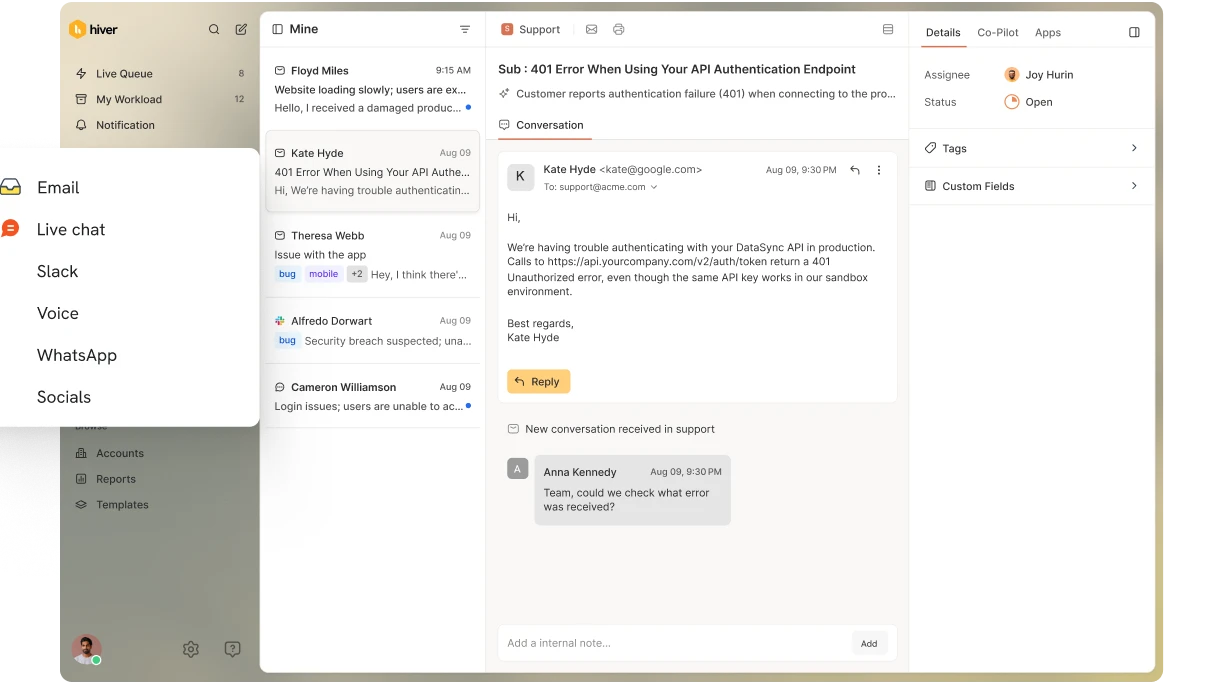
With Hiver, they created a shared inbox that allows team members to tag each other, add context to tickets using email notes, and assign queries clearly. The team also uses custom views and tags to easily filter tickets, enabling faster access to information and more responsive communication with their clients.
2. Train Support Teams to Speak “Logistics”
A customer-facing rep who can explain why a package missed its delivery window—and what’s being done about it—is infinitely more valuable than one who escalates every issue.
At a minimum, support reps in logistics should understand:
- Last-mile delivery challenges and common carrier failures
- How customs documentation and holds impact ETAs
- Rerouting protocols when delays or misroutes occur
- Warehousing SLAs and fulfillment timelines
- International shipping regulations and duty handling
You don’t need a full-blown logistics ops but instead a structured training program that demystifies these concepts.
For your own team, start with internal knowledge-sharing sessions — bring in ops leaders to walk through your shipping process end-to-end. Then, supplement with online resources.
Recommended reading
Establish a training cadence — quarterly refreshers or biannual deep-dives — and standardize internal documentation so new joiners can ramp up quickly. The more your support team understands logistics, the fewer delays get mishandled, and the more trust you build with every conversation.
3. Automate the Repetitive — So Humans Can Focus on What Matters
In logistics support, not all tickets are created equal. Some require critical thinking, judgment, and collaboration — like handling an SLA breach or rerouting a high-value shipment. Others are repetitive: status updates, ETA requests, billing clarifications, and follow-up nudges.
When your agents spend the majority of their time on low-value tasks, the high-impact work suffers.
Start by auditing your last 100 queries. Which ones come up again and again? Which could be handled without human intervention?
Then, automate what you can:
- Set rules to auto-route emails to the right person based on keywords, sender, or subject line.
- Categorize and tag issues (e.g., “customs,” “billing”) for easier prioritization.
- Close resolved tickets automatically to reduce clutter.
These automations improve SLA adherence, reduce manual errors, and help your team focus on complex queries that require real context and empathy.
This is where a tool like Hiver fits in naturally. Its automation engine lets you route emails based on precise conditions— like customer type or query topic—with round-robin and load-based assignment also available.

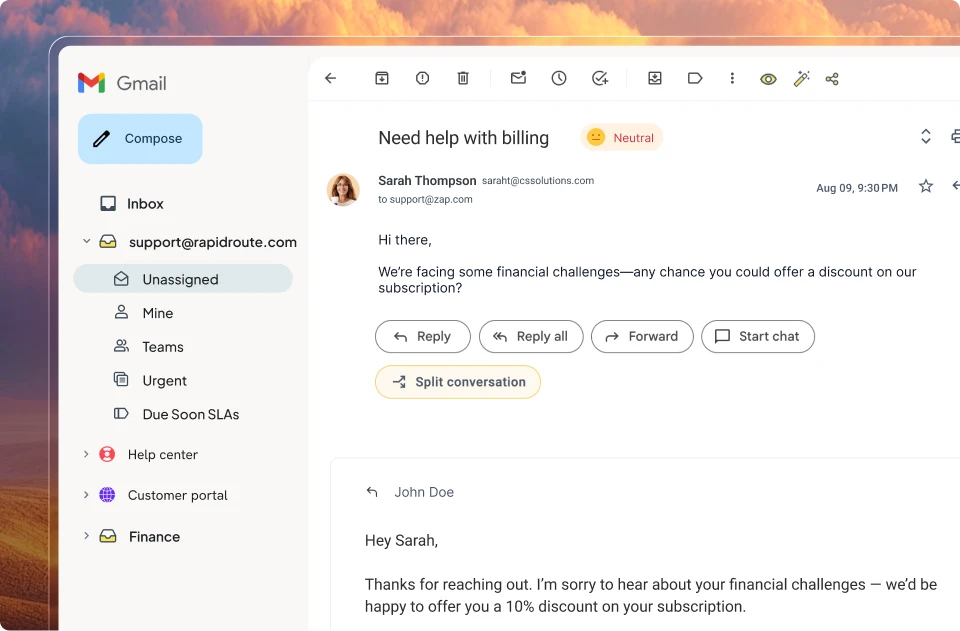
And when you layer in Harvey, Hiver’s built-in AI assistant, the impact multiplies. Harvey can summarize long email threads so agents don’t have to scroll through back-and-forth messages, draft replies using context from past conversations, recommend the next best action, and even detect sentiment to flag sensitive conversations.
💡Company Spotlight
Arrive Logistics implemented a customer service software to streamline email workflows and reduce time spent on repetitive queries. With the help of automation, assignments, and status tracking, they achieved a 40% reduction in email resolution time, saving over 650 hours in a single month.
By eliminating internal CCs and forwards using Notes and tracking performance through built-in analytics, their team was also able to make better staffing decisions and improve internal collaboration.
4. Collect Customer Feedback (And Actually Use It)
One of the simplest ways to improve your logistics support experience is also one of the most underused: just ask your customers how you’re doing.
Too often, logistics teams operate in the dark—assuming what customers care about or why frustrations occur. But the best teams don’t rely on guesswork. They build tight feedback loops, turning every delivery or support interaction into an opportunity to learn, improve, and fine-tune their service.
Here’s how leading teams use feedback to drive meaningful change:
- Track satisfaction by touchpoint (e.g., delivery experience vs. query resolution)
- Spot patterns—are certain agents, teams, or shipping partners underperforming?
- Refine communication workflows and training based on recurring themes
Don’t wait for end-of-quarter surveys or NPS blasts. Instead, trigger short, timely CSAT surveys right after a shipment is delivered, an issue is resolved, or a conversation is closed.
You can automate this process with customer support tools. This ensures timely, relevant feedback and gives teams visibility into what’s working—and where to improve. Tools like Hiver allow you to send CSAT surveys automatically, and break down responses by agent or issue type.

5. Offer Self-Service for Common Logistics Questions
In logistics, a large portion of support volume comes from questions that don’t actually need a human to answer.
“Where’s my order?”
“How long does customs clearance take?”
“Can I change my delivery address?”
These aren’t complex problems—they’re routine. And customers often prefer solving them on their own if given the chance.
That’s why a solid self-service strategy is critical—not just to reduce ticket volume, but to give customers faster, more convenient resolutions.
Start by reviewing your last few weeks of support queries. Identify the top 5–10 repetitive questions your team handles regularly. Then create simple, concise articles that address each one. Focus on clarity—short sentences, step-by-step instructions, and screenshots when relevant.
Structure your knowledge base in a way that reflects the logistics journey:
- Before shipment: order confirmation, address changes, expected timelines
- In transit: tracking instructions, delays, customs FAQs
- After delivery: return process, damaged items, invoice requests
For teams handling high volume, adding a lightweight chatbot can enhance discoverability. Even simple keyword-based bots that surface relevant help content can reduce inbound queries drastically.
And if customers do need to escalate, make sure your self-service tools are integrated with your support workflows—so agents can pick up where the customer left off, with full context.
6. Measure Support Performance with Metrics That Actually Matter in Logistics
In most logistics businesses, support isn’t just about speed or efficiency. It’s about preventing escalations, communicating during time-sensitive disruptions, and keeping customers informed throughout complex delivery cycles. That means you need to track performance using metrics that reflect the real stakes of your support function.
Start with the basics: First Response Time (FRT), Resolution Time, and CSAT. These still matter. Customers expect fast replies, quick resolutions, and an outlet to share how they felt about the experience. But you’ll need to go further to really optimize performance in a logistics context.
Track WISMO query volume (Where Is My Order)—it’s one of the best indicators of whether your proactive communication is working. If WISMO tickets drop over time, your alerts and expectations-setting are doing their job.
Also consider monitoring:
- Repeat contact rate per shipment or order: Are customers reaching out multiple times for the same issue?
- Escalation rate by shipment type or partner: Are certain carriers or delivery regions triggering more issues?
- SLA breach count: How often are your team’s promised response/resolution windows being missed?
- Time to escalation resolution: How quickly are high-priority or enterprise issues being solved?
It’s also useful to tag support tickets by issue type (e.g., delay, customs, misrouted, billing) and track trends over time. This helps surface recurring pain points—not just for support, but for operations and logistics leadership as well.
💡Company Spotlight
Flexport, a technology platform for global logistics, manages over 1,500 customer conversations each month using Hiver.
By leveraging features such as shared inboxes, automation, and collaboration tools, Flexport has achieved a 50% reduction in email resolution time, saving a total of 387 hours in a month.
If you’re using a shared inbox or help desk platform, set up dashboards that allow you to segment by agent, team, region, or shipment type. Use this data to inform coaching, staffing plans, or even carrier partner reviews.

Don’t Just Move Shipments—Deliver Confidence at Every Step
In logistics, customer service is often the only thing standing between a delayed shipment and a lost account. And when a package is stuck, rerouted, or missing—how you communicate matters more than what actually happened.
The best logistics teams don’t rely on reactive support. They rely on:
- Clear ownership for every customer issue
- Real-time visibility into shipments and past interactions
- Proactive updates that eliminate guesswork
- Lightweight processes that scale without slowing teams down
If your support still depends on manual triage, siloed inboxes, or vague responses, it’s time to rethink how you operate. Start by identifying where customer frustration builds most and then fix it at the system level.
Because in logistics, your ability to deliver answers is just as important as delivering packages.
FAQs on Customer Service in Logistics
1. Why is proactive communication important in logistics?
Because logistics disruptions—like delays, reroutes, or customs holds—are inevitable. Proactive communication helps you stay ahead of customer frustration. By sharing updates before they ask, you show accountability and build trust, even when things go wrong.
2. What KPIs should logistics companies track to measure customer service performance?
Focus on metrics that reflect speed, quality, and customer confidence. Key KPIs include:
- First Response Time (FRT) – How quickly you acknowledge customer queries
- Resolution Time – How long it takes to fully resolve issues
- CSAT (Customer Satisfaction Score) – Direct feedback from customers post-resolution
- WISMO ticket volume – Frequency of “Where’s my order?” queries, a sign of communication gaps
- Repeat contact rate – How often customers follow up on the same issue
3. How does internal collaboration impact logistics customer service?
Logistics support depends on seamless coordination across departments—especially between customer service, operations, and warehouse teams. Without shared visibility or clear ownership, updates get delayed and customers receive inconsistent information. Strong internal collaboration leads to faster resolutions and fewer dropped issues.
4. What strategies help logistics companies improve customer satisfaction?
To improve customer satisfaction, focus on:
- Sending real-time updates on shipment status and exceptions
- Setting clear expectations and meeting them
- Automating repetitive queries to reduce response time
- Empowering customers with self-service tools
- Training support teams to speak the language of logistics
The more reliable and informed your communication, the more confident your customers feel.
5. How can logistics teams reduce “Where’s my order?” (WISMO) tickets?
WISMO queries usually spike when tracking updates are slow or unclear. To reduce them:
- Send proactive shipment notifications for key milestones
- Provide real-time tracking links
- Automate alerts for delays, customs holds, or delivery changes
- Link tracking details in chat, email footers, and help center pages to avoid unnecessary tickets.
6. What tools can improve customer service in logistics?
Logistics teams benefit from:
- Shared inboxes to manage high-volume queries with clear ownership
- CRMs to access customer history and preferences
- Real-time tracking platforms to monitor shipments and update customers
- Self-service portals to handle FAQs and reduce repetitive tickets
- Internal collaboration tools to align support, ops, and dispatch teams
Choose tools that work together and reflect your operational workflow.
Start using Hiver today
- Collaborate with ease
- Manage high email volume
- Leverage AI for stellar service