




Dynamics 365 and Salesforce are often on the same shortlist, but they are not identical tools.
Both are powerful CRM platforms with strong service capabilities, yet they differ in how they are set up, how they integrate with the rest of your stack, and how easy they are to run day to day.
In this article, you will see how Dynamics 365 and Salesforce differ in usability, features, pricing, and real-world performance.
TL; DR
- Dynamics 365: Microsoft’s CRM and ERP suite for managing sales, service, finance, and operations in one system. Works closely with Outlook and Teams and offers AI-driven insights.
- Best for: Teams already using Microsoft 365 that want connected data and cross-department workflows.
- Pricing: $50, $105, and $195 per agent per month.
- Pros: Strong Microsoft integrations, good AI, unified sales and service data.
- Cons: Interface feels heavy, setup often needs admin or IT effort.
- Salesforce: A CRM platform for sales, service, marketing, and analytics with extensive customization and a large app ecosystem.
- Best for: Enterprises that need flexible workflows and advanced reporting.
- Pricing: $25, $100, $175, and $350 per user per month.
- Pros: Very customizable, strong reporting, huge integration ecosystem.
- Cons: Complex setup, higher long-term cost, admin dependence.
Table of Contents
- What is Dynamics 365?
- What is Salesforce?
- Dynamics 365 vs Salesforce: Feature Comparison
- Dynamics 365 vs Salesforce vs Hiver: Pricing & Plans Analysis
- Reviews from People Who Actually Used the Software
- Which Platform Fits Your Business: Dynamics 365 or Salesforce?
- Choose the Right Solution to Scale Your Customer Service and Drive Efficiency
- Frequently Asked Questions
What is Dynamics 365?
Dynamics 365 is a suite of CRM and ERP applications from Microsoft. Teams can use individual apps or combine them to manage sales, customer service, finance, operations, and supply chain on one platform.
You can:
- Track leads, opportunities, and accounts
- Manage customer service cases across channels
- Tie customer data to invoices, inventory, or field service
- Use AI to automate routine work and surface insights
Because Dynamics 365 connects with Microsoft 365, Outlook, Teams, and Power Platform, it works well for companies that already live in the Microsoft ecosystem.
What is Salesforce?
Salesforce began as a CRM for sales teams and now covers sales, service, marketing, commerce, and analytics. It offers separate “clouds” for each function and a large ecosystem of apps on the AppExchange.
Salesforce allows organizations to customize workflows and integrate business functions into a unified system that adapts to any need.
Dynamics 365 vs Salesforce: Feature Comparison
Here is a quick overview of key areas to compare Dynamics 365 and Salesforce Service Cloud.
| Feature | Dynamics 365 | Salesforce Service Cloud |
|---|---|---|
| Ease of use | Familiar for Microsoft users, cross-device access, built-in AI guidance | Interface can feel busy, onboarding often takes longer |
| Ticket management | Tracks customer cases, links to accounts and activities, AI-based routing | Deep case workflows tied to CRM data and sales history |
| Omnichannel | Email, chat, voice, SMS, social channels, Teams, customer portals, knowledge | Voice, SMS, WhatsApp, Messenger, digital channels via partners and APIs |
| Automation & AI | Smart routing, workflows, assignment rules, AI-driven insights | Einstein AI for predictions, recommendations, and workflow automation |
| Customization | Configurable forms, views, and business rules | Strong customization with fields, flows, and custom components |
| Integrations | Tight Microsoft integration; connectors for other tools | Larger partner ecosystem; deeper third-party and cross-cloud integrations |
| Pricing | From $50/agent/month for service | From $25/user/month, higher tiers at $100+ |
| Best for | Teams that want connected processes and better use of Microsoft tools | Enterprises that need detailed control and broad CRM coverage |
1. Ticketing and Case Management
Dynamics 365: Dynamics 365 centralizes customer issues in a unified ticketing system. Cases capture interactions across channels, and AI-powered routing forwards each case to the right agent or queue.
Agents can:
- View full customer history
- Use multi-session support to work on several cases at once
- Use knowledge base articles inside the case view
- Collaborate with other teams over Teams and internal notes
It helps teams move from scattered inboxes to structured case management.
Salesforce Service Cloud: The platform connects cases directly with sales and marketing data. Support teams can see context about opportunities, campaigns, and past interactions in one record.
Admins can:
- Add custom fields for business-specific data
- Build layered approval flows and escalations
- Set up complex routing rules across queues and teams
This level of control is useful for enterprises with many regions, products, or teams.
What to choose:
- Dynamics 365: For AI-powered routing, multi-session support, and integration across your entire organization,
- Salesforce: For advanced customization and complex workflows.
2. Omnichannel Support
Dynamics 365: Dynamics 365 Omnichannel for Customer Service brings email, chat, SMS, voice, social channels, and Microsoft Teams into a single experience.
It supports:
- Live chat and chatbots
- SMS and digital messaging
- Voice with call transcription and sentiment analysis
- Social channels like Facebook and LINE
- Agent scripts and real-time guidance
Enterprise routing sends conversations to the most suitable agent based on skills, capacity, or priority.
“I run on Microsoft 365 (Outlook + Teams), and Dynamics 365 Sales felt like home. The Teams dialer inside Sales Hub lets my reps call from the CRM and get real-time transcripts/action items saved to the record—zero copy/paste busywork.” –G2 user
Salesforce: Salesforce embeds omnichannel support across Service Cloud. Service Cloud Voice connects calling with case records and live analytics. Messaging covers SMS, WhatsApp, Facebook Messenger, web chat, and custom channels via APIs.
Teams can:
- Route calls and messages based on skills and availability
- Use a single console for phone, chat, and digital channels
- Combine service with sales and marketing journeys
What to choose:
- Dynamics 365: For businesses needing seamless integration with Microsoft tools and a unified omnichannel experience.
- Salesforce: For teams requiring extensive customization and advanced integrations across sales, marketing, and customer service
3. Dynamics 365 and Salesforce Integrations
Both platforms offer a rich marketplace of apps and connectors.
| Category | Dynamics 365 Marketplace | Salesforce AppExchange |
|---|---|---|
| Focus | Apps for support, chat, ticketing, and operations | Apps for sales, service, marketing, and analytics |
| Customer service integrations | Categories for customer service, messaging, and contact centers | Service Cloud listings with thousands of support and engagement apps |
| CRM connectivity | Connects to other CRMs via connectors and integration tools | Native CRM layer shared across sales, service, and marketing |
| Channel integrations | Connectors for chat, email, phone, WhatsApp, social channels | Integrations for SMS, WhatsApp, Messenger, and telephony via partners |
| Customization tools | Power Apps and Power Automate for low-code workflows | Apex, Flow, and Lightning components for deeper customization |
| Analytics & reporting | Apps for SLA dashboards and CSAT reporting | Einstein Analytics and third-party analytics apps |
Dynamics 365 works best if you want your service platform to sit inside a Microsoft-first stack with minimal extra plumbing.
Salesforce AppExchange gives access to a very wide ecosystem. It suits teams that are ready to invest in integration work and want their CRM to sit at the center of many tools.
“I doesn’t have any dislikes regarding service cloud but, the drawback of Salesforce Service Cloud is its complexity, which can feel overwhelming for small to medium-sized teams. The platform’s extensive customization options and layered navigation often require specialized knowledge, making onboarding slow and potentially costly. For organizations needing a simpler CRM, this added complexity may outweigh the benefits.” –G2 user
What to choose:
- Dynamics 365: For teams needing a seamless, integrated customer service solution with minimal IT effort.
- Salesforce: For enterprises needing flexibility, deep integrations, and scalable solutions across functions.
Dynamics 365 vs Salesforce vs Hiver: Pricing & Plans Analysis
Dynamics 365 and Salesforce are built for teams that want broad CRM capabilities across sales, service, and operations. They work well for organizations that need heavy customization, deep system integrations, and cross-department workflows.
But they also come with higher setup effort, ongoing admin work, and pricing that scales quickly.
If your priority is day-to-day customer service rather than managing a full enterprise CRM, this is where Hiver provides a cleaner alternative.
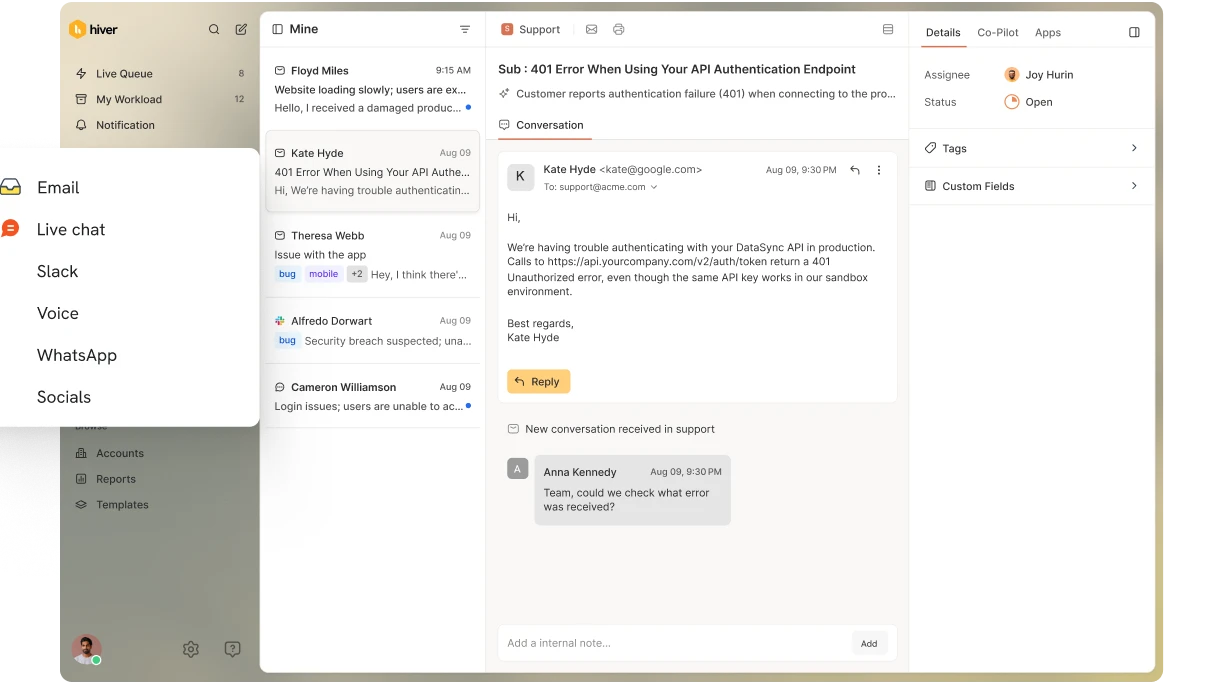
Hiver gives you email, chat, WhatsApp, voice, automation, and AI in a simple interface that teams can start using immediately, without configuration cycles or hidden costs.
Here is a quick way to compare pricing and fit across all three platforms:
| Plan Tier | Hiver | Dynamics 365 Customer Service | Salesforce Service Cloud |
|---|---|---|---|
| Entry/Starter Plan | Free Plan ($0). Shared inbox, unlimited users, one shared mailbox. | Free Plan ($0). Basic tools for simple service scenarios. | Starter Suite ($25/user/month). CRM plus basic sales, service, marketing, and commerce. |
| Mid-Tier Plan | Growth ($25/user/month). SLAs, CSAT, customer portal, workflows, and automations. | Service Professional ($50/agent/month). Case management and self-service for simpler scenarios. | Pro Suite ($100/user/month). Adds real-time chat, quoting, forecasting, and more automation. |
| Advanced / Professional Plan | Pro ($45/user/month). Advanced analytics, live chat, WhatsApp, chatbots, and load-balanced round robin. | Service Enterprise ($105/agent/month). AI-based support for complex cases. | Enterprise ($175/user/month). AI for service, workflow automation, and self-service help center. |
| Enterprise / Top Plan | Elite ($75/user/month). Skill-based routing, custom objects, advanced security, and custom roles. | Service Premium ($195/agent/month). Contact center plus CRM service solution with strong AI. | Unlimited ($350/user/month). Adds knowledge, bots, and 24/7 support. Agentforce 1 Service ($550/user/month) adds full AI and unified data. |
| Free / Trial | Free plan available | Free trial available | Free trial available |
Quick pricing takeaways
- Dynamics 365: Competitive entry pricing, but you often move to higher tiers to unlock advanced AI, contact center features, and richer self-service.
- Salesforce: Affordable entry tier, but costs increase as you need more automation, AI, and support. Total cost also includes potential implementation and admin time.
- Hiver: Transparent per-user pricing with core customer service features, AI, and multichannel support included, which makes budgeting simpler for support leaders.
Reviews from People Who Actually Used the Software
Reviews often reveal onboarding complexity and day-to-day usability insights.
Dynamics 365
Dynamics 365 reviewers highlight the advantage of Microsoft connectivity.
“Microsoft Dynamics 365 integrates with other Microsoft tools like Teams and Outlook. It automates routine tasks like lead tracking and reporting and saves time.” –G2 user
Some point out UI density:
“UI feels dense out of the box. Too many fields and clicks until you tailor forms and views.” –G2 user
Salesforce
Salesforce reviewers appreciate its flexibility but note its demands. Many mention high ownership costs and the need for admins or consultants, especially when integrations or custom configurations are required.
Reviews highlight onboarding challenges, adoption hurdles, and support quality, which often matter more than feature lists.
These reviews suggest a pattern:
- Dynamics 365 and Salesforce both deliver strong capabilities once configured
- Both can feel heavy or complex for smaller or more focused support teams
- Teams that only need customer service functionality may not use most of the platform
That is where a more focused customer service platform like Hiver becomes relevant.
Which Platform Fits Your Business: Dynamics 365 or Salesforce?
Your tech stack, team size, and internal skills matter as much as features when choosing between Dynamics 365 and Salesforce.
| Factor | Dynamics 365 | Salesforce | Hiver |
|---|---|---|---|
| Team size | 1–300 users | 50–5,000+ users | 5–500+ support agents or shared inbox users |
| Budget range | $0–$195 per agent/month | $25–$550 per user/month (depending on edition) | $0–$75 per user/month (Hiver AI available at $20 add-on) |
| Technical skills | Intermediate to advanced | Intermediate to advanced | Low to moderate |
| Primary use case | Integrated platform for sales, service, finance, and operations | Full CRM with broad coverage across sales, service, marketing, and analytics | Customer service across email, live chat, WhatsApp, voice, chatbots, and self-service |
| Industry focus | Manufacturing, finance, operations-heavy environments | Enterprise, financial services, healthcare, large B2B and B2C | SaaS, ecommerce, service teams across many industries |
| Growth stage | Small to mid-sized companies using Microsoft 365 | Mid-market to large enterprises with complex processes | Growing teams that want modern customer service without running a full CRM stack |
Choose the Right Solution to Scale Your Customer Service and Drive Efficiency
If your team wants a platform that ties customer conversations to sales, finance, or operations, Dynamics 365 leans in that direction. It works smoothly with Microsoft tools and gives teams helpful AI insights, though it often needs more setup time and technical involvement.
Salesforce works well for companies that rely on detailed workflows and need a CRM they can tailor in many different ways. It is powerful, but the learning curve and long implementation cycles can slow down smaller or fast-moving teams.
Hiver offers a more straightforward approach. You get email, chat, WhatsApp, voice, automation, and AI in one place, without a heavy configuration process. Teams can start using it quickly, and the pricing stays predictable as you grow.
It is ideal for support leaders who want strong capabilities without managing a large, complex system.
If you are aiming for faster responses, cleaner workflows, and a platform your team can master in days instead of months, Hiver is an option worth considering.
Book a demo to see how it fits your support operations.
Frequently Asked Questions
1. Which platform is better for mid-sized businesses, Salesforce or Dynamics 365?
Dynamics 365 fits mid-sized businesses using Microsoft tools. Salesforce suits larger teams that want deep customization across departments.
2. Is Dynamics 365 easier to set up?
Yes. Dynamics 365 connects naturally with Outlook, Teams, and Office 365. Salesforce requires more setup time and often needs admin involvement.
3. Which offers stronger AI, Salesforce or Dynamics 365?
Both include strong AI. Dynamics 365 offers operational guidance and case routing. Salesforce Einstein helps with predictions, sales insights, and workflow automation.
4. How do pricing models differ, Dynamics 365 or Salesforce?
Dynamics 365 ranges from $50 to $195 per agent per month. Salesforce starts at $25 but adds cost quickly due to addons and premium plans. Hiver offers simple, transparent per-user pricing.
5. Why choose Hiver over Dynamics 365 or Salesforce?
Hiver combines multichannel support, AI automation, quick setup, and predictable pricing. It is ideal for teams that want modern customer service features without enterprise-level overhead.