




Great customer service isn’t always about grand gestures.
Sometimes, it’s as simple as this: I had to cancel a flight last minute. I expected a long hold time, a maze of emails, and maybe if I was lucky, a partial refund. But within 10 minutes, a real person addressed my query and resolved it. No transfers. No scripts. Just fast, clear, human support.
That’s the kind of service customers remember.In this guide, we’ll unpack what great customer service actually looks like in 2025. You’ll learn 14 tips that top teams rely on, and some examples that show how small moments can create big loyalty.
Start using Hiver today
- Collaborate with ease
- Manage high email volume
- Leverage AI for stellar service
What Is Great Customer Service?
Great customer service means solving problems quickly, communicating clearly, and showing genuine empathy, so the customer feels supported and heard.
It’s not just about giving a solution, but how you solve it that leaves a lasting impression. Here’s what great service consistently looks like:
✅Customers can reach you easily without any hoops or hunting for help
✅They get timely, relevant, and human responses
✅They walk away feeling better than when they reached out
That’s the bar.
Customers expect more than just a resolution. They want a smooth experience, fast answers, and the sense that someone is actually listening. And when you get that right, the payoff is real: higher satisfaction, stronger loyalty, and more word-of-mouth referrals.
14 Tips To Help You Deliver Great Customer Service
Delivering consistent and good customer service is built on a set of consistent habits. Some of them include how quickly you respond, how clearly you communicate, and how reliably you follow through.
So, whether you’re managing a handful of customer emails or running a full-fledged support operation, these tips will help you:
- Reduce resolution time
- Prevent issues from falling through the cracks
- Leave customers feeling heard and valued
In the sections below, we’ll break down exactly what these practices look like, and how you can apply them to deliver service that stands out.
1. Acknowledge every customer query immediately
Customers hate being left in the dark. Even if you don’t have a solution yet, a quick response shows them they’ve been heard.
Salesforce found that 83% of customers expect to interact with someone immediately after reaching out. That first reply sets the tone. If it doesn’t come, customers start to feel ignored, and follow-ups start piling in.
At the same time, sending constant manual updates can drain your support team.In a Reddit thread, support agents shared how repeated status checks slowed them down, especially when updates weren’t tracked in one place.
- Here are a few fixes teams found helpful:
- Send batch updates instead of one-off responses
- Route queries to the right team immediately
- Use a central dashboard to track progress and avoid duplicate replies
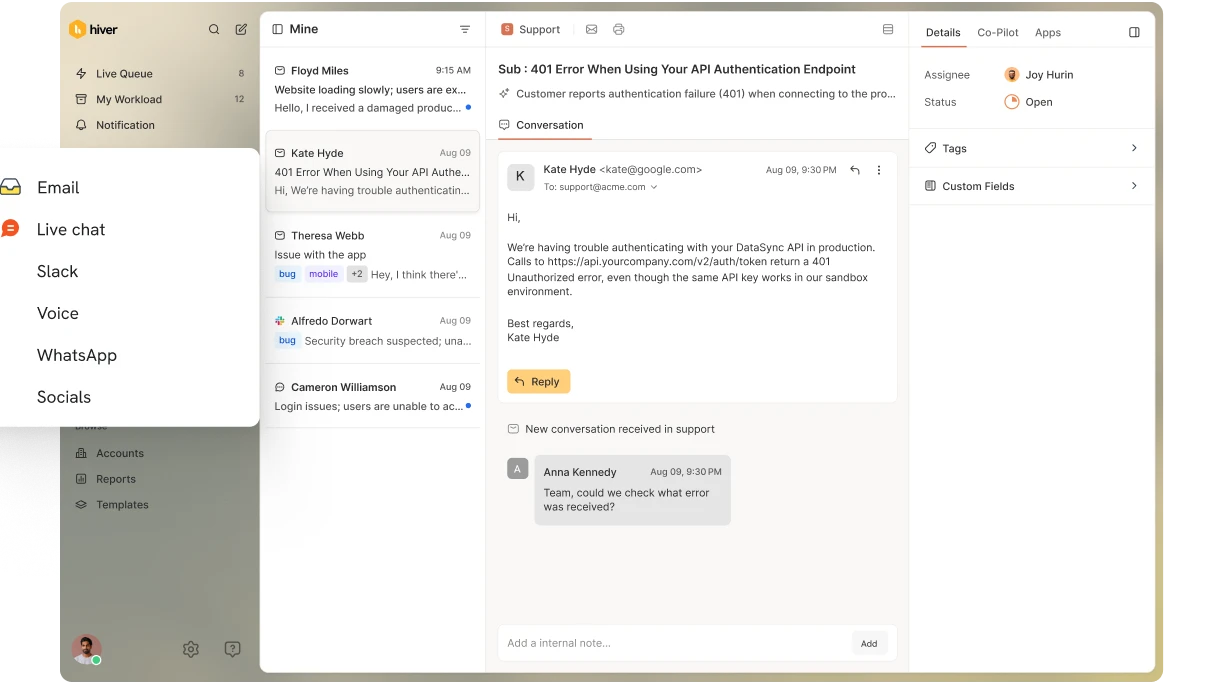
This is where a centralized platform can be helpful. For instance, tools like Hiver offer features like email templates and collision alerts. Templates allow your team to send instant, consistent acknowledgments without rewriting replies every single time. Collision alerts prevent multiple agents from replying to the same query, so nothing gets missed or duplicated.

Here’s how to make sure your customers never have to chase you:
✅ Acknowledge every request as soon as you receive it: Even if you don’t have a solution yet, an immediate confirmation like: “Hi Alex, we’ve received your request and are looking into it. Expect an update within 2 hours.” can go a long way in building trust.
✅ Set clear expectations: Tell customers what’s happening and when. If a fix takes 48 hours, say that upfront, and follow through. Transparency lowers anxiety and cuts down on unnecessary follow-ups.
✅ Keep customers in the loop (even If nothing’s changed): A quick “Still working on this, just looping in our billing team. Will update you tomorrow,” can prevent escalation and shows that someone’s actively handling it.
2. Set honest timelines, and stick to them
Most customers don’t expect instant solutions. But they do expect you to keep your word.
If your support team says, “We’ll get back to you in an hour,” that clock starts ticking—whether you meant it literally or not. And when you miss the mark, even with a good reason, trust takes a hit.
It’s easy to offer aggressive timelines to reassure an anxious customer. But that short-term relief can backfire. Missed deadlines lead to more follow-ups and unnecessary escalations.
Instead, here’s how to build a service culture that is reliable:
✅ Be realistic, not overly optimistic. If a fix could take 48 hours, say so. Customers appreciate honesty more than vague reassurance.
✅ Timebox your check-ins. Don’t wait until the issue is resolved to reply. Use progress updates to show that the issue is moving, even if you don’t have a final answer yet.
✅ Set SLAs, and track breach risks. With customer service tools like Hiver, you can assign SLAs by query type, monitor approaching deadlines, and act before things fall through the cracks.
Justin Bonar – Bridges, Customer Support Technician at Verisk Property Estimating Solutions (Xactware). explains how dangerous it can be to overpromise customers, as you not only break their trust, but also lose a customer in the process.
He says:
“You never want to set a timeline just to keep a customer calm. If it doesn’t pan out, the conversation becomes twice as hard. It’s better to be honest upfront than to have to backtrack later”.
– Read more of his insights on handling difficult customer conversations.
3. Own up to mistakes
Customers don’t expect perfection. But what they do expect is honesty.
When things break—whether it’s a service outage, missed delivery, or internal error—the worst thing you can do is go silent or sugarcoat the issue.
Trying to “contain” a bad situation by being vague only creates more frustration. Transparency, on the other hand, can increase customer trust. That’s because it shows you’re accountable, not evasive.
A customer on Reddit put it perfectly during a delayed shipment experience:
….”You have to be honest with your customers, and if there are delays, then sort them out. This is probably going to be the last time I buy from them, and I’ve been a loyal customer for several years now.”
People can sense when something’s off. And when they feel you’re dodging accountability, trust starts to erode. On the flip side, transparency shows integrity. It tells the customer: we respect you enough to be real with you.
Here’s what that looks like in practice:
✅ Own the issue, clearly and directly. A simple: “We dropped the ball on this, and we’re really sorry.” earns more respect than a vague, corporate apology.
✅Explain what happened—minus the jargon or finger-pointing. Instead of:
“We acknowledge your frustration,” say: “You’re right to be upset. We missed the mark, and here’s what we’re doing about it.”
✅Share what happens next. Outline the fix. Let them know what’s changing, how you’re following up, and what they can expect from here.
4. Personalize beyond scripts
Scripts can help with consistency, but they can’t replace human connection.
Customers can spot a templated response in seconds. And while consistency matters, what really sticks with people is when support feels personal: when someone remembers their name, references their issue, and talks like a real person—not a policy document.
In fact, a Zendesk study found that over 60% of customers feel like they’re treated as numbers, not people. That’s your chance to do better.
How to personalize the right way:
✅ Use names, and use them naturally. A “Hey Sam” beats “Dear Customer” every time.
✅ Reference past context. Mention earlier conversations or known issues. This shows you’re paying attention, not just reacting.
✅ Adapt the tone. If a customer is frustrated, meet them calmly. If they’re chatty, be warm. Scripts should guide, not dictate.
Here’s what Andrei Kurtuy says about personalization:
“Focus on making your customer care team efficient and empathetic… Tailor your offers based on their profile. This shows them they’re valued.”— Andrei Kurtuy, Co-Founder & CCO, Novorésumé.
5. Empower agents to act
If your support agents can’t make decisions, they can’t deliver great service.
When every refund, exception, or workaround needs a manager’s sign-off, your agents feel stuck, and your customers have to wait longer. Over time, that frustration adds up on both sides. In fact, a Harvard Business Review report found that frontline employees with decision-making power are more engaged, and their customers are more satisfied.
Train your support teams not just to route issues but to solve them. And that can only happen when agents are trusted to act.
Here’s how to make that happen:
✅ Set clear guardrails. Define what agents can approve on their own—discounts, replacements, etc. Also, clearly define when escalation is needed.
✅ Document edge cases. Create a playbook for trickier scenarios so agents aren’t left guessing (or escalating) every time.
✅ Give access to context. Agents need the full picture to make quick, confident decisions. A shared inbox makes this easy. Your team can view the entire conversation history, internal notes, and any updates added by other team members. No more digging through tools or waiting on someone else for context.
✅ Back them publicly. If an agent makes a tough call in the customer’s favor, support it. That’s how you build confidence and speed.
Also, empower your team to be adaptable. Because no two customers or situations are the same. Here’s what Adam Bost, Director, Disputes, Fraud and Recovery, Branch says about exceptional customer service:
“Exceptional customer service can take on multiple forms, but the core of exceptional customer service is knowing how to adapt quickly through flexible systems and policies… The worst thing one can do is do nothing.”
Here’s a simple escalation matrix that teams can adopt:

6. Offer intuitive self-service options
Customers shouldn’t have to raise a ticket just to answer a simple question.
Whether it’s checking refund timelines, updating account info, or troubleshooting an issue, many of these can (and should) be solved without waiting for a support reply.
A Harvard Business Review study found that 81% of customers try to resolve issues on their own before contacting support. But when they can’t find clear answers thats when Frustration builds fast.
That’s why a well-organized, easy-to-search knowledge base is needed. A knowledge base is a repository of help articles, how-to guides, FAQs, and troubleshooting steps. It’s designed to give customers quick access to answers, without needing to wait for a support reply. Some examples of good knowledge bases are Notion’s help center or slack’s support portal.

Here’s what a good customer-facing knowledge base should offer:
✅ Answers to common questions—clearly written and free of jargon.
✅ Step-by-step guides for tasks like cancellations, returns, or setup.
✅ Search that actually works, with relevant results and intuitive categories.
✅ Mobile-friendly formatting, since many users look for help on the go.
Recommended reading
7. Deliver multichannel support, consistently
Being available on multiple channels isn’t enough. What matters is that customers get the same quality of service no matter how they reach you—email, chat, social, or WhatsApp.
Many teams start strong on one channel and then expand without a plan. This results in inconsistent tone, slower responses, and dropped conversations.

If a customer reaches out on Instagram and gets a friendly, helpful reply, but later gets a cold, delayed email response – that inconsistency breaks trust.
How to stay consistent across every channel:✅ Build shared guidelines for tone, response time, and escalation✅ Use tools like a help desk that unify conversations from all channels in one place✅ Review a sample of responses regularly to spot gaps and train your team
How to stay consistent across every channel:
✅ Build shared guidelines for tone, response time, and escalation.
✅ Use tools like a help desk that unify conversations from all channels in one place.
✅ Review a sample of responses regularly to spot gaps and train your team.
Customers don’t think in channels. They just want help. So, make sure the experience feels familiar, no matter where they start.
8. Communicate with clarity
It’s true that support solves customer problems. But a part of your support team’s job is also explaining the solution in a way the customer actually understands.
If your replies are packed with jargon, legal phrasing, or technical shortcuts, you risk confusing the customer and frustrating them further. Clarity builds confidence. It reduces follow-ups. And it makes even bad news easier to accept.
How to keep your communication clear:
✅ Use plain language, not internal terminology.
✅ Break instructions into steps instead of one long paragraph.
✅ Avoid assumptions. Don’t expect customers to know your process.
✅ End with a clear next step, not a vague “let us know if you need anything”.
✅ Before hitting send, ask: will this make sense to someone reading it for the first time? If the answer is no, rewrite it.
9. Collect and close the feedback loop
Feedback is only valuable if it drives action.
Most businesses ask for it. Far fewer do something meaningful with it. When customers take the time to share their experience, good or bad, they expect a response as well. When that doesn’t happen, feedback feels like a formality. And thats why, over time, customers stop engaging.
Closing the loop changes that. It creates a sense of partnership. It shows customers that their voice can shape decisions, and not just sit in a spreadsheet.
How to create a useful feedback loop:
✅ Ask targeted questions—make it easy to respond with specifics.
✅ Track common themes and share them internally.
✅ Let customers know what changed based on their feedback
✅ Acknowledge and say thank you, even if the feedback is critical
For instance, we spoke to Jordan Hooker, a seasoned customer experience (CX) professional and Principal Consultant at Tavolo Consulting. He shared how their team handled feedback in a way his team could take action of customer feedback and close the loop.
“We gave our support agents ownership of the feedback process. They flagged patterns, explained the impact, and suggested fixes. That input led to real collaboration with product and engineering, and eventually to changes our customers genuinely valued. It took time, but the results were clear. Happier customers and fewer repeat issues.”
10. Be empathetic, even when you can’t fix the issue
You won’t always have a solution. But you can always show that you care.
Sometimes, the answer is a “no” – not because you don’t want to help, but because the request falls outside your policies, the product doesn’t support it, or the issue is simply out of your control. What matters most in those moments is how you respond.
Empathy isn’t about fixing everything. it’s about making customers feel seen and heard. You may not be able to fix everything every time. But you can definitely make your customers feel seen and heard. And that’s exactly what empathy is.
Here’s what that looks like:
✅ Acknowledge their frustration: “I completely get why this would be frustrating.”
✅ Be honest, but human: “While we can’t offer a refund in this case, I want to make sure this doesn’t happen again.”
✅ Offer what you can do: A workaround, a timeline, or a promise to follow up – anything that makes the customer feel better.
Here’s what Kaitie Weaver says about showing empathy to your customers.
“Great customer service is all about making the customer feel understood. Even if you can’t solve their problem, listening and sympathizing can make a big difference.” — Kaitie Weaver, Manager, Brand and Communications, Helcim
Recommended reading
11. Know your product inside out
Support teams shouldn’t rely on guesswork or secondhand information. If an agent needs to check with another department before answering basic questions, that’s a sign of a knowledge gap, and customers feel it.
When agents understand how the product works in real situations, they give faster, more relevant help and avoid escalations that slow everything down.
How to build real product fluency:
✅ Set up a test account for agents to explore the product hands-on.
✅ Include support teams in internal product demos and feature walkthroughs.
✅ Create a searchable product handbook for known edge cases and tricky workflows.
✅ Assign agents specific areas of the product to specialize in, then rotate quarterly
12. Use shared tools to gain full context
Support breaks down when agents lack visibility. If someone has to ask, “Has anyone replied to this yet?” or “What did we promise them before?” – the customer is already feeling the gap.
A shared tool gives your team one place to track ownership, past replies, internal notes, and status—so nothing slips through.

| What to put in place:✅ Use a shared inbox or helpdesk (basically a centralized platform) that shows full conversation history✅ Store internal notes where they’re easy to find—not buried in Slack✅ Track ticket ownership clearly, so customers aren’t getting double responses When your team sees everything that’s happened, they reply with context. That saves time and prevents repeat work. |
What to put in place:
✅ Use a shared inbox or helpdesk (basically a centralized platform) that shows full conversation history.
✅ Store internal notes where they’re easy to find, not buried in Slack.
✅ Track ticket ownership clearly, so customers aren’t getting double responses.
When your team sees everything that’s happened, they reply with context. That saves time and prevents repeat work.
13. Track service metrics that actually matter
Metrics like ticket volume doesn’t reflect customer experience. You need to know if your team is solving issues well and not just clearing the queue.
That’s why it’s important to track the right service metrics. Ones that show quality, consistency, and customer satisfaction.
What to measure:
✅ First contact resolution: Are most issues solved in one go?
✅ Time to resolution: How long are customers waiting for a fix?
✅ CSAT (Customer Satisfaction Score): Are customers happy with the support they received?
✅ Customer Effort Score (CES): How easy was it for the customer to get their issue resolved?
Use these metrics to spot bottlenecks, not just report numbers. Good data should lead to better decisions.

14. Coach, shadow, and celebrate
Even experienced agents need feedback. But training isn’t just onboarding slides—it should be part of the day-to-day. When teams hear what they did well, where they can improve, and get to learn from each other’s work, service gets stronger across the board.
What consistent coaching looks like:
✅ Pair new agents with mentors during their first few weeks.
✅ Set up shadowing sessions for tough ticket types or channels.
✅ Use real tickets as coaching examples in team reviews✅ Call out great replies publicly so others can learn from them.
Strong service habits come from consistent practice, clear feedback, and celebrating wins. Growth doesn’t happen by accident, so make it part of the plan.
Also, make sure to regularly check-in with your support team.
“One way to review customer service processes is to have regular check-ins… see how your agents are interacting with customers.”— Linda Shaffer, Chief People Operations Officer, Checkr
The Not-To-Do List for Great Customer Service
Even the best intentions can fall flat if your team slips into habits that frustrate customers. Here’s what to avoid if you want your service to stand out for the right reasons:
🚫 Leaving customers in the dark
A customer should never have to ask, “Did anyone see my message?” Always acknowledge their query—even if you don’t have an immediate solution. Silence creates anxiety while transparency builds trust.
🚫 Passing the customer around
Nothing kills confidence faster than being transferred five times. Give agents the tools and autonomy to resolve queries without unnecessary handoffs.
🚫 Blaming the customer (even subtly)
Phrases like “as we already explained” or “you must have misunderstood” come off as defensive. Focus on resolution, not who’s at fault.
🚫Running an outdated knowledge base
If customers have to dig through outdated help articles or navigate a maze to reach you, frustration is inevitable. A clean, current knowledge base makes self-service easy, and cuts down on tickets too.
🚫 Overpromising to defuse a situation
Saying “you’ll hear back in an hour” might calm a customer, for now. But if you miss that deadline, trust takes a hit. Set realistic expectations and meet them.
🚫 Ignoring tone mismatch
A cheerful reply to a clearly frustrated customer can come off as tone-deaf. Match the energy. Be calm when they’re angry, direct when they’re rushed, and upbeat when they’re positive. Tone = trust.
🚫Assuming “polite” equals “helpful”
es, be respectful. But don’t mistake politeness for service. A friendly tone won’t fix a vague answer or a missed follow-up. Substance matters just as much as style.
You may also like: The Complete Guide to Customer Service Best Practices
What Does Great Customer Service Mean to You?
For some customers, great service means never having to repeat themselves. For others, it’s a quick resolution, a kind tone, or just feeling like a person and not a case number.
The truth is, great customer service isn’t one-size-fits-all. But it always comes back to one core question:
Does your service reflect what your company stands for?
If your brand claims to care about customers, but support replies take days… that gap doesn’t go unnoticed. And it costs you. A Hiver study found that 72% of customers switch brands after just one poor service experience.
Before you define what “great” looks like for your support team, ask yourself:
- What does our company truly value?
- What do our customers expect from us?
- And where do those two align?
That intersection is where consistently great service happens. It’s not always about grand gestures but about showing up in a way that’s human, helpful, and true to your brand.
Frequently Asked Questions (FAQs)
- What are the key skills for delivering great customer service?
Empathy, communication, problem-solving, and patience top the list. But just as important are context awareness and consistency—knowing how to adapt to different customers and showing up reliably across every interaction. - How do you provide great customer service?Start by making it easy for customers to reach you. Then respond quickly, communicate clearly, and follow through. Equip your team with tools that give them full visibility and empower them to solve problems without jumping through hoops. And always close the loop—even if you don’t have the perfect answer.