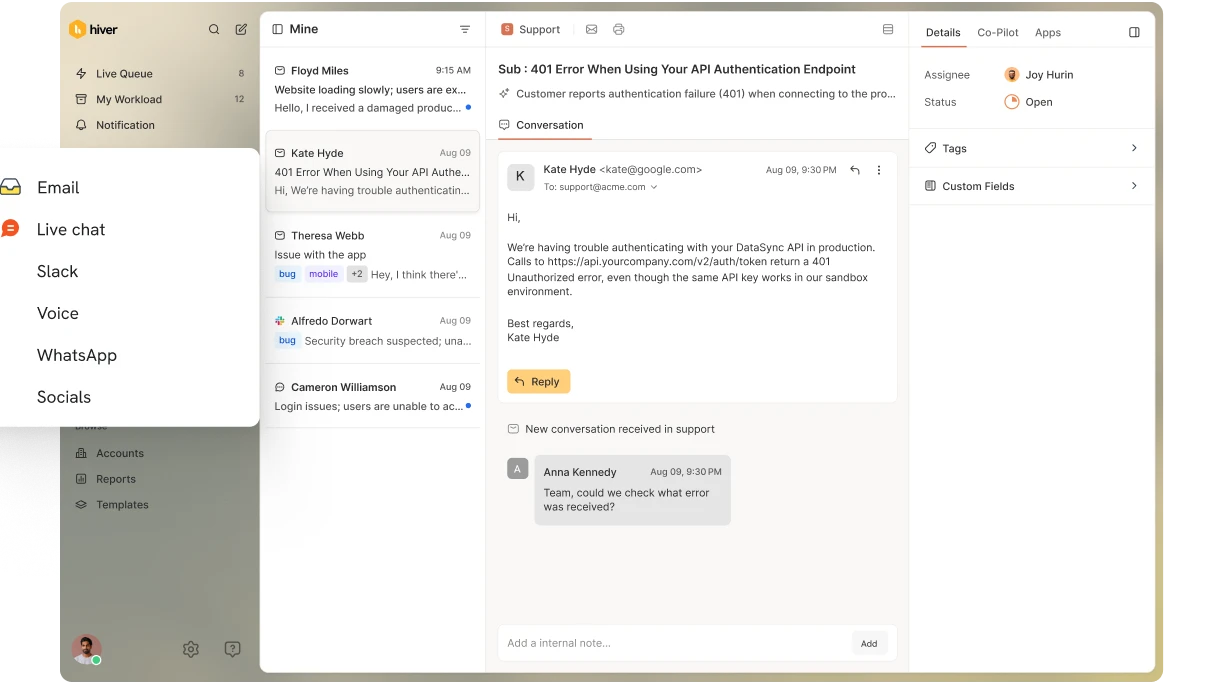







Customers don’t stick to just one customer service channel—they switch seamlessly between email, chat, social media, WhatsApp, and even voice assistants. And every channel matters: 77% of customers prefer email, while 63% turn to live chat for fast answers (according to a research by Hiver).
The challenge? Customers expect consistently great support, no matter where they connect.
In this detailed guide, we’ll break down:
- The 11 most impactful customer service channels for 2025
- Practical advice on when and how to use each channel
- Insights into why the right channel strategy matters for your business
What are Customer Service Channels?
Customer service channels are the various touchpoints customers use to connect with your business when they need support. These channels range from traditional methods like email and phone calls to modern options such as live chat, social media, WhatsApp, and self-service portals.
Here’s the thing: Each channel serves a unique purpose and meets distinct customer expectations. A channel perfect for one situation—like resolving quick queries via live chat—might not be ideal for complex issues that need detailed documentation via email.
Let’s take a closer look at the 11 customer service channels that businesses are focusing on in 2025—and what makes each one worth considering for your support strategy.
11 Customer Service Channels to Focus on in 2025
| Customer Service Channel | Best for | Strengths |
|---|---|---|
| Email Support | – Detailed queries – Documentation – Async conversations | Trackable, straightforward, and easy to document |
| Phone Support | – Sensitive issues – Escalations – Real-time resolution | Human touch, empathy, clarity |
| Live Chat | – Pre-sales – Quick troubleshooting – Instant responses | Fast, convenient, and high customer satisfaction |
| Social Media | – Fast issue visibility – Public engagement | Brand visibility, engagement, and responsiveness |
| – Personal mobile-first conversations and alerts | Direct, familiar, widely adopted | |
| SMS/Text | – Urgent, short updates and confirmations | High open rates, no app needed |
| Video Support | – Complex setups – SaaS onboarding – Face-to-face demos | High-touch, visual guidance |
| Chatbots | – Answering FAQs – Lead capture – 24/7 assistance | Instant, scalable, cost-effective |
| Community Forums | – Peer support – Feature requests – Niche questions | Crowdsourced answers, community building |
| Self-Service (KB & Customer Portal) | – FAQs – Onboarding – Account management | 24/7 help, scalable, customer-friendly |
| Voice Assistants | – Hands-free help – Order updates – Quick voice queries | Convenient, emerging tech, fast access |
1. Email Support
Email remains a foundational customer service channel—and for good reason. It’s ideal for issues that require detailed explanations, careful thought, and precise documentation. In fact, according to recent data, 37.4% of customers still prefer email as their primary customer service channel.
The real advantage of email is its asynchronous nature. Customers can describe their issues clearly without feeling rushed, even adding attachments for extra context. Every email interaction creates a searchable history for audits, escalations, or spotting trends over time.
However, email isn’t suited for everything, especially urgent issues. As Craig Stoss, VP of Partnerships and Solutions at Kodif, says, “You wouldn’t email the fire department if your house were on fire. Email should be one part of your customer service strategy, not the entire strategy.”
Email is best for scenarios like:
- Complex troubleshooting: Explaining detailed, multi-step solutions clearly.
- Billing and policy inquiries: Clarifying refund eligibility, billing disputes, or policy details.
- Escalations requiring multiple approvals: Managing issues that need coordination among different teams.
- Cross-time-zone communication: Handling issues where instant responses aren’t critical.
But if you want to get email support right:
Your strategy must tackle common email-related issues, such as duplicate replies, unclear ticket ownership, missed emails, and lack of visibility into query statuses. Simply relying on Gmail or Outlook for email management won’t be enough, especially as your customer support scales.
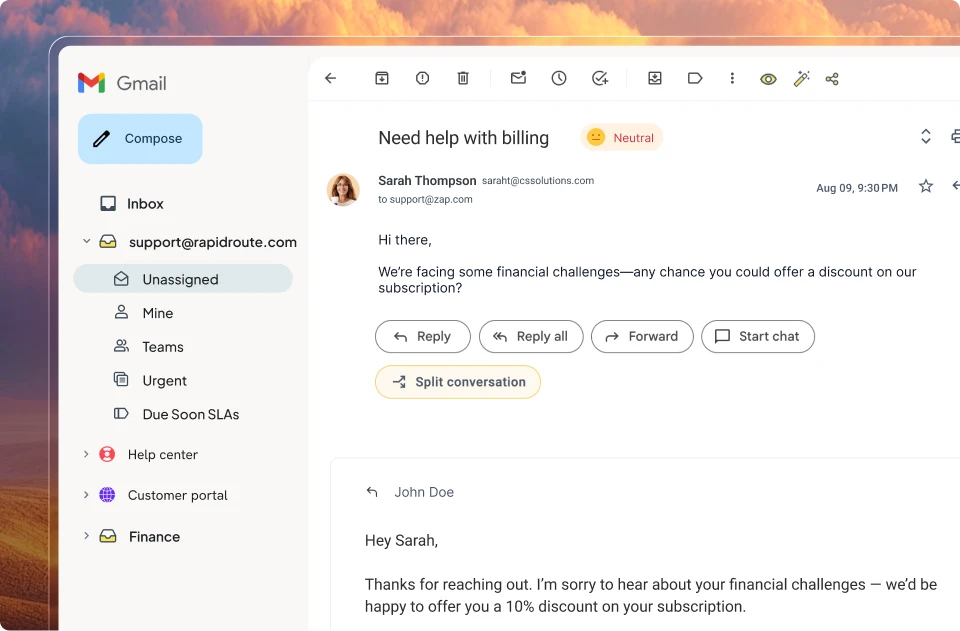
An AI-powered shared inbox (such as the one offered by Hiver) makes email management easier and more collaborative.

With Hiver, you can:
- Instantly see when someone else is replying, eliminating duplicate responses.
- Automatically route emails to the right person or team, set priorities, and categorize queries.
- Use internal notes and tags within emails, so your team doesn’t have to switch between tools or forward messages.
- Access detailed analytics and reports to track key metrics such as response time, resolution rates, and even create custom reports.
2. Phone Support
Phone remains essential for customer service, particularly when dealing with complex, sensitive, or urgent issues. An impressive 83% of customer service teams offer telephone support. This shows that many businesses still prioritize direct communication with customers over the phone as a reliable means of assistance. That direct communication is only as useful afterward as it is documented, and many teams rely on a speech-to-text API to turn calls into transcripts they can refer encethe same way they reference emails and chats.
Phone support is particularly valuable when:
- Customers face frustrating situations that need immediate empathy and reassurance (like unexpected charges or billing disputes). In fact, 39% of customers hate long waiting times.

- Time-sensitive issues arise (account lockouts, critical service interruptions) requiring immediate, personalized help.
- Sensitive matters (fraud alerts, cancellations) where trust and quick responses are crucial.
Best practices for phone support:
- Set clear expectations upfront: “At the start of calls, clarify expected call length or next steps clearly (“This should take about 5-10 minutes”). This calms the conversation and builds trust.”
- Document and centralize conversations: Use tools that allow agents to log call summaries, tag issues, and assign follow-ups, especially when agents juggle both calls and emails. Like, with Hiver’s Aircall integration, your team can handle calls from an inbox-like interface. Easily assign calls, track follow-ups, and see the full context of every conversation without juggling tabs.

3. Live Chat Support
Live chat is the channel customers turn to when they want quick answers—without picking up the phone or waiting hours for an email. It’s fast, low-effort, and less disruptive than most channels.
Customers can chat while working, commuting, or even sitting in a meeting. Plus, since conversations stay within a single session (and are often saved as transcripts), there’s no loss of context between messages.
Live chat is perfect for:
- Pre-sales questions like “Does this plan support multiple users?”
- Quick fixes, such as password resets or tracking updates
- Busy periods where teams need to respond fast without overwhelming the phone lines
How to get live chat right:
- Place your chat widget where it matters most—on high-intent pages like pricing, checkout, or your help center. It should be easy to spot, without getting in the way.
- Choose a tool that’s quick to set up and fits into your team’s existing workflow. With Hiver’s AI-powered live chat, you can add a branded widget to your site or app and offer instant, real-time support.

- Templates are great for speeding up routine replies, but a little personalization goes a long way. Something as simple as “Hey Sam, happy to help 👋” feels warmer and more human than a generic “Dear Customer.”
Recommended reading
4. Social Media Support
Social media has evolved into a powerful customer service channel, especially for real-time queries, public complaints, and brand engagement.
With billions of active users across platforms like X (formerly Twitter), Instagram, Facebook, and LinkedIn, customers now expect quick, transparent help right where they scroll. In fact, 78% of customers who complain on social media expect a response within an hour.
Social media support is particularly valuable when:
- Customers raise issues publicly, tagging your brand or commenting on posts.
- You want to provide proactive updates, like service outages, delays, or known bugs, to reduce inbound volume and manage expectations in real time.
Best practices for social media support:
- Reply publicly, resolve privately: Acknowledge issues where they happen, then shift to DMs for sensitive info or follow-ups.
- Respond fast using social listening tools: Platforms like Sprout Social, Hootsuite, Brandwatch, and Mention help track mentions, tags, and messages in real time so you can respond quickly and never miss an issue.
Recommended reading
5. WhatsApp Support
WhatsApp is one of the most widely used messaging apps, with over 2 billion users globally. For customers, it’s fast, familiar, and convenient, making it an ideal channel for quick, personal, and real-time support.
WhatsApp support can be useful for:
- Quick service updates and alerts like order confirmations, delivery ETAs, appointment reminders, or payment notifications.
- Checking in after an issue is resolved or sharing a feedback link to gauge customer satisfaction.
How to get WhatsApp support right:
- Centralize your WhatsApp conversations: Tools like Hiver help manage WhatsApp conversations alongside other channels (like email, chat, and phone) using an inbox-like interface. This unified view will help your team track, assign, and respond to queries without switching platforms.

- Enable real-time alerts: Turn on instant notifications for incoming WhatsApp messages so your team never misses a time-sensitive query.
- Automate conversation assignments: Automatically assign WhatsApp queries to the right team members using skill-based or round-robin logic. It saves time, eliminates manual triage, and helps your team focus on solving problems—not sorting tickets.
6. SMS/Text Support
SMS is unmatched when it comes to reach and immediacy. With open rates as high as 98%, it’s the most reliable way to get seen, especially for urgent or time-sensitive messages.
It works on any phone, with or without internet, making it a strong choice for reaching older or offline customers. That said, SMS is best used in short, high-impact moments, not for back-and-forth conversations. Think alerts, reminders, or quick updates that don’t need too much context.
Use SMS to:
- Send instant alerts like order confirmations, shipping updates, and appointment reminders.
- Broadcast critical notices like service-outage warnings or flash-sale alerts.
- Confirm simple requests such as “Your refund has been processed,” “Your table is ready.”
- Link to short surveys, NPS requests, or self-service articles.
How to get SMS support right:
- Craft concise, value-driven texts (preferably under 160 characters)
- Include a direct call to action and a link to richer self-service when needed
- Personalize messages using customer data (like first names or order numbers)
- Ensure replies are routed back into your main support system so agents can seamlessly pick up any follow-up.
7. Customer Self-Service Options
Self-service has become the preferred choice for many customers. In fact, according to a study by Superoffice, 40% say they’d rather find answers on their own than reach out to support. And it’s not hard to see why.
A well-organized help center can solve basic issues, like password resets, tracking orders, or troubleshooting errors, without the back-and-forth of a ticket.
Customer portals take it a step further. They let users track past conversations, view account history, or initiate returns at their convenience, even during off-hours. For instance, Hiver’s customer portal lets you deliver a fully branded, 24/7 self-service hub. Customers can submit and track tickets without needing help from a support agent.

When done well, self-service:
- Reduces ticket volume by handling repeat questions automatically
- Empowers customers to find solutions at their own pace
- Works 24/7—ideal for global teams and after-hours support
How to get self-service right:
Pick a KB tool you’ll actually use: For example, Hiver lets you easily manage a searchable knowledge base and group the help articles into neat categories. You can also integrate it with Live Chat, enabling website visitors to find answers instantly.

Keep your knowledge base fresh: Your help center isn’t just for customers; it powers your AI too. AI Copilot, like the one in Hiver, uses your knowledge base to suggest responses, answer FAQs, and summarize resolutions. If your content is outdated or vague, the AI becomes less valuable, and your team spends more time correcting its drafts.
8. Video Chat Support
When customers are stuck, even after reading help articles or emailing your team, video can make all the difference. It lets support reps share their screen, read visual cues, and walk someone through a setup or fix in real time.
It’s especially helpful for:
- High-touch onboarding—guiding new users through dashboards, integrations, or compliance steps
- Account recovery or access issues—where screen sharing is faster and more secure than long email threads
- Customers with accessibility needs, such as those who rely on lip reading or sign language
How to get video support right:
- Pick a one-click platform: Use browser-based video tools like Zoom or Google Meet, so customers can join with a single link and no installs.
- Prep before you connect: Ask users to share key details (OS, browser, error messages) via a quick pre-call form. This saves time and ensures you can jump straight into the issue.
9. Chatbot Support
Your team can’t be online all the time, but your chatbot can. It’s perfect for handling FAQs like “Where’s my order?” or “What’s your return policy?” without making customers wait. Even at 2 a.m., it can greet users, answer common questions, and route complex issues to the right person.
Chatbots are especially useful for:
- Reducing first-response time, even during off-hours
- Capturing leads or triaging support requests
- Helping customers self-serve without the need for an agent
How to get chatbot support right:
- Start by automating real, high-volume queries, like order tracking or password resets, and keep responses short, clear, and conversational. Always give customers the option to talk to a human, with the full chat history passed along for a smooth handoff.
- From there, choose a chatbot tool that fits your workflow and team size. AI-powered chatbots offered by tools like Hiver, Freshchat, and Tidio integrate easily into your existing workflow to handle common queries.
10. Community Forums Support
Community forums give your customers a place to ask questions, share advice, and learn from each other. Over time, they become rich, searchable libraries of real-world solutions—built by your users.
They also reduce the pressure on your support team. Instead of submitting a ticket, customers often find what they’re looking for in an existing thread. And as those conversations grow, they surface useful trends: common feature requests, recurring pain points, even bugs your team hadn’t spotted yet.
Forums are especially valuable when you’re supporting:
- Niche or long-tail queries that don’t always have a clear-cut answer
- A large, active user base that’s willing to help each other
How to get community forums right:
Take Atlassian or Salesforce—both use forums to support power users, crowdsource solutions, and encourage peer-to-peer help. The key is to stay involved. Moderate discussions, highlight helpful posts, and make sure your team occasionally steps in to share updates or close the loop on feature requests.
11. Voice Assistants (Alexa, Google Assistant)
Voice assistants, like Alexa and Google Assistant, are moving beyond timers and music—they’re now a hands-free way for customers to get basic support.
Whether it’s checking order status, confirming delivery times, or asking product questions, voice is fast, convenient, and increasingly part of the customer’s daily routine.
They also support accessibility needs, offering a simple, spoken interface for users who may have visual or motor impairments. For brands, voice is a way to future-proof their support stack—especially in industries like retail, logistics, smart home tech, and banking, where quick updates and real-time access make a real difference.
How to get voice support right:
- Voice is best for quick, low-effort queries—things like “When will my package arrive?” or “What’s my account balance?” It works well in connected environments or when customers are on the move.
- If you’re exploring this channel, start with structured, high-volume questions that are easy to answer and don’t require context from past interactions. And if voice isn’t relevant for your business yet, it’s still worth keeping on the radar—it’s evolving fast.
Why Choosing the Right Customer Service Channels Matters
Choosing the right customer service channels isn’t just a tech decision— it directly affects how happy your customers are, whether they stick around, and how smoothly your support operations run.
It saves time and money.
When HubSpot moved to a chat-first approach, they saw a 1.6× boost in productivity and saved $2.3M annually on support headcount. The right channels don’t just help your customers—they scale with your team.
It builds customer loyalty.
Different channels can play distinct roles in earning and keeping customer trust. For example, live chat can provide immediate answers during purchase decisions, while email is ideal for thoughtful follow-ups or sharing important documentation.
When things go wrong, a friendly voice on the phone can turn frustration into reassurance. When customers feel heard and helped, no matter the channel, they’re more likely to return.
It makes support more efficient.
Efficiency comes from matching the complexity of the issue to the right channel. For example, Puppy Dogs and Ice Cream, an online bookstore for children, implemented an automated FAQ system (using a chatbot and help center) and achieved a 55% reduction in ticket volume.
In short, the channels you offer—and how you use them—can directly impact CSAT, retention, and team bandwidth. Let’s look at how to choose the right mix.
How to Choose the Right Channels for Your Business
Selecting the customer service channels is one of the most important decisions you’ll make while defining your customer service strategy. Here are some tips to guide your decision-making:
1. Understand your customer demographics
Customer preferences vary widely by age, geography, and tech comfort. Match your channels to the habits of your core users.
- Gen Z & Millennials prefer fast, informal channels like chat, social media, and messaging apps.
- Gen X & Boomers often lean toward traditional support: phone and email.
There’s no one-size-fits-all—your mix should reflect your customer base.
2. Map channels to the customer journey
Each stage of the journey—awareness, consideration, purchase, and post-sale—has different needs. The trick is to map the customer journey with the right channel. A first-time visitor might want quick answers via chat, while a returning customer with a billing issue might prefer email. When channels match these expectations, you reduce effort and increase satisfaction.
3. Start with what you can support well
It’s tempting to open every channel, but every new one comes with staffing, training, and tooling needs. Ask yourself:
- Do we have the team capacity to support this channel consistently?
- Will it require new tools or integrations?
- Can we track and measure it effectively?
Do a cost-benefit analysis before adding a channel. Will it reduce ticket volume? Improve CSAT? Drive sales?
4. Test, measure, and adapt
There’s no perfect mix on Day 1. Start small, test intentionally, and expand based on what works.
- Run small pilots: Launch a new channel, like live chat or WhatsApp, for a specific use case or customer segment.
- Track effectiveness: Look at resolution time, volume, CSAT, and follow-up rate per channel.
- Track channel-wise analytics: Tools like Hiver help you track key metrics across email, chat, voice, and WhatsApp. This allows you to compare performance, identify gaps, and double down on what’s working, without adding new dashboards or tools.
Manage All Customer Service Channels In One Place
Customers don’t think in channels—they simply want quick, accurate support without having to repeat themselves. Offering customer service through multiple channels like email, chat, voice, or messaging apps only works well if these channels are seamlessly connected. Every new interaction should naturally continue from where the previous one ended.
To achieve this, equip your teams with tools that provide full context effortlessly, including past conversations, customer history, and internal documentation. Integrating your channels and customer data allows your team to understand customer needs clearly, collaborate effectively, and deliver consistently great experiences.
When your support feels effortless and connected for customers, every interaction becomes an opportunity to build lasting loyalty.
Frequently Asked Questions (FAQs)
1. Which customer service channel is the most effective?
It depends on your industry, the type of issue, and what your customers prefer:
- Live chat or SMS is great for fast, transactional queries.
- Email or phone works best for detailed or sensitive conversations.
- Social media and WhatsApp help if your audience is active online and expects quick updates.
The most effective channel is the one your customers are comfortable using, and your team can support consistently.
2. What is an omnichannel customer service experience?
An omnichannel customer service means customers can switch between channels, like email, chat, phone, or WhatsApp, without losing context. Your support team sees the whole picture across touchpoints, enabling seamless conversations, faster resolutions, and more personalized help.
3. How can small businesses manage multiple customer service channels efficiently?
Start with the top 2–3 channels your customers use most and scale as you grow without compromising quality. Use a unified platform to manage all channels in one place, so your team isn’t switching tabs or losing context. To stay efficient, automate repetitive tasks like assigning conversations or sending quick replies, set clear response time benchmarks, and regularly review channel performance to adjust based on customer feedback and operational needs.
4. Which customer service channels are best for urgent queries?
The best channels for urgent queries include:
- Phone Support: Instant, human-to-human interaction.
- Live Chat: Immediate text-based support is ideal for multitasking.
- WhatsApp & SMS: Real-time mobile notifications and responses.
- Chatbots: Instant responses, especially for simple, repetitive issues.
5. How many customer service channels should a company offer?
There’s no one-size-fits-all number—it depends on your customers and team capacity. Most companies do well with 3 to 5 core channels, such as email, live chat, and phone. Start with the ones your customers prefer most, and expand gradually based on demand and available resources.
6. What are the common mistakes businesses make when choosing support channels?
Some common mistakes include:
- Offering too many channels without the resources to manage them properly
- Choosing channels based on trends, not customer preferences
- Running disconnected systems that don’t share customer context
- Ignoring analytics and feedback when evaluating channel effectiveness
To avoid these, start small, choose based on data, and focus on integration and consistency.
7. What’s the difference between multichannel and omnichannel support?
- Multichannel support means your business offers support through various channels—like email, phone, live chat, and social media—but each operates in its own silo. Customers may need to repeat their issue if they switch from one channel to another, and agents often lack the full picture.
- Omnichannel support, on the other hand, connects all those channels so that customer interactions are unified and seamless. Whether a customer starts with a live chat and follows up via email or phone, your team can see the entire history in one place.
Start using Hiver today
- Collaborate with ease
- Manage high email volume
- Leverage AI for stellar service