






A medium-sized business purchases an enterprise license for an AI video marketing tool after thorough market research.
In the beginning, everything was great, and videos were easy to make. But a few months in, the tool added new features that no one really understood, the videos all looked the same, and the team struggled to get the most out of what they’d bought.
This is where customer success comes in.
The customer success team guides customers through any difficulties they may face, educates them on new features, shows them how to use the tool better, and helps them reach the results they signed up for. Without that, even a great product can lose its shine.
In this article, we’ll discuss the foundations of customer success, the lifecycle, and the metrics that matter.
TL;DR
- Customer success = proactive outcomes. Guide customers to results tied to their business goals so renewals and growth feel natural.
- Who needs it: Any recurring-revenue model (SaaS, subscriptions, B2B services) that wins or loses on retention.
- Why it matters: Higher retention and expansion, more advocacy, stronger feedback loops to product/marketing, and more personalized guidance.
- Core metrics: NRR/GRR, customer health score (usage, adoption, sentiment, support).
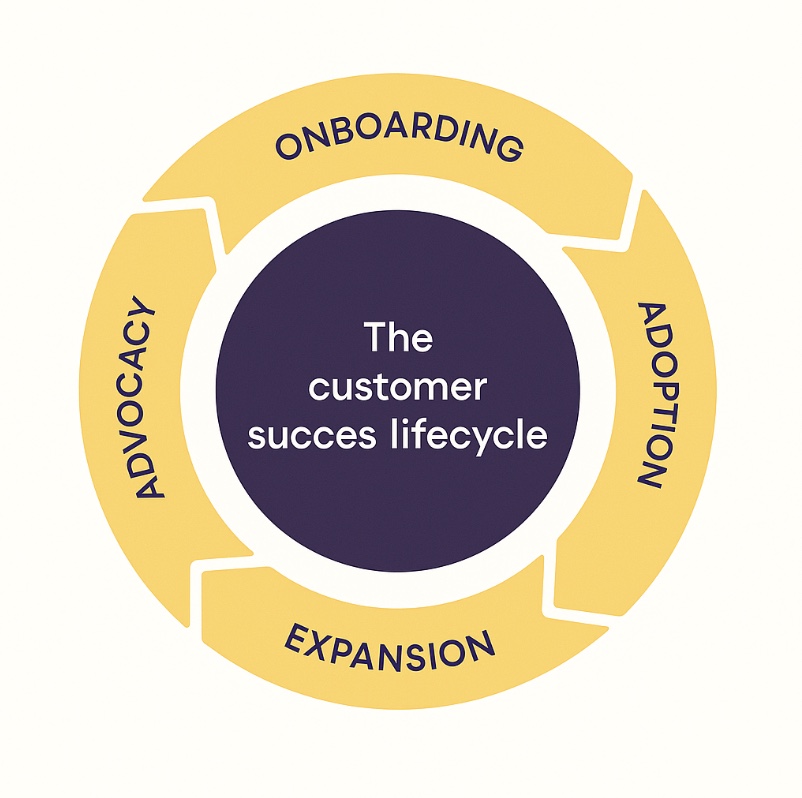
- Lifecycle (stage map): Onboarding → Adoption → Value → Expansion → Advocacy. Assign one owner, one action, and one metric per stage.
- Team roles: CSM, Onboarding Specialist, Digital CSM, CS Analyst, CS Ops, CS Lead/Manager, VP CS, CCO: Each with clear ownership and success measures.
- To build a customer success strategy: Define segments, map the customer lifecycle, choose engagement models, measure impact, and act on customer signals.
- What Hiver does: Reporting and built-in CSAT/NPS help show before-and-after outcomes, fueling renewal and expansion conversations.
What is Customer Success?
Customer success is a proactive approach to make sure customers achieve meaningful outcomes with your product that tie directly to their broader business goals. It’s built on strong relationships and a clear understanding of what success looks like for each customer.
In short, your success depends on theirs. Strong relationships and shared goals sit at the center of customer success.
A dedicated customer success team monitors how customers use the product, shares best practices, and builds the foundation for long-term loyalty.

Who Needs a Customer Success Strategy?
Any business built on recurring revenue, long-term contracts, or customer retention needs a customer success strategy.
For example, SaaS companies, B2B service providers, and subscription businesses rely on it to keep customers engaged, reduce churn, and drive growth.
Why is Customer Success Important?
Customer success is central to retention and advocacy. In fact, 58% of organizations that excel at it see revenue grow more than 20% annually.
Here are some reasons why customer success deserves a seat at the table:
1. Boosts Revenue Through Upsells and Expansion
Customer success teams talk to customers more often than sales teams, which puts them in the best position to identify upgrades and cross-sell opportunities. By helping customers get maximum value, they also maximize revenue potential.
2. Increases Customer Retention
You can’t always rely on acquiring new customers. A proactive customer success function keeps existing ones satisfied, reducing customer churn in subscription-based models. Retained customers also become a stable foundation for long-term growth.
3. Improve Customer Satisfaction
Every interaction with your customers is an opportunity to help them achieve their goals. Listening to your customers builds trust and turns the relationship into a long-term partnership.
According to a Deloitte report, customer-centric companies earn about 60% more profit than non-customer-focused companies. Satisfied customers are also more likely to explore advanced features and recommend your product to others.
4. Share Insights Within a Feedback Loop
Customer success teams gather insights from customer interactions and share them with the product, sales, and marketing teams. These insights guide business improvements and create better overall experiences.
5. Provide Personalized Customer Experiences
Customer success teams engage with customers on a deeper level, tailoring support and guidance to their specific goals and challenges.
Personalized customer experiences improve customer satisfaction and make customers feel valued, increasing their loyalty and long-term commitment.
Difference Between Customer Success, Customer Support, Account Management, vs. Customer Experience
Same customer, different jobs. The table below shows who owns what goals, KPIs, and when to engage for customer success, support, account management, and CX.
Knowing the difference helps businesses assign clear roles and deliver better customer results.
- Customer Success (CS): A proactive function focused on helping customers achieve their business outcomes through onboarding, adoption, and value realization. The goal is to drive retention and growth by ensuring customers see measurable value from the product.
- Customer Support: A reactive function that resolves issues, troubleshooting requests, and technical questions across channels. Customer support ensures customers can keep using the product effectively without disruptions.
- Account Management (AM): A relationship-driven role that manages contracts, renewals, and revenue growth, often with a commercial focus. Account managers act as the primary business contact, balancing customer needs with company targets.
- Customer Experience (CX): A broader discipline that looks at the entire journey across all touchpoints to ensure customers have a positive experience. CX spans multiple teams and aims to create consistent brand trust and loyalty.
Comparison table
| Aspect | Customer Success (CS) | Customer Support | Account Management (AM) | Customer Experience (CX) |
|---|---|---|---|---|
| Goal | Proactively help customers achieve business outcomes through onboarding, adoption, and value realization | Resolves issues and questions fast across channels. | Manage contracts, renewals, and revenue growth | Improve the end-to-end customer journey across all touchpoints. |
| Owner | Customer Success Manager (CSM), CS Ops, Onboarding/Implementation | Support agents/reps, Support lead/manager | Account Manager/Customer Account Executive. | Head of CX/VP of CX with cross-functional partners (Product, Marketing, Support, CS, Sales) |
| Primary KPIs | Net Revenue Retention (NRR), Gross Revenue Retention (GRR), Health score, Time-to-First-Value (TTFV), Adoption rate, Expansion rate | First Response Time (FRT), resolution time, CSAT score | Renewal rate, Expansion revenue, Net upsell/cross-sell, Forecast accuracy | Net Promoter Score (NPS), Customer Satisfaction (CSAT), overall brand perception |
| Typical motions | Proactive customer onboarding, training, usage monitoring, and identifying upsell opportunities | Reactive troubleshooting, ticket resolution, FAQs | Strategic check-ins, contract negotiations, and building long-term relationships | Journey mapping, analyzing customer feedback, optimizing interactions |
| When to engage | Throughout the post-sale lifecycle: Onboarding → adoption → value → expansion → advocacy | When customers face technical problems or need assistance | During renewal cycles, business reviews, or upsell discussions | At every stage of the customer journey, across digital and in-person touchpoints |
Recommended reading
Customer Success vs Customer Service: Key Differences in 2025.
Key Customer Success Metrics & KPIs to Track
Measuring customer success metrics is about linking customer outcomes to business growth. The following are some of the key metrics that show how effectively your strategy is working:
1. Net Revenue Retention (NRR)
NRR measures how much recurring revenue you retain and expand from your existing customers over time.
- 100% = You kept all starting revenue
- >100% = Expansion beat churn/downgrades
- <100% = Churn/downgrades beat expansion
Formula to calculate NRR:
NRR (%) = ((Starting Recurring Revenue + Expansion − Contraction − Churn) ÷ Starting Recurring Revenue) × 100
- Starting Recurring Revenue = Monthly Recurring Revenue(MRR)/Annual Recuring Revenue(ARR) from the same cohort at the start of the period
- Expansion = upsell/cross-sell/seat adds in that cohort
- Contraction = downgrades/discounts in that cohort
- Churn = recurring revenue lost from logo/seat churn in that cohort
How to calculate Net Revenue Retention:
- Pick a period (month/quarter) and lock a cohort of active customers at day 1.
- Sum their starting MRR/ARR.
- Add upsells to those accounts; subtract downgrades and churn from those accounts.
- Plug into the formula. Exclude new logos from the numerator and denominator.
Example: Start ₹100k MRR; +₹20k expansion; −₹5k contraction; −₹10k churn → NRR = (100+20−5−10)/100 = 105%.
2. Gross Revenue Retention (GRR)
GRR shows pure retention of the base, ignoring expansion. It helps spot product fit and onboarding/adoption strength.
Formula to calculate GRR:
GRR (%) = ((Starting Recurring Revenue − Contraction − Churn) ÷ Starting Recurring Revenue) × 100
How to calculate Gross Revenue Retention:
Follow the same cohort method as NRR, but do not add expansion. Subtract only downgrades and churn, then divide by the starting revenue.
Example: Start ₹100k; −₹5k contraction; −₹10k churn → GRR = (100−5−10)/100 = 85%.
3. Customer Health Score
Customer success teams use customer health scores to quantify the health of a customer relationship, often indicating risks of churn or opportunities for upselling and growth.
The score combines multiple data points, such as product usage, support interactions, customer satisfaction (NPS/CSAT), and more, into a single, trackable value.
How to calculate customer health score:
There is no single, industry-wide standardized formula for the Customer Health Score, but several SaaS vendors and industry sources commonly cite weighted, multi-factor formulas using normalized data.
To calculate this score, companies often combine several factors that reflect engagement and satisfaction. Each factor is given a weight, and the scores are combined into a single value, usually scaled from 0 (at high risk) to 100 (very healthy).
Formula (simplified):
Customer Health Score=(Metric1×Weight)+(Metric2×Weight)+(Metric3×Weight)+…
Example calculation:
Let’s say a company measures Customer Health Score using the following metrics:
- Feature usage depth (weight: 35%)
- Training completion rate (weight: 25%)
- Support response quality (CSAT from tickets) (weight: 25%)
- Billing/renewal consistency (weight: 15%)
Here’s how the weighted sum works:
- Feature usage depth: 80 × 0.35 = 28
- Training completion rate: 60 × 0.25 = 15
- Support response quality: 85 × 0.25 = 21.25
- Billing/renewal consistency: 70 × 0.15 = 10.5
Total Customer Health Score = 28 + 15 + 21.25 + 10.5 = 74.75
In this case, the customer scores 75 out of 100, which places them in the “healthy but monitor” zone. They are generally engaged but may need encouragement to complete training and deepen product use.
Recommended reading
The Customer Success Lifecycle (Stage Map)
The customer journey doesn’t stop after a deal is closed. Success teams guide customers through a series of stages, from getting their first quick win to eventually becoming brand advocates.
Each stage builds on the last, and knowing where a customer is in this lifecycle helps teams prioritize actions, assign ownership, and track the right metrics.
Stage 1: Onboarding: Get the First Win Quickly
The goal of onboarding is speed to value. Customers should reach their first “win moment” as soon as possible, whether sending their first campaign, closing their first ticket, or generating their first report.
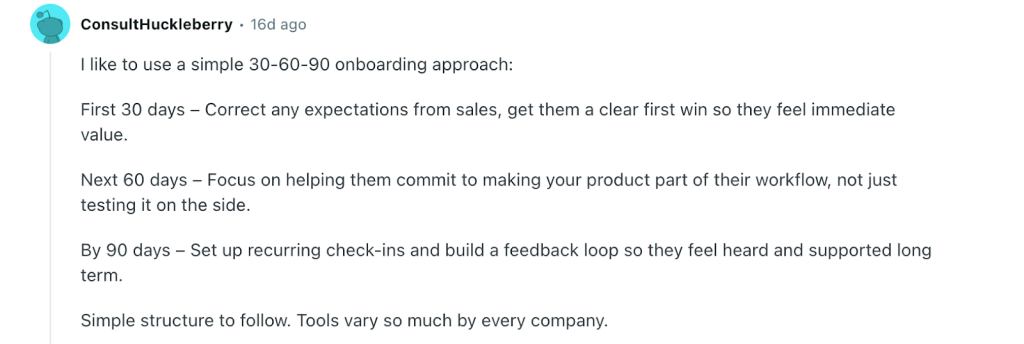
Early momentum sets the whole account’s trajectory. Treat the first 60–90 days like a project. Across Reddit, customer success threads point to a simple pattern: The first 90 days customer retention. Emphasize onboarding, land an early win, and clear setup blockers quickly.

90-day onboarding plan (Quick checklist)
- Days 0–7: Kickoff, success plan agreed, admin access, data, and integrations unblocked.
- Days 8–30: First workflow is live, the first report is sent to the champion, core users are trained, and baseline health is captured.
- Days 31–60: Second use case live, weekly usage reviews, sponsor check-in, early value story drafted.
- Days 61–90: ROI confirmed, executive recap delivered, expansion hypothesis logged, risk list with owners and dates.
Key metric to track: Time to First Value (%) (TTFV)
Best practice: Assign a dedicated onboarding owner. Having one clear point of contact ensures customers don’t feel lost in handoffs and builds accountability for quickly getting them to that first win.
Stage 2: Adoption: Deepen and Broaden Usage (Feature Adoption)
The next step is to drive consistent and meaningful product use once your customer achieves the first win. Build habits around core features, then layer in advanced capabilities when the customer is ready.
Key metric to track: Feature adoption rate (%)
Best practice: Track breadth (how many features are used) and depth (frequency/volume of use). Pair education campaigns with in-app nudges to expand product adoption.
Stage 3: Value Realization: Confirm ROI (Renewal Intent/NPS)
At this stage, customers must clearly see how the product connects to their business goals. Tie the product to the KPIs they own; when results show up on their dashboard, clear linkage to KPIs improves renewal rates.
Key metric to track: ROI (%), payback period (months)
Best practice: Build ROI calculators or success dashboards that map product usage directly to business outcomes. Product renewal conversations become easy when customers can quantify the impact of dollars saved or revenue gained.
Pro tip: With Hiver, customer success teams can prove ROI and strengthen renewal conversations by showing customers the outcomes, such as faster resolutions, higher CSAT, and improved SLA performance.

Hiver’s Reporting Analytics feature makes this easy. Dynamic dashboards track real-time resolution times, CSAT scores, and SLA success rates. Custom reports let you filter data that matters most, while built-in CSAT and NPS surveys capture sentiment directly.
Stage 4: Expansion: Right-Time Cross-Sell/Upsell (Expansion Rate)
Once you establish trust with your customer, they are more open to exploring additional features, higher tiers, or complementary products. Timing and relevance are everything here.
Expansions also create opportunities to re-engage stakeholders, revisit success goals, and show how the product can solve a wider set of challenges across teams or departments.
Key metric to track: Expansion rate (%)
Best practice: Agree on ROI math at kickoff and keep a shared before/after scorecard. Translate wins into their KPIs, like time saved, cost avoided, and revenue created, and send an exec-ready one-pager ahead of renewal.
Stage 5: Advocacy: Referrals, Stories, References
The final stage is turning happy customers into advocates who actively promote your product. Advocacy provides peer proof that reduces risk for new buyers and shortens sales cycles.
Key metrics to track: Referral Rate (%), Referral Conversion Rate (%)
Best practice: Celebrate customer wins publicly. Collect customer testimonials and highlight their success stories in newsletters, product updates, or social posts, and give advocates a platform to showcase their expertise. Positioning them as thought leaders strengthens loyalty while boosting your brand’s credibility.
Roles & Responsibilities in a Customer Success Team
Building a successful customer success function requires a well-defined team with clear responsibilities. From onboarding to expansion, each role guides customers toward their goals.
In the table below, you compare the core customer success roles, what they own, and how to track performance.
| Role | Primary Responsibility | Key Metric(s) |
|---|---|---|
| Customer Success Manager (CSM) | Own a customer portfolio; guide outcomes; run reviews; identify risk; surface real expansion opportunities. | GRR/NRR, renewal rate, adoption depth/breadth, health trend, and save rate. |
| Customer Success Analyst | Turn product/account data into signals and insights; build dashboards; measure playbook impact. | Health prediction accuracy, lift after plays, time-to-signal, insight→action rate. |
| Onboarding Specialist | Lead post-sale handoff; set expectations; train; remove early friction; get to first value fast. | TTFV, activation rate, onboarding completion, days to go-live. |
| Digital Customer Success Manager | Run one-to-many programs (in-app/email/automation) for long-tail accounts; drive activation/adoption at scale. | Activated accounts, key feature adoption, in-app/email engagement, and self-serve deflection. |
| Customer Success Representative / Specialist | Provide hands-on enablement for a segment or product area; answer “how do I…?”; share field insights. | Time to unblock, adoption for assigned use cases, CSAT on sessions. |
| Customer Success Coordinator | Keep notes, tasks, and data clean; manage scheduling and follow-ups; ensure action items close. | Data completeness, follow-up SLA hit rate, action item closure rate. |
| Customer Success Operations Manager (CS Ops) | Build processes, tooling, reporting; govern playbooks; improve handoffs and daily execution. | Reporting accuracy, playbook adherence, time saved per rep, tool adoption, cycle times. |
| Customer Success Team Lead / Manager | Coach CSMs; review health and pipelines; remove blockers; align with Sales/Support/Product/Marketing. | Team GRR/NRR, cadence coverage, save rate, scorecard/QA lift. |
| VP of Customer Success | Own retention strategy, segmentation, coverage model; partner on forecasts and product priorities. | GRR/NRR by segment, expansion rate, cost to serve, and referenceable customers. |
| Chief Customer Officer (CCO) | Executive owner of customer outcomes company-wide; set the customer agenda tied to revenue and roadmap. | Company GRR/NRR, NPS/VoC trend, cross-functional OKRs linked to retention and growth. |
5 Best Practices to Build Your Customer Success Strategy
A strong customer success strategy makes this possible by driving adoption, retention, and long-term growth.
Here are some best practices for designing a strategy that drives adoption, retention, and growth at scale:
1. Set Goals, Milestones, and Owners
Create a simple success plan for each customer segment, with goals, milestones, owners, and a defined “first win.”
Also, revisit these plans every quarter to validate whether customer goals have changed.
Pro tip: For an SMB, the first win could be “launch first campaign in 14 days.” For an enterprise, it might be “complete system integration in 90 days.” Anchoring early outcomes makes renewal discussions much easier.
2. Map the Customer Lifecycle
Outline the customer success journey.
Onboarding → Adoption → Value → Expansion → Advocacy
Assign one action & one metric per stage and add ownership to each stage so customers know who to reach out to at every point (onboarding specialist, CSM, support, etc.).
Example: Adoption stage = “Complete training module” (action) and “% of active users in first 60 days” (metric). It keeps the lifecycle measurable instead of abstract.
3. Choose the Right Engagement Model
Select high-touch, digital, or hybrid engagement based on the customer segment, and review it quarterly to adjust as needs evolve.
Customer success practitioners emphasize this segmentation should be data-driven.
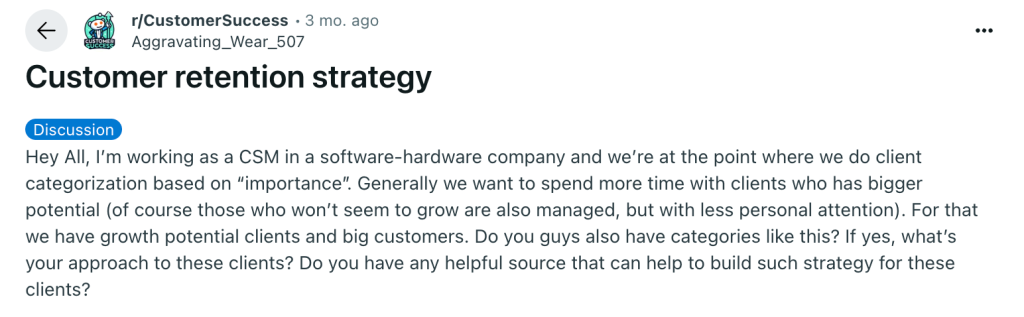
The three engagement models:
- High-touch: Personalized interactions such as QBRs, onboarding workshops, and regular 1:1 check-ins – typically for enterprise accounts
- Digital: Scalable channels like automated emails, in-app guides, and webinars – often more effective for SMBs than expected
- Hybrid: Combines automation for routine updates with periodic CSM calls for strategic touchpoints
Pro tip: Use past churn and renewal data to guide your coverage model. If smaller accounts renew well with automated touchpoints, shift CSM bandwidth toward high-value enterprise accounts.
4. Build a Basic Health Score
Combine product usage depth, adoption breadth, support load, and customer sentiment into a red/yellow/green score.
To avoid skewed results, weight these factors by importance. For example, product usage may carry 50%, while sentiment holds 20%.
Example: Automate health score updates weekly using your CRM or CS platform. Real-time scoring ensures CSMs act on fresh signals rather than outdated data.
5. Respond to Signals with Owned Checklists
Use triggers like a drop in usage or a key contact leaving the account to activate short, assigned checklists. Track the impact of each playbook to see what improves retention.
Build both proactive (growth-focused) and reactive (risk-mitigation) playbooks so the team can respond quickly in any scenario.
Pro tip: Automate triggers in your CRM or CS platform so signals like inactivity, milestone delays, or champion exits instantly assign the right playbook to an owner.
Your Next Steps to Stronger Customer Retention
Customer success is the link between customer outcomes and business growth. Every touchpoint, from onboarding to renewal, is a chance to reinforce value, build trust, and deepen loyalty.
When you guide customers toward their goals and treat their wins as your own, renewals stop being a push and start happening naturally.
Start now
- Write one success plan per segment: goals, milestones, owners, and a defined first win.
- Map the lifecycle: Onboarding → Adoption → Value → Expansion → Advocacy, with one action and one metric for each stage.
- Choose coverage by segment: high-touch, hybrid, or digital; set cadences and review quarterly.
- Stand up a simple health score with red/yellow/green thresholds.
- Wire triggers to short playbooks and track lift after each run.
- Create one shared backlog and send a monthly “You said → We did” update.
Remember, even the most powerful products cannot guarantee loyalty on their own. What keeps customers invested is seeing real value delivered consistently through strong customer success.
Frequently Asked Questions
1. What is a customer success manager (CSM)?
2. What does a customer success manager do?
Typical responsibilities of a customer success manager include creating success plans, running business reviews, monitoring product usage, flagging risk, coordinating with product/support/sales, and identifying right-time expansion. 54% of customer success managers say their work led to measurable account expansion. The aim is simple: proven outcomes for the customer and durable revenue for the vendor.
3. How do I become a customer success manager?
Most CSMs come from adjacent roles like support, onboarding, or account management. Focus on building communication, problem-solving, and product skills, then show how you’ve driven customer outcomes. A basic understanding of CS metrics and success plans also helps you stand out.
4. What are the core pillars of customer success?
The pillars usually include onboarding, adoption, value realization, expansion, and advocacy. Together, they cover everything from helping customers see first value quickly to turning satisfied users into long-term champions.
5. How is customer success different from customer support?
The main difference between customer success and customer support lies in their approaches. Customer support is reactive; it solves problems after they occur, such as troubleshooting technical issues or answering user questions. Customer success is proactive; it works to anticipate needs, guide adoption, and align the product with a customer’s long-term goals.
Start using Hiver today
- Collaborate with ease
- Manage high email volume
- Leverage AI for stellar service