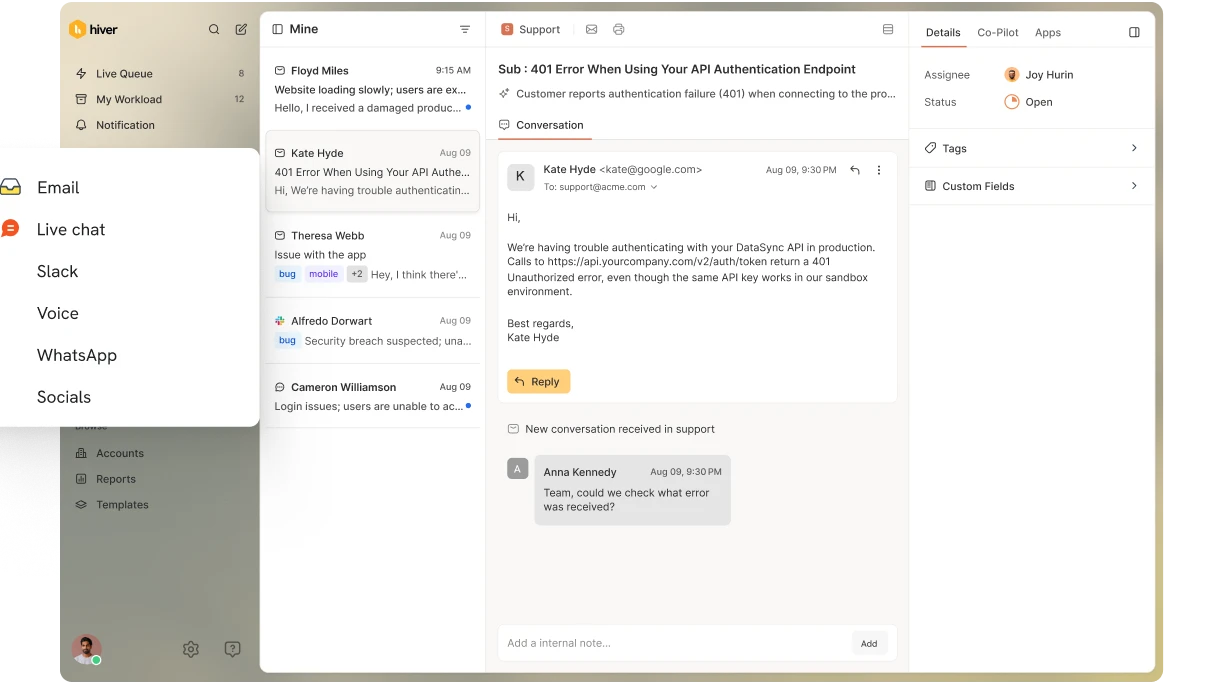







You added live chat to cut down email volume. Turned on Instagram DMs to be more “approachable”. Enabled WhatsApp because your customers expect it.
Now, your team is juggling five channels, conversations are scattered, and the customer experience is anything but smooth.
That’s the trap of multi-channel support: showing up everywhere without a plan.
It’s not about how many channels you support. It’s about picking the right ones — and managing them in a way that keeps quality consistent, conversations connected, and your team sane.
In this guide, we’ll break down:
- What multi-channel support really means (and how it’s different from omnichannel)
- How to choose channels that actually matter to your customers
- How to build a strategy your team can realistically manage
- And how to measure what’s working — beyond CSAT scores
Table of Contents
- What is multi-channel customer support?
- Why is multichannel customer support important?
- Key channels in multi-channel customer support
- Multi-channel vs. omnichannel support: Key differences
- How do you implement a multi-channel customer support strategy?
- Step 1. Identify the channels your customers actually use
- Step 2. Choose tools that support those channels
- Step 3. Train your team to work across channels (and switch smoothly)
- Step 4. Set smart SLAs, and act before things go south
- Step 5. Use automation to tag, route, and respond faster
- Step 6: Monitor performance per channel
- Challenges of managing multi-channel support
- Metrics to track multi-channel support performance
- Multichannel customer support only works if it’s sustainable
- Frequently Asked Questions
What is multi-channel customer support?
Multichannel customer support is the practice of helping customers across multiple platforms, like email, chat, phone, or social media.
But it’s not about being everywhere. It’s about being intentional.
- Use email for complex or follow-up queries
- Use chat for quick, real-time help
- Use phone for high-stakes, sensitive conversations
- Use social for visibility or lightweight check-ins
Each channel plays a different role, and your team needs to treat them that way.
Train your team to handle each channel separately. They’ll need different skills for writing an email vs. chatting in real time. Set clear expectations for response time on each platform. What works for chat won’t work for email.
Also, don’t assume the same agent will handle the full conversation. Let’s say a customer starts with a chat about a billing issue and then emails later with more details. Even if different teammates respond, both replies must be accurate and connected.
That’s where a multi-channel strategy becomes critical. Without one, quality slips, response times drag, and customers feel ignored.
Now, let’s look at why it matters in customer experience.
Why is multichannel customer support important?
When customers can choose how they reach you, they feel in control, shaping how they experience your brand. A well-run multi-channel setup helps you meet that expectation in 5 ways:
- Enables customers to reach support on their preferred platform: Customers use different platforms, such as email at work, chat in-app, and social media on the go. Multi-channel support lets them reach you without changing their habits.
- Improves response time by aligning channel with query type: When customers can pick the fastest or most familiar channel. This means they get help sooner without having to figure out how to contact you.
- Builds trust through consistent availability across platforms: Being available across channels shows that you value customer choice, so customers don’t feel like they’re taking a gamble when they reach out.
- Balance workloads across your team: Your team can shift volume between channels, like moving quick issues to chat or deflecting simple questions to email so that live support can be focused.
- Supports different user preferences: Some customers want to speak to a human, while others prefer to send a message and move on. Multi-channel support lets you serve both well.
Of course, not all channels serve the same purpose. Some are better for quick resolutions, while others handle more complex issues. Let’s break down the key ones to focus on.
Recommended reading
7 Tips for Building a Multi-Channel Customer Support Strategy
Key channels in multi-channel customer support

Not every channel needs to be in your mix, but your chosen ones should serve a clear purpose. Here are the most common support channels you should look into.
- Email: Best for detailed queries, documentation, and follow-ups. Use it to handle complex issues that don’t need an immediate response.
- Live Chat: Ideal for quick, in-the-moment questions. Place it on high-intent pages like checkout or account settings to reduce friction.
- Phone: Useful for urgent, emotional, or high-value conversations. Offer it when personal reassurance or fast resolution matters most.
- Social Media: Good for handling public complaints, brand mentions, or quick updates. Respond fast; these channels are highly visible.
- Self-Service (FAQs, Help Center): Use it to deflect common queries, reduce ticket volume, and empower customers to solve problems on their own.
Each of these channels plays a different role. The key is to match your support efforts with how customers naturally behave on each one.
Multi-channel vs. omnichannel support: Key differences
It’s easy to confuse multi-channel and omnichannel customer experience. Both involve using multiple platforms, but how they’re managed makes all the difference.
| Feature | Multi-Channel Support | Omnichannel Support |
|---|---|---|
| Channel Availability | Multiple, but handled separately | Multiple, connected, and integrated |
| Customer Experience | May require repeating context across channels | Seamless experience with shared context |
| Team Workflow | Agents manage each channel in isolation | Agents have full visibility across all interactions |
| Tooling | Separate tools or disconnected systems | Centralized platform or unified workspace |
| Setup Complexity | Easier to start, but harder to scale | More complex to set up, but easier to scale with consistency |
| Best Use Case | Early-stage or resource-constrained support teams | Mature support orgs focused on delivering consistency at scale |
If you’re managing growing volume across several platforms but don’t have the systems to sync them all, a smart multi-channel strategy is your best next step.
Recommended reading
How do you implement a multi-channel customer support strategy?
A solid multi-channel strategy starts with knowing your customers’ needs and making sure your team delivers consistently.
Step 1. Identify the channels your customers actually use
Start by checking the facts. Where are customers actually messaging you, via email, chat, phone, or Instagram DMs? Don’t rely on assumptions. Pull reports from your helpdesk, scan your chat logs, review call data, and take a quick look at your social inbox.
If it’s still unclear, ask them directly. A one-question survey like “When you need help, what’s the first place you go?” can give you the answer you need.
The key is to figure out which 2–3 channels matter most and start there. Trying to cover everything from day one will only stretch your team and slow down response times.
Step 2. Choose tools that support those channels
Once you know which channels matter most, it’s time to pick the right tools to support them. And this part really matters. The right setup makes things easier. While the wrong one slows your team down, adds busywork, and creates gaps in customer experience.
Focus on what fits for you. If most of your volume comes from email and chat, your team should be able to manage both in one place. If customers often reach out on social media, replying to DMs shouldn’t mean logging into a separate tool to copy-paste context.
One Reddit user shared how this played out at their CRM startup. They had two options: build native integrations or rely on tools like Zapier. Zapier kept breaking, so they invested upfront in a system (Mautic) that let them track social, email, and website activity all in one place.
“We decided to go with mautic while building ours, as it had great repo of community plugins. It also gave basic framework of doing complex automations like tracking anonymous visitor data and sending him Dynamic content, notifications then email then sms etc as per lifecycle. We ofcourse had to put significant dev efforts but it was onetime to build configurable omnichannel tracking & content delivery system.
Log social interactions like comments, likes, and DMs directly on the contact record. Tracks email opens, clicks, and engagement without needing third-party add-ons. Monitors website visits and actions to tie behavior back to specific users.
It can go beyond this. We can identify anonymous visitors and run omnichannel campaigns to pursue them using offers on the product catalogues they are looking for. It’s an ecosystem that deals with lifecycle level conversion than sending individual stage content. Hopefully, we can see the era where even such complexity can be surpassed, especially the rise of LLM agents.”
– Reddit user
That’s the tradeoff. Either you choose tools that reduce chaos, or you work around them.
Always test with real support queries before committing. If it doesn’t make your team faster, it’s not worth it.
Step 3. Train your team to work across channels (and switch smoothly)
Your tools can only take you so far. Multi-channel support works only if your team can switch between channels, without losing context or dropping the ball.
Start with this truth – Email allows for detail. Chat needs speed and clarity. Phone calls require empathy and quick thinking. Treat them the same, and quality drops.
To make sure quality doesn’t drop:
1. Create channel-specific playbooks by:
- Defining tone and language guidelines for each channel.
- Setting expected response times.
- Outlining clear escalation rules.
- Keeping it short, clear, and easy to reference.
2. Train agents to review past conversations:
- Even if the earlier interaction happened on a different channel.
- Customers expect continuity, not a reset with every touchpoint.
Let’s say a customer starts a chat about a failed payment. They leave before the issue is resolved and follow up via email the next day. Your agent should see that earlier chat and pick up where it left off. This small detail is what turns a frustrating experience into a smooth one.
Even when tools aren’t perfect, a well-trained team can stitch conversations together with ease. That’s what customers remember.
Recommended reading
Step 4. Set smart SLAs, and act before things go south
Every channel runs on its own clock. Chat is instant. Email gives you more breathing room. And Social media is somewhere in between. If you treat them all the same, you’ll either burn out your team or frustrate your customers.
That’s why you need channel-specific SLAs (Service Level Agreements). These aren’t just internal goals. They’re commitments to your customers and your team.
Start by defining the first response time and resolution time for each channel. Use your existing response data to set a realistic baseline, then push for consistency.
Here’s a rough benchmark to start with:
| Channel | First Response Time | Resolution Time | Notes |
|---|---|---|---|
| Live Chat | 1–2 minutes | Under 15 minutes | Prioritize real-time responses. Auto-assign chats. |
| 4–6 hours | Within 24 hours | Use automation to triage and tag incoming emails. | |
| Phone | Within 3 rings / 30 mins | During the same call or follow-up within 1 hour | Train for first-call resolution when possible. |
| Social Media | Within 1 hour | Within 4–6 hours | Monitor during business hours with alerts set up. |
| Help Center | N/A | N/A | Track deflection rate and update top articles monthly. |
Document these SLAs, share them with your team, and bake them into your helpdesk settings. Use alerts to flag tickets that are close to breaching SLAs. Don’t just track them, act on them.
Also, be transparent. If you publish your SLA (e.g., “Our typical response time is under 1 hour”), you build trust and hold yourself accountable.
Finally, revisit your SLAs regularly, because what works today may not scale tomorrow.
Step 5. Use automation to tag, route, and respond faster
Multi-channel support can get messy fast, especially when volume picks up. The only way to stay efficient without burning out your team is smart automation.
Start simple. Use automation to:
- Tag incoming messages based on keywords, intent, or customer type
- Route tickets to the right team based on topic or channel
- Send instant replies for common questions or when agents are offline
Let’s say a billing-related email comes in. An automation rule can tag it as “Billing,” assign it to the finance support queue, and send an auto-reply like, “We’ve received your query and passed it to our billing team. You’ll hear from us within 4 hours.”

This saves time, sets expectations, and gets the ticket to the right person without manual triage.
Also, don’t overdo it. The goal isn’t to replace your team, it’s to reduce low-value work so they can focus on conversations that need a human touch.
💡Pro Tip: Review your top 20 most common queries per channel. If they’re predictable and repetitive, they’re great candidates for automation.
Automation is what makes multi-channel scalable. Without it, even the best strategy will eventually hit a wall.
Step 6: Monitor performance per channel
Don’t just track overall response time or CSAT. Break it down by channel. Here’s why: a blazing-fast chat reply can mask a 2-day delay on email. And unless you break down your metrics by channel, you won’t spot the gaps that frustrate customers.
What to track by channel:
- First response time: Are you fast where it matters?
- Resolution time: How long does it take to close the loop?
- CSAT/NPS per channel: Some channels may drive better satisfaction than others.
- Volume trends: Are certain channels getting overloaded or underused?
Use your helpdesk reports or dashboards to build a channel-specific view. Review it weekly to watch for shifts in volume, gaps in SLA adherence, and satisfaction dips.
This is how you keep each channel accountable and your overall support experience consistent.
Challenges of managing multi-channel support
Running support across multiple channels sounds great, until you’re deep in it. More channels mean more complexity, not just more convenience.
- Lost context between channels: When a customer moves from chat to email, your team shouldn’t start from scratch.
▶️Use internal notes or a shared timeline to stitch together the conversation. If your tools don’t support that, create a habit of linking past tickets manually.
- Uneven workloads across the team: One agent drowning in chat while another waits on email tickets.
▶️Fix this with auto-assignment rules,round robin assignments and channel-specific SLAs. Also set up a live dashboard to help rebalance workloads in real time.
- Inconsistent customer experience: If email replies are thoughtful but social responses (like that on instagram are robotic), your brand will take a hit.
▶️Build tone guidelines for each channel. Include examples, audit monthly, and coach your team based on real interactions.
- Too many tools, too little flow: If agents juggle five platforms just to respond, they are bound to miss things.
▶️Use integrations or shared inbox tools to pull everything into one interface.
- Blind spots in performance: You’re tracking overall CSAT and SLAs, but don’t know which channel is dragging performance down.
▶️Break metrics down by channel: response time, resolution time, CSAT. Review weekly and dig into patterns.
Multi-channel only works if every channel works. Treat each one like its own support lane, with its playbook, goals, and metrics.
Metrics to track multi-channel support performance
Since you’ll be handling multiple channels, you cannot depend on overall metrics or averages. In multi-channel support, you need to know exactly how each channel performs or you’ll miss the real issues. Here’s what to track and why:
1. First response time: How fast are you replying?
Customers expect speed, especially on chat and social.
- Chat: under 2 minutes
- Social: within 1 hour
- Email: within a few hours
→ Set SLAs per channel. Use alerts to flag delays. Review weekly and adjust staffing as needed.
2. Resolution time: How long does it take to fully solve issues?
Quick replies don’t matter if the issue drags on.
→ Audit tickets with long resolution times. Look for bottlenecks like unclear ownership or routing delays. Fix with templates, better escalation paths, or clearer workflows.
3. Ticket volume: Where’s the workload coming from?
High volume on one channel can overwhelm your team and hurt response times.
→ Monitor spikes. They may signal product bugs, feature confusion, or broken flows. Use this data to adjust shifts or reconsider which channels need full support.
4. CSAT and NPS: How satisfied are customers on each channel?
You may see high scores on email, but lower ones on chat due to rushed replies.
→ Break feedback down by channel. Review conversations tied to low scores and use them in team coaching.
5. Channel switch rate: Are customers jumping channels to get help?
If someone starts on chat and ends up emailing, something’s not working.
→ Tag multi-channel tickets. Investigate what forced the switch—slow replies, poor answers, or resolution gaps. Strengthen first-contact resolution on the original channel.
For efficiency, you can build a dashboard that displays all of these by channel. Don’t wait for averages to mislead you; fix what’s broken where it actually happens.
Multichannel customer support only works if it’s sustainable
It’s not hard to offer support on five different channels. The hard part is doing it well without burning out your team or disappointing your customers.
That’s the real test of a multi-channel strategy: can you maintain speed, quality, and context across every channel you support? If not, it’s time to rethink.
You don’t need to be everywhere. You need to be consistent where it counts. That means:
- Choosing only the channels your customers actually use
- Equipping your team with the right tools and clear playbooks.
- Automating the repetitive stuff so agents can focus on what matters.
- Track performance by channel.
If any part of your support feels reactive, slow, or scattered, don’t wait for it to break. Simplify. Prioritize. Fix what’s not working.
Multi-channel support should make your service better, not harder. If it’s not sustainable, it’s not working.
Frequently Asked Questions
1. What is a multi-channel customer support strategy?
Multichannel support means helping customers across platforms like email, chat, and phone, depending on their preferences.
2. What’s the difference between multichannel and omnichannel support?
Multichannel involves separate channels, while omnichannel syncs them for a seamless experience.
3. What are the benefits of implementing a multi-channel support strategy?
A strong multi-channel strategy helps you:
- Make support more accessible
- Improve customer satisfaction
- Reduce response and resolution times
- Shorten wait times across channels
4. How can businesses decide which channels to include?
Start by understanding your customers. Then:
- Analyze support volume by channel
- Review customer feedback and common touchpoints
- Look at industry benchmarks
- Run small tests to see what actually works
Don’t try to support everything. Focus on 2–3 high-impact channels first.
5. What challenges come with multi-channel support?
The most common hurdles are:
- Keeping responses consistent across platforms.
- Managing staffing and workloads efficiently.
- Integrating tools and systems.
- Protecting customer data across all channels.
6. How do you measure the success of a multi-channel strategy?
Track performance by channel, not just overall. Focus on:
- CSAT or NPS per channel
- First response and resolution times
- Channel utilization (volume and workload)
- Customer retention and repeat contact rates
Use this data to improve workflows, rebalance staffing, and eliminate low-performing channels if needed.
Start using Hiver today
- Collaborate with ease
- Manage high email volume
- Leverage AI for stellar service