






Quick summary
The best email support platforms in 2026 are Hiver for complex B2B support with AI included in every plan, Zendesk for enterprise teams with heavy routing needs, and Help Scout for small, email-first teams that want fast onboarding.
Here are our top three picks:
| Tool | Best for |
| Hiver | Complex B2B support, cross-team collaboration, AI included in every plan |
Zendesk | Enterprise teams needing deep customization and routing |
Help Scout | Small, email-first teams that want fast onboarding |
Still managing customer support from a regular inbox?
Then you’re probably missing messages, duplicating work, or wondering–”did someone already reply to this?“
Email support systems fix that by turning every customer email into a trackable ticket with an owner and a status.
In 2026, the best email support systems combine structured workflows with AI that triages requests, drafts replies, and monitors quality. The real differences now sit in two places: how well the AI handles complex, multi-step requests, and how that AI is priced.
This guide covers the 12 best email ticketing and help desk systems, grouped by the kind of team each one fits.
Why listen to us
Hiver powers email support for 10,000+ customer service, finance, and HR teams worldwide, including Flexport, Ping Identity, Gusto, and Epic Games, who’ve resolved 484 million+ requests on the platform. We hold a 4.6-star G2 rating, and we evaluated every tool here on setup effort, ease of use, feature depth, and total cost, verified July 2026.


What is an email ticketing system?
An email ticketing system helps you track, respond to, and resolve customer queries in an organized and efficient way. It does this by turning every customer email into a ‘ticket’. Each ticket has a unique identification number, which helps teams track and monitor it until resolution. The system also helps teams prioritise customer emails, and collaborate internally; this is especially helpful in scenarios where different departments need to work on a ticket.
Other important features that are part of email ticketing systems include automation (to create workflows), tagging (to categorize customer emails), and analytics (to measure support quality and agent performance). Modern systems also use AI to speed up triage, pull key details from emails, and help agents draft accurate replies faster.
15 best email ticketing and help desk solutions: Compared by buying criteria
| Platform | Best for | Key features | G2 rating | Starting price |
| Hiver | Complex B2B support with AI in every plan | – Cross-Team Collaboration – AI Copilot– AI Agents– Integrations & Workflows | 4.6/5 | $25 per seat/month |
| Help Scout | Small, email-first teams | – Custom Reporting– Shared Inbox – Beacon Self-Service widget | 4.4/5 | $25/user/month |
| Zoho Desk | Cost-conscious small teams | – Zia (AI Assistant)– Contextual AI Sentiment Analysis– Multi-brand Help Centers | 4.4/5 | $7 per user/month |
| Jitbit | IT teams wanting cloud or self-hosted options | – Ticket Management– Knowledge Base– Automation & Integrations | 4.3/5 | Custom based on option |
| HelpCrunch | Startups wanting a unified inbox with marketing tools | – Shared Inbox– Automated Workflows– Knowledge Base | 4.7/5 | $15 per user/month |
ProProfs Desk | Small teams wanting low-cost multilingual ticketing | – Omnichannel Ticket Routing– Parent-Child Tickets– Canned Responses | 4.7/5 | $19.99 per user/month |
| Zendesk | Enterprise teams needing deep customization and routing | – AI Agents– AI Copilot– AI Powered Ticket Intelligence | 4.3/5 | $19 per user/month |
| Intercom(now known as Fin) | AI-led enterprise support | – Live Chat & Messaging– AI Chatbot (Fin)– Help Center | 4.5/5 | $19 per user/month |
| HappyFox | Customizable workflows and task breakdowns | – Smart Rules– Automated Workflows– SLA Management | 4.4/5 | $24 per seat/month |
| Freshdesk | High-volume teams scaling into AI add-ons | – Freddy AI– Self-service portal and Knowledge Base– Gamification | 4.4/5 | $19 per agent/month |
| Front | Multi-channel teams with a collaboration focus | – Shared Drafts– Automated Workflows– Team Collaboration | 4.7/5 | $25/seat/month |
| LiveAgent | Email ticketing plus chat and a call center | – Real-time Live Chat– Built-in Call Center– Ticket Automation | 4.5/5 | $15 per month |
“Evaluating email ticketing tools and want to see the workflow instead of reading feature lists? Take the Hiver product tour for a quick walkthrough.”
Best email ticketing system for complex B2B support
Complex support means multi-step requests, cross-team handoffs, and account context spread across your CRM, ERP, and billing systems. If that’s your day-to-day, start here.
15 Best Help Desk Solutions for Customer Support Teams in 2026
1. Hiver

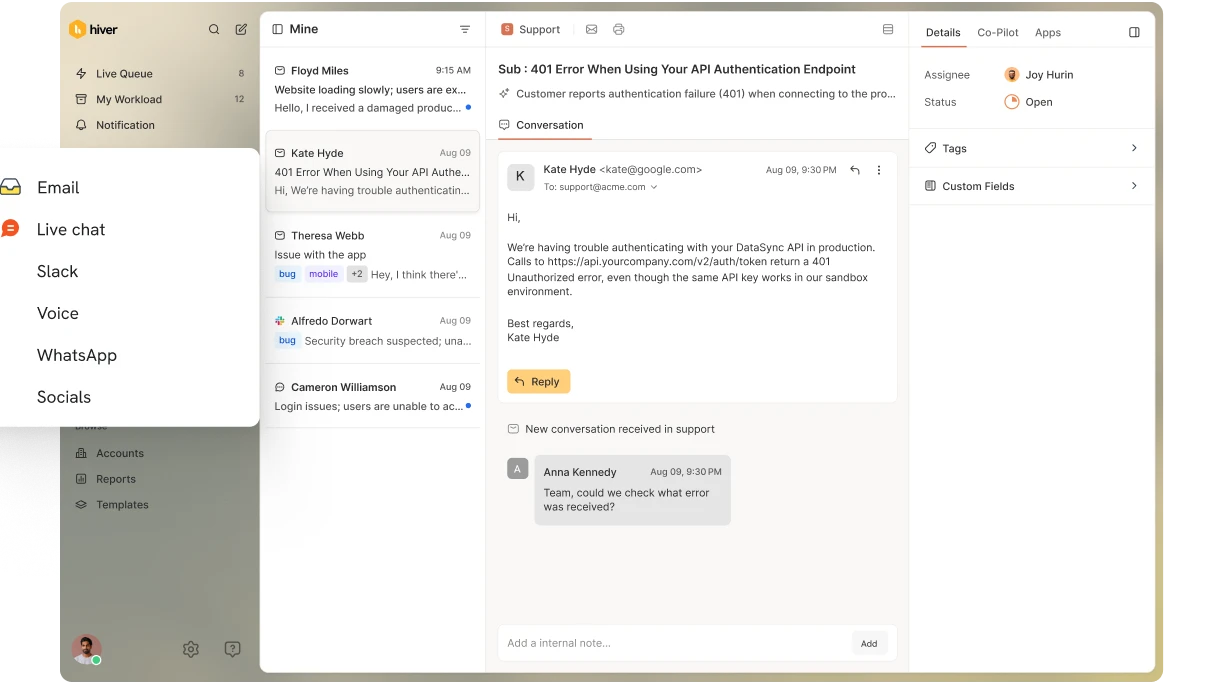
Hiver is the agentic omnichannel customer service platform where teams resolve complex support requests with AI Agents, cross-team collaboration, workflows, and ticketing.
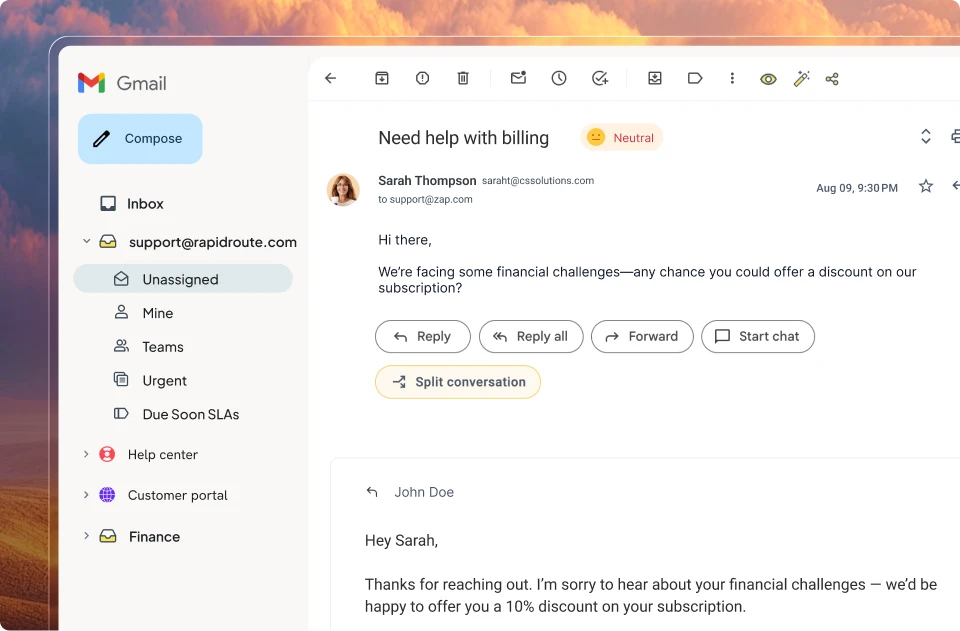
Hiver helps teams manage shared inboxes, like support@ or billing@, and turns every incoming email into a trackable conversation with an owner and a status It also has built-in ticketing with routing, SLAs and custom fields so nothing falls through the cracks. It’s built for teams that have outgrown Google Groups, distribution lists, or a plain shared inbox and need real ownership and structure instead.
Escalations and handoffs stay visible to everyone involved, and teams collaborate over Slack without leaving Hiver. Hiver connects to your CRM, ERP, and order management systems to pull full context into every conversation, so agents and AI both have what they need without switching tools.
That focus on hard tickets shows up in the results. Flexport’s freight operations team runs exactly this kind of work: a single shipment question can involve carriers, customs, and the customer at once. After moving to Hiver, the team resolved customer emails 50% faster. “With Hiver, we have much better visibility across support conversations. Trying to achieve this level of collaboration without it would be impossible,” says Nathan Strang, Ocean Freight Operations Manager at Flexport. Read the Flexport case study.
Key features
- AI Agents: tag incoming emails, read tone, pull out details like order IDs, and resolve routine requests end to end, so agents only touch the tickets that need them.
- AI Copilot: drafts replies, fixes tone, and summarizes long threads while an agent works a harder ticket.
- AI Insights: shows performance trends and customer sentiment, plus where automation could help next, without manual reporting work.
- Ticketing with clear ownership: every email becomes a trackable ticket with an assignee and a status (Open, Pending, or Closed), with SLA tracking and automations handling sorting and assignment as volume grows.
- Cross-team collaboration: internal notes, @mentions, shared drafts that let two people write one reply together, and collision alerts so customers never get two answers to the same email.
- Integrations: two-way sync with Slack, Asana, Jira, and Salesforce. An agent can raise a Jira issue from a ticket, and engineering’s updates show up back in the same thread.
Pricing

- Free: $0, free forever, with shared inbox basics for teams just getting started, and no agent limits
- Growth: $25 per user/month, ideal for small teams delivering multi-channel support
- Pro: $55 per user/month, for teams transforming their support with advanced features
- Elite: $85 per user/month, for teams that need the full platform
- Trial: 7-day free trial. AI capabilities are included in plans rather than metered; see current plans and pricing
Pros
- AI included in every plan, so costs stay predictable as automation scales
- Built for complex, multi-step tickets that need input from teams outside support
- Most teams are running in under 15 minutes, without a dedicated admin
- Help center writes itself, with AI drafting articles from resolved conversations to close knowledge gaps
- No agent limits, even on the lowest tier plan
Cons
- Some advanced capabilities, like custom reporting, sit on higher tiers
Best for: email-first customer service, finance, and HR teams that handle complex, high-stakes requests and want AI that resolves them end to end, not just deflects the easy ones.
Best email ticketing systems for small teams
Under roughly 10 agents, setup effort and cost matter more than feature depth. Most tools here have a free plan or a sub-$20 entry price. Watch the fine print on free tiers: most cap agents, contacts, or both.
2. Help Scout

Help Scout is a clean, email-first helpdesk known for giving agents full customer context without switching tools. It’s one of the easiest platforms for a small team to adopt, and its self-service tooling is strong. Its AI features are useful but limited in scope. In comparison, Hiver’s AI supports teams across the entire workflow, with AI embedded across triage, response, and insights.
Key Features
- Customer context sidebar: past interactions, contact info, and activity on every conversation, so agents respond without switching tools.
- Beacon widget: embeds a contact form, chat box, and knowledge base link into your site or app, letting customers pick how they reach you
- Workflow essentials: ticket routing, prioritization, automation, analytics, response templates, and tagging.
- AI toolkit: AI Drafts suggests responses from past conversations, AI Summarize condenses threads, and AI Assist refines tone and grammar.
Pricing

- Free: up to 5 users, 1 inbox, and 100 contacts per month
- Standard: $25 per user/month
- Plus: $45 per user/month
- Pro: $75 per user/month (10-user minimum)
- AI Answers: billed separately at $0.75 per resolution
- 15-day free trial
Pros
- Clean, email-like interface with near-zero onboarding effort
- Solid knowledge base and self-service tooling
- Real free tier for very small teams
Cons
- AI is limited in scope, and the autonomous AI Answers bills per resolution
- Add-ons and the Standard-to-Plus jump raise the real price quickly
- The free plan’s 100-contact monthly cap is a hard wall for a growing queue
Best for: small to mid-sized businesses looking for an intuitive email ticketing system to manage customer conversations.
Learn what makes teams choose Hiver over Help Scout.
3. Zoho Desk

Zoho Desk is a budget-friendly helpdesk from the Zoho suite, with a forever-free plan and one of the lowest entry prices in the category. It’s a natural choice for teams already running Zoho products like Zoho CRM. According to some users, integrating it with tools outside the Zoho ecosystem can get tricky.
Key Features
- Zia AI: sentiment analysis on incoming tickets plus response suggestions drawn from your knowledge base.
- Automatic ticket handling: email-to-ticket conversion with priority sorting and criteria-based auto-assignment.
- Multi-channel intake: collects tickets from email, social media, live chat, web forms, and phone.
- Agent collaboration: private comments, tagging, interaction history, and pre-made templates.
Pricing

- Express: $7 / Standard: $14 / Professional: $23 / Enterprise: $40 per agent/month, billed annually
- Zia AI is bundled into seat prices, with the most advanced AI on Enterprise
- 15-day free trial
Pros
- One of the lowest paid entry prices in the category
- Sentiment-aware triage on a small-team budget
- Tight fit with the rest of the Zoho suite, including Zoho CRM
Cons
- Integrations outside the Zoho ecosystem can get tricky to set up
- Advanced AI and channel features sit on the top tiers
Best for: cost-conscious small teams that want AI-assisted ticketing, especially if they already run Zoho products.
4. Jitbit

Jitbit is a straightforward, email-first helpdesk that has been around since 2005 and deliberately stays lean. It loads fast, and teams can set it up in minutes (as quickly as 30 seconds, by its own claim). Its defining trait is deployment flexibility. You can run it in the cloud or host it on your own servers, which makes it a favorite of IT teams with compliance or infrastructure requirements.
Key Features
- Flexible hosting: cloud version or a self-hosted install on your own infrastructure.
- Ticketing essentials: shared inbox, email assignments, canned responses, and advanced reporting.
- AI assistance: ticket summarization, enhanced article suggestions, and automated responses.
- Knowledge base builder: self-service content without a separate tool.
Pricing

21-day free trial
Pros
- Self-hosted option for teams with infrastructure or compliance requirements
- Flat cloud pricing rather than per-seat, which favors larger small teams
- Minimal setup and a simple interface
Cons
- Email-only: no live chat, call center, or social channel support
- The mobile app has limited functionality, so on-the-go support is impractical
Best for: small and mid-sized IT and helpdesk teams that want a lightweight system with flexible hosting.
5. HelpCrunch

HelpCrunch is an all-in-one customer communication platform that covers support, sales, and marketing in a single subscription, which makes it a popular pick for startups running lean. According to some users, its main drawback is limited (around 30) native integrations with other tools and CRM systems, which makes it harder to streamline workflows across a bigger stack.
Key Features
- Unified inbox: email, chat, and social DMs in one queue with tagging, assignment, and merging.
- AI editor: real-time translation, tone adjustment, and condensing of long replies.
- Customer view: location, time zone, and product-usage path for every contact, so you understand intent before replying.
- Marketing tools: email campaign builders and popups most helpdesks don’t carry.
Pricing

- Basic: $15 per user/month
- Pro: $25 per user/month
- Unlimited: $620/month flat
Pros
- Low entry price with chat and email together
- Marketing tools bundled in, useful for startups running lean
- Strong customer-context view
Cons
- Around 30 native integrations, which limits workflow automation across your stack
- AI conversation allowances are tight (50/month on Pro), and paid extensions add up
Best for: startups and small to mid-sized businesses that need an all-in-one ticketing solution with built-in marketing tools.
6. ProProfs Desk

ProProfs Desk is an easy-to-use, budget-friendly ticketing tool that covers the essentials for small teams, and it now has one of the lowest entry prices in the category. It integrates easily with other ProProfs tools like Knowledge Base and Chat, but it lacks strong third-party integrations with tools like HubSpot CRM and Zapier.
Pricing

- Essentials: $39.99/month, or $19.99/month billed annually, for 1 user and 1,000 tickets/month
- Business: $49.99/month, or $29.99/month billed annually, for 1 user and 6,000 tickets/month
- Business Complete Elite: $179.97/month total for 3 user seats and 15,000 tickets/month, billed annually. 15-day free trial
Pros
Pros
- Parent-child structure suits multi-part requests on a budget
- Free plan for solo operators
- Easy integration with other ProProfs tools (Knowledge Base, Chat)
Cons
- Weak third-party integrations (no native HubSpot CRM or Zapier), which blocks custom cross-app workflows
Best for: small teams that want low-cost, multilingual ticketing and can live inside the ProProfs ecosystem.
Best Email Ticketing Systems for Enterprise Teams
At enterprise scale, the evaluation flips: routing depth, permissions, and integrations matter more than time-to-value. The trade-off across this category is consistent. These are powerful platforms with long implementations and AI that bills by usage on top of seats, so model your ticket volume against the per-resolution rates before you sign, not after.
7. Zendesk

Zendesk is the market leader in helpdesk and ticketing software, and a popular choice among large teams that use multiple support channels. Setting up and using the platform isn’t straightforward, though. Most teams need a dedicated admin to configure and maintain it, and many Zendesk customers end up paying for AI capability they never fully implement.
Key Features
- Agent Workspace: email, chat, mmessaging, and calls in one unified view with full customer history.
- AI routing: tickets routed by intent, language, and customer sentiment, with response suggestions for agents.
- AI QA and workforce management: automated quality monitoring plus AI forecasting, scheduling, and real-time adherence.
- Ecosystem: community forums, knowledge base, and one of the largest integration marketplaces in the category.
Pricing

- Support: from $19 per agent/month (email and ticketing only)
- Suite: $55 to $115+ per agent/month, billed annually; Enterprise is sales-led
- AI agents: included in every plan since May 2026, with a small free resolution allowance; above it, each AI resolution bills at roughly $1.50–$2.00, and overages are charged automatically
- Copilot: separate add-on at $50 per agent/month
- 14-day free trial, no free plan
Pros
- Deepest routing, customization, and enterprise governance in the category
- Massive marketplace of prebuilt integrations
- Mature AI QA and workforce management tooling
Cons
- Complex setup with a real learning curve; plan for a dedicated admin
- AI bills per resolution above a small allowance, with auto-charged overages
- Fully loaded cost (seats + Copilot + resolution meter) far exceeds the sticker price
Best for: large and enterprise-sized companies looking for an all-in-one customer service ticketing system.
What makes Hiver the no-fuss, high-impact alternative to Zendesk
8. Intercom (now known as Fin)

Intercom is a customer messaging and support platform built around an AI-first approach, best known for Fin, its AI agent. Two things changed in 2026. In May, the company renamed itself Fin, and in June, Salesforce signed a definitive agreement to acquire it for roughly $3.6 billion, expected to close in late 2027. Pricing hasn’t changed, but on a multi-year contract, the roadmap will eventually sit inside Salesforce. Fin itself launched with outcome-based pricing back in early 2023, about a year ahead of most competitors, so the usage-based model other platforms are now adopting is one Fin pioneered.
Key Features
- Three ticket types: Customer Tickets keep buyers informed on progress, Back-office Tickets let agents collaborate privately with billing or engineering, and Tracker Tickets manage broad issues like outages affecting many customers.
- Fin AI Agent: learns your brand’s tone, supports over 45 languages, embeds across your website, product, and app, pulls in account and purchase data from external sources, and hands off complex issues to human agents.
- Customer portal: buyers view, track, and manage their tickets in one place, with custom ticket statuses that match your process.
- Side conversations: loop in external partners without losing customer context.
Pricing

- Essential: $19 (list price $29, discounted rate as of this writing) / Advanced: $85 / Expert: $132 per seat/month
- Fin AI: $0.99 per outcome (a resolution, procedure handoff, or disqualification), billed on top of seats
- 14-day free trial
Pros
- One of the most capable autonomous AI agents on the market
- Thoughtful ticket architecture for coordinating internal and customer-facing work
- Strong in-app and messenger-first support experience
Cons
- $0.99 per outcome on top of seats makes costs scale with automation success
- Add-ons and channels push the real price well past the $29 headline
- Pending Salesforce acquisition adds roadmap uncertainty for long-term contracts
Best for: fast-growing businesses and enterprises that need a ticketing system with AI-powered automation and multi-channel customer engagement.
9. HappyFox

HappyFox is known for its flexibility and customization. Its ticketing system lets you shape your support process to fit your team’s exact needs, from the information a ticket captures to the steps used to resolve it. The trade-off is ramp-up time. The interface can feel complex, and there’s a steep learning curve.
Key Features
- Custom workflows: ticket forms, email templates, and resolution steps configured to your exact process.
- Task breakdown: split one ticket into smaller trackable tasks assigned to different agents.
- Bulk actions: tag, re-status, and manage many tickets at once, with pinning for critical issues.
- Reporting: ticket volume, response time, resolution time, and customer satisfaction.
Pricing

- Help Desk: from $24 per agent/month; also available with unlimited-agent pricing
- HappyFox AI: from $14 per agent/month
- Workflows: from $199/month
- Autopilot: pay as low as 2¢ per successful action
- 14-day free trial
Pros
- Workflow customization depth unusual at this price point
- Task breakdown suits teams coordinating multi-person resolutions
- Strong bulk-management tooling for busy queues
Cons
- The base plan caps at five agents, forcing an upgrade as you grow (Hiver places no agent limits, even on its free plan)
- The interface is complex, with a steep learning curve
Best for: teams that need to shape the helpdesk around a precise internal process and will invest the ramp-up time.
Best Email Ticketing Systems for High-Volume, Multi-Channel Support
When email is one of five channels and volume runs to hundreds of conversations a day, you need collision detection, load-balanced routing, and one queue across channels. These three tools are built for that shape of work.
10. Freshdesk

Freshdesk’s email ticketing system is amongst the most sophisticated in the industry, and it scales from a small team to serious multi-channel volume. According to several users, setting up its advanced features can be challenging, often requiring extra training. Its most useful AI capabilities are also sold as paid add-ons. In comparison, Hiver includes AI capabilities natively within its plans.
Key Features
- Collision detection and shared ownership: agents see who’s already on a ticket, and higher tiers let two agents share ownership, a useful on-the-job training tool for managers.
- Freddy AI: automates tasks, summarizes issues, and suggests responses (sold as add-ons; see Pricing).
- Self-service: portal and knowledge base with FAQs and help guides.
- Gamification: support tasks become challenges with points, rewards, and leaderboards to keep agents engaged.
Pricing

- Growth: $19 per agent/month
- Pro: $55 per agent/month
- Enterprise: $89 per agent/month (annual billing)
Pros
- Scales well from small team to serious volume
- Collision detection and shared ownership built for busy queues
- Broad omnichannel coverage via the Freshdesk Omni line
Cons
- Advanced feature setup is genuinely difficult without help
- AI is sold as add-ons: per-agent Copilot plus per-session Agent packs
- The free plan is now time-limited, so long-term free usage is off the table
Best for: growing and high-volume teams that want omnichannel ticketing, automation, and scalability.
Recommended reading: Discover what makes Hiver a smarter choice for a ticketing system over Freshdesk.
11. Front

Front is a shared inbox solution built for teams that work and collaborate out of a common mailbox, and it’s known for encouraging a highly collaborative work environment. Many users raise concerns about its pricing. The plan lineup changed completely in 2026, some basic features sit on higher-priced plans, and AI is gated behind paid add-ons. Hiver bakes AI capabilities into its base plans at no added cost.
Key Features
- Universal inbox: email, social, and live chat in one central queue, assigned by availability and expertise.
- Shared drafts: colleagues co-write one reply, with full visibility into each other’s work.
- AI toolkit: AI Compose drafts emails, AI Summarize condenses queries into bullet points, and AI Answers runs round-the-clock chat.
- Workflow automation: rules, macros, and workspaces that deepen with each tier.
Pricing

- Starter: $25 per seat/month (one channel type; caps at 10 seats)
- Professional: $65 per seat/month (caps at 50 seats)
- Enterprise: $105 per seat/month
- AI add-ons: Copilot and Smart QA about $20 per seat/month each
- Billed annually; 14-day free trial, no free plan
Pros
- Best-in-class collaboration mechanics: shared drafts, comments, visibility
- Clean, familiar inbox experience that teams adopt quickly
- Solid multi-channel coverage on Professional and above
Cons
- AI features stack as per-seat add-ons, with Autopilot metered per resolution
- Seat caps on Starter (10) and Professional (50) force tier jumps
- No free plan, and mandatory paid onboarding on larger contracts
Best for: organizations that need a collaborative ticketing solution for managing multi-channel communications.
12. LiveAgent

LiveAgent is an affordable, multi-channel helpdesk that keeps every customer conversation organized in one place, whether it starts on email, chat, or a phone call. It’s been on the market since 2004 and delivers strong value for teams that want voice support included without an enterprise budget, though the interface feels dated in places.
Key Features
- Hybrid ticket stream: a conversation that starts on chat and continues on email stays in one continuous thread.
- Universal inbox: assigning, tagging, merging, and splitting from a centralized dashboard, with a To Solve button that flags priorities.
- Built-in call center: voice support without a third-party phone system.
- AI Answer Assistant: generates polished replies to help agents respond faster.
- Online ticket history: customers and agents access past tickets via a simple link.
Pricing

- Small: $15 / Medium: $29 / Large: $49 / Enterprise: $69 per agent/month, billed annually
- AI features are included across plans; social media channels cost extra on the smaller plans
- 30-day free trial
Pros
- Email, chat, and a call center in one affordable package
- Hybrid ticket stream genuinely solves cross-channel context loss
- Long trial makes evaluation low-risk
Cons
- Social media channels cost extra on the smaller plans, and WhatsApp runs through third-party providers
- Interface feels dated next to newer platforms
Best for: small to large teams that need affordable multi-channel ticketing with voice included.
See how Hiver compares to Front for teams weighing collaboration features against a lower total AI cost.
What Features Should You Look For in an Email Ticketing System?
When evaluating email ticketing systems, list your pain points first and identify the features that solve them. Here are the most important ones to look for:
Customizable views: Managers should be able to set up custom views for their team members. For example, a frontline agent should only see their tickets. This prevents information overload and ensures security protocols are followed.
Automations: You should be able to automatically assign and organize (tag) customer queries with no manual effort. For instance, all emails on billing can be auto-assigned to a billing specialist using automations.
Collaboration features: Delivering great customer service takes teamwork. Look for a system where your support staff can collaborate on crafting customer responses, share internal notes, and escalate issues to the right people–without stepping on each other’s toes.
See how Hiver compares to Front for teams weighing collaboration features against a lower total AI cost.
What Features Should You Look For in an Email Ticketing System?
When evaluating email ticketing systems, list your pain points first and identify the features that solve them. Here are the most important ones to look for:
- Automations: You should be able to automatically assign and organize (tag) customer queries with no manual effort. For instance, all emails on billing can be auto-assigned to a billing specialist using automations.
- Collaboration features: Delivering great customer service takes teamwork. Look for a system where your support staff can collaborate on crafting customer responses, share internal notes, and escalate issues to the right people–without stepping on each other’s toes.
- Customizable views: Managers should be able to set up custom views for their team members. For example, a frontline agent should only see their tickets. This prevents information overload and ensures security protocols are followed.
- Performance tracking: Your ticketing system should help you track key metrics like response and resolution times, customer satisfaction, and agent performance. This can help you identify bottlenecks in your processes and make data-driven decisions to improve support quality.
- SLA management: The system should let you set and track Service Level Agreements (SLAs). This ensures that customer queries are responded to and resolved on time. For instance, you can set up an SLA where all incoming customer queries are responded to within 24 working hours.
- Multi-channel support: Different customers would reach out to you in different ways. Some may prefer email, some may opt to chat with you in real-time, others might choose to tag you on their socials and express their opinion. Look for a system that brings all these queries and comments into one single place.
- Integration capabilities: Your ticketing software should integrate with other tools you’re currently using, such as CRM, project management software, and more. This reduces tab-switching, improves response times, and keeps everyone on the same page.
- Mobile accessibility: If your ticketing system comes with a mobile app, your customer support team can manage tickets on the go.
- Customer history: Having access to a customer’s past interactions can help your agents provide them with more contextual and personalized support without asking the same questions over and over.
- AI-powered assistance: Your ticketing tool should empower your agents with AI assistance like suggested replies and ticket summaries, and increasingly, AI agents that resolve routine requests on their own. Check how the AI is priced. Per-resolution and per-session billing can grow faster than your seat costs.
- Customer self-service options: Invest in a ticketing solution that integrates with your company’s knowledge base or FAQ section. This helps customers find answers on their own, reducing the number of tickets your support team has to handle. It’s a win-win!
How Does an Email Ticketing System Work?
At a glance, an email ticketing system turns chaotic email threads into structured, trackable tasks. But how exactly does it work behind the scenes?

Here’s what happens when a customer sends in an email:
Step 1: A ticket is created
Every incoming email automatically becomes a ticket. This ticket gets a unique ID so it can be tracked from start to finish. No more emails buried in folders or lost in long threads.
Step 2: The ticket is categorized and prioritized
The system tags the ticket based on keywords, sender, or subject, like “Billing” or “Technical Issue.” Priority levels (High, Medium, Low) can be auto-applied depending on urgency or SLAs.
For example, emails from VIP customers or containing the word “urgent” can be auto-marked high priority.
Step 3: The ticket is assigned or routed
Tickets are either auto-assigned using rules (like round-robin or skill-based routing) or manually assigned by a manager. This ensures clear ownership and faster response times.
Step 4: The team collaborates and resolves the issue
Some email ticketing tools come with collaboration features that let agents @mention teammates, add internal notes, and even create shared email drafts without ever leaving the ticket. This avoids back-and-forth emails or Slack messages.
Step 5: Feedback is collected and the ticket is closed
Once the issue is resolved, the agent closes the ticket. Most systems let you trigger a quick CSAT survey to capture customer feedback at this point.
Step 6: Performance is tracked through reports
Managers get a full view of agent performance and support quality. Most email ticketing tools allow you to track metrics like average response times, resolution rates, SLA breaches, ticket volumes, and more. These insights help identify bottlenecks and improve support processes.
Recommended reading
Customer Support Ticketing System: The Complete Guide
What’s the Difference Between a Shared Inbox and an Email Ticketing System?
Shared inboxes and ticketing systems both help teams manage emails from addresses like support@company.com or it@company.com. But that’s where the similarities end.
A shared inbox gives everyone access to incoming messages, but without structure. There’s no clear ownership, no status updates, and no way to know who’s working on what.
An email ticketing system adds that missing structure. Every email becomes a trackable ticket that’s assigned to the right person, tagged by priority or topic, and marked with a clear status (Open, Pending, Closed). It also brings in SLAs, performance tracking, and internal collaboration tools.
So although shared inboxes work well for low volumes, ticketing becomes essential once higher volume, SLAs, or cross-team collaboration comes in.
Here’s how they compare:
Feature | Shared Inbox | Email Ticketing System |
| Ownership | Anyone can reply | Clear assignees and accountability |
| Status Tracking | Manual or missing | Open, Pending, Closed statuses |
| Collaboration | Forwarding CCs, side chats | Internal notes, @mentions, shared drafts |
| Automation | Basic filters at best | Auto-assign, auto-tag, round-robin workflows |
| Reporting | None | Dashboards for SLAs, response time, workload |
| Scalability | Breaks down with volume Built for high-volume, | multi-channel teams |
When Should You Switch From a Shared Inbox to a Ticketing System?
You’ll know it’s time to move on from a shared inbox to a ticketing system when:
- You’re handling 25+ support emails a day
- Multiple agents end up replying to the same email
- Important queries go unanswered
- You can’t track how your team is performing
- There’s no clear handoff or ownership
Example: Your IT team manages hardware requests, software bugs, and password resets. In a shared inbox, these get lumped together. With an email ticketing system, each issue is auto-tagged, assigned to the right person, and tracked until resolved.
Recommended reading
What Is a Shared Inbox + 10 Best Tools to Pick From in 2025
Which Teams Benefit Most From an Email Ticketing System?
An email ticketing system isn’t just for support teams – any team that deals with a high volume of emails should invest in it. Whether it’s customer-facing service or internal requests, ticketing brings structure – and AI helps teams handle volume without losing quality.
Here’s how different teams can put them to work:
- Customer Support: No more lost emails or duplicated responses. Every customer request can be assigned, tracked, and resolved efficiently.
- IT & Helpdesk: From password resets to major tech troubleshooting, delegate, prioritize and track IT requests without inbox clutter.
- HR & People Ops: Streamline queries and processes related to onboarding, payroll and benefits so employees get assistance faster.
- Finance & Accounting: Track, manage, and organize invoices, reimbursements, and approvals without hassle.
- Sales & Business Development: Ensure timely follow ups and never lose a lead or let a deal fall through the cracks.
- Legal & Compliance: Stay on top of contracts, policy approvals, and compliance requests without drowning in emails.
- Operations & Logistics: Effortlessly organize and monitor supplier communications, shipment updates, and inventory requests.
No matter the team, an email ticketing system cuts down manual work, improves accountability, and enhances customer satisfaction across the board.
Recommended reading
Internal Ticketing Systems: How they work, features, and tools to consider
What Are the Best Practices for Using an Email Ticketing System?
So, once you’ve adopted an email ticketing system that suits your organization’s needs, the next step is to make sure you get the most value from it. That’s where some best practices come in handy:
- Train your agents: The most fundamental step is to train your agents to use the email ticketing system. Make sure they know how to navigate the interface and use its main features. You can schedule training sessions every 3 months to cover updates or changes.
- Categorize and prioritize: Categorize tickets by type (like technical issues or billing queries) and prioritize them based on urgency. You can also use color-coded labels and tags to visually highlight priority levels.
- Use templates wisely: Canned responses can speed up replies. But use them carefully. Make sure the response template aligns with what the customer is asking. Also, don’t forget to personalize certain parts of the email (such as the customer’s name) before hitting send.
- Maintain a knowledge base: Update and optimize the content on your knowledge base regularly. Sync up with your support team once a month to see if there are any commonly asked questions from customers that haven’t been answered on the knowledge base, and ensure they’re added.
- Set clear SLAs: Define clear Service Level Agreements (SLAs) for response and resolution times. Also, make sure to monitor them regularly.
- Gather and act on feedback: After resolving a ticket, ask for customer feedback. You can use this feedback to spot any issues or concerns and make necessary adjustments to improve your support processes.
- Keep customers informed: Always update customers on their ticket status, especially if there are delays. Proactive communication can prevent frustration and build trust. You can use automated emails to convey the status of their inquiries.
- Encourage internal feedback: Your agents are the main users of the ticketing system. Encourage them to provide feedback on the system’s functions and any challenges they face. You can even have a bi-monthly meeting where all your support staff share what they like and don’t like about using the software.
What is an email help desk software?
An email help desk software is a customer support platform that helps support teams manage requests received through email and other channels. Unlike a basic email ticketing system, it provides a broader set of tools for running support, including knowledge bases, customer portals, live chat, automation, analytics, and AI.
For a start, an email help desk organizes incoming requests into tickets that agents can assign, prioritize, track, and resolve. But it goes further to give managers visibility into metrics like response times, resolution rates, ticket volume, and customer satisfaction.
The exact capabilities vary by platform. Some, like Help Scout, focus primarily on email-based support and keep the experience simple for agents. Others, such as Hiver, combine email ticketing with AI Agents, AI Copilot, workflows, SLAs, collaboration, and omnichannel support for teams handling more complex requests.
Email ticketing system vs email help desk software
| Email ticketing system | Email help desk software | |
| Primary purpose | Organize and track email requests | Manage the broader customer support operation |
| Core features | Ticketing, assignment, status tracking, tagging | Ticketing plus automation, reporting, knowledge bases, and more |
| Channels | Primarily email | Email plus chat, phone, social, WhatsApp, and other channels |
| Best for | Teams that mainly need structured email workflows | Teams that need a complete support platform |
In most support environments, the two terms overlap, and many teams use them interchangeably.
The main difference is scope: email ticketing focuses on managing support requests, while email help desk software provides a broader system for managing customer support.
For teams that only need to turn emails into trackable tickets, a dedicated ticketing tool may be enough. While teams with complex workflows, multiple channels, or growing support operations may benefit from a full help desk.
How we selected the tools on this list
To determine the 12 best email ticketing and help desk platforms, we considered key email support features like:
- Ticket management: Can it turn emails into trackable tickets with clear ownership, statuses, priorities, and assignment?
- Automation: Can it automate repetitive tasks like ticket routing, tagging, prioritization, and follow-ups?
- Collaboration: Can multiple agents work on the same request without duplicating work or losing context?
- Analytics: Does it provide reports on response times, resolution rates, ticket volume, SLAs, and agent performance?
- AI capabilities: Can its AI help with tasks like triaging, summarization, drafting, sentiment analysis, or resolving routine requests?
- Multichannel support: Does it let teams manage requests from channels beyond email? For example, chat, voice, social media, or messaging apps?
- Integrations: Can it connect with the CRM, communication, project management, and other tools your team already use?
- Ease of use: Can you get started quickly without extensive technical setup or training?
- Pricing: Does the pricing match the features offered, and are important capabilities included in the base plan or locked behind expensive tiers?
- Scalability: Can the platform support a growing support operation without making workflows or costs unmanageable?
Based on these key criteria, here are the tools that made this list and what makes each one worth considering
What are the challenges of implementing an email ticketing system?
Rolling out an email ticketing system isn’t just a software decision. It’s a shift in how your team handles customer communication. And while the benefits are huge, it’s normal to hit a few bumps along the way.
Here are some common implementation challenges, and how to solve them:
1. Integration Bottlenecks
The issue: You want your ticketing system to connect smoothly with tools like your CRM, Slack, project trackers, or billing software. But sometimes APIs clash, or integrations feel half-baked.
The fix: Before committing, test key integrations during the trial period. Look for tools with native integrations or flexible APIs (Hiver, for instance, integrates with Salesforce, Asana, Jira , and Slack out of the box).
Platforms that support webhooks make custom workflows much easier.
2. Team Adoption and Onboarding
The issue: Your team is used to a shared inbox. New workflows and dashboards can feel intimidating or unnecessary, leading to slow adoption or shadow workflows.
The fix: Pick a tool with a familiar interface. Also, roll out in phases: start with one department or use case (like billing queries), gather feedback, and expand from there.
Did you know? Most teams start using Hiver in under 15 minutes. Check out how Pattern Life, a physician-focused insurance brokerage, set up Hiver with almost no training and started resolving customer queries on day one.
3. Data Migration and Setup
The issue: Switching from one system to another means migrating old tickets, contacts, and workflows without losing context or breaking anything.
The fix: Choose a vendor that offers migration support or detailed documentation. Most modern tools support CSV imports, historical data migration, and email syncing. For a smoother setup, define key tags, SLA rules, and user roles before the switch.
4. Cost vs. Feature Overload
The issue: You find a tool that’s packed with features, but you’re only using 30% of it. Worse, that unused complexity still costs you.
The fix: Don’t pay for bells and whistles your team won’t use. Instead, start with a tool that’s modular or easy to scale.
Hiver’s plans, for example, offer essential features on the free tier, so teams can start small and upgrade as needs evolve.
5. Workflow Training and Optimization
The issue: Even with the right tool, support can stay inefficient if workflows aren’t optimized. Agents default to manual processes, defeating the purpose of automation.
The fix: Invest time in workflow reviews. Use built-in analytics to find bottlenecks like SLA breaches or delayed responses. Then automate what you can: routing, tagging, assigning, etc.
Why agentic email support might be the next step for your support team
While an email ticketing system brings structure to your support, it doesn’t eliminate the work behind every ticket.
Your team still has to triage incoming requests, route them to the right person, gather context from other systems, draft responses, and follow up. As volume grows, these manual steps create bottlenecks, and knowledge gaps and inconsistent resolutions make it harder to maintain support quality.
Agentic email support changes that by putting AI across the entire support lifecycle, rather than limiting it to individual tasks.
AI agents can understand a request, investigate the issue, pull information from connected systems, follow established procedures, take actions, and resolve routine requests. When human judgment is needed, AI can hand the request to an agent with the relevant context, similar issues, and suggested next steps already prepared.
So, instead of one ticket, one task, and one resolution at a time, AI handles the work around each request while your team focuses on the cases that genuinely need them.
Hiver’s agentic customer service platform takes this approach by making AI an intelligence layer across email support. Its AI Agents handle requests from intent to resolution, while AI Copilot supports agents with context and actions.
AI Insights surface patterns that can improve support operations, and resolved conversations feed back into the knowledge base, so what your team learns from one case can help resolve the next.
If you’re choosing a ticketing system today, look beyond whether it can assign a rep to a ticket. Consider whether its AI capabilities are strong enough to reason, take action, learn, and improve across the full support lifecycle—as Hiver’s does.
Choose for the Support You’ll Have in a Year
The right email ticketing system isn’t the one with the longest feature list. It’s the one that matches how your team actually works. Small teams should optimize for setup, speed and honest free tiers.
speed and honest free tiers. Enterprise teams should model AI usage costs before signing, because per-resolution meters at Zendesk, Intercom, and Front mean the invoice grows with your automation success. High-volume teams should test collision handling and routing under real load.
And if your team handles complex queries that cut across departments, with AI you want included rather than metered, Hiver is the strongest place to start. It combines shared inbox simplicity with ticketing structure and AI across the full support lifecycle, built for email support from the ground up.
Ready to see it in action? Start your free trial today or book a demo.
Frequently asked questions
1. What is an email ticketing system?
An email ticketing system is software that converts incoming customer emails into trackable tickets with unique IDs, assigned owners, and status labels. It gives support teams structure, visibility, and accountability that a standard inbox can’t provide.
2. How does an email ticketing system improve customer service?
It gives every email a clear owner, status, and priority. Teams respond faster, avoid duplicate replies, and can track performance metrics like response time and resolution rate across the queue.
3. Can email ticketing systems integrate with other tools?
Yes. Most platforms integrate with CRMs, project management tools, live chat, and communication apps like Slack. Hiver, for example, connects natively with Salesforce, Jira, HubSpot, Asana, and Slack.
4. Are email ticketing systems suitable for small businesses?
Yes, email ticketing platforms can help small businesses organize support, automate repetitive work, and scale as ticket volumes grow, even with a lean budget. Hiver, for example, starts at $25/user/month, giving smaller teams access to robust ticketing and AI capabilities without requiring enterprise budgets.
5. What is the best email ticketing software?
The best option depends on your team’s support needs. For teams handling complex requests, Hiver combines ticketing and cross-team collaboration with AI Agents that can triage, investigate, take actions, and resolve requests across the support lifecycle. Other platforms may be a better fit for teams that prioritize simpler email-based support or enterprise-scale customization.
6. Can I track my support team’s performance with an email ticketing system?
Yes. Most systems include reporting dashboards that track first response time, average resolution time, SLA compliance, ticket volume, and agent workload.
7. What is the role of automation in email ticketing systems?
Automation handles routing, tagging, priority assignment, and status changes without manual input. It reduces repetitive work and ensures tickets reach the right agent faster.
8. What are the benefits of using AI in email ticketing systems?
AI automates triage (tagging, sentiment detection, routing), assists agents with reply suggestions and thread summaries, and surfaces quality and performance insights for managers. The result is faster response times and more consistent support quality. When comparing tools, check how AI is priced. Per-resolution and per-session billing can grow faster than your seat costs.
9. What is the difference between a shared inbox and an email ticketing system?
A shared inbox gives multiple agents access to a common email account but provides no structure. An email ticketing system adds ticket ownership, status tracking, SLA management, automation, and reporting on top of that access.
10. Which email ticketing system is best for B2B support teams?
Hiver is built specifically for B2B email support operations, with cross-team collaboration, account-level context from CRM and ERP integrations, and AI that goes beyond basic deflection. Zendesk and Intercom (now known as Fin) are also commonly used by B2B teams at larger scale, though both bill AI by usage on top of seat fees.