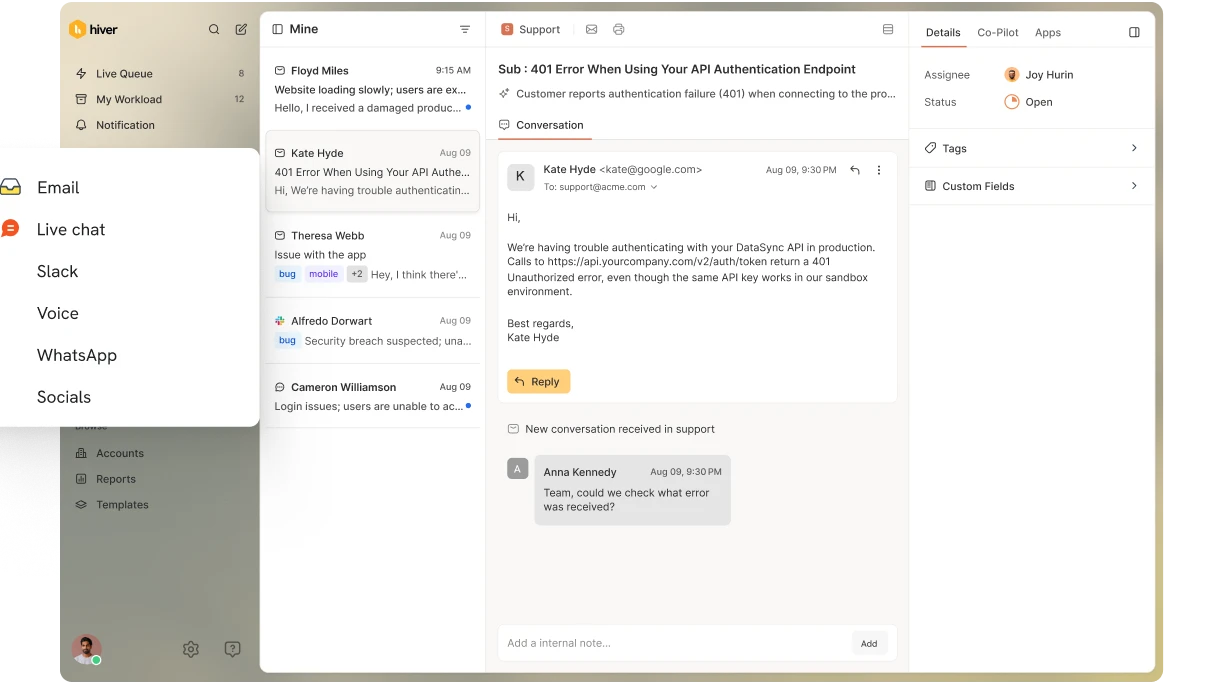







TL;DR : What are the best AI email assistant tools?
- Gemini (Gmail) — Best for built-in AI inside Gmail
- Microsoft Copilot (Outlook) — Best for built-in AI in Microsoft 365 workflows
- Hiver — Best for teams that want to manage emails collaboratively with AI
- Superhuman — Best for fast, high-volume email workflows
- Inbox Zero — Best for individuals who want AI to handle the inbox before they open it
- Shortwave — Best for AI search and a task-style inbox
- Notion Mail — Best for turning email into structured workflows
“How do you all manage email without losing your mind?”
Those were the exact words of a Reddit user dealing with 200+ emails a day across Gmail, Outlook, Mailchimp, and Zapier. Despite spending over $150 a month on tools, they were still losing more than two hours every day just trying to stay on top of their inbox.
Their question was simple: Is this normal?
And honestly, it pretty much is. Email volume piles up, new tools get added to cope with it, and before long, managing your inbox takes more time than actually using it productively.
That’s the gap AI email assistants are trying to fill. But not all of them solve the same problem. Some focus on writing, others on organisation, search, or automation.
This guide breaks down the 11 best AI email assistants by use case, so you can pick what actually fits how you handle email.
A note on how we built this list: We looked at AI email management tools that consistently show up across Google, LLMs, and real user discussions on Reddit. From there, we tested free trials where possible and went through G2 reviews to understand what people actually experience. The focus wasn’t just on features, but on what they lead to in practice: speed, collaboration, and automation.
Also, full disclosure, this blog is by Hiver, and we have included Hiver on this list. It has been evaluated the same way as every other tool here, with the goal of giving you a clear, useful breakdown so you can choose what actually fits your workflow.
Best AI email assistants for every use case
Here’s a breakdown of the best AI email management assistants right now, based on how you actually use email day to day.
| Tool | Best For | Starting Price | Built For |
| Gemini (Gmail) | Built-in AI inside Gmail | $7.99/month | Individuals |
| Microsoft Copilot (Outlook) | Built-in AI in Microsoft 365 | $30/user/month | Individuals |
| Hiver | Teams managing shared inboxes with AI | Free / $25/user/month | Teams |
| Superhuman | Fast, high-volume email workflows | $30/user/month | Individuals |
| Inbox Zero | AI handling the inbox before you open it | $18/user/month | Individuals |
| Shortwave | AI search and a task-style inbox | Free / $14/user/month | Individuals, light team use |
| Notion Mail | Turning email into structured workflows | Free | Individuals |
| SaneBox | Automatic low-priority email filtering | $3.49/month | Individuals |
| Fyxer AI | Inbox triage plus meeting notes | $30/month | Individuals |
| Boomerang | Follow-up discipline and conditional reminders | Free / $4.98/month | Individuals |
| Canary Mail | Privacy-focused AI email with encryption | Free / $3/month (yearly) or $100 lifetime | Individuals, some team features |
1. Gemini in Gmail: Best for built-in AI inside your Gmail inbox
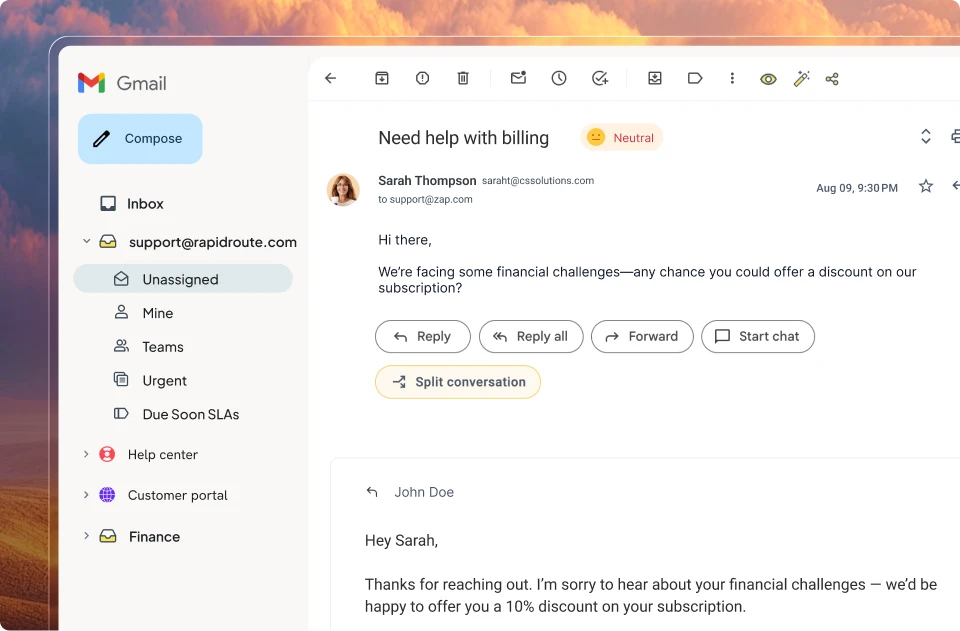
If you’re already using Gmail, Gemini is the easiest AI email assistant to get started with. You don’t have to download, configure, or sign up for anything. Just click on the icon next to the settings at the top right of your Workspace app, and you’re good to go.

Snapshot of Gemini in Gmail
Jump into any long thread and the AI summarisation feature gives you the context in seconds. Long threads, late additions, came back after a week off? Hit summarise and get the gist without scrolling through 14 replies to find the one sentence you needed.
Writing-wise, it covers the basics well. AI can draft a reply, tweak the tone, or lean on context-aware suggestions based on what’s already in the thread.
But search is where it gets genuinely useful. Instead of digging through your inbox for a confirmation number or an attachment from three months ago, you can ask something like “find my last invoice from Amazon” or “what was the tracking ID in that shipment email” and get a direct answer. It also pulls context from Google Drive, which puts it a step ahead of most standalone tools that only see what’s in your inbox.
And since everything is already connected within Google Workspace, Gemini extends to Calendar too. You can check your availability, ask about upcoming events, or create new ones without leaving Gmail.
Google is also testing AI-led organisation—grouping emails into “To-dos” and “Topics”—which could be useful once it matures a bit more.
One thing worth keeping in mind though: all of this runs through Google’s servers, so your emails and documents are being processed in the cloud. That’s fine for most people, but if you’re handling sensitive data, it’s a factor to consider before going all in.
Gemini also falls short when it comes to team email management. It’s built for individual use, so once multiple people are involved, there’s no ownership, no assignment, and no coordination. That leads to duplicate replies, missed emails, and confusion over who’s responsible.
Pros
- Built directly into Gmail, zero setup required, nothing to install or configure
- Solid for summarising threads, drafting replies, and accurate search across your inbox
- Connects to Drive and Calendar for context beyond just what’s in your inbox
- Free tier is genuinely usable, not just a crippled trial
Cons
- Doesn’t go far beyond individual productivity use cases; no ownership or routing for shared addresses
- Privacy concerns around sensitive data, since everything runs through Google’s servers
- Can lose context during long, fragmented conversations spanning weeks or months
- AI-led organisation (Topics, To-dos) is still early and inconsistent
Pricing
Available through Google AI plans starting at $7.99/month (Google AI Plus), with the Pro tier at $19.99/month if you need higher usage limits.
2. Microsoft Copilot in Outlook: Best for built-in AI if you use Outlook
Where Gemini is native to Gmail, Copilot is Microsoft’s answer for Outlook.
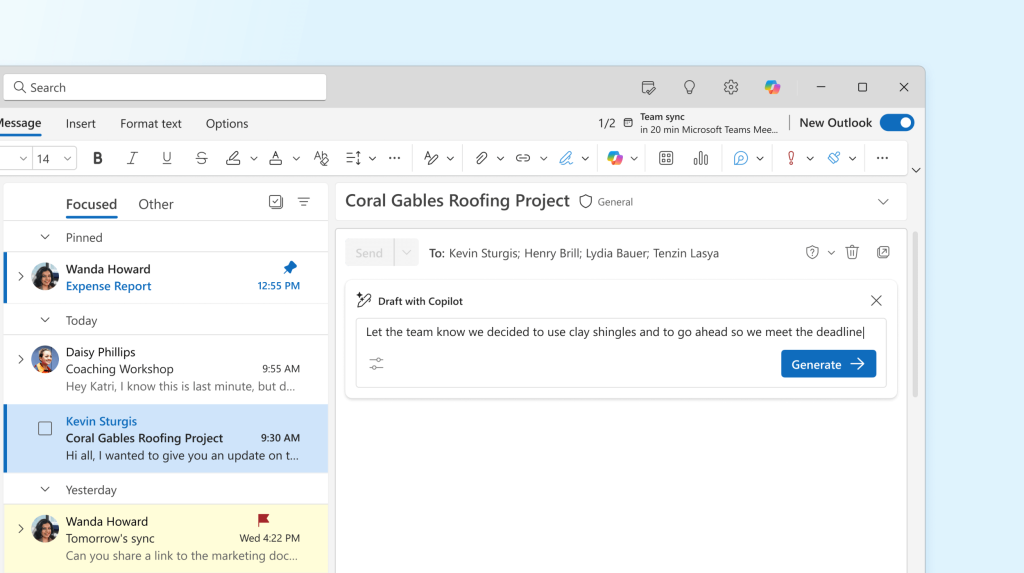
It lets you draft a reply from a short prompt, summarise a long thread, adjust tone or length before sending, or select a block of text and have Copilot rework it on the spot. It also picks up the smaller stuff, like flagging unread emails from your manager or setting up an automatic reply for when you’re out.
You can also ask the Copilot Chat feature things like “which unread emails are most important, summarise them and pull in any related context from my chats and documents.” It reaches across Teams messages and files to find the answers, which is useful when your work is spread across multiple tools.
Scheduling can help you set up a meeting, draft an agenda based on your current projects, or use “Schedule with Copilot” directly from an email thread. It reads the conversation, creates an invite with a title and agenda, adds the thread as an attachment, and pulls in the right attendees. You just review and send.
Another feature worth calling out is Coaching by Copilot. Before you send an email, it reviews tone, clarity, and structure and tells you what to improve. Gemini doesn’t have an equivalent, and it’s useful when a message needs to be framed well. That said, it only suggests improvements, you still have to make the edits yourself.
Few other things worth knowing before committing would be that its generated emails tend to sound a bit generic and sometimes even inaccurate. And like Gemini, Copilot only works on primary mailboxes, meaning shared, delegated, archived, or non-Exchange inboxes aren’t supported. This is a real gap if you manage email across multiple accounts or work out of a shared space.
Pros
- Works across the entire Microsoft 365 stack, not just email, pulling in Teams and files
- Scheduling directly from an email thread saves a lot of back-and-forth coordination
- Coaching feature reviews tone and clarity before you send, useful for high-stakes messages
Cons
- Generated output often needs a rewrite before sending; drafts can sound generic
- Full feature set is paywalled behind the add-on licence, on top of a Microsoft 365 subscription
- Coaching flags issues but doesn’t fix them; you still do the editing yourself
- Only works on primary mailboxes, not shared, delegated, archived, or non-Exchange inboxes
Pricing
Microsoft 365 Copilot is available as an add-on to existing Microsoft 365 plans, starting at $30/user/month.
3. Hiver: Best for teams that want to manage emails collaboratively and use AI for automation
Most tools on this list are built for one person’s inbox. Hiver solves what happens when multiple people share the same email address and no one can tell who’s handling what.
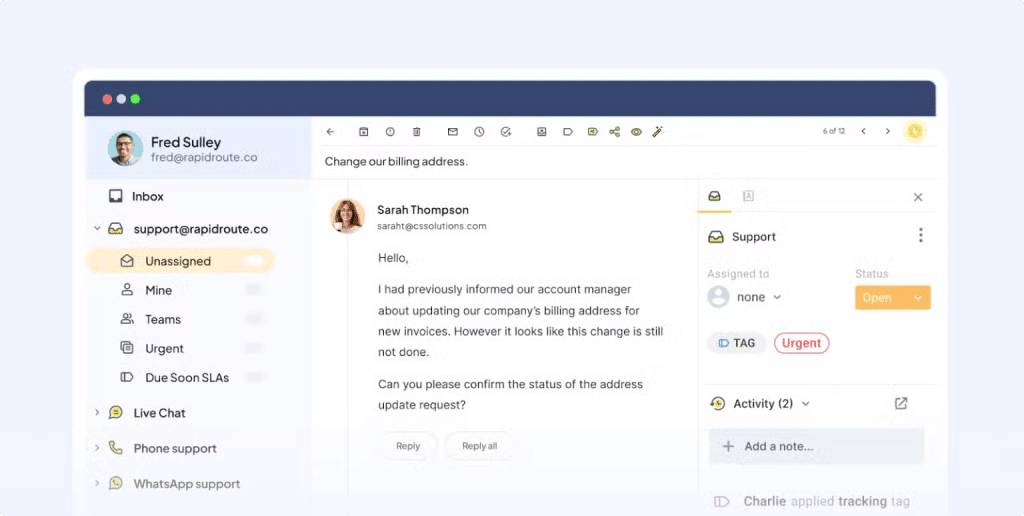
Managing emails in Hiver
If your team runs a support@, billing@, or ops@ inbox, you’ve probably seen this before. A customer writes in asking about a refund, and two agents reply with different answers because there’s no clear ownership. Another email sits unanswered because everyone assumes someone else picked it up. And when a customer follows up, the next person has to scroll through forwards just to understand what’s going on.
Hiver brings structure to these everyday workflows. When a new email comes in, it can be assigned instantly so ownership is clear from the start. A billing query can be tagged and routed to finance. If it needs input from engineering, you can @mention them directly in the thread and add context as an internal note.
This also makes response timelines easier to manage. For example, if a customer issue needs a reply within a few hours, SLA rules track it automatically and alert the team before it’s breached. Managers can quickly see what’s pending, what’s delayed, and who’s responsible, while reporting gives visibility into response times, workload, and bottlenecks.
Teams can run Hiver directly inside Gmail, OR as a standalone omnichannel platform that connects with Gmail, Outlook, or another email provider.
Incoming emails don’t just sit there waiting to be sorted. AI Tasks picks them up, understands intent, and routes them automatically—without relying on keywords alone. Say a customer writes “I was charged twice for my order.” A keyword rule built around “refund” won’t catch that. AI Tasks does. It understands what the customer is asking for, extracts details like order ID or amount, routes the email to billing, and can trigger the next step (like logging the request or sending an interim reply) without any manual triage.
This approach holds up as volume grows. Because AI reads intent rather than matching keywords, workflows don’t break every time a customer phrases something differently.
For repetitive queries like order status, password resets, or policy questions, AI Agents handle them end-to-end without an agent needing to step in.
When a request needs a human, AI Copilot assists inside the conversation. It summarises long threads, drafts replies based on context, and surfaces relevant information without the agent switching tabs. Before anything goes out, AI QA checks the response for tone, clarity, and completeness — catching issues before they reach the customer.
In practice, all of this means fewer dropped conversations and less coordination overhead. A customer asking about pricing and a custom integration gets assigned to the right person, the relevant teammates are looped in through internal notes, and everything stays in one thread.
“We’ve gained time, accuracy, and complete visibility into our operations. Hiver doesn’t just streamline work—it gives us the clarity to perform at a higher level.”

James Ribera
Director of Account Management, Conservice
For a solo user who just wants smarter email, Gemini or Copilot work fine. For a team managing shared inboxes at any real volume, Hiver does what those tools can’t. It routes conversations to the right person, tracks ownership, and maintains quality across every reply.
Pros
- Easiest setup among team-based email tools, most teams are running within minutes
- AI Tasks route queries by intent, not keywords, so phrasing variations don’t break workflows
- AI Agents deflect repetitive queries before they reach the queue, end to end
- AI is included across every paid plan, with no separate metering or per-resolution charges
Cons
- Priced per seat, so it’s not built for individual use
- Mobile experience has room to improve
Pricing
Free forever for teams just getting started, with no agent limits. Paid plans: Growth $25/user/month, Pro $55/user/month, Elite $85/user/month. AI is included across every paid plan, not billed separately. Onboarding and support are included across all plans.
4. Superhuman Mail: Best for fast, high-volume email workflows
The premise for Superhuman is simple: take your inbox (be it Gmail, Outlook or any other email provider) and rebuild the experience around speed. Keyboard shortcuts, split inboxes, follow-up reminders, read receipts: everything is designed to help you move faster and miss less.
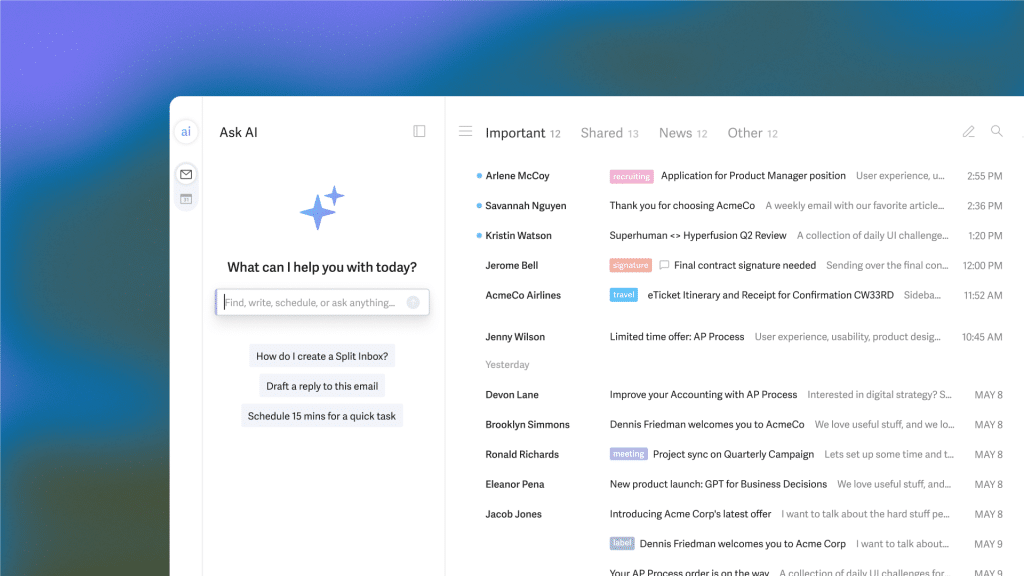
Superhuman Mail’s UI
Once you’ve created the shortcut-driven workflow, processing email becomes genuinely quick as most actions take a single keystroke. Superhuman even offers a one-on-one onboarding session to get you there faster, which is a thoughtful touch, but also a signal that the learning curve is steep enough to need it.
The AI pulls context from past conversations, surfaces action items, and can retrieve what a specific contact said three months ago without you having to dig. It also helps categorise emails into separate inboxes automatically.
Its Split Inbox functionality divides your single, overwhelming email list into distinct, focused streams and the Scheduled Send features help with staying organised and following up on time.
Reviewers also consistently find its search feature faster and more powerful than Gmail’s native search, which matters when you’re dealing with high email volume every day.
A reddit user who has used both Copilot and Superhuman draws the comparison:“For pure email productivity, Superhuman wins. For org-wide deployment where you’re already deep in the Microsoft stack, Outlook is harder to displace.”
However, the keyboard-first workflow can feel restrictive if you’re used to folders, tags, or clicking through emails in a more traditional way. You also don’t get much control over how your inbox is structured, whether that’s split inbox setups or default views that match your workflow.
Ecosystem fit is another constraint. Superhuman is built primarily for Gmail. While it does support Outlook, the experience is more limited, and support for other providers is minimal.
And then there’s the cost. At $30–$40 per month, it’s firmly positioned as a premium tool. The pricing can feel high unless you fully commit to the workflow and actually benefit from the speed gains.
Pros
- Improves productivity substantially once you’ve learned the keyboard shortcuts
- AI helps pull out action items, understand past emails, and organise conversations automatically
- Strong search that’s faster and more reliable than Gmail’s native search
- Split inbox, reminders, and read receipts all work well out of the box
- One-on-one onboarding session included, genuinely helps flatten the learning curve
Cons
- Steep learning curve; the keyboard-first workflow takes real time to internalize
- Limited inbox customisation compared to more flexible tools
- Expensive relative to what Gmail already offers natively, especially post-Gemini
- Works best with Gmail; Outlook and other providers feel like afterthoughts
- $30 to $40/month puts it firmly in premium territory for a single-user tool
Pricing
Starts at $30/user/month, billed monthly.
5. Inbox Zero: Best for individuals who want AI to handle the inbox before they even open it
Most AI email tools wait for you to open an email before they help. Inbox Zero is an automated AI email assistant that works the other way around. By the time you get to your inbox, emails are already labelled, low-value senders are blocked, and anything that needs a reply has a draft waiting, written in your voice, based on your email history.
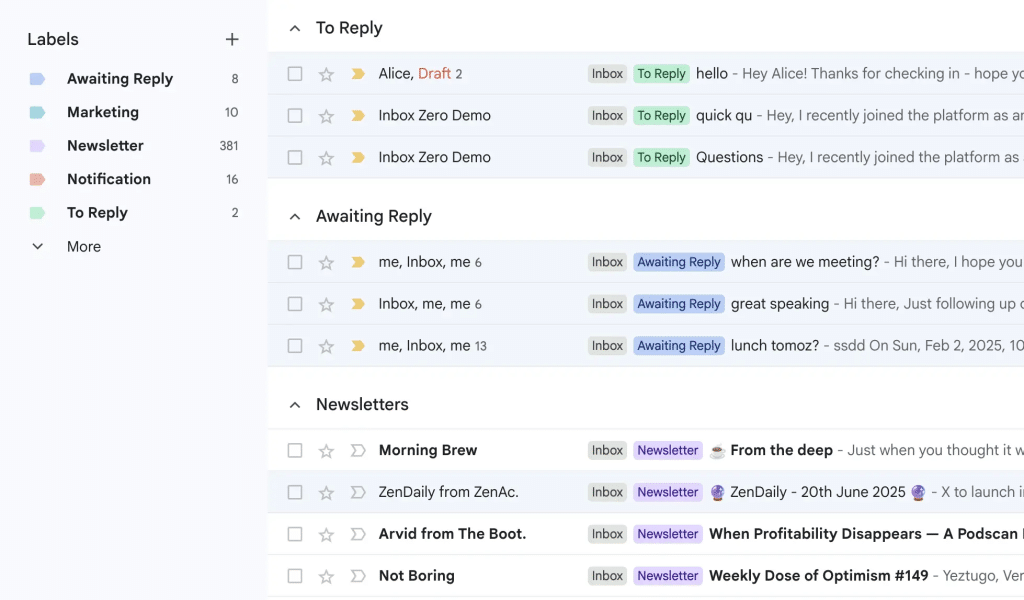
Inbox Zero’s UI
The setup takes minutes. Connect Gmail or Outlook and let the AI learn your categories so that it can start organising from there. You can use the default labels or define your own in plain English, which means no rule-building, filter syntax, or maintenance when new email types start showing up.
Once that’s in place, the replies start to feel noticeably more personal. Instead of generic drafts, Inbox Zero pulls from your past emails to match your tone, phrasing, and even how you usually sign off.
Bulk unsubscribing is another genuine time-saver. You can see which senders are clogging your inbox, how often you actually read them, and clear them in a single action. The cold email blocker stops new spam and unsolicited emails from getting in, so you’re not back to square one a few weeks later. Attachments get automatically filed to the right Google Drive or OneDrive folder, which removes a small but persistent manual task for anyone dealing with invoices, contracts, or reports regularly.
However, their web UI has room to improve. Self-hosting is available but requires meaningful technical setup, so it won’t suit most users. Outlook support exists, but users often point out that it’s not as fully developed. Also, because Inbox Zero sits alongside your email client rather than replacing it, users who want a full email app experience (with a built-in interface, keyboard shortcuts, and calendar integration) will need to look elsewhere.
Like most tools on this list, it’s designed for an individual’s inbox. If your team needs ownership, routing, and collaboration on shared email addresses, Inbox Zero won’t cover that ground.
Pros
- Pre-drafted replies in your voice, ready before you open the email
- Smart categorisation and cold email blocking reduce inbox noise automatically
- Bulk unsubscribe clears years of clutter in a single action
- Manage your inbox directly from Slack, Telegram, or the web, without switching apps
- Setup takes minutes and learns your categories in plain English, no filter syntax required
Cons
- Web UI could be cleaner and more polished
- Self-hosting is available but feels cumbersome for non-technical users
- Outlook support exists but is a frequently requested area for improvement
- Not a full email client, works on top of Gmail or Outlook rather than replacing them
- Built for individual inboxes; no ownership or routing for shared team addresses
Pricing
Starts at $18/user/month (billed annually) with a 7-day free trial, no credit card required. The Plus plan at $28/month adds multi-account support, Slack integration, and unlimited knowledge base access.
6. Shortwave: Best for AI search and a task-style inbox
Shortwave is built around a simple idea: your inbox should be a place where you can actually get work done. It restructures emails into tasks, bundles threads together, and there’s a clear system for what needs action and what doesn’t.

Shortwave’s UI
The platform’s AI search is a feature reviewers mention most. Instead of digging through folders or crafting queries, you can ask something like “find the last invoice from Stripe” or “what did John say about the renewal,” and get answers from your entire email history.
It also has AI writing and scheduling features that support day-to-day work. It learns your tone to draft replies and can handle scheduling without leaving the inbox.
The inbox-to-task workflow turns email into tasks, groups, and prioritises them directly in your inbox. Bundles, delivery scheduling, and a clear done/to-do system make it easier to stay on top of what actually needs action.
For small teams, Shortwave’s collaboration features like shared threads, internal comments, and email assignments act as a lightweight coordination layer. They help teams stay aligned, discuss context, and keep ownership clear without switching tools. This works well for visibility and day-to-day coordination. But it does not support structured routing or deeper workflows. Unlike tools like Hiver, built for team inbox management with assignment and automation, Shortwave focuses on keeping communication organized and collaborative.
The trade-offs here is that the workflow might take getting used to, especially if you’re transitioning from Gmail. Some people click with it, others don’t. CRM integrations could be better too, and the email editing experience isn’t the most polished. Users also notice occasional slowdowns.
Pros
- AI-powered search that finds answers across your full email history, not just recent threads
- Light team collaboration via shared threads, internal comments, and email assignments
- AI drafting learns your tone from your sent history over time
- Free plan available, with paid tiers starting reasonably low for individuals
Cons
- Setting up the task-based workflow takes real adjustment, especially coming from Gmail
- CRM integrations could be more robust and consistent
- Loading speed has frustrated some users, particularly on larger inboxes
- Collaboration features support visibility, not structured routing or deeper team workflows
Pricing
Free plan available. Paid plans start at $14/user/month (billed annually), with team plans at higher tiers. No credit card required to start.
7. Notion Mail: Best for turning email into structured workflows
Notion Mail is an email client built on top of Gmail that lets you organise emails the way you would organise work inside Notion. Instead of managing messages through folders or labels, you structure them into views, filters, and workflows.
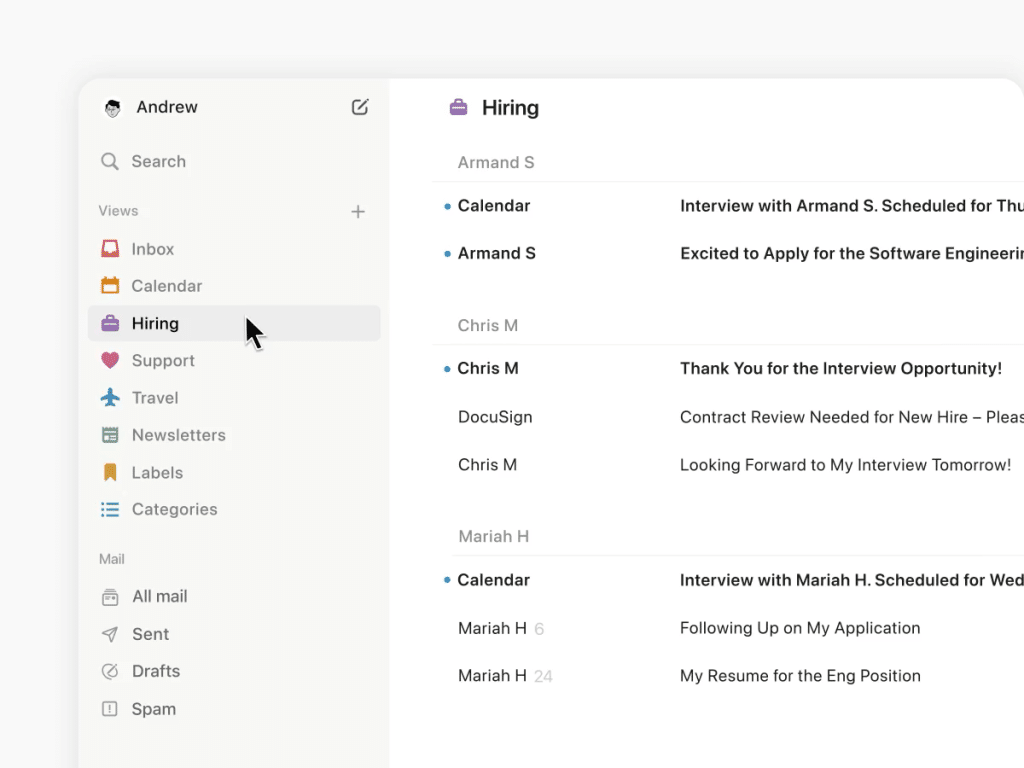
Notion Mail’s UI
If you’re a founder tracking investor conversations, a recruiter managing candidates, or an operator trying to bring structure to inbound requests, this is where it starts to click. Instead of folders and labels, you can build views like:
- Emails that need action today
- Hiring pipeline conversations
- Customer support tickets by issue type (refunds, bugs, account access)
- Invoices, payment confirmations, and vendor billing threads
That’s the shift this product is built around. You’re not just reading emails. You’re organising them into workflows.
It starts to feel closer to managing a database than clearing an inbox. Emails become items you can sort, group, and act on, rather than threads you’re trying to keep up with.
The AI layer fits into that model by defining rules in plain English to auto-label emails, create snippets for repeat replies, and use filters to surface important information. If you already use Notion, the editor and interaction model feel familiar almost immediately.
In fact, that’s one of the first things Notion users mention on Reddit:
“This feels like Notion… more functional compared to other Gmail wrappers, especially with customizable views.”
But the experience isn’t consistent yet once you try to extend it beyond basic organisation. The biggest gap shows up when you expect deeper workflows across tools. For example, turning emails into tasks, linking them to projects, or syncing them into your Notion databases is still limited.
There are also practical limitations depending on how you work day to day. It’s tightly tied to Gmail, with limited support beyond that. You can’t manage multiple email accounts under a single Notion account, each email requires a separate setup. Search and filtering also lag behind more mature tools.
So while the idea is strong, it still falls short if you’re dealing with high email volume or juggling multiple accounts.
The trade-off is clear. Notion Mail gives you flexibility if you want to build your own system. But for reliability and depth across standard email workflows, it still has ground to cover.
Pros
- Custom views make it easy to organise emails by context, not just folders
- AI auto-labelling reduces manual triage across incoming mail
- Snippets and editor improve everyday writing for repeat replies
- Clean interface that feels familiar immediately to existing Notion users
- Free to get started, with no credit card required
Cons
- Limited integration with Notion databases and broader workflows, despite the pitch
- Gmail-only support limits flexibility for mixed-provider teams
- Not ideal for multi-inbox or high-volume setups; each email needs separate setup
- Still an early product with noticeable gaps in search and filtering maturity
Pricing
Free to get started. Paid plans are available through Notion’s broader pricing tiers. No credit card required to try.
8. SaneBox
SaneBox takes a different approach from most tools on this list: instead of drafting or summarising, it quietly filters your inbox before you even see it. Its flagship feature, SaneLater, learns which senders you engage with quickly versus which ones you routinely ignore, and automatically routes the low-priority ones to a folder for review on your own schedule.
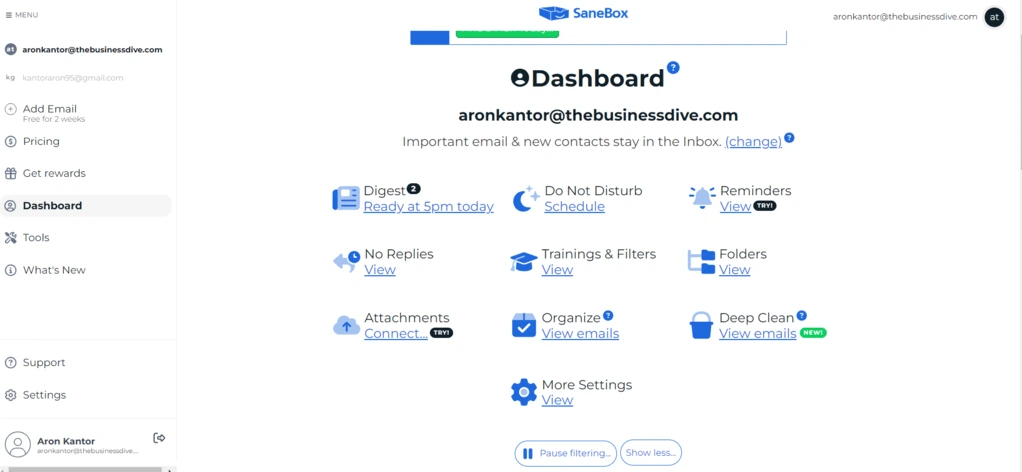
SaneBlackHole handles the rest: drag a sender there once, and you’ll never see a message from them again, a genuinely effective one-click unsubscribe. It works inside whatever email client you already use, so there’s no migration or new interface to learn. Worth noting upfront: SaneBox’s filtering is rule-based and behavioral, not generative AI. It won’t draft replies or extract tasks; it’s purely a triage layer sitting on top of your inbox.
Pros
- Genuinely reduces inbox noise without requiring you to change how you write or organize email
- Works inside any email client, no migration required
- SaneBlackHole is one of the more effective one-click unsubscribe tools available
- Users report saving several hours a week once the filtering is dialed in
Cons
- Filtering is rule-based, not generative AI; it won’t draft replies, summarize threads, or extract tasks
- No free tier, every plan is paid after the trial ends
- Priced per person, so a small team adds up quickly with no built-in collaboration features
Pricing
Snack is $3.49/month for 1 email account with a choice of 2 SaneBox features. Lunch is $5.99/month for 2 email accounts with a choice of 6 features per account, including SaneReminders for follow-up tracking. Dinner is $16.99/month for 4 email accounts with every feature included, plus phone support on top of email and chat. There’s no free tier, but a 14-day free trial is available, and longer commitments (annual or biyearly billing) bring the effective monthly rate down further.
9. Fyxer AI
Fyxer positions itself as a junior assistant living inside your inbox. It sorts incoming mail into categories, drafts replies in your voice for messages that need one, and sends an AI notetaker into your meetings to capture and summarize notes automatically. On the Professional plan, Fyxer Chat lets you search across your email using natural language, plus a HubSpot integration to sync activity to your CRM.
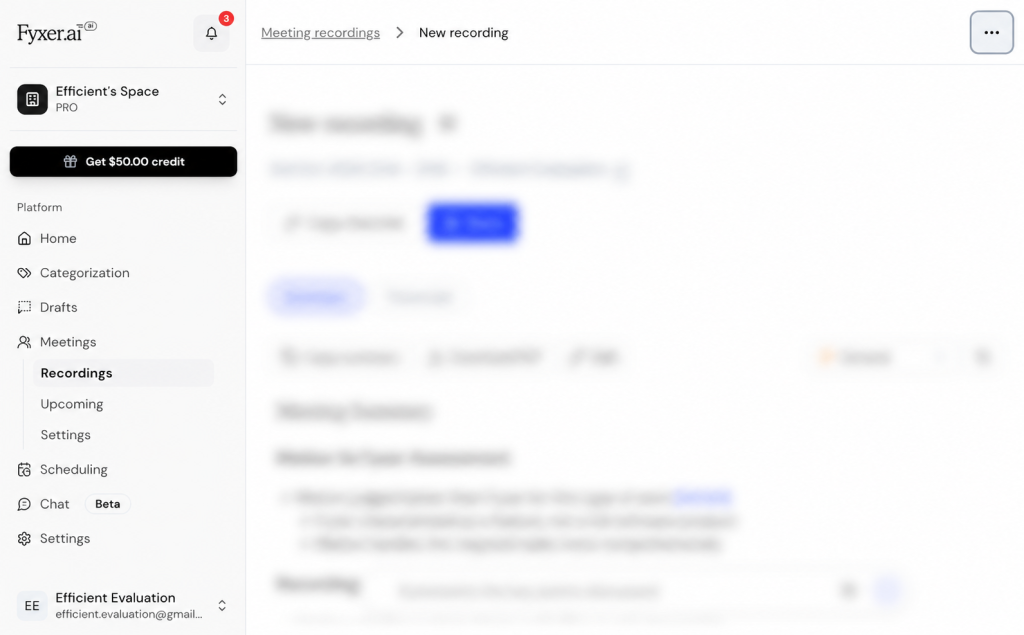
It connects to both Gmail and Outlook, and setup takes about two minutes. The catch is scope and cost. Fyxer is built for one person’s inbox, and its pricing includes overage fees once your incoming email volume exceeds your plan’s allotment, which several reviewers flag as an unpredictable cost driver.
Pros
- Combines inbox triage with meeting notetaking in a single subscription, covering more than just email
- Near-zero learning curve; connects to your existing inbox and works in the background
- Genuinely useful for busy executives, salespeople, or consultants managing high email and meeting volume
Cons
- Overage fees apply once your inbound email exceeds your plan’s monthly allotment, making costs unpredictable at scale
- No permanent free plan, and several users report being charged unexpectedly after the trial period
- Built for individual use; the 50-seat Enterprise floor makes it impractical for smaller teams wanting admin controls
- Categorization accuracy is inconsistent for some users, occasionally requiring more correction than it saves
Pricing
Starter is $30/month ($22.50 billed annually) for a single inbox and calendar. Professional is $50/month ($37.50 billed annually) and adds multiple inboxes, integrations, and Fyxer Chat. Enterprise is custom, with a 50-seat minimum. Every plan includes a 7-day free trial; there’s no permanent free tier.
10. Boomerang
Boomerang started as a scheduling tool for Gmail and has stayed close to that core: send-later, return-to-inbox reminders, read receipts, and its most distinctive feature, Inbox Pause, which holds incoming mail so it can’t interrupt you. Its AI layer, called Respondable, is lighter-touch than most tools on this list.
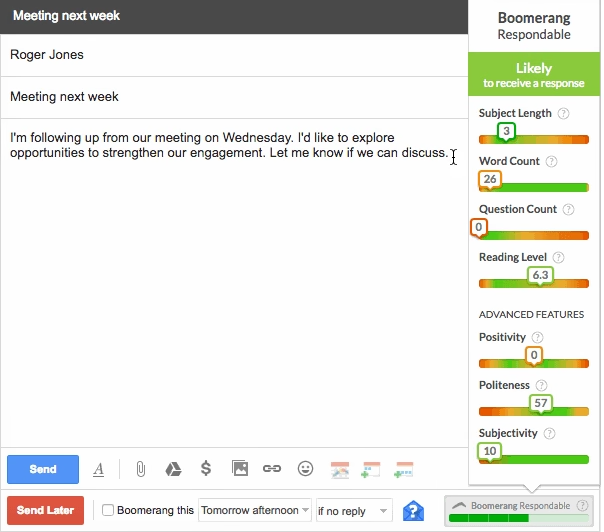
Rather than drafting replies for you, it gives real-time feedback on your writing, tone, clarity, likely response rate, as you compose. The standout workflow is conditional follow-ups: automatically resurface an email if the recipient hasn’t replied by a set time, something native Gmail still can’t do.
Pros
- The conditional “follow up only if no reply” workflow is genuinely unique and hard to replicate with native Gmail
- Inbox Pause is a real productivity feature for anyone who struggles with constant interruption
- Affordable at the Pro tier, which unlocks most of what people actually want
Cons
- The free plan’s 10 message credits a month makes it more of a permanent trial than a usable tier
- Respondable gives feedback, not full AI drafting, so you’re still writing most of the email yourself
- Premium’s price is hard to justify unless you specifically need CRM integration
- Occasional sync and rendering issues after Gmail UI updates, per user reports
Pricing
Basic is free with 10 message credits a month. Personal is $4.98/month with unlimited credits and mobile apps. Pro is $14.98/month and adds Inbox Pause, Respondable, and recurring messages. Premium is $49.98/month and adds Salesforce and CRM integration.
11. Canary Mail
Canary Mail leads with privacy and security rather than raw AI capability: end-to-end encryption, phishing and ransomware protection, impersonation detection, and a SecureSend feature for HIPAA-compliant confidential messages, alongside an AI Copilot for drafting and reading, calendar and scheduling tools, and cross-device sync across up to 5 devices on paid plans.
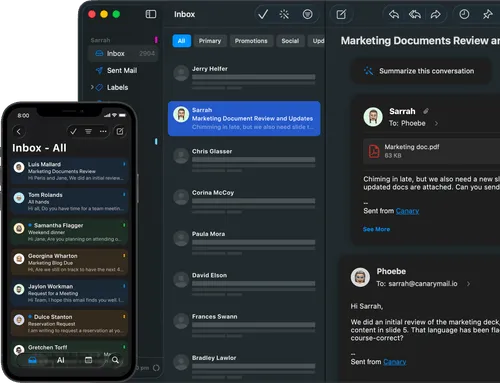
It’s a genuinely different pitch from the productivity-first tools elsewhere on this list, built around the idea that AI and security should come bundled rather than treated as separate add-ons.
Pros
- Strong privacy and security positioning, genuinely differentiated from every other tool on this list
- AI Copilot covers the core drafting and reading use cases most readers want, alongside genuinely rare security features like PGP and SecureSend encryption
- Both a one-time lifetime purchase and a discounted yearly subscription are available, so you can pick whichever billing model suits you
- Free plan is unlimited on mail accounts and genuinely usable on its own, not just a crippled trial
Cons
- AI capability is described by third-party reviewers as more surface-level writing assistance than deeper tools like Shortwave
- The two billing modes (lifetime vs. yearly) show up differently across review sites, so double-check which one a given price refers to before comparing
- Full security suite (PGP, SecureSend, phishing/impersonation detection) is locked to the top Pro+ tier
- Requires a subscription to unlock the AI and security features that are the main draw
Pricing
Free is $0 forever, with a genuinely useful feature set (unified inbox, snooze, templates, Inbox Zero, unlimited mail accounts, 2 supported devices). Growth adds AI Copilot, read receipts, send later, and calendar scheduling, priced at $3/month billed yearly ($36/year) or $100 as a one-time lifetime purchase. Pro+ adds the full security suite (PGP encryption, SecureSend/HIPAA, phishing and impersonation protection, priority support), priced at $10/month billed yearly ($100/year) or $300 as a one-time lifetime purchase. Every paid tier includes a 7-day free trial, no credit card required, and automatically reverts to the Free plan if you don’t upgrade.
How to choose the best AI email assistant
The right tool depends on what’s actually broken in your email workflow. Here’s what to look at:
- Who’s using it — one person or a team?
If you’re managing your own inbox, Gemini, Microsoft Copilot, Superhuman, and Shortwave can help you move faster. They focus on drafting, summarising, and search.
If you’re working across a team, the problem changes. It’s less about speed and more about coordination. In contrast, Hiver is built for ownership, routing, and visibility across conversations.
- Where does the bottleneck sit?
If you spend more time writing emails, prioritise AI drafting quality and tone matching. Inbox Zero and Shortwave are strong here.
In case you spend time finding, prioritise search, Shortwave and Superhuman lead on this. When emails get missed, replies are duplicated, or ownership isn’t clear, it’s a coordination problem. Hiver’s AI Tasks and routing are designed to fix that.
- Which email provider are you locked into?
Gemini only makes sense inside Google Workspace. Copilot only makes sense inside Microsoft 365. Superhuman and Shortwave work with both but treat Gmail as primary. SaneBox and Canary Mail work across most providers as an overlay. Hiver works with Gmail, Outlook, and other providers. Choose based on your primary setup and needs.
- What’s the real cost?
Monthly price is only part of it. Factor in seats, whether AI is included in the base plan or gated behind a higher tier, and what happens when Gmail or Outlook ships the same feature natively.
Best AI email assistant: which one should you choose?
There isn’t a single winner here, and that’s the point.
If speed is the goal, start with what you already use. Gemini and Copilot handle the basics without adding another tool. For more tailored workflows, pick between Superhuman for speed, Shortwave for task-driven inboxes, Inbox Zero for pre-inbox automation, Notion Mail to turn your inbox into a structured system, SaneBox if filtering alone solves your problem, Fyxer AI if you want triage bundled with meeting notes, Boomerang if follow-up discipline matters more than AI drafting, or Canary Mail if privacy is the deciding factor.
The picture changes when email is shared across a team. Replying faster stops being the bottleneck. The real problem is knowing who owns what, making sure nothing gets missed, and stopping the same customer from getting two different replies. That’s a coordination problem, and most AI writing assistants aren’t built to solve it.
Is coordination over email breaking down in your team? Try Hiver for free to see how it handles that in practice.