Skip to content



ServiceNow has been the go-to ITSM platform for enterprise teams for years. It’s comprehensive, feature-rich, and can handle just about anything you throw at it.
But here’s the thing—not every team needs (or can handle) a platform that powerful.
Sometimes you just need a straightforward solution that delivers value without the complexity.
ServiceNow might have every feature imaginable, but many teams find better ROI with lightweight tools that focus on doing the essentials really well.
So, in this blog post, we’re exploring top alternatives, comparing them with ServiceNow, and helping you choose the right one for your team.
Quick disclaimer before you dive in.
This guide is about helping you find the best fit for your team, not the most recognizable name. We focus our reviews on the essentials: ease of use, automation, pricing, channel coverage, reporting, and how each tool scales.
We’ve done the research and scouted user reviews and experiences on hands-on setup, product usage, and features. We’ve also looked at limitations and what each tool does best.
Table of Contents
- Why Look for a ServiceNow Alternative?
- Top ServiceNow Competitors for Support Teams in 2025
- Why Hiver is the Best ServiceNow Alternative
Why Look for a ServiceNow Alternative?
Don’t get me wrong—ServiceNow is an impressive platform. But impressive doesn’t always mean right for your team. Here are the main reasons why teams are exploring alternatives:
- Users often cite months of planning, coordination, and customization just to get basic workflows running. And that’s before factoring in training and troubleshooting.
The implementation and customization process often requires significant time and expertise, which can be challenging for organizations without strong technical support.
Businesses need to come to the table with process and know what outcomes they need and need a competent implementation partner and architect. This is not upfront when getting into ServiceNow.
- ServiceNow’s licensing structure isn’t exactly transparent. Costs can escalate quickly as you add features or users. For many teams, the ROI just doesn’t add up, especially when there are more cost-effective alternatives available.
For small size organization ServiceNow can be little bit expensive. If the platform is heavily customized then sometimes ongoing updates and maintenance can be complex.
The platform requires significant investment to make good user experience.
- Despite being an enterprise-grade platform, many users report inconsistent support experiences.
Customer support is poor. Support team tends to cut and paste answers you are already able to find online. Requires use of partner or own work to get answers.
Product customer support needs improvement.
- As ITSM evolves, newer platforms built natively on AI are changing the game. Unlike ServiceNow, these tools promise smoother user experiences and faster workflows — without the heavy setup or maintenance overhead.
The tool needs to include more AI features and capabilities.
Top ServiceNow Competitors for Support Teams in 2025
Here’s a quick breakdown of the top ServiceNow alternatives to look out for:
| Platform | Highlights | Pricing |
|---|---|---|
| Hiver | Best for teams needing AI-powered customer and IT support | Starts at $19/user/month; free trial available |
| Jira Service Management | Best for dev and IT teams already using Atlassian tools | Free for 3 agents; paid plans from $19.04/user/month |
| BMC Helix | Best for enterprises needing fast ITIL-aligned deployment | Custom pricing |
| Zendesk | Best for omnichannel customer service and employee support | Starts at $55/user/month; 14-day free trial |
| SolarWinds Service Desk | Best for MSPs and global teams needing multi-tenant ITSM | Starts at $39/user/month |
| Freshservice | Best for SMBs wanting simple, modern ITSM | Starts at $29/user/month; 14-day free trial |
| SysAid | Best for mid-sized teams needing automation without complexity | Custom pricing (Standard, Pro, Enterprise plans) |
| ManageEngine SDP | Best for ITSM teams needing on-prem/cloud + deep customization | From $13/technician/month; feature-based pricing tiers |
| Spiceworks | Best for small IT teams seeking a free platform | Free basic version; premium starts at $5/seat/month |
| HappyFox | Best for growing businesses needing ITIL-aligned ticketing | Starts at $49/agent/month; free trial via demo request |
Hiver

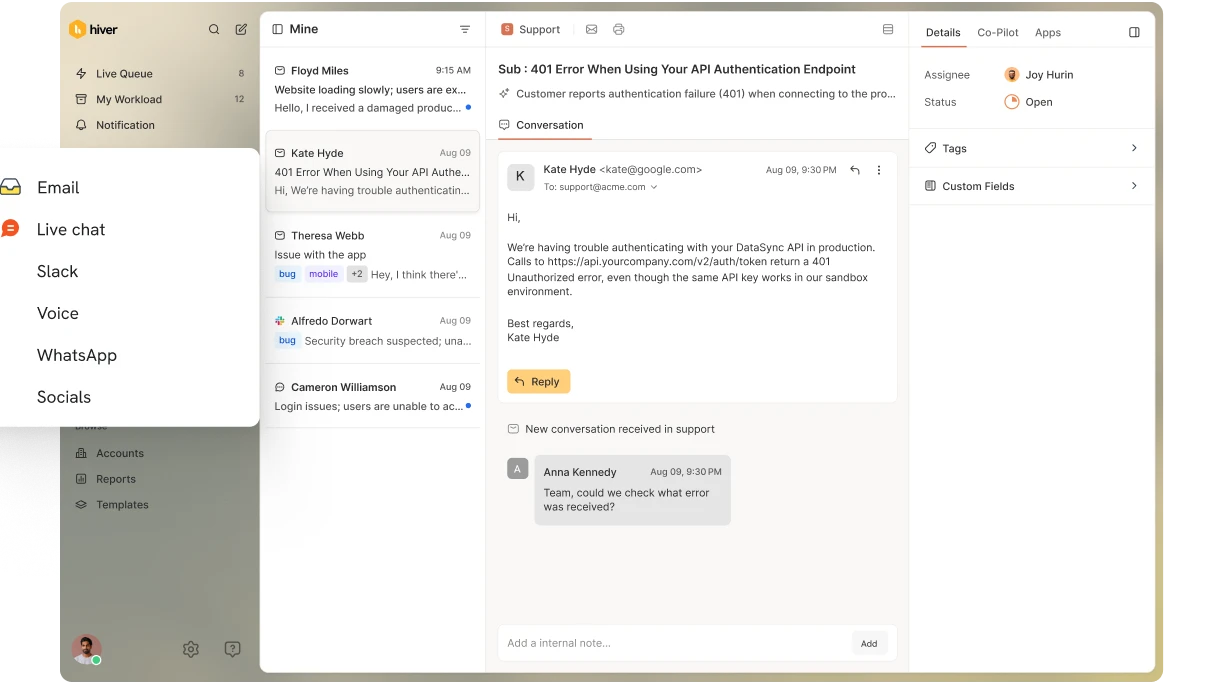
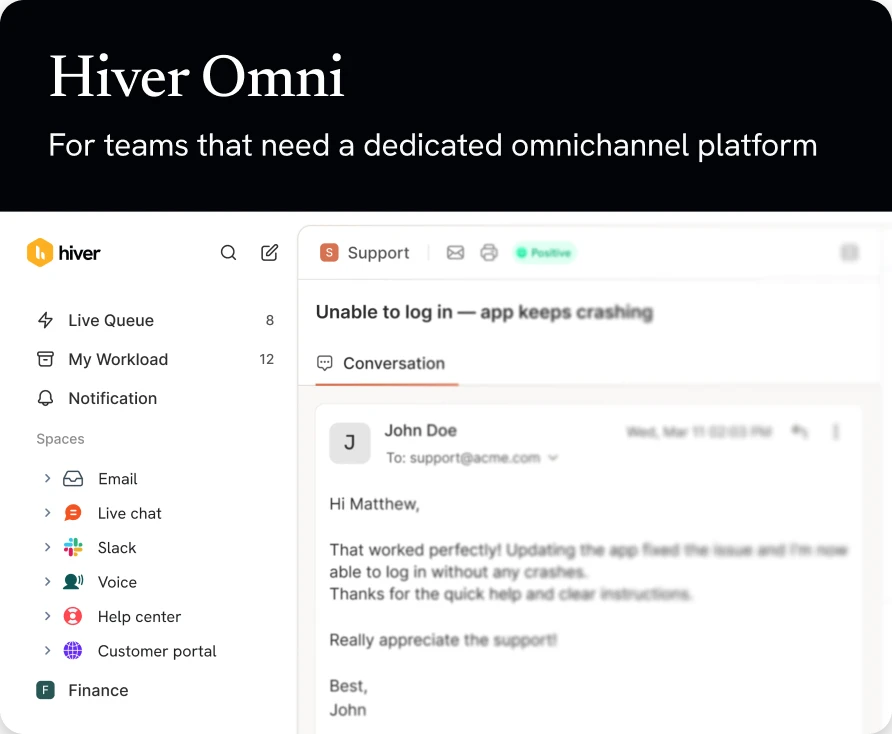
Hiver is an AI-powered customer service platform that brings together email, live chat, WhatsApp, and phone support in one intuitive, easy-to-use interface. Unlike ServiceNow’s setup which can take anywhere from days to weeks, Hiver gets teams up and running in 30 minutes with minimal setup needed.
Hiver also excels in its ability to scale support without adding complexity. It offers native integrations with tools like Shopify and WhatsApp, built-in automations to reduce manual work, and real-time collaboration features.
It’s built for teams that value ease of use and speed just as much as structure. It also makes managing IT and customer support easy without the complexity of traditional enterprise tools.
Best for:
Teams that want an AI-powered helpdesk for customer service and ITSM.
Key Features:
- With Hiver, AI works where your team does — across both customer and IT workflows. AI Agents take care of triage and routing, while AI Copilot drafts and summarizes replies. Plus, AI Insights gives you a clear view of customer health and team performance, right inside your inbox.
- Convert emails into trackable tickets with clear statuses and timelines, for internal IT issues and external queries.
- Manage employee onboarding requests, access issues, password resets, and hardware/software needs, all from a shared inbox setup.
- Manage email, live chat, WhatsApp, and phone inquiries from a unified interface.
- Define response and resolution goals for different request types, with automated escalations.
- Set up auto-assignment rules, tag-based routing, and status updates to reduce manual work and keep processes consistent.
- Collaborate with teammates using private notes and shared drafts to ensure nothing slips through the cracks.
- Built-in CRM functionality with customer history, contact management, and interaction timeline.
- Track SLA compliance, team productivity, resolution times, and request trends across departments.
Pros:
- Ultra-fast setup, intuitive, minimal training required.
- Powerful enough for complex workflows, yet simple enough for everyday use.
- Scales easily as your team grows, with predictable costs.
- 24×7 customer support, with all plans.
What Users Like:
“Hiver has been great for managing the queue of support inquiries that come to us on a daily basis. I really enjoy that I can use some of the automation features to pick up on certain words or the intent of the request, and from there, properly assign it to the relevant team member to handle”
“What I like best about Hiver is how easy it is to set up and start using. The integrations are seamless and really enhance productivity, and the support team is always responsive and helpful. It makes collaboration across teams simple and efficient, while also being cost-effective”
Cons:
- The platform can occasionally be glitchy.
- Users might experience auto log outs on rare occasions.
What Users Dislike:
“I can’t think of one bad thing other than every once in a while it auto logs out or something. Very rarely”
“It can occasionally be glitchy. This is rare, but will sometimes mean you will not see an updated/replied to email after the initial reply”
Pricing:
Hiver offers a forever-free plan. Paid plans starts at $25/user/month for Growth (ticketing, chat, automation, SLA); and Pro tier at $49/user/month; with custom enterprise plans available.
All plans offer a 7-day free trial.
Why Hiver is a Better Alternative to ServiceNow:
“We’re looking to move from ServiceNow due to the implementation time- it takes a lot of time to get things moving with ServiceNow”
“We’re a logistics company using Google Workspace for most of our transactions, but with ServiceNow there’s been a huge divide- when it’s really busy, emails get missed. So we’re looking at a solution that helps us track our emails better and get the right people involved in the conversation so we don’t lose clients”
This is what we often hear from ex-ServiceNow customers: heavy setup costs, long implementation times, and a platform that feels too complex for day-to-day use. That’s where Hiver has the upper hand. It’s simple, quick to deploy, and cuts down on operational overhead.
Hiver also brings IT service management and customer support together in one intuitive platform. From handling internal IT requests like onboarding to managing external tickets, everything stays organized with minimal effort.
ServiceNow might offer broader capabilities, but Hiver wins on simplicity, speed, and being purpose-built for teams that want ITSM without the extra weight.
Jira Service Management
Jira Service Management is Atlassian’s subset of enterprise ITSM needs, and it’s particularly strong for teams already living in the Atlassian ecosystem. It stands out for its faster implementation and lower total cost of ownership compared to ServiceNow.
The platform is easy enough for new team members to start using right away, but it is still packed with the flexibility and depth needed to manage complex ITSM workflows.
Best For:
Development and IT teams that want deep integration with Atlassian products and better workflow customization for DevOps or cross-team collaboration.
Key Features:
- Get incident and problem management features with customizable workflows and SLA tracking built right in.
- Connect directly with Confluence to create and share articles, so teams and customers can find answers on their own.
- Track IT assets easily and let users submit requests through a self-service portal with custom forms and approvals.
- Create real-time dashboards with customizable reports and advanced analytics.
- Use Atlassian Intelligence for smart suggestions, automated responses, AI-powered triage, and insights.
Pros:
- Powerful automation and incident management.
- Huge ecosystem of integrations and extensibility via Atlassian Marketplace.
- Advanced analytics, security features, and compliance.
What Users Like:
“What is liked best about Jira are its powerful agile project management features, including customizable workflows and Agile boards (Scrum and Kanban), which help teams visualize, track, and manage work effectively”
“Jira’s core strength is its flexibility. Projects are highly customizable and can be configured with specific workflows, permissions, and issue types”
Cons:
- Interface can be overwhelming for non-technical users.
- Many advanced features are locked behind higher-priced Premium/Enterprise tiers; overall costs can escalate quickly for large teams.
What Users Dislike:
“What I dislike a little bit about it is that it is complex. It has its own jargon. If you do not have enough knowledge, you can drown in the menus.”
“Jira requires a steep learning curve if you are new to project management or software development methodology.”
Pricing:
Free for up to 3 agents; Standard at $19.04/agent/month; Premium at $47.82/agent/month; Enterprise is custom priced. Jira Service Management offers a 7-day free trial.
Why Jira is a Better Alternative to ServiceNow:
Jira Service Management is easier to integrate for teams already in the Atlassian environment, with much faster rollout, more transparent costs, and powerful automation and DevOps capabilities compared to the lengthy, complex ServiceNow deployments.
BMC Helix
BMC Helix (formerly Remedy) is one of ServiceNow’s closest competitors in the enterprise ITSM space. It stands out for offering pre-configured ITIL workflows that let teams hit the ground running quickly, without spending months in setup mode.
The platform excels at using AI to dive deeper into data and helps your team act on it. It’s AI, HelixGPT clusters recurring issues, suggests the best next steps, and flags potential problems before they escalate.
You can also customize workflows, calendars, and risk rules to match how your team actually works, which makes daily operations smoother and easier to manage.
Best For:
Large enterprises seeking fast, out-of-the-box ITIL alignment, complex workflow automation, and predictive analytics for IT operations.
Key Features:
- AI-powered incident and problem management for rapid detection and clustering of recurring issues.
- Low-code development platform for building custom applications and workflows.
- AI-powered virtual agents for both end-users and service desk agents.
- Advanced workflow automation with prebuilt and customizable templates.
- Easy-to-use, drag-and-drop dashboards for reporting and data visualization.
Pros:
- Extremely robust automation and analytics suite.
- Highly configurable to complex enterprise needs.
What Users Like:
“BMC Helix ITSM has a very comprehensive set of ITIL-aligned features that helped us streamline service delivery. The platform covers almost everything we need—incident, change, request, knowledge, and CMDB—in a single solution.”
“BMC remedy is a great ITSM tool, one of the best that I have ever used. It provides seamless integration to other tools such a Microsoft Outlook and other MS Office tools.”
Cons:
- Not ideal for SMBs; can be overwhelming and cost-prohibitive for smaller teams.
- Implementation may still require dedicated resources.
What Users Dislike:
“Expensive compared to other ITSM tools”
“The platform is powerful, but it’s not the easiest to use at the beginning. The interface looks a bit dated compared to some newer ITSM tools, and training the team took more time than expected.”
Pricing:
Since BMC Helix primarily caters to enterprise users, they offer custom pricing that’s available on request.
Why BMC Helix is a Better Alternative to ServiceNow:
ServiceNow can feel bloated and extensive for teams, along with painfully long implementation times. That’s where BMC Helix offers comparable depth but with faster ITIL onboarding, advanced AI-powered automation, and a focus on predictive action rather than reactive fixes.
Zendesk
Zendesk stands out for one simple reason: it’s built entirely around service. While ServiceNow spreads its capabilities across IT, HR, CRM, supply chain, and more, Zendesk is laser-focused on helping companies provide consistent support experiences across customer, IT, and HR.
Zendesk offers purpose-built tools for customer support teams, with faster setup, native voice capabilities, and AI features.
Best For:
Mid-sized to enterprise businesses prioritizing omnichannel customer service management.
Key Features:
- Advanced ticketing system for logging, prioritizing, and tracking IT issues efficiently.
- AI features such as Answer Bot for automated responses and intelligent ticket routing based on customer intent.
- Automated workflow management for ticket routing and escalation.
- Self-service portal and rich knowledge base to empower users.
- Built-in collaboration tools with internal chat, notes, and easy escalations.
- Broad integrations with third-party tools and compliance with GDPR/HIPAA.
Pros:
- Strong multi-channel and mobile support for end users.
- Powerful automation for routine and complex workflows.
What Users Like:
“What I like best about Zendesk Support Suite is that it brings all our customer conversations, whether in email, live chat or social media into one place”
“The ability to customize workflows and dashboards according to business needs is one of its greatest strengths“
Cons:
- Lacks native change management and deep ITIL/CMDB features.
- Limited to customer service and IT teams—less suited for complex, cross-departmental automation.
What Users Dislike:
“Some of the features for non-enterprise plans are a bit limited, and the learning curve for some features is a bit harder to go through”
“While Zendesk is feature-rich, its pricing can quickly add up, especially if you need access to more advanced tools like Explore Professional or custom roles”
Pricing:
It starts at $19/user/month, Suite Team at $55/agent/month, advanced plans up to $115+/agent/month, and custom enterprise tiers. The platform also offers a 14-day free trial.
Why Zendesk is a Better Alternative to ServiceNow:
Zendesk stands out for rapid deployment, ease of use compared to ServiceNow, and lower cost of entry, especially as an enterprise tool. While teams are frustrated by ServiceNow’s complexity and long implementation timelines, Zendesk is the alternative for skipping those and focusing on better ROI and customer service for IT workflows.
SolarWinds Service Desk
SolarWinds Service Desk is a user-friendly, ITIL-compliant platform that skips the complexity of platforms like ServiceNow and focuses on what IT teams actually use: solid asset tracking, intuitive workflows, and a streamlined service desk.
It has a strong focus on IT asset management and multi-channel support and is built for managed service providers and global organizations.
Best For:
MSPs, global teams, and mid-to-large organizations needing asset tracking, scalable ITSM, and intuitive workflows.
Key Features:
- Incident and service request management with smart routing and virtual agents.
- Native cloud-based setup that allows managed service providers (MSPs) to support multiple clients from a single platform.
- Offers support for over 40 languages with the ability to tailor views by location, making it easier to manage global service operations.
- Includes client-specific portals, configuration tools, and detailed reporting tailored for MSPs.
- Strong integration ecosystem with SolarWinds and partner apps.
Pros:
- Simple, intuitive UI praised by users.
- Fast to implement—no steep learning curve.
- Excellent reporting, 24/7 support, and comprehensive online resources.
What Users Like:
“Highly customizable to whatever automations, rules, reminders, etc. that your team needs to run their ticketing and asset management efficiently“
“Simplified interface for ITSM processes for incident management, request management and easy navigation for end users”
Cons:
- Might not be a fit for companies looking for advanced AI or no-code customization.
- Mobile app is limited compared to web version.
What Users Dislike:
“One of the main thing that is frustrating about SolarWinds Service desk is the search function for Asset management“
“The worst part is the support. We have a ticket currently that has been open for over a month with little progress”
Pricing:
Starts at $39/user/month with higher tiers offering additional support and features. Pricing may vary based on add-ons such as database, incident management and so on.
Why SolarWinds is a Better Alternative to ServiceNow:
SolarWinds Service Desk offers faster setup, lower training overhead, and fair pricing compared to ServiceNow, especially for organizations seeking multi-tenant architecture and tight control over IT assets.
Freshservice
Freshservice is a modern, lightweight alternative to ServiceNow, especially for teams that don’t want to spend months configuring their help desk. It’s designed for quick deployment, with a clean interface that’s easy for agents and end-users to pick up right away.
Freshservice also keeps things simple and accessible. You get core ITSM functionality, AI-powered workflows, and automation, without the complexity or enterprise price tag.
Best For:
Small to medium-sized businesses with fast-paced support needs, or teams moving away from legacy ITSM tools.
Key Features:
- AI-powered automation engine and Freddy Co-Pilot for auto-triage, agent assistance, and predictive SLAs.
- Core ITSM modules (incident, problem, change management) with ITIL alignment.
- Unified support that automatically converts interactions from email, phone, chat, and social media into organized tickets.
- No-code drag-and-drop builder that makes it easy to automate ticket routing, approvals, and notifications without writing scripts
- Uses AI to identify ticket trends, flag bottlenecks, and offer suggestions to improve service desk performance over time.
Pros:
- User-friendly, quick to onboard.
- Seamless integrations with the app ecosystem.
What Users Like:
“What initially drew me to Freshservice was its clean, intuitive user interface—it immediately felt more modern and user-friendly than other ITSM tools I had tried”
“We use Freshservice in a small team and it works great for us. It is very easy to use. It provides all ITSM requirements. Overall it meets our requirement in IT, security and accounting team”
Cons:
- Reporting is less advanced than that of competitors.
- Not a great fit for organizations needing deep ITOM capabilities.
- Custom workflows and advanced features require higher-tier plans.
What Users Dislike:
“The reporting features are not well developed. There are a lot of basic reports that we use to run from our previous help desk system that we are unable to do within FreshService”
“The price is really high, even for us as an educational institution. There is a lot of benefit compared to other helpdesks like SolarWinds or Atlassian, but the cost is really hard to justify at times”
Pricing:
Starts at $29/agent/month, with the Growth plan at $59/agent/month and Pro plan at $109/agent/month. Freshservice also has enterprise tiers and offers a 14-day free trial for all plans.
Why Freshservice is a Better Alternative to ServiceNow:
Freshservice provides easy ITIL adoption, automation, and a modern UX that reduces onboarding time and boosts agent productivity, outpacing ServiceNow’s drawn-out, resource-heavy deployments.
SysAid
SysAid is ServiceNow’s more approachable competitor in the ITSM space, particularly for organizations that want enterprise-grade functionality without ServiceNow’s complexity and cost burden.
What sets it apart is its focus on AI-powered automation and ease of use. While ServiceNow demands extensive training and dedicated admin resources, SysAid keeps things simple with an interface that IT teams can master quickly.
Best For:
Mid-market organizations wanting quick deployment, powerful automation, and cost transparency without sacrificing core ITSM capabilities.
Key Features:
- Complete ITIL suite—incidents, problems, change, configuration, and asset management out of the box.
- AI-Powered ticket categorization to auto-categorize and route incoming tickets, and a built-in AI CoPilot that answers common questions.
- Converts emails into actionable tickets, automates follow-ups, and keeps communication streamlined.
- Automates repetitive IT tasks, from password resets to approval chains, with minimal setup.
- Lets teams build, manage, and surface help articles within the platform for faster resolutions.
Pros:
- No hidden fees—transparent pricing for all essential features.
- Speedy AI ticket triage and self-service, which reduces manual support needs.
What Users Like:
“We are currently in the process of implementing SysAid ITSM and have been thoroughly impressed by its robust AI and automation capabilities, as well as its integration potential across our systems”
“SysAid is being used as our internal support ticketing system with our tech services team. It does a great job of helping us build efficiency and tracking support for the team that is always facing capacity restraints due to number of requests”
Cons:
- Delays in automated alerting and some limited workflow customization as compared to top-tier competitors.
- Lacks broad third-party integrations.
What Users Dislike:
“The downsides are some of the clunky baked-in features, for example, the FAQ is unusable for end-users but great for adding knowledge to train the AI systems, the email notifications and workflows are quite difficult to master”
“The only minimal downside I’ve experienced with SysAid is the email notification and response function can be duplicative and a bit clunky”
Pricing:
SysAid offers three tiers: Standard, Pro, and Enterprise plans. The standard plan only offers help desk features, while the Pro plan includes ITSM functionality.
You’ll need to contact SysAid’s sales team for a custom quote based on your team’s size and requirements.
Why SysAid is a Better Alternative to ServiceNow:
SysAid leapfrogs ServiceNow’s complexity with zero hidden costs, AI-powered efficiency, and quick, guided onboarding; ideal for organizations wanting fast value and lean IT.
ManageEngine ServiceDesk Plus
ManageEngine ServiceDesk Plus is a feature-rich alternative to ServiceNow, ideal for teams that need powerful ITSM without the heavy costs or long deployment timelines. It’s highly customizable, scales easily, and offers both cloud and on-premise options to fit different IT environments.
What sets it apart is its flexibility. From licensing to hosting to workflow design, you get more control than you typically do with ServiceNow.
Best For:
Teams needing full ITSM capability with flexible deployment (cloud/on-prem), deep customization, and multi-departmental use.
Key Features:
- Comprehensive platform covering incident, problem, change, service request management, asset, and project management in one solution, along with ITIL compliance.
- Automates ticket routing with keyword-based logic and detects anomalies based on past patterns to reduce manual triage.
- Has a low-code customization platform to build and modify workflows, forms, and processes.
- Easily extend service management to HR, finance, and other departments using the same platform.
- Choose between cloud or on-prem deployments, with subscription or one-time purchase models to match your budget.
Pros:
- Free tier, ideal for nonprofits and small orgs.
- Easy to use and configure, scalable as needs grow.
What Users Like:
“Easy to use ITSM tool for requester and technician, User-friendly UI which allows the administrator to modify as per the requirements.”
“ServiceDesk Plus is one of the best ITSM Tool that I have used. The implementation/installation is very easy for IT Companies.”
Cons:
- Advanced workflow customization can be slow to set up; there is a learning curve for certain automations
- Some interface elements feel dated compared to newer SaaS tools.
What Users Dislike:
“The portal is a little slow if you get the hosted plans. It takes some time to customise and get what you need with the tool”
“ManageEngine ServiceDesk Plus can be limiting for complex automations and customizations, making it less suitable for highly specialized needs.”
Pricing:
Cloud Standard starts at $13/technician/month; advanced plans, with expanded features, range from $27 to $67/tech/month.
Why it’s a Better Alternative:
ManageEngine ServiceDesk Plus delivers all of ServiceNow’s core ITSM features at a fraction of the complexity and cost, with easier customization, rapid support, and solid cloud or on-premise flexibility.
Spiceworks
Spiceworks is a completely free alternative to platforms like ServiceNow. It’s purpose-built for smaller IT teams that want a simple, no-cost way to manage help desk tickets, assets, and networks, without the complexity or expense of enterprise software.
While ServiceNow caters to enterprise operations, Spiceworks is all about covering the essentials with minimal setup and community-driven support. It’s a great starting point for businesses that need IT visibility and structure, but can’t commit to premium tools just yet.
Best For:
Small IT teams, startups, and nonprofits that want essential ticketing/asset functionality with no upfront costs.
Key Features:
- Free help desk with no licensing fees or restrictions, with full access to ticketing, asset tracking, and network tools right out of the box.
- Automatically scans your network to detect devices like computers, printers, routers, and switches for easy tracking.
- Manage tickets across multiple office locations through a centralized dashboard with local user portals.
- Run automated scans on a recurring schedule to keep your hardware and software inventory up to date.
- Monitors devices for outdated or unauthorized software to help catch security risks early.
Pros:
- Completely free core platform; highly cost-effective.
- Simple, intuitive UI, easy to deploy.
What Users Like:
“Spiceworks community is always helpful about issues. We are using all of our support tickets. Integration and implementation is very easy with Spiceworks Cloud Help Desk”
“I like that the Spiceworks Help Desk is super easy to use and fairly easy to implement and roll out to users. It has a reasonable amount of features at a good price”
Cons:
- Minimal automation and limited integrations; lacks SSO/LDAP.
- No customer support, teams can only refer to community resources, and may need dedicated staff for upkeep.
What Users Dislike:
“The mobile app lacks some features that are on desktop, often email notifications are delayed, and integrating with other systems is quite challenging. sometimes response delays are there”
“Not the most intuitive navigation layout, perhaps my Dashboard count should be a clickable link, instead of swimming through dropdown menus.”
Pricing:
Free core; premium plan with extra features starts at $5/seat/month.
Why it’s a Better Alternative:
Spiceworks eliminates cost and complexity, providing all the basics out of the box and making it the obvious entry-level choice for teams turned off by ServiceNow’s price and setup barriers.
HappyFox
HappyFox stands out by keeping things simple. Unlike ServiceNow’s complex enterprise setup, HappyFox is built for growing teams that want to deliver fast, efficient support without long deployments or heavy admin work.
It offers core ITSM features like incident, problem, and change management, but in a more accessible package. While it may not match ServiceNow’s scale, it delivers ITIL-aligned capabilities that are more than enough for mid-sized teams that prioritize quick setup and ease of use.
Best For:
SMBs and mid-size organizations needing robust ticket automation, multi-channel support, and granular SLA management with predictable costs.
Key Features:
- Automatically turns customer messages from email, phone, chat, social media, and web forms into tickets, all managed from one inbox.
- Get Incident, problem, and change management in an ITIL-ready package and Lightweight asset management features to log hardware and software alongside support tickets.
- Build workflows for routing, SLAs, follow-ups, and escalations using a powerful rule engine that reduces manual workload.
- Create and manage self-service content across multiple languages, helping users find answers without raising tickets.
- Track resolution times, agent performance, ticket trends, and more using easy-to-build dashboards and reports.
Pros:
- Rapid implementation with a full ITSM suite.
- Strong automation and AI capabilities.
What Users Like:
“With minimal configuration, you can start your help desk support system. It is easy to maintain, easy to integrate with existing platforms, and also extensible via its powerful API.”
“It looks and performs good, is easy for our organization to use, and has the features we needed. It feels like a newer tool and it’s refreshing to look at without a lot of extra bloat”
Cons:
- May be too costly for very small startups or teams.
- Lacks advanced IT asset management compared to top enterprise competitors.
- May not suit companies that want enterprise-grade customization.
What Users Dislike:
“The reports may be confusing, and some of their features require a higher tier.
Managing contacts is not the best experience. It does it work, but it could be improved giving option such as disabling a contact without deleting it”
“They were starting to make a big push into AI. I believe that people need to check AI responses before they are sent, and sometimes, the right thing for customers is a human touch”
Pricing:
Happyfox’s Pricing starts with the Team Plan at $49/agent/month (500 assets), with higher tiers available. HappyFox offers a free trial, but it’s gated behind a demo request. Once they understand your requirements, you’ll get access to a trial account to explore the platform.
Why it’s a Better Alternative:
HappyFox offers the ITIL core, automation prowess, and fast time-to-value, while ServiceNow requires months of deployment and training. For teams focused on speed and results, HappyFox delivers a clear efficiency boost.
Why Hiver is the Best ServiceNow Alternative
If ServiceNow feels too complex or clunky, you’re not alone. Many support teams are looking for solutions that are easier to use, quicker to set up, and flexible enough to handle both IT and customer service requests.
The goal is simple: help people faster, without unnecessary friction.
A good helpdesk should work with your team — not slow it down. From staying on top of incoming requests to making sure nothing slips through the cracks, the right tool can make a big difference in how smoothly your support operations run.
Hiver offers a refreshingly straightforward approach to managing support. It’s designed to keep things organized, improve response times, and make collaboration easy — all without overwhelming your team.Curious to see how it works? Go ahead and start the free trial today!
Start using Hiver today
- Collaborate with ease
- Manage high email volume
- Leverage AI for stellar service