Skip to content




Your customers don’t remember every feature you launch. They remember how you make them feel.
A quick reply to a support ticket. A personalized email that actually solves their problem. A social media comment you didn’t ignore. These moments add up, and they determine whether customers stick around, spend more, or quietly switch to a competitor who makes them feel valued.
A strong customer engagement strategy helps you create those moments.
This guide explains why engagement matters, the metrics that predict success, and seven actionable strategies to turn customers into loyal advocates.
Table of Contents
- What is Customer Engagement?
- What are The Benefits of Customer Engagement?
- Customer Engagement vs. Customer Experience vs. Customer Satisfaction
- How to Improve Customer Engagement: 7 Strategies
- 1. Define Your Brand Voice and Personality
- 2. Map Every Customer Touchpoint in the Journey
- 3. Use Data for Hyper-Personalization
- 4. Foster Active Social Media Communities
- 5. Reward Participation and Feedback
- 6. Build Comprehensive Self-Service Resources
- 7. Leverage AI for Customer Engagement Automation
- Top 7 Metrics To Measure Customer Engagement
- A Simple Action Plan for Your Customer Engagement Strategy
- Frequently Asked Questions (FAQs)
What is Customer Engagement?
Customer engagement is the ongoing relationship between your brand and your customers. It’s built through meaningful, consistent interactions across every touchpoint, from support emails to social posts.
Engagement isn’t about one-time transactions or flashy campaigns. It’s about trust, value, and emotional connection. When customers feel understood and valued, they interact more, stay longer, and advocate for your brand.
What are The Benefits of Customer Engagement?
Customer engagement directly impacts your bottom line. Research shows that companies prioritizing digital customer engagement saw their revenues rise by an average of 70%. But the benefits of customer engagement extend far beyond immediate revenue. They compound over time and result in:
1. Increased Customer Loyalty and Repeat Purchases
Loyal customers come back more often and spend more over time. A Bain analysis found that even a 5% increase in customer retention can raise profits by 25% to 95%, depending on the business and industry.
Sephora’s Beauty Insider program is a good example of this. It built stronger relationships by offering tiered rewards and personalized perks. Today, over 17 million members in North America make up about 80% of Sephora’s sales. By mixing meaningful rewards with emotional connection, Sephora turned occasional shoppers into loyal brand fans.
2. Higher Customer Lifetime Value (CLV)
Engaged customers buy more and stay longer, resulting in an increase in CLV. Starbucks Rewards shows how strong this approach can be: 30 million+ active members drive nearly 60% of revenue. When Starbucks doubled down on its Rewards program in 2019, sales rose by 7%.
Here’s why it works. The system rewards customers with Stars every time they make a purchase. As points accumulate, they unlock free items and exclusive perks. This creates a loop (the more they buy, the closer they get to rewards), encouraging extra visits and add-ons beyond coffee. Over time, that simple incentive turns occasional buyers into loyal, high-value customers.
3. Resilience to Competitor Offers
When customers feel emotionally connected to your brand, they’re less likely to switch based solely on price. For example, 93% of Amazon Prime users renew their plan after 1 year. That’s because its value-rich membership integrates seamless service, exclusive perks, and consistent delivery that competitors struggle to replicate.
4. Organic Brand Advocacy and Reduced Acquisition Costs
Delighted customers recruit others, which lowers acquisition costs. Dropbox, for instance, built growth into the product with a referral loop that paid users in storage. It fit the job to be done, so people shared. The outcome: from 100,000 to 4 million users in 15 months, roughly 3,900% growth, without heavy ad spend. Referrals turn users into your marketing team.
When customers love your product, they naturally share it with their friends. This word-of-mouth marketing is incredibly powerful.
5. Valuable Feedback for Continuous Improvement
Engaged customers don’t just use your product; they tell you exactly where it falls short. When you track feedback across the customer journey, patterns emerge: Which features confuse new users? Where do power users hit roadblocks? When does engagement drop off? This intelligence helps you design training and enablement that lands at the right moment, not too early or too late.
The key is connecting feedback to behavior. If customers mention struggling with a feature at day 60 and your data shows usage declining around the same time, that’s your cue to intervene with targeted education.
Take ZoomInfo, for instance. The team mapped education to key moments in the journey. They noticed a dip in enthusiasm around 90 days, so they added a second round of training, and usage increased immediately. They also built “education interventions” around months 7 and 10, and moved in-person training to three months before renewal.
Customer Engagement vs. Customer Experience vs. Customer Satisfaction
These three terms are often used interchangeably, but they measure very different things:
Customer engagement is what your brand does: the actions you take to build lasting relationships through ongoing, meaningful interactions. It’s proactive and continuous. This can include loyalty programs, follow-up emails, and social media replies.
Customer experience is how customers feel about every touchpoint, from browsing your site to post-purchase support. It’s perception-based and holistic. It basically is a measure of how easy and consistent their entire journey feels.
Customer satisfaction is how happy customers are with a specific moment or transaction. It’s reactive and short-term. For instance, rating a recent support call or delivery.
Here’s a quick comparison to help you understand the difference:
| Aspect | Customer Engagement | Customer Experience | Customer Satisfaction |
|---|---|---|---|
| Focus | What the brand does to build relationships | What the customer perceives throughout their journey | How happy the customer is with a specific interaction |
| Timeframe | Ongoing, long-term relationship building | Entire customer lifecycle | Moment-in-time evaluation |
| Perspective | Brand-driven, proactive | Customer-driven, holistic perception | Outcome-driven, reactive |
| Goal | Foster loyalty, repeat interactions, and advocacy | Create positive perceptions, meet expectations | Ensure immediate contentment |
| Measurement | Engagement rate, CLV, repeat purchase rate, and social interactions | Net Promoter Score (NPS), Customer Effort Score (CES) | Customer Satisfaction Score (CSAT), reviews |
How to Improve Customer Engagement: 7 Strategies
Now that you understand what customer engagement is and why it matters, let’s explore seven actionable strategies you can implement to strengthen relationships, increase loyalty, and drive long-term growth.
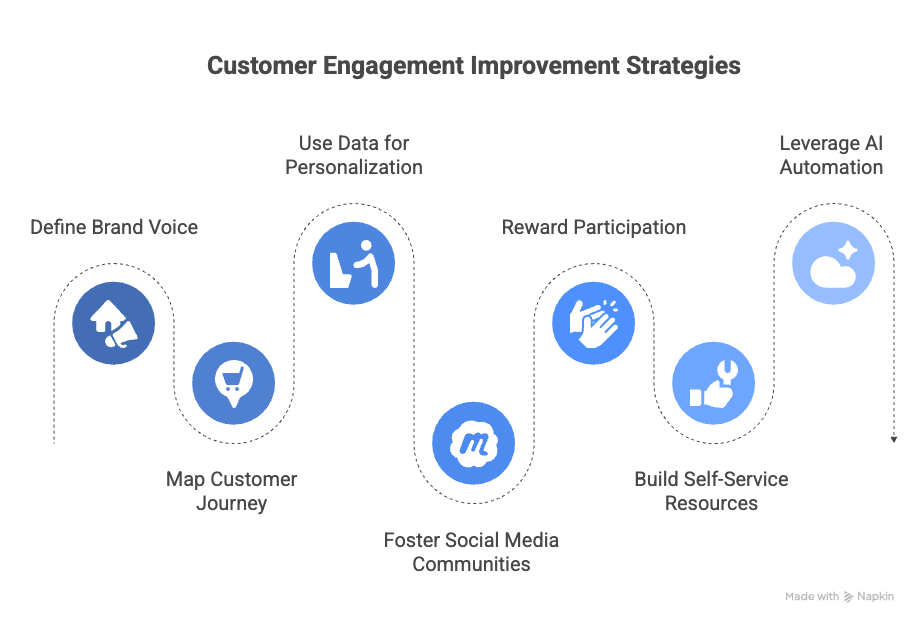
1. Define Your Brand Voice and Personality
Your brand voice is the distinct personality of your brand. It’s how you communicate, what you say, and how you make customers feel across every interaction. A strong brand voice creates recognition, builds trust, and fosters emotional connections.
In fact, 86% of consumers say authenticity is a key factor when deciding what brands they like and support, making a consistent, genuine voice essential for engagement.
How to build your brand voice:
- Align with your mission and values: Start by reviewing your company’s mission statement and core values. Identify specific vocabulary, phrases, and tone that reflect who you are.
- Audit your current content: Review your top-performing emails, social posts, and campaigns. What themes resonate? What language connects with your audience? Use these insights to refine your voice.
- Create brand voice guidelines: Document your tone (formal vs. conversational), language style (simple vs. technical), and provide dos and don’ts with concrete examples for different platforms.
- Be authentic: Stay emotionally true to your brand’s mission rather than chasing fleeting trends. Consistency builds trust.
Mailchimp built its brand around being “the experienced and compassionate business partner” for small businesses. Their voice is plainspoken, genuine, and uses dry humor. This consistency across emails, website copy, and social media has made Mailchimp instantly recognizable and trusted by millions of small business owners worldwide. Their brand voice guide explicitly states: “We’re weird but not inappropriate, smart but not snobbish.”
2. Map Every Customer Touchpoint in the Journey
Customer journey mapping visualizes where, when, and how customers interact with your brand from first website visit to post-purchase follow-up. It reveals engagement opportunities and friction points you might otherwise miss.
Understanding the customer journey enables you to deliver the right message at the right time and identify where customers drop off.
How to map your customer journey:
- Define clear goals (increase conversions, reduce churn, improve onboarding)
- Gather insights from surveys, interviews, analytics, and CRM data
- Identify all touchpoints (ads, website, checkout, emails, support, loyalty programs)
- Create a visual journey map showing actions, emotions, and pain points
- Analyze patterns and optimize weak points.
A perfect example of this is Slack. They realized that getting new users to send their first message was the most critical user journey for activation. By mapping this journey, they discovered non-technical users struggled with workspaces, channels, and threads.
So they optimized this by minimizing setup steps. They pre-created a #general channel, added tooltips directing users to the message input, and celebrated the first message with friendly feedback. This focus reduced early churn and significantly increased activation rates by ensuring users quickly experienced Slack’s core value: real-time communication.
3. Use Data for Hyper-Personalization
Generic messaging no longer works. In fact, 73% of customers expect better personalization as technology advances. Customers want you to anticipate needs and engage based on context, like what they just browsed, purchased, or left in their cart.
Here’s how to personalize effectively:
- Use purchase history, browsing behavior, and product usage to tailor messaging
- Segment audiences by behavior, preferences, lifecycle stage, or demographics
- Deploy dynamic content (personalized emails, recommendations, homepage experiences)
- Use AI to predict needs, optimize send times, and scale personalization.
Amazon, for instance, pioneered personalization at scale using algorithms that analyze browsing history, purchase patterns, and behavioral data. Their “customers who bought this also bought” and “recommended for you” features drive massive engagement.
Cencosud, for instance, used Amazon Personalize, resulting in a 600% increase in click-through rates and a 26% rise in average order value.
4. Foster Active Social Media Communities
Customers don’t just want to see your posts on social media platforms. They want to participate, be heard, and feel connected to a community that shares their interests. When customers see your brand responding to comments, celebrating user stories, or addressing concerns publicly, they witness your values in action.
How to build engaged communities:
- Be genuinely interactive: Respond to comments, ask questions, start conversations, and participate in relevant discussions.
- Share valuable content beyond your product: Post stories, educational content, humor, how-tos, and behind-the-scenes glimpses that resonate with your audience’s broader interests.
- Cover “shoulder” industries: If you’re a fitness brand, share nutrition tips and wellness inspiration; if you sell travel gear, post destination guides, and adventure stories.
- Run interactive campaigns: Use polls, quizzes, contests, and user-generated content challenges to encourage participation and keep followers engaged.
- Be consistent: Regular posting maintains visibility and keeps your brand top-of-mind.
For instance, Nike operates over 20 dedicated social media accounts targeting specific interests, locations, and demographics. They host community events like Air Max Day (celebrating their iconic sneaker line) with exclusive releases, design contests, and global meetups. Nike Run Club and Nike Training Club apps create spaces where millions of athletes track workouts, join challenges, and connect with each other.
5. Reward Participation and Feedback
Rewarding participation transforms passive consumers into engaged partners who provide feedback, create content, and advocate for your brand without being asked. Whether it’s leaving a review, referring a friend, or sharing a photo of your product, small incentives create powerful engagement loops.
How to reward engagement:
- Create loyalty programs: Offer points, discounts, exclusive perks, or early access to new products for purchases and engagement activities (reviews, referrals, social shares).
- Incentivize feedback: Provide discounts or rewards in exchange for reviews, surveys, or testimonials, then act on the input to show you’re listening.
- Gamify participation: Use challenges, achievement badges, leaderboards, or tiered membership levels (bronze, silver, gold) to make engagement fun and aspirational.
- Make rewards meaningful: Ensure incentives align with what your customers actually value. Free shipping might matter more than a 5% discount, or exclusive experiences might outweigh cash rewards.
6. Build Comprehensive Self-Service Resources
When customers can find answers instantly through your knowledge base instead of waiting for replies, they stay engaged with your product rather than abandoning it in frustration. They’re exploring, learning, and discovering features on their own terms, which deepens their understanding and investment in your solution.
How to create effective self-service:
- Build a centralized knowledge base: Create an online library with FAQs, how-to guides, troubleshooting articles, video tutorials, and step-by-step walkthroughs.
- Make it easy to navigate: Use clear categories, robust search functionality, and an intuitive design so customers find answers in seconds, not minutes.
- Keep content updated: Regularly review and refresh articles to ensure accuracy.
- Integrate across channels: Connect your knowledge base to your website, mobile app, chatbot, and IVR system so customers can access help wherever they are
- Enable community support: Add forums where customers can ask questions and share solutions with peers.
1% for the Planet, for example, cut response times from 4 days to 48 hours by building a centralized knowledge base with Hiver. The team created a single, reliable library of resources covering certification processes, donation guidelines, and membership policies. Coordinators pull verified answers instantly to guide members through complex processes, ensuring every response is accurate and consistent.
Members can also access the knowledge base directly to find answers without waiting, while the team regularly updates content whenever certification guidelines or policies change. “The Knowledge Base helps a ton because all the information is shared equitably across our network. It’s easy to update and ensures members receive consistent responses to their queries,” says Kaylee Duncanson, Membership Manager.
7. Leverage AI for Customer Engagement Automation
AI doesn’t just respond to customer needs; it anticipates them.
AI analyzes patterns in customer behavior. It studies past purchases, support history, browsing activity, and uses that data to anticipate what comes next. It routes inquiries based on sentiment and complexity, surfaces relevant help articles before customers ask, and triggers proactive outreach when engagement drops. When a case needs human attention, AI hands off full context so agents don’t waste time gathering background.
Hiver’s AI Copilot, for instance, analyzes incoming emails, drafts context-aware responses, and suggests replies based on past resolutions. Support teams cut response time without sacrificing personalization. The AI learns from every interaction, so answers get sharper over time.
How to implement AI for engagement automation:
Map your highest-volume, repetitive touchpoints, such as password resets, order tracking, and FAQ responses, and deploy AI chatbots or smart email routing there first.
Pair this with an AI-powered knowledge base that serves personalized help articles based on customer context. Use email automation platforms like Mailchimp or ActiveCampaign to send behavior-triggered campaigns (abandoned cart reminders, onboarding sequences, win-back emails) at precisely the right moment.
As your business scales and customer interactions span multiple channels, upgrade to comprehensive CRM platforms. It will help you with unified customer profiles, predictive analytics, and intelligent routing.
Top 7 Metrics To Measure Customer Engagement
Here are the five essential customer engagement metrics you should monitor:
1. CSAT (Customer Satisfaction Score)
CSAT, or Customer Satisfaction Score, is a direct measure of a customer’s satisfaction associated with a specific interaction or their overall experience. It typically involves a survey with a simple question, such as “How would you rate your satisfaction with our service today?” on a scale of say, 1 to 5.
CSAT helps you detect issues before they harm overall loyalty. It’s ideal for quickly identifying pain points and testing whether improvements to specific services are working.

2. Customer Engagement Score (CES)
Customer Engagement score is the number that tells you how actively customers interact with your brand across various touchpoints. This can be website visits, product usage, email opens, social interactions, support contacts, and loyalty program participation.
3. Net Promoter Score (NPS)
NPS assesses long-term customer loyalty by asking: “How likely are you to recommend our brand to friends or colleagues?” on a 0-10 scale. Unlike CSAT, NPS evaluates the overall relationship customers have with your company.
4. Conversion Rate
The percentage of visitors who complete a desired action like signing up for a newsletter, downloading a resource, starting a trial, or making a purchase.
For instance, if 50 out of 1,000 visitors subscribe to your newsletter, your conversion rate is 5%. Conversion rate measures how effectively your engagement efforts prompt action. It’s vital for assessing campaign performance and identifying friction points in the customer journey.
5. Social Mentions, Likes, Comments, and Shares
These metrics measure customer interactions with your brand on social media. An example is tracking the number of times a new product announcement is shared or liked on platforms like Instagram.
6. Pages Per Session
Indicates how many pages a visitor navigates through in a single session on your website. This way, you can track whether users read multiple blog posts in one visit.
7. Session Time
The average time spent by visitors on your site. A longer session time could indicate higher engagement, like spending several minutes reading a detailed product description.
A Simple Action Plan for Your Customer Engagement Strategy
Building a successful customer engagement strategy doesn’t require overhauling everything at once. Start simple:
1. Set up tracking for core engagement metrics: Use tools like Hiver to track CSAT scores, response times, and engagement trends across support channels.
For social engagement metrics (mentions, shares, sentiment), leverage Sprout Social or Hootsuite. For website behavior (conversion rate, bounce rate, session time), rely on Google Analytics and Hotjar to identify drop-off points.
2. Start with one high-impact strategy: Pick one engagement tactic that addresses your biggest gap: building a self-service knowledge base, launching a loyalty program, or refining your brand voice. Execute it well, measure results over 60 days, then scale what works.
3. Unify your customer communication: Fragmented tools create gaps that frustrate both customers and teams. Centralize interactions with a platform like Hiver that consolidates email, chat, and social channels into one interface, so your team has full customer context in every conversation.
Customer engagement isn’t about perfecting every touchpoint. It’s about showing up consistently, listening intentionally, and making customers feel like they matter. The brands that win today don’t just sell products; they build relationships that last. Start small, measure relentlessly, and let every interaction move you closer to becoming the brand customers choose again and again.
Frequently Asked Questions (FAQs)
1. What is the difference between customer engagement and customer satisfaction?
Customer engagement measures how actively and frequently customers interact with your brand across touchpoints like website visits, product usage, email opens, and social. Customer satisfaction (CSAT) measures how happy customers are with a specific interaction or transaction at a given moment. Engagement is ongoing and relationship-focused (“Are they choosing to interact with us?”), while satisfaction is transactional and moment-focused (“Did we meet expectations this time?”).
2. How can small businesses improve customer engagement without a large budget?
Small businesses can drive engagement cost-effectively through personalized emails using free tools like Mailchimp or HubSpot to segment customers and send targeted messages. Being genuinely active on social media by responding to comments, sharing user content, and starting conversations builds relationships without spending on ads. Creating simple loyalty or referral programs with affordable platforms like Smile.io rewards customers for participation.
3. How often should businesses communicate with customers to maintain engagement?
It depends on your industry and channel, but research shows clear patterns. For B2B brands, bi-monthly emails (twice a month) work best. You can also pair it with monthly check-ins or quarterly business reviews to maintain relationships. B2C brands typically see optimal engagement with weekly to 2-4 emails per week.
4. What are the most common mistakes businesses make with customer engagement?
Common mistakes include one-way broadcasting instead of two-way conversations, inconsistent experiences across channels due to fragmented systems, and ignoring customer feedback. Poor or nonexistent personalization also frustrates customers. To avoid these pitfalls, build engagement around genuine relationships and long-term value creation instead of short-term transactions.
Start using Hiver today
- Collaborate with ease
- Manage high email volume
- Leverage AI for stellar service