



A support agent gets a ticket on Monday morning. An enterprise customer’s integration broke over the weekend and their ops team has been blocked for six hours.
The agent loops in the account manager, who creates a new Jira ticket for engineering — manually typing the context across, because their helpdesk and Jira don’t talk to each other. Engineering fixes it by Tuesday afternoon, and the customer is finally unblocked.
Three months later, at renewal, the customer brings it up. “Remember when we were down for six hours and it took two days to get a clear answer?” The customer remembers, but your team doesn’t. The full record of what was said and promised, what the timeline actually looked like lies scattered across Jira, Slack, and someone’s inbox.
That missing context doesn’t just create a bad renewal conversation. It compounds across every handoff, escalation, and channel that the customer used to chase an answer. This is what we call the co-ordination infrastructure breakdown, and here’s what Hiver does about it.
The information loss
The expectation is that everything important gets documented. The reality is that 79% of opportunity-related data never makes it into the CRM, and only 2% of sellers trust the accuracy of what does.
The most important context in a B2B relationship is almost always informal — the commitment made on a call where nobody was taking notes, the pricing exception agreed in passing, the Slack message at 11pm before a customer went live.
This is the failure mode that doesn’t show up in ticket metrics. The resolutions get recorded, but the process, people, and relationships don’t survive a team change.
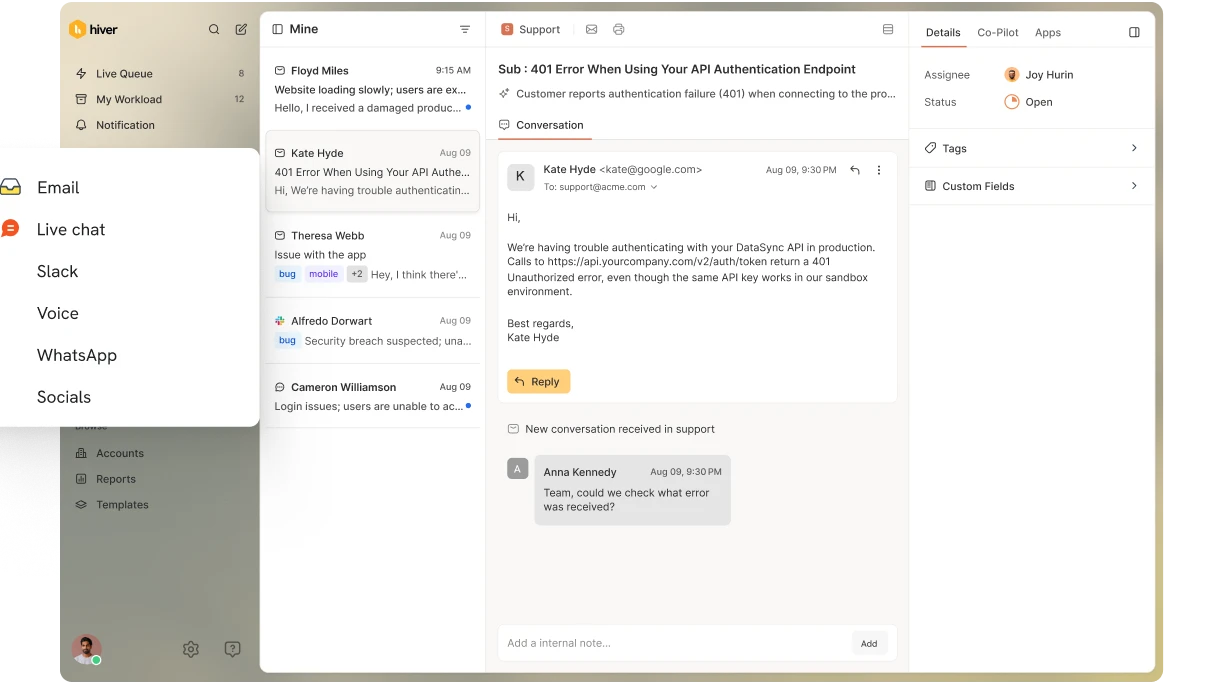
In Hiver, the context travels with the ticket. Internal Notes in Hiver thread directly into the customer conversation — visible to every team brought in, invisible to the customer. Every decision and internal discussion stays connected to the account record permanently.

When teams discuss a customer issue, that conversation happens in a Slack thread linked directly to the customer request. This serves as a record of the entire process of resolution. When a new CSM takes over, they can see not just what was resolved, but how, and what commitments and exceptions were made along the way. The informal context that normally lives in one person’s memory becomes part of the account’s institutional record.
The accountability gap
When a ticket moves from L1 to L2 support, L1 still nominally owns it but can’t move it forward. The resolution depends on an engineering team or billing team they have no direct visibility into.
L2 often sends it back for more information asking for details like account tier, error logs, steps already tried. In most setups, a returned ticket resets the SLA clock entirely. A ticket open for six hours is suddenly treated as if it just arrived, without any of the urgency it had earned on its journey.
Meanwhile, the customer follows up and the agent has nothing new to tell them.
Unito documented a logistics company where handoff delays averaged three hours because escalated tickets landed in a queue engineering checked only twice daily. According to data, the average resolution time in B2B SaaS is 15 hours. Most of that isn’t the actual work – it’s the gap between escalation and action.
Hiver’s Cross-team Spaces give every team involved — L1, L2, engineering — a shared view of who has the ticket, what the status is, and what the next step is. Hiver also ties the SLA to the conversation, not the agent. Ownership changes from L1 to L2 and back don’t reset the timer. Tag-based rules allow distinct policies per escalation tier, so when a ticket moves from L1 to L2, a tag change triggers the new policy automatically. The original clock doesn’t disappear, but works along with the handoff. This way, an SLA breach affects every team working to solve the problem and it becomes a more collaborative effort to find a resolution.
The channel switch and trust loss
B2B customers now use an average of ten interaction channels across their journey — up from five in 2016, according to McKinsey’s 2024 B2B Pulse. In a support context, that means the same customer might email your support team, follow up on chat, call your account manager, and send a message through your Slack channel; all about the same unresolved issue, across a single week.
Each interaction creates a distinct record in a separate system, owned by a separate team. And none of these teams has the full picture. The customer, meanwhile, is operating under the assumption that your company has a shared memory. They’ve raised the issue and they expect the next person they speak to know all about it.
This is where the structural cost of disconnected tools starts to compound. Real-time updates don’t exist unless someone manually creates them. Hiver’s integrations with Jira, Linear, NetSuite, HubSpot, and Salesforce surface updates automatically into the conversation thread. When engineering closes the Jira ticket, it appears in Hiver. When Finance confirms in Netsuite, it appears in the thread. No manual notification, no update that never got sent.
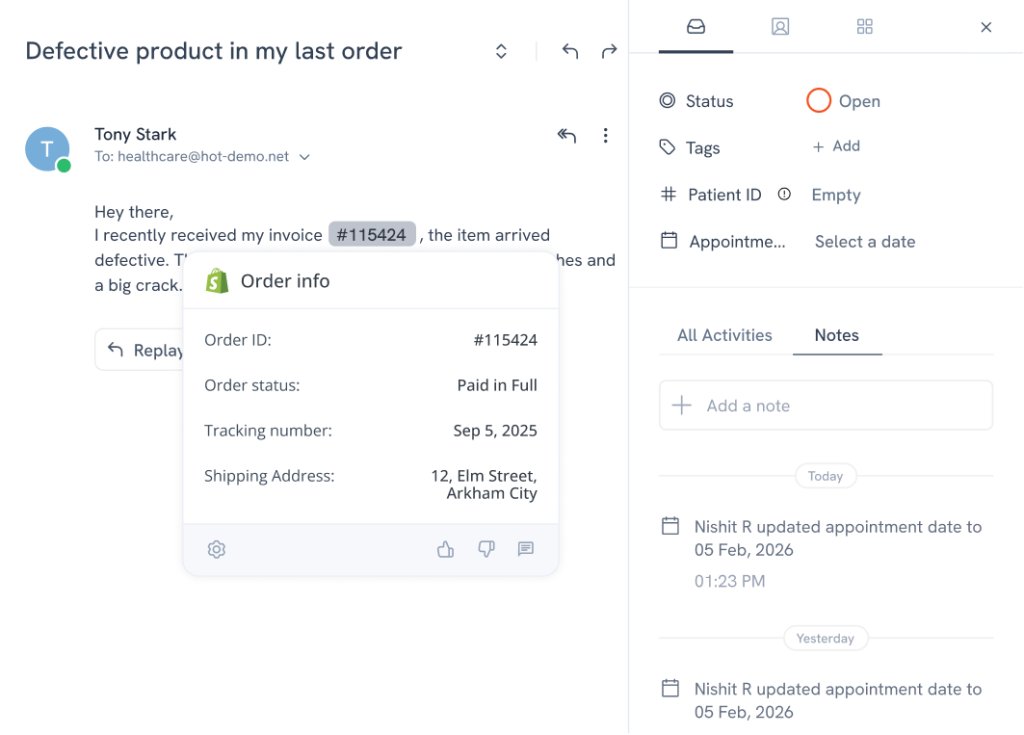
Omnichannel ticketing unifies email, chat, voice, and WhatsApp into one conversation record. The agent who picks up Tuesday’s call already knows about Monday’s email and the Jira status. Every interaction across every channel — including everything that happened six months ago — is in one place when the renewal conversation comes around.
When AI makes it worse
A customer raises an issue on chat. The AI — working from a knowledge base, without access to account history or the active incident — confidently tells them the issue doesn’t exist. They follow the advice. The problem gets worse. They come back angrier, with evidence your system gave them bad information.
Most support AI is static — trained on a snapshot of your knowledge base and unchanged until someone manually updates it. As your product changes and new failure patterns emerge, the AI keeps answering from a picture that’s getting more out of date every week. In B2B, where a wrong answer reaches a customer who has been building a relationship with your team for eighteen months, that confidence is the problem.
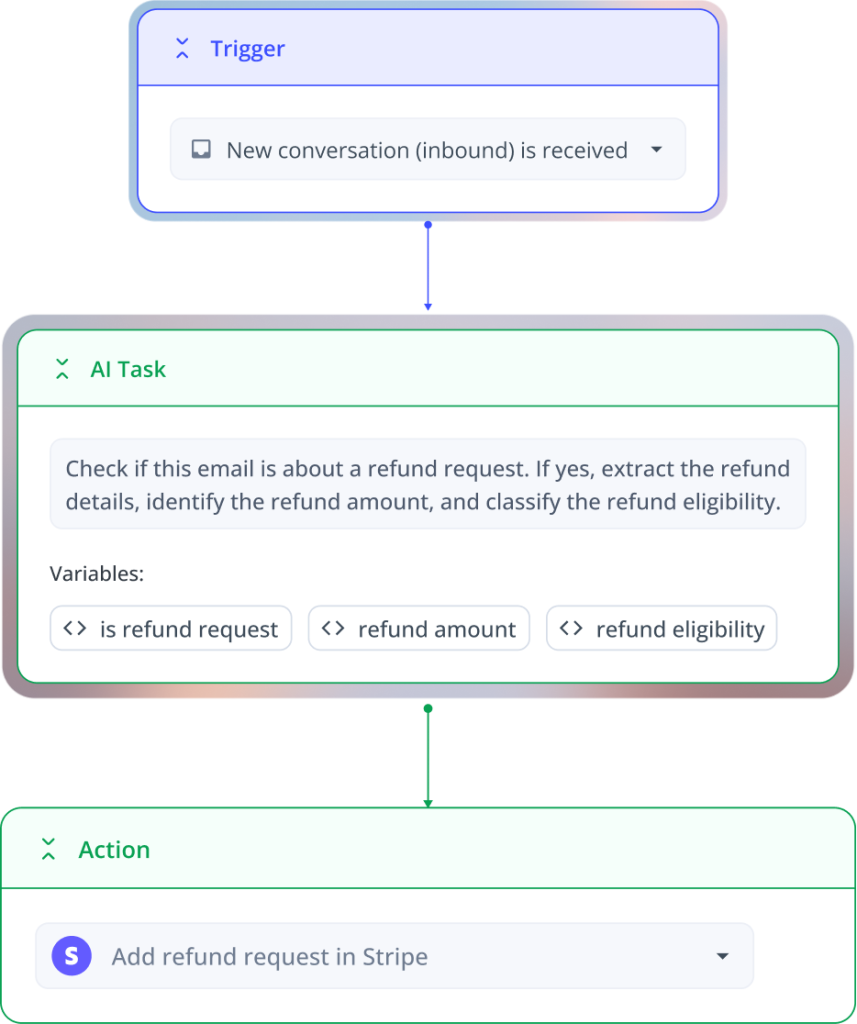
AI Tasks works behind the scenes instead: routing conversations by account tier and issue type, flagging negative sentiment before it escalates, generating handoff summaries so the next agent arrives fully briefed, and drafting responses for agents to review. It operates from full customer context — so what it produces is grounded in the actual situation. The agent’s judgment stays in the loop. The overhead around it doesn’t.
The problem isn’t your process. It’s what your process is built on.
The shared ownership doc, the weekly sync between support and engineering, the rule that no ticket leaves without a named owner — these are all reasonable responses to a problem that plagues every CX team. These cultural fixes, however, only define behaviours someone has to perform. These work if teams remember to send an update, manually re-type context, or become the coordinating layer because nobody else has visibility.
What Hiver does is convert those behaviours into something the infrastructure handles, regardless of whether anyone else remembers.
The cost of this infrastructure breakdown doesn’t announce itself. It shows up in the account manager who is burning out doing a job that three tools should have done automatically. It shows up three months later, in a renewal conversation about an incident everyone thought was closed but where the customer remembered a missing piece and your team remembered nothing.
Support coordination is not a process problem. It is an infrastructure decision.