






ServiceNow remains one of the most recognized names in IT service management. It helps large IT teams run complex workflows across incident management, change processes, asset tracking, and more.
You get powerful automation, deep integrations, and a unified platform that ties IT operations together.
But many teams also talk about steep learning curves, long implementations, and costs that rise quickly. For smaller or mid-sized IT departments, the platform can feel heavy when all they need is a fast, reliable IT help desk that fits into their existing workflows.
If you are evaluating ServiceNow, the real question is simple. Does the platform deliver enough value to justify its complexity and cost for your IT team?
In this article, we breaks down what ServiceNow does well and where users struggle.
TL; DR
- ServiceNow is an enterprise ITSM platform that helps large organizations manage incidents, requests, changes, and workflows across multiple departments.
- Best suited for enterprises with complex processes that need deep automation, integrations, and a centralized operations layer.
- Pricing is custom. Industry estimates place ITSM between 100 and 400 dollars per user per month with no free tier.
- Known for strong automation, a unified platform, and broad workflow coverage.
- Users report steep learning curves, slow performance at scale, high implementation costs, and limited pricing transparency.
Table of Contents
What Is ServiceNow?
ServiceNow is a cloud-based IT service management and workflow automation platform. It helps IT teams manage incidents, service requests, problems, change approvals, and cross-department workflows from a central system.
Originally built as an IT help desk, ServiceNow now covers HR, security operations, customer service, asset management, and custom apps. It’s designed for large organizations that need structured processes, audit-ready workflows, and advanced automation.
ServiceNow fits best in environments where IT teams handle high volumes, depend on strict SLAs, and need detailed reporting and control.
Key Features of ServiceNow
ServiceNow comes with a broad set of ITSM and workflow tools. Here’s a breakdown of the features IT teams use the most.
1. IT Service Management (ITSM)
ServiceNow’s ITSM suite includes incident, problem, and change management. Teams can automate routing, set priorities, and manage approvals without manual work. The service catalog helps employees request devices, access, or services through a self-service portal.
“ServiceNow has been my go-to tool for request management and incident management, and it was very user friendly once we all got the hang of it.” –G2 user
2. Unified Platform Across Departments
ServiceNow connects IT, HR, customer service, and security workflows under one system. This gives companies a single platform for all service operations.
One user highlighted how Customer Service Management brings together cases, knowledge articles, and back-end processes so agents don’t have to switch tools.
3. Knowledge Management
Teams can build a knowledge base for internal use or customer-facing documentation. Articles can be created directly from tickets, and AI tools help identify gaps.
4. Automation and AI
ServiceNow uses AI to route tickets, manage virtual agents, and trigger follow-up tasks. IT teams use automation to enforce SLAs, escalate issues, or run approval chains.
5. Dashboards and Analytics
You can create dashboards with drag-and-drop widgets. These dashboards show metrics like ticket volumes, SLA breaches, employee feedback, and workload distribution.
“The dashboard is simple to customize and helps you see what’s important without clicking around too much.” –G2 user
6. Cross-Team Collaboration
Teams can work together on complex issues using shared notes, @mentions, and multi-team workflows. This helps IT, finance, HR, and operations resolve issues faster without juggling multiple tools.
7. Customer Service Management (CSM)
CSM routes customer queries from chat, email, web, and phone into one console. Cases can be escalated directly into ITSM when technical help is required.
“Customer Service Management eases visibility for the customers and lets agents create IT tickets directly if needed.” –G2 user
8. Security Operations
ServiceNow Security Operations brings threat intelligence, incident response, and vulnerability tracking into one place. IT security teams can prioritize risks and manage remediation workflows efficiently.
Recommended reading – Servicenow vs Salesforce
ServiceNow Customer Reviews
User feedback highlights both strong capabilities and common frustrations.
Pros
Strong Workflow Consolidation
“I like that ServiceNow makes it easy to manage work in one place. You can see ticket status right away and know who’s working on what.” –G2 user
Deep Automation
Teams rely on routing, escalations, and SLA enforcement to reduce manual workload and keep processes consistent.
Enterprise Integrations
ServiceNow’s ability to connect with existing enterprise systems creates a unified data environment that improves decision-making and operational efficiency.
“SN integrates with other compatible software very well.” –G2 user
Cons
Steep Learning Curve
ServiceNow’s extensive feature set can make the onboarding process challenging for new users, especially those without dedicated technical resources.
“Because it’s so feature rich, the learning curve can be steep for new users.” –G2 user
Performance Issues
Despite its powerful features, some users have reported slowdowns, especially when handling large volumes of tickets or running complex reports.
“It can feel slow at times, especially when opening large tickets or reports.” –G2 user
Customization Requires Developers
Customization of workflows and forms often requires specialized knowledge or developer support, which can create bottlenecks for teams without a dedicated IT staff.
“Even small configuration changes often require deep knowledge or help from developers.” –G2 user
Limited Training Resources
Some users have found the available training resources inadequate for helping new users navigate the platform.
“Lack of tutorials and easy-to-understand videos for first-time users.” –G2 user
ServiceNow Pricing Overview
ServiceNow does not publish pricing publicly. Costs vary across ITSM, ITOM, HRSD, CSM, and Security Operations. Pricing depends on the modules you choose, the number of fulfillers, and contract terms.
Industry estimates suggest ITSM often falls between 100 and 400 dollars per user per month. Large implementations typically involve onboarding fees, professional services, and long deployment cycles.
For many teams, this makes budgeting difficult and long-term costs hard to forecast.
Hiver: A Modern, Faster ITSM Alternative
If your IT team needs strong service workflows without enterprise overhead, Hiver offers a simpler and more cost-effective option.
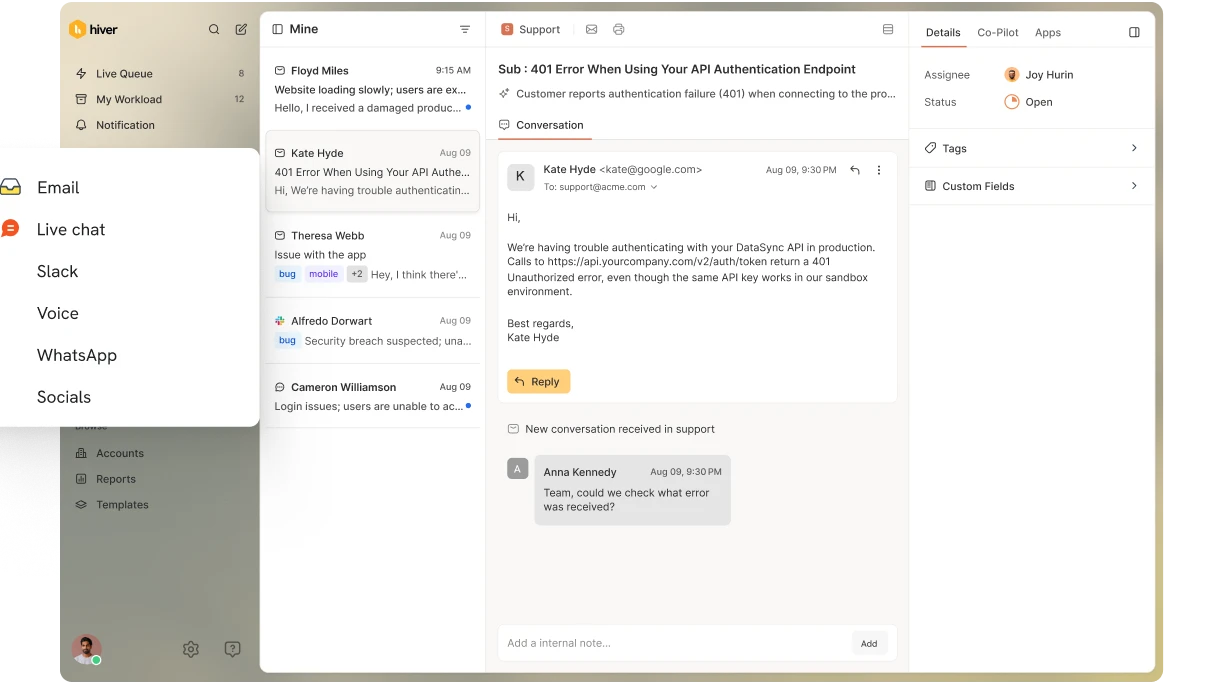
Hiver helps IT teams manage requests across email, live chat, WhatsApp, voice, and an internal portal. It uses AI to triage requests, draft replies, summarize long threads, and reduce manual work.
Teams get approval workflows, SLA alerts, analytics, collaboration tools, and 100+ integrations including Jira, Slack, NetSuite, and ClickUp.
Why IT teams choose Hiver
- Go live in under two hours
- No complex UI or heavy setup
- AI for routing, resolutions, and summaries
- Multichannel IT support out of the box
- Built-in knowledge base and chatbots for L1 queries
- Clear pricing from 19 dollars per user per month
- Unlimited users on the Free plan
For IT teams that want speed, clarity, and predictable pricing, Hiver is much easier to adopt than ServiceNow.
Hiver vs ServiceNow: What’s the Better Fit?
ServiceNow works best for large enterprises with complicated processes and long-term transformation goals.
Hiver works best for IT teams that want a modern, AI-driven helpdesk that fits into their inbox and can be deployed instantly.
If your focus is fast setup, smooth adoption, and clear pricing, Hiver offers strong IT service capabilities without enterprise overhead.Want to see how Hiver fits your IT workflows? Book a demo.
Frequently Asked Questions
1. How long does ServiceNow take to implement?
It takes typically 6 to 18 months depending on complexity and number of modules.
2. Is ServiceNow suitable for smaller IT teams?
Not always. The platform can feel heavy for smaller teams that don’t need enterprise-level customization.
3. How does ServiceNow compare to simpler IT help desks?
ServiceNow supports broad enterprise workflows. Tools like Hiver focus on IT service delivery, rapid deployment, and clear pricing.
4. What technical expertise do you need?
Most teams hire dedicated ServiceNow admins. Even small workflow changes often require technical specialists.