

ServiceNow vs. Salesforce: Which Platform Delivers Real Business Value?
ServiceNow vs. Salesforce
Quick Decision Guide
Platform Comparison Overview
Understanding Each Platform
Salesforce Service Cloud: The CRM-Powered Service Engine
Hiver: The Scalable Modern AI Customer Service Platform
Feature Deep Dive
Implementation and Total Cost Reality
Final Recommendations
Choosing between enterprise platforms shouldn’t require a team of consultants. After extensive analysis of ServiceNow and Salesforce Service Cloud with real IT and support teams, we’ve discovered that the most feature-rich platform isn’t always the best choice. Sometimes the tool that just works wins over the one that promises everything.
This guide examines the different approaches to customer service: ServiceNow’s workflow automation empire, and Salesforce’s CRM-centric service tools. Let’s cut through the vendor promises and see which platform actually delivers value for your team.
Quick Decision Guide
Choose ServiceNow if: You’re a large enterprise with complex IT workflows, dedicated technical resources, and need comprehensive ITSM capabilities across multiple departments.
Choose Salesforce Service Cloud if: You’re already invested in Salesforce’s CRM ecosystem and want integrated customer service tools with strong sales and marketing alignment.
Platform Comparison Overview
Primary Focus
IT Service Management & Workflows
CRM-Based Customer Service
Scalable Customer Service Platform
Setup Time
Weeks to months
45-75 days
Minutes
Learning Curve
Steep, requires training
Moderate, CRM-focused
Minimal
ITSM Capabilities
Industry-leading
Basic service desk features
Strong customer service focus
Customer Service
Comprehensive CSM
CRM-integrated excellence
Unified multi-channel support
Customization
Highly customizable
Good CRM customization
Essential customization
Pricing Clarity
Complex, custom quotes
Tiered with add-ons
Transparent, flat pricing
AI Integration
Now Assist AI platform
Einstein AI leadership
AI Copilot for automation
Multi-Channel
IT-focused channels
CRM omnichannel
Email, Chat, WhatsApp unified
Understanding Each Platform
ServiceNow: The Enterprise Workflow Engine
ServiceNow started as an IT service management platform and evolved into a comprehensive workflow automation engine. It’s designed for large organizations that need to orchestrate complex processes across multiple departments with strict governance and compliance requirements.
What makes it powerful:
Comprehensive ITSM: Industry-leading incident, problem, change, and request management
Workflow automation: Connect processes across IT, HR, finance, and operations
Single data model: Unified platform architecture eliminates data silos
Enterprise scalability: Handles thousands of users and complex organizational structures
AI-powered insights: Now Assist provides intelligent automation and predictive analytics
Where it struggles:
Complexity overhead: Requires dedicated administrators and often external consultants
Implementation time: Deployment typically takes 3-6 months for full configuration
Cost escalation: Pricing can balloon quickly with additional modules and users
User adoption challenges: Interface and workflows often feel overwhelming to end users
Salesforce Service Cloud: The CRM-Powered Service Engine
Salesforce Service Cloud extends the company’s dominant CRM platform into customer service territory. It excels when you need tight integration between sales, marketing, and support functions, providing a unified customer view across the entire lifecycle.
What makes it powerful:
CRM integration: Complete customer context from marketing touchpoints through support resolution
Einstein AI: Advanced predictive analytics, sentiment analysis, and automated response suggestions
Omnichannel capabilities: Unified interface for phone, email, chat, social media, and messaging
Customization power: Extensive configuration options and AppExchange ecosystem
Sales alignment: Support interactions automatically inform sales teams about account health
Where it struggles:
CRM dependency: Works best when you’re already committed to Salesforce’s ecosystem
Feature complexity: Advanced capabilities require expensive tier upgrades
Setup investment: Implementation typically takes 45-75 days with significant customization
Cost accumulation: Modular pricing means essential features often require multiple “Clouds”
Hiver: The Scalable Modern AI Customer Service Platform
Hiver takes a fundamentally different approach as a scalable customer service platform designed for teams that want professional support capabilities without operational complexity. Instead of forcing teams to learn new interfaces, it delivers sophisticated customer service through an interface that teams already understand.
What makes it powerful:
Minimal training: Works within familiar workflows that require zero to minimal training
Rapid deployment: Teams typically operational within hours of setup
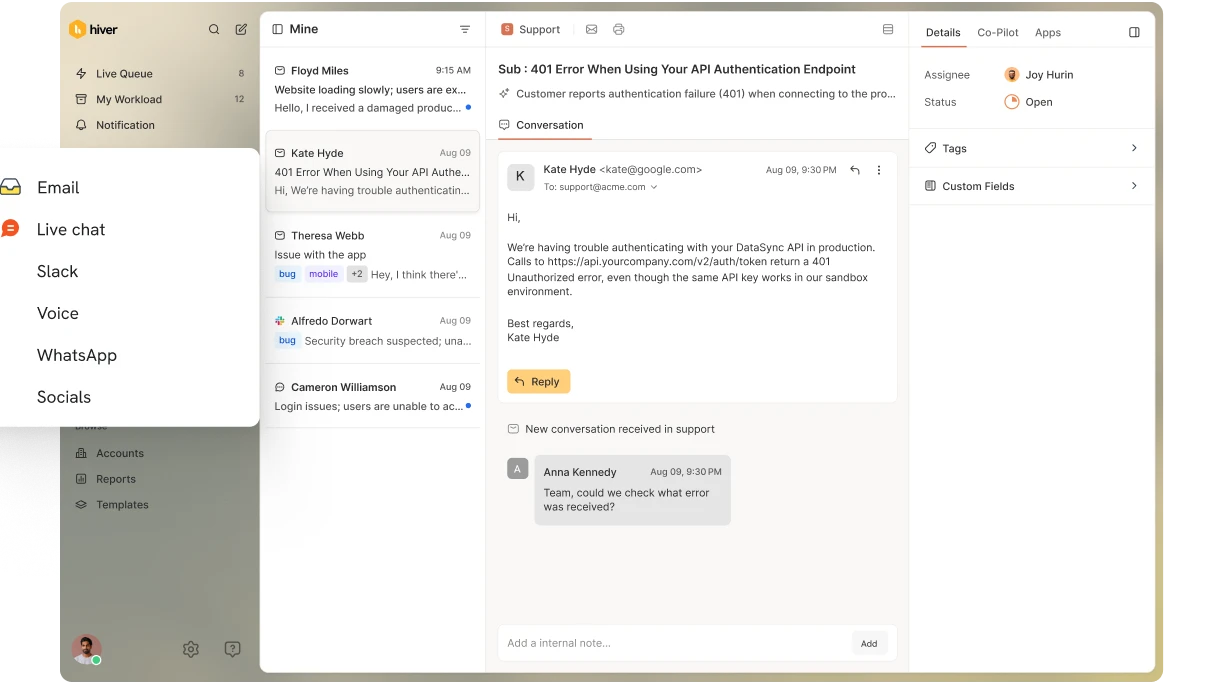
Unified service management: Handles customer service across email, chat, and WhatsApp from a single platform
AI Copilot: Intelligent automation for routing, response suggestions, and workflow optimization
Collaboration focus: Built-in features like collision detection, shared drafts, and team coordination
Feature Deep Dive
IT Service Management Capabilities
ServiceNow represents the pinnacle of ITSM sophistication with comprehensive incident management, change management workflows, problem management with root cause analysis, and detailed asset lifecycle tracking. The Configuration Management Database (CMDB) maps relationships between every IT component.
Salesforce Service Cloud approaches ITSM from a customer service perspective with solid case management and knowledge base functionality, but IT service management feels like an add-on to the core CRM platform.
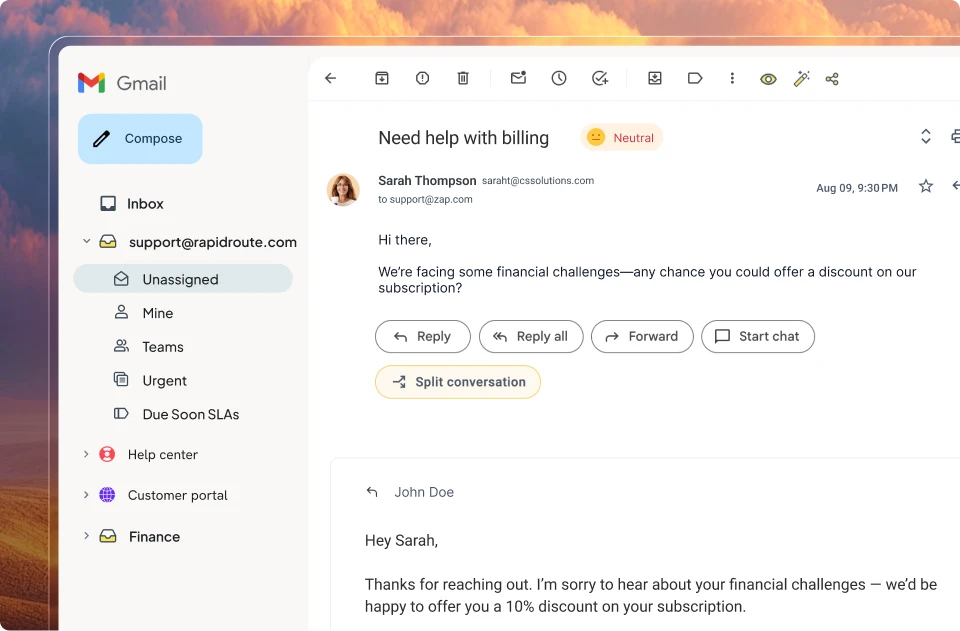
Hiver treats customer service management as an essential business function that shouldn’t require specialized training. Customer requests appear as organized conversations with professional tracking, assignment, and escalation capabilities powered by AI Copilot.
Customer Service Management Philosophy
ServiceNow CSM focuses on process standardization and workflow automation—the assembly line approach where every case follows predetermined paths with strict SLA tracking.
Salesforce Service Cloud takes the comprehensive customer knowledge approach. When a customer reaches out, agents see complete purchase history, marketing interactions, and previous support cases.
Hiver brings efficiency and effortlessness together. Customers reach out through multiple channels, but conversations stay unified and intelligent. The AI Copilot analyzes context, suggests responses, and routes inquiries to the best-qualified team members automatically.
The collaboration features are where Hiver excels. Team members can add private notes, share draft responses for review, and coordinate without creating confusion for customers.
Workflow Automation Approaches
ServiceNow offers the most sophisticated workflow automation with multi-departmental process orchestration and autonomous AI agents for complete request fulfillment. The sophistication comes with complexity costs requiring technical expertise for building and maintaining workflows.
Salesforce Service Cloud provides CRM-focused automation where Einstein AI predicts case outcomes, suggests knowledge base articles, and routes cases to agents with relevant expertise. The platform’s automation supports rather than replaces human decision-making.
Hiver focuses on practical automation that works immediately:
Smart routing: Automatically assign conversations based on content analysis and agent expertise
SLA management: Track response times and escalate before deadlines
Follow-up automation: Schedule check-ins based on conversation status
AI Copilot suggestions: Recommend relevant responses based on conversation patterns
Implementation and Total Cost Reality
Real-World Deployment Timelines
ServiceNow Implementation Journey:
Weeks 1-4: Requirements gathering, process mapping, architecture design
Weeks 5-12: Platform configuration, custom development, integration setup
Weeks 13-20: Testing, user training, pilot deployment
Weeks 21-24: Full rollout and optimization
Most organizations need 6-12 months to fully realize ServiceNow’s capabilities.
Salesforce Service Cloud Implementation:
Weeks 1-3: CRM assessment and service requirements analysis
Weeks 4-8: Configuration, automation setup, integration development
Weeks 9-12: Testing, training, gradual rollout
Implementation typically takes 3-4 months, faster with existing Salesforce investment.
Hiver Implementation:
Day 1: Platform setup and team member addition
Days 2-3: Workflow configuration and AI Copilot setup
Week 1: Team training and process optimization
Week 2: Full operational deployment
Most teams are fully operational within one week.
Final Recommendations
For Most Organizations: Match Your Actual Needs
The biggest mistake teams make is choosing platforms based on capabilities they might need someday rather than problems they’re dealing with today. Hiver’s modern AI customer service platform approach focuses on being powerful enough to handle real business needs while staying simple enough that your team will actually use it.
Choose ServiceNow if:
You’re managing complex IT infrastructure across multiple departments
Compliance and governance requirements demand detailed process control
You have dedicated technical resources for implementation and maintenance
Process standardization across large organizations is a priority
Choose Salesforce Service Cloud if:
You’re already invested in Salesforce’s CRM ecosystem
Customer service integration with sales and marketing is essential
You need sophisticated customer interaction tracking and analytics
Omnichannel customer engagement is a business requirement
Choose Hiver if:
You want professional customer service capabilities without operational disruption
Zero learning interface appeals more than learning new complex systems
Rapid deployment and immediate value realization are priorities
Platform simplicity and team adoption matter more than feature breadth
The Scalability Advantage
After testing all three platforms extensively, Hiver consistently delivers the highest ratio of value to complexity. While it doesn’t match the feature breadth of enterprise platforms, it solves the core customer service problems that most organizations actually face.
Hiver’s interface eliminates the biggest barrier to platform success: user adoption. When teams can be productive immediately without training, the compound benefits often outweigh the theoretical advantages of more sophisticated platforms.
Real Success Stories

“With Hiver, I always know where an issue stands—and we no longer miss emails. It’s like having an extra person on my team.”
Nathan Strang
Ocean Freight Operations Manager, Flexport

“With Hiver, we’re finally having real conversations with our customers. No ticket numbers, no robotic emails—just personal, human interactions.”
Scott Gellatly
General Manager, itGenius