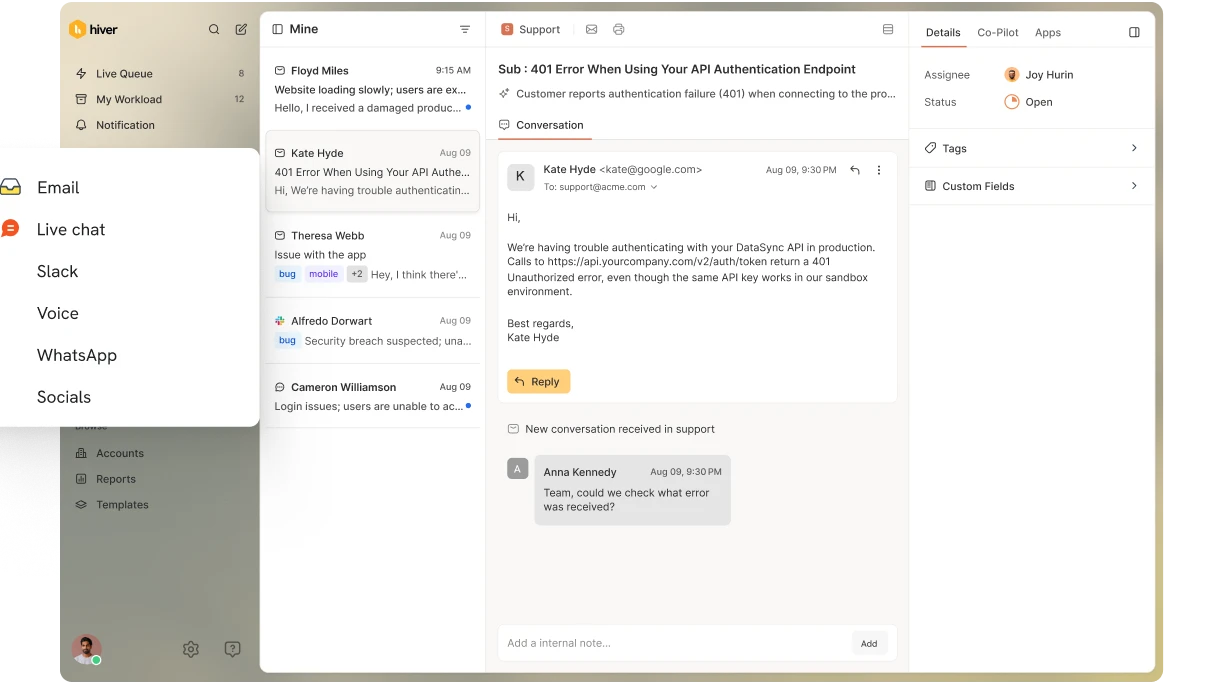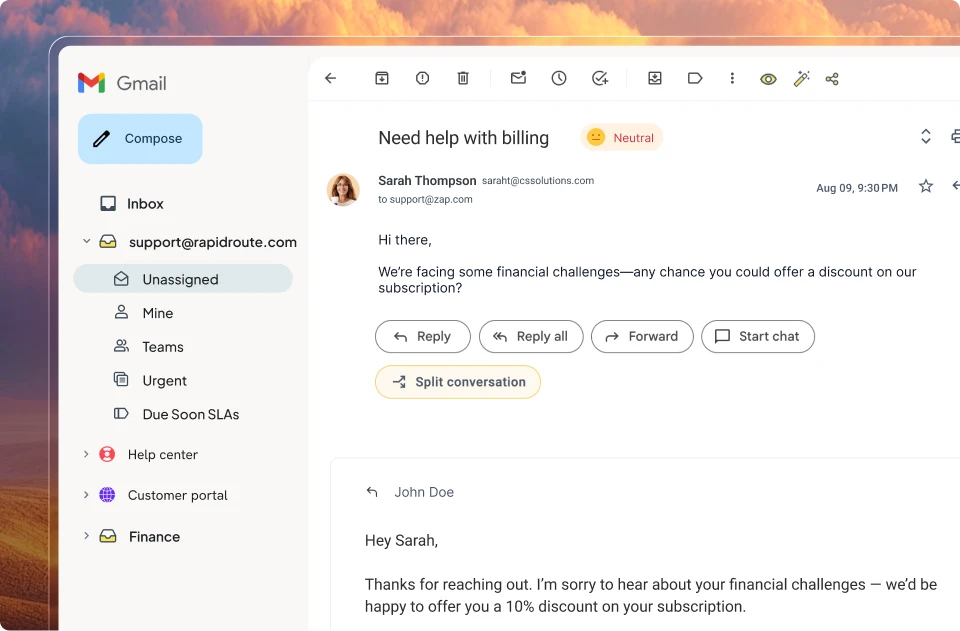







Most support teams don’t struggle to find a live chat tool. They struggle to find one that holds up once volume picks up. A widget that works fine during a pilot falls apart when you’re managing 300 chats a day across a team of 15 agents, especially if the AI drops context on handoff or your reporting doesn’t tell you where things are breaking down.
What’s changed in the last couple of years isn’t just the addition of AI. It’s the expectation that live chat should function as a full support channel, not a standalone widget. Support leaders are now asking whether the tool integrates with their CRM, whether the AI can handle tier-1 queries without a script, and whether the reporting gives them enough signal to actually manage the team. A blinking chat bubble doesn’t answer those questions.

I tested the most widely used live chat tools and evaluated them on six criteria: AI resolution quality, handoff experience, ease of setup, routing and queue management, reporting and analytics, and pricing transparency. Each entry includes a scorecard so you can compare at a glance.
Here are the top picks:
- Best for ecommerce (Shopify): Gorgias — starts at $10/mo
- Best AI-native live chat: Hiver — free plan available, paid from $25/user/mo
- Best free option: Tawk.to — completely free
- Best for SaaS / in-app support: Intercom — starts at $29/user/mo
- Best for small businesses: Tidio — starts at $29/mo
How I Evaluated These Live Chat Tools?
I tested free plans and trials across these tools firsthand, and cross-referenced findings with reviews on G2, Capterra, and Reddit. Here’s what I scored them on:
- AI resolution quality: how well bots handle real queries without dropping context
- Handoff experience: whether the bot-to-human transition preserves conversation history
- Ease of setup: time from sign-up to a working chat widget
- Routing and queue management: skills-based, intent-based, and round-robin options
- Reporting and analytics: response times, agent performance, chat volume trends
- Pricing transparency: what’s actually included, and where costs spike as you scale
Each tool entry ends with a scorecard rating against these six criteria.
10 Best Live Chat Software in 2026
The right live chat tool depends on how your team is structured, which channels you support, and how much of the queue you want AI handling versus agents.
What I’ve tried to do here is give you enough signal on each tool to make that call yourself.
1. Gorgias
Ideal for: Ecommerce brands on Shopify, BigCommerce, or Magento
Gorgias is built exclusively for ecommerce support. Its Shopify integration pulls purchase history, shipping status, and open returns directly into every chat. When a customer asks about their order, the agent has full context before responding — no tab switching, no copy-pasting order numbers.
You can also set up Chat Campaigns that proactively message visitors who’ve spent more than 60 seconds on a product page. ALOHAS used this to double their revenue from customer support within three months of enabling it.
Pricing
Gorgias charges per ticket, not per seat. This is a key structural difference from most tools on this list.
- Starter: $10/month for 50 tickets
- Basic: $50/month for 300 tickets
- Pro: $300/month for 2,000 tickets
- Advanced: $750/month for 5,000 tickets
- Enterprise: custom pricing.
This works well when volume is predictable. During high-volume periods like Black Friday, costs can spike fast. The AI Agent is a paid add-on charged per automated resolution, so teams with seasonal spikes should model this before committing.
Strengths
- The Shopify integration is where Gorgias genuinely pulls ahead. You can configure routing rules so any chat tagged “refund” goes to an agent, while “order tracking” queries are handled by the AI Agent directly. The AI pulls live shipping data from Shopify and responds with the actual tracking link, not a generic placeholder.
- Agents can issue refunds, edit orders, and process returns from inside the helpdesk without opening Shopify. This matters for teams where agents are handling multiple chats simultaneously.
- The guided self-service flows inside the chat widget let customers click through structured paths like “Track my order” or “Start a return” without involving an agent. The bot handles it end to end by pulling order data automatically.
- 150+ integrations including Klaviyo, Recharge, Attentive, and Yotpo.
Weaknesses
- The AI Agent only integrates with Shopify, BigCommerce, and Magento. WooCommerce isn’t currently supported. If you run on WooCommerce, you’re getting the helpdesk without the AI depth, which limits the ROI considerably.
- On Starter and Basic plans, vendor support is email only. If something breaks and you need a fast resolution, you’ll have to wait. Live chat support is locked behind higher tiers.
User Reviews:
- “Agents can issue refunds, edit orders, and track shipments directly from the helpdesk — no tab switching” – G2
- “The interface is a bit overwhelming at first so ease of use can be an issue to a few.” — Capterra
- “AI agent fees create unpredictable bills.” — G2
Gorgias’s Score Card as a Live Chat Tool
| AI resolution quality | ⭐⭐⭐⭐ |
| Handoff experience | ⭐⭐⭐⭐⭐ |
| Ease of setup | ⭐⭐⭐ |
| Routing & queue management | ⭐⭐⭐ |
| Reporting & analytics | ⭐⭐⭐ |
| Pricing transparency | ⭐⭐ |
2. Hiver Omni
Ideal for: Teams that want live chat where AI handles the frontline, escalations are structured, and managers have full visibility into how their AI agents are performing.
Hiver Omni is a customer service platform built for teams that want to resolve complex customer requests without losing control of how they’re handled. AI agents take the first line of support, resolving what they can, and when something needs a human, the conversation is handed off with full context — whether that stays in chat or continues over email.
Where Hiver Omni differs is in how much control you have over three things: how accurately the AI responds, how intelligently it hands off, and how much visibility you have into every conversation it handles.
Precision: You can train the AI agent on your knowledge base, SOPs, and internal documentation — so it’s answering from your actual content, not providing generic responses.
Guardrails and handoffs: Escalations don’t just go to any available agent. If the customer is on a high-value account, Hiver Omni routes directly to their account manager instead of dropping them into a generic queue.
CyberHunter embedded Hiver Omni’s live chat inside their client portal and saw support volume drop by 20% during peak hours as a result.Observability and feedback loop: Hiver Omni lets you monitor every conversation an AI agent handles — how it responds, where it gets stuck, and when it hands off. You can leave feedback directly on individual conversations to improve future behavior.
Pricing
Unlike most tools in this category, Hiver Omni includes both AI Agents and AI Copilot across all paid plans — no add-ons required.
- Growth: $25/user/month
- Pro: $55/user/month
- Elite: $85/user/month
Strengths:
- Once a conversation is handed off to a human, AI Copilot works alongside the agent in real time — drafting replies, summarizing the thread so the agent is up to speed instantly, and suggesting answers based on your knowledge base. The handoff doesn’t slow the conversation down.
- Chatbot flows are built with a drag-and-drop builder, so you can customize how conversations are handled without any technical knowledge. For example, if a customer raises a refund request on chat, the bot collects the order ID and reason, checks eligibility against your refund policy, and either triggers the refund automatically if conditions are met or escalates to a human agent with all the details already captured.
- At Hiver, the measure of a good AI agent on chat isn’t just how many conversations it closes — it’s whether the answers it gives are actually correct. Every change to the AI agent is tested and scored for faithfulness, relevance, and groundedness before it goes live.
Weaknesses:
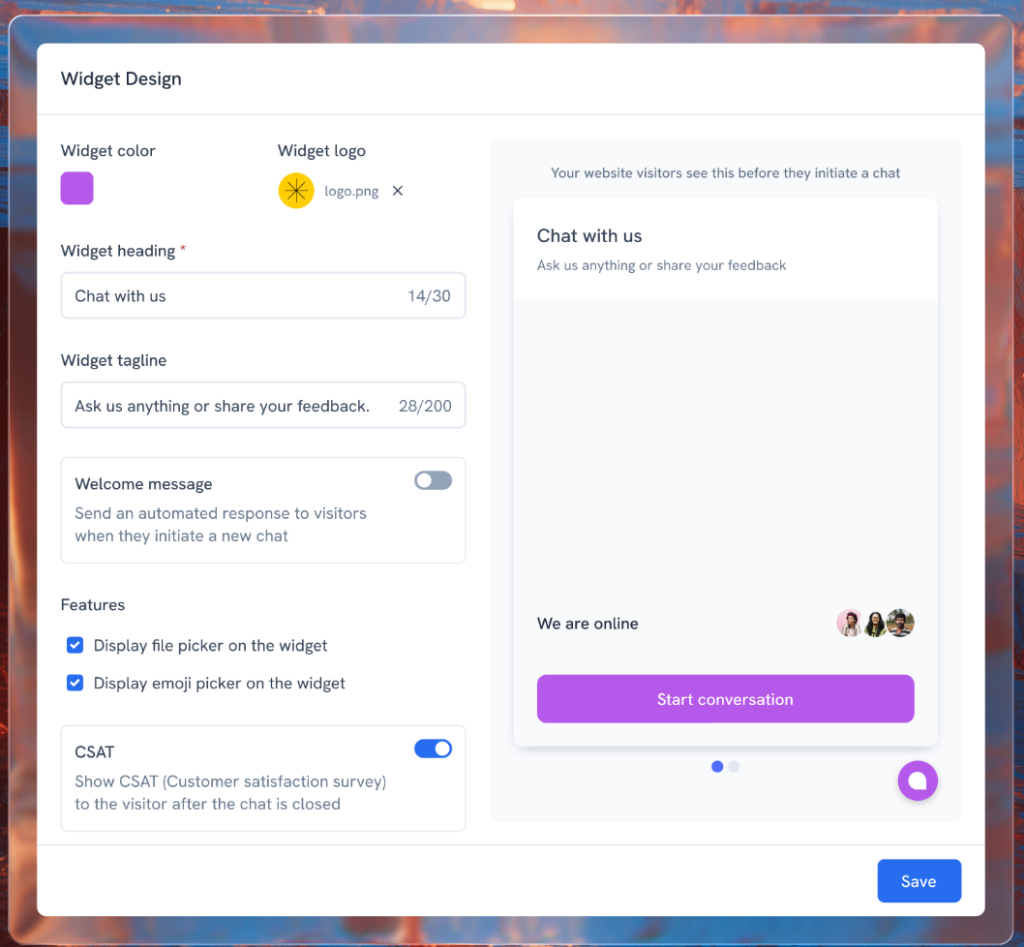
- Widget customization is limited. You can adjust the color and welcome message, but positioning and design options are constrained.
- Hiver Omni doesn’t support behavior-triggered proactive chat. If reaching out to visitors based on their actions on the page is a priority, this is a gap to factor in upfront.
User Reviews:
- The live chat is equally seamless, it feels native to our workflow. Being able to assign chats as tasks and collaborate with the team using internal notes has significantly improved our response time and organization. – G2
- “Chatbots manage routine queries, and complex cases go straight to agents in real time. The handoff is very smooth.” – Nelson Jay Dela Cruz, Miki Travel
- “The chat feature is great too because it allows us to have contextual conversations without leaving the platform, which speeds up communication significantly.” – G2
- “The live chat icon for our websites is not customizable and cannot be positioned on the page to match our design. That’s a bummer!” — G2
Hiver Omni’s Score Card as a Live Chat Tool
Out of 5 stars, here’s how I’d rate Hiver Omni as a live chat tool based on the evaluation criteria:
| AI resolution quality | ⭐⭐⭐⭐ |
| Handoff experience | ⭐⭐⭐⭐⭐ |
| Ease of setup | ⭐⭐⭐⭐⭐ |
| Routing & queue management | ⭐⭐⭐ |
| Reporting & analytics | ⭐⭐⭐ |
| Pricing transparency | ⭐⭐⭐⭐⭐ |
3. Tawk.to
Ideal for: Small teams and bootstrapped businesses that need live chat at zero cost
Tawk.to is completely free — not a capped free tier, but the full product. Unlimited agents, unlimited chats, unlimited websites, at no cost. They monetize through optional add-ons and a hired agent service.
Setup takes under two minutes. Copy a JavaScript snippet into your site header and the widget is live.

Pricing:
The core platform is free with no usage limits.
AI pricing: AI Assist is a usage-based add-on. The free tier includes 100 AI message credits per month. Paid plans start at $29/month.
Strengths:
- Truly unlimited on the free plan. A team of 50 agents across 10 websites pays nothing, which isn’t common in this category.
- The agent dashboard shows every active visitor — their location, current page, and visit history. Agents can proactively open a chat if someone’s been on the pricing page for five minutes without converting.
- Apollo, the AI bot, is trained on your knowledge base and handles common queries while suggesting replies to agents in real time.
- You can hire tawk.to’s trained agents for $1/hour if your team can’t staff chat around the clock.
Weaknesses:
- 100 AI credits covers roughly 3 to 4 conversations a day. Meaningful automation starts at $29/month per property, which adds up quickly across multiple sites.
- The free plan shows tawk.to branding on every widget. Removing it costs $29/month per property.
- Native CRM integration is shallow. Two-way sync with Salesforce or HubSpot isn’t natively supported — connections go through Zapier.
- Reporting is fairly basic.
User Reviews:
- “It’s completely free while still offering solid features such as chat history, visitor monitoring, and basic reporting.” — G2
- “Didn’t connect into other apps as well as alternatives.” — Capterra
- “Mobile app is helpful but sometimes it misses important visitor communication.” — G2
Tawk.to’s Score Card as a Live Chat Tool
| AI resolution quality | ⭐⭐ |
| Handoff experience | ⭐⭐⭐ |
| Ease of setup | ⭐⭐⭐⭐⭐ |
| Routing & queue management | ⭐⭐⭐ |
| Reporting & analytics | ⭐⭐ |
| Pricing transparency | ⭐⭐⭐ |
4. Intercom
Ideal for: Product-led SaaS teams and in-app support
Intercom’s live chat feels less like a widget added to a product and more like part of the product itself. That works well for onboarding flows and feature-related questions, where what the user is doing in the app matters as much as what they’re asking.
Before an agent responds, Intercom surfaces which pages the customer visited, what plan they’re on, and their full conversation history. For SaaS teams handling account-specific questions, that context is genuinely useful.
Pricing
- Essential: $29/seat/month
- Advanced: $85/seat/month
- Expert: $132/seat/month
AI pricing: Fin AI Agent costs $0.99 per resolved conversation, on top of your seat price. AI Copilot is an additional $29/agent/month. These costs stack and scale with usage in ways that are hard to predict upfront.
Strengths:
- Fin can handle multi-step queries, not just FAQs. You can configure it to process a refund request end to end: identify the issue, check eligibility, apply the credit, and confirm with the customer — no human involvement required.
- The automation builder uses a visual canvas with drag-and-drop triggers and actions. I built a workflow to route billing queries to a specific team in under 10 minutes.
- 450+ integrations including Salesforce, HubSpot, Slack, and Stripe. Intercom scores 89% for app connectivity on G2 — one of the highest in this category.
Weaknesses
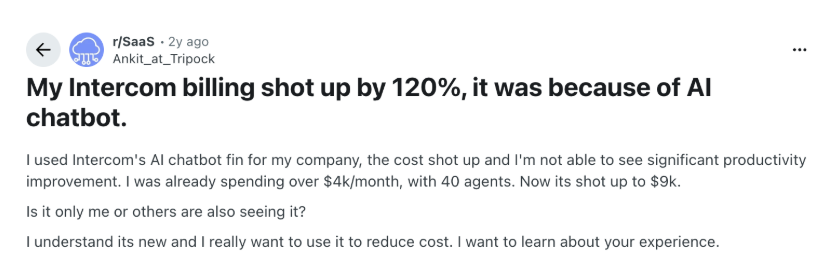
- Pricing gets unpredictable at scale. An analysis of 200+ Capterra reviews found teams consistently reporting actual bills running two to three times their initial estimate.
- There’s no live vendor support unless you’re on a Premier Support package.
“Although the initial setup was okay with help from Intercom, we don’t feel we get the ongoing support we need unless paid for” – User review on G2
- Intercom’s depth is most useful for in-app, product-led support. For teams whose primary channel is email, much of the feature set becomes overhead.
User Reviews:
- “It’s the best support platform available, and it looks like it will continue to remain so as development keeps going.” — Capterra
- “The price per user is too high and putting the whole team on it is not feasible for us.” — G2
- “Reporting could be better. It’s not always obvious where FIN/teammates start, or how to separate the interactions in the reporting view, which makes it harder to interpret the results.” — G2
Intercom’s Score Card as a Live Chat Tool
| AI resolution quality | ⭐⭐⭐⭐ |
| Handoff experience | ⭐⭐⭐⭐ |
| Ease of setup | ⭐⭐⭐ |
| Routing & queue management | ⭐⭐⭐⭐ |
| Reporting & analytics | ⭐⭐⭐ |
| Pricing transparency | ⭐⭐ |
5. Tidio.
Ideal for: Small businesses that want AI-assisted chat without a complex setup
Tidio is a lightweight live chat tool for teams that want to get started quickly without investing in a full support platform. The interface is simple and the setup is fast.
Lyro, Tidio’s AI agent, is the main reason teams choose it. Paste in your website URL, Lyro crawls your product pages, FAQs, and policies, and starts answering questions — no training scripts or manual uploads needed. Axioma, a UK-based car repair service, reached an 89% AI resolution rate after deploying it.
Pricing
Tidio has three separate billing pools: human conversations, AI conversations, and Flow visitors. Your actual bill is rarely what the plan page shows.
- Starter: $29/month — 100 human conversations, 50 AI conversations, 100 Flow visitors
- Growth: $49.17/month — 250 human conversations
- Plus: $749/month — custom limits
- Premium: custom pricing
AI pricing: Lyro is also sold as a standalone add-on starting at $32.50/month for 50 AI conversations.
Strengths
- Shopify, WooCommerce, and BigCommerce connect natively. Lyro can check order status, answer product questions, and recommend items from your store data. Instagram and Facebook Messenger plug into the same inbox.
- The Flows builder lets teams create structured chatbot scenarios without code. Define a trigger, map out the bot’s responses, and you’re done. Useful for lead capture and cart abandonment without needing developer support.
- Lyro is powered by Claude and learns from your website URL. In testing, it was answering accurate product questions within 30 minutes of setup.
Weaknesses:
- When Lyro hits its monthly quota, it stops working entirely. One reviewer described it as being “punished by their own success” during traffic spikes from marketing campaigns.
- Lyro isn’t available on WhatsApp. For businesses outside North America where WhatsApp is the primary support channel, that’s a dealbreaker.
- Lyro and Flows can’t run in the same conversation — you have to choose one or the other for each scenario, which limits how sophisticated your automation can get.
User Reviews:
- “Implementation was incredibly smooth — we had our chatbot running within 30 minutes of signup. The AI responses are surprisingly accurate for our technical product questions.” — G2
- “The lack of Lyro AI Agent on WhatsApp is critical — most of my clients use WhatsApp more than the website widget.” — Capterra
- “Reporting is okay but deeper analytics could be more flexible for teams that rely on chat performance data.” — G2
Tidio’s Score Card as a Live Chat Tool
| AI resolution quality | ⭐⭐⭐⭐ |
| Handoff experience | ⭐⭐⭐ |
| Ease of setup | ⭐⭐⭐⭐ |
| Routing & queue management | ⭐⭐⭐ |
| Reporting & analytics | ⭐⭐ |
| Pricing transparency | ⭐ |
6. Pylon
Ideal for: B2B support teams managing customer conversations in Slack
In most B2B companies, a single issue might start in a shared Slack channel, continue over email, and need input from multiple teams before it’s resolved. Nothing gets tracked, no SLAs are applied, and nothing feeds into a ticketing system unless someone manually copies it over.
Pylon converts those Slack conversations into trackable tickets with owners, statuses, and SLA timers. For teams managing dozens or hundreds of customer Slack channels, this eliminates the manual overhead that usually falls on CSMs or support leads.
Why is Pylon on this list?
Most B2B teams are already talking to customers in Slack channels. But those conversations don’t get tracked, SLAs don’t get applied, and nothing feeds into a ticketing system. Pylon fixes that. It monitors your shared Slack channels and converts those conversations into trackable tickets, with clear owners and statuses.
Pricing
- Starter: $59/seat/month — email, chat widget, knowledge base, broadcasts
- Professional: $89/seat/month — adds Slack Connect, automations, analytics, API
- Enterprise: $139/seat/month — adds Microsoft Teams, customer portal, advanced RBAC
AI pricing: AI Assistants and AI Agents are add-ons at $50 and $100/seat/month respectively. At the Professional tier, full AI capability brings the per-seat cost to $189/month.
Strengths:
- Slack and Microsoft Teams as full support channels is Pylon’s core differentiator. When a customer messages in a shared Slack channel, Pylon creates a ticket, assigns it, and tracks it against SLAs automatically.
- AI Agents can triage tickets by account tier, draft replies from your internal runbooks, and escalate based on issue type — more relevant for B2B workflows than generic FAQ handling.
- Pylon auto-generates help articles based on how your team has resolved past issues. Documentation stays current without a dedicated writer maintaining it.
- Customer-facing portals let B2B clients check their open ticket status, which cuts down on “any update?” follow-ups.
Weaknesses:
- Pylon doesn’t support WhatsApp, SMS, or social media channels. It’s built specifically for B2B and isn’t the right fit for B2C or ecommerce teams.
User Reviews:
- “Pylon makes it super easy for us to communicate with all our customers. We onboard everyone into individual Slack channels and at this point we have hundreds of them — sending a manual message would take forever.” — G2
- “I use Pylon for routing and triaging B2B customer support tickets, sharing customer portals, and following up with customers.” — G2
- “Initial setup can be somewhat cumbersome.” — G2
Pylon’s Score Card as a Live Chat Tool
| AI resolution quality | ⭐⭐⭐⭐ |
| Handoff experience | ⭐⭐⭐⭐ |
| Ease of setup | ⭐⭐⭐ |
| Routing & queue management | ⭐⭐⭐⭐⭐ |
| Reporting & analytics | ⭐⭐⭐⭐ |
| Pricing transparency | ⭐⭐⭐ |
7. LiveChat
Ideal for: High-volume website support teams where speed and agent efficiency are the priority
LiveChat is built around one thing: fast, stable website chat at scale. I sent multiple messages in quick succession across concurrent conversations and nothing lagged.
Reporting is also a strength. Response times, chat volume, and agent activity are visible without digging through dashboards, which helps managers spot bottlenecks quickly.

Why is LiveChat on the list?
The message preview feature of LiveChat let’s you see what a customer is typing before they hit send. That sounds small until you’re handling 10 concurrent chats. Also, the chats load fast,and there’s no lag even under volume. For teams where speed of response is the primary metric, LiveChat’s focus on doing this one thing well pays off.
Pricing
- Starter: $19/agent/month
- Team: $49/agent/month
- Business: $79/agent/month
- Enterprise: custom pricing
AI pricing: Copilot, reply suggestions, and chat summaries are included across all plans. The AI chatbot is a separate product called ChatBot, sold by a sister company, starting at $52/month. Autonomous AI resolution means two subscriptions from day one.
Strengths:
- Message preview lets agents see what a customer is typing before they hit send. Combined with page tracking and visit history, agents have context before the conversation even starts.
- AI Copilot suggests replies with cited sources, summarizes chats, auto-tags conversations, and helps refine tone — included on all plans, not locked behind a premium tier.
- A staffing prediction feature analyzes historical chat volume and tells managers how many agents are needed per shift. Most live chat tools don’t offer this.
Weakness:
- The Starter plan allows only one agent. A two-person team immediately jumps to $49/agent/month.
- A 20-agent team on the Team plan pays $980/month before the ChatBot add-on. Multiple reviewers flag affordability as a concern for growing teams.
- No built-in AI chatbot. If autonomous resolution is a priority, you’re managing two separate vendor relationships and billing cycles.
User Reviews:
- “The platform is fast, stable, and easy to use.” — G2
- “App malfunctioning, alerts and notifications are not reliable — customer service is not very helpful.” — Software Advice
- “Should have more apps as part of the generic platform rather than having to pay for many of them — e.g. ticketing system for tracking and monitoring.” — Capterra
LiveChat’s Score Card
| AI resolution quality | ⭐⭐⭐ |
| Handoff experience | ⭐⭐⭐⭐ |
| Ease of setup | ⭐⭐⭐⭐⭐ |
| Routing & queue management | ⭐⭐⭐⭐ |
| Reporting & analytics | ⭐⭐⭐⭐ |
| Pricing transparency | ⭐⭐⭐ |
8. LiveAgent
Ideal for: Teams that want chat, email, and calls in one tool without multiple subscriptions
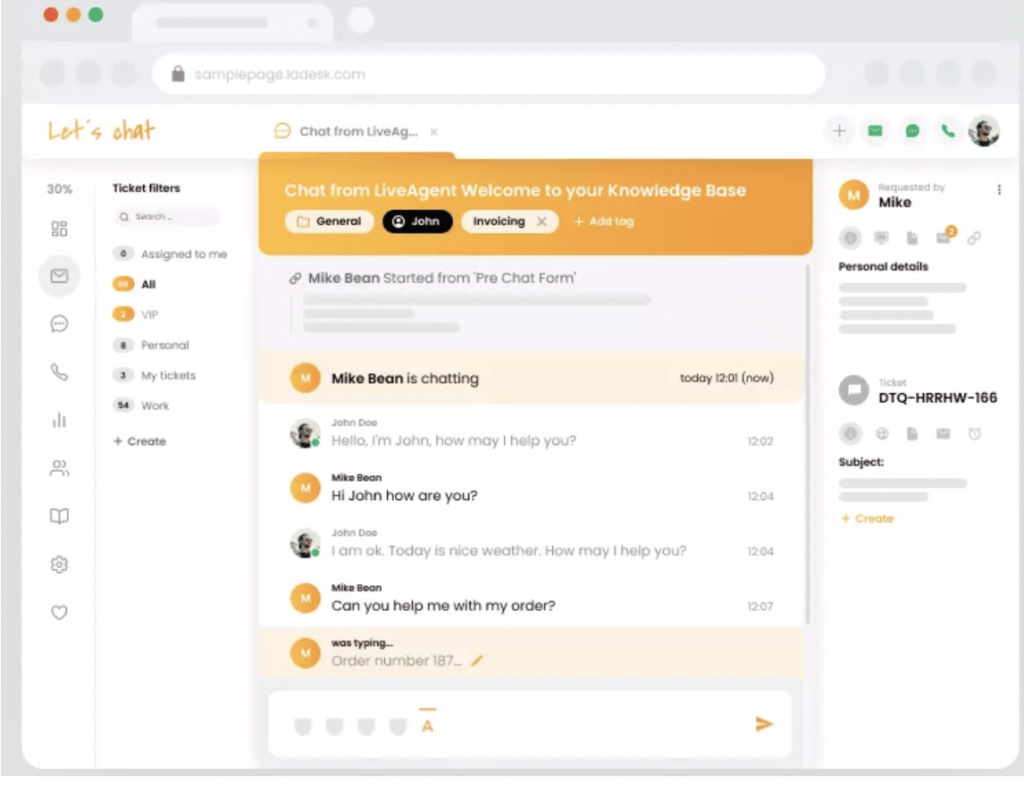
LiveAgent is a helpdesk platform that treats chat as one channel among several. If a customer starts with a chat about a refund and later emails with more details, both interactions appear in the same ticket. The agent picks up the full thread without asking the customer to repeat themselves.
Pricing:
- Small: $15/agent/month
- Medium: $29/agent/month
- Large: $49/agent/month
- Enterprise: $69/agent/month
AI pricing: AI features are included in the base plan — no add-on fees.
Strengths:
- The AI Answer Assistant suggests replies based on past conversations and knowledge base content.
- Sentiment detection flags frustrated customers earlier in a conversation so teams can prioritize before things escalate.
- Built-in call support means phone queries are handled from the same interface as chat and email, eliminating a separate phone system.
Weaknesses:
- The interface feels dated compared to newer tools on this list.
- Automation is limited to basic rules. Complex conditional workflows aren’t supported without workarounds.
- The mobile app has recurring stability issues. Cashes and delayed notifications appear consistently across reviews.
User Reviews:
- “Great all-in-one helpdesk with chat, email, and call support in one place.” — G2
- “The interface feels a bit outdated, but the functionality is solid.” — Capterra
- “Setup takes time, especially when configuring multiple channels.” — G2
LiveAgent’s Score Card
| AI resolution quality | ⭐⭐ |
| Handoff experience | ⭐⭐⭐⭐ |
| Ease of setup | ⭐⭐⭐ |
| Routing & queue management | ⭐⭐ |
| Reporting & analytics | ⭐⭐⭐ |
| Pricing transparency | ⭐⭐⭐⭐ |
9. SmartsUpp.
Ideal for: Small ecommerce stores that want visitor tracking and AI chat at a low per-team cost
Smartsupp is built for small online stores that want to chat with shoppers in real time and automate repetitive questions. What sets it apart at its price point is a real-time visitor list showing everyone on your site — which page they’re on, where they came from, and how long they’ve been browsing.
Mira, the AI shopping assistant, can handle up to 80% of common questions and escalates to a live agent when a query goes beyond its training.
Pricing:
- Free: $0/month — 25 conversations/month, 1 operator
- Solo: $17/month — unlimited conversations, 50 AI reply assists
- Plus: $25/month — 3 operators, 250 AI reply assists
- Expert: $83/month — 500 AI reply assists
AI pricing: The AI Reply Assistant is included in paid plans. Mira is a separate add-on starting at $16/month for 100 conversations.
Strengths:
- Real-time visitor tracking lets agents proactively open a chat if someone’s been on the checkout page for four minutes without purchasing.
- The Plus plan at $25/month covers 3 operators total. A small team of three pays $25 rather than $49 per person.
- Native WhatsApp, Facebook Messenger, and email integration means all channels come through one dashboard. The Google Analytics 4 connection tracks how many purchases were influenced by a chat.
Weaknesses
- The free plan’s 25-conversation limit runs out in a day or two for any store with moderate traffic.
- Mira’s 100-conversation limit at the base add-on tier runs out quickly for stores with decent traffic.
- Logic-based automation — routing different query types to different agents — requires the Expert plan. Teams will hit this ceiling earlier than expected.
User Reviews:
- “It is rapid and easy to communicate with customers via live chat with Smartsupp.” — Capterra
- “It simple but with many functions and it helps us with better conversion ratio on our online shop.” — G2
- “Customization and analytics are a bit limited compared to some competitors, and some advanced features are only available in higher-priced plans.” — G2
SmartsUpp’s Score Card
Out of 5 stars, here’s how I’d rate SmartsUpp as a live chat tool based on the evaluation criteria:
| AI resolution quality | ⭐⭐⭐⭐ |
| Handoff experience | ⭐⭐⭐ |
| Ease of setup | ⭐⭐⭐⭐⭐ |
| Routing & queue management | ⭐⭐⭐ |
| Reporting & analytics | ⭐⭐⭐⭐ |
| Pricing transparency | ⭐⭐⭐⭐ |
10. Zendesk. Best For Enterprise Businesses
Ideal for: Enterprise support teams with complex routing needs and compliance requirements
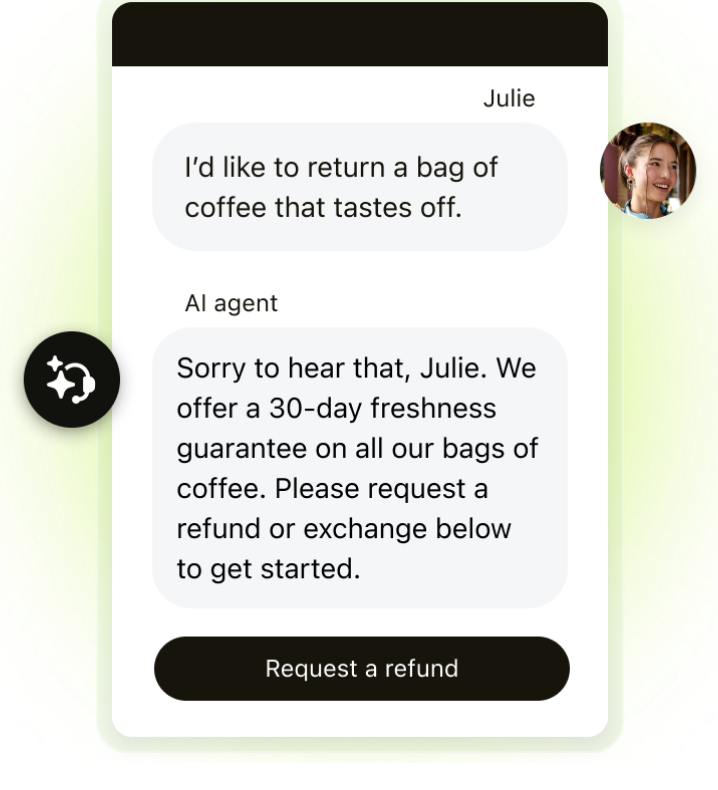
Zendesk Chat is part of the broader Zendesk platform. Chat conversations convert into tickets automatically, can be tracked and prioritized like any support request, and converted to email if a customer steps away. Agents can loop in teammates, leave internal notes, and see full customer history.
Four Seasons Hotels built their entire guest support operation on Zendesk Chat. Zipcar used Zendesk’s no-code workflows to improve operations without developer support. These are complex, multi-channel operations, not simple chat widget setups.
Pricing
Zendesk messaging is bundled into Suite plans, not sold separately.
- Support Team: $19/agent/month — limited chat functionality
- Suite Team: $55/agent/month
- Suite Professional: $115/agent/month
- Suite Enterprise: $169/agent/month
AI pricing: Basic AI agents are included in Suite plans. Advanced AI agents are a separate add-on with unpublished pricing. AI Copilot is $50/agent/month. QA is $35/agent/month. Workforce Management is $25/agent/month.
Strengths:
- Omnichannel routing assigns conversations based on intent, language, skill set, and workload. A technical query in Spanish routes automatically to a Spanish-speaking technical agent.
- Zendesk QA reviews 100% of conversations using AI — every chat, email, and AI-handled interaction.
- 1,200+ integrations in the marketplace. Most tools a mid-market or enterprise team is running will have a native connection.
Weaknesses:
- Configuration takes real time and often requires professional services.
- The cost trajectory is steep. Teams entering at $19/agent end up spending significantly more once AI, QA, and workforce management are added.
- Zendesk’s own customer support is frequently cited as slow and unresponsive — a recurring theme across G2 and Capterra.
User Reviews:
- “Having chat, email and phone support all in Zendesk Suite is a big help. It allows me to keep record of all my customer chats, responding quickly and handling tickets on different platforms.” — Capterra
- “Setup can be a bit confusing with managing users in both admin and the support sections of the suite.” — Capterra
- “Pricing becomes a concern as needs grow. Costs rise with the number of agents, features, and add-ons like AI, leading some teams to question its long-term value.” — G2 / Capterra synthesis
- “Zendesk Suite offers strong value for money considering the wide range of features included — ticketing, automation, analytics, and omnichannel support.” — Capterra
Zendesk Chat’s Score Card
| AI resolution quality | ⭐⭐⭐⭐⭐ |
| Handoff experience | ⭐⭐⭐⭐ |
| Ease of setup | ⭐ |
| Routing & queue management | ⭐⭐⭐⭐ |
| Reporting & analytics | ⭐⭐⭐⭐ |
| Pricing transparency | ⭐ |
Quick Comparison Chart for Best Live Chat Software
Most tools today offer chat, automation, and some level of AI, but the real difference shows up in how they handle conversations at scale.
For example, some tools are built for high-volume website chats, while others are designed for Slack-based B2B support or ecommerce workflows. That’s why two tools with similar feature lists can feel completely different in day-to-day use.
This comparison table breaks that down clearly. Instead of listing features, it shows what each tool is actually best suited for, how their pricing works as you scale, and where they stand in terms of real-world usability.
| Tool | Best Fit For | Key Features | Pricing |
|---|---|---|---|
| Gorgias | Ecommerce brands (Shopify, BigCommerce) | Shopify-native context, AI agent for order queries, proactive chat campaigns | Starts at $10/month (ticket-based) |
| Hiver | AI-first teams wanting chat + email + WhatsApp in one place | AI Agent + Copilot included, smooth chat-to-email handoff, robust analytics | Free plan; paid from $25/user/month |
| Tawk.to | Small teams needing a free solution | Unlimited chats, visitor tracking, AI Assist (add-on), hire agents on demand | Free; AI from $29/month |
| Intercom | SaaS teams needing in-app support | Deep customer context, Fin AI agent, workflow builder, 450+ integrations | Starts at $29/user/month + AI costs |
| Tidio | Small businesses starting with AI chat | Lyro AI agent, no-code flows, ecommerce integrations | Starts at $29/month + AI add-on |
| Pylon | B2B teams using Slack for support | Slack-to-ticket conversion, AI agents, internal collaboration | Starts at $59/seat/month + AI add-ons |
| LiveChat | High-volume website chat teams | Fast chat performance, AI Copilot, staffing predictions, integrations | Starts at $19/agent/month |
| LiveAgent | Teams needing chat + email + call support | Omnichannel helpdesk, AI Answer Assistant, call support, ticketing | Starts at $15/agent/month |
| Smartsupp | Small ecommerce stores | Real-time visitor tracking, AI shopping assistant, multichannel inbox | Free; paid from $17/month |
| Zendesk | Enterprise support teams | Advanced routing, AI QA, omnichannel support, deep integrations | Starts at $55/agent/month (Suite) |
Key Features That Makes It The Best Live Chat Software
Most teams pick a live chat tool based on the demo. Three months in, they find it can’t handle their support volume, doesn’t connect to the CRM, or charges extra every time the AI resolves something. These are the features that actually matter.
1. Real-time Messaging
Speed is the point of live chat. But real-time messaging isn’t just about low latency — it’s about giving agents the right context before they type their first response. Typing previews, visitor page tracking, and conversation history all affect how quickly an agent can resolve a query.
2. AI Chatbots and Agents
There’s a meaningful gap between a rule-based chatbot and a proper AI agent. A chatbot follows scripts. An AI agent reads your knowledge base, understands intent, and resolves queries without a human stepping in. The thing to look for is what happens at handoff. If the AI doesn’t preserve context when it escalates, the customer has to repeat themselves — which defeats the purpose.
3. Proactive Invitations
Waiting for customers to reach out is a passive strategy. Proactive triggers fire a message when a visitor hits a specific condition: 60 seconds on a pricing page, a returning visitor on checkout, or a user idle mid-form. Done well, this reduces drop-offs and captures intent that would otherwise walk away.
4. Canned Responses
For high-volume teams, a well-maintained canned response library is one of the highest-leverage features in any chat tool. Agents aren’t retyping the same answers all day. The better tools pair canned responses with AI so the system suggests the right response based on conversation context, not just a keyword match.
5. Intelligent Routing
A chat landing with the wrong agent wastes everyone’s time. Good routing assigns conversations based on agent skill, availability, or account ownership automatically. You can configure a rule that sends “billing” chats to the finance team and VIP account chats directly to their CSM.
6. Omnichannel Support
Customers don’t limit themselves to one channel. They’ll start on chat, follow up by email, and message on WhatsApp, sometimes about the same issue. A unified inbox means agents have full context without jumping between tools. Without it, the same customer ends up repeating themselves across multiple threads.
7. Analytics and Reporting
Response time and chat volume tell you how busy the team is. Resolution rate, CSAT, AI handoff patterns, and agent performance by conversation type tell you whether support is actually working. Without that visibility, identifying where things are going wrong is mostly guesswork.
8. CRM and Help Desk Integration
Every tool on this list can show you a chat. The ones that stand out show you the chat alongside the customer’s account history, open tickets, billing status, and CRM notes — without switching tabs. If your live chat tool doesn’t connect to your existing stack, it becomes another silo to manage.
How To Choose The Right Live Chat Software?
1. Business Size and Scalability
Small teams need fast setup and predictable costs. Larger teams need routing rules, SLA tracking, and reporting that scales with headcount. Check how the pricing model behaves at growth — per-seat pricing that jumps sharply at certain thresholds can make something affordable today feel expensive in six months.
2. Integration Capabilities
Your live chat tool needs to connect to your CRM, helpdesk, and ecommerce platform. A chat that can’t surface account history or log to Salesforce creates more work for agents. Verify whether integrations are native or Zapier-dependent, and whether data syncs in both directions.
3. Budget and Pricing Models
Pricing pages rarely show what you’ll actually pay. Some tools charge per seat, some per conversation, some per AI resolution. A tool listed at $29/month can easily become $200+ once you add AI or hit a usage cap. Map out your expected volume, team size, and automation needs — then run the actual math against each pricing model.
4. Security and Compliance (GDPR/SOC 2)
If your business handles sensitive data in healthcare, fintech, or legal, GDPR compliance, SOC 2 Type II, and HIPAA support aren’t optional. Several tools on this list don’t cover all three. Check data residency options too — especially if you have European customers. Verify before signing an annual contract.
5. User Experience (UI/UX)
A tool agents find confusing will get abandoned or used wrong. The best live chat software should take less than a day to learn. Run a real test — have an agent handle mock conversations and note where they hesitate. If agents are missing chats because the mobile app is unreliable, the feature set becomes irrelevant.
Finding the Right Live Chat Software
Gorgias is purpose-built for ecommerce. Intercom is the right call for product-led SaaS. Pylon solves a specific B2B problem most chat tools don’t touch. Zendesk scales for enterprise complexity, with the cost and setup that comes with it.
If you want live chat, AI, and email support in one place without paying separately for each capability, Hiver is worth a close look. AI Agents and Copilot are included in paid plans, setup is fast, and the channel-switching problem that makes multi-tool stacks frustrating is largely solved. There’s a free plan if you want to test it first.
Frequently Asked Questions (FAQs)
1. What is live chat software?
Live chat software lets businesses talk to customers in real time through a chat widget on their website or app. It allows support or sales teams to answer questions instantly, instead of relying on email or phone calls.
2. What is the difference between live chat and chatbot?
Live chat connects customers directly with human agents in real time. Chatbots use predefined rules or AI to answer common questions automatically. Most modern setups use both—bots for first responses, humans for complex issues.
3. Can live chat integrate with my CRM and other apps?
Yes. Most live chat tools integrate with CRMs, helpdesks, ecommerce platforms, and collaboration tools. Integrations help teams see customer context, track conversations, and avoid switching between systems.
4. What metrics should I track to measure live chat success?
Key metrics include first response time, resolution time, chat volume, CSAT, conversion rate (for sales), and missed chats. These metrics show whether chat is improving customer experience or creating new bottlenecks.
5. What are the top benefits of live chat software?
The biggest benefits are faster response times, fewer missed inquiries, higher customer satisfaction, and better conversion rates. Live chat also helps teams resolve issues while customers are actively browsing, which reduces drop-offs.
6. Should I use real human agents over bots and AI agents in live chat?
The most effective setup uses both human and AI agents. AI agents handle repetitive queries like order status, password resets, FAQs instantly and around the clock. Human agents step in for complex, sensitive, or high-value conversations where judgment and empathy matter. The key is a clean handoff between the two, so customers never have to repeat themselves.
7. What is the best live chat software for a small business?
The best options depend on your budget and how much automation you need. tawk.to is completely free. It can be used by unlimited agents, and you can have unlimited chats, with no time limit. Hiver offers a live chat widget in this free plan, and its paid plan starts at $25/user/month and includes live chat, AI Agents, and email support in one place.Tidio starts at $29/month and adds AI-powered automation through Lyro, which handles up to 67% of common queries automatically.