






Your customers don’t wait for business hours anymore. They message you from airports, browse your site at midnight, and expect help whenever they need it.
They don’t want to sit in queues or repeat the same issue to different agents. They’d rather find answers on their own, quickly and accurately.
That’s where self-service steps in, with help articles and simple bots designed to guide customers independently.
The problem is that most self-service tools feel rigid, but AI-driven self-service changes that. It understands intent, pulls from past conversations and knowledge bases, and gives context-aware answers.
In this guide, you’ll learn what AI self-service really means, how it works, and how your team can use it to deliver faster customer support.
What Is AI Self‑Service?
AI self-service is a smarter way for customers to get help on their own. It uses artificial intelligence to understand questions, find the right information, and guide users to solutions without human involvement.
Instead of relying on static FAQs, AI-powered chatbots and virtual assistants respond in real-time and provide support that is faster and more personalized.
When Apple launched Siri in 2011, it was one of the first widely used virtual assistants. You can ask questions in Siri in any way you want, and you will get instant answers in natural language.
At that time, it was not built for customer support, but it gave us a glimpse into what AI-powered self-service could look like.
Now, AI self-service has evolved into a vital part of customer support operations. It powers:
- AI chatbots that handle Tier-1 queries like order tracking or password resets.
- Virtual agents that access connected systems such as CRMs and ticketing tools to handle more complex interactions.
- Smart knowledge bases that surface relevant answers based on intent, not just keywords.
These AI tools improve with every interaction, scale infinitely, and reduce support costs.
How AI Self-Service Works (Step-by-Step Process)
AI self-service combines several layers of intelligence to make support more human-like:
Step 1: The customer asks a question in their own words via chat, email, or mobile.
Step 2: AI detects intent using natural language understanding.
Step 3: AI pulls context from past conversations, customer data, and internal knowledge bases.
Step 4: AI delivers an answer or completes an action, for example, resetting a password or confirming an order status.
Step 5: If the issue requires personal attention, AI escalates to a human agent with a full conversation history.
The balance in automation and context makes AI self-service far more reliable than traditional rule-based systems.
Example: How Hiver Powers AI Self-Service
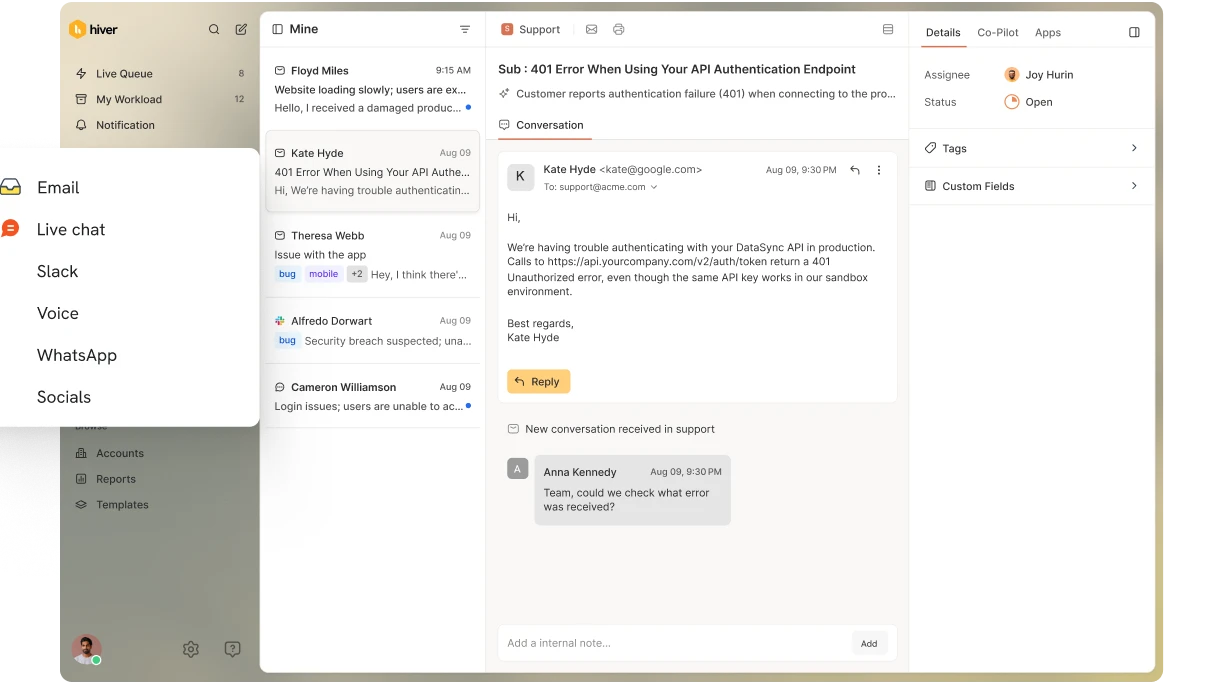
Most AI tools require switching between multiple dashboards. Hiver, a modern AI customer service platform, bridges that gap with its AI-powered live chat. It enables you to automate responses to routine queries. You can embed help articles directly in the chat and easily transfer complex issues to agents when needed.
Real-time alerts, automated assignments, and mobile updates ensure your team never misses a conversation.

Benefits of Adopting AI Self-Service
AI self-service is quickly becoming the backbone of modern customer support. By 2029, experts predict it will resolve nearly 80% of common service issues without human involvement.
As support continues to evolve, AI will handle routine requests, allowing teams to focus on delivering thoughtful and personalized experiences. Here’s how it makes a real difference:
✅ Faster and More Accurate Resolutions
AI self-service is built to understand customer intent. Instead of keyword-matching or sending users on a wild goose chase, they deliver relevant answers on the first try. This reduces frustrating back-and-forth and gets issues resolved much faster.
🌍 Be Available 24/7 Without Expanding Your Team
Your customers can get help anytime, anywhere. Doesn’t matter if it’s 3 PM in New York or 3 AM in Tokyo. AI self-service keeps your support desk open round the clock, so you can serve global users without hiring in multiple time zones.
💸 Cut Ticket Volume and Lower Costs
AI self-service automates repetitive work by resolving common queries on its own. Your team spends less time on routine tickets and more time solving complex problems.
💛 Build Customer Satisfaction and Loyalty
People love quick answers. AI self-service provides your customers with instant answers, leading to higher customer satisfaction scores and increased brand loyalty.
📈 Scale Effortlessly as You Grow
AI doesn’t burn out, take vacations, or hit capacity. It can check 10 queries or even 10,000 without help. You can scale your support team effortlessly without a proportional increase in headcount.
📊 Better Insights Into Customer Needs
Every AI interaction captures these insights:
➡️ What customers search for
➡️ What they click
➡️ Where they get stuck.
Those insights help your team refine FAQs, improve chat flows, and strengthen the overall support experience.
Recommended reading
Understanding Customer Intelligence: Benefits, Types, and Use Cases
AI Self-Service Best Practices (How to Get It Right)
Implementing AI self-service requires thoughtful planning, thorough testing, and iterative refinement to ensure optimal results. Here’s how to set your team up for success:
1. Audit High-Volume Queries and Friction Points
Start with your data. Identify recurring customer questions, tickets with long resolution times, and FAQs with heavy traffic. Those are prime areas for automation, where AI can instantly reduce workload and improve response speed.
2. Choose the Right AI Tools for Your Support Channels
The best AI tools fit easily into how your customers prefer to communicate. If chat is the main touchpoint, deploy AI chatbots. If most requests come through email, utilize AI assistants that suggest responses or automatically tag conversations.
3. Create Conversational Flows With Clear Escalation Paths
AI should know when to hand over things. Design conversational flows that feel natural but include clear handoff triggers. When a chatbot can’t solve a query, it should transfer the customer to an agent without losing context.
4. Continuously Train Your AI With Real Feedback
Monitor failed queries, abandoned chats, and unclear intents. Feed this feedback into your AI model on a regular basis. The more real-world data it gets, the sharper and more accurate it becomes over time.
5. Integrate AI With Your Knowledge Base
Link your chatbot or virtual agent to your internal knowledge base so it can surface accurate, context-aware answers. It turns static FAQs into a live, self-learning support engine.
How to Measure AI Self-Service Success
Setting up AI self-service is just the first step. To determine if it’s actually working, you’ll need to track the right metrics:
1. Ticket Deflection Rate
Measures how many queries AI resolves without human involvement.
Formula to calculate deflection rate: (Number of AI-resolved queries ÷ Total incoming queries) × 100
A high deflection rate means your system is doing its job, resolving routine issues and freeing up agents to focus on complex ones.
2. Chatbot Containment Rate
Tracks the percentage of chatbot sessions that stay self-contained.
Formula to calculate containment rate: (Chatbot sessions not escalated to an agent ÷ Total chatbot sessions) × 100
High containment means your chatbot can resolve issues independently.
3. CSAT for AI Interactions
Ask for feedback at the end of AI-led sessions. Use this to surface friction points that could impact the customer experience.
Pro tip: Gather Feedback in Real Time with Hiver
You can easily measure how customers feel after every interaction using Hiver’s CSAT surveys. Ask for feedback at the right moment, after a resolution, a response, or whenever it fits your workflow.
Personalize questions to encourage better participation and use those insights to identify training needs, compare team performance, and enhance overall service quality.

4. Resolution Time and Escalation Rate
Monitor how quickly AI resolves issues and how often it escalates to agents for further assistance. Rising resolution times or a spike in escalations may signal the need for retraining.
5. Self-Service Success Rate
Shows how often customers successfully resolve issues through AI tools.
Formula to calculate success rate: (Successful AI resolutions ÷ Total self-service attempts) × 100
However, you should know that success doesn’t lie solely in vanity metrics. You can’t just look at deflection rate or time-to-resolution in isolation. To gain a more accurate and nuanced understanding, consider how they interact, reinforce, or contradict each other.
As Marti Clark, Senior Program Manager at Salesforce, put it in a conversation about IT operations and support:
“Any one metric can be gamed. Real insight comes from looking at KPIs in conjunction. While response times might be excellent in a particular region, we may also notice that their user effort scores are not satisfactory, and their quality scores are lacking. Combining these two metrics can provide a better understanding of the business’s performance. So you can have a whole range view of the user experience.”
As such, these metrics must be read together to understand what’s working, what’s not, and where your AI self-service can improve.
Real-World Examples of Brands Using AI in Self-Service
Before you start building your own strategy, it helps to see how leading companies are already using AI self-service to deliver faster customer service.
1. Bank of America
Bank of America’s AI-powered virtual assistant, Erica, uses natural language processing to guide customers through transactions, spending insights, and reminders. It spots patterns to proactively share tips on spending, refunds, and upcoming bills.
Since 2018, Erica has handled over two billion interactions for 42 million clients, resulting in a significant reduction in branch visits and call volumes.

2. T‑Mobile
T-Mobile partnered with OpenAI to develop IntentCX, an AI platform that interprets customer intent and sentiment in real-time.
It uses T‑Mobile’s network and app data, plus OpenAI’s latest models, to proactively resolve issues before customers even reach out.
“IntentCX is much more than chatbots. Our customers leave millions of clues about how they want to be treated through their real experiences and interactions, and now we’ll use that deep data to supercharge our Care team as they work to perfect customer journeys.”
Mike Sievert CEO, T-Mobile
3. Ping Identity
Ping Identity’s Accounts Payable team uses Hiver’s AI email-based automation to summarize long vendor threads, track status, and highlight urgent payments. It helps AP specialists spot payment terms & due dates instantly.
Ping Identity has reduced follow-up emails by 45% and cut resolution time by 65%. AI-powered search made it easy to locate past emails for audits and compliance purposes. The team also saved 89 hours every month.

How Hiver Supports Smarter AI Self-Service
A good self-service strikes the right balance between automation and human insight. While AI handles the repetitive queries, human agents can focus on tasks that require problem-solving and creative thinking.
With Hiver, you don’t need to choose between AI-powered efficiency and personal support. You get both. Our AI-powered support combines:
- Smart automation to instantly handle FAQs and reduce ticket queues
- Contextual ticketing to track every conversation with the complete customer history
- Collaboration tools that help teams work effortlessly across email, live chat, and shared inboxes
Your customers deserve instant, intelligent, and human support. Book a demo with our experts and see how simple AI self-service can be.
Frequently Asked Questions
1. What is automated self-service?
Automated self-service uses predefined rules and workflows, like menu bots or scripted responses, to resolve simple issues without agent help.
2. What is intelligent self-service?
Intelligent self-service uses AI to understand customer intent, personalize responses, and resolve queries dynamically. It often improves over time through machine learning.
3. How can a self-service chatbot help?
A self-service chatbot can instantly answer common questions, reduce wait times, deflect repetitive tickets, and provide 24/7 support. It improves both efficiency and customer satisfaction.
4. How is AI self-service different from traditional self-service options?
Traditional self-service relies on static resources, such as FAQs or help centers. AI self-service adds real-time understanding, conversation, and decision-making. It makes support faster, smarter, and more personalized.
5. What are the best AI-driven self-service tools available today?
Top solutions include Hiver, Intercom, Zendesk, Salesforce Service Cloud, and Dialpad. Each helps automate routine support, but Hiver stands out for AI chatbots built for complex support.
Start using Hiver today
- Collaborate with ease
- Manage high email volume
- Leverage AI for stellar service