




Quick Summary
Gmail is still everywhere in 2026, but it’s no longer the automatic choice. Outlook makes the most sense for teams working with Microsoft 365, and Zoho Mail offers the best mix of features and affordability for business users.
And if you’re managing shared emails, Hiver is the easiest way to add structure and AI-powered workflows to manage complex email support.
For most of us, “email” and “Gmail” are practically synonymous.
It’s the address we created years ago and never stopped using. It’s tied to our photos, bank accounts, streaming apps, and almost everything else we do online. And to be fair, Gmail’s clean interface and deep integration with Google Drive, Docs, and Calendar make it incredibly convenient.
But being the default doesn’t mean Gmail is perfect.
Over the years, I’ve noticed more people running into the same frustrations: ads in the interface, shrinking free storage, account lockouts, and even security concerns—Google recently warned that a breach could impact its 2.5 billion Gmail users.
For 2026, I wanted to test the strongest Gmail alternatives myself: tools built for privacy, business workflows, team collaboration, or simple everyday email, to understand which ones work best for different needs.
Table of Contents
- First, Here’s How I Evaluated These Gmail Alternatives
- 10 Best Gmail Alternatives For 2026
- Which Gmail Alternative Is Right for You?
First, Here’s How I Evaluated These Gmail Alternatives
While Gmail is popular, recurring issues like account lockouts, privacy trade-offs, shared storage limits, and heavy ecosystem dependency push customers to explore better options.
Keeping this in mind, here’s what I looked at while comparing each provider:
- Account control: How easily you can manage or recover your account without ecosystem lock-in.
- Privacy and security: Encryption, data-handling practices, and jurisdiction.
- Flexibility: Support for custom domains, third-party clients, and migration tools.
- Team features: Shared mailboxes, delegation, tags, and workflow capabilities.
- Storage: Realistic limits and handling of large files.
- Best-fit use cases: Who the service actually works best for—personal, business, privacy-first, or team workflows.
10 Best Gmail Alternatives For 2026
Here’s a comprehensive roundup of Gmail alternatives, whether you’re running a business, looking for a free everyday account, or care about privacy.
| Provider | Best For | Pricing | G2 Rating |
|---|---|---|---|
| Outlook | Teams already using Microsoft 365; enterprise workflows | $6–$22/user/month (Microsoft 365 plans) | 4.5/5 |
| Zoho Mail | Small businesses wanting an affordable branded inbox | $1–$6/user/month | 4.4/5 |
| Fastmail | Individuals wanting privacy + custom domain control | $3–$9/user/month | 4.3/5 |
| Yahoo Mail | Everyday personal email with extra storage | Free; $5/month for Yahoo Mail Plus | 3.8/5 |
| iCloud Mail | Apple ecosystem users who want a simple, built-in email | Free; iCloud+ from $0.99/month | 3.9/5 |
| Proton Mail | Privacy-first users | Free; €3.49–€9.99/month | 4.4/5 |
| Tuta Mail | Users wanting fully encrypted mail, contacts & calendar | Free; €3–€8/month | 4.6/5 |
| Mailfence | Users needing OpenPGP interoperability | Free; $2.50–$3.50/month | 4.7/5 |
| Hiver | Teams managing shared inboxes (support@, sales@) that need automations and AI features | Free; $19–$79/user/month | 4.6/5 |
| HEY | Users wanting both control and privacy | $99/year personal; $12/user/month domains | 3.9/5 |
1. Outlook
Outlook has long been the go-to Gmail alternative for businesses deeply tied to Microsoft’s ecosystem. It’s bundled with Microsoft 365, which means you’re getting email and seamless access to Teams, OneDrive, Word, Excel, and the rest of the suite. For enterprises that already live in that world, Outlook is a natural fit.
Why Outlook Made My List
Where Gmail keeps things lightweight and simple, Outlook leans into business workflows. You get bigger mailbox sizes, advanced calendaring, email groups, and deep integrations with identity and access management. It also offers more robust admin controls, which I think is critical for companies that need strict compliance and security standards.
Key Features
- Business-class email at scale: Most plans offer a 50 GB mailbox, large message size support, and attachments up to 150 MB, making it suitable for long-term storage and large files.
- Intelligent inbox + add-ins: Features like Focused Inbox, advanced search, rules, and add-ins let you customize workflows and connect Outlook to business apps.
- Advanced security & admin tools: Phishing and malware protection, MFA, encryption, data loss prevention, legal holds, retention policies, and Azure AD-based access control.
- AI enhancements (Copilot): Summaries, reply drafts, scheduling help, and prioritized inbox views.
- Cross-platform availability: Full-featured apps for Windows, macOS, iOS, Android, and a powerful web version.
- Shared mailboxes & delegation: Teams can use shared addresses like support@ without extra licenses, and executives can delegate inbox and calendar management.
- Advanced scheduling tools: Scheduling Poll and shared calendars make group meeting coordination easier.
Pros
- One inbox for email, calendar, tasks, and meetings.
- Focused inbox filters important messages
- Deep Microsoft 365 integration for workflows
Cons
- Can feel slow with heavy inboxes or large files
- Search isn’t always fast or accurate
- AI features for replies/scheduling aren’t very effective
These pros and cons have been summarised from Microsoft’s G2 Reviews.
Pricing
- Microsoft 365 Business Basic: $6.00 user/month
- Microsoft 365 Business Standard: $12.50 user/month
- Microsoft 365 Business Premium: $22.00 user/month
2. Zoho Mail
Zoho Mail works well for small and midsize businesses that want a professional Gmail alternative without high costs.
It’s part of the broader Zoho ecosystem, which includes Zoho Desk, CRM, finance, HR, and project management apps. Hence, the tool is especially appealing if you want an affordable all-in-one suite.
Why Zoho Mail Made My List
Unlike Gmail’s free plan, Zoho Mail supports custom domains on even its lowest tier. Their integrated calendar and to-do lists make it easy to manage day-to-day tasks and stay on top of schedules.
Key Features
- Custom domain support from the start: Use branded email (you@yourdomain.com) even on entry-level plans, with unlimited aliases under your domain.
- Forever-free, ad-free plan: Supports up to five users without ads. This is rare among free email client providers.
- Built-in collaboration: Tag teammates, assign tasks, comment on threads, and share notes directly inside your inbox without switching tools.
- Robust security and compliance: SSL/TLS, S/MIME, 2FA, GDPR and HIPAA compliance, retention policies, e-Discovery, and a 99.9% uptime guarantee.
- Large attachment support: Paid plans allow attachments up to 1 GB, automatically converted to links. This is much higher than Gmail’s 25 MB limit.
- Folders + tags for deeper organization: Hierarchical folders and multiple-level tagging make it easier to sort and auto-route messages (e.g., Product → Bugs → Technical Issues).
- Unified multi-account access: Manage multiple email accounts in one place with minimal friction.
Pros:
- Easy organization with clear separation between folders and tags
- Completely ad-free experience, even on the free plan
- Supports multiple accounts in one place without friction
Cons:
- Very limited storage on the free plan
- The interface can feel clunky and difficult to navigate
- Workflow isn’t as smooth or intuitive as other email providers
These pros and cons have been summarised from Zoho Mail’s G2 Reviews.
Pricing
- Mail Lite: $1/user/month
- Workplace Standard: $3/user/month
- Mail Premium: $4/user/month
- Workplace Professional: $6/user/month
3. Fastmail
Fastmail is a great Gmail alternative if you want a private, ad-free inbox. You get full control over your email identity, including the option to use your own domain. It works well for freelancers, small teams, or anyone juggling multiple projects.
Why Fastmail Made My List
Fastmail is built for speed and simplicity. It doesn’t scan your inbox or run ads. You get more freedom than most providers, especially if you want portable email that isn’t tied to a big tech ecosystem.
Key Features
- Custom domain hosting: Use your own domain (or multiple domains) without extra fees.
- Fully ad-free, privacy-first model: Fastmail doesn’t scan or sell your data.
- Calendar + contacts + file storage built in: Integrated tools keep planning and organization simple.
- Cross-platform freedom: Works via web, iOS/Android apps, and any IMAP/SMTP client. Supports open standards like CalDAV/CardDAV for syncing calendars and contacts.
- Email masking with 1Password: Generate aliases for sign-ups to cut down spam and protect your real email address.
- Import from any provider: Seamless migration tools for Gmail, Outlook, Yahoo, and more.
Pros:
- Strong security with two-factor authentication and multiple encryption options
- Useful email masking to reduce spam
- Easy import data from other email platforms
Cons:
- Pricing can feel high for users needing multiple accounts
- Limited storage options compared to competitors
- Fewer plan tiers, making upgrades less flexible
- Not ideal for teams or businesses that need collaboration features
These pros and cons have been summarised from Fastmail’s G2 Reviews.
Pricing
- Basic Plan: $3 per user per month
- Standard Plan: $5 per user per month
- Professional Plan: $9 per user per month
4. Yahoo Mail
Yahoo Mail is one of Gmail’s oldest competitors. While it doesn’t get the same hype as newer privacy-first providers, it’s still a widely used free option for handling everyday email.
Why Yahoo Mail Made My List
Yahoo Mail offers perks Gmail doesn’t, like disposable email addresses to control spam, built-in travel and shopping features, and even an ad-free plan for a small monthly fee.
Although Yahoo cut its once-massive 1 TB free storage down to 20 GB in 2025, that’s still more generous than Gmail’s 15 GB. The free version is ad-heavy, but as a basic everyday inbox, it’s still reliable.
Key Features
- Disposable email addresses: Yahoo pioneered this feature: create aliases for sign-ups and delete them later to avoid spam. Gmail’s “+addressing” is similar, but Yahoo makes it easier to manage.
- Travel and shopping integrations: Automatically organizes flight details, package tracking, and even coupons from your inbox into easy-to-navigate views.
- Clean cross-platform consistency: Yahoo Mail works smoothly across web, iOS, and Android.
- Built-in organization tools: The inbox automatically categorizes things like promotions and newsletters, and includes one-click unsubscribe options, helping you manage clutter with less effort.
- Powerful built-in search: Yahoo Mail’s search integrates with Yahoo Search on the web, so you can run broader internet lookups without leaving your mailbox.
Pros:
- Intuitive interface with customizable themes
- Strong spam filters that keep the inbox clean
- Fast search with unique image-search capabilities
Cons:
- Limited integrations and productivity features
- Ad-heavy experience on the free plan
- No dedicated desktop client for Windows
These pros and cons have been summarised from Yahoo’s G2 Reviews.
Pricing
- Yahoo Mail Plus: $5/month
5. iCloud Mail
iCloud Mail is the easiest Gmail alternative for Apple users. If you already use an iPhone, iPad, or Mac, your @icloud.com address works across all your devices with almost no setup.
Why iCloud Mail Made My List
It’s easy to use, heavy on privacy, and tightly integrated with the Apple ecosystem. You don’t need extra apps or complex settings. Everything syncs automatically, and unlike Gmail, Apple doesn’t scan your inbox for ads.
Key Features
- Hide My Email (privacy feature): This is a privacy feature available to iCloud+ subscribers that enables you to generate unique, random email addresses on demand. You can use them when signing up for newsletters or online accounts. All messages are forwarded to your real inbox, so your primary email stays private while you still receive everything important.
- Custom email domain support: With iCloud+, you can bring your own domain name and use it for family or team email accounts. This makes iCloud Mail more professional than many “free” providers.
- Strong security by default: Includes TLS encryption, two-factor authentication, and Apple’s privacy-first approach (no ads or scanning for marketing).
- Cross-platform access: Works on all Apple devices, but also supports IMAP so you can connect it to third-party clients on other platforms.
Pros:
- Deep integration with macOS and the Apple ecosystem
- Handles multiple accounts easily with smart folders and tags
- No need for extra mail clients, saving setup time and cost
Cons:
- Struggles to organize long email threads and attachment-heavy conversations
- Limited built-in collaboration features compared to Gmail or Outlook
- Weak video call and third-party app integrations
- Search and filtering are less powerful than other modern clients
My personal favourite review is: “Apple Mail is super functional and easy to use. I have even taught my grandparents how to navigate through the mail app so they can send and receive emails with ease.”
These pros and cons have been summarised from iCloud Mail’s G2 Reviews.
Pricing
- Free Plan
- iCloud+: $0.99/month
6. Proton Mail
Proton Mail is the best Gmail alternative for people who put privacy first. It was founded by scientists at CERN and is based in Switzerland, a country known for strong data protection laws.
Why Proton Mail Made My List
Unlike Gmail, which scans data for personalization and ties into the broader Google ecosystem, Proton Mail is built on a zero-access encryption model: even Proton can’t read your messages. For journalists, researchers, activists, or anyone who wants to fully separate their identity from a major tech platform, Proton is the gold standard.
Key Features
- End-to-end encryption: Emails between Proton users are encrypted automatically. You can also send password-protected, expiring messages to anyone outside Proton.
- Swiss jurisdiction: Data is protected by Swiss privacy laws and stored in hardened data centers under 1,000 meters of granite rock.
- Open-source and audited: Apps and encryption standards are transparent and regularly audited.
- Custom domains: Available on paid plans for personal or business use.
- Proton ecosystem: Works with Proton Drive, Proton VPN, Proton Calendar, and Proton Pass.
- Cross-platform access: Web, iOS, Android, and a desktop bridge for IMAP/SMTP support.
Pros:
- Strong end-to-end encryption for both Proton users and external recipients
- Secure ecosystem with calendars, storage, and VPN options
Cons:
- Very limited storage (just 1 GB) on the free plan
- Fewer integrations and productivity features than mainstream providers
These pros and cons have been summarised from Proton Mail’s G2 Reviews.
Pricing
- Free Plan
- Mail Plus: €3.49/month
- Proton Unlimited: €9.99/month
7. Tuta Mail
Tuta Mail (previously called Tutanota) is another strong privacy-focused Gmail alternative. Based in Germany, it offers encrypted mail, contacts, and even calendar entries—something very few providers manage at this depth.
Why Tuta Mail Made My List
While Proton Mail often grabs the spotlight, Tuta Mail offers larger free storage (1 GB expandable to 10 GB), affordable paid plans, and a commitment to building its own infrastructure, including its encrypted calendar and contacts.
Gmail monetizes through ads and ecosystem lock-in, but Tuta Mail’s business model is subscription-only. That means no data mining, third-party tracking, or ads ever.
Key Features
- Full end-to-end encryption: Emails, contacts, and calendar entries stay encrypted.
- Germany-based: Follows strict GDPR and EU privacy regulations.
- Open-source: All core apps are transparent and independently audited.
- Custom domains: Available on paid plans for families or teams.
- Encrypted search: Uses local decryption so you can search your mailbox safely.
- Ad-free forever: Even free accounts have no ads or trackers.
- Cross-platform access: Web, iOS, Android, and desktop support through an IMAP bridge.
Pros:
- Fully encrypted mailbox, contacts, and calendar for secure daily use
- Affordable pricing with reliable mobile apps for iOS and Android
Cons:
- No support for subfolders, limiting email organization
- Fewer integrations and productivity features
- Interface can feel basic compared to other modern email services
These pros and cons have been summarised from Tuta’s G2 Reviews.
Pricing
- Free plan
- Revolutionary: €3/month
- Legend: €8 /month
8. Mailfence
Mailfence is a privacy-focused email provider built in Belgium and protected by strong EU privacy laws. It stands out because it supports open standards like PGP, which lets you exchange encrypted emails with anyone, not just people on the same platform.
Why Mailfence Made My List
Most secure email providers keep you inside their ecosystem. Mailfence doesn’t. Its PGP support makes it easy to communicate securely with users on any compatible service. You also get a built-in calendar, contacts, and secure document storage.
Key Features
- OpenPGP-based end-to-end encryption: Send encrypted and digitally signed emails to anyone using PGP, ensuring confidentiality and authenticity.
- Belgium jurisdiction: Protected by Belgian and EU privacy laws, outside of U.S. surveillance-heavy jurisdictions.
- Built-in suite: Includes email, calendar, contacts, and cloud-based document storage with encryption.
- Interoperability: Unlike Proton or Tuta, Mailfence integrates seamlessly with existing PGP ecosystems, which is ideal for users who already use encryption tools.
- Cross-platform support: Accessible via web, IMAP/SMTP, mobile apps, and desktop clients.
Pros:
- Protected by EU and Belgian privacy laws
- Easy migration tools for importing your existing inbox
Cons:
- Free plan offers very limited storage (only 500 MB)
- Many features, such as message size, filters, and aliases, are locked behind paid tiers
- More usage restrictions compared to other secure email providers
These pros and cons have been summarised from Mailfence’s G2 Reviews.
Pricing
- Free Plan
- Base: 2.5$/m
- Entry: 3.5$/m
9. HEY
HEY is a Gmail alternative built by 37signals that takes a more opinionated approach to email. Instead of following the traditional inbox model, HEY reorganizes how messages reach you and gives you more control over what gets through.
It combines email and a built-in calendar in one service and focuses heavily on privacy, blocking tracking and ad-based targeting by default.
Why HEY Made My List
HEY challenges the standard “anyone can email you anytime” system by introducing screening and separating messages into dedicated spaces.
It delivers a calmer inbox for people who want stricter control, fewer interruptions, and clear boundaries between different types of email. Its privacy stance is strong, and the service is consistent across desktop and mobile apps.
Key Features
- The Screener: Approve or block first-time senders before they reach your inbox.
- Inbox / Paper Trail / Feed: Separate areas for important mail, receipts, and newsletters.
- Built-in calendar: A simplified, modern calendar integrated directly into HEY Mail.
- Privacy protections: Blocks tracking pixels and avoids data extraction or ads.
- Cross-platform apps: Available on web, desktop, and mobile.
- Easy migration: Tools to move from Gmail and link multiple accounts.
Pros
- Clean, attractive interface that feels modern and easy to navigate.
- An effective filtering model that separates important mail, newsletters, and receipts automatically.
- The Screener gives you control over who can email you.
Cons
- Search functionality isn’t very effective. Retrieving old messages is difficult.
- Limited integrations, rules, and automations compared to Gmail or Outlook.
These pros and cons have been summarised from HEY’s G2 Reviews.
Pricing
- HEY for You: $99/year
- HEY for Domains: $12/user/month
- HEY for Families: $179/year total
10. Hiver
Yes, I am aware that Hiver is not an email provider. It’s an email management tool that integrates with Gmail, Outlook, and other email providers.
I included it here because many teams try to manage shared inboxes like support@ or sales@ inside a normal Gmail account, and that’s where confusion usually begins.
Why Hiver Made My List
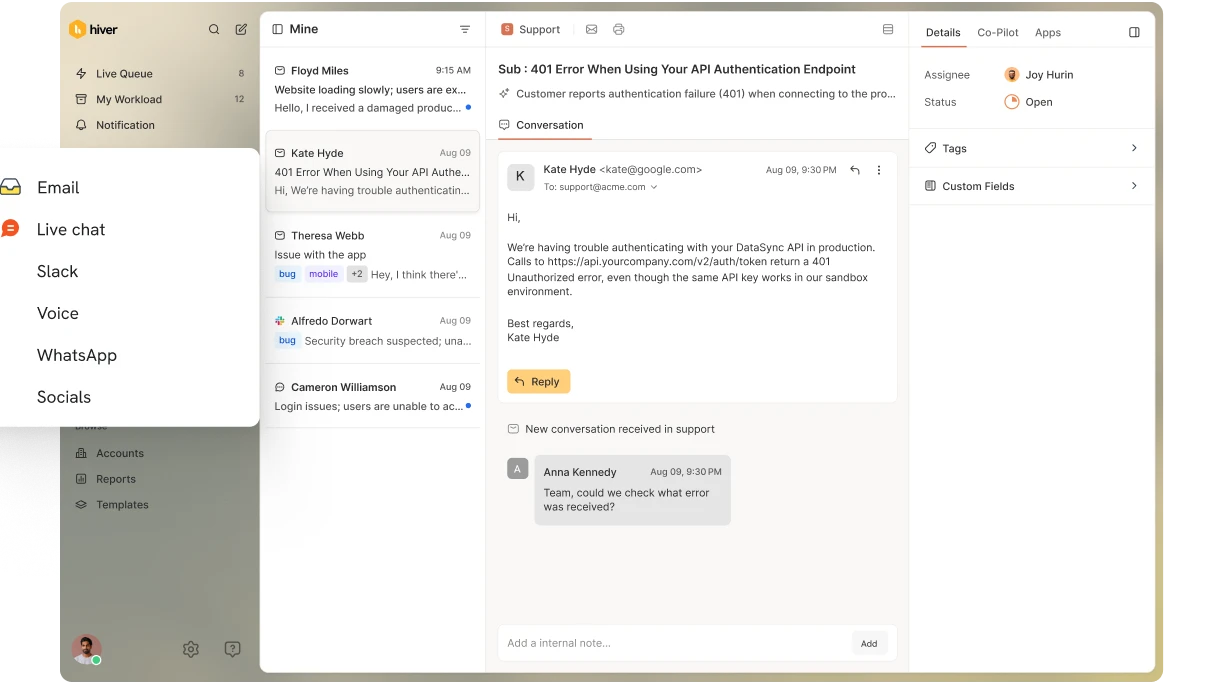
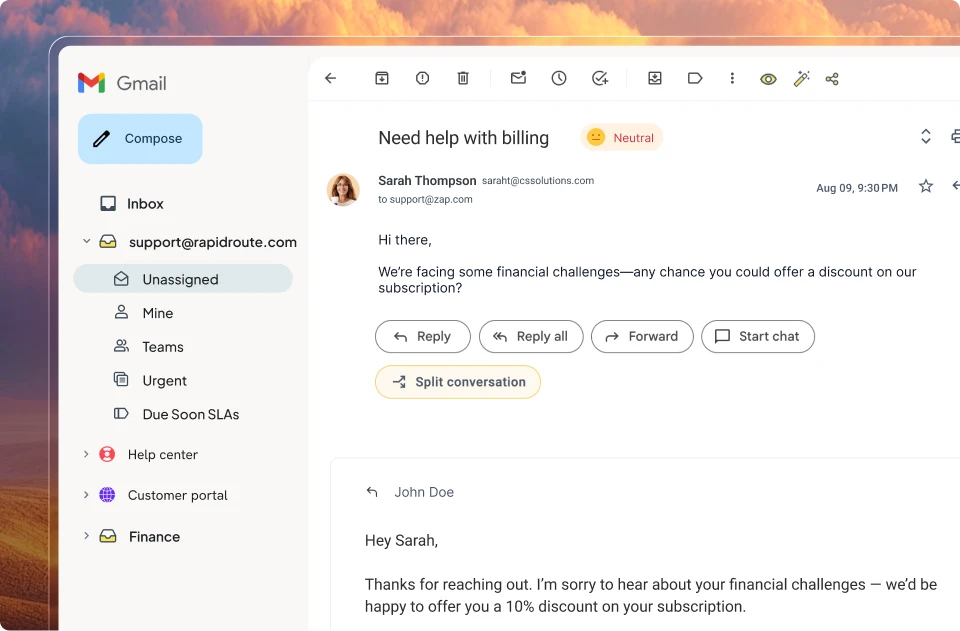
Gmail isn’t built for shared ownership. When multiple teammates respond from the same address, it’s easy to miss messages or send duplicate replies. Hiver adds structure by letting teams assign emails, collaborate, and automate routine work.
Where Gmail’s AI stops at simple suggestions, Hiver AI goes further—drafting replies, detecting sentiment, checking QA, and highlighting volume spikes so teams can stay proactive.
Key Features
- Ticketing: Assign emails as tickets and see clear ownership, status, and progress at a glance.
- Automations that save hours: Auto-tag and auto-route all incoming emails so repetitive tasks run on their own.
- Seamless collaboration: Add internal notes, @mention teammates, and share drafts when you want to collaborate internally on emails.
- Knowledge base: Create a simple, searchable help center so customers can find answers fast without contacting support.
- Customer portal: Allows users to log in to the customer portal, track ticket status, add updates, and view past requests online.
- AI-powered live chat: Handle queries end-to-end using an AI chatbot that pulls information from your help docs and past tickets.
- Actionable analytics: Track SLAs, response times, CSAT, and team performance across channels.
Pros
- Makes team email collaboration easy, even when working remotely
- Complete visibility into who is handling what.
- Simple assignments, comments, and tags keep workflows organized
- Mirrors the Gmail inbox which reduces onboarding time and tool switching
Cons
- Free plan feels limited
- Closed emails can be slower to locate
These pros and cons have been summarised from Hiver’s G2 Reviews.
Pricing
Hiver offers four pricing options:
- Forever free plan
- Lite: $19 per user per month
- Pro: $49 per user per month
- Elite: $79 per user per month
Which Gmail Alternative Is Right for You?
If I had to choose from these tools, here’s how I’d pick them:
- For work: I’d choose Outlook if my team lives in Microsoft 365, or Zoho Mail if I wanted affordable, branded email without ads.
- For privacy: I’d go with Proton Mail for maximum security, or Fastmail/Tuta if I wanted strong privacy with a simpler, more everyday workflow.
- For personal use: If I’m already in the Apple ecosystem, iCloud Mail is my go-to pick. Yahoo Mail is also worth considering.
- For team inboxes: If I’m handling shared emails like support@ or sales@, I’d add Hiver so the team can assign emails, collaborate on responses, and use AI to automate operational tasks .
Frequently Asked Questions
1. What’s the most secure Gmail alternative?
The most secure Gmail alternatives are Proton Mail and Tuta Mail. Proton is based in Switzerland and uses end-to-end encryption with zero-access architecture. Tuta offers encryption across mail, contacts, and calendar, and operates under strict German privacy laws.
2. What’s the best free Gmail alternative?
The best free Gmail alternatives are Yahoo Mail for everyday use, iCloud Mail for Apple users, and Zoho Mail’s free plan for a simple inbox with a custom domain and zero ads.
3. What’s the best Gmail alternative for businesses?
Outlook is the top choice for companies already using Microsoft 365 and needing advanced admin controls. Hiver is a good fit for teams that manage shared inboxes like support@ and sales@ and need AI-powered email workflows, assignments, SLAs, and automations.
4. How do I migrate from Gmail to another provider?
To migrate, you’ll have to first create a new account with your chosen provider, enable IMAP in your Gmail settings, and then use your new provider’s import or migration tool (such as Proton’s Easy Switch) to transfer emails, contacts, and calendars. Finally, you can set up Gmail forwarding so new messages automatically go to your new inbox.
5. Are Gmail alternatives safer?
They can be. Providers like Proton Mail and Tuta don’t scan your inbox or monetize your data, making them safer for privacy-first users. Business-oriented platforms like Outlook offer strong compliance, retention policies, and administrative controls that Gmail’s consumer version lacks.
6. What’s the best Gmail alternative for sending large files?
The best services for large files are Outlook.com, which supports attachments up to 150 MB, Zoho Mail, which allows up to 250 MB, and iCloud Mail Drop, which can handle files up to 5 GB.