




When you look for live chat software, two names consistently pop up: LiveChat and FreshChat.
At first glance, they seem quite similar in what they offer. Both promise faster conversations, better engagement, and happier customers.
But the reality is different. LiveChat is a standalone chat tool that helps agents manage live conversations at scale efficiently. FreshChat, on the other hand, is an AI-powered chat platform that is also part of the Freshworks ecosystem. It can connect to other tools like Freshdesk Omni and Freshservice to bring deep customer context into real-time interactions.
This guide below examines how the two tools differ across automation, integrations, reporting, and pricing, so you can understand the trade-offs and decide which live chat tool benefits your team most as you grow.
LiveChat vs FreshChat: Quick Comparison
If you want to quickly see where these tools differ without reading the full breakdown, this table gives you the essentials upfront.
| Criteria | LiveChat | FreshChat |
|---|---|---|
| Setup time | Very fast; 1–2 days for basic deployment | Moderate; 3–7 days depending on workflows and integrations |
| Ease of use | Simple, chat-first | Feature-rich, steeper learning curve |
| Automation & AI | Limited, add-on-based | Built-in bots and AI |
| Integrations | Broad, flexible | Strong inside Freshworks |
| Reporting | Chat-focused, basic | Broader, more layered |
| Pricing type | Per-agent | Per-agent |
| Hidden costs | Bots, ticketing, KB add-ons | AI usage, advanced features on higher tiers |
| Mobile app quality | Stable, reliable | Mixed user feedback |
| Overall G2 rating | 4.5/5 | 4.5/5 |
| Overall user sentiment | Fast, focused, reliable | Powerful, but complex to use |
LiveChat vs FreshChat: Detailed Feature Breakdown
✍️Author’s note: Before diving into specific features, it’s worth clarifying how these products are structured.
LiveChat is positioned as customer service software centered on live chat. It includes chat tools, messaging channels, reporting, team management, and AI features within the core product, and it can be extended further through other Text Inc. products like HelpDesk, ChatBot, and KnowledgeBase.
FreshChat is part of the broader Freshworks support suite. While it offers live chat and messaging capabilities on its own, many of its advanced workflows, automation layers, and reporting features are closely tied to Freshdesk and other Freshworks products.
This structural difference influences how each platform handles automation, integrations, reporting depth, and long-term scalability.
Now that the high-level differences are clear, let’s look more closely at how LiveChat and Freshchat compare across core features and day-to-day workflows.
Ease of Setup and Use
The differences between LiveChat and FreshChat become apparent during onboarding and daily use.
LiveChat is generally quicker to deploy. Teams can go live with minimal configuration, and the interface is built around handling active conversations efficiently. One G2 reviewer describes it as:
“The interface is simple, conversations feel smooth, and it’s convenient to handle multiple chats at once.” Source
The emphasis is on keeping agents focused on real-time conversations without requiring complex setup.
FreshChat typically involves more configuration upfront. While users describe the interface as clean and modern, setting up routing rules, automation flows, and integrations often takes additional time. A reviewer notes:
“Freshchat boasts an incredibly user-friendly interface…(but) creating a bot is still very tedious and technical.” Source
That said, reviews also point out some practical gaps.
Users mention that there’s no option to edit a message once it’s sent, which is a miss for a real-time chat tool.
Others call out the chatbot experience—Freddy AI in particular. As one reviewer puts it, Freddy “does not really understand” queries well, and setting it up takes time, especially for teams expecting quick wins from automation.
On its own, FreshChat works well for basic live chat, but it clearly nudges teams toward the larger Freshworks stack as they scale.
Verdict: LiveChat stays focused on fast, human-led chat. FreshChat makes more sense if you want an all-in-one, automation-heavy support setup.
Recommended reading
LiveChat Review: Key Insights on Features, Pricing, and Performance
Agent Workspace & Collaboration
With LiveChat, the agent workspace is centered on managing live conversations efficiently.
Agents can set chat limits to control how many conversations they handle at once, use canned responses and message sneak-peek to reply faster, and transfer chats instantly between agents or groups.
Features like chat supervision help managers monitor performance without disrupting active conversations. The interface keeps chat threads front and center, which reduces context switching and keeps agents focused on response speed.
As per a G2 user:
“The most beneficial feature for us is the ability to look into the rep who’s on a chat and live coach or help them with answers through internal messages.”
FreshChat takes a more unified workspace approach. Within the agent view, conversations are not limited to customer chats. When connected to Freshdesk or upgraded to Freshdesk Omni, agents can see all open tickets, past issues, CRM details, and conversations across email, messaging, and voice in one place.
“With Freshchat seamlessly integrated into our operations along with Freshdesk, engaging customers across channels has never been easier” – G2 User
I noticed that this deeper visibility is one of the main reasons teams choose FreshChat within the Freshworks ecosystem. Agents can reference ticket history, past purchases, and cross-channel interactions without switching tools, which helps when handling more complex or multi-step issues.
At the same time, that broader structure introduces more configuration. Setting up routing rules, bot workflows, and cross-channel visibility requires planning.
Verdict: LiveChat’s workspace is optimized for fast, focused live conversations. FreshChat’s workspace is built for cross-channel visibility and ticket-linked collaboration, especially when paired with Freshdesk Omni.
AI, Bots & Automation
This is where I see the difference between LiveChat and FreshChat show up very clearly.
In LiveChat, AI primarily works behind the scenes to assist agents. Features like reply suggestions, summaries, and message drafting help agents respond faster, but AI does not typically handle customer conversations autonomously within the core product.
For teams that want automated chat flows, bots are available through separate products like ChatBot.
One user notes, “I enjoy the flexibility it offers, like modifying different chat prompts for different pages,” but also adds that they are “not sure [the chatbot] takes the most current information.”
FreshChat applies AI more directly to customer interactions. Freddy AI can handle common queries through bots, route conversations, and reduce the number of chats that reach agents.
At the same time, FreshChat also offers AI assistance features such as suggested replies and workflow automation within the agent workspace.
As one G2 user mentions, Freddy can “summarize a chat or an email and craft a response using information from our database. It can also transcribe a call, rephrase text, enhance tone, and expand responses.” The reviewer also highlights that website pages can be integrated into FreshChat and turned into canned responses, making it easier to address common FAQs.
Verdict: This difference matters in practice. LiveChat’s AI is designed to make agents more efficient during live conversations. FreshChat’s AI is designed to both assist agents and automate parts of the conversation before an agent gets involved.
Recommended reading
Chatbot vs Live Chat: Which is Better for Customer Experience?
Proactive Messaging & Engagement
LiveChat offers basic engagement rules such as greetings, availability-based messages, and page-level triggers. These are simple to configure and typically don’t require ongoing management.
In practice, this means teams can launch proactive chat prompts without building complex automation trees or maintaining multi-step workflows.
FreshChat takes a more workflow-driven approach. Proactive messages can be tied to bots, campaigns, or predefined flows. For example, you can set up a workflow where a visitor landing on a pricing page receives a bot-led qualification sequence, gets routed based on responses, and automatically creates a ticket if the issue isn’t resolved.
That flexibility allows for more structured engagement, especially across multiple channels. However, users note that configuring these workflows takes planning and becomes more valuable on higher plans or when paired with other Freshworks products.
Verdict: LiveChat keeps message triggers simple. FreshChat offers more control, but with more setup.
Branding & Widget Customization
Customization is one of those areas where limitations matter as much as flexibility.
With LiveChat, the widget is easy to launch and looks clean by default. User reviews consistently point to quick setup and a polished UI. The trade-off is depth.
Customization stays mostly visual. Teams that want more granular control—different widgets by use case, deeper behavioral rules, or complex variations—often run into limits unless they rely on integrations or additional products.
FreshChat allows more control over how the widget behaves across channels, campaigns, and automation flows. For example, a SaaS company can show one chat experience to trial users, another to paying customers, and automatically trigger different bot flows based on user behavior. This makes it easier to tailor experiences, but reviews suggest that setup takes more time and feels heavier for teams that just want basic live chat running quickly.
Verdict: LiveChat is faster to customize, but less flexible. FreshChat is more configurable.
Integrations & Extensibility
LiveChat positions integrations as a way to extend its standalone live chat product into your existing stack.
From what I see on their website, LiveChat offers:
- 200+ integrations across CRMs, ecommerce platforms, analytics tools, and automation apps
- Native integrations with tools like Shopify, WooCommerce, HubSpot, Salesforce, Google Analytics, and Facebook
- APIs, webhooks, and SDKs for custom workflows
- Separate but tightly connected products for bots, ticketing, and knowledge base (ChatBot, HelpDesk, KnowledgeBase)
The upside is flexibility. You can plug LiveChat into almost any setup without changing your core systems. The downside is that some functionality lives across multiple products, which can mean extra setup, extra licenses, or more integration work if you want an “all-in-one” experience.
FreshChat’s integration story is much more ecosystem-led. On their site, chat is clearly positioned as one part of a larger Freshworks platform rather than a standalone tool.
From what’s highlighted:
- Deep native integration with Freshdesk, Freshdesk Omni, Freshsales, and other Freshworks products
- Built-in connections for WhatsApp, Instagram, Facebook Messenger, email, and voice
- Shared customer context across chat, tickets, CRM, and automation
- APIs and marketplace integrations, but with strongest value inside the Freshworks stack
I noticed that this setup reduces the need for external tools once you’re fully inside Freshworks. Chat, bots, tickets, and analytics are designed to work together out of the box.
The trade-off comes down to ecosystem fit. LiveChat offers a wide range of third-party integrations, which makes it easier to plug into a mixed tech stack.
FreshChat integrates most deeply within the Freshworks suite, especially with Freshdesk and Freshsales. Teams already using Freshworks tools may benefit from that tighter connection.
Verdict: LiveChat works well in diverse tech stacks. FreshChat works best within the Freshworks ecosystem.
Reporting & Analytics
With LiveChat, reporting is centered on live chat performance and agent activity. Teams can track core metrics such as total chats handled, missed chats, response time, chat duration, customer satisfaction, and basic revenue attribution through tracked sales and goals. There are also reports focused on agent performance and staffing prediction to help manage availability.
Some teams find this helpful for quick checks, but others feel it falls short. Reviews mention that reporting can be “not very insightful. In practice, LiveChat’s analytics often rely on tags, basic agent metrics, or external tools like Google Analytics to fill gaps.
FreshChat provides a wider set of built-in metrics.
Reviews mention access to “first response time, resolution time, agent productivity, and customer satisfaction.” That said, this depth comes with friction.
Some users say that “understanding the reports is a little confusing,” and that analytics start to feel useful only after investing time in setup or moving to higher plans or Freshdesk Omni.
Verdict: LiveChat’s reporting can feel limited or insufficient for some teams. FreshChat offers more data, but it takes effort to turn that data into insight.
LiveChat vs FreshChat: Pricing Breakdown
The pricing for both tools looks straightforward on the surface, but the real differences emerge as teams grow and add features.
LiveChat pricing plans
- Starter — $19/agent/month
Basic live chat, limited visitor tracking, 60-day chat history, basic live chat widget customization
- Team — $49/agent/month
Unlimited chat history, unlimited campaigns, full widget customization, basic reporting
- Business — $79/agent/month
Advanced and on-demand reporting, agent performance metrics, work scheduler, staffing prediction
- Enterprise — Custom pricing
SSO, compliance options (including HIPAA), dedicated onboarding and account manager
Note: LiveChat’s plans are for teams that want a dedicated chat platform. Features like AI chatbots, ticketing, and knowledge base are separate products under the Text platform (ChatBot, HelpDesk, KnowledgeBase), each priced independently. This keeps core chat pricing predictable, but costs rise as you add more products.
FreshChat pricing plans
- Free
Website live chat, email, unified agent workspace (up to 10 agents)
- Growth — ~$18/agent/month
WhatsApp and social channels, real-time dashboards
- Pro — ~$48/agent/month
Custom dashboards, advanced routing, multiple SLA policies
- Enterprise — ~$77/agent/month
Skills-based routing, enhanced security, and advanced administration
Note: FreshChat’s pricing scales with agents, channels, and plan tier. AI is not bundled: Freddy AI Copilot is charged per agent, and Freddy AI Agent is charged per session. As teams add automation, routing, and analytics, pricing becomes more layered and usage-dependent.
LiveChat is easier to forecast if your business’s main priority is to provide chat support. You pay more when you add bots, ticketing, or a knowledge base as separate products. FreshChat can start cheaper, especially with the free plan, but the total cost grows as you move to higher tiers, add agents, and pay separately for AI usage.
LiveChat vs FreshChat: Pros and Cons
Before deciding, it helps to see the trade-offs side by side.
LiveChat and FreshChat both cover the basics, but they approach automation, AI, and customization differently. The table below highlights where each tool stands out—and where teams often run into limits.
| LiveChat | FreshChat | |
|---|---|---|
| Pros | Strong, human-first live chat built for real-time conversationsSimple, focused agent workspace that’s easy to manage at high ticket volumesPredictable per-agent pricing for core live chatBroad integrations with CRMs, ecommerce, and analytics toolsFaster setup and lower day-to-day complexity | The free plan makes FreshChat accessible to early-stage startups.Native support for multiple channels (WhatsApp, social, email, app chat)Context-rich agent view with customer history across channelsBroader built-in metrics like first response time and CSATStrong fit inside the Freshworks ecosystem |
| Cons | Bots, ticketing, and knowledge base are separate paid productsReporting can feel basic or insufficient for some teamsDeeper automation requires add-onsTotal cost rises as you bolt on more tools | Pricing becomes layered with agents, higher plans, and AI usageFreddy AI setup takes time and isn’t always accurate.Reporting and routing can feel complexBest value often requires Freshdesk Omni |
Which Platform Is Right for You?
Based on user review summaries on G2, here’s how LiveChat and FreshChat stack up in real usage patterns and satisfaction levels:

However, this overall user sentiment may not apply equally to every business. To make this more practical, let’s look at how preferences typically change based on your team’s needs.
Small teams with limited budgets
For small teams, the priority is usually speed and cost clarity.
LiveChat fits well when you need reliable, human-led live chat without much setup. Agents can start quickly, pricing is easy to follow, and you’re not forced into automation or add-ons early.
FreshChat’s free plan can also work at this stage, especially for teams that want to experiment with bots or multi-channel messaging from the beginning.
Growing teams that need automation
As support volume grows, automation and routing start to matter more.
FreshChat is better suited here. It’s built to support bots, workflows, and multiple messaging channels as needs evolve. The trade-off is time and complexity. Setup takes longer, and pricing becomes layered as teams move to higher plans and start using AI features.
Larger teams that need reporting and integrations
For larger teams, visibility and integration flexibility are often more important than speed alone.
LiveChat works well if you want clear, chat-focused reporting and the ability to plug into an existing tech stack. FreshChat makes more sense if you want reporting across channels and are already invested in the Freshworks ecosystem.
Why Some Teams Choose Hiver Instead
Most live chat tools handle customer conversations in silos. If support agents want more context or information about a prospect or customer, they need to switch tools. They need to dig through their help desk or CRM to figure this out. And imagine doing this manually for every customer chat you handle.
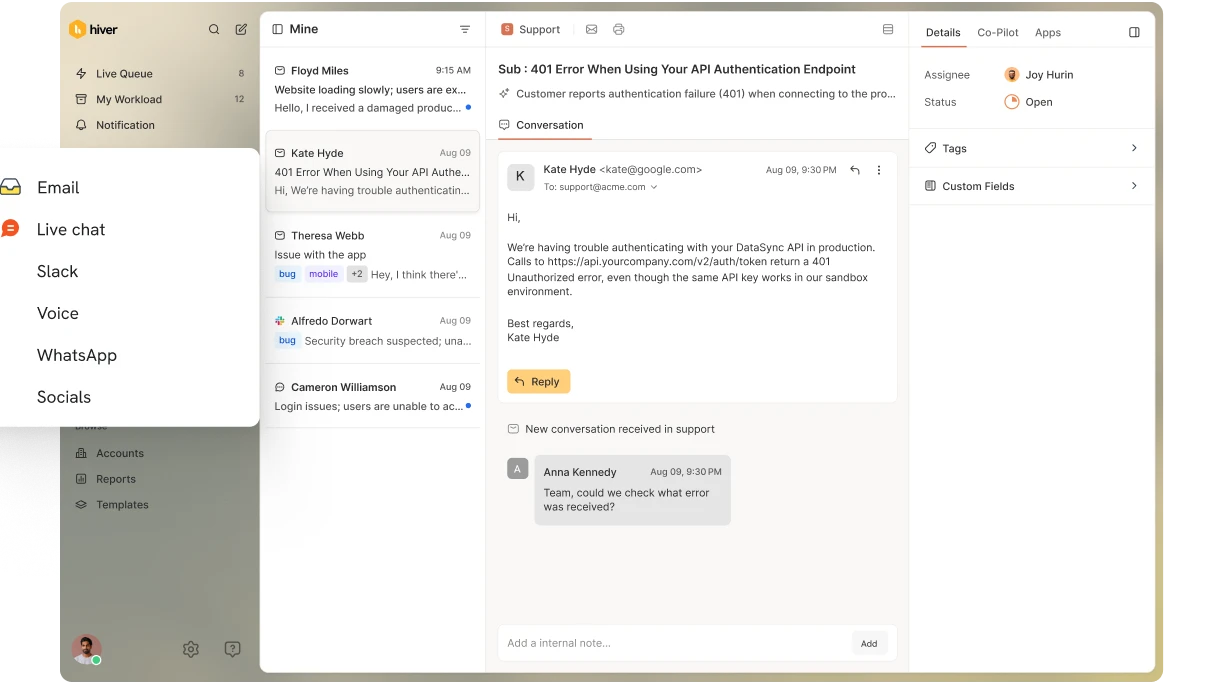
But that’s not the case with Hiver. Hiver is an AI-powered customer service platform designed for modern support teams. Instead of separating chat, bots, ticketing, and reporting across tools, it brings them into a unified workspace, so agents always work with full context.
You get access to customer profiles, past issues, CSAT, and sentiment scores when handling customer chats. You can also pull up information from your knowledge base without switching tabs or screens.
Hiver’s AI is embedded directly into the workflow. AI Copilot suggests contextual replies, refines tone, and summarizes conversations. AI Agents automatically categorize, tag, route, detect urgency, and resolve simple queries. Automation rules can route and prioritize conversations without heavy setup.
Collaboration happens inside the same interface. Agents can use internal notes and @mentions to collaborate with other departments on cases. Built-in reporting provides visibility into resolution time, workload, and customer satisfaction.
Pricing is straightforward. There’s a free plan available and paid tiers that include automation and AI features without separating them into multiple add-ons.
Explore the free plan to see if it fits your workflow.
Frequently asked questions
1. Which is better: LiveChat or FreshChat?
There’s no single winner. LiveChat works better for teams that want fast, human-led chat with minimal setup, while FreshChat fits teams building toward automation and multi-channel support.
2. Which tool is better for small businesses: LiveChat or FreshChat?
LiveChat is usually a better fit for small businesses that value quick setup, simple workflows, and predictable costs. FreshChat’s free plan can help early on, but complexity and pricing tend to rise as soon as teams add agents or automation.
3. Which platform is better for high-volume support teams?
For high-volume support teams, LiveChat generally performs well because its agent workspace and routing are optimized for speed and real-time handling of multiple conversations.
That said, teams that also need AI-assisted replies, shared context across conversations, and fewer tool handoffs often look at platforms like Hiver. It combines live chat and automation in a single workspace instead of across separate products.
4. What features differentiate LiveChat from FreshChat?
LiveChat is for businesses that have a dedicated support team to manage chat conversations, while FreshChat differentiates itself with built-in bots, automation flows, and deeper integration with the larger Freshworks ecosystem.
5. What are the pros and cons of LiveChat vs FreshChat?
LiveChat’s strengths are simplicity, speed, and chat-focused pricing, but it relies on add-ons for bots and ticketing.
FreshChat offers more automation and channels out of the box, but requires more setup effort and has layered pricing.
6. What are the pricing differences between LiveChat and FreshChat?
LiveChat uses per-agent pricing for chat and charges separately for bots, ticketing, and knowledge base tools. FreshChat uses tiered plans and adds separate costs for AI usage, which can make pricing harder to predict as teams scale.
7. Is LiveChat more user-friendly than FreshChat?
For most teams, yes. LiveChat is easier to learn and use for chat-only workflows, while FreshChat has a steeper learning curve due to its automation and multi-channel features.
8. Which Platform Offers Better Reporting and Analytics?
FreshChat provides broader reporting across chat, bots, and channels. LiveChat’s reporting is more limited and chat-centric, which works for some teams but feels insufficient for others.
9. Does FreshChat Offer Better Chatbot Support Than LiveChat?
Yes. FreshChat has stronger native chatbot capabilities through Freddy AI, while LiveChat typically requires separate products to achieve similar automation.
10. Does FreshChat Offer a Free Plan?
Yes. FreshChat includes a free plan for small teams with basic chat and email support. LiveChat does not offer a free plan, but does provide a free trial.
11. Is FreshChat Too Complex for Small Teams?
It can be. FreshChat is manageable at first, but it becomes more complex as teams enable automation, routing, and AI features on higher plans.
12. What Are the Best Alternatives to LiveChat and FreshChat?
For teams that want live chat with built-in AI and automation, Hiver is a strong alternative. It also helps you manage other support channels, such as email, WhatsApp, and phone, from a unified workspace. Hiver empowers your support team to use AI in the right way. They can leverage it to draft responses, fetch information from your documentation, and also trigger workflows for refunds or reimbursements.