

About the company
The Oakland Public Education Fund (Ed Fund) drives community investment in Oakland’s public schools so every student can learn, grow, and thrive. Founded in 2003, the nonprofit connects donors, volunteers, and district partners to the programs that make the most significant impact. Since 2013, it has raised more than $250 million to support student success across the city.
Nathan Bellet, the Director of Information Technology, oversees the Ed Fund’s cloud systems, ROI, and general operations. His team supports every department’s digital tools and ensures smooth communication between the team, the school district, fiscal sponsorship clients, and the broader Oakland community.
Growing messages, missing context
As the Ed Fund grew, every department — from HR and Finance to Programs and Operations — started managing more communication with schools, donors, and volunteers. But relying on personal inboxes and shared logins made it hard to stay organized and consistent.
- Emails scattered across inboxes: Teams managed a wide mix of requests — from volunteer sign-ups and school partnership inquiries to fiscal sponsorship questions, HR forms, and reimbursement approvals — all coming through individual accounts or shared credentials for group addresses like info@oaklandedfund.org. When someone left, their email history disappeared, leaving the team without visibility into what had been promised, approved, or resolved.
- Ownership lost in transition: Program leads often shared personal addresses in public materials. When they moved on, inquiries kept landing in those inboxes, and no one saw them.
- Slow replies: Without shared visibility or tracking, teams missed follow-ups and took over a week to respond to some messages. District partners and clients often waited without updates.
- Seasonal overload: At the start of the school year and again in January, volunteer requests spiked, and teams struggled to triage messages quickly.
- No way to measure work: Managers couldn’t see which emails needed action, track who was responding, or find trends across inboxes.
“When the team left, their email trails went with them. Conversations just stopped, and we had no easy way to see what was pending or who owned what.” — Nathan Bellet, Director of Information Technology
Finding a better way to share, assign, and track work
The Ed Fund first discovered Hiver through its HR department, which struggled to juggle incoming requests between two team members. They needed a way to share emails, discuss context, and pass ownership without constant forwarding. Hiver fit that need perfectly.
What started as a simple solution for one department quickly expanded across the organization. As more teams saw how easily HR could collaborate with Hiver, they asked to join. Within a few years, Hiver became the default system for handling external communication.Nathan approved Hiver’s rollout early on and oversaw its steady adoption. Each department added Hiver as new needs emerged — from Finance tracking fund inquiries to Programs managing volunteer messages. Over time, the Ed Fund standardized all public-facing inboxes — from volunteer and sponsorship addresses to general contact lines — under Hiver to maintain continuity, especially during the team transitions.
“Once one team started using Hiver, others saw the difference and wanted the same. It wasn’t a top-down rollout — it spread because it actually worked.” — Nathan Bellet, Director of Information Technology
Creating structure, speed, and visibility across team communication
Once the Ed Fund decided to expand Hiver’s use beyond the HR team, Nathan and his team focused on building a structure that fit how each department worked. Instead of changing how people communicated, Hiver became the framework that kept those conversations organized, traceable, and easy to manage.
- Centralized inboxes connect every department’s work
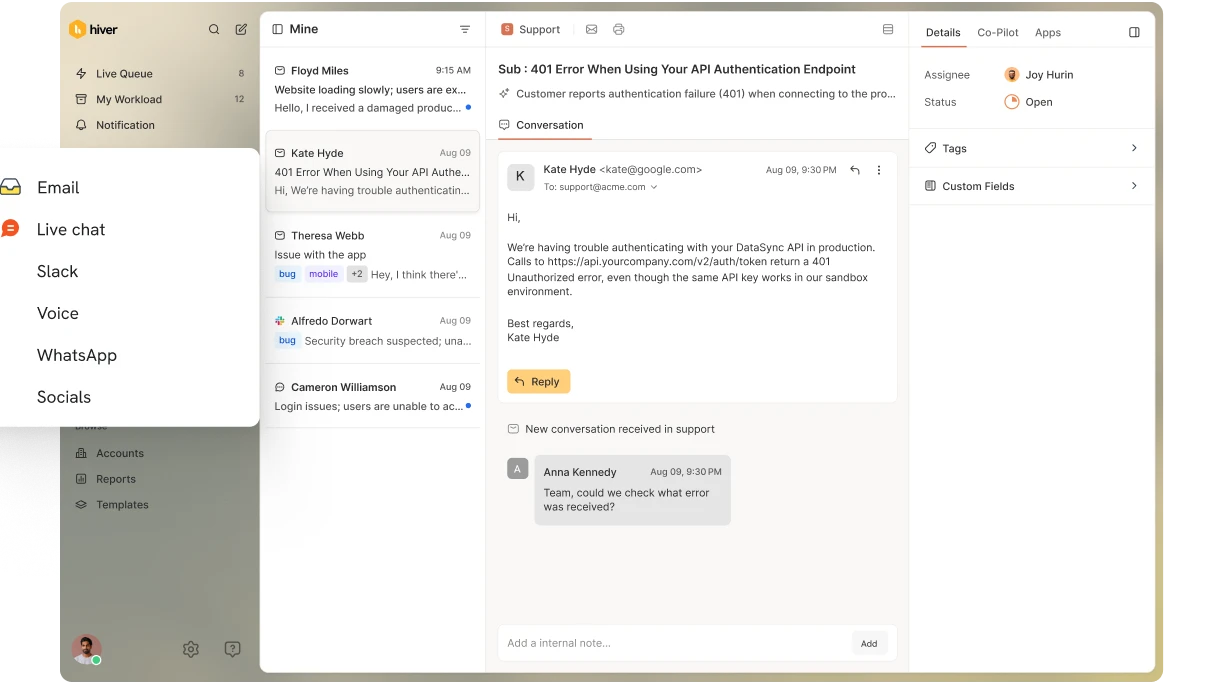
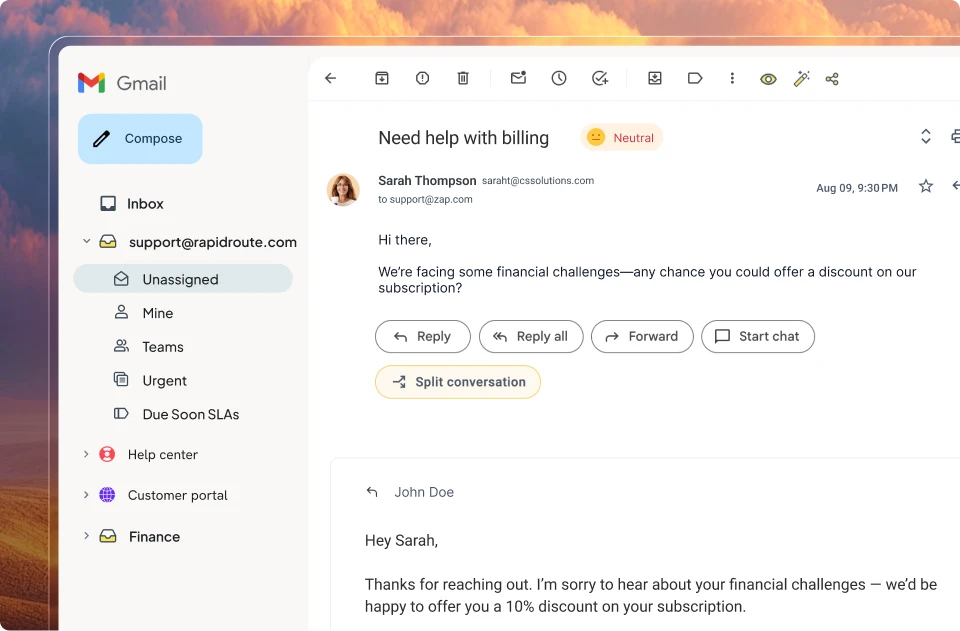
The Ed Fund runs all external communication through Shared Inboxes — HR manages internal and hiring queries, Finance handles fiscal sponsorship requests, Programs coordinates with school volunteers, and Operations oversees district communication. This unified setup keeps every conversation visible and helps teams efficiently assign, track, and resolve requests. - Clear ownership ensures accountability
Teams assign incoming emails manually to review and route messages thoughtfully. For program-specific addresses, they use aliases that automatically assign messages to the right owner. For example, when someone emails techlink@oaklandedfund.org, it directly reaches the program lead — no manual sorting or delays. - Notes keep collaboration within context
Instead of forwarding threads or switching to Slack, the team members now add Notes directly inside the email, tagging teammates for input or updates. This keeps every discussion linked to its original message, making it easy for anyone to step in and continue a conversation when roles shift or the team is on leave. - Auto-responders help manage peaks in volume
During busy seasons — like the school year kickoff or January volunteer wave — auto-replies instantly acknowledge receipt and set expectations. This small change reduces repeated follow-ups and reassures senders that their message is being reviewed. - SLAs drive faster responses
Managers track first-response time through SLAs, Hiver’s built-in performance metric. When emails approach their response limit, Hiver alerts the assigned user, keeping teams prompt even when inboxes flood. Response times that once stretched past a week now average under two business days for high-impact inboxes — a transformation Nathan calls “night and day.” - Analytics reveal team performance and trends
Department heads rely on Hiver Analytics to understand volume, workloads, and bottlenecks. They can see how many messages need replies, who’s handling the most requests, and where response times are slipping. These insights help leaders rebalance responsibilities and prepare for seasonal surges. - Templates standardize recurring communication
The team uses pre-written Templates for common responses — like stipend instructions or reimbursement guidance — to ensure clarity and tone consistency. They customize each reply quickly, saving time while keeping messages professional and accurate. - Tagging organizes communication by partner and purpose
Hiver auto-tags messages from key domains, such as the Oakland Unified School District, allowing the team to spot priority inquiries at a glance. Nathan’s team also reviews and updates old Tags, ensuring the tagging system evolves with the organization’s needs. - AI tools amplify efficiency and insight
The Ed Fund is actively experimenting with Hiver’s AI capabilities. Teams use AI Summarizer to catch up on long threads instantly, AI Tagging to identify stipend-related requests, and AI Sentiment Analysis to gauge tone before replying. Nathan’s team also designs AI prompts to make replies more context-aware — a step toward smarter automation in their upcoming five-year tech plan.
“Hiver AI is becoming part of how we think about our systems. It’s shaping how we plan for the next five years.” — Nathan Bellet, Director of Information Technology
- Salesforce integration brings full context
Hiver’s Salesforce integration gives the team immediate access to donor, volunteer, or client information without leaving the inbox. When a new sender writes in, users can instantly see their history with the Ed Fund — helping them craft informed, personal responses. This bridge between Salesforce and Hiver has become vital for maintaining strong relationships with partners and sponsors.


“Integrating Salesforce with Hiver bridges our communication and relationship data. The team don’t have to guess who’s writing in — they can focus on responding meaningfully.”
Nathan Bellet
Director of Information Technology
Transforming communication into measurable impact
Since adopting Hiver across departments, the Oakland Public Education Fund has seen significant, quantifiable improvements in how teams communicate, collaborate, and serve their partners.
- Response time improved by 72%
Average first-response time dropped from more than seven days to under two business days, with some inboxes responding within 24 hours. - 61 hours saved every month
Across all Hiver features, the Ed Fund saves 61 hours each month — the equivalent of 1.5 full work weeks — through automation, templates, and in-thread Notes that streamline communication.
- 344 automations triggered monthly save 11 hours
- 177 Notes replace side conversations, saving 6 hours
- 315 templates for recurring emails save 11 hours
- 35,000 emails handled quarterly with 99% accuracy
One forward-facing inbox processed 35,000 messages in three months, of which only ~300 required replies. Hiver’s structure and analytics help teams filter non-actionable emails with 99% accuracy, ensuring focus on high-impact requests. - 100% visibility and accountability across inboxes
Managers now have complete visibility into every Shared Inbox — tracking volume, response time, and ownership in real time. This has helped eliminate missed messages and ensure 100% accountability across teams. - Turnover continuity improved to 100%
When the team transitions or leaves, new members can resume conversations instantly using Shared Inboxes and Notes. Since adopting Hiver, the organization has reported zero communication loss due to the team turnover. - Smarter, context-driven communication
Hiver AI and Salesforce integration have enabled 100% contextual visibility in communication. The team can see sender relationships, sentiment, and conversation history before responding — leading to faster, more informed replies and stronger relationships.
“Hiver turned communication from something we managed reactively into something we can measure, improve, and trust. We finally see the full picture — and we move faster because of it.” — Nathan Bellet, Director of Information Technology
Expanding automation and building an AI-ready future
After seven years with Hiver, the Ed Fund continues to evolve how teams collaborate. Nathan and his IT team are now focusing on expanding automation, refining tagging, and embedding AI more intentionally into daily workflows.
- Broader SLA adoption: More departments plan to roll out SLAs to bring consistency and accountability across all Shared Inboxes.
- Smarter automation: Nathan will work with team leads to identify new automation opportunities that reduce manual effort without losing control.
- Tag cleanup: The team will retire old tags and maintain a lean, relevant tagging system.
- AI enhancement: They’ll measure AI Tagging accuracy for stipend requests and pilot AI-generated draft replies for common inquiries.
- Strategic integration: AI will become part of the Ed Fund’s five-year tech roadmap — including sentiment-based alerts and context-aware responses.
“Every year, we fine-tune how we use Hiver — cleaner tags, better automations, smarter AI. It’s all about evolving with purpose, not just change for the sake of change.” — Nathan Bellet, Director of Information Technology
Keeping communication consistent as the team grows
Hiver has become part of how the Ed Fund operates day to day — a steady framework that supports the team, maintains visibility, and helps every department serve Oakland’s schools more effectively. With clearer ownership, faster collaboration, and smarter use of AI, the organization continues to scale its impact without losing the personal touch that defines its work.
“Hiver has been with us for years because it grows the way we do. It keeps our communication grounded, even as our needs evolve.” — Nathan Bellet, Director of Information Technology