




Customer service teams don’t have time to wrestle with complex software. They need a help desk that’s quick to launch, reliable under pressure, and easy for agents to use. That’s where HappyFox comes in.
It promises fast setup, strong automation, and an intuitive interface that keeps your support queue under control. But does it hold up once your team grows and analytics become crucial?
In this article, we review where HappyFox performs well and where it falls short to help you decide if it’s the right fit for your support operations.
TL; DR
- What is HappyFox? Cloud-based help desk and ticketing platform that centralizes support from email, chat, phone, web, and social media. Known for fast setup, automation, and a clean interface.
- Best for: Small to mid-sized teams seeking an easy-to-manage support system without IT involvement.
- Setup time: A few hours, quick and beginner-friendly.
- Pricing: Starts at $21 per agent per month, scaling up to $89; Enterprise Pro is custom-priced. Unlimited-agent plans are billed annually by ticket volume.
- Key strengths: Fast setup, smart automation, SLA tracking, reliable performance, and transparent demos.
- Main drawbacks: Limited reporting in lower tiers, basic knowledge base, and annual billing for unlimited plans.
- Ratings: G2 4.5/5 (130+), Capterra 4.6/5 (90+).
Table of Contents
Key Features of HappyFox
HappyFox focuses on clarity and control. Teams get enough depth to manage growth without feeling buried in settings.
Unified Ticketing
All customer messages from email, chat, phone, and social channels land in one queue. Owners can assign, prioritize, and follow progress without losing context.
“The ease of use in general is excellent for the platform.” — G2 reviewer
Automation and Smart Rules
Rules handle routing, tagging, escalations, and follow-ups. Agents avoid repetitive work and focus on complex questions.
“Ease of use. Managing tickets is easy with automation and quick replies. Customer support is the best.” — G2 user
Pro Tip: Start with three rules: route by keyword, escalate when SLA is at risk, and auto-tag VIP accounts.
SLA Management
Teams define response and resolution targets by issue type or customer tier. Automated reminders keep service steady and avoid missed expectations.
Pro Tip: Pair SLA timers with canned responses that set clear expectations and reduce back-and-forth.
Knowledge Base
Publish help articles, FAQs, and step-by-step guides. Self-service deflects routine questions and lowers inbound volume.
Reporting and Analytics
Dashboards show volumes, response times, and productivity. Leaders spot trends and plan staffing.
Pro Tip: Track first contact resolution, backlog by queue, and SLA breaches weekly. Those three numbers drive most improvements.
Customization and Integrations
An open API and native integrations connect HappyFox to CRMs, chat, and project tools. Workflows adapt to current systems rather than forcing a rebuild.
“Getting set up with HappyFox and their friendly sales and support staff was a breeze. They were very transparent with the capabilities of their platform and provided an exceptional demo of features prior to signing up.” — G2 reviewer
HappyFox Customer Reviews
Pros
1. Easy Setup and Quick Onboarding
HappyFox is known for its short learning curve and fast setup.
One reviewer mentioned “Task management. Ease of setting up. Quick onboarding.”
Another highlighted that “with minimal configuration you can start your help desk support system… after an easy implementation, you can start providing customer support almost instantly.”
2. Intuitive Ticketing and Productivity Feature
Automation, canned replies, and SLAs help teams stay organized.
One reviewer shared, “Ease of use. Managing tickets is easy with automation and quick replies.”
Another explained the platform “gave the company greater capacity, issue tracking, and efficiency… it prevented our team from tripling in size.”
3. Reliable Performance
HappyFox is praised for long-term stability and performance.
“Not only was it easy to implement, but it is easy for our employees and our client success agents to use. The software works flawlessly” – G2 review
Cons
1. Knowledge Base and Reporting Gaps
“Enhancement required on the knowledge base side.” – G2 review
2. Contact Management Drawbacks
“Managing contacts is not the best experience. It does work, but it could be improved by giving options such as disabling a contact without deleting it.” – G2 review
3. Web-Based Experience Issues
“Not a smooth user experience from the standpoint of the customer, coming from a GSuite Help Desk.” – G2 review
HappyFox Pricing Analysis
HappyFox offers both per-agent and unlimited-agent (ticket volume–based) pricing.
Agent-Based Pricing
| Plan | Price (per agent/month) | Key Features | Best For |
|---|---|---|---|
| Basic | $21 | Email ticketing, automation, SLA management, knowledge base | Small teams starting with help desk tools |
| Team | $39 | Custom roles, time tracking, task management, reports | Mid-sized teams needing visibility |
| Pro | $89 | Multi-brand support, asset management, templates, analytics | Growing teams |
| Enterprise PRO | Custom | All Pro features + custom integrations & premium support | Large enterprises |
Unlimited-Agent Plans
Ideal for large teams. Pricing depends on annual ticket volume (Growth, Scale, Scale Plus tiers).
Note: Annual billing only. No month-to-month plans.
Additional Costs to Consider
- Exceeding ticket limits incurs extra charges (typically per additional 5,000 tickets)
- Telephony features may include per-minute call fees.
- Some analytics and integrations are restricted to higher tiers.
- Custom branding or data centers increase the total cost.
Cost-Effectiveness Analysis
For small to mid-sized teams, HappyFox offers good value, especially for those wanting fast setup and strong automation. However, costs can rise with ticket-based billing.
Hiver, by contrast, offers a Free plan for teams getting started with customer service, including email, live chat, and WhatsApp support. Paid plans start at $35 per user/month (Growth) and scale up to $55 (Pro) and $95 (Elite). All paid tiers include multichannel support, automation, analytics, and integrations.
Hiver Pricing Advantage
| Plan | Price (per user/month) | Key Features |
|---|---|---|
| Free | $0 | Email ticketing, live chat, WhatsApp, voice, basic collaboration |
| Growth | $35 | SLAs, automation, approvals, customer portal, analytics |
| Pro | $55 | CSAT surveys, chatbots, advanced analytics, data exports |
| Elite | $95 | Skill-based routing, custom roles, HIPAA compliance |
| AI Add-on | +$20 | AI Copilot, AI Summarizer, tagging, sentiment analysis, Ask AI |
- Free Trial: Hiver offers a 7-day free trial with full access.
- HappyFox: No public free trial, only demos.
Why Hiver’s Multi-Channel Approach Works Better for Modern Teams
HappyFox offers dependable help desk functionality, but today’s customers expect real-time, multichannel engagement. That’s where Hiver stands out.
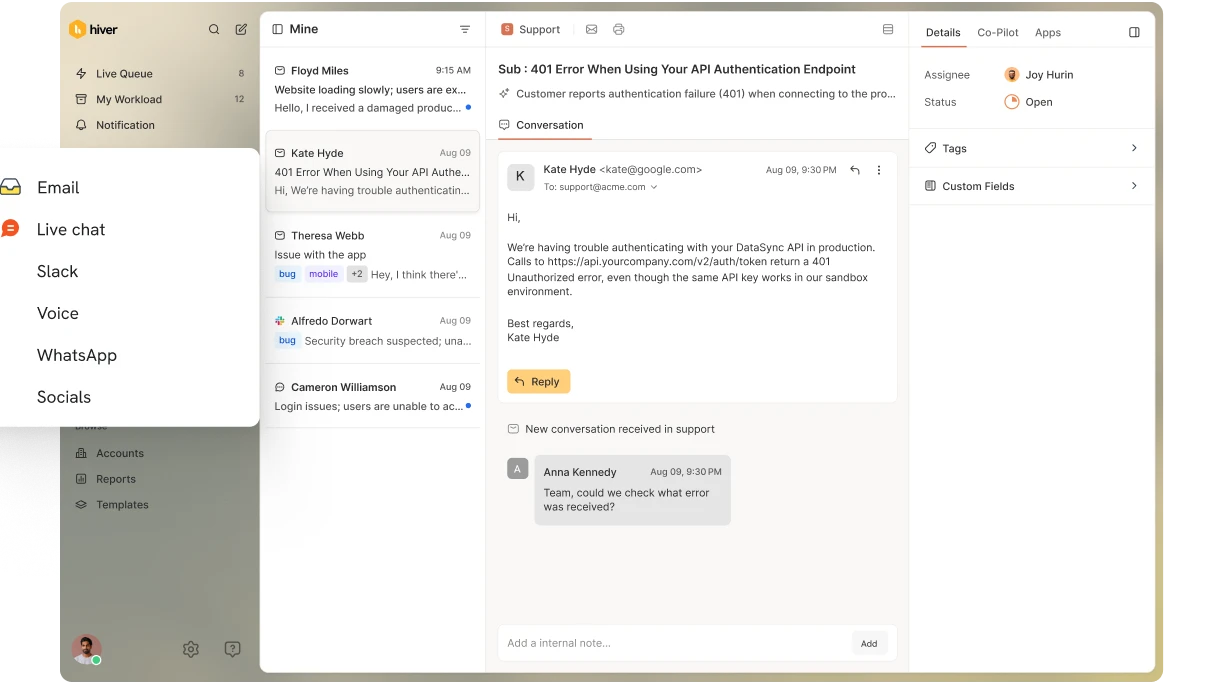
Teams can handle email, live chat, WhatsApp, voice, and social messages, all inside one familiar inbox.
Here’s what sets Hiver apart:
- AI-Powered Workflows: Hiver’s AI Copilot automates triage, drafts replies, and learns from past conversations.
- Unified Multichannel Inbox: Manage all channels without switching tabs.
- Faster Setup: Start resolving queries in minutes.
- Advanced Analytics: Deep insights through Conversation and Tag Reports.
- Predictable Pricing: Scales with headcount, not ticket load.
Recommended reading
How to Choose the Right Platform for Your Team
Choosing between HappyFox and Hiver depends on your goals:
- Pick HappyFox if you want a reliable ticketing tool with simple automation.
- Pick Hiver if you’re ready to modernize support with AI, chat, WhatsApp, and voice, without heavy setup.
Hiver’s inbox-based design helps teams deliver faster, consistent support without juggling multiple tools.
Book a personalized demo or start your free trial today.
Frequently Asked Question
1. What is HappyFox, and how does it work?
A cloud help desk and ticketing system that centralizes support across email, chat, phone, and social. Automation manages routing, escalations, and SLAs.
2. How does HappyFox handle ticket management?
All interactions convert to tickets in a single dashboard. Teams assign owners, set priorities, and track progress from one place.
3. What are the key features of HappyFox for customer support?
Unified ticketing, automation, and SLAs, customizable workflows, a self-service knowledge base, reporting and analytics, and wide integrations.
4. Is HappyFox easy to set up?
Yes. Many teams report setup within hours and minimal configuration. Good fit for small to mid-sized teams that value quick starts.
5. How does HappyFox help with automation?
Smart Rules handle routing, tagging, and follow-ups. Agents avoid repetitive tasks and focus on complex work.
6. How does HappyFox compare to other help desk platforms?
More affordable and faster to implement than many enterprise tools. Strong at ticketing and automation. The depth of analytics and breadth of the knowledge base may feel limited for fast-growing teams.
7. What are the drawbacks of using HappyFox?
Reporting depth on lower tiers, clunky contact management for some teams, and a knowledge base that needs richer features. AI and advanced options often sit behind add-ons.