






Support teams today switch conversations across chat, email, product, WhatsApp, and social. If you choose a tool that is not built for the right use case, you either overpay or end up fighting the product.
Drift and Intercom both promise more intelligent chatbots. Drift focuses on sales and revenue. Intercom focuses on providing support and enhancing the customer experience. The challenge is deciding which one fits your reality.
In this guide, you will see how they differ in terms of automation, setup effort and pricing
TL; DR
- What is Drift? Drift is an AI-driven conversational marketing platform that helps sales teams engage website visitors, qualify leads, and push high-intent prospects into the pipeline.
- What is Intercom? Intercom is a customer service platform with AI chat (Fin), a shared inbox, and ticketing, built to help support teams manage chat, email, and other channels from one place.
- Choose Drift if your focus is sales and you need an AI chatbot that handles qualification, meetings, and CRM driven workflows.
- Choose Intercom if you need an omnichannel helpdesk with strong automation, advanced ticketing, and collaboration at scale.
- User Reviews: Drift holds 4.4/5 on G2 and Capterra. Intercom holds 4.5/5 on both platforms.
- Pricing: Drift offers custom pricing through Salesloft. Intercom starts at $29 per helpdesk seat per month plus $0.99 per Fin AI resolution. Hiver offers a Free plan, then Growth at $25, Pro at $45, and Elite at $75 per user per month, with Hiver AI available for $20 per user per month.
- Key Differences: Drift is built for revenue teams. Intercom is built for support teams. Hiver provides a simpler, multichannel alternative with predictable pricing and fast setup.
Table of Contents
- What is Drift?
- What is Intercom?
- Drift vs Intercom: A Side-by-Side Feature Comparison
- Drift vs Intercom: Pricing & Plans Analysis
- Reviews from Real Users
- Which Platform Fits Your Business: Drift vs. Intercom vs. Hiver?
- Choosing the Right Solution for a Simplified Customer Support
- Frequently Asked Questions
What is Drift?
Drift is a conversational marketing and sales engagement product from Salesloft. It turns website visitors into conversations, then into opportunities.
It uses AI chat agents and playbooks to greet visitors, ask qualifying questions, and route them to the right sales workflow or meeting link. All of this ties back into your CRM and Salesloft rhythms so reps always know who to talk to next.
Drift works best for teams that treat the website as a primary source of pipeline and want revenue-focused chat rather than a classic helpdesk.
What is Intercom?
Intercom is a customer service platform that combines chat, email, a shared inbox, and AI. It is designed to help support teams resolve issues quickly across channels.
Fin, Intercom’s AI Agent, answers a large chunk of questions based on your knowledge and policies. Anything more complex becomes a ticket and lands in the helpdesk, where agents manage SLAs, escalations, and follow-ups.
Intercom fits teams that want a modern helpdesk with AI built into every step of the workflow.
Drift vs Intercom: A Side-by-Side Feature Comparison
It’s easier to spot the right fit when you see them next to each other. Here’s a quick comparison of Drift and Intercom across key areas.
| Category | Drift | Intercom |
|---|---|---|
| Interface | AI-powered live chat interface with easy setup. | Intuitive helpdesk with omnichannel support. |
| Ease of Use | Simple for sales teams, easy setup with minimal configuration. | User-friendly, great for support teams with easy navigation. |
| Ticket Management | Focus on lead conversion, integrates with CRM for pipeline management. | Comprehensive ticket management with omnichannel support. |
| Collaboration | Real-time chat, routing to sales reps, and integrations for team collaboration. | Team collaboration with shared inbox and workflows. |
| Automation | AI chatbots, real-time lead qualification, and automated routing. | AI-powered workflows, ticket routing, and proactive messaging. |
| Channels Supported | Live chat, email, website, and social media integrations. | Email, live chat, SMS, WhatsApp, and more. |
| Customization | Customizable chat settings, automated responses, and workflows. | Customizable chat experiences, knowledge base, and automated workflows. |
| Integrations | Salesforce, HubSpot, Slack, and other CRM tools. | Integrates with CRM, helpdesk tools, and third-party apps. |
| Analytics & Reporting | Tracks engagement, lead conversion, and ROI. | Advanced reporting on team performance, CSAT, and SLA tracking. |
AI Chatbots
Drift: Drift’s AI Chat Agent greets visitors, answers basic questions, and qualifies them in real time. It can:
- Ask routing questions
- Decide whether to book a meeting, send a link, or call in a rep
- Push qualified contacts into Salesloft and CRM
“If customers find themselves looking for information, they want it NOW. Luckily, with Drift, you can make that experience both pleasant and streamlined through the AI chatbot.” – G2 user
It is designed for revenue. It is less suitable for complex troubleshooting or multi-step support workflows.
Fin AI: Intercom’s Fin AI Agent is built for customer service. It can:
- Use your knowledge base and procedures to answer questions
- Handle first level support across channels
- Escalate to agents and create tickets when needed
“It cleared a huge chunk of our chats, solved issues efficiently, helped us maintain CSAT, and gave us more time to focus on migrations while improving the overall user experience.” – G2 user
Fin’s main goal is to reduce ticket volume and response times while keeping quality high.
What to choose:
- Drift: For sales teams needing a proactive AI chatbot to engage, qualify, and convert leads 24/7.
- Intercom: For support teams needing an AI chatbot to handle service inquiries and smoothly transition them into tickets
Ticket Management
Drift: Drift’s ticket management system is designed for sales-driven teams. It converts website chats, emails, and messages into conversation records, ensuring no lead is missed and prospects are engaged quickly.
Focused on lead qualification, Drift excels at managing real-time conversations, using custom workflows, automated routing, and prioritization to direct leads to the right sales reps and streamline revenue generation. However, it’s not built for handling a high volume of complex customer service requests.
“Drift’s real-time communication capabilities have revolutionized the way we interact with our website visitors, allowing us to provide instant support and convert inquiries into sales in a matter of moments. The lead qualification feature is a game-changer.” – G2 user
Intercom: Intercom’s ticketing is more traditional. It centralizes conversations from chat, email, and other channels into one helpdesk. Agents can view the full history, internal notes, and SLAs in a single place.
Fin can deflect a big share of tickets by answering questions up front. It also routes conversations to the right team or person. Back office tickets help internal teams collaborate on complex issues without losing context.
“We use Fin daily; it has reduced the number of tickets hitting our team by over 40%.”- G2 user
What to choose
- Drift: Best for sales teams needing real-time engagement and lead qualification with CRM integration.
- Intercom: Ideal for support teams needing omnichannel ticketing, team collaboration, and AI-powered ticket management.
Conversational Landing Pages
Drift: Drift’s Conversational Landing Pages replace static forms with live conversations. When a target account visits, the chat agent knows who they are, engages them, and alerts the right rep.
It’s ideal for account-based marketing and high-intent campaigns where every visit matters.
“Overall, Drift.com is a robust and user-friendly solution for any business looking to enhance their customer engagement through conversational marketing.” – G2 user
Intercom: Intercom can also create conversational experiences on key pages, driven by Fin and automation. It uses visitor behavior to show the right message, suggest relevant content, or invite users to chat.
Integrations
Both Drift and Intercom offer a wide range of integrations to enhance their functionality for sales, marketing, and customer service teams. Here’s how they compare:
| Integration Category | Drift | Intercom |
|---|---|---|
| CRM / Customer Data | Salesforce, HubSpot, Zoho CRM (via connectors) | Salesforce, Pipedrive, Marketo (via built-in apps) |
| E-commerce | Privy, SalesTempo, Marketo | Stripe, WordPress (via app directory |
| Communication / Collaboration | Slack, Microsoft Teams, Google Meet | Whatsapp, Facebook, Instagram |
Drift: Drift excels with a wider Salesloft Revenue Orchestration Platform. It integrates deeply with:
- Salesforce and other CRMs
- Sales engagement tools inside Salesloft
- Collaboration tools like Slack
“It seamlessly integrates with our CRM to keep track of current and potential clients and their needs. We use it daily at work, and it’s one of the best tools in our tech stack.”- G2 user
Intercom: Intercom offers a broad app ecosystem for support and product teams. It connects with:
- CRMs like Salesforce and Pipedrive
- Ecommerce and billing tools like Stripe
- Channels like WhatsApp, Facebook, and Instagram
- Custom workflows via APIs and webhooks
“Its ease of integration with workflows and macros allowed us to create complex routes (e.g., KYC verification on WhatsApp) and provide quick and consistent responses to users.”- G2 user
What to choose:
- Drift: Ideal for sales teams needing real-time engagement and powerful integrations to automate lead qualification and conversion.
- Intercom: Best for support teams requiring strong CRM, e-commerce, and issue-tracking integrations, with flexibility for customization.
Drift vs Intercom: Pricing & Plans Analysis
Let’s break down how Drift and Intercom structure their pricing and what you actually get for your investment.
| Plan | Drift | Intercom |
|---|---|---|
| Free | Not available | Not available |
| Entry / Growth | Not available | Essential PlanPricing: $29/seat/month, billed annually Key Features:Fin AI Agent ($0.99 per resolution)MessengerShared Inbox and Ticketing systemPre-built reportsPublic Help Center |
| Mid / Pro | Advanced PlanPricing: Custom pricingKey Features:Pipeline generationConversational intelligenceOpportunity management | Advanced PlanPricing: $85/seat/month, billed annuallyKey Features:Multiple team InboxesWorkflows automation builderRound robin assignmentPrivate and multilingual Help CenterIncludes 20 free Lite seats |
| Top / Elite / Enterprise | Elite PlanPricing: Custom pricingKey Features:SandboxMultiteamNo-code custom object signals | Expert planPricing: $132/seat/month, billed annuallyKey Features:SSO & identity managementHIPAA supportService level agreements (SLAs)Multibrand Messenger / Help CenterIncludes 50 free Lite seats |
| AI Add-ons | Account agents, Forecast | Proactive support plus, Copilot |
| Free Trial | Not available | Yes (14-day trial) |
Pricing Overview
Drift offers flexible, custom pricing through Salesloft that suits mature revenue teams but can be overkill for smaller support-focused teams.
Intercom offers clear seat-based tiers plus usage-based AI. They have transparent pricing with clear tiers, starting at $29 per seat/month for the Essential plan. It also charges $0.99 per resolution for the Fin AI Agent, allowing scalability based on support volume. While this model is scalable, the cost can add up quickly.
“While the quality of answers is strong, the per-resolution model can become expensive quickly, and it makes forecasting support costs harder. More flexible pricing options or bundled plans would make it a more accessible solution for growing support teams.”- G2 user
Intercom’s clear pricing tiers offer predictability, while Drift’s flexibility makes it suitable for teams with advanced needs.
Drift is ideal for teams looking for an advanced sales workflow, while Intercom is better suited for customer service teams who need scalable, predictable pricing.
What to Choose
- Choose Intercom if your main success metric is support efficiency and CSAT, and you want a full AI-first helpdesk with rich automation.
- Choose Drift if your main success metric is pipeline and revenue, and you want a chat agent that sits inside a broader revenue platform.
Reviews from Real Users
User reviews reveal how these tools behave after the honeymoon period.
Drift
Drift users like its impact on the top of the funnel and sales productivity. They often mention faster lead qualification and better use of web traffic.
“You can interact with potential leads instantly.”- G2 user
However, some users have expressed concerns about the hidden subscription model and customer service.
“I made a one-time order, but Drift signed me up for a subscription without consent. Cancelling has been a nightmare, and support takes forever to respond.” – Drift user
Intercom
Intercom users praise its AI features and interface. Many treat it as the hub for all customer communication.
“Fin can handle a lot of first-level support automatically, repetitive questions, triage, basic troubleshooting, freeing up human agents for more complex tasks. This means faster response times and more consistent support.”- G2 user.
On the other hand, several users raised concerns about pricing and the responsiveness of support.
“Compared to other AI chatbot solutions we’ve evaluated, Fin’s pricing feels high, especially for teams handling large ticket volumes.”- G2 user
Which Platform Fits Your Business: Drift vs. Intercom vs. Hiver?
Drift and Intercom solve very different problems. Drift is designed for sales teams that prioritize lead qualification and pipeline growth, while Intercom is tailored for support teams that manage high volumes of conversations across various channels.
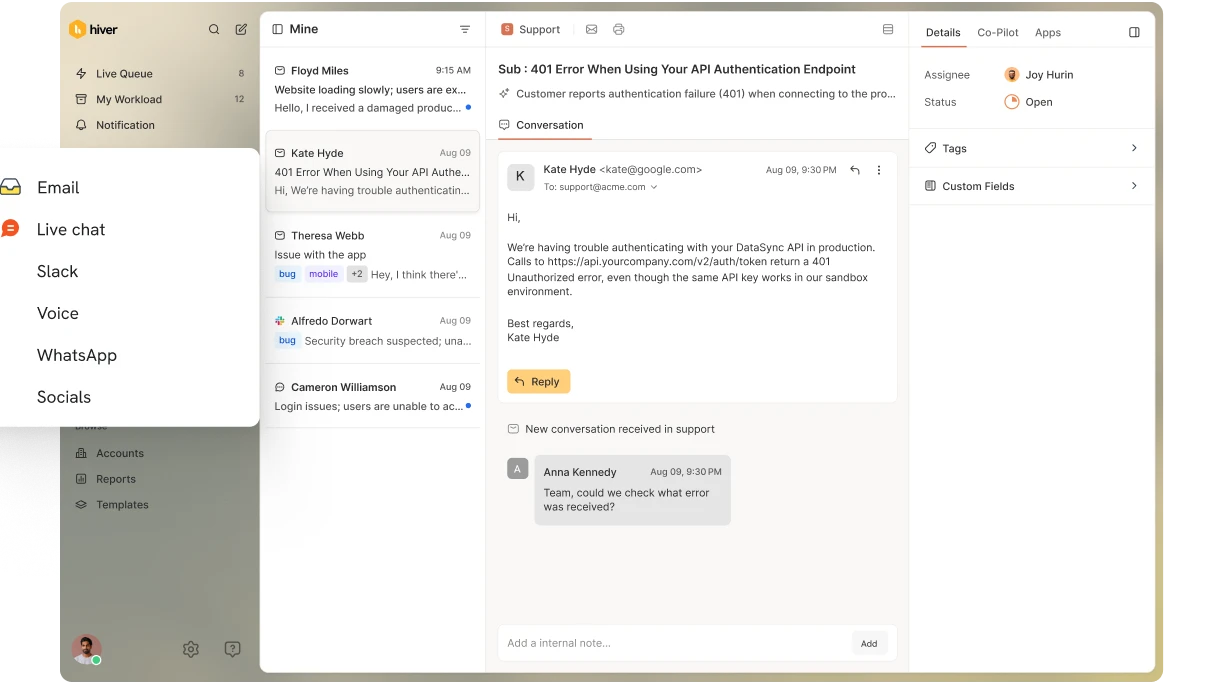
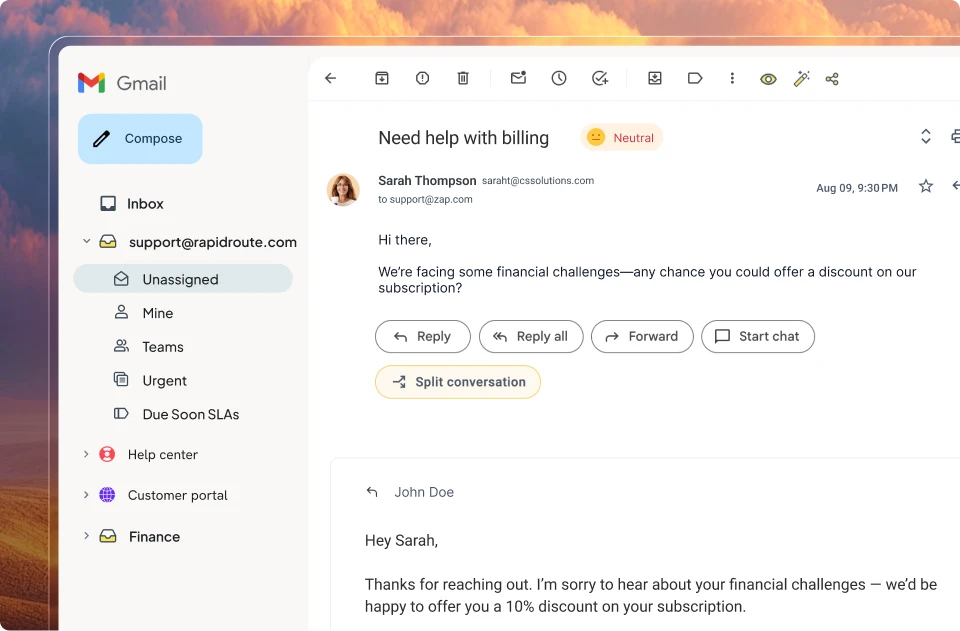
If you need a simpler and support-focused solution, this is where Hiver offers a straightforward option. Hiver offers multichannel customer service with AI and automation, without the complexity of a large helpdesk platform.
Here is a quick way to think about fit:
| Factor | Drift | Intercom | Hiver |
|---|---|---|---|
| Team Size | 10–200+ users | 10–1000+ users | 5–500+ users |
| Budget Range (Annual Billing) | Custom pricing (contact sales) | $29–$132 per seat/month | $25–$75 per user/month |
| Technical Skills | Moderate to high setup complexity | Moderate to high setup complexity | Low to moderate setup |
| Primary Use Case | Lead qualification, AI-driven workflows | Multi-channel support and automation | Multichannel support and shared inbox |
| Industry Focus | SaaS, e-commerce, enterprise sales | SaaS, e-commerce, tech, mid-market | SaaS, e-commerce, professional services |
| Growth Stage | Scaling teams with lead generation needs | Early to enterprise-level growth | Growing to mid-market and enterprise |
Hiver starts with a free plan, allowing you to begin small and scale without needing to switch tools.
Choosing the Right Solution for a Simplified Customer Support
If your day-to-day tasks involve handling tickets, SLAs, and customer escalations, you are more closely aligned with Intercom and Hiver than Drift.
Drift will still help, but it is optimized for the revenue side. Intercom gives you deep capabilities and a powerful AI agent, but you need to be ready for setup effort and variable AI costs.
Hiver offers a middle path. It gives you multichannel support, automation, and AI in a cleaner, simpler package that is easier to roll out and easier to budget for.
If you want to modernize support without rebuilding your stack, Hiver is worth a serious look.Book a demo with our Hiver experts and see how quickly your team can get up and running.
Frequently Asked Questions
1. Which platform is best for sales-driven teams?
Drift is best suited for sales teams that require real-time lead qualification and CRM-driven workflows. Hiver is also a strong option for teams that want simple multichannel support and AI assistance without managing complex sales-centric workflows.
2. Is Intercom better for customer support or sales?
Yes. Intercom is stronger for customer support. Fin handles common questions, and the helpdesk manages tickets, SLAs, and collaboration across channels.
3. What kind of setup effort do Drift and Intercom require?
Drift requires setup of playbooks, routing, and CRM connections, often led by RevOps and sales teams. Intercom requires configuration of inboxes, channels, routing, and knowledge sources, usually led by support and ops teams.
4. How does pricing differ among Drift, Intercom, and Hiver?
Drift uses custom, package-based pricing through Salesloft. Intercom uses seat-based pricing plus $0.99 per Fin resolution, with extra cost for Copilot and other add-ons. Hiver offers Free, then Growth at $25, Pro at $45, and Elite at $75 per user per month(billed annually), with an optional Hiver AI add-on at $20 per user per month.
5. Why choose Hiver over Drift and Intercom?
Hiver offers multichannel customer service, AI assistance, and automation in a simpler interface with transparent pricing. Teams get modern support capabilities without complex seat types, per-resolution billing, or long setup cycles.
Start using Hiver today
- Collaborate with ease
- Manage high email volume
- Leverage AI for stellar service