Skip to content





A day in the finance team is often consumed by manual, repetitive work that leaves little space for strategic thinking.
As businesses scale, these traditional processes struggle to keep up. As companies grow, the volume of financial data multiplies. It’s a cycle that keeps teams not necessarily productive.
That’s where finance automation comes. By automating routine workflows, it helps teams move faster, reduce human error, and focus on higher-value work like forecasting and financial planning.
In this blog, we’ll break down what finance automation really is, how it works behind the scenes, and why it’s reshaping the way finance leaders build for the future.
Table of Contents
- What Is Finance Automation?
- Key Financial Processes That Can Be Automated
- Use Cases of Automation in Financial Services
- Key Benefits of Financial Services Automation
- How to Set Up Finance Automation
- Bring Finance Automation into Your Everyday Workflow
- Frequently Asked Questions
What Is Finance Automation?
Finance automation involves the use of AI, robotic process automation (RPA), and workflow tools to automate repetitive finance tasks that are time-consuming and labor-intensive. Instead of doing things manually, such as updating financial records or processing data, automation steps in and saves you time.
Automation in finance helps teams run smoothly by taking over everyday processes like:
- Invoice processing: Capturing data, matching it to records, and flagging errors
- Accounts payable (AP): Scheduling payments and reconciling vendor data
- Expense management: Auto-categorizing transactions and spotting anomalies
- Financial reporting: Pulling real-time data into dashboards
- Customer support queries: Automatically tagging, assigning, and prioritizing emails
These tasks may not seem complex, but they add up. When you do it manually, it slows you down. With automation, financial institutions can handle these operations more efficiently and accurately.
Why Finance Teams Are Turning to Automation
There’s so much pressure on finance teams today with tighter budgets and higher expectations for accuracy. Automation is solving that problem by:
- Freeing up analysts for forecasting and strategic insights
- Reducing close cycles from weeks to days
- Improving audit readiness with full digital trails
- Ensuring consistency across multi-entity reporting
Automation is rapidly becoming the standard way modern finance teams operate.
Key Financial Processes That Can Be Automated
Finance automation can touch almost every recurring process in accounting and operations. Below are areas where automation delivers measurable impact.
1. Accounts Payable (AP)
Manually processing invoices and approvals often leads to lost paperwork and delayed vendor payments. Automation tools capture invoice data from emails, route it for approval, and trigger payments, without manual input.
2. Accounts Receivable (AR)
Automation helps finance teams send reminders, match payments, and update ledgers instantly. You can ensure steady cash flows without the need for manual follow-ups.
3. Financial Close & Reconciliation
Automation connects data across ERP, CRM, and banking systems to automatically reconcile ledgers. Early discrepancy detection helps teams close books faster and maintain greater accuracy.
4. Payroll & Expense Management
Automation validates data from timesheets, calculates deductions, and updates payroll with minimal human error. HR and finance teams can maintain consistency and prevent duplicate entries.
5. Compliance & Audit Preparation
Automated audit trails capture every transaction and approval step, creating a verifiable digital record. Strong governance controls and accurate logs make compliance reviews more streamlined and efficient.
6. Budgeting & Forecasting
Integrated automation tools pull real-time data from accounting platforms to create rolling forecasts. Accurate, up-to-date insights enable finance leaders to plan more effectively and respond quickly.
Use Cases of Automation in Financial Services
Now that you know which processes can be automated, let’s talk about where automation really makes an impact in financial services. Let’s look at where automation is making the most significant impact in finance today:
1. Simplifying Bookkeeping & Expense Management
Manual data entry is tedious and prone to errors. Automation tools can extract information directly from receipts and invoices, reconcile transactions across accounts, and even flag any anomalies that appear unusual. It cuts down hours of manual work for finance teams and makes audits quicker and less stressful.
2. Improving Financial Planning & Forecasting
Automation platforms that connect to real-time data sources help finance teams run budgets and forecasts with up-to-date numbers.
They can test different scenarios automatically, generate reports, and provide insights that are much harder to get through spreadsheets alone.
3. Enhancing Cybersecurity & Fraud Detection
With so many transactions happening every second, humans can’t catch every suspicious activity. AI-driven automation continuously monitors patterns around the clock, flags unusual behavior, and can even instantly freeze accounts if needed.
A proactive approach like this stops fraud before it becomes a problem, protecting both the institution and its customers.
4. Boosting Employee Benefit Onboarding
Internal automation tools, such as HR management system bots, make it easier for employees to update their personal information, request time off, or access payroll details without waiting for approvals.
The additional efficiency frees up HR teams and speeds up processes that directly impact employee satisfaction.
5. Supporting Investment & Procurement Workflows
Automated systems can follow preset investment rules, monitor procurement limits, and automatically flag any risks or delays with vendors. These workflows reduce compliance risks and keep projects moving smoothly without the need for constant manual checks.
Recommended reading
How to Implement Chatbots in Banking: 4 Key Steps to Boost Efficiency
Key Benefits of Financial Services Automation
Following are the key areas where finance automation creates a measurable impact across operations:
Faster Turnaround Times on Transactions
By automating routine tasks like data entry and case routing, teams can respond to customer requests much quickly. Transactions get processed faster, and customers don’t have to wait around.
Lower Processing and Labor Costs
When you automate repetitive work, your team can focus on higher-value tasks that need human judgment. The shift reduces the need for extra headcount and lowers operational costs.
Improved Compliance and Audit Trails
Financial services need to be extra careful about compliance. Automation creates clear, detailed records of every action taken, making audits easier and ensuring all regulatory requirements are met.
Enhanced Customer Service and Personalization
Automation frees up agents from manual busywork, allowing them to spend more time listening and addressing customer needs personally. The result is a better customer experience and stronger trust.
Higher Accuracy and Fewer Manual Errors
When you enter data manually, mistakes are prone to happen. Automation reduces errors by standardizing workflows and minimizing human intervention where it’s not needed.
How to Set Up Finance Automation
The most effective approach is to start small. Not every process needs to be automated from the start, and attempting to do it all at once usually backfires. Instead, pick one problem, solve it with a simple workflow, and build from there.
Consider this example:A financial team noticed their analysts were spending hours every week following up on overdue invoices. It was a repetitive task, and frankly, not the best use of the team’s time. It didn’t require any deep thinking or personal touch, just reminders being sent at the right time. That’s when they asked, “Could this be automated?”
Here’s how you set it up:
Step 1: Spot the Bottlenecks
Start by identifying tasks that slow the team down but don’t require manual handling. Late invoice follow-ups often stand out immediately, draining time and energy that could be spent on higher-value work.
Step 2: Review Existing Tools
Review the existing systems in place, such as your CRM or accounting platform. Instead of adding new software, connect them with a no-code automation tool. When an invoice passes its due date, the workflow can automatically send a follow-up email to the client.
Step 3: Assign Ownership
Designate one team member to set up and maintain the workflow. Clear accountability ensures smooth execution and allows quick adjustments when processes evolve.
Step 4: Build a Simple Workflow
Create a trigger that checks due dates on a daily basis. If an invoice is overdue, a pre-written email is sent to the client with all the necessary details, eliminating the need for reminders and lost time.
Step 5: Test and Expand
Run the workflow for a few weeks, monitor results, and measure the time saved. Once it’s working well, apply the same approach to other repetitive tasks across finance operations.
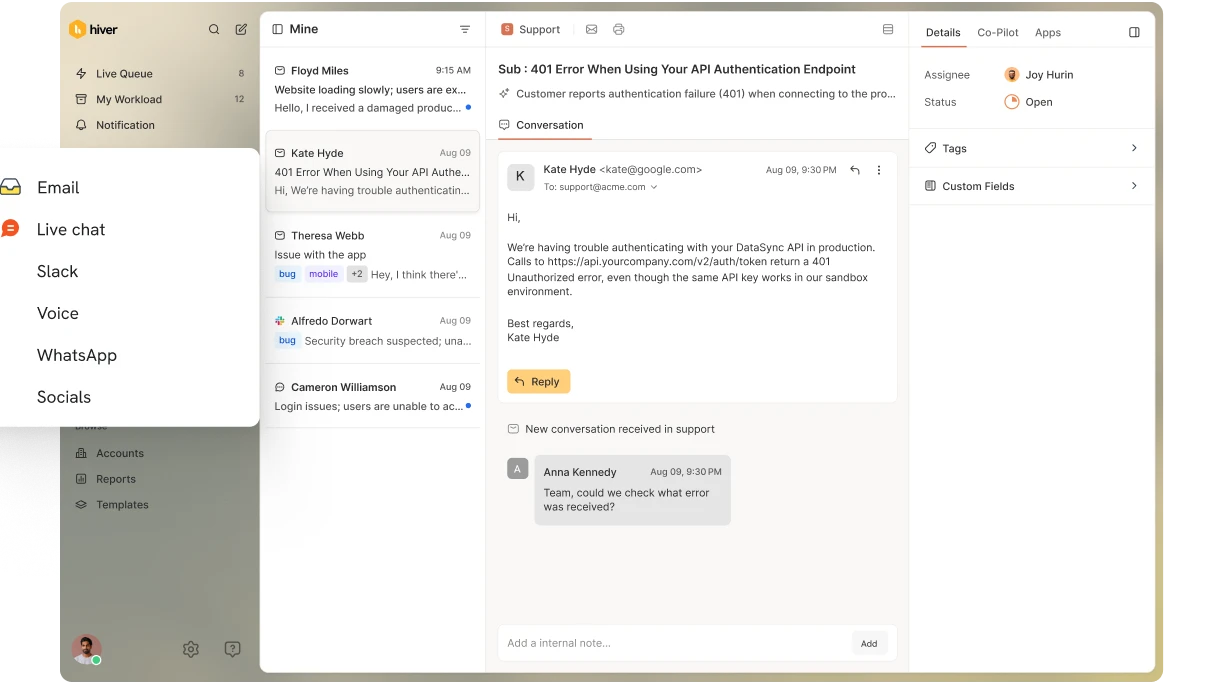
Using a tool like Hiver makes automation feel effortless. It brings all your channels, including email, live chat, WhatsApp, voice, and text into one inbox, so your team never misses a message. Also, Hiver AI takes care of the repetitive stuff, deflecting common queries, drafting quick replies, and routing conversations automatically
Real-world example:
Countless, an accounting firm in New York, handled all their processes manually, assigning tickets, forwarding emails, and managing client queries. It led to losing time deciding who to assign tickets to and forwarding emails from an already cluttered inbox.
After adopting Hiver’s omnichannel inbox, they could tag teammates, delegate approvals, and track SLAs directly in Gmail, saving 29 hours per month and preventing zero missed emails.

Bring Finance Automation into Your Everyday Workflow
The future of financial operations lies in automation that simplifies how your teams work. The right setup integrates into daily routines, reduces repetitive effort, and helps everyone stay organized with minimal extra effort.
That’s where Hiver can help. It keeps teams aligned, ensures every request is handled on time, and eliminates the back-and-forth that slows work down. Finance teams get complete visibility into ongoing tasks and can collaborate smoothly all without leaving Gmail.
With Hiver, finance teams can manage work more efficiently, maintain complete visibility across operations, and focus on building stronger customer relationships instead of chasing manual tasks.
Book a Demo today to see how finance automation can fit into your team’s workflow.
Frequently Asked Questions
1. Can I use automation in investment banking?
Yes. Investment banks automate reporting, onboarding, data collection, and internal workflows to speed up operations and reduce manual effort.
2. Which finance processes should I automate first?
Start with repetitive workflows like accounts payable, reconciliations, and expense reporting, they deliver quick wins and measurable ROI.
3. What are the risks of finance automation?
Integration and data security are key concerns. Choose platforms that comply with standards like SOC 2 and GDPR to safeguard sensitive financial data.
4. What are some finance automation examples?
Some common examples include automated email routing (with tools like Hiver), KYC checks, self-serve account updates, and real-time transaction alerts.
5. What is AI automation in finance?
AI automation uses machine learning and pattern recognition to go beyond rule-based tasks. In finance, this can include fraud detection, credit scoring, customer behavior analysis, and predictive analytics.
6. Is finance automation suitable for small businesses?
Absolutely. Cloud tools and Gmail-based solutions, such as Hiver, enable small teams to automate tasks without requiring heavy IT infrastructure.
Start using Hiver today
- Collaborate with ease
- Manage high email volume
- Leverage AI for stellar service