Skip to content


Zoho vs. Salesforce: Which Platform Actually Fits Your Business?
Quick Decision Guide
Feature Comparison Table
Understanding Each Platform
Feature Deep Dive
Implementation and Total Cost Reality
Final Recommendations
Looking Forward: Platform Evolution and Trends
When you search for a CRM and customer support platform, you’ll find tons of them online, each claiming to be the best. After researching Zoho and Salesforce extensively and analyzing real user experiences, I’ve discovered that the “best” platform isn’t always the one with the most impressive feature list. Sometimes the tool that matches how your team actually works delivers better results than the one that promises to do everything.
This guide examines the distinct approaches to customer relationship management and support: Zoho’s comprehensive yet affordable suite and Salesforce’s enterprise-grade powerhouse. Let’s cut through the marketing noise and see which platform delivers real value for your specific needs.
Quick Decision Guide
Choose Zoho if: You’re a small to medium-sized business that needs comprehensive CRM functionality with sales, marketing, and support tools at an affordable price point.
Choose Salesforce if: You’re an established enterprise with complex sales processes, need extensive customization capabilities, and have the budget and resources for comprehensive implementation.
Feature Comparison Table
Primary Focus
All-in-one Business Suite
Enterprise CRM & Sales
AI Customer Service Platform
Target Market
SMBs to Mid-Market
Enterprise & Large Organizations
Support Teams of All Sizes
Setup Time
Days to weeks
Weeks to months
Within minutes
Learning Curve
Moderate, user-friendly
Steep learning curve
Zero learning curve
CRM Capabilities
Comprehensive suite
Industry-leading
Basic contact management
Customer Support
Good support tools
Service Cloud integration
Purpose-built for support
Customization
Good customization
Highly customizable
Essential customization
Pricing Value
Excellent value
Premium pricing
Transparent pricing
Integration Ecosystem
1000+ integrations
Massive AppExchange
Essential integrations
AI Features
Zia AI included
Einstein AI leader
Practical AI features
Understanding Each Platform
Zoho: The Affordable Powerhouse
Zoho takes a unique approach by offering a comprehensive business suite that includes CRM, customer support, accounting, HR, and project management—all at prices that don’t require enterprise budgets. It’s designed for growing businesses that want professional capabilities without breaking the bank.
What makes it powerful:
- Complete business suite: CRM, support, finance, HR, and productivity tools in one ecosystem
- Exceptional value: Advanced features available at fraction of enterprise platform costs
- User-friendly design: Intuitive interface that doesn’t require extensive technical training
- Rapid deployment: Most businesses can be operational within days, not months
- Zia AI assistant: Built-in AI for lead scoring, sales predictions, and task automation
Where it struggles:
- Enterprise scalability: May struggle with extremely large, complex organizations
- Advanced customization: Less flexible than enterprise platforms for complex workflows
- Integration depth: Fewer specialized enterprise integrations compared to Salesforce
- Market perception: Sometimes viewed as “budget alternative” rather than enterprise solution
Salesforce: The Enterprise Standard
Salesforce remains the gold standard for enterprise CRM, offering unmatched customization, extensive third-party ecosystem, and proven scalability for the world’s largest organizations. It’s built for companies that need a platform capable of handling complex, multi-departmental sales processes.
What makes it powerful:
- Market leadership: Proven track record with enterprise customers across industries
- Unlimited customization: Platform can be tailored to virtually any business requirement
- Einstein AI: Advanced predictive analytics, lead scoring, and automated insights
- AppExchange ecosystem: 4,000+ third-party applications and integrations
- Enterprise security: SOC 2, GDPR compliance, and enterprise-grade data protection
Where it struggles:
- Complexity tax: Advanced features require significant expertise to configure properly
- Cost escalation: Pricing increases rapidly as you add users and advanced features
- Annual commitments: No monthly billing options, requiring yearly contract commitments
- Training investment: Teams need substantial training to utilize platform effectively
Hiver: The Modern AI Customer Service Platform
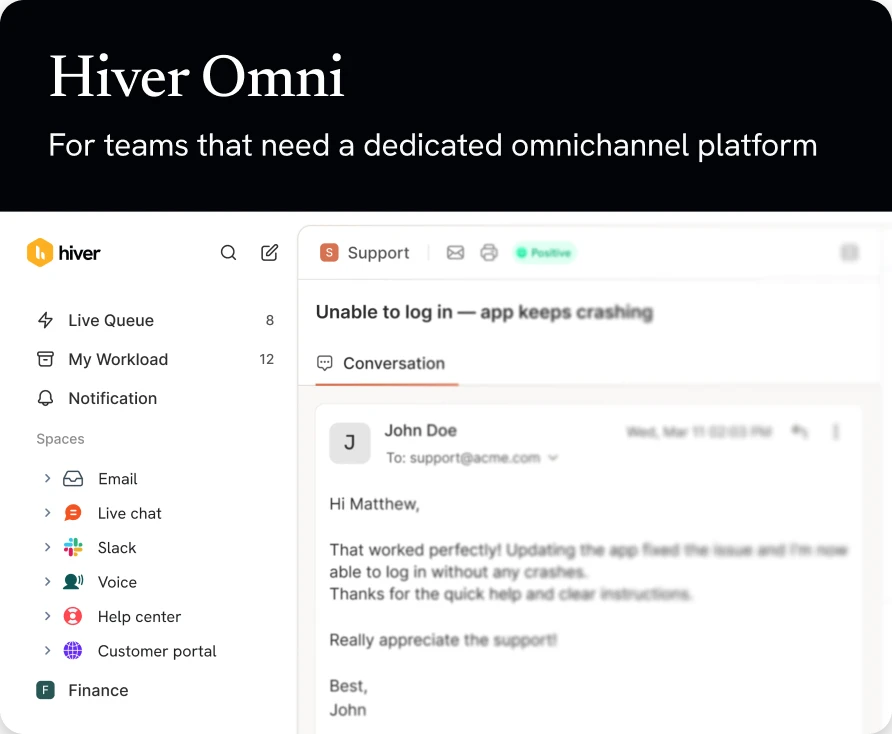
Hiver takes a fundamentally different approach by enhancing your existing workflow rather than replacing it. Instead of learning new CRM interfaces, teams get professional customer support, CRM capabilities, and AI embedded at every step.
What makes it powerful:
- Instant deployment: Teams operational within minutes, not weeks or months
- Support-first design: Purpose-built for customer service and support workflows
- Collaboration excellence: Built-in features like collision detection, shared drafts, and team coordination
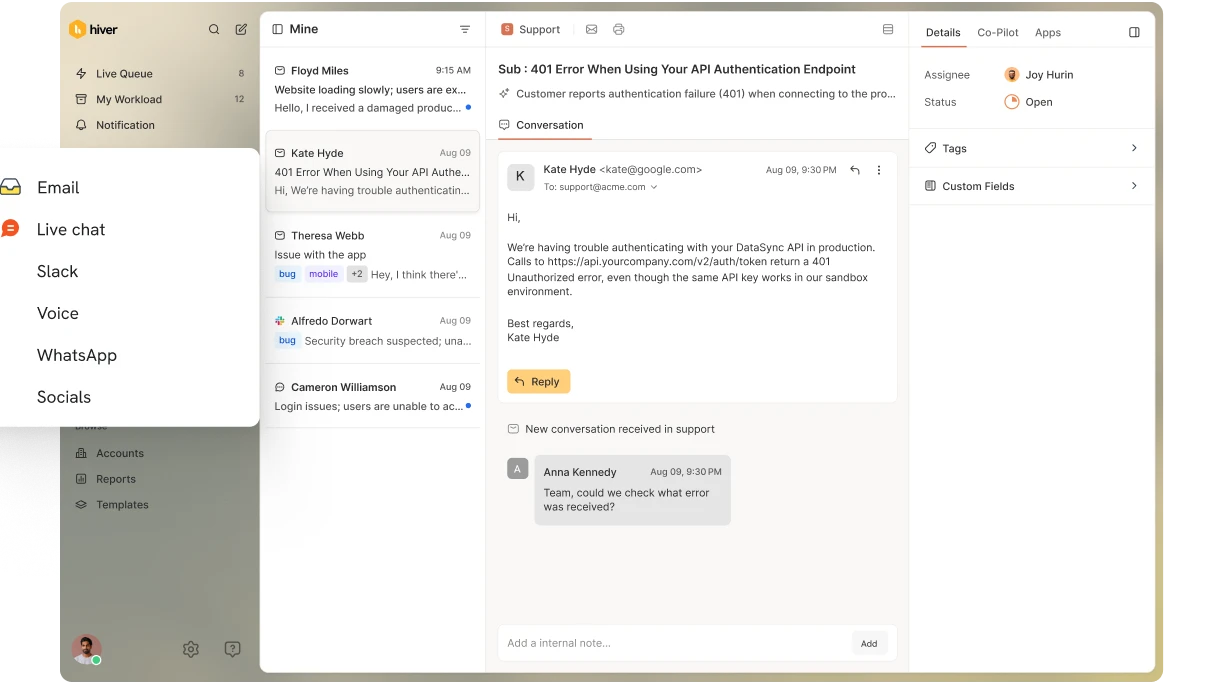
- Unified communications: Email, chat, voice, and WhatsApp integrated in single conversation threads
Intentional focus areas
- Support specialization: Designed specifically for customer service, not comprehensive CRM
- Simplicity over complexity: Essential features delivered effectively rather than feature bloat
- Small to medium businesses: Optimized for teams that value efficiency over extensive customization
Feature Deep Dive
CRM and Sales Management: From Simple to Sophisticated
The right CRM approach depends on your sales complexity, team size, and growth trajectory. Each platform serves different points on this spectrum effectively.
Zoho CRM strikes an impressive balance between comprehensive functionality and accessibility. The platform includes lead management with scoring rules, opportunity tracking with multiple pipelines, contact management with 360-degree customer views, and workflow automation. What sets Zoho apart is making advanced features like AI-powered sales predictions and custom reporting available at entry-level pricing tiers.
The SalesSignals feature deserves particular attention. It provides real-time notifications when leads interact with your brand across multiple channels, including social media and third-party applications. This level of intelligence typically costs extra on other platforms but comes standard with Zoho’s Professional plan at $20/user/month.
Salesforce Sales Cloud represents the pinnacle of CRM sophistication. The platform can handle the most complex sales scenarios imaginable – multi-stage approval processes, territory management across global regions, collaborative forecasting with what-if scenarios, and integration with enterprise resource planning systems. Einstein AI analyzes historical data to predict deal outcomes, suggest next best actions, and identify at-risk opportunities before they stall.
The customization capabilities are virtually unlimited. Organizations can create custom objects, build complex workflow automations, and develop specialized applications on the Salesforce platform. However, this power requires significant expertise. Most organizations need dedicated Salesforce administrators and often external consultants for complex implementations.
Hiver approaches CRM differently by focusing on customer relationship management through support interactions rather than sales-focused CRM. The platform maintains contact histories, tracks customer communication across channels, and provides team members with complete conversation context. While not designed for complex sales pipeline management, Hiver excels at nurturing customer relationships through exceptional support experiences.
The way Hiver is built means customer data stays connected to natural communication flows. When a customer emails about an issue, agents immediately see previous conversations, order history (through integrations), and team notes, all within a familiar interface.
Customer Support and Service Management: Different Philosophies, Real Results
Customer support success depends on solving problems efficiently while maintaining relationships. Each platform approaches this challenge with distinct philosophies.
Zoho provides comprehensive customer service tools through Zoho Desk, which can be integrated seamlessly with the CRM. The platform offers multi-channel support (email, phone, chat, social media), knowledge base management, and SLA tracking. What makes Zoho compelling is the price point—advanced support features that cost hundreds of dollars per agent on other platforms come included in mid-tier Zoho plans.
The platform excels at connecting support interactions with broader business context. Support agents can see customer purchase history, previous sales interactions, and marketing campaign responses all within the same interface. This holistic view enables more personalized and effective customer service.
Salesforce Service Cloud approaches support through its comprehensive Customer 360 vision. When customers contact support, agents see complete interaction history across every touchpoint—marketing emails, sales calls, previous support cases, and even social media interactions. Einstein AI analyzes customer sentiment in real-time and suggests responses based on similar successful cases.
The omnichannel capabilities are industry-leading. Customers can start conversations on Twitter, continue via email, and finish through live chat while maintaining complete context. The platform’s strength lies in handling high-volume, complex support scenarios for large organizations with extensive customer bases.
Hiver brings customer support back to its essential elements: helping people efficiently through clear communication. The platform transforms email conversations into professional support interactions with assignment capabilities, SLA tracking, and team collaboration—all without leaving the email environment.
The collaboration features distinguish Hiver from traditional help desk software. Team members can add private notes (“customer is having a difficult day, extra patience needed”), coordinate responses through shared drafts (“does this explanation make sense?”), and prevent duplicate responses through collision detection. It’s support that feels human because it maintains natural communication patterns.
Automation and Workflow Management: Simple Rules to Complex Orchestration
Effective automation eliminates repetitive work while preserving human judgment for complex decisions. The automation complexity you need depends on your business processes and technical resources.
Zoho provides practical automation through workflows, blueprints, and validation rules. Workflows can automatically assign leads, trigger follow-up emails, and update records based on specific criteria. Blueprints guide team members through structured processes—like ensuring all required information is collected before moving deals to the next stage.
The Zia AI assistant adds intelligent automation by analyzing patterns in your data and suggesting actions. For example, Zia can predict which leads are most likely to convert, recommend optimal follow-up timing, and alert managers to deals that might need attention. This level of AI insight typically requires expensive add-ons on other platforms but comes included with Zoho’s Enterprise tier.
Salesforce offers the most sophisticated automation capabilities available. Process Builder enables complex, multi-step workflows that can trigger actions across multiple systems. Lightning Flow provides visual workflow design for business users, while Apex code allows developers to create completely custom automation logic.
Einstein AI enhances automation with predictive capabilities—automatically prioritizing leads based on conversion probability, suggesting optimal contact timing, and identifying accounts at risk of churn. The recent addition of Einstein GPT enables natural language automation, where users can describe desired workflows in plain English and have the system build them automatically.
Hiver focuses on automation that supports natural support workflows without overwhelming teams. Smart routing automatically assigns customer emails to appropriate agents based on content analysis or round-robin distribution. SLA automation tracks response times and escalates before deadlines are missed. Template suggestions recommend relevant responses based on customer inquiry patterns.
The automation works immediately after setup and can be modified by support managers without technical expertise. It’s designed to enhance email-based workflows rather than replacing them with complex rule engines.
Integration and Ecosystem: Connecting Your Business Tools
Modern businesses use dozens of specialized applications, making integration capabilities crucial for platform success.
Zoho offers over 1,000 integrations, with many popular business tools available as native connections. The Zoho ecosystem itself provides significant integration value—CRM, support, accounting, HR, and project management tools all share data seamlessly. For businesses willing to adopt multiple Zoho applications, this creates a unified business platform at remarkably affordable prices.
Popular integrations include Google Workspace, Microsoft 365, QuickBooks, PayPal, and major marketing platforms. Many integrations that cost extra on other platforms come free with Zoho. The platform also offers robust APIs for custom integrations when needed.
Salesforce provides the most extensive integration ecosystem through AppExchange, featuring over 4,000 certified applications. MuleSoft (owned by Salesforce) enables enterprise-grade integration scenarios, connecting legacy systems, ERP platforms, and specialized industry applications.
The integration depth is unmatched—Salesforce can serve as the central hub for complex enterprise technology stacks. However, this capability comes with complexity costs. Managing numerous integrations requires dedicated expertise, and licensing costs can accumulate quickly as organizations add specialized applications.
Hiver prioritizes essential business tool integrations that works within your existing workflows:
- Google Workspace and Microsoft 365: Native email, calendar, and productivity integration
- Popular CRM systems: Connect customer data without leaving the platform
- Project management tools: Link support conversations to development tasks and project timelines
- Communication platforms: Integrate with Slack, Microsoft Teams, and other collaboration tools
The integration approach emphasizes reliability and simplicity over exhaustive connectivity. Most teams find Hiver’s available integrations cover essential needs without creating maintenance overhead.
AI and Intelligent Features: Practical Intelligence vs. Marketing Hype
Artificial intelligence in business platforms ranges from genuinely helpful automation to impressive demos that don’t deliver practical value. Understanding what AI features actually improve daily operations is crucial.
Zoho’s Zia AI provides practical intelligence that works immediately:
- Lead scoring: Analyzes lead behavior and engagement to predict conversion probability
- Sales predictions: Forecasts deal outcomes based on historical patterns and current activities
- Anomaly detection: Identifies unusual patterns in sales data that might require attention
- Voice commands: Allows sales reps to dictate notes and update records hands-free
- Image recognition: Automatically extracts information from business cards and documents
What makes Zia impressive is its accessibility—advanced AI features come included with mid-tier plans rather than expensive add-ons. The AI learns from your specific business data and improves recommendations over time.
Salesforce’s Einstein AI represents the most sophisticated CRM intelligence available:
- Predictive lead scoring: Advanced algorithms analyze dozens of factors to rank lead quality
- Opportunity insights: Predicts deal outcomes and suggests actions to improve win rates
- Account intelligence: Identifies expansion opportunities and churn risks across customer base
- Einstein GPT: Natural language generation for email drafts, meeting summaries, and reports
- Conversation insights: Analyzes sales calls and emails to identify successful patterns
Einstein’s power lies in its ability to process massive amounts of data and identify complex patterns human analysts might miss. However, the AI requires substantial data volume to be effective and often needs extensive configuration to deliver meaningful insights for specific business contexts.
Hiver’s AI focuses on support-specific intelligence that is present in every step right from the setup:
- Intelligent routing: Analyzes email content to suggest appropriate team members for assignment
- Response recommendations: Suggests relevant templates based on customer inquiry patterns
- Language detection: Automatically identifies email language and routes to appropriate agents
- Performance optimization: Identifies workflow bottlenecks and suggests efficiency improvements
While less sophisticated than enterprise AI platforms, Hiver’s intelligence delivers immediate value without configuration complexity. The AI understands support workflows and provides recommendations that actually help teams respond faster and more consistently.
Implementation and Total Cost Reality
Real-World Deployment Timelines
Understanding actual implementation timeframes will help you set realistic expectations and plan resource allocation effectively for your business needs. Real-world deployments rarely follow vendor timelines. What’s promised in sales conversations often collides with the complexity of your existing systems, data migration requirements, and the inevitable scope adjustments that emerge once work begins.
What makes this particularly critical is the hidden cost of extended timelines. Every additional month of implementation means delayed ROI, continued reliance on inefficient processes, and potential loss of team momentum. Teams that go in expecting a quick win but encounter a six-month slog often see adoption rates plummet before they even go live. Conversely, organizations that plan for realistic timelines can maintain enthusiasm, properly train users, and build the internal expertise needed for long-term success.
Zoho Implementation Journey:
- Week 1: Account setup, data import, and basic configuration
- Week 2: Workflow customization, team training, and integration setup
- Week 3: Advanced feature configuration and process optimization
- Week 4: Full deployment with ongoing support and fine-tuning
Most organizations achieve full Zoho deployment within 2-4 weeks, significantly faster than enterprise alternatives. The platform’s intuitive design and built-in tutorials enable business users to handle much of the configuration independently.
Salesforce Implementation Timeline:
- Week 1: Account setup, data import, and basic configuration
- Week 2: Workflow customization, team training, and integration setup
- Week 3: Advanced feature configuration and process optimization
- Week 4: Full deployment with ongoing support and fine-tuning
Salesforce implementations typically require 6-12 months for full deployment, with ongoing customization and optimization continuing indefinitely. Success requires dedicated project management and often external consulting support.
Hiver Implementation Process:
- Day 1: Workflow integration and team member setup
- Day 2-3: Shared inbox configuration and workflow establishment
- Week 1: Feature exploration, team training, and process optimization
- Week 2: Full operational deployment with performance monitoring
Hiver teams are typically fully operational within one week, with advanced feature adoption happening organically over the following month. The rapid deployment allows immediate value realization without disrupting existing workflows.
Final Recommendations
For Most Growing Businesses: Zoho Delivers Exceptional Value
Unless you have specific enterprise requirements, Zoho offers the best combination of comprehensive functionality and affordable pricing. The platform provides 80% of enterprise CRM capabilities at 30% of the cost, making it ideal for businesses that need professional tools without enterprise complexity.
Choose Zoho when:
- You need comprehensive CRM with sales, marketing, and support integration
- Budget is a significant consideration but you don’t want to sacrifice functionality
- Your team can handle moderate complexity for significant capability gains
- You prefer unified business platform over multiple specialized tools
For Enterprise Complexity: Salesforce Remains Unmatched
When your sales processes are genuinely complex, compliance requirements are extensive, or integration needs span enterprise-grade systems, Salesforce’s capabilities justify its premium pricing and implementation complexity.
Choose Salesforce when:
- You have complex, multi-stage sales processes requiring extensive customization
- Enterprise security, compliance, and audit requirements are non-negotiable
- You need unlimited scalability and have dedicated technical resources
- Integration with complex enterprise systems is essential
- Budget allows for premium platform investment and ongoing administrative costs
For Support-Focused Teams: Hiver Eliminates Complexity
When customer support excellence is your primary goal and you want professional capabilities without disrupting existing workflows, Hiver’s approach delivers immediate value with minimal complexity.
Choose Hiver when:
- Customer support quality is your primary competitive advantage
- You need immediate results without extensive implementation projects
- Transparent pricing and predictable costs are important
- Team adoption and user satisfaction matter more than feature breadth
The Simplicity Advantage
After testing all three platforms extensively, Hiver consistently delivers the highest ratio of value to complexity. While it doesn’t match the feature breadth of enterprise platforms, it solves the core service management problems that most organizations actually face.
Hiver eliminates the biggest barrier to platform success: user adoption. When teams can be productive immediately without training, the compound benefits often outweigh the theoretical advantages of more sophisticated platforms.
Looking Forward: Platform Evolution and Trends
The customer support and CRM landscape is rapidly shifting toward AI-first platforms that eliminate busywork rather than just adding more features. Each platform is taking notably different approaches to this transformation.
Zoho continues enhancing Zia with sophisticated predictive analytics and natural language processing. Recent updates in 2025 show Zoho doubling down on making AI accessible across their entire business suite. For customer support specifically, Zia’s newest capabilities include automatic ticket summarization, tone analysis, and contextual reply suggestions that understand both internal knowledge bases and external information sources.
Salesforce continues to lead with Einstein GPT and autonomous AI agents for complex business processes. Their recent Agentforce rollout represents a fundamental shift toward autonomous AI that can handle entire workflows without human intervention. These agents can manage everything from lead qualification to customer service interactions while maintaining enterprise-grade compliance and security.
Hiver focuses on practical AI that enhances your workflows without complexity overhead. Rather than competing on AI sophistication, Hiver emphasizes immediate utility. Their AI features include intelligent routing based on email content analysis, smart template suggestions that understand context, and collaboration insights that identify workflow bottlenecks. The key differentiator is implementation simplicity. These AI features work immediately without requiring extensive configuration or training periods.
Real success stories

“We tried Zendesk, Salesforce—everything felt complicated. But Hiver being right inside Gmail makes it a breeze to work with.”
James McNeil
President & CEO, Daybreak Metro

“With Hiver, we’re finally having real conversations with our customers. No ticket numbers, no robotic emails—just personal, human interactions.”
Scott Gellatly
General Manager, itGenius
Frequently Asked Questions
What are the limitations of Zoho?
Is Zoho CRM easy to learn?
What are the negatives of Zoho?
What are the issues with Salesforce implementation?
What challenge does Salesforce face?

Vasundhara is a Senior Copywriter at Hiver who works in the Digital Marketing team at Hiver. They research from platforms like Reddit, Product Hunt, G2, Gartner, and Capterra to put forward real-world experiences and present balanced software comparisons that help readers make informed decisions.
Customer service software that feels like your inbox