Skip to content


Zoho vs. HubSpot: Which Platform Actually Fits Your Business?
Quick Decision Guide
Platform Comparison Overview
Understanding Each Platform
Feature Deep Dive
Implementation and Total Cost Reality
Final Recommendations
Looking Forward: Platform Evolution and Trends
Choosing between two powerhouse platforms can feel too stressful. After analyzing hundreds of user reviews, testing platform capabilities, and examining real-world implementations, one thing is clear: the “best” platform isn’t always the most feature-rich or well-known. Sometimes the solution that matches your team’s actual workflow delivers better results than the one promising to revolutionize everything.
This guide examines distinct approaches to customer relationship management and support: Zoho’s affordable comprehensive suite, and HubSpot’s marketing-first powerhouse. Let’s cut through the vendor promises and see which platform delivers real value for your specific needs.
Quick Decision Guide
Choose Zoho if: You’re a small to medium-sized business that needs comprehensive CRM functionality with sales, marketing, and support tools at budget-friendly pricing with extensive customization options.
Choose HubSpot if: You prioritize user experience and want an all-in-one inbound marketing and sales platform with superior interface design, even if it means paying premium prices for advanced features.
Platform Comparison Overview
Primary Focus
Comprehensive Business Suite
All-in-One Inbound Marketing
AI Customer Service Platform
Target Market
SMBs to Mid-Market
SMBs to Large Enterprise
Support Teams of All Sizes
Setup Time
2-4 weeks
Hours to weeks
Minutes
Learning Curve
Moderate complexity
User-friendly
Minimal
CRM Capabilities
Full-featured suite
Marketing-integrated CRM
Basic contact management
Customer Support
Integrated support tools
Service Hub integration
Purpose-built for support
Customization
Highly customizable
Good customization
Essential customization
Pricing Value
Excellent value
Premium pricing
Transparent pricing
Integration Ecosystem
1000+ integrations
Massive ecosystem
Essential business tools
AI Features
Zia AI included
Breeze AI leader
Practical AI features
Understanding Each Platform
Zoho: The Budget-Friendly Powerhouse
Zoho approaches business software through comprehensive integration—offering CRM, customer support, accounting, HR, and project management within a unified ecosystem that doesn’t require enterprise budgets. It’s designed for growing businesses that want professional capabilities without premium pricing.
What makes it powerful:
- Complete business ecosystem: CRM, support, finance, HR, and productivity tools sharing unified data
- Exceptional value: Advanced features available at significantly lower cost than competitors
- Extensive customization: Flexible platform that adapts to unique business processes
- Rapid deployment: Most businesses operational within weeks, not months
- Zia AI assistant: Built-in intelligence for lead scoring, sales predictions, and automation
Where it struggles:
- Interface complexity: Some users find navigation less intuitive than modern alternatives
- Feature overwhelming: Extensive capabilities can confuse teams needing simple solutions
- Performance issues: Mobile app and some features receive mixed reviews
- Support quality: Customer service experiences vary, with some users reporting limited responsiveness
HubSpot: The User Experience Champion
HubSpot built its reputation on inbound marketing and expanded into a comprehensive business platform that prioritizes user experience and interface design. It’s particularly strong for businesses that view marketing and sales as integrated functions requiring sophisticated automation.
What makes it powerful:
- Superior interface design: Industry-leading user experience with intuitive navigation
- Inbound marketing expertise: Built-in tools for content marketing, SEO, and lead generation
- Breeze AI suite: Advanced artificial intelligence for content creation, workflow automation, and predictive analytics
- Comprehensive ecosystem: Over 1,000 integrations with extensive third-party applications
- Rapid user adoption: Teams typically productive within hours due to interface familiarity
Where it struggles:
- Premium pricing: Costs escalate quickly with HubSpot’s Sales Hub Professional at $90/user/month and Enterprise at $150/user/month
- Feature limitations: Many advanced capabilities restricted to higher-tier plans
- Customization constraints: Less customization flexibility compared to platforms like Zoho, with features like custom modules limited to Enterprise editions
- Marketing focus: CRM capabilities, while solid, are secondary to marketing functionality
Hiver: The Modern AI Customer Service Platform
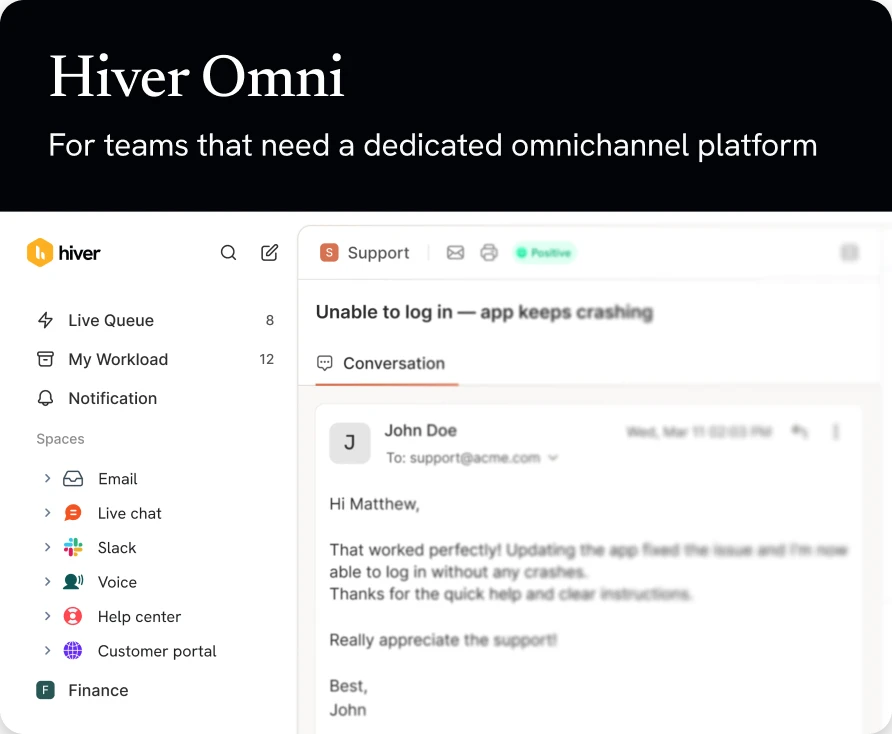
Hiver takes a fundamentally different approach by enhancing existing workflows rather than replacing them. Instead of learning new interfaces, teams get professional and powerful customer support capabilities within the platform.
What makes it powerful:
- Instant deployment: Teams operational within hours, not weeks or months
- Support-first design: Purpose-built for customer service and team collaboration
- Collaboration excellence: Features like collision detection, shared drafts, and team coordination prevent duplicate work
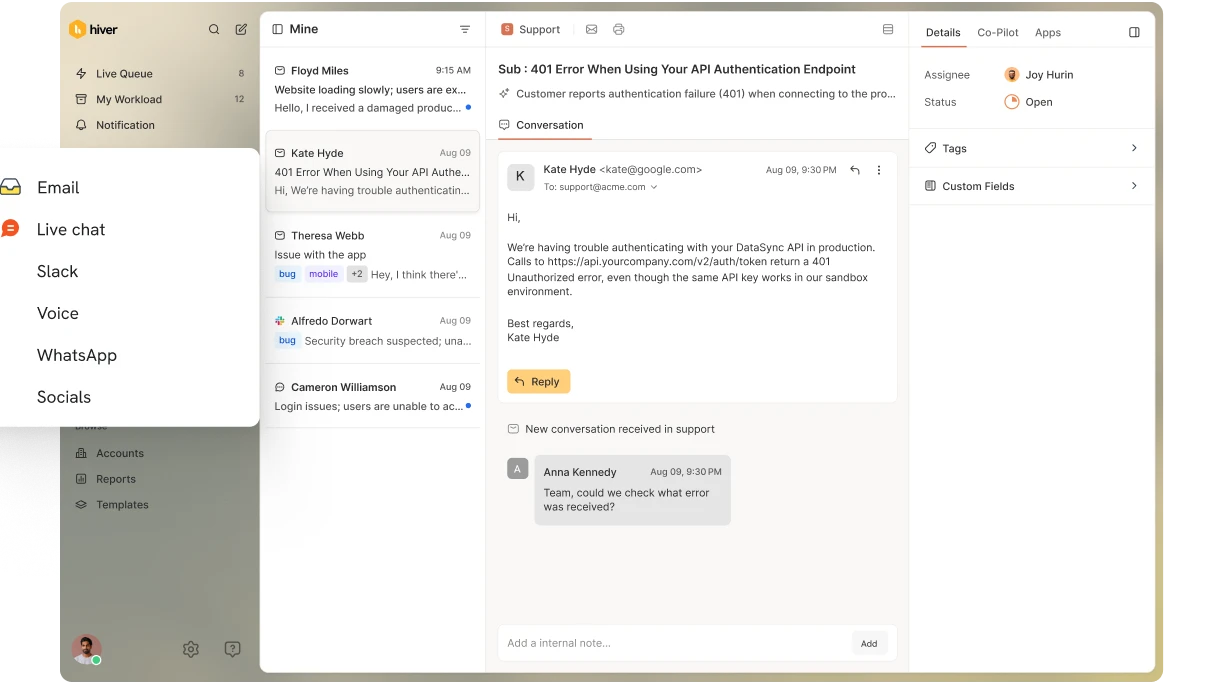
- Unified communications: Email, chat, WhatsApp, and voice integrated in single conversation threads
Intentional focus areas:
- Support specialization: Designed specifically for customer service, not comprehensive CRM
- Simplicity over complexity: Essential features delivered effectively rather than feature bloat
- Team collaboration: Built for teams that prioritize communication and coordination over extensive automation
Feature Deep Dive
CRM and Sales Management: From Simple to Sophisticated
The right CRM approach depends on your sales complexity, team size, and growth trajectory. Each platform serves different points on this spectrum effectively.
Zoho CRM strikes a balance between comprehensive functionality and accessibility. The platform includes flexible sales automation, varied customization options, and powerful analytics with features like multiple pipelines, custom reports, and intelligent anomaly detection available from mid-tier plans. The SalesSignals feature provides real-time notifications across multiple channels, while Zia AI offers predictions and automation typically reserved for enterprise platforms.
HubSpot Sales Cloud excels at marketing-integrated sales processes. The platform offers robust contact management with easy segmentation, tagging, and tracking of interactions, combined with sophisticated automation and workflow builders. HubSpot’s templates and workflow builder were more intuitive, with condition suggestions, interactive pipeline, and general hand-holding that made things easier compared to other platforms.
Hiver approaches CRM through support relationships rather than traditional sales pipelines. The platform maintains contact histories, tracks customer communication across channels, and provides team members with complete conversation context while staying within the interfaces teams already use.
Customer Support and Service Management: Different Philosophies, Real Results
Customer support success depends on solving problems efficiently while maintaining relationships. Each platform approaches this with distinct philosophies.
Zoho provides comprehensive customer service tools through Zoho Desk, integrated with CRM data. The platform offers multi-channel support, knowledge base management, and SLA tracking with support interactions connected to broader business context including customer purchase history and previous sales interactions.
HubSpot approaches support through its comprehensive Customer 360 vision with Service Cloud integration. The omnichannel capabilities handle high-volume, complex support scenarios, though custom reports and dashboards are only available in Professional and Enterprise editions, and the custom report builder is less intuitive than competitors.
Hiver focuses on support excellence through team collaboration. The platform offers collision detection to prevent multiple agents from replying to the same email, shared inboxes for centralizing emails, and collaborative features like shared drafts and @mentions. Teams can conduct day-to-day tasks while benefiting from automated workflows, customized email templates, and instant notifications.
Automation and Workflow Management: Simple Rules to Complex Orchestration
Effective automation eliminates repetitive work while preserving human judgment for complex decisions.
Zoho provides practical automation through workflows, blueprints, and validation rules. Workflows are available from the free edition, with options to build macros for repetitive tasks and write custom functions. Zia AI enhances automation with lead scoring, optimal follow-up timing, and deal risk identification.
HubSpot offers sophisticated automation capabilities with its workflow builder and Process Builder. Breeze Copilot and Agents automate time-consuming workflows, while Breeze Intelligence helps create content consistent with brand voice across marketing, sales, and customer service. However, workflows with automation options are only available in Professional edition and above, with limits that apply across multiple hubs.
Hiver focuses on automation that supports your team’s natural workflows. Smart routing automatically assigns conversations, categorization handles repetitive tasks, and SLA automation tracks response times while escalating before deadlines. The automation works immediately without configuration complexity.
Integration and Ecosystem: Connecting Your Business Tools
Modern businesses rely on multiple specialized applications, making integration capabilities crucial.
Zoho offers over 1,000 integrations with the advantage of a unified business ecosystem. Many integrations that cost extra on other platforms come free with Zoho, and the platform provides robust APIs for custom integrations.
HubSpot provides the most extensive integration ecosystem through over 1,000 certified applications. The HubSpot CRM platform includes more than 1000 integrations spanning marketing, sales, service, and more, up from 500 apps in 2020.
Hiver prioritizes essential business tool integrations with 100+ apps that allows viewing, editing, and updating data within Hiver without switching tabs, including popular platforms like Slack, Salesforce, and Asana.
AI and Intelligent Features: Practical Intelligence vs. Marketing Hype
Artificial intelligence ranges from genuinely helpful automation to impressive demos that don’t deliver practical value.
Zoho’s Zia AI provides accessible intelligence including lead scoring, sales predictions, anomaly detection, voice commands, and image recognition available with mid-tier plans rather than expensive add-ons.
HubSpot’s Breeze AI represents sophisticated CRM intelligence. Breeze includes Copilot, Agents, and Intelligence components that automate workflows and create brand-consistent content across marketing, sales, and customer service. However, using AI for lead assignment costs an additional $30 whereas competitors include similar features in standard plans.
Hiver’s AI focuses on support-specific intelligence. Features include AI Summarizer for turning long email threads into crisp summaries, AI Compose for adjusting tone and content, and contextual guidance in conversations.
Implementation and Total Cost Reality
Real-World Deployment Timelines
Understanding actual implementation timeframes will help you set realistic expectations and plan resource allocation effectively for your business needs. Real-world deployments rarely follow vendor timelines. What’s promised in sales conversations often collides with the complexity of your existing systems, data migration requirements, and the inevitable scope adjustments that emerge once work begins.
What makes this particularly critical is the hidden cost of extended timelines. Every additional month of implementation means delayed ROI, continued reliance on inefficient processes, and potential loss of team momentum. Teams that go in expecting a quick win but encounter a six-month slog often see adoption rates plummet before they even go live. Conversely, organizations that plan for realistic timelines can maintain enthusiasm, properly train users, and build the internal expertise needed for long-term success.
Zoho Implementation Journey:
- Week 1: Account setup, data import, and basic configuration
- Week 2: Workflow customization, team training, and integration setup
- Week 3-4: Advanced feature configuration and process optimization
Most organizations achieve full Zoho deployment within 2-4 weeks, though some users report the interface being less intuitive, with features like automation buried in setup settings.
HubSpot Implementation Timeline:
- Days 1-7: Account setup and basic configuration
- Week 2-3: Team training and workflow establishment
- Week 4+: Advanced feature adoption and optimization
HubSpot teams are typically productive within hours due to interface familiarity and superior onboarding guides with dedicated onboarding hub featuring text guides, learning milestones, and real-time automated demos.
Hiver Implementation Process:
- Day 1: Platform integration and team member setup
- Day 2-3: Shared inbox configuration and workflow establishment
- Week 1: Full operational deployment with performance monitoring
Teams can get started in under five minutes with Hiver working in an easy-to-use AI platform.
Final Recommendations
For Most Growing Businesses: Consider Your Primary Focus
The right platform depends on whether you prioritize comprehensive business management, marketing-integrated sales, or support excellence.
Choose Zoho when:
- You need comprehensive CRM with extensive customization at affordable pricing
- Your team can handle moderate complexity for significant capability gains
- Budget constraints make premium platforms unfeasible
- You prefer unified business platform over multiple specialized tools
Choose HubSpot when:
- User experience and interface design are critical priorities
- Inbound marketing is central to your business strategy
- You have budget for premium platform investment
- Your team values ease of use over extensive customization options
Choose Hiver when:
- Customer support excellence is your primary competitive advantage
- You want AI at every step and not just limited to the surface
- You need immediate results without extensive implementation projects
- Team collaboration and coordination matter more than feature breadth
Looking Forward: Platform Evolution and Trends
The customer support and CRM landscape continues evolving toward AI-first platforms that eliminate busywork rather than adding complexity.
Zoho continues enhancing Zia with sophisticated predictive analytics and natural language processing, making AI accessible across their business suite.
HubSpot leads with Breeze AI and autonomous agents for complex business processes, representing a shift toward AI that handles entire workflows without human intervention.
Hiver focuses on practical AI that enhances your existing workflows without complexity overhead, emphasizing immediate utility over sophistication.
Real success stories

“We tried Zendesk, Salesforce—everything felt complicated. But Hiver being right inside Gmail makes it a breeze to work with.”
James McNeil
President & CEO, Daybreak Metro

“With Hiver, we’re finally having real conversations with our customers. No ticket numbers, no robotic emails—just personal, human interactions.”
Scott Gellatly
General Manager, itGenius
Frequently Asked Questions
What are the main differences between Zoho, HubSpot, and Hiver?
Is Zoho CRM easy to learn?
Which platform is most cost-effective?
How long does implementation take for each platform?
Which platform is easiest to use?
What are the AI capabilities of each platform?

Vasundhara is a Senior Copywriter at Hiver who works in the Digital Marketing team at Hiver. They research from platforms like Reddit, Product Hunt, G2, Gartner, and Capterra to put forward real-world experiences and present balanced software comparisons that help readers make informed decisions.
Customer service software that feels like your inbox