




When you think of helpdesk software, Zoho Desk often comes up as a reliable, feature-rich option. The platform promises to centralize customer communication, automate workflows, and give support leaders the necessary visibility.
Many teams also find that Zoho Desk’s flexibility brings extra complexity. Setup takes time, automation rules need careful configuration, and costs can increase as the team grows.
In this article, we break down Zoho Desk’s key features, pricing, pros, and cons, as well as why many growing teams are switching to a simpler customer service platform.
TL;DR
- Zoho Desk centralizes email, chat, phone, social, and web forms in one workspace.
- Automation, SLAs, and custom workflows help larger teams run structured operations.
- Users praise the ecosystem and integrations with Zoho CRM and Analytics.
- Common pain points include a steep learning curve, slower performance at scale, and add-on costs.
- Hiver delivers multichannel support and AI automation with a familiar interface and faster setup, often at a lower total cost.
Table of Contents
- What is Zoho Desk?
- Key Features: How Zoho Desk Works Day-to-Day
- Real User Feedback: Pros and Cons
- Zoho Desk Pricing Analysis
- Zoho Desk vs Hiver: Which One Fits Modern Teams Better?
- Making the Right Choice for Your Customer Service
- Frequently Asked Questions
What is Zoho Desk?
Zoho Desk is a cloud-based help desk software that turns every customer query into a trackable ticket. Teams manage email, live chat, phone, social media, and web forms from a unified dashboard.
Beyond ticketing, teams receive workflow automation, SLA tracking, and an AI assistant called Zia, which provides sentiment detection, categorization, and article suggestions. Deep integrations with Zoho CRM, Zoho Analytics, and Zoho Projects make it a natural fit for companies invested in the Zoho suite.
Connections to tools such as Slack and Microsoft Teams extend collaboration beyond support.
Key Features: How Zoho Desk Works Day-to-Day
Here’s a closer look at how Zoho Desk actually works once a team starts using it daily.
Omnichannel Ticketing
Zoho Desk unifies messages from email, chat, phone, social, and web forms. Every conversation becomes a ticket, so agents track status without juggling tools.
“Zoho Desk is easy to use and helps us centralize all customer requests from email, Line, and social media into one place. The ticketing system makes it simple to assign, track, and follow up on issues.” – G2 user
Workflow Automation and SLAs
Rules route tickets by priority, tag issues, send follow-ups, and escalates when deadlines approach. Teams create triggers for SLA breaches or supervisor alerts.
“The automation of tasks such as ticket assignment or sending automatic responses saves the team a lot of time.” – G2 user
AI Assistance (Zia)
Zia detects sentiment, categorizes incoming tickets, and suggests help center articles. Teams also monitor spikes in specific topics such as refunds. Many users find it valuable, though some consider Zia basic compared with newer, more proactive AI.
Knowledge Base and Self-Service
Teams publish FAQs, simple guides, and community posts to answer common questions. A good knowledge base reduces repeat tickets and makes agents’ work easier.
Pro Tip: Review top search queries and failed chatbot intents monthly, then update articles that address those questions.
Customization and Integrations
Admins tailor fields, forms, and layouts to mirror internal processes. Integrations with the Zoho ecosystem and third-party apps support cross-functional workflows.
“Zohodesk can be wonderfully integrated into existing structures, e.g., telephony, mail routing, and ERP. We use Zohodesk with several companies every day, divided among multiple clients.” – G2 user
Analytics and Reporting
Dashboards track SLA compliance, response times, backlog trends, and CSAT. Custom reports help leaders spot bottlenecks in handoffs and escalations. New users often need time to learn the reporting model.
Onboarding and Support Tools
Zoho Desk includes setup guides, migration tools, and access to certified implementation partners. Smaller teams often mention longer setup timelines than expected.
Real User Feedback: Pros and Cons
Pros
- Intuitive interface once configured
“The interface is clean and user-friendly, making it easy for support teams to manage tickets.”- G2 user
- Complete omnichannel support
“The omnichannel ticket management is fantastic, it lets our team handle customer queries from email, social media, and live chat all in one unified interface.” – G2 user
- Strong integration ecosystem
Users consistently mention value from the broader Zoho platform and app connections across CRM, analytics, and projects.
Cons
- Limited AI depth
“The biggest downside for Zoho Desk is its primitive AI offering. There isn’t much from what we’ve seen so far when it comes to agentic AI.” – G2 user
- Mobile app limitations
“The mobile app feels a bit limited compared to the desktop version, especially when checking ticket details or adding notes.” – G2 user
Zoho Desk Pricing Analysis
Zoho Desk follows a tiered pricing model designed to accommodate businesses of varying sizes. Here’s how each plan compares:
| Plan | Price (Annual) | What You Get | Best For |
|---|---|---|---|
| Express | $7/agent/month | Email ticketing, basic knowledge base, standard templates | Small teams handling support primarily by email |
| Standard | $14/agent/month | Multi-channel support, workflow automation, and SLA management | Growing teams need multiple support channels |
| Professional | $23/agent/month | Advanced automation, custom reports, social media integration | Established teams managing complex processes |
| Enterprise | $40/agent/month | Advanced security, custom branding, priority support | Large organizations with compliance needs |
Additional costs can include:
- Professional services for specialized customizations
- Data migration assistance
- Training services
- Premium integrations and add-ons
Pro Tip: Map required features to plan tiers before shortlisting a vendor. Confirm whether AI, analytics depth, and sandboxing sit behind higher plans.
Recommended reading
11 Best Free Help Desk Software of 2025 (Easy to Use & Reliable)
Zoho Desk vs Hiver: Which One Fits Modern Teams Better?
Zoho Desk suits organizations that prioritize deep customization and feel comfortable investing time in setup and administration. Many growing teams want speed, simpler workflows, and predictable pricing.
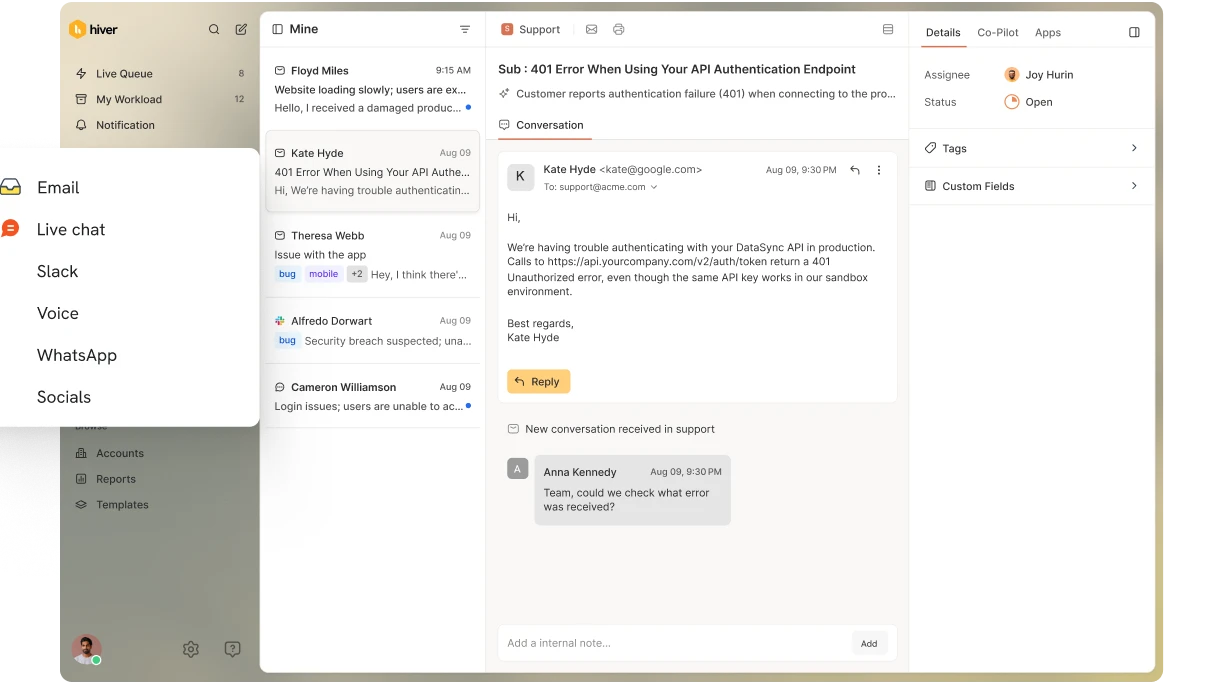
Hiver is an AI-powered customer service platform that combines email, live chat, WhatsApp, voice, SMS, and social media into one unified platform.
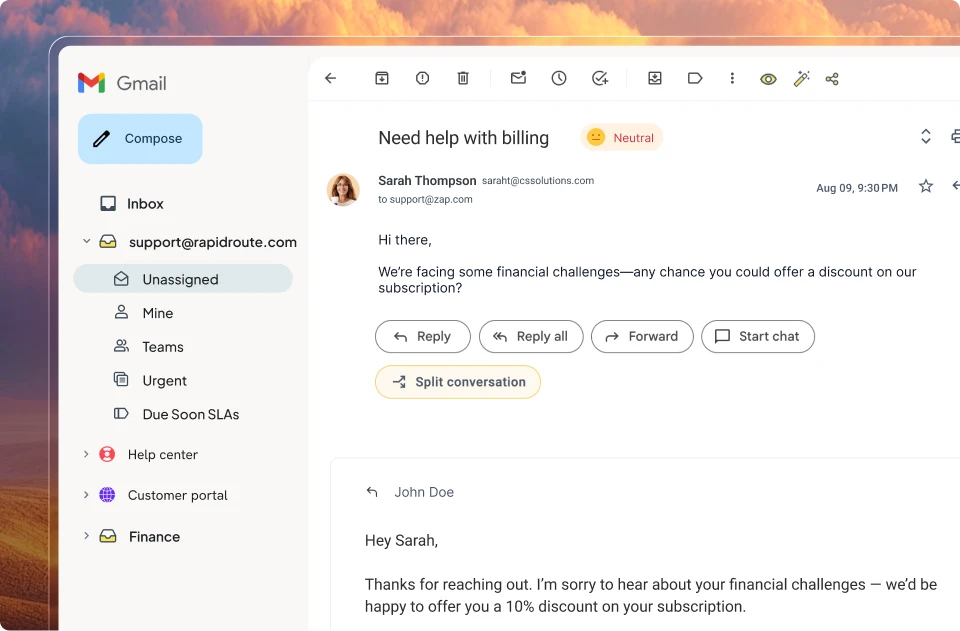
The interface feels familiar, so agents become productive quickly. AI features, such as AI Copilot and AI Agents, draft replies, triage conversations, and deflect common questions without requiring complicated configuration.
Why teams pick Hiver:
- Setup finishes in hours, not weeks.
- AI features work out of the box, so leaders see faster value.
- Pricing stays predictable without heavy add-on stacking.
- 24/7 support is included on every plan.
Comparison highlights:
| Feature | Hiver | Zoho Desk |
|---|---|---|
| Ease of Setup | Ready in hours, intuitive UI that mirrors your inbox | Complex setup |
| Multichannel Support | Email, live chat, WhatsApp, voice, social | Email, chat, phone, social; requires deeper configuration |
| AI Features | AI Copilot drafts replies, AI Agents auto-handle FAQs, AI Insights flag churn risks | Zia offers sentiment detection and article suggestions |
| Automation | Built-in workflows, smart triage, and AI routing | Workflow rules and SLA automation; manual setup needed |
| Analytics | AI-driven reports for response trends and workload balance | Custom dashboards; advanced options behind higher tiers |
| Pricing | Free plan available; paid plans start at $35 (Growth) and $55 (Pro), with an optional AI add-on at $20/user. | $7–$40/agent + paid add-ons |
| Support & Onboarding | 24/7 live chat and email support on all plans | Premium support is available at higher tiers |
Making the Right Choice for Your Customer Service
Both platforms are capable. It really depends on what your team values most.
If you require in-depth customization and are willing to accept a longer learning curve, Zoho Desk is a solid fit.
However, if you want a modern customer service solution that’s easy to set up and scales with your business, Hiver is the more practical choice.
You’ll get multichannel ticketing, collaboration tools, analytics, and automation in one intuitive interface that feels familiar, not foreign.Ready to see it for yourself? Start your free 7-day Hiver trial.
Frequently Asked Questions
1. How long does the Zoho Desk setup take?
Basic configuration finishes in a few weeks. Specialized workflows, complex integrations, or multi-brand structures can often take several months to implement.
2. Does Zoho Desk suit growing businesses?
Yes, provided teams have bandwidth for configuration and process maintenance. Fast-growing teams that value quick time to value often prefer a simpler platform such as Hiver.
3. What extra costs should teams plan for?
Expect professional services for complex setup, data migration, training, and paid integrations or marketplace apps.
4. How does Zoho Desk AI compare?
Zia supports sentiment analysis, classification, and anomaly detection. Many teams seeking deeper automation prefer platforms where AI drafts replies, auto-routes with context, and provides ready insights without requiring heavy tuning.
5. Is migration from Zoho Desk straightforward?
Data export is supported. Migrating custom fields, workflows, and integrations may require expert support or third-party tools.
Start using Hiver today
- Collaborate with ease
- Manage high email volume
- Leverage AI for stellar service