




Jira Service Management (JSM) was built for teams that thrive on structure. It brings order to IT requests, incident escalations, and internal collaboration by linking everything through Jira Software and Confluence.
Its flexibility, from automation to SLA tracking, gives organizations tight control. But that control comes with complexity. The platform can be difficult to set up, and teams without prior Jira experience often encounter a steep learning curve.
Some features, such as asset tracking and reporting, are also available only with higher-priced plans. Here’s a breakdown of where Jira shines and where it can slow you down.
Table of Contents
- What Is Jira Service Management?
- Key Features of Jira Service Management
- Jira Reviews From Customers
- Jira Service Management Pricing Breakdown
- Additional / Hidden Costs to Consider
- Cost-Effectiveness Analysis
- Hiver’s Pricing Advantage
- Jira Service Management vs. Hiver: Pricing Comparison
- Why Hiver Is Better for Customer-Facing Teams
- Making the Right Choice
- Frequently Asked Questions
Key takeaways
- What it is: Jira is a project management and issue-tracking tool from Atlassian, built for teams managing complex, agile workflows.
- Best for: Software and engineering teams running Scrum or Kanban frameworks that need deep customization and traceability.
- Pricing: Starts free for 10 users, but costs scale quickly due to add-ons and training needs.
- Pros: Excellent traceability, detailed reports, and flexible workflows.
- Cons: Steep learning curve, slower performance with large projects, and high long-term costs.
- Verdict: Ideal for large or technical teams. For simpler project collaboration, Hiver offers AI-powered workflows at a fraction of Jira’s cost.
What Is Jira Service Management?
Jira Service Management extends Jira beyond project tracking into a full-scale IT operations hub. It combines IT service management, DevOps collaboration, and customer support within a single ecosystem.
It integrates natively with Atlassian tools, such as Confluence and Opsgenie, keeping communication between IT, development, and business teams transparent. It’s a solid fit for mid-size and enterprise companies already using Jira Software.
Key Features of Jira Service Management
JSM’s strength is the way it brings IT, engineering, and operations together. Below are the core areas where teams see the most value.
1. Centralized Request Management
JSM helps teams capture, categorize, and route service requests efficiently, from email, portals, or connected apps, ensuring no query slips through. Everything lands in one place, promoting faster resolution and clear accountability.
2. Custom Workflows and Automation
From password resets to approvals, JSM’s automation engine helps teams design rules that fit their processes. Workflows can be as simple or as complex as needed, automating repetitive actions and reducing manual errors.
“What is liked best about Jira are its powerful agile project management features, including customizable workflows and Agile boards (Scrum and Kanban), which help teams visualize, track, and manage work effectively.” – G2 user
3. SLA Tracking and Performance Visibility
Managers can set response and resolution targets, and dashboards make it easy to track performance trends. SLAs encourage accountability and help teams measure service quality over time.
4. Knowledge Base and Self-Service Portal
JSM connects with Confluence to build internal or external knowledge bases. Employees and customers can find answers before raising tickets, a simple but effective way to deflect repetitive queries.
5. Incident, Problem, and Change Management
The platform supports deeper ITSM use cases like incident response and change tracking. Tickets can link to problems or configuration items, keeping developers and service teams aligned.
6. Integrations and Scalability
As part of the Atlassian suite, JSM integrates with tools like Opsgenie, Slack, and 600+ marketplace apps. It scales across teams and geographies, though managing it requires admin experience.
Jira Reviews From Customers
Pros
1. Ease in Task Management
Multiple users found Jira simple for managing tasks in one place.
“Jira is helpful for managing tasks at one place.” – G2 User
2. Smooth Setup for PMs and Engineers
“The ease of use, ease of integration with other tools like slack etc.” – G2 user
Cons
1. Slack Integration Limitations
“Jira’s Slack integration is great, but it could improve with faster syncing, fewer notification overloads, and more advanced in-Slack actions.” – G2 user
2. Performance Issues on Larger Projects
“Jira can feel overwhelming at first because of its complexity. The interface has many features that are not always intuitive” – G2 user
Jira Service Management Pricing Breakdown
| Plan | Price (per agent/month) | Highlights |
|---|---|---|
| Free | $0 | Up to 3 agents; basic templates for IT, HR, marketing |
| Standard | $20 per agent/ month | Adds AI-powered Rovo Agents, branded help center, audit logs |
| Premium | $51.42 per agent/ month | Adds virtual agent, asset management, AIOps, incident/change modules |
| Enterprise | Custom | Includes Atlassian Analytics, unlimited automations, enterprise security |
Note: In 2025, Atlassian introduced the Service Collection, which bundles Jira Service Management, Customer Service Management, Assets, and Rovo AI. Core ITSM features like change, incident, and problem management now sit under Premium and Enterprise plans, while Assets (CMDB) and Virtual Service Agent are billed separately based on usage.
Additional / Hidden Costs to Consider
- Asset object consumption (CMDB) fees.
- Automation and advanced rules limited to Premium/Enterprise.
- Consulting and setup for custom workflows or integrations.
- Paid add-ons from the Marketplace.
- SSO and audit features via Atlassian Access.
- Storage and user seat overage charges.
The base per-agent price often underrepresents total cost. Large teams can absorb it; smaller teams may struggle.
Cost-Effectiveness Analysis
JSM is powerful but expensive to scale. The jump from Standard to Premium unlocks essential ITSM modules, creating a steep price curve.
Budget-conscious teams must account for asset consumption, plugins, and training.
Hiver’s Pricing Advantage
If your support operations revolve around customer-facing communication (not IT governance), Hiver offers a leaner alternative.
Why Hiver Wins for Simplicity:
- Transparent per-user pricing with fewer hidden costs.
- No CMDB or asset-based billing.
- Built-in automation and analytics.
- Minimal setup or admin dependency.
- Fast deployment with a familiar inbox-like interface.
Hiver’s flat pricing helps smaller and mid-size teams achieve faster ROI, without navigating Jira’s layered licensing.
Jira Service Management vs. Hiver: Pricing Comparison
| Metric | Jira Service Management | Hiver |
|---|---|---|
| Entry Cost | Free for up to 3 agents on the Free plan | Free plan available for up to 10 users (email, chat, WhatsApp, voice) |
| Typical Mid-Tier | $7.91–$14.54/user/month (Standard to Premium, annual billing) | $35–$55/user/month (Growth to Pro, annual billing) |
| Hidden Costs | Add-ons like Assets (CMDB), Atlassian Guard, and Marketplace integrations can increase the total cost | Minimal — AI add-on ($20/user/month) is optional |
| Complexity | High: | Low |
| ROI Timeline | Long | Fast |
Both tools offer a 7-day free trial. They are ideal for testing workflows before committing.
For detailed pricing information and to start your free trial, visit Hiver’s pricing page.
Why Hiver Is Better for Customer-Facing Teams
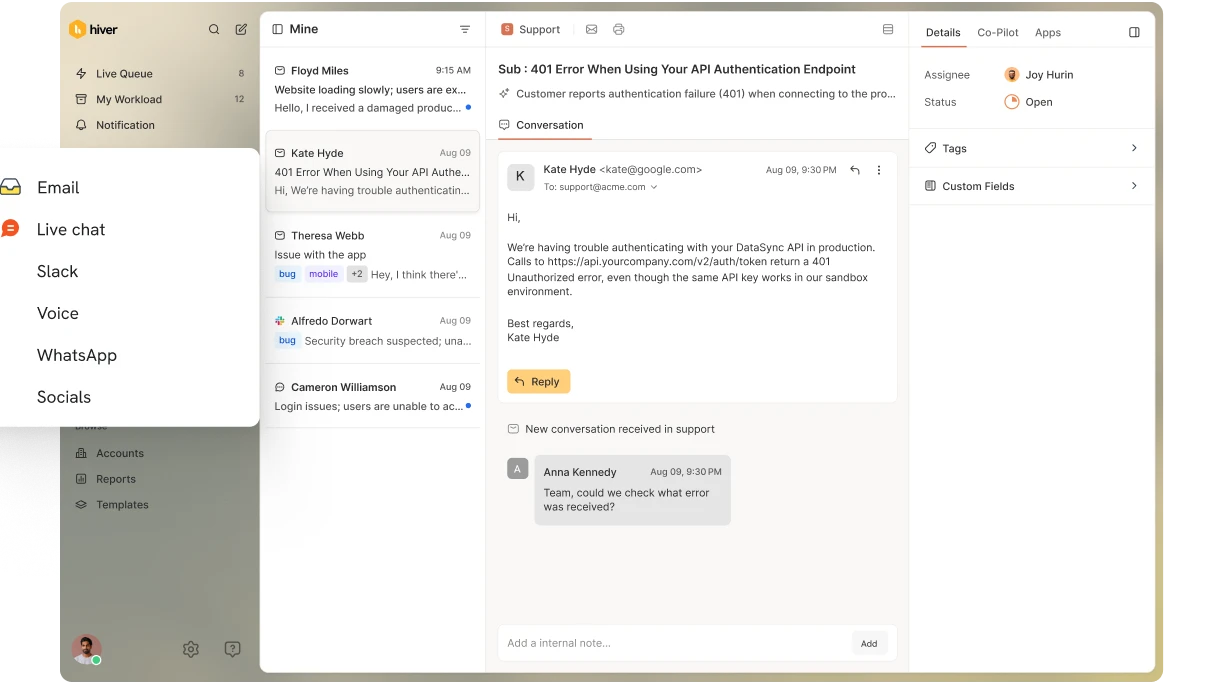
Jira Service Management is ideal for process-heavy IT or DevOps setups. Hiver, by contrast, unifies email, live chat, WhatsApp, voice, and social support in one place, perfect for service teams that prioritize responsiveness and simplicity.
With AI-powered live chat, built-in analytics, and quick setup, Hiver reduces admin burden while improving team collaboration.
Recommended reading
Explore our detailed Jira vs. Hiver comparison to see which platform aligns best with your team’s scale, structure, and collaboration needs.
Recommended reading:
Making the Right Choice
The right choice between Jira Service Management and Hiver depends on how your team operates and the complexity of your workflows.
Your decision depends on what your team values most:
- Jira Service Management: Best for large enterprises needing full ITSM depth.
- Hiver: Best for agile, customer-facing teams that want speed, simplicity, and transparent pricing.
If your priority is faster response times, unified multichannel communication, and easy onboarding, Hiver is your best next step.
🎯 Book a personalized demo today and see how Hiver simplifies service delivery.
Frequently Asked Questions
1. Is Jira Service Management the same as Jira Software?
No. Jira Software focuses on agile project tracking; JSM adds ITSM features like SLAs, portals, and change management.
2. Does Jira Service Management have a free plan?
Yes, for up to 3 agents. Advanced modules are paid.
3. What ITIL processes does JSM support?
Incident, problem, change, request, and service catalog workflows.
4. How is JSM pricing structured?
Per-agent monthly, plus costs for add-ons, assets, and integrations.
5. What’s included in JSM’s Assets/CMDB?
Configuration item tracking, billed per object/month.
6. Is JSM hard to set up?
Yes, for complex teams. Most need admin or consultant support.
Start using Hiver today
- Collaborate with ease
- Manage high email volume
- Leverage AI for stellar service