




Quick summary
| # | Tool | Best for |
|---|---|---|
| 1 | Hiver | Teams handling complex support that want AI across the full support lifecycle |
| 2 | Zendesk | Enterprises that want deep customization and a big integration marketplace |
| 3 | Help Scout | Small teams under 25 that want a clean, affordable helpdesk |
Front, Zoho Desk, Intercom, Pylon, and Kustomer round out the full list below, each a better fit for a specific kind of team.
We compared 8 Freshdesk alternatives on pricing, ratings, and fit
There’s a good reason Freshdesk is everywhere. It’s affordable, way faster to set up than Zendesk, and packs enough features to run most support teams without needing a full-time admin to keep it running.
The catch, however, is Freshdesk was built for high-volume, straightforward support. But B2B support rarely works like that. A single issue pulls in multiple teams, calls for a person’s judgment, and depends on context spread across your tools, codebase, and docs. It is account-centric, process-heavy, and spans teams, tools, and channels. Freshdesk just isn’t built for that kind of cross-team chaos, so teams end up duct-taping solutions together with chaotic Slack threads, manual Jira updates, and endless email forwards.
If you’re hunting for Freshdesk alternatives that can actually handle complexity, you’re in the right place.
Why listen to us?
We’ve spent more than a decade building customer service software, and over 10,000 teams, including Gusto, Ping Identity, and Epic Games, now run their support on Hiver. Watching so many outgrow single-queue helpdesks like Freshdesk has shown us where they strain: a ticket needs finance, engineering, or customer success before it can close, and there’s nowhere to put that. Flexport cut resolution times by 50% after switching, and Conservice saves 265 hours a month on support workflows. We compete in this space, so we’ll say plainly when another tool fits better.

What is Freshdesk?
Freshdesk is a cloud-based customer support platform from Freshworks. It handles ticketing, email, chat, phone, and social media support through a single dashboard. It serves teams of all sizes, from small businesses on the free plan to enterprises running multi-brand support.

Freshdesk has been around for over a decade. It’s built a large user base around affordable entry pricing and a wide feature set, plus Freddy AI as an add-on for automation and agent assistance.
Some reasons you might be looking for alternatives to Freshdesk
AI stops short of complex tickets
Most helpdesk AI, Freshdesk’s included, is built for requests that fit a script: an order status check, a password reset, a return policy question. It answers from the knowledge base and hands everything else to your team.
B2B tickets rarely fit a script. Resolving one usually means investigating the account, following a procedure, and taking action across several systems. That takes AI that can work through multi-step requests end to end and bring in a support rep only when judgment is needed.
Reporting and customization are gated behind higher tiers
The price jump from Growth ($19/agent/month) to Enterprise ($89/agent/month) is pretty brutal, especially when the exact features a growing team needs are trapped on the higher tier.
Want custom analytics, a sandbox environment, or multi-brand support? You’re forced to upgrade. That structure is fine when you’re just starting out, but as soon as you outgrow the basics, you’re suddenly paying nearly five times as much per agent. Essential features like these should scale with your business, and definitely not feel like a steep toll booth.
Cross-team collaboration doesn’t go deep enough
Complex support tickets don’t stay in a single queue. A billing dispute needs Finance, a bug escalation hits Engineering, and a renewal risk calls for CS. Every time a ticket gets handed off, the full context has to travel with it. Otherwise, the customer is stuck repeating themselves.
Freshdesk handles standard routing fine, but its collaboration model falls short once multiple teams get involved. Keeping complete conversation history and account context intact across every handoff is a much harder problem than just assigning a ticket to the right inbox.
Some users report inconsistent support experiences
Recent customer reviews on Capterra include complaints about slow response times and inconsistent support experiences. If vendor support is an important part of your buying decision, it’s worth factoring those experiences into your evaluation alongside the platform’s features and pricing.
8 best Freshdesk alternatives
| Tool | Key strength | Best for | Starting price |
| Hiver | Ticketing, collaboration, and workflows with AI woven throughout the support lifecycle. | B2B teams running complex, cross-team support | $25/user/mo (annual) |
| Zendesk | Deepest customization and largest integration marketplace here | Enterprises needing granular control over every workflow | $19/agent/mo |
| Help Scout | Genuine free plan and simplest learning curve | Small teams under 25 wanting a clean, affordable helpdesk | Free (5 users); $25/user/mo paid |
| Front | Shared inbox that feels like a personal email client | Teams that live in email and need CRM-like context | $25/seat/mo (10 seats) |
| Zoho Desk | Native integration with 50+ Zoho apps | Teams already running the Zoho ecosystem | Free (3 users); $7/user/mo paid |
| Intercom | Autonomous AI resolution with no per-seat AI cost | High-volume transactional support wanting AI-first deflection | $29/seat/mo |
| Pylon | Account-based support model with native Slack/Teams channels | B2B teams needing account context and multi-channel Slack support | $59/seat/mo |
| Kustomer | Timeline view built on a continuous customer story | Ecommerce and subscription brands needing full customer history | $89/seat/mo (8-seat min) |
Now let’s look at each Freshdesk alternative in detail.
1. Hiver

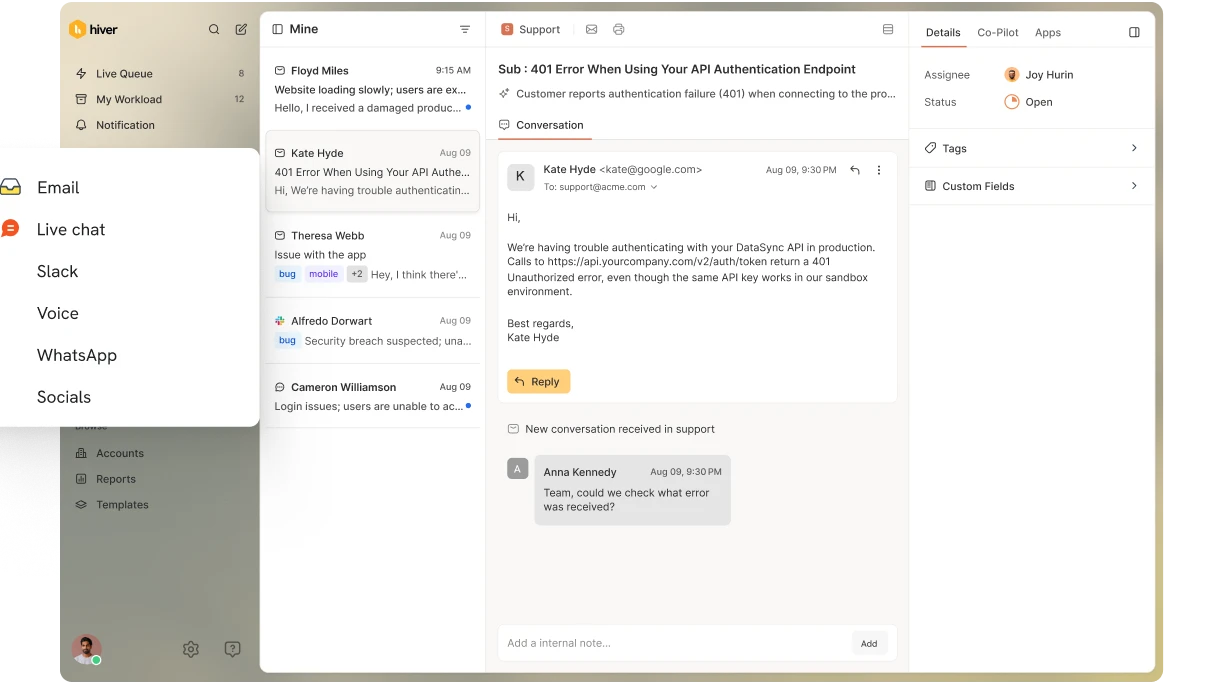
Hiver is an agentic, omnichannel customer service platform built specifically for complex support. It pulls your conversations, internal teams, and tech stack into a single workspace. This way, it’s easy to triage, assign, and prioritize incoming requests across every channel. When a ticket needs extra eyes, your support reps can loop in the teams needed with simple @mentions and internal notes, or collaborate directly via Slack. Because complete ticket history and account context travel with every handoff, cross-functional escalations stay completely seamless.
It also syncs directly with your CRM (like Salesforce or HubSpot) so support reps always have full account visibility right beside the conversation. You can trigger automated workflows to route tickets, update customer records, and keep your tools in sync without manual data entry.
Hiver’s AI Agents handle end-to-end resolution for multi-step issues. It can investigate problems, execute your SOPs, and take actions across external tools. For tickets that need a person, the AI Copilot acts as a smart assistant, pulling answers from your knowledge base, connected systems, and past tickets to surface answers and draft accurate responses on the fly.
Key features
- Ticketing: assigns a clear owner to every conversation and tracks its status, priority, custom attributes, and SLA.
- Cross-team collaboration: keeps conversation history, internal notes, @mentions, Slack threads, and linked Jira/Linear tickets connected to one customer thread across every team involved.
- Omnichannel Inbox: email, chat, voice, SMS, social, and Slack land in one queue, so a conversation that starts on chat and moves to a call keeps its full history.
- Workflow Automation: routes, assigns, tags, triages, and escalates requests using conditions and data from connected apps, and lets teams build workflows in plain language.
- Integrations and Omnichannel Inbox: pulls data from CRM, ERP, and 100+ other connected apps into the conversation, and brings email, chat, Slack, voice, SMS, and social into one unified timeline.
- AI Agents: resolve complex requests from intent to resolution, gathering context, following your team’s procedures, and bringing in a support rep when judgment is needed.
- AI Copilot: pulls similar past issues, drafts replies in your team’s tone, and suggests next steps on requests that need a person. Your team reviews and sends.
- AI QA: reviews every conversation against the quality parameters you define, instead of a manager sampling a random handful.
Pricing

- Growth: $25/user/mo (billed annually)
- Pro: $55/user/mo (billed annually)
- Elite: $85/user/mo (billed annually)
- Voice add-on: $35/seat/mo, 1,000 pooled minutes per voice seat/month included, additional usage at $0.03/minute, no add-on fees on top
- 2-seat minimum, 7-day free trial
Pros
- Ticketing, collaboration, omnichannel support and AI live in one workspace instead of three separate tools bolted together
- Cross-team collaboration keeps conversation history intact across support, engineering, finance, and customer success without tab-hopping
- AI Agents orchestrate multi-step actions across connected systems, using customer and account context to drive resolution.
Cons
- Voice is an add-on and isn’t included in the base plans
- Not designed for ITIL or service catalog use cases.
2. Zendesk

Zendesk is one of the largest customer service platforms on the market. It serves enterprise support operations with deep customization and a marketplace of over 1,500 integrations. If your team needs granular control over every workflow, trigger, and automation rule, Zendesk gives you more configuration options than most competitors on this list.
The trade-off is complexity. Zendesk’s setup takes time and needs agent training, and AI comes at a premium. The Copilot add-on costs $50/agent/month on top of your Suite plan. Hiver integrates its AI capabilities into the support workflow, while several of Zendesk’s more advanced AI capabilities carry additional costs.
Key features
- Custom Workflows: Build complex trigger-and-automation sequences with conditional logic, macros, and SLA-based escalation rules.
- Marketplace: Access 1,500+ pre-built integrations and apps for CRM, ecommerce, analytics, and developer tools.
- Omnichannel Routing: Manage email, chat, phone, social, and messaging from a unified agent workspace.
- Advanced Reporting: Create custom dashboards and reports with live data, filterable by channel, team, and individual agent.
Pricing
- Support Team: $19/agent/mo (billed annually)
- Suite Team: $55/agent/mo (billed annually)
- Suite Professional: $115/agent/mo (billed annually)
- Suite Enterprise + Copilot: contact sales
- Copilot add-on: $50/agent/mo
Pros
- The deepest customization options on this list, with granular control over triggers, macros, SLAs, and workflow logic
- A marketplace with 1,500+ integrations, so your team can connect almost any tool it already uses
- Enterprise-grade reporting with custom dashboards that break down performance by channel, team, and agent
Cons
- Setup is complex and typically needs dedicated admin time or outside consultants to configure properly
- Copilot costs $50/agent/month on top of an already premium Suite plan, so AI-assisted support gets expensive at scale
- The platform’s depth creates a steep learning curve for new agents, and onboarding takes longer than simpler alternatives
3. Help Scout

Help Scout is a customer support platform built for small teams that want a clean, straightforward helpdesk without the overhead of an enterprise system. It focuses on shared email, live chat, and a knowledge base, and it does all three well for teams under 25 people.
The free plan covers up to 5 users, one of the few helpdesks you can start without a credit card or sales call. AI Answers, Help Scout’s AI feature, costs $0.75 per resolution. It handles straightforward knowledge-base questions well, but not the multi-step reasoning a complex, cross-team ticket needs.
Key features
- Shared Inbox: Manage customer conversations across email and chat with collision detection, private notes, and saved replies.
- AI Answers: Resolve straightforward questions by pulling from your knowledge base, at $0.75 per resolution.
- Beacon Widget: Embed a help center, live chat, and contact form in your app or site with a single widget.
- Customer Profiles: View conversation history, recent activity, and custom properties for every contact in one sidebar.
Pricing
- Free: $0 (up to 5 users, 1 inbox)
- Standard: $25/user/mo (billed annually)
- Plus: $45/user/mo (billed annually)
- Pro: $75/user/mo (billed annually)
Pros
- A genuine free plan for up to 5 users, one of the few helpdesks that lets small teams start without paying
- Clean interface that new agents can learn in a day, so there’s almost no onboarding overhead
- Per-resolution AI pricing ($0.75/answer) means you only pay for AI when it actually resolves something
Cons
- Reporting options are limited on lower plans, and teams needing custom analytics have to move to Plus ($45/user/mo) or higher
- No built-in phone or voice support, so teams managing calls need a separate tool
- AI Answers pulls from your knowledge base only, so it can’t reason across account data, CRM records, or past conversations the way a cross-team platform can
4. Front

Front is a shared inbox platform built for teams that manage high-volume email, SMS, and social messages collaboratively. It combines the feel of a personal email client with helpdesk features like assignment, tagging, SLAs, and internal comments. If your team spends most of its day in email and needs CRM-like context without switching tools, Front is a strong fit.
It’s a different kind of Freshdesk alternative than most on this list, less about ticketing structure, more about making a shared inbox feel like real-time teamwork. Shared drafts let two people write one reply together before it goes out, which is the feature reviewers point to most often when explaining why they picked Front over a simpler shared inbox.
Key features
- Shared Inbox with Ownership: Assign emails to specific team members with clear ownership, collision detection, and internal comments on every thread.
- SLA Management: Set response-time targets by priority, channel, or customer segment and track performance in live dashboards.
- CRM Integration: Pull Salesforce, HubSpot, or Pipedrive data into the conversation sidebar without leaving Front.
- Workflow Automation: Build rules to tag, route, assign, and escalate messages based on keywords, sender, or custom conditions.
Pricing
- Starter: $25/seat/mo (up to 10 seats, billed annually)
- Professional: $65/seat/mo (up to 50 seats, billed annually)
- Enterprise: $105/seat/mo (unlimited seats, billed annually)
Pros
- The shared inbox feels like a personal email client, so teams already comfortable in email can adopt it with minimal friction
- Internal comments, shared drafts, and collision detection make it easy for multiple people to collaborate on a single thread
- Strong reviewer sentiment around usability and day-to-day support quality
Cons
- Seat caps on lower tiers (10 on Starter, 50 on Professional) force growing teams into plan upgrades earlier than expected
- No built-in knowledge base, so teams that need self-service have to add a separate tool
- AI capabilities aren’t as mature as dedicated AI-first platforms like Intercom or Hiver
5. Zoho Desk

Zoho Desk is a customer service platform that fits naturally into the broader Zoho ecosystem, including Zoho CRM, Zoho Analytics, and 50+ other Zoho apps. If your team’s already on Zoho, adding Desk is a natural fit. Your CRM, project management, and finance tools all connect without custom integrations.
What sets Zoho Desk apart isn’t just the price point, it’s that Zia, the built-in AI assistant, comes bundled into every tier rather than gated behind a premium plan, a rarer setup in this category than it should be.
Key features
- Zoho Ecosystem Integration: Share data natively with Zoho CRM, Zoho Projects, Zoho Books, and 50+ Zoho apps without third-party connectors.
- Zia AI Assistant: Classify tickets, detect sentiment, suggest replies, and flag anomalies using Zoho’s built-in AI.
- Multi-department Management: Run separate helpdesks for support, sales, and operations under one account with cross-department visibility.
- Blueprint Automation: Design step-by-step process flows for ticket resolution with approval stages, SLA checks, and conditional branching.
Pricing
- Free: $0 (up to 3 users)
- Express: $7/user/mo billed annually ($9 billed monthly)
- Standard: $14/user/mo billed annually ($20 billed monthly)
- Professional: $23/user/mo billed annually ($35 billed monthly)
- Enterprise: $40/user/mo billed annually ($50 billed monthly)
Pros
- Starts at $7/user/month with a free plan for up to 3 users, so it’s the most accessible option on this list for budget-conscious teams
- Native integration with 50+ Zoho apps eliminates the connector tax that other platforms charge for CRM and analytics sync
- Zia AI is included in plans and isn’t a paid add-on, so teams get ticket classification and sentiment analysis without extra cost
Cons
- The platform’s full strength depends on being in the Zoho ecosystem. Teams using Salesforce, HubSpot, or other non-Zoho tools won’t get the same integration depth.
- The interface feels dated compared to newer platforms like Help Scout and Front, and navigation can be confusing for new users
- Enterprise-grade features like sandbox testing and guided conversations are locked behind the $40/user/month plan
6. Intercom

Intercom is a customer service platform built around AI-first resolution. Its Fin AI Agent resolves conversations on its own at $0.99 per outcome, with no seat cost attached to the AI itself. If your team handles high-volume transactional support and wants to resolve as many tickets as possible without a rep, Intercom is built for exactly that.
Intercom optimizes for deflection rate, the share of tickets AI resolves without an agent. For complex B2B support, where responses may depend on account-specific context and human judgment, deflection alone isn’t always the right metric. For high-volume consumer support, it’s a genuine advantage.
Key features
- Fin AI Agent: Resolve customer conversations autonomously at $0.99 per outcome, trained on your help center, past conversations, and custom content.
- Messenger: Embed a customizable chat widget with proactive messages, product tours, and in-app surveys.
- Workflows Automation: Build automated sequences for routing, assignment, and follow-ups using a visual builder.
- Multilingual Help Center: Publish and manage help content in multiple languages with AI-assisted translation.
Pricing
- Essential: $29/seat/mo
- Advanced: $85/seat/mo
- Expert: $132/seat/mo
- Fin AI Agent: $0.99/outcome (available standalone or with any plan)
- 14-day free trial
Pros
- Fin AI Agent resolves conversations at $0.99/outcome with no seat cost, so teams with high ticket volumes can scale AI without per-agent pricing
- Per-outcome pricing means you pay for results, not for seats you might not fill
- The Messenger widget supports proactive messages, product tours, and surveys, so it does more than reactive support
Cons
- Advanced AI and automation features can make the platform expensive as support needs grow.
- AI is optimized for deflection, so complex tickets that need multi-step reasoning or cross-team coordination still fall to support reps without the same tooling support
- Intercom’s strength is high-volume consumer support. Teams running complex B2B operations with account-sensitive decisions will find the AI layer isn’t built for that depth.
7. Pylon

Pylon is an AI-native support platform built for B2B teams managing customer relationships across Slack Connect, Microsoft Teams, email, and WhatsApp.
Unlike most helpdesks that organize work around tickets, Pylon organizes everything around accounts. Every conversation tied to a specific company, with CRM data, renewal timelines, and account history surfaced alongside it. Support, success, and engineering work from the same view.
Key features
- Account-based intelligence: Every ticket is connected to a specific company, with CRM data from Salesforce or HubSpot surfaced alongside it. Support agents see renewal timelines, contract details, and account history before they type a word.
- AI Agents and Copilot: Automates ticket routing, summarizes conversations, and drafts replies using your knowledge base. Routine requests get resolved end-to-end without agent involvement. Complex ones hand off with full context intact.
- Account health scoring: Pylon calculates health scores based on ticket frequency, sentiment, and product usage, surfacing at-risk accounts before they become a churn conversation. Most helpdesks don’t offer this without a separate CS tool.
- Shared workflows across teams: Support, success, and engineering share views, assignments, and context in one place, so escalations don’t mean starting from scratch or hunting down context across tools.
Pricing
Plans start at $59/seat/month, with Professional and Enterprise tiers at $89/seat/month and $139/seat/month respectively. AI Assistants and AI Agents are separate add-ons, starting at $50 per seat/mo and $100 per seat/mo each. No free trial.
Pros
- Users consistently praise the ability to manage customer requests across Slack, email, and chat from one place, staying organized without conversations slipping through the cracks..
- The integration depth is a genuine strength. Having CRM data, active client issues, ongoing projects, and account tasks in one dashboard gives account managers and support teams the much-needed context.
Cons
- There is no mobile app. Agents can only access Pylon through Slack or a desktop browser, which creates real delays for managers handling escalations away from their desk.
- Users have noted that the AI needs meaningful improvement before it can handle nuanced product questions reliably.
8. Kustomer

Kustomer is a support CRM for teams that need more than a ticket queue. It works best when agents need to see the full customer story before replying — past conversations, order history, refunds, account details, notes, and recent activity — all in one timeline.
That distinction matters most for ecommerce, retail, and subscription businesses where support quality depends on context. Agents aren’t just answering “Where is my order?” They’re deciding how much latitude to give a high-value customer, whether to preemptively offer a resolution, and how to respond in a way that doesn’t start from scratch.
In Freshdesk, a customer who contacts you five times creates five separate tickets. In Kustomer, those five interactions live in one continuous thread alongside purchase history, account notes, and behavioral data..
Key features
- Customer timeline: Shows emails, chats, SMS, social messages, calls, orders, notes, and past interactions in one chronological view. Agents don’t toggle between tabs or cross-reference a CRM. The context is already there.
- Kustomer IQ (AI automation): Handles intelligent routing, suggests responses, detects sentiment, and auto-classifies conversations, reducing manual triage. Recent updates have added AI-powered API actions and real-time web referencing, expanding what automation workflows can trigger without custom development.
- Ecommerce integrations: Connects with tools like Shopify and Magento, so agents can see order and customer data while handling the conversation.
- No-code AI agents: Teams can deploy customer-facing bots that resolve routine queries and hand off to reps when needed, without writing a single line of code. The workflow library now includes over 50 no-code tools covering data formatting, value calculation, and business hours logic.
Pricing
Kustomer runs on annual seat-based contracts, with a minimum of 8 seats required. The Enterprise plan starts at $89/seat/month, and the Ultimate plan at $139/seat/month. AI features are priced separately as add-ons ($0.60 per engaged AI conversation; $40/user/month for agent-assist AI). It offers a 30-day free trial.
Pros
- The timeline view is one of Kustomer’s biggest strengths. Agents can see the customer’s full interaction history, which helps them handle repeat contacts without going in blind.
- Reporting is notably in-depth, covering both customer insights and team performance in ways that reviewers say outpace most alternatives in this category.
Cons
- Some users feel Kustomer’s knowledge base is clunky to build and maintain. Search can also be frustrating, making it harder for agents to find the right information when they need it.
- The 8-seat minimum and annual-only contracts make Kustomer difficult to evaluate without a significant commitment upfront. There’s no monthly billing option and no self-serve trial.
5-step evaluation checklist before you switch from Freshdesk
Switching help desks takes time, budget, and internal buy-in. Before you shortlist anything, run it through these five questions.
- Can it handle escalations across multiple teams without breaking context? B2B support tickets rarely stay with one team. A billing dispute pulls in Finance. A bug escalates to Engineering. Check whether the tool supports multi-tier escalation natively — L1 to L2 to L3 — with full context transfer at each handoff, and whether it syncs with Jira or your project management tool so internal teams don’t need a separate system.
- Does it surface account context, not just ticket history? In B2B support, the question isn’t just “what did this customer ask?” It’s “what’s happening with this account overall?” Look for tools that show open tickets, sentiment trends, renewal dates, and MRR alongside the conversation — not buried in a separate CRM tab.
- What does the real price look like with AI, voice, and chat included? Build out the full number: your agent count, AI features, any channel add-ons for voice or messaging, and advanced reporting. If the total is significantly higher than the starting plan, ask why before signing anything.
- How much control do you have over where AI steps in? For B2B support teams, an AI hallucinating a contractual term or SLA detail isn’t a minor error. Ask whether you can deploy AI by query type, customer tier, or autonomy level — and whether you can see how it’s making decisions before expanding its scope.
- How long before your team is actually productive? Some tools require weeks of configuration before they’re useful. Ask vendors for a realistic onboarding timeline for teams your size, what migration support is included, and how much ongoing admin the platform requires after go-live.
Find the Freshdesk alternative that fits your team
Every platform on this list brings something solid to the table, but no single tool is a one-size-fits-all fix. The right choice ultimately comes down to your operational priorities: whether that’s seamless cross-team collaboration, transparent pricing, or scaling without tier-upgrade shock.
If your support team manages complex, multi-team escalations, standard ticketing just won’t cut it. You need built-in collaboration, deep integrations, and AI native to your workflow. You don’t want those tacked on as an afterthought. That’s exactly where Hiver shines.
Ready to see how Hiver can streamline your team’s escalations and shorten resolution times? Book a demo today to test-drive it against your actual support queue.
FAQs
What is the best Freshdesk alternative?
Hiver is designed for complex support that needs cross-team collaboration, advanced ticketing and AI. Zendesk leads on enterprise-scale customization. Help Scout’s free plan is the better start for small teams on a budget.
Is Freshdesk’s AI included in the price?
Not fully. Basic automation is included, but the more capable Freddy AI features are add-ons. Copilot runs $29/agent/month, and AI Agent sessions cost $49 per 100 after the first 500. That adds up fast for a mid-size team.
Can I switch from Freshdesk without losing my data?
Most platforms here support migrating ticket history, contacts, and knowledge base articles from Freshdesk. Hiver, Zendesk, and Intercom all offer guided migration support.
Which Freshdesk alternative has the best AI?
Intercom’s Fin AI Agent uses per-outcome pricing and is designed around autonomous resolution. Hiver’s AI Agents are designed to handle more complex, multi-step requests using connected customer and account context. Help Scout’s AI Answers focuses on resolving questions using knowledge-based content.
Is Zendesk better than Freshdesk?
Zendesk offers deeper customization, a larger marketplace (1,500+ integrations), and stronger reporting. Freshdesk is cheaper at entry ($19/agent/month vs. $55/agent/month for Zendesk Suite). Zendesk has the edge for large, complex operations; Freshdesk’s lower price may still work for smaller teams. See our Zendesk alternatives guide for more.