






You’ve likely interacted with a chatbot before, maybe while browsing a website, just checking an order, or even asking for quick help.
And you’ve probably also noticed how some feel clunky and scripted, while others seem to understand what you mean and reply naturally. Those smarter, more human-like conversations come from NLP chatbots.
NLP chatbots go beyond simple keyword matching. They understand intent, pick up context, and adapt to how people really speak, making support and sales conversations feel effortless.
In this guide, you’ll learn what NLP chatbots are, how they work, and why they’re changing customer interactions across industries.
TL;DR
NLP chatbots are changing how businesses interact with customers by understanding their language, intent, and tone, thereby making conversations feel more human.
What they are: Chatbots powered by Natural Language Processing (NLP) that understand and respond to human language instead of relying on pre-set rules.
Who they help: Support, e-commerce, healthcare, fintech, and education teams that handle repetitive customer interactions.
Why it matters: They deliver humanised 24/7 support, reduce agent workload, and create faster, more personalized experiences.
What they do: Understand intent, detect emotion, extract entities, and generate natural, contextual replies across channels.
What’s next: NLP chatbots will combine with LLMs to create more intelligent, adaptive systems that understand nuance and emotion.
What is an NLP Chatbot?
An NLP chatbot (Natural Language Processing chatbot) uses AI to understand, interpret, and respond to human language naturally.
They don’t just rely on fixed rules or keywords to trigger preset replies. NLP chatbots use techniques such as tokenization, intent classification, entity recognition, and sentiment analysis to analyze intent, extract meaning, and generate the appropriate response.
Real-world example: At Domino’s largest U.S. franchisee, RPM Pizza, a recruitment chatbot named Dottie helps speed up hiring by chatting with job applicants over text. It screens candidates and answers common questions. By understanding natural language in both English and Spanish, Dottie enables recruiters to connect more quickly and reduce drop-offs.

Unlike traditional bots, NLP chatbots can handle complex questions, understand variations in phrasing, and even learn from past interactions.
To understand how they work, it helps to know the three key components of language processing:
- NLP (Natural Language Processing) is the overall framework that enables machines to process and understand human language.
- NLU (Natural Language Understanding) focuses on interpreting the meaning, context, and intent behind what users say.
- NLG (Natural Language Generation) helps the chatbot craft natural, human-like responses.
Together, these components allow chatbots to interpret free-form language, maintain context, and deliver accurate, conversational replies, making customer interactions feel effortless.
How NLP Chatbots Work
NLP chatbots turn messages into structured data and run them through a pipeline.
Say, you are a user, and you ask, “Where is my order?”, the chatbot won’t just check for keywords. It processes the entire message to understand intent, extract meaning, and give you the best response.
Here’s how each stage works:
- Input: The conversation begins when a user sends a message, like “Can I change my flight to tomorrow?” The chatbot receives raw text or speech and prepares it for deeper language analysis.
- Tokenization: Next, your message is broken into smaller units called tokens (words or phrases). Through tokenization, the chatbot identifies sentence structure, enabling it to recognize “change my flight” as an action.
- Intent Recognition: Machine learning models classify what the user wants to accomplish, such as rescheduling a booking or checking an order status. Identifying intent helps the chatbot focus on the meaning.
- Entity Extraction: The chatbot identifies specific details, or entities, within the text, such as “flight,” “tomorrow,” or “evening.” Those details add context, making the response accurate and relevant.
- Response Generation: Once intent and entities are clear, the bot formulates a reply using predefined flows or AI models. The goal is to produce an answer that feels conversational and aligns with the user’s request.
Together, these steps enable NLP chatbots to understand open-ended questions, retain context, and deliver natural, human-like conversations.
Recommended reading
NLP Chatbot vs Rule-Based Chatbot
While an NLP chatbot can understand user intent, some chatbots are not capable of doing that. The difference lies in how they process input and handle user intent.
A rule-based chatbot operates according to predefined rules. It recognizes specific keywords or phrases and gives fixed responses. If a customer types something outside its programmed options, it usually fails to understand or redirects to a human agent.
You already know how an NLP chatbot works; it’s clear why NLP chatbots feel more natural. It understands language the way people use it, recognizing context and tone, making conversations feel more human.
Here’s how NLP and rule-based chatbots compare in practice:
| Aspect | Rule-Based Chatbot | NLP Chatbot |
|---|---|---|
| Customer Experience | Feels scripted; limited personalization | Understands intent, tone, and phrasing for smoother interactions |
| Scalability | Hard to maintain as queries grow | Expands easily with new intents and data |
| Resolution Rate | Handles basic FAQs only | Resolves complex queries without escalation |
| Team Efficiency | Agents still handle most queries | Agents focus only on high-value interactions |
| Customer Insights | Minimal data beyond clicks | Provides intent and sentiment data for analytics |
NLP Chatbot vs LLM Chatbot
NLP chatbots and LLM chatbots serve different purposes. Understanding how they differ helps you decide which is better for your business or use case.
LLMs (Large Language Models) are built on deep learning architectures, specifically transformer neural networks. They’re trained on enormous text datasets spanning books, articles, and online conversations.
It enables LLM chatbots to generate detailed, context-aware responses and sustain lengthy, natural conversations that feel remarkably human.
| Aspect | NLP Chatbot | LLM Chatbot |
|---|---|---|
| Technology | Built using Natural Language Processing and machine learning models trained on specific datasets | Powered by Large Language Models (like GPT or Claude) trained on massive internet-scale data |
| Training Data | Domain-specific and carefully curated to fit a business or industry | Broad, general knowledge drawn from diverse sources |
| Accuracy | Performs well with defined intents and structured workflows | Handles open-ended queries but may generate inconsistent or “hallucinated” answers |
| Customization | Easy to fine-tune for specific products, services, or FAQs | Requires advanced prompt engineering or fine-tuning; harder to constrain for compliance |
| Cost | Lower setup and operational costs | Higher infrastructure and API usage costs |
| Best For | Customer support, lead qualification, and service automation | Research, creative writing, and knowledge-based conversations |
In short, NLP chatbots excel at task-oriented, reliable interactions, while LLM chatbots shine in flexible, knowledge-driven conversations.
Many modern businesses even combine both, using an NLP chatbot for structured support flows and an LLM-powered assistant for complex or unstructured questions.
How to Build an NLP Chatbot
The right approach for building an NLP chatbot depends on whether you want full control through coding, flexibility through frameworks, or quick deployment with ready-made platforms.
Here’s how to build an NLP chatbot:
Step 1: Define Your Goals
Start by deciding what you want your chatbot to achieve. Do you want it to automate customer support, help with sales inquiries, or answer internal team questions?
Clear goals will help you plan the right features and training data.
Step 2: Choose Your Approach
Pick how you want to build your NLP chatbot, from scratch, using frameworks, or through ready-made platforms.
- From Scratch (Python, NLP libraries): Total control using tools like NLTK, spaCy, or Transformers.
- Open-Source Frameworks (Rasa, Botpress): Balanced flexibility and speed.
- Platforms (Dialogflow, IBM Watson, Hiver): Easy setup with built-in NLP and analytics.
Step 3: Design Conversation Flows
Map out how users will interact with your chatbot. Plan common questions, greeting messages, and fallback replies for when the bot doesn’t understand something.
For example, a banking chatbot could start with “Hi! How can I help you today?” and offer quick routes like “Check balance,” “Block card,” or “Talk to support.”
Step 4: Train Your NLP Model
Feed your chatbot with real phrases, user intents, and sample data so it can understand the meaning behind them, rather than just matching keywords. Utilize NLP techniques as discussed earlier to improve accuracy.
Step 5: Test and Optimize
Before going live, run test chats to identify gaps in understanding. Track fallback rates, unresolved queries, and CSAT scores to see how well your NLP chatbot performs. Keep iterating; the more you test, the smarter it gets.
Recommended reading
Benefits of NLP Chatbots
NLP chatbots help brands stay available around the clock, deliver personalized support, and learn from every conversation to continuously improve customer experience. Here’s where they add the most value:
Be There for Your Customers with 24/7 Customer Support
Your support team might not be available round the clock, but your customer expects instant answers when they need them. With NLP chatbots, you can handle requests instantly and respond to customers.
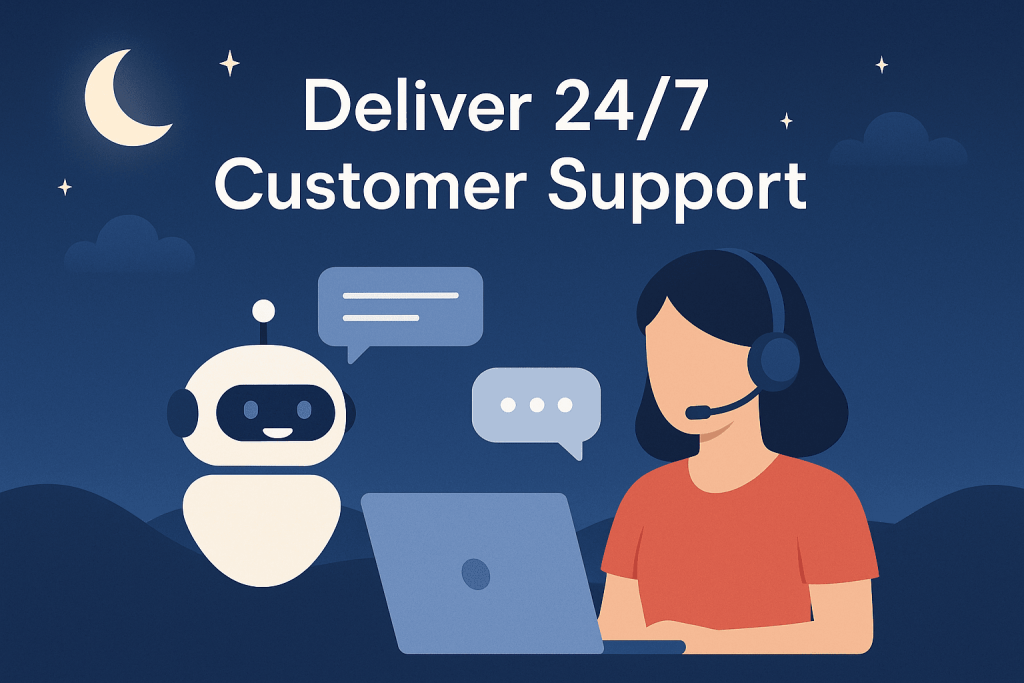
Example: A travel company’s chatbot assists passengers with itinerary changes at 2 a.m., confirming bookings instantly. This way, travelers don’t have to wait till morning to talk with an agent.
Reduce Agent Workload and Free Up Time for Complex Queries
Routine questions, such as order updates or refund policies, no longer require human attention. NLP chatbots handle repetitive queries, so your agents can focus on solving nuanced issues that need human context.
Example: An e-commerce support team used an NLP chatbot to handle routine “Where’s my order?” messages, which helped agents focus more on resolving shipment delays and personalized customer issues.
Engage Customers in Multiple Languages
Serving global customers means speaking their language. Multilingual NLP chatbots automatically detect and respond in the user’s preferred language, creating a more inclusive experience.
Example: A global fashion retailer uses an NLP chatbot that switches between English, French, and Spanish, allowing shoppers worldwide to receive instant, localized product support.
Personalize Conversations for Better Engagement
Every returning customer expects a bit of recognition. NLP chatbots remember the context from past chats and tailor their responses accordingly, turning generic support into a meaningful conversation.
Example: A subscription platform’s chatbot greets users by name. “Welcome back, Maya! Ready to renew your plan?” and suggests renewal discounts based on their previous subscription, creating a more personal and relevant exchange.
Get Customer Insights Through Conversation Data
With NLP chatbots, you can capture recurring topics, emotional tone, and trends across conversations. These insights help your teams make better customer service decisions.
Example: Say, after analyzing chatbot conversations, a company finds that many users had questions about “data export” features. The team uses that feedback to update help articles and refine the in-app onboarding journey.
Common Use Cases of NLP Chatbots
NLP chatbots’ ability to understand natural language makes them highly adaptable to a wide range of real-world applications. Here are some of the most impactful applications:
E-commerce – Creating Smarter Shopping Experiences
In online retail, NLP chatbots act as personal shopping assistants. They help customers find products, track orders, and process returns, all through natural questions such as “Where’s my order?” or “Show me similar shoes under $80.”
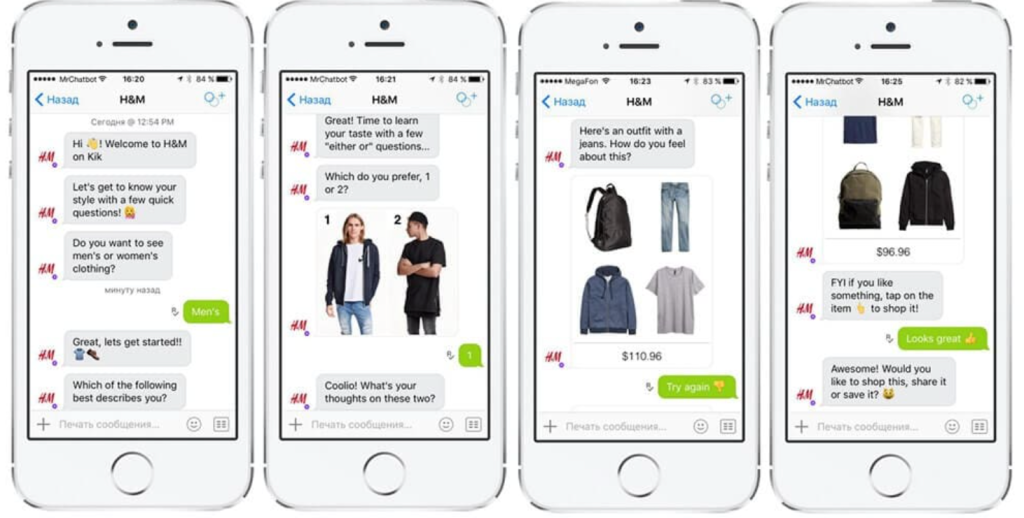
For example, H&M launched a chatbot on the Kik messaging app that uses NLP to offer fashion advice and personalized product recommendations to shoppers.
Healthcare – Improving Patient Care with Instant Assistance
Hospitals and clinics use NLP chatbots to manage appointments, share care instructions, and answer patient queries. A patient might ask, “Book me an appointment with Dr. Sam for Monday,” or “When will my lab reports be ready?”
A notable example is UCHealth’s Livi chatbot, which assists patients with scheduling and health queries. It can pull up test results or send appointment reminders, integrating smoothly into the patient’s care journey.

Finance & Fintech – Simplifying Everyday Banking Services
Banks and fintech apps rely on NLP chatbots for everyday services like balance checks, card management, and fund transfers. Customers can simply type, “What’s my current balance?” or “Block my credit card,” and get quick, secure responses.
Take Bank of America’s digital assistant Erica as an example. The chatbot allows customers to check balances, track spending, transfer funds, and get financial advice just by typing or speaking requests in the mobile app.

Virtual Assistants – Boosting Daily Productivity
NLP chatbots power virtual assistants that make daily life simpler. They handle reminders, scheduling, and alerts through natural commands such as “Set a reminder for tomorrow at 9 a.m.” or “What’s on my calendar today?”
Apple’s Siri was one of the first popular AI assistants, setting the stage for how people interact with technology using voice. It used voice recognition and NLP to perform tasks like sending messages, setting reminders, adding calendar events, and answering general questions in a natural dialogue.

Customer Service – Delivering Faster Resolutions
Across industries, NLP chatbots resolve common customer issues instantly, reducing ticket backlogs and improving satisfaction. A telecom bot, for instance, can answer billing queries or plan details without routing users to an agent.
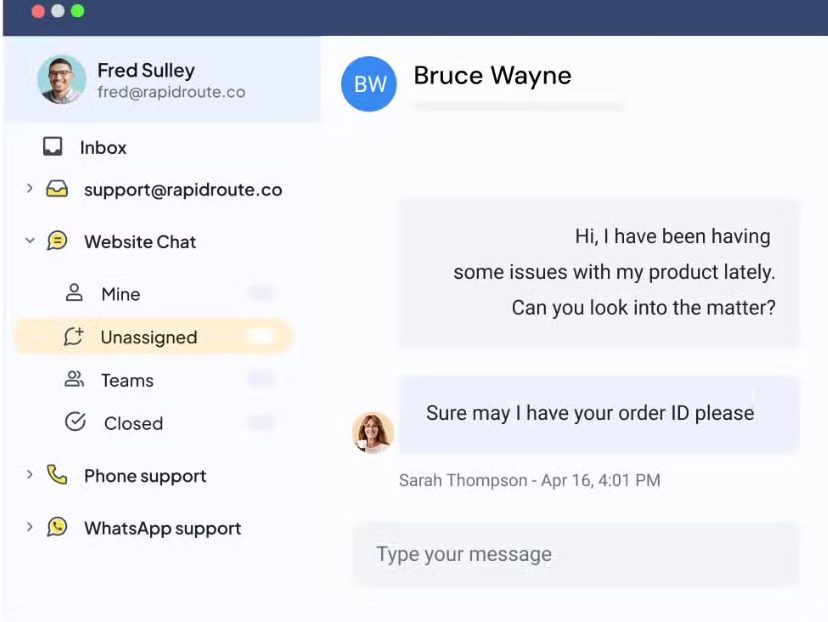
Take CyberHunter, for example, a cybersecurity firm under Grant Thornton Netherlands, which integrated Hiver’s chatbot into its customer portal. The team was able to set up automated chatbot workflows to instantly handle common queries, like password resets and login troubleshooting, without human intervention.
Travel & Hospitality – Simplifying Bookings and Itinerary Management
In the travel sector, NLP chatbots simplify bookings, check-ins, and itinerary changes. A traveler might message, “Change my flight to Monday morning” or “Book a hotel for the weekend in New York.”
In air travel, KLM Royal Dutch Airlines uses a messenger-based chatbot that assists passengers with flight bookings, check-in, boarding passes, and real-time flight updates via chat.

HR & Recruitment – Streamlining Hiring and Employee Support
HR teams use NLP chatbots to streamline hiring and internal communication. Candidates can ask, “What’s the status of my application?” or “When is my interview scheduled?” while employees get instant answers to policy or leave-related questions.
A great example is L’Oréal’s AI recruiting assistant Mya. The chatbot converses with job applicants to ask screening questions, provide information about roles, and even schedule interviews.
Education – Enabling Personalized, On-Demand Learning
Educational platforms deploy NLP chatbots as study companions that assist students with learning and assessments. A student might type, “Explain Newton’s first law” or “Quiz me on Chapter 4,” and get instant guidance.
For example, Khan Academy’s chatbot is available to students 24/7 to help with homework or explain concepts in subjects ranging from math and physics to the humanities.

Together, these use cases demonstrate how NLP chatbots enhance customer experience and improve productivity across all industries.
Challenges in NLP Chatbots
Despite their many advantages, NLP chatbots face several challenges that can affect accuracy, performance, and user experience. Some of the key limitations include:
1. Dependence on Data Quality
The quality of a chatbot’s responses depends on the data it’s trained on. Limited or biased datasets can lead to inaccurate answers or unintentional bias in replies.
What you can do: Continuously refine training data with real user queries. Remove low-quality or biased inputs. Test new variations regularly to ensure the bot stays relevant and reliable.
2. Lack of Personalization
Creating personalized, human-like interactions remains a challenge. Many NLP chatbots respond generically and fail to adapt to individual preferences or user tone. Building strong personalization requires integrating chat history, sentiment data, and CRM inputs to understand each user’s context.
What you can do: Connect your chatbot with CRM systems or past chat history to tailor replies. Use sentiment analysis to adjust tone and create more human-like, contextual interactions.
3. Protecting User Privacy
Chatbots often handle sensitive data, including customer information, financial details, and health records. You need to protect such information to maintain user trust and meet compliance standards.
What you can do: Encrypt conversations, anonymize stored information, and restrict data access. Clearly communicate data usage policies to earn and maintain user trust.
4. Managing Ethical Risks
Chatbots learn from data, and they can unintentionally reflect stereotypes or biased viewpoints. You should ensure that fairness, transparency, and accountability remain an ongoing challenge.
What you can do: Train on diverse datasets and set clear rules for sensitive topics. Include a human review loop to monitor edge cases and maintain fairness in responses.
5. Keeping the Bot Updated
NLP chatbots require regular updates and retraining to maintain accuracy. Without ongoing learning loops and feedback mechanisms, their performance tends to degrade over time.
What you can do: Track analytics like fallback rate and user satisfaction, then retrain or tweak workflows regularly. Schedule monthly reviews to ensure accuracy and performance remain high.
The Future of NLP Chatbots
As AI continues to advance, chatbots are becoming more conversational, context-aware, and capable of handling complex customer interactions that once required human agents.
The global NLP market is growing rapidly, valued at USD 59.7 billion in 2024 and projected to reach USD 439.85 billion by 2030, expanding at a CAGR of 38.7% from 2025 to 2030. The surge reflects how central NLP has become to the development of more intelligent communication systems.
Modern businesses are already integrating NLP with LLMs (Large Language Models) to create more intelligent systems. While NLP handles structured, intent-based queries with precision, LLMs add reasoning and creativity to more open-ended conversations.
Together, they make chatbots that can understand nuance, detect tone, and generate human-like responses.
We’re also seeing major improvements in multilingual processing, emotion recognition, and voice-based chat. Modern chatbots can already switch languages mid-conversation and detect emotional tone in real-time, capabilities once thought years away.
For instance, Microsoft’s XiaoIce was built with emotional intelligence capabilities that help it recognize user emotions and adjust its responses in real-time. The result is more natural, engaging conversations that keep users interacting longer.
For businesses, the opportunity lies in combining the reliability of NLP with the adaptability of newer AI models. That balance ensures chatbots stay accurate, cost-effective, and aligned with your brand voice while still evolving with customer expectations.
The best chatbots of tomorrow will continue to use NLP as their foundation, enhanced by generative AI to deliver truly personalized and intelligent experiences.
Deploying Smarter Conversations with NLP Chatbots
You’ve seen how NLP chatbots work, where they excel, and why they’re crucial for modern customer communication.
Combining NLP’s precision with data insights and continuous learning allows your chatbot to evolve into a reliable digital teammate. It can handle routine queries instantly, freeing up your agents’ time for high-value work.
If you want to build an NLP chatbot for your business, you don’t need to start from scratch.
Hiver Chatbots take the no-code approach and are built specifically for customer support, making them applicable in any industry. We help teams automate repetitive conversations, route complex queries to agents, and maintain context across every customer interaction.
Using a simple visual flow builder, you can design and customize conversations in minutes. With Hiver Chatbots, you can:
- Automate FAQs and repetitive questions to save agent time.
- Manage chatbot flows easily through an intuitive admin panel.
- Provide 24/7 support without adding extra staff.
It doesn’t matter whether you’re in e-commerce, SaaS, finance, or customer service; Hiver Chatbots help you improve conversation quality. See how it works in real time.
FAQ
1. How does NLP make chatbots smarter?
NLP enhances chatbots by enabling them to recognize intent, detect emotions, and interpret variations in phrasing. The chatbot can now respond more accurately and contextually, even when users type informally or make spelling errors.
2. Is ChatGPT based on NLP?
Yes. ChatGPT and other large language models are built using NLP and deep learning techniques. They take NLP a step further by using large-scale neural networks trained on massive datasets to generate fluent, context-aware responses.
3. What’s the difference between NLP chatbots and AI chatbots?
All NLP chatbots are AI-powered, but not all AI chatbots use NLP. Basic AI chatbots follow rules or decision trees, while NLP chatbots understand meaning, intent, and context, making them more flexible and conversational.
4. Which programming languages are best for building NLP chatbots?
Python is the most popular choice, thanks to its rich NLP libraries like spaCy, NLTK, and Transformers. JavaScript, Java, and R are also used depending on the platform or business need.
5. Can NLP chatbots fully replace humans in customer support?
No. NLP chatbots handle repetitive queries efficiently but still struggle with empathy, judgment, and complex issues. The best results are achieved by combining bots for speed and human agents for emotional or nuanced situations.
6. What are the main types of chatbots?
Chatbots typically fall into four categories: rule-based bots, NLP-powered bots, AI chatbots, and LLM chatbots. Each type varies in complexity from simple scripted interactions to advanced, self-learning systems.
Start using Hiver today
- Collaborate with ease
- Manage high email volume
- Leverage AI for stellar service