

About the company
CyberHunter is a managed cybersecurity service developed by Grant Thornton Netherlands, built to help SMBs improve their cyber resilience without the need for in-house security teams. Designed for always-on protection, CyberHunter offers 24/7 threat monitoring, vulnerability detection, and rapid incident response—backed by expert guidance and a user-friendly dashboard. The service blends advanced technology with human insight to protect businesses from today’s evolving cyber threats.
Werner Alsemgeest, Specialist Master in Cyber Risk Services, leads the firm’s CyberHunter offering, which is a managed cybersecurity monitoring service designed for SMBs without internal security operations.
Outgrowing Google Groups: The need for structure and scale
Before Hiver, CyberHunter used Google Groups to manage two shared emails — one for security alerts, and one for customer support. This setup worked well till their client base started scaling.
Key challenges included:
- No visibility or ownership: Security alerts and client support emails landed in a shared email, with no way to assign them to specific team members or track who was handling what.
- Lack of automation: The team couldn’t automate repetitive tasks like tagging incidents by client, sending reminders when clients didn’t respond, or escalating unresolved tickets. They also had no way to automatically filter out low-priority alerts or duplicate incident notifications.
- Scalability breakdown: As the volume of alerts increased—ones from antivirus tools, cloud platforms, account monitors, and dark web scans—critical issues got buried in cluttered email threads. New team members had no structured workflows, increasing the risk of inconsistent or delayed responses.
- No SLA tracking or analytics: Google Groups doesn’t have the functionality to offer insight into support performance. As a result, CyberHunter couldn’t track key metrics like first response time or average resolution time.
No on-demand support channel: Clients had no way to get immediate help within the platform. Without live chat, all support flowed through email. This was not ideal for time-sensitive issues.
“We didn’t want a tool that forced us to change our system. We needed something that worked with Google Workspace — but gave us control and structure.”
What CyberHunter needed
To support its fast-growing cybersecurity operations and deliver consistent, high-quality service, the CyberHunter team needed a solution that could:
- Integrate seamlessly with Google Workspace
So they wouldn’t have to switch platforms or reroute email flows. - Provide visibility and structure
Enabling clear ticket ownership, workload tracking, and better collaboration. - Automate repetitive tasks and streamline communication
To handle high volumes of alerts efficiently and reduce manual errors. - Support consistent workflows for new and existing team members
Ensuring scalable onboarding and standardized incident handling.
“You just add Hiver as a layer on top. The structure was already there—we just enhanced it.”
A scalable customer service platform
Hiver delivered exactly what CyberHunter was looking for, without requiring a disruptive overhaul of their systems. Hiver allowed Werner’s team to build structure, clarity, and automation directly into their existing workflows.
How they use Hiver today: Centralizing alerts, tickets, and client communication
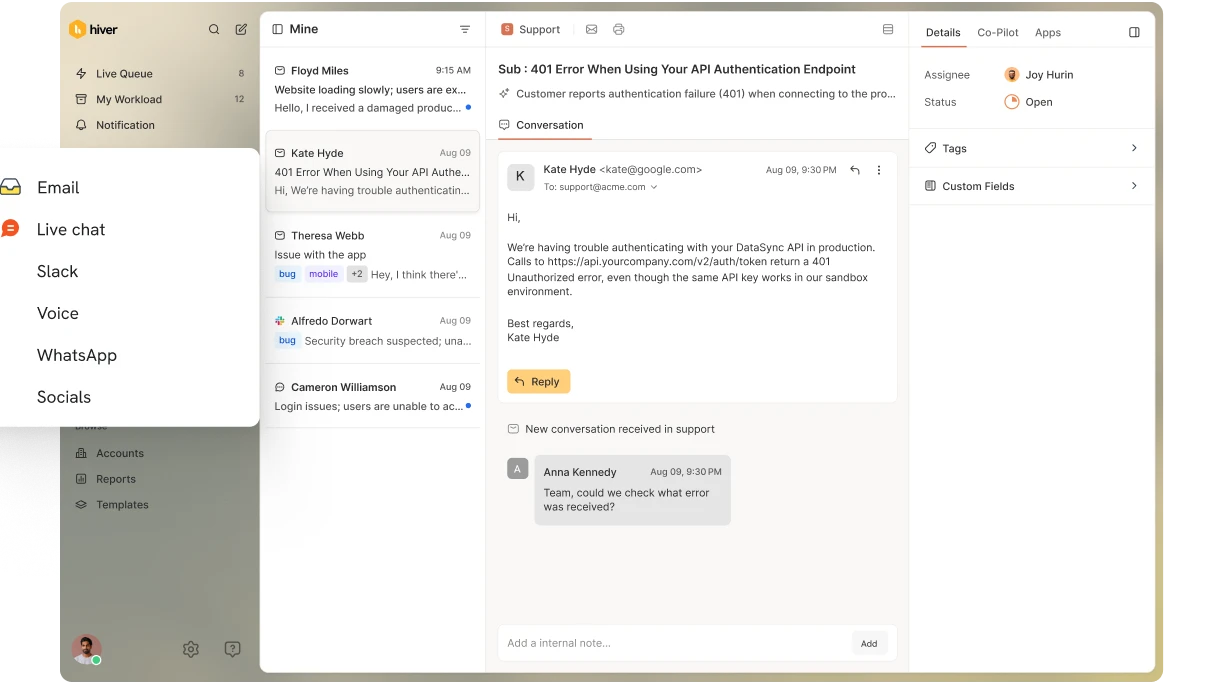
Shared Inboxes for targeted streams
CyberHunter uses three main shared inboxes to separate communication by purpose:
- Alerts Inbox: Receives real-time incident notifications from tools like antivirus platforms, intrusion detection systems, and other monitoring software.
- Support Inbox: Receives client queries related to incidents, password resets, or follow-ups, which are converted into actionable tickets within Hiver.
- Health Inbox: Receives emails pertaining to the internal status of CyberHunter systems, such as performance or reliability issues that require internal attention.
Each inbox supports ticket assignment, status tracking, internal notes, and tags, ensuring clarity on ownership and no missed alerts, even as the team scales.
Custom Automations to reduce manual work
Werner and his team implemented several automation flows using Hiver’s no-code automation engine:
- Company name detection: Automatically tags tickets with the client’s company name and routes them to the assigned point of contact.
- Auto-reminders: Reopens tickets if clients don’t respond within 24 hours, prompting the team to follow up.
- False positive filtering: Automatically identifies and closes low-risk or duplicate alerts, reducing unnecessary noise.
- Team notifications: Alerts team leads when another analyst sends a notification to a client, keeping everyone in the loop.
These automation rules replaced much of the manual triage process from before and improved prioritization.
Live Chat with built-in Chatbot workflows
CyberHunter embedded a Live Chat widget directly into their client portal, enabling customers to initiate conversations while reviewing their security insights.
To reduce manual workload, the team designed automated chatbot workflows that handle FAQs and common queries—like password resets, login issues, feedback, or general incident reporting. For example:
- When a client selects “I am unable to login,” the chatbot asks if they forgot their password.
- If they say “Yes,” it prompts for a mobile number to verify identity before issuing a new password.
- Based on the response, the chatbot either escalates to a live agent or closes the conversation if the request is resolved.
- If no agent is available, the chatbot gently informs the user that “all Hunters are currently solving cybercrimes” and invites them to leave a message.
Similar flows are in place for feedback, incident reporting, and other human support requests—each designed to intelligently handle the conversation or route it to the right person when needed.
This setup has helped deflect a significant volume of repetitive queries, leading to an estimated 20% drop in their support load during peak hours. Ultimately, this has freed up agents to focus on critical incidents without compromising client responsiveness.

“The live chat inside our client portal makes it easy for customers to reach us in real time—and with chatbot workflows in place, a lot of common questions are handled automatically. It’s reduced our support load by about 20% during peak times.”
Werner Alsemgeest
Specialist Master
Analytics for daily ops and SLA monitoring
Every morning, the CyberHunter team reviews a custom-built analytics report within Hiver as part of their daily stand-up. The dashboard provides a real-time view of:
- All tickets received and resolved the previous day
- SLA breaches and pending follow-ups
- Trends in ticket categories or recurring incident types
This daily review keeps the team aligned and enables fast decision-making. In addition, analytics help track performance against SLAs, ensuring client expectations are consistently met.
The measurable impact of switching to Hiver
After adopting Hiver, CyberHunter team significantly enhanced their cybersecurity support operations. The platform helped the team streamline workflows, improve team coordination, and build a scalable foundation for growth.
- Up to 50% faster response times
The team reduced their average response time by 50% with clear ticket ownership, automated reminders, and centralized workflows.
- 60% less manual work in ticket triage
Automations now handle repetitive tasks like identifying clients, tagging tickets, and routing them to the right team member. This saves an estimated 24+ hours through automation alone.
- 20% drop in support volume
By setting up a chatbot in their customer portal, the team deflects 20% of queries which allows everyone to focus on more complicated incidents.
- 600+ hours saved across the board
Between automation, better prioritization, and improved workflows, the team saves 600+ hours every month.
- Improved team accountability and SLA adherence
With one-click ticket assignment and real-time analytics, the team now has 100% visibility into ticket ownership and reviews all open tickets daily during stand-ups.
“Hiver gave us the structure and control we needed to scale our customer service—without losing speed, flexibility, or data integrity.”
What’s next for CyberHunter with Hiver
As CyberHunter continues to grow, the team is exploring ways to deepen their use of Hiver beyond core ticketing and support workflows.
- Bringing customer context into tickets: They plan to integrate CRM data directly into ticket views, giving agents instant access to account history, prior incidents, and client details without switching tools.
- AI-enabled agent guidance: The team is experimenting with Hiver AI Copilot that helps agents draft structured responses to incoming tickets. This capability ensures that even new team members can match the tone, format, and resolution quality of experienced analysts. It’s something that aims to bring consistency to client communication at scale.
“We’re building workflows that scale with people, not just tickets. Hiver and AI will help us maintain consistency as we expand.”
Conclusion
CyberHunter team transformed their cybersecurity support operations with Hiver, eliminating workflow chaos, improving client responsiveness, and building scalable processes for future growth. By unifying email, live chat, automation, and analytics within one platform, Hiver enabled the team to focus on what matters most: protecting SMBs from cybersecurity threats.
“With Hiver in place, we’ve built a foundation we can grow on—faster response times, better collaboration, and complete control over client data.”